
Life, 1906-04-05 · page 30 of 58
Life — April 5, 1906 — page 30: what you’re looking at
What you’re looking at
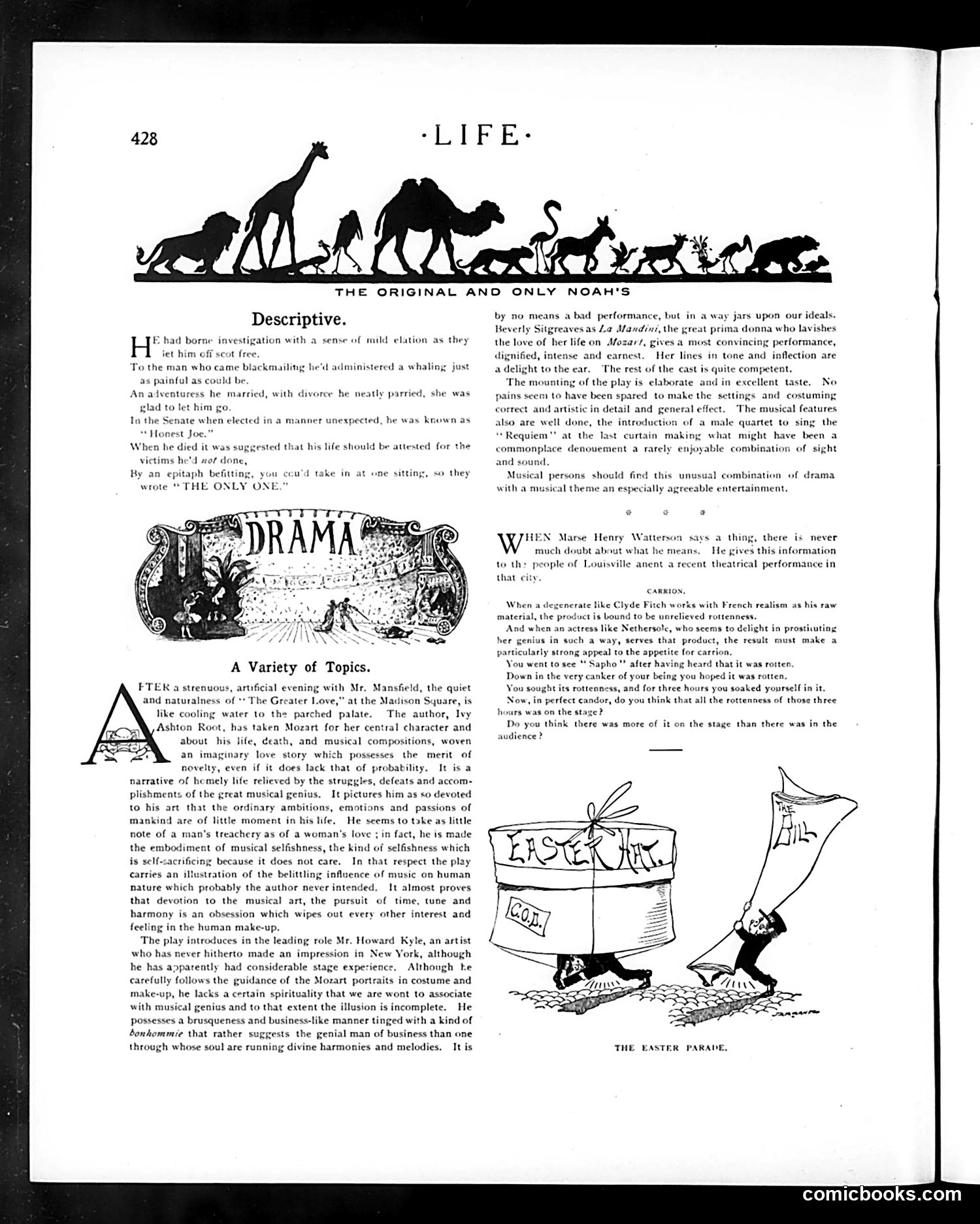
This page from *Life* magazine contains theater reviews rather than political cartoons. The main content discusses two Broadway productions: **"The Greater Love"** - A play about Mozart's life by Ivy Ashton Root, starring Howard Kyle. The reviewer criticizes Kyle's performance as lacking the spiritual depth expected of a musical genius portrayal, though he praises Beverly Sitgreaves' performance as the prima donna "La Mandini." **"Carrion"** - The review references a caustic critique by Henry Watterson (a prominent Kentucky newspaper editor) condemning playwright Clyde Fitch's work as "degenerate" for using "French realism" as source material. This reflects late 19th/early 20th-century American anxiety about European theatrical naturalism as morally corrupting. The illustration labeled "THE EASTER PARADE" appears to be unrelated satirical artwork about fashionable Easter dress. The page reflects period attitudes toward theatrical morality and artistic merit rather than political satire.
📄 Transcribed text from this page (OCR, searchable)
Machine-transcribed from the original scan — historical spelling and the odd misread are preserved.
THE ORIGINAL ANDO ONLY NOAH'S Descriptive. E had borne investigation with a sense of mild elation as they iet him off scot free, To the man who came blackmailing ministered a whaling just as painful as could be An adventuress he married, with div © neatly parried, she glad to let him g In the “Honest Joe.” nate when elected er unexpected, he was known as When he died it was suggested that his life should be attested for the victims he'd nor done, By an epitaph befitting, you ccu'd take in wrote * THE ONLY ONE.” A Variety of Topics. FTER a strenuous, artificial evening with Mr, Mansfeld, the quiet and naturalness of ** The Greater Love,” at the Madison Square, is like cooling water to the parched palate. Ashton Root, has taken Mozart for her central character and about his life, death, and musical compositions, woven an imaginary love story which possesses the merit of It isa narrative of homely life relieved by the struggles, defeats and accom- plishments of the great musical genius, It pictures him as so devoted to his art that the ordinary ambitions, emotions and passions of mankind are of little moment in his life, He seems to take as little note of a man’s treachery as of a woman’s love ; in fact, he is made the embodiment of musical selfishness, the kind of selfishness which is self-sacrificing because it does not care. In that respect the play carries an illustration of the belittling influence of music on human nature which probably the author never intended. It almost proves that devotion to the musical art, the pursuit of time, tune and harmo: The author, Ivy novelty, even if it does lack that of probability. y is an obsession which wipes out every other interest and feeling in the human make-up. ‘The play introduces in the leading role Mr. Howard Kyle, an artist New York, although he has apparently had considerable stage experience. Although he carefully follows the guidance of the Mozart portraits in costume and make-up, he lacks a certain spirituality that we are wont to associate with musical genius and to that extent the illusion is incomplete. He possesses a brusqueness and business-like manner tinged with a kind of donhommie that rather suggests the genial man of business than one through whose soul are running divine harmonies and melodies. It is who has never hitherto made an impression in by no means a bad performance, but in a way jars upon our ideals. Beverly Sitgreavesas La Mandini, the great prima donna who lavishes the love of her life on Afozart, gives a most convincing performance, dignified, intense and earnest The rest of the cast is quite competent. ‘The mounting of the play is elaborate and in excellent taste. Her lines in tone and inflection a a delight to the ear. pains seem to have been spared to make the settings and costuming correct and artistic in detail and general effect. ‘The musical features fa male quartet to sing the + Requiem"? at the last curtain making what might have been a commonplace denouement a rarely enjoyable combination of sight also are well done, the introduction nd sound 1 combination of drama with a musical theme an especially agreeable entertainment, Musical persons should find this unu: HEN Marse Henry Watterson says a thing, there is never much doubt about what he means. He gives this information to ths people of Louisville anent a recent theatrical performance in that city CARRION. When a degenerate like Clyde Fitch works with French realism as his raw material, the product is Lound to be unrelieved rottenness. And when an actress like Nethersole, who seems to delight in prostivuting serves that product, the result must make a particularly strong appeal to the appetite for carrion, Sapho'? after having heard that it was rotten. Down in the very canker of your being you hoped it was rotten, You sought its rottenness, and for three hours you soaked yourself in it, Now, in perfect candor, do you think that all the rottenness of those three hours was on the stage? Do you think there was more of it on the stage than there was in the audienc er genius in such a wa’ You went to see THE EASTER PARADE, comicbooks.com