
Life, 1906-04-05 · page 34 of 58
Life — April 5, 1906 — page 34: what you’re looking at
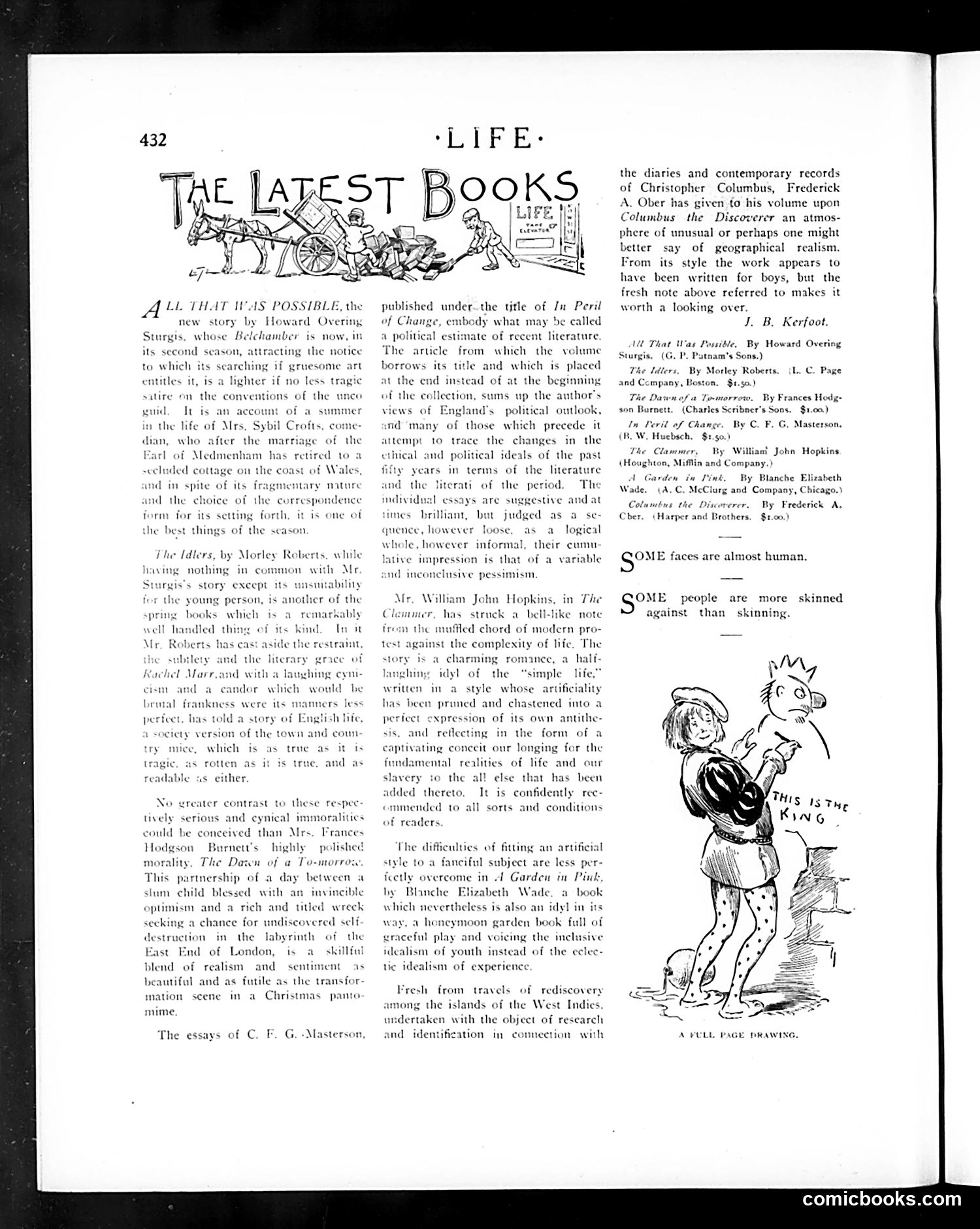
What you’re looking at
This page reviews contemporary books, with one full-page cartoon illustrating a satirical point. The cartoon depicts a character in Victorian dress addressing what appears to be a child or servant, declaring "THIS IS THE KING"—likely mocking the pretensions or absurd social hierarchies of the era. The book reviews themselves discuss literary works addressing social issues: Mrs. Hodgson Burnett's *The Dawn of To-morrow* contrasts optimistic slum reform with cynical upper-class decay; C.F.G. Masterson's essays trace political ideology through literature; and William John Hopkins's *The Clemmer* celebrates "the simple life" while critiquing modern complexity. The cartoon's point appears to be satirizing either false authority, class pretension, or the arbitrary nature of social status—suggesting someone's self-proclaimed importance is absurd or unjustified. The juxtaposition with earnest literary criticism about social reform creates ironic commentary on Victorian society's actual values.
📄 Transcribed text from this page (OCR, searchable)
Machine-transcribed from the original scan — historical spelling and the odd misread are preserved.
A LL THAT WAS POSSIBLE, the story by Howard Overing hamber new Sturgis, whose Be is now, in its second season, attracting the notice to which its searching if gruesome art entitles it, is a lighter if no less tra: satire on the conventions of the unco guid. It is an account of a summer in the life of Mrs, Sybil Crofts, come- an, who after the r tii of the rl of Medmenham has retired to a -celuded cottage on the coast of Wales, mature und the choice of the correspondence rm for its setting forth, it is one of e best things of the season The Idlers, by Morley Roberts, while having nothing in common with Mr “S story except its unsuitability r the young person, is another of the pring books which is a remarkably kind. In it has cast aside the restr literary grace of Rachel Marr cism and a brutal perfect ad with hing cym- candor would be frankness were its manners less has told a story of English life, society version of the town and coun which is as true as is rotten as it is true, and as readable as either, No greater contrast to these respec tively serious and cynical immoralities Frances polished could be conceived than Mrs Burnett's _ highly The Dawn of a nership of a slum child blessed Hodgson morality To-morrox This ps ay between a with an_ invincible optimism and a rich and titled wreek secking a chance for undiscovered self destruction in the labyrinth of the East End of London, is a skillful blend of realism and beautiful and as futile as the transfor- scene ina Christmas panto sentiment as mation mime. The essays of C. Masterson, published under.the title of Jn Peril of Change, embody what may e called a political estimate of recent literature. The article from which the volume borrows its title and which is placed at the end instead of at the the collection, sums up the author's beginnin ws of England's political outlook, nd ‘many of those which precede it to trace the changes in the itical ideals of the past terms of the literature period. Thy nd at attempt ethical and pe fifty years in and the fiterati of the dividual essays are brilliant, bat suggestive imes judged as a se- quence, however loose, as a logical their cumu pression is that of a variable whole, however informa lative iv nd inconclusive pessimism The note Mr. William John Hopkins, in struck a bell-like irom the mufiled chord of modern pro- test against the complenity of life, The half Clemmer, Ni a charming romance, idyl of the “simple life, written in a style whose artificiality has been pruned and chastened into story gehiny pericct expression of its own antithe- and reflecting in the form of a captivating conceit our longing fer the fundamental of life and our slavery to the al! realities else that has been added thereto, It is confidently ree- commended to all sorts and conditions of readers. The difficulties of fitting an artificial style to a fanciful subject are less per- icetly overcome inl Garden in Pink, hy Blanche Elizabeth Wade. a book which nevertheless is also an idyl in i arden book full of graceful play and voicing the ine idealism of youth instead of the eclec- way. a heneymoon tic idealism of experience Fresh from travels of among the islands of the West Indies undertaken with the object of research and identification in with rediscovery connection the diaries and contemporary records of Christopher Columbus, Frederick A. Ober has given to his volume upon Columbus the Discoverer an atmos- phere of unusual or perhaps one might better say of geographical realism. From its style the work appears to have been written for boys, but the fresh note above referred to makes it worth a looking over. J. B. Kerfoot. Wt That Was Possible, Sturgis, (G By Howard Overing P, Putnam's Sons.) The Idlers, By Morley Roberts. (1. C. Page $t.50.) The Dawn of a Tomorrow son Burnett. (Charles Scribne: In Peril of Change. (BW. Huebsch. $2.50.) The Clammer, Wy Williant Jobn Hopkins (Houghton, Mifflin and Company.) By Frances Hodg- Sons. $1.00) By C. F. G. Masterson, 1 Garden in Pink, Wade. By Blanche Elizabeth (A.C. McClurg and Company, Chicago.) Columbus th Cher Discoverer. Wy Frederick A, (Harper and Brothers. $1.00.) ‘¢ almost human. OME against people are skinned than more skinning. A FULL PAGE DRAWING, comicbooks.com