
A complete issue · 36 pages · 1904
Life — August 4, 1904
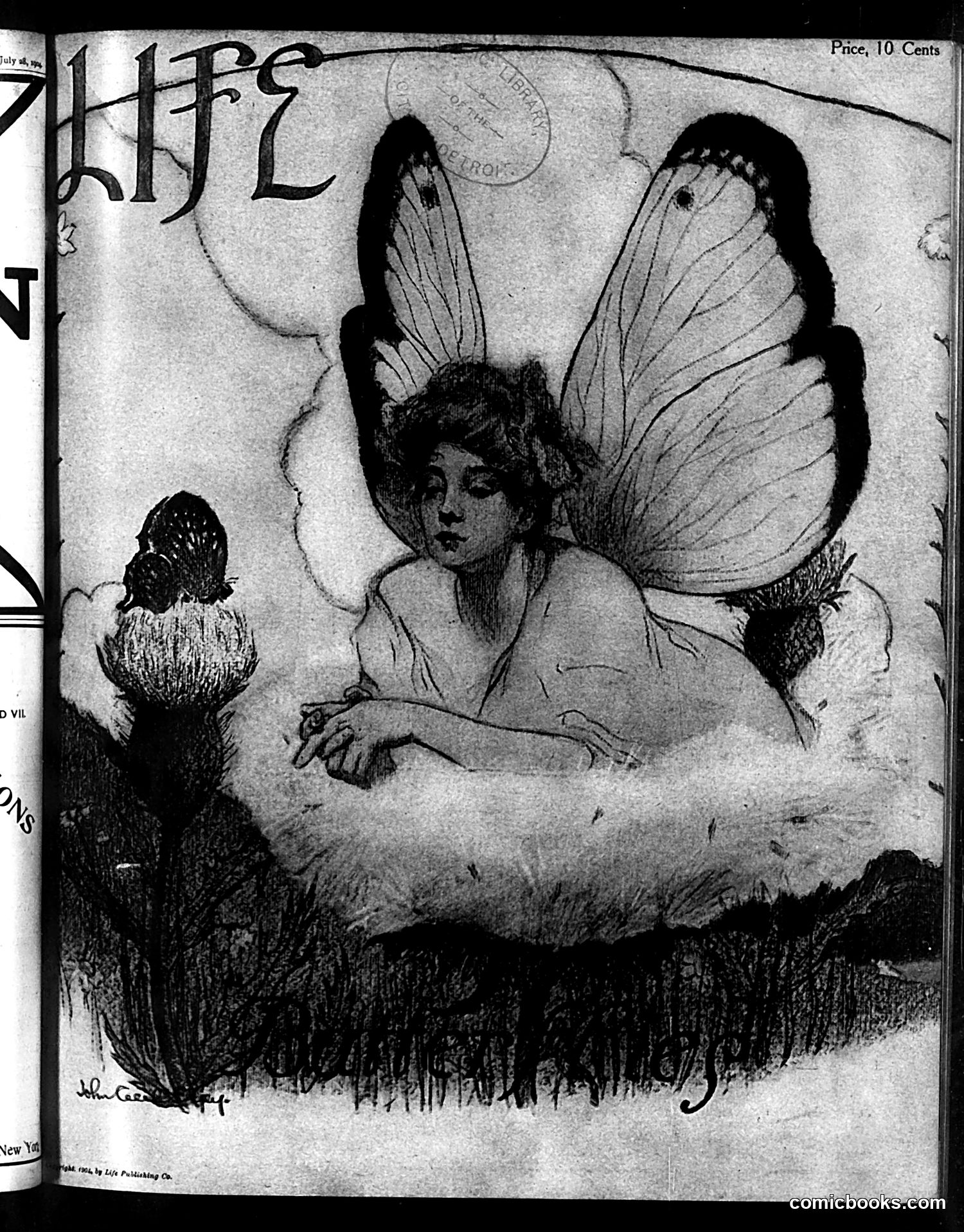
This appears to be a cover or illustration from *Life* magazine (price 10 cents, dated July 28, 1904, based on visible text). The image depicts a fairy-like female figure with large wings surrounded by flowers and natural elements in a whimsical garden setting. Without clearer text visible in the OCR, I cannot definitively identify the specific political or social reference. However, the aesthetic suggests this is likely either: - A straightforward fantasy/fairy tale illustration (common *Life* cover subject matter) - A satirical commentary on contemporary social movements using fairy/nature symbolism The artistic style and subject matter are consistent with early 1900s popular illustration, but the specific satirical point remains unclear from the image alone. More legible text would be needed to explain the intended meaning to a modern reader.
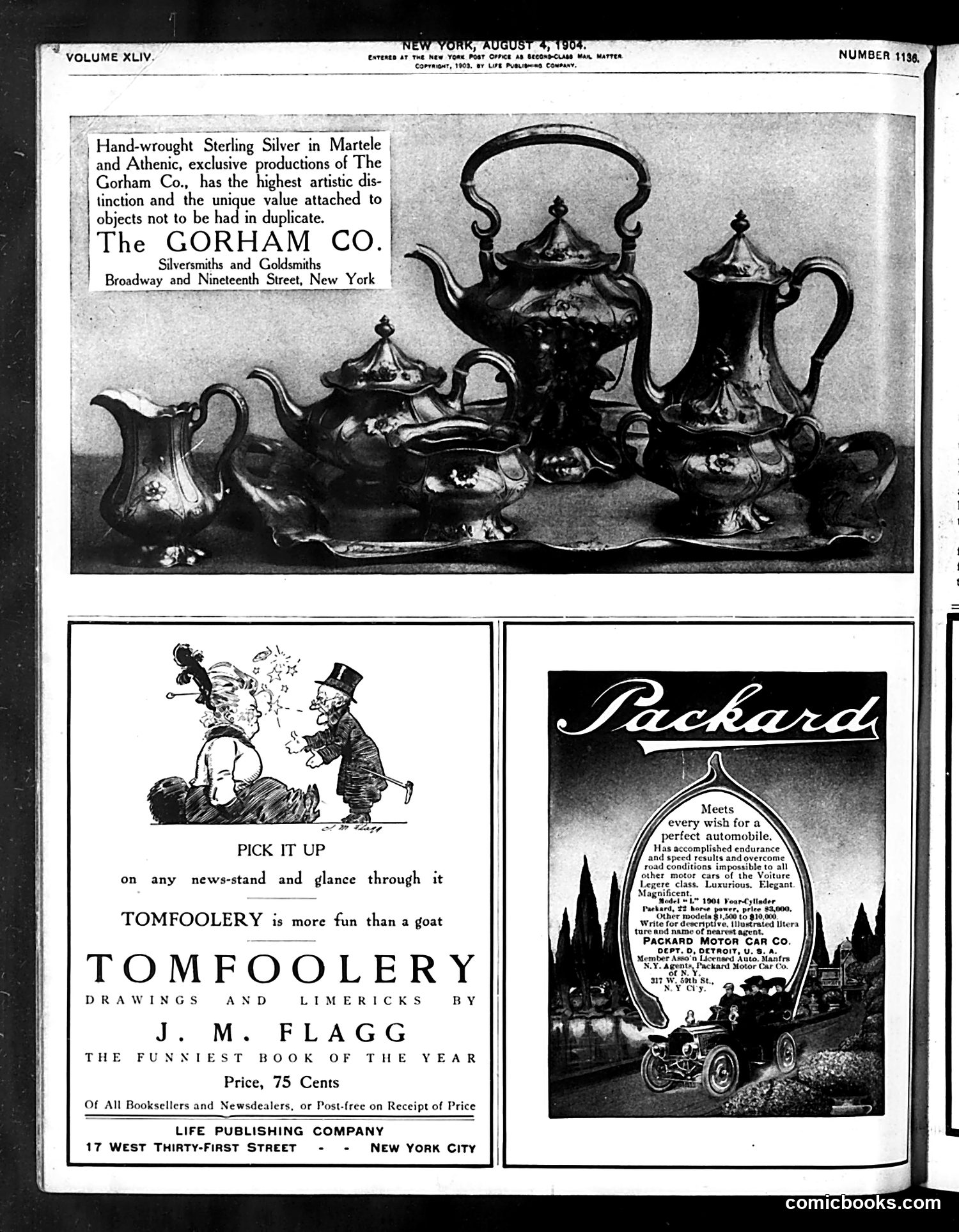
This page is primarily **advertising**, not political satire. The top features The Gorham Company's sterling silver tea service—promotional copy emphasizing handcrafted quality and exclusivity. The left advertisement shows **"Tomfoolery"** by M. Flagg—a humor book. The cartoon depicts a figure splashing someone with water, captioned "PICK IT UP," presenting the book as lighthearted entertainment. The right side advertises the **Packard Motor Car**, featuring an elegant automobile with text emphasizing its performance and luxury status, positioning it among high-class vehicles. No political figures or satirical commentary appear here. This is a straightforward commercial page showcasing luxury goods and entertainment products aimed at wealthy 1904 readers.
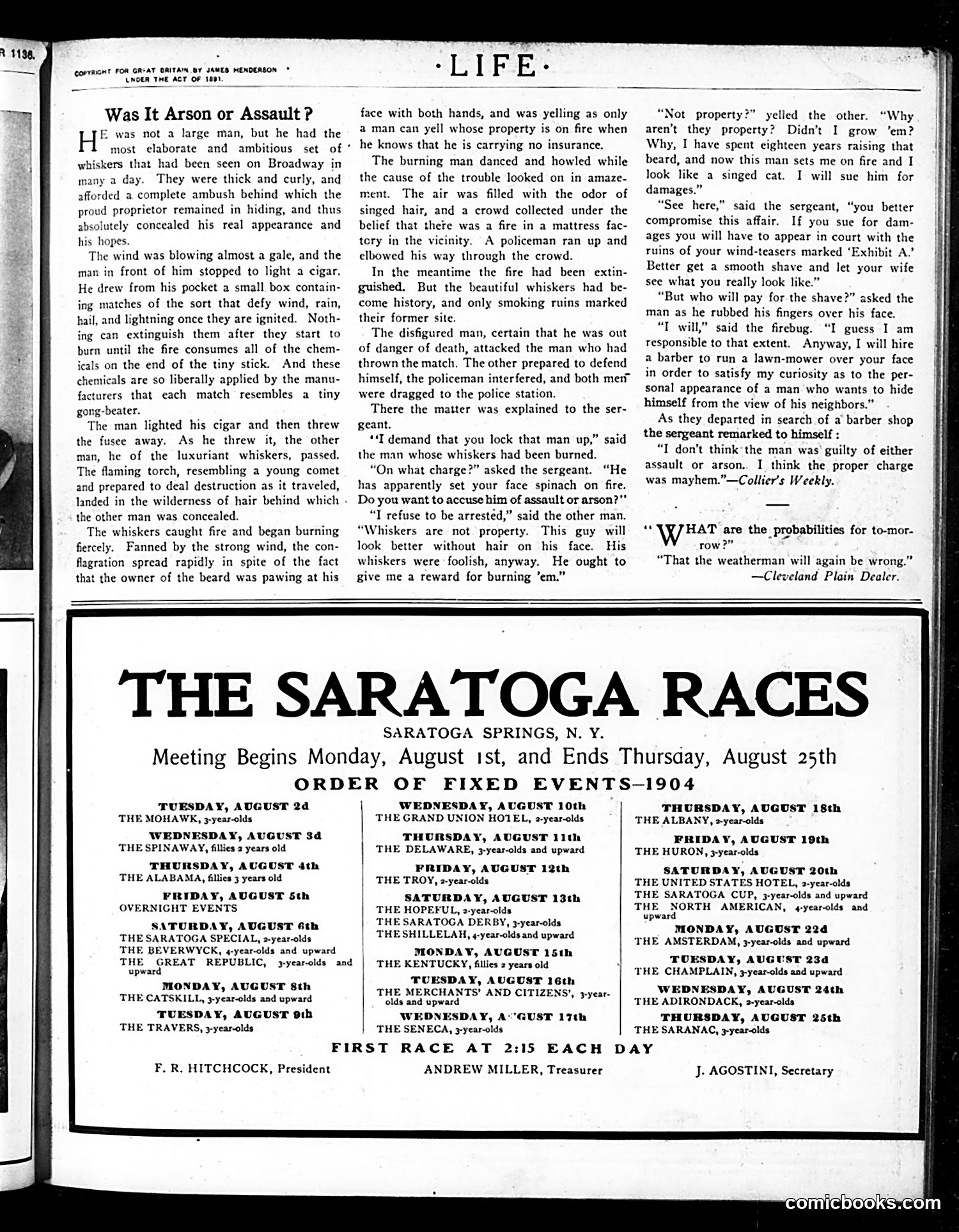
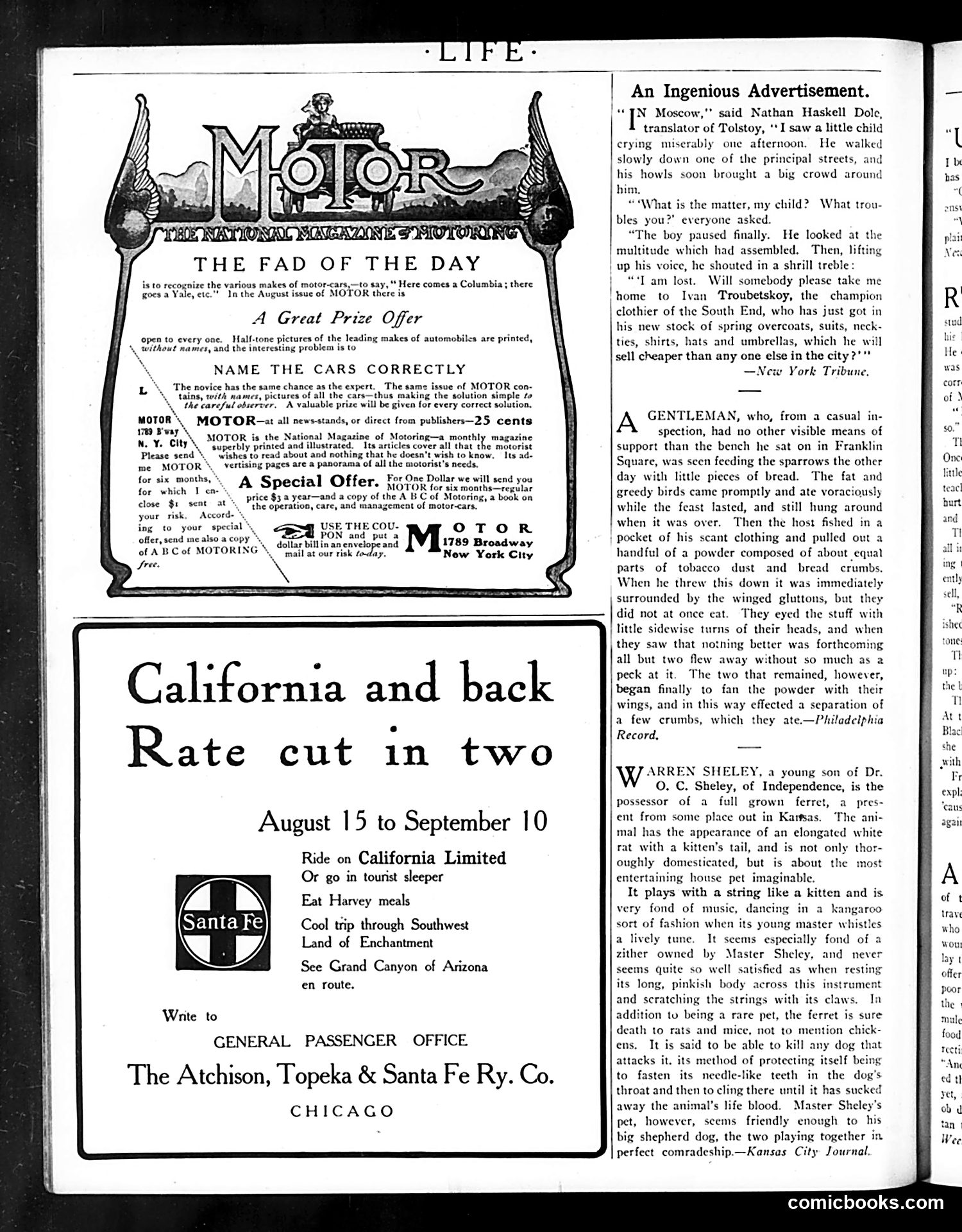
This page is primarily **advertising and light humor**, not political satire. The left side features Motor magazine ads offering prize contests for correctly naming automobile makes and subscriptions. The central Santa Fe Railway ad promotes a California trip with discounted rates (August 15-September 10). The right side contains three brief humorous anecdotes rather than cartoons: 1. **"An Ingenious Advertisement"**: A Moscow child cries until a crowd assembles, then announces a street vendor's wares—satirizing how effective a crowd is for advertising. 2. **The Gentleman and Pigeons**: A man feeds sparrows breadcrumbs from his pocket on a park bench, attracting pigeons who steal from his clothing—gentle humor about unexpected consequences. 3. **Warren Sheley's Ferret**: A domestic ferret pet described as friendly despite its species' reputation for killing animals. These are nostalgic slice-of-life vignettes with mild satirical humor, not political commentary.
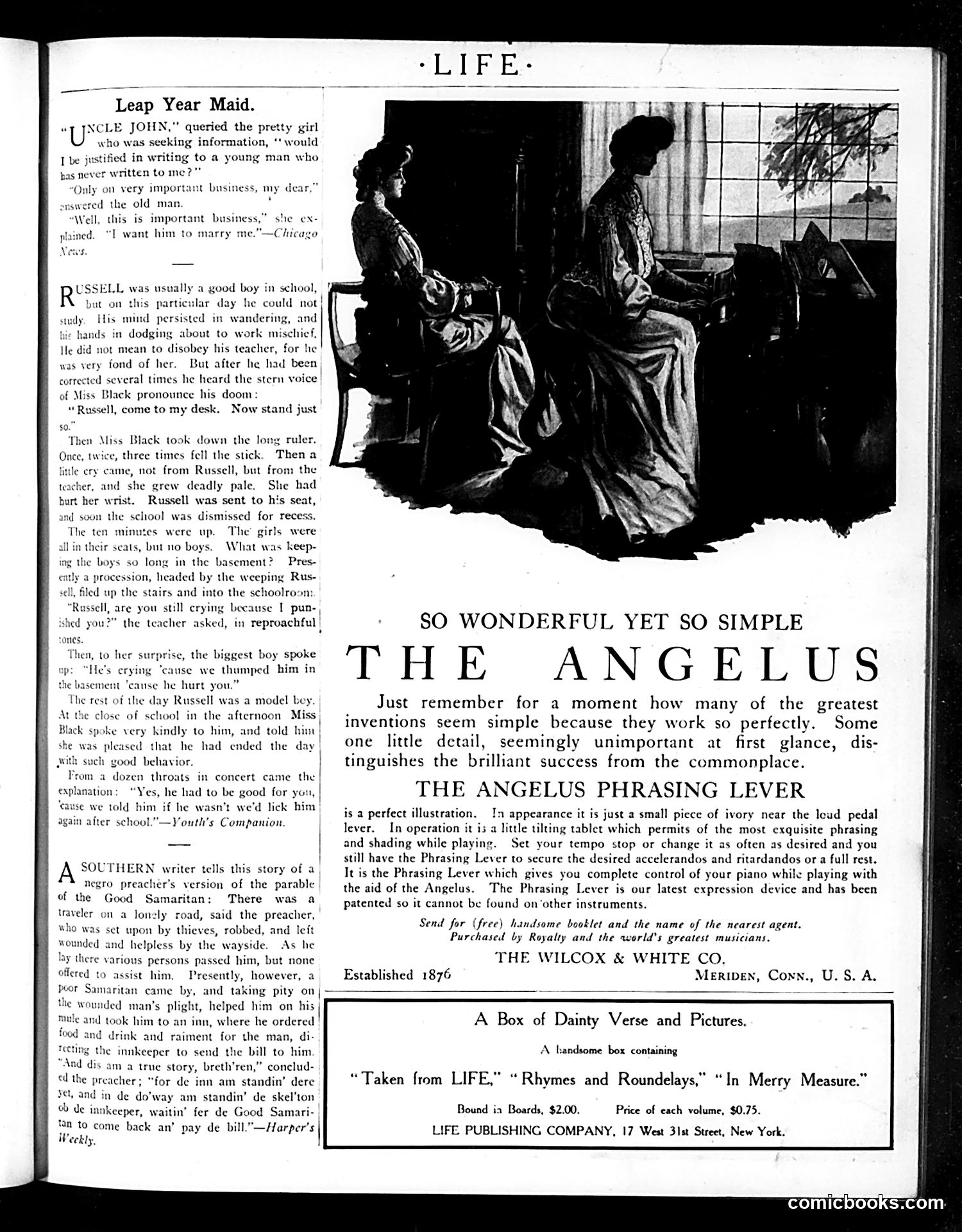
This page contains two distinct sections: **Left side:** A short story titled "Leap Year Maid" about a schoolboy named Russell who misbehaves and is disciplined by Miss Black, the teacher. A girl writes to Uncle John asking if it's proper to write to a boy who hasn't written to her. The stories illustrate traditional gender roles and courtship etiquette of the era. **Right side:** An advertisement for "The Angelus Phrasing Lever," a piano device claimed to give "complete control of your piano while playing." The ad emphasizes how "one little detail, seemingly unimportant at first glance" distinguishes great inventions from commonplace ones—a rhetorical strategy common in early 20th-century product marketing. There is no political satire on this page. It's primarily a humor/advice column with advertising.
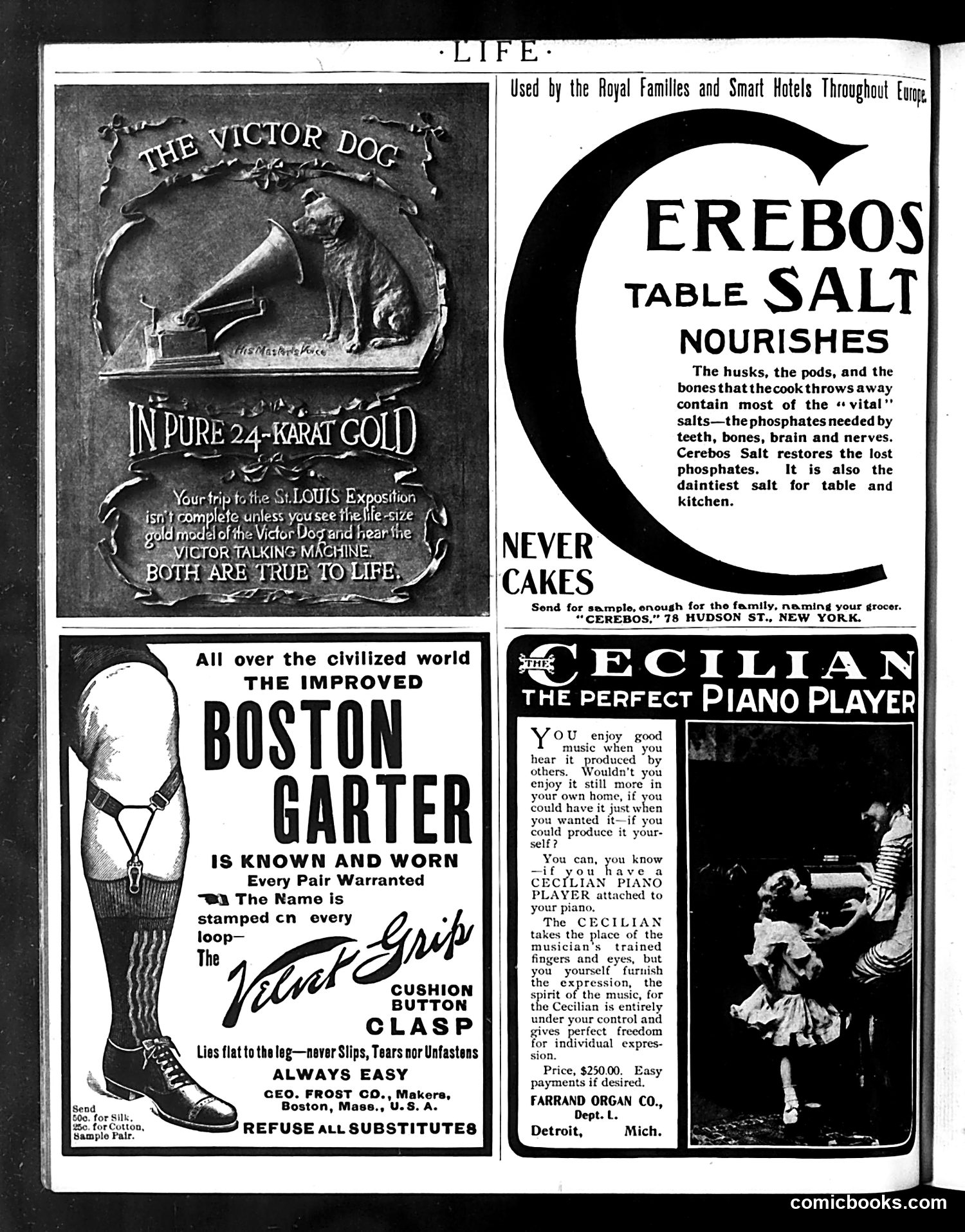
This page is **primarily advertising**, not political satire. It contains four product advertisements from what appears to be an early 20th-century issue of Life magazine: 1. **Victor Dog** (top left): Promotes a gold model and talking machine at the St. Louis Exposition 2. **Cerebos Salt** (top right): Table salt claiming nutritional benefits 3. **Boston Garter** (bottom left): Hosiery with a cushioned button clasp, marketed as reliable and comfortable 4. **Cecilian Piano Player** (bottom right): A mechanical piano attachment allowing home music production No political cartoons or social satire appear on this page. The content reflects period consumer goods and early 20th-century marketing conventions, including health claims and mechanical novelties typical of that era.
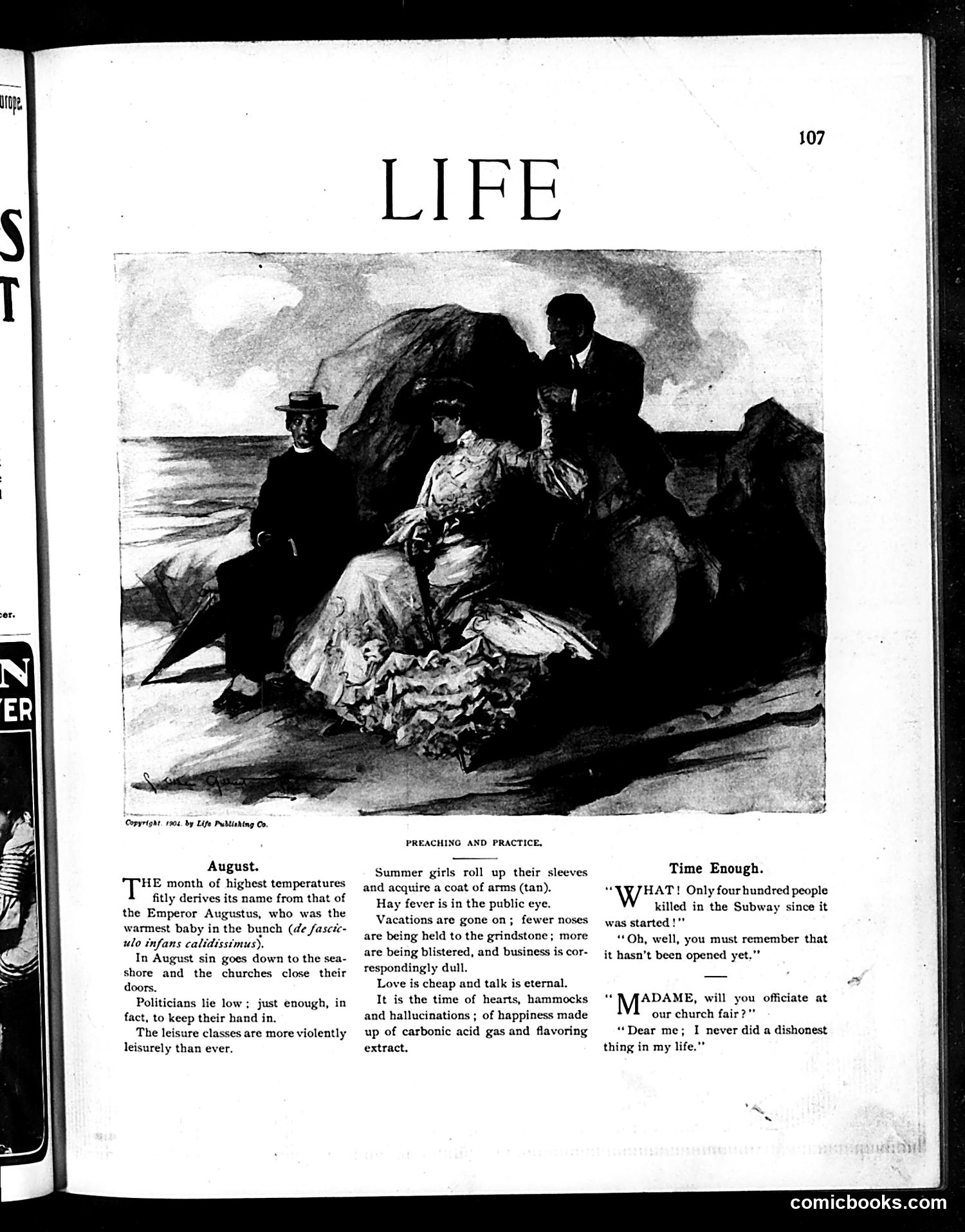
The illustration titled "Preaching and Practice" depicts a coastal scene with well-dressed figures—a woman in elaborate dress seated centrally, attended by men in formal attire. This appears to be social satire about hypocrisy. The accompanying text sections mock August weather complaints and summer leisure activities. "Time Enough" satirizes a subway death's delayed investigation. The church fair dialogue mocks someone's claim of moral rectitude despite apparently dishonest behavior. The overall theme critiques the gap between public propriety and private conduct—"preaching" versus "practice." The beach setting and formal dress suggest this targets upper-class hypocrisy, a common *Life* magazine subject. The specific figures are unclear, though the scene implies commentary on contemporary social pretension and moral inconsistency among the wealthy.
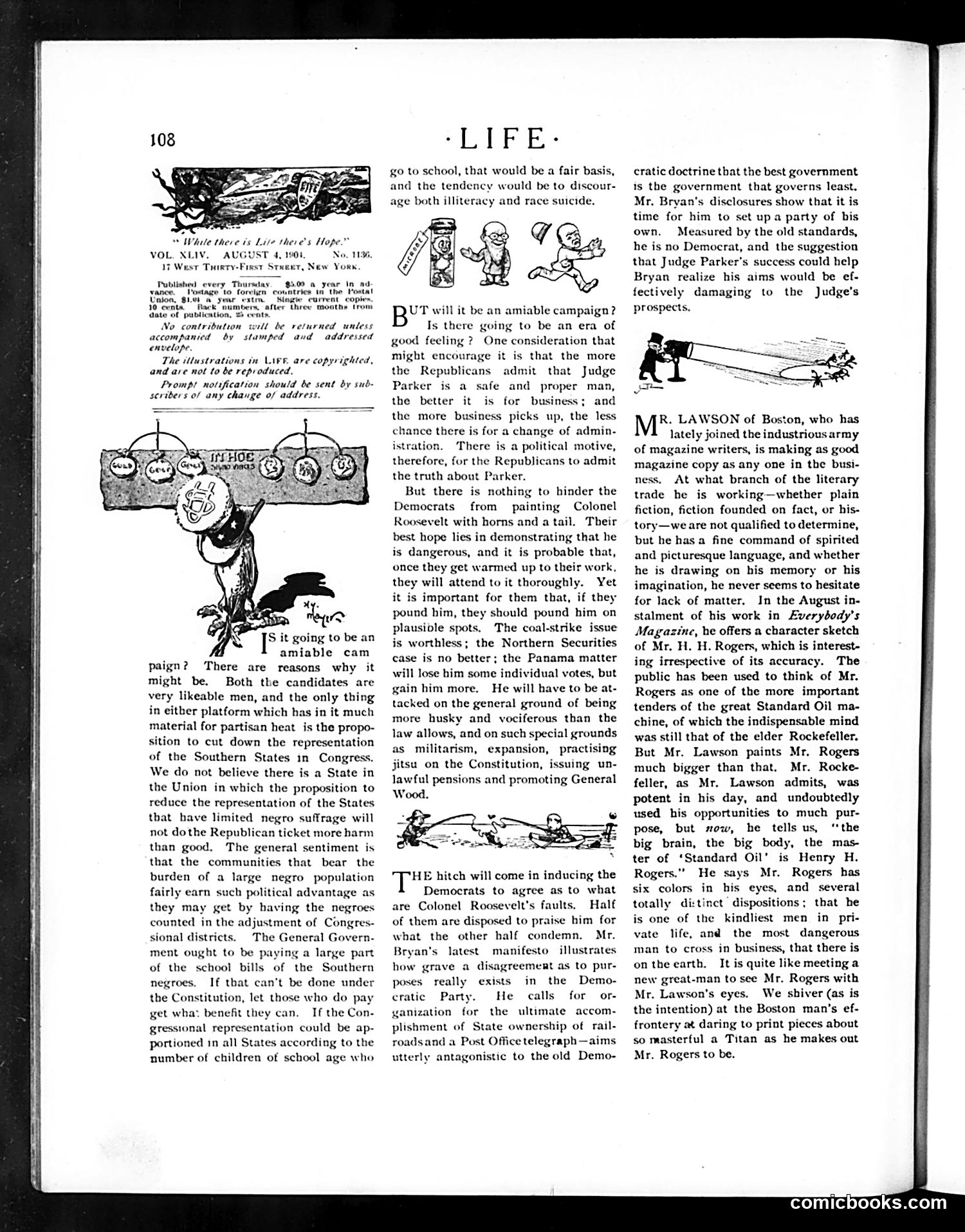
This page discusses the 1904 presidential campaign. The text critiques both candidates, suggesting Republicans admit Judge Parker (the Democratic nominee) is "safe and proper" for business—implying the GOP fears him less than expected. The cartoons mock campaign tactics. One depicts a political "machine" with gears labeled with politicians' names, suggesting mechanical manipulation of the nomination process. Another shows figures being thrown or tumbled, likely representing campaign chaos or candidates being discarded. The text references Colonel Roosevelt, comparing him unfavorably to standard business figures like H.H. Rogers and Rockefeller. The piece argues the Democrats' real disagreement isn't about Roosevelt's faults but organizational philosophy—particularly state ownership of railroads and telegraph systems versus private control.
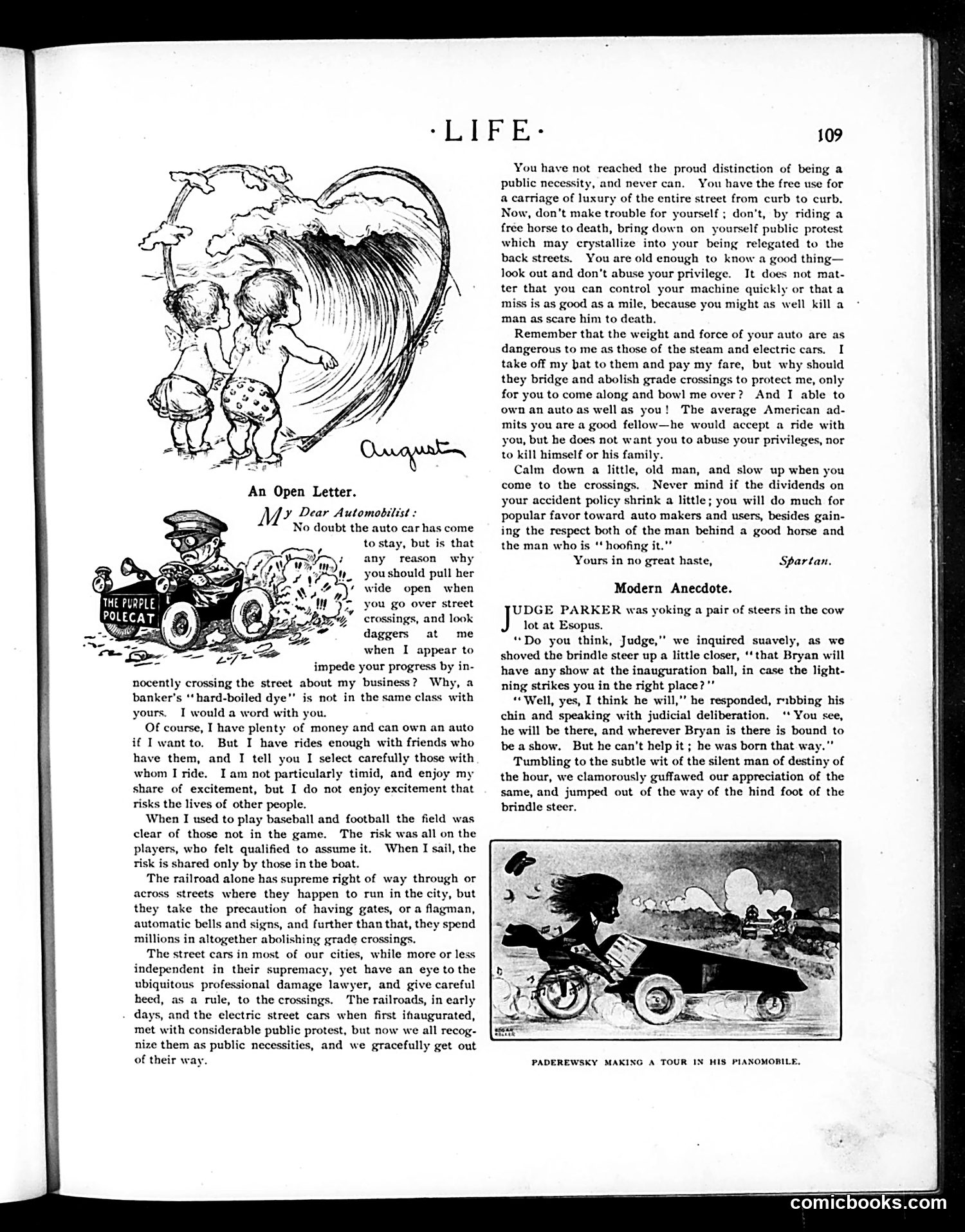
This page contains an "Open Letter" to automobile drivers, illustrated with two cartoons. The top cartoon shows two children in an oversized heart, satirizing sentimentality about cars. The letter, signed "Spartan," addresses dangerous driving practices—specifically reckless street crossings and speeding. It argues that automobile owners should exercise the same caution and responsibility they'd expect from horse-drawn carriage drivers. The writer appeals to drivers' sense of class and propriety, noting that banks' respectable citizens shouldn't drive with the recklessness of lower-class characters. Below is a "Modern Anecdote" about Judge Parker witnessing a steer at a cow lot, discussing Bryan's potential appearance at an inauguration ball—likely referencing William Jennings Bryan's political campaigns. The bottom photograph shows someone named Paderewski touring in a pianomobile (an early automobile).
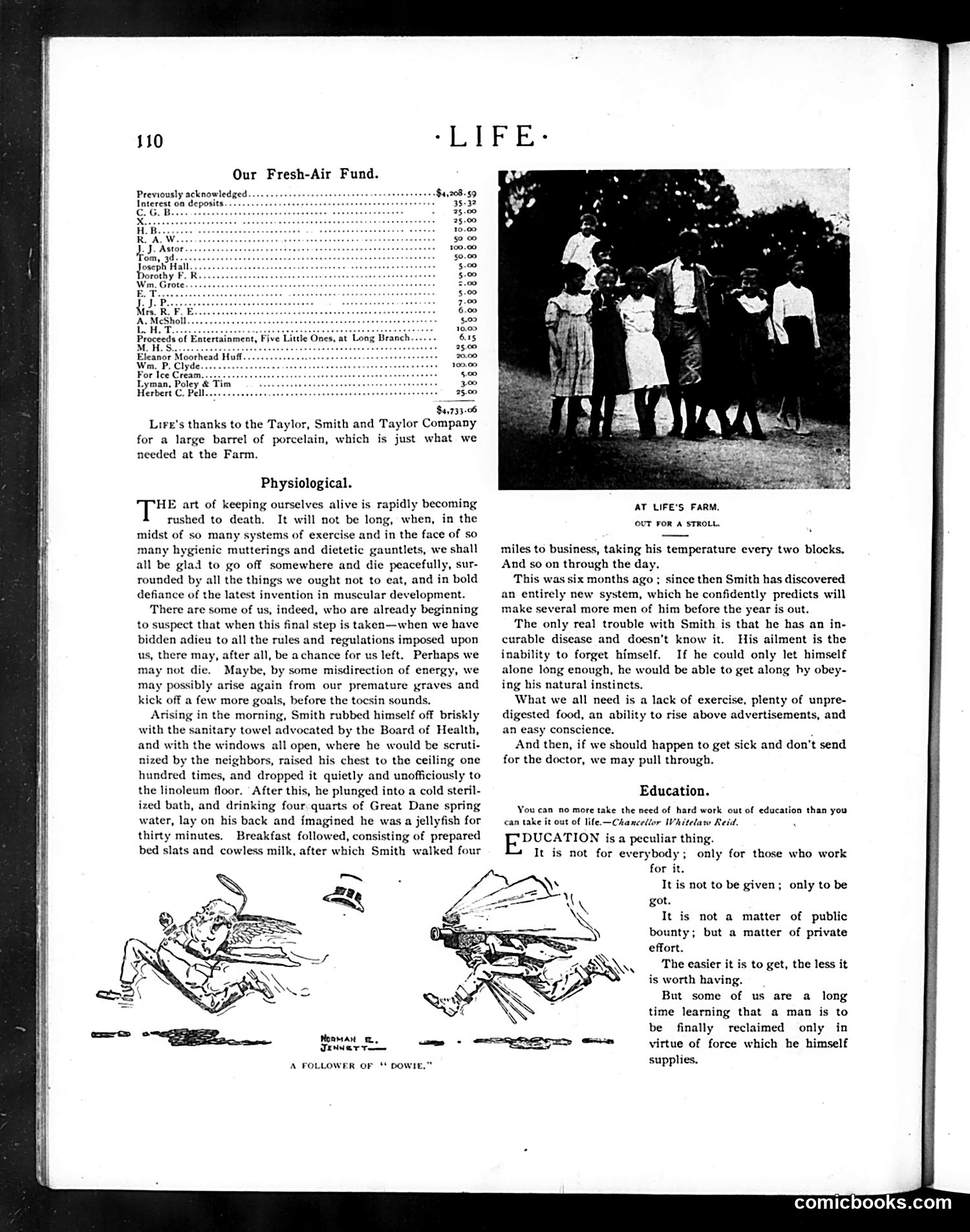
This page contains two distinct sections: **Upper left**: A "Fresh-Air Fund" donation list—a charitable fundraising appeal, not satire. It lists contributors and amounts for sending poor children to the countryside for health benefits. **Lower section**: A cartoon labeled "A Follower of 'Dowie'" depicting a figure in exaggerated exercise poses. This references **John Alexander Dowie**, a controversial faith healer and cult leader of the early 1900s. The satire mocks Dowie's followers and their peculiar health practices or exercise regimens. The cartoon suggests absurd, contorted physical movements as mockery of Dowie's health philosophies or the extreme devotion of his disciples. The accompanying "Physiological" article discusses health, exercise, and avoiding illness—contextualizing the cartoon's jab at alternative health movements of the era.
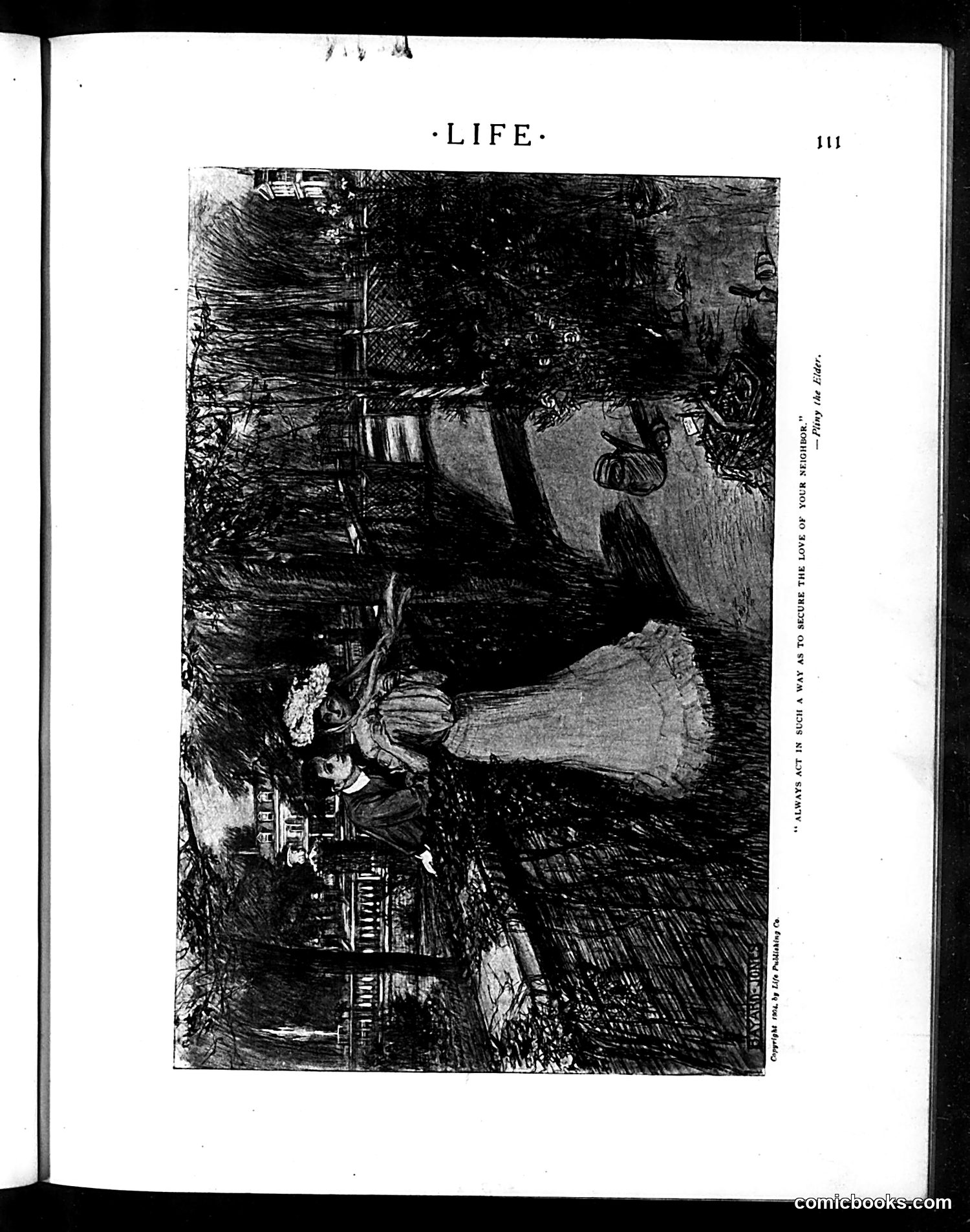
I can see this is page 111 from Life magazine, and the image appears to be a dark, detailed etching or engraving showing an interior scene with multiple figures. However, the image quality and contrast make it difficult to identify specific details with certainty. The caption along the right edge appears to reference "Madame Art" and something about "securing the love of your boyfriend," suggesting this may be a satirical piece about romance, social aspiration, or domestic life—common Life magazine subjects. Without being able to read the caption clearly or identify the specific figures depicted, I cannot confidently explain the cartoon's political or social commentary. The artistic style suggests early-to-mid 20th century, but I cannot determine the precise satirical point without more legible text.
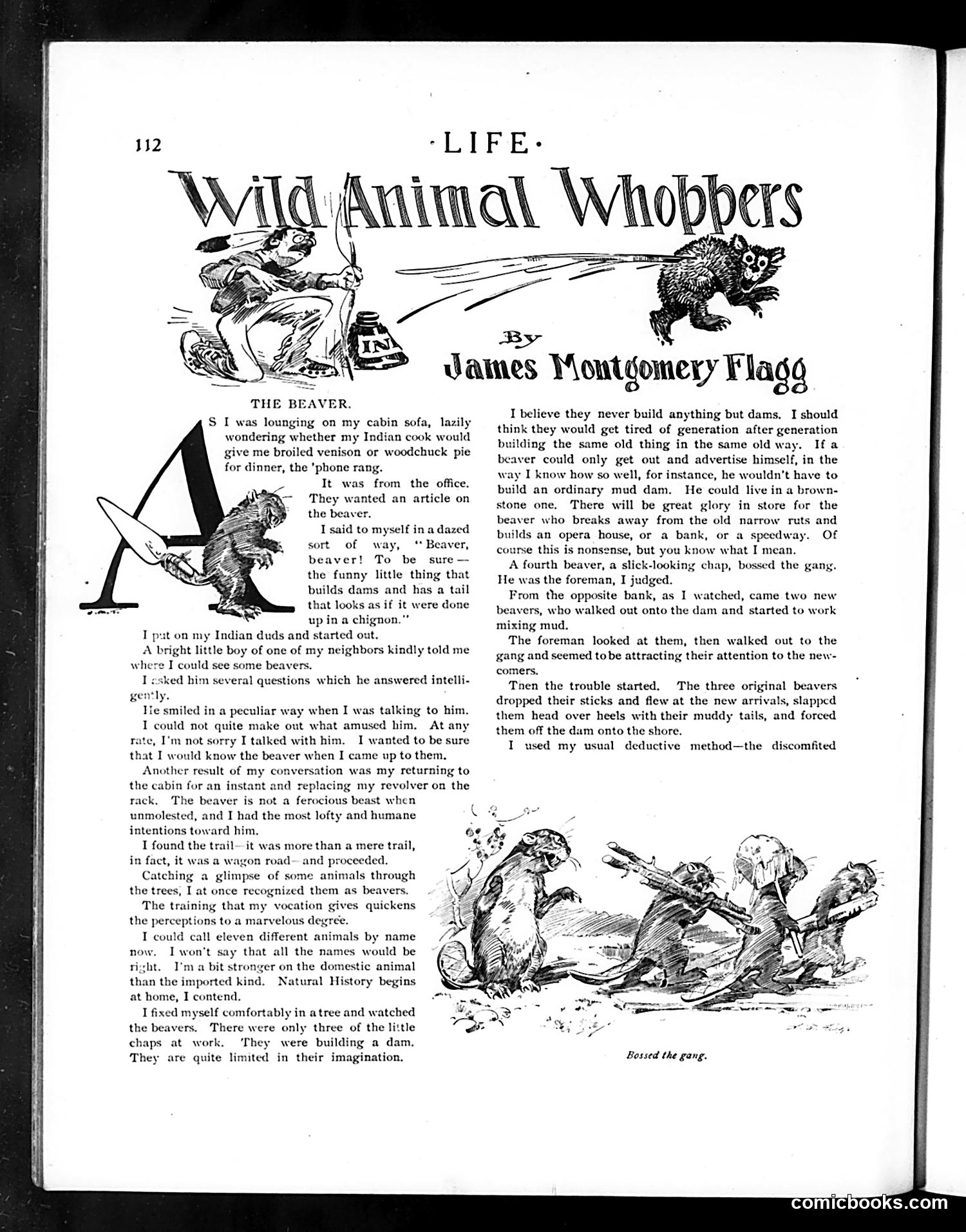
This is a humorous nature essay, not political satire. Flagg recounts observing beavers building a dam while lounging in his cabin. The piece gently mocks human assumptions about animal behavior—particularly the notion that beavers mindlessly repeat the same task generation after generation. Flagg's humor centers on anthropomorphizing the beavers: he imagines one advertising himself, another building an "opera house" or "bank," suggesting beavers might have ambitions beyond dam-building. The accompanying sketches show beavers at work and the "trouble" that erupts when newcomers arrive and clash with the original gang. The satire targets not animals but human nature—our tendency to underestimate animal intelligence and creativity.
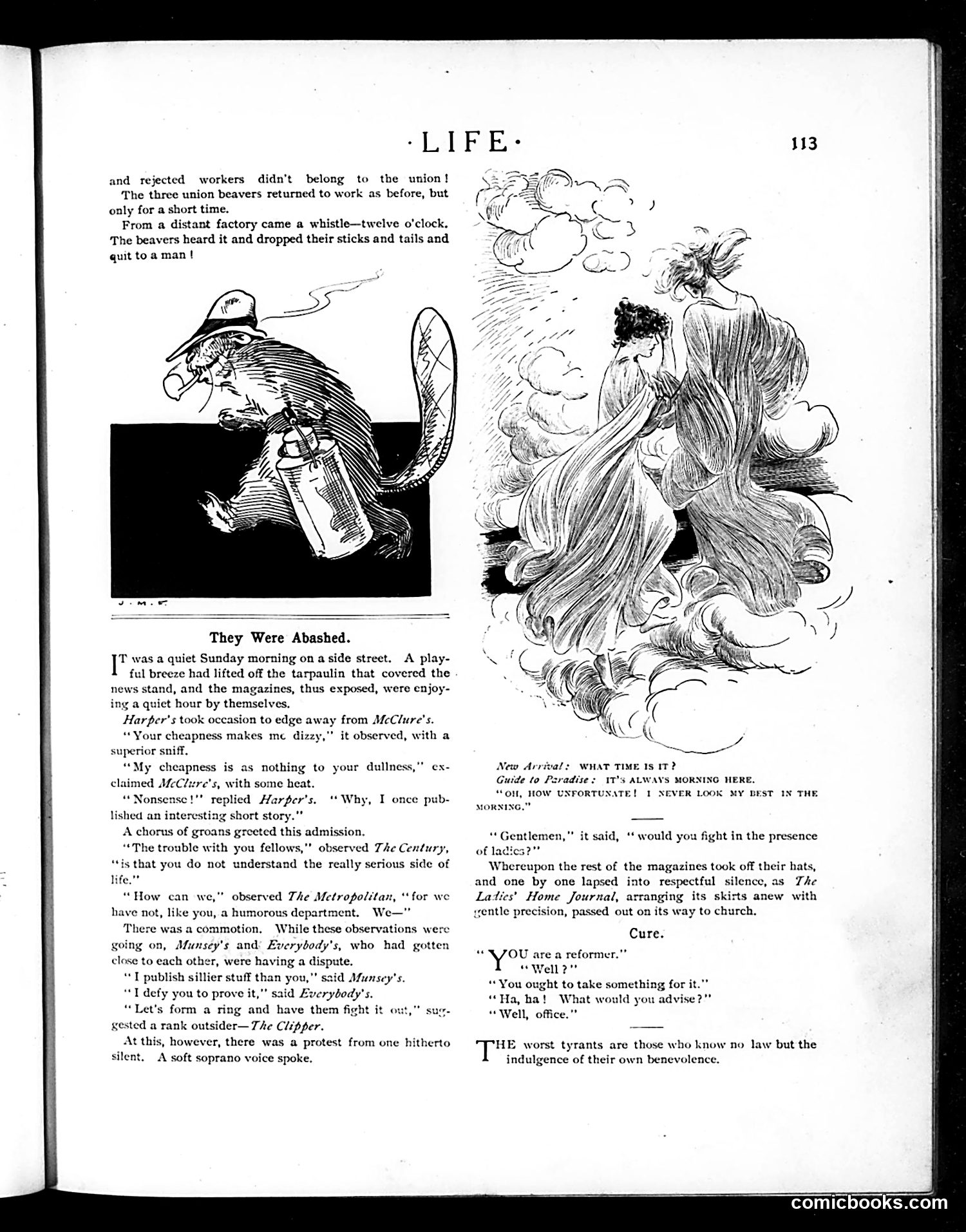
This page contains two satirical pieces about American magazines of the early 20th century. **Top cartoon:** Shows a beaver (representing union labor) abandoning work when a factory whistle sounds at noon, illustrating the tension between union solidarity and workers' desire to leave at scheduled times. **Main story:** A personified debate among competing magazines—*Harper's*, *McClure's*, *The Century*, *Metropolitan*, *Munsey's*, and *Everybody's*—each boasting about their editorial quality while insulting rivals. *Harper's* claims superiority through serious content; *McClure's* counters about cheapness versus dullness; *The Metropolitan* boasts a humor department. The satire mocks magazine competition and pretension. The joke's climax occurs when *The Ladies' Home Journal*—entering as a "new arrival"—immediately commands deference from all male-oriented publications, who respectfully silence themselves. This jokes about the magazine's popularity and the era's gender conventions, while gently poking fun at male editors' gallantry toward "ladies' " publications. The closing aphorism about tyranny appears unrelated to the preceding content.
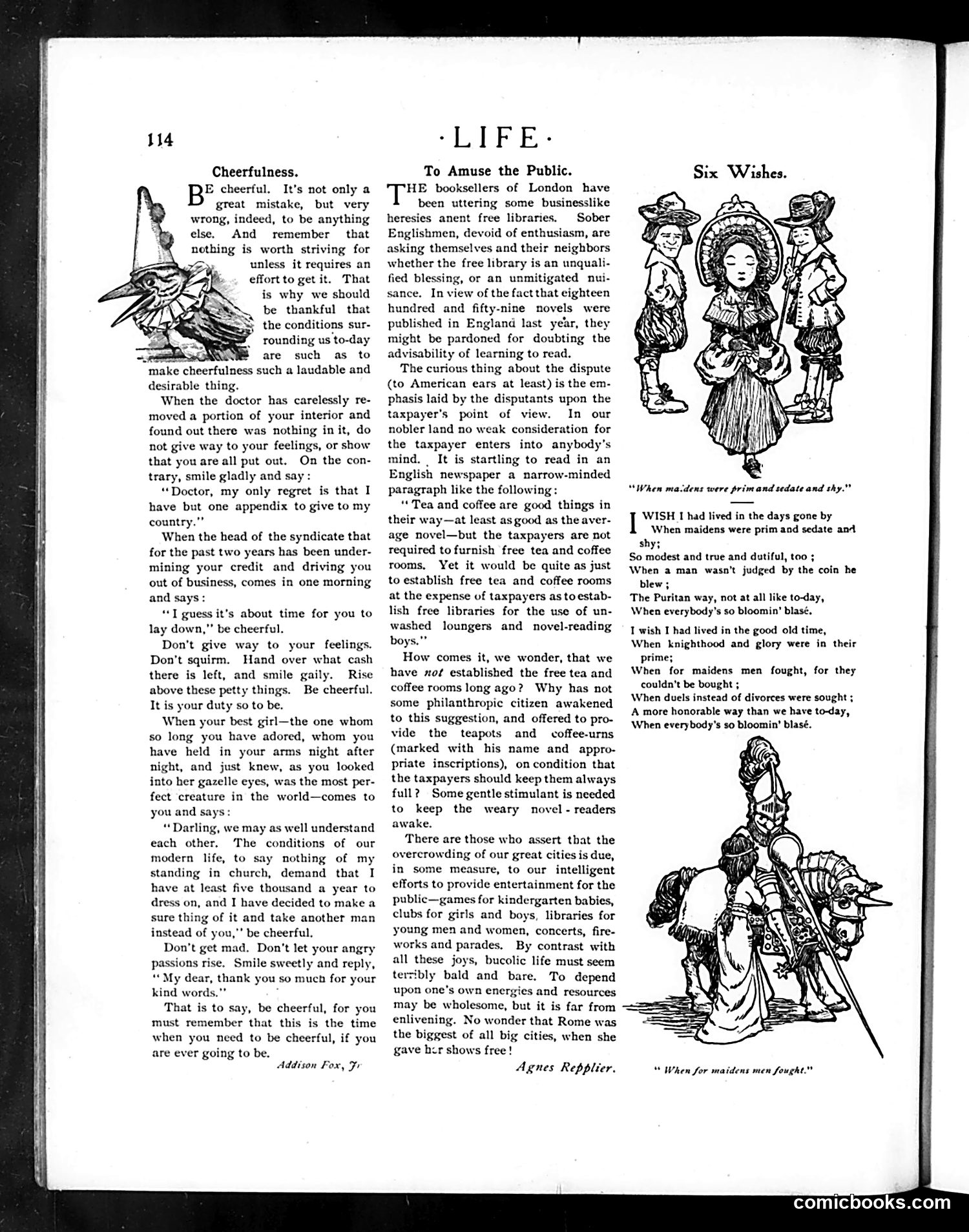
This page contains three satirical pieces attacking different targets: **"Cheerfulness"** (left): Mocks the era's toxic positivity culture by depicting absurd scenarios where one should remain cheerful despite catastrophe—a failed surgery, business ruin, and romantic betrayal. The satire is straightforward: the advice to "be cheerful" in genuinely awful circumstances is ridiculous. **"To Amuse the Public"** (center): Ridicules English debates over free public libraries. English taxpayers questioned whether subsidizing libraries for "unwashed loungers and novel-reading boys" was worthwhile, especially given the 1,859 novels published annually. The American author sarcastically wonders why free tea and coffee rooms haven't been funded—implying Americans wouldn't quibble over such public goods. **"Six Wishes"** (right): Three illustrated vignettes showing idealized past scenarios ("When maidens were prim and sedate," "When a man wasn't judged by the coin he has," "When knighthood and glory were in their prime"). This nostalgic piece contrasts with modern life's materialistic concerns. The page satirizes contemporary social hypocrisy, class anxieties, and nostalgia for simpler times.
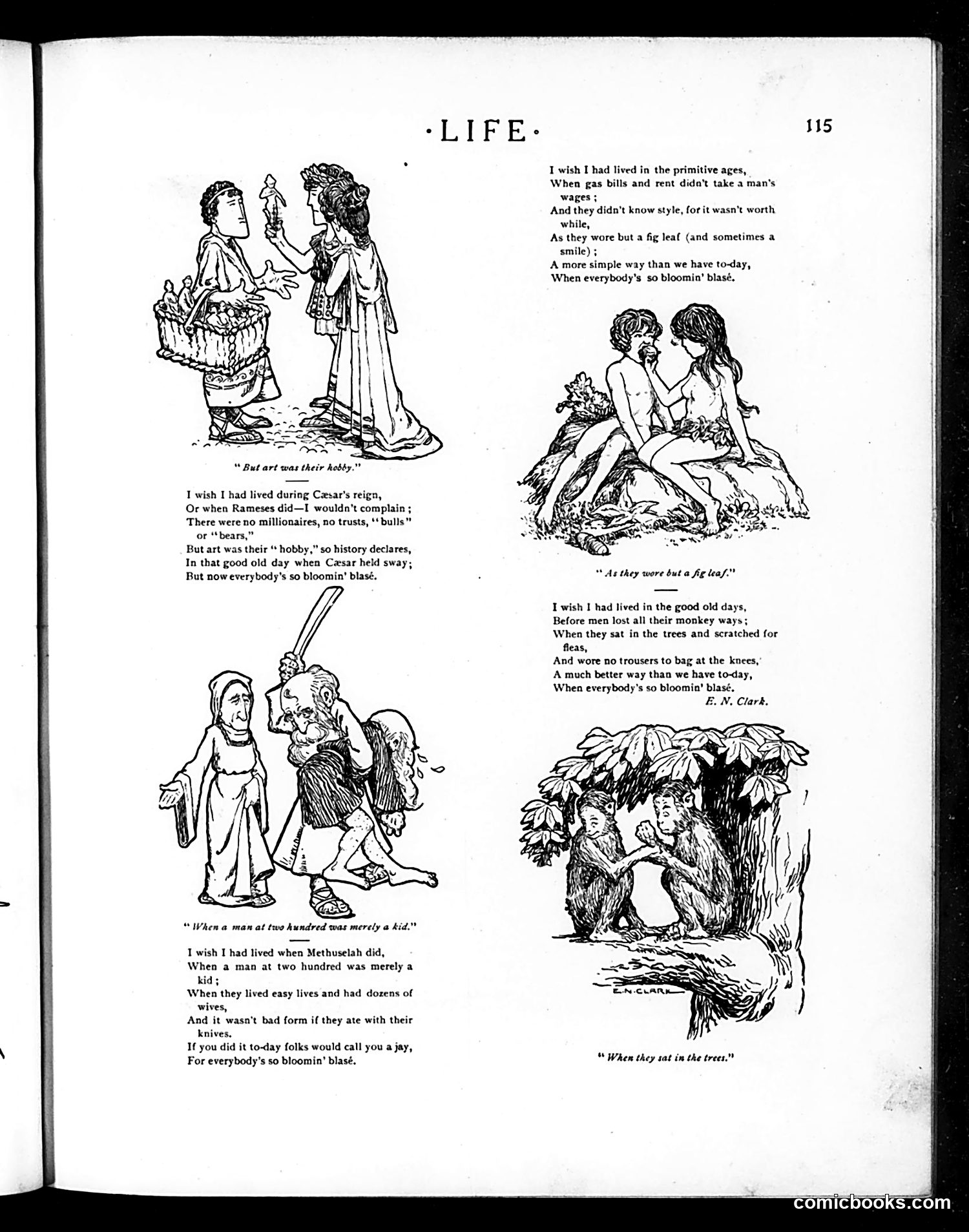
This page satirizes **turn-of-the-century social pretension and ennui**—the fashionable complaint that modern life is exhausting and morally corrupt compared to "better" historical periods. The poem (credited to E.N. Clark) uses escalating absurdity: the speaker wishes he'd lived in Caesar's Rome, Methuselah's era, primitive times, or even as tree-dwelling primates—each supposedly simpler and happier than the present. The repeated refrain "everybody's so bloomin' blasé" is the joke: the speaker's own complaints exemplify the very jaded attitude he's criticizing. The accompanying illustrations show each fantasized era, with captions like "But art was their hobby" and "When they sat in the trees." **The satire targets**: wealthy Americans nostalgic for imagined golden ages while ignoring actual modern problems (rent, gas bills, social pressure). It mocks the pose of world-weary sophistication—treating perpetual discontent as fashionable rather than genuine.
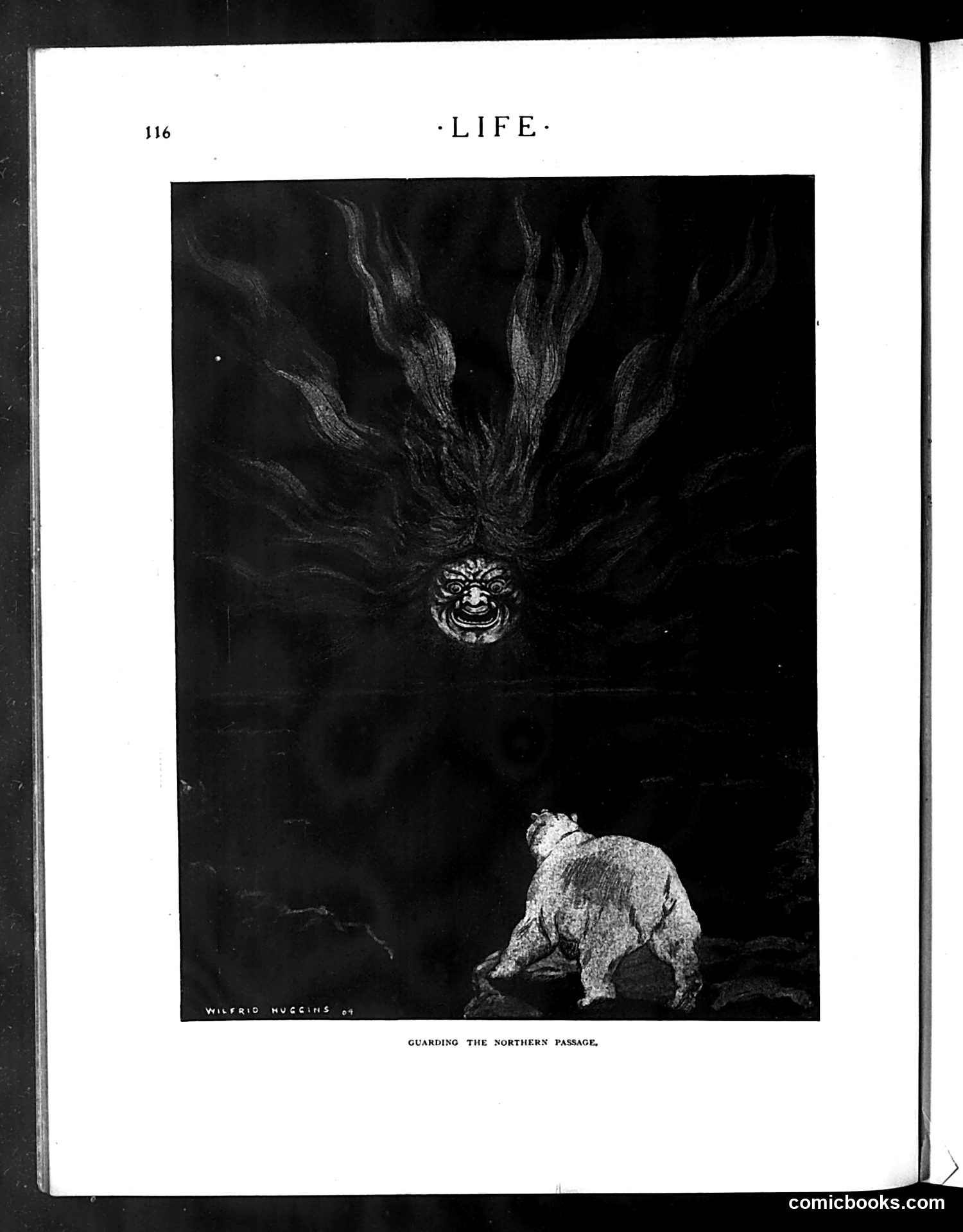
This appears to be a dark political cartoon by Wilfrid Hugging showing a small figure (possibly representing a nation or political entity) confronted by a menacing, demonic creature with wild hair looming above in shadow. The "Northern Passage" likely refers to Arctic territorial or shipping routes—a geopolitical concern during periods of imperial expansion or Cold War tension. The small, hunched figure appears vulnerable or defensive, while the threatening apparition suggests an external threat or invading force. Without the publication date visible, the exact historical context is unclear, but the imagery suggests commentary on a nation facing intimidation over northern territorial claims or passage rights. The creature may personify a rival power or the dangers of Arctic competition.
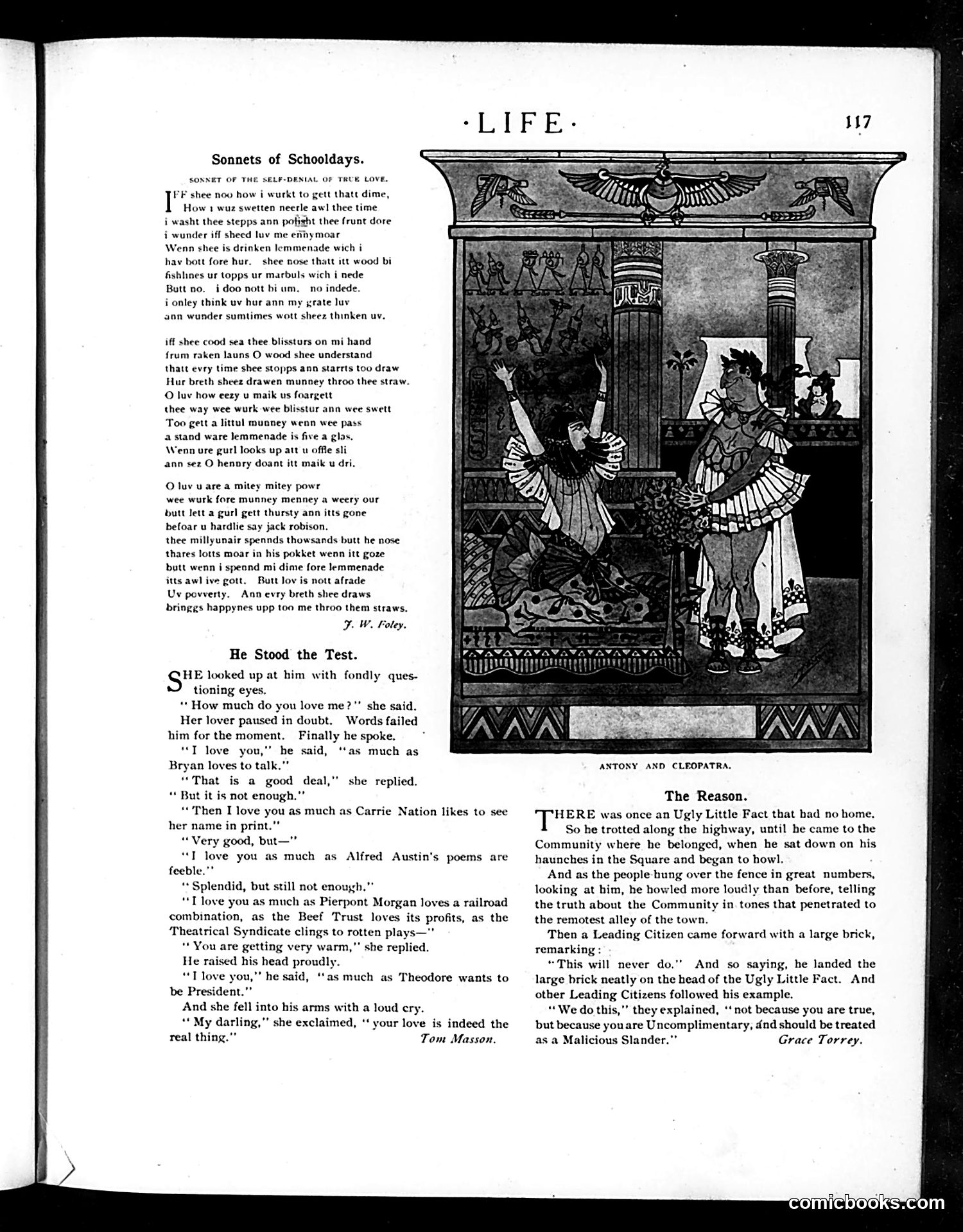
This page contains three distinct pieces of satirical content: **"Sonnets of Schooldays"** uses deliberately misspelled, phonetic verse to humorously depict a schoolboy's self-sacrifice—working chores to buy lemonade for a girl he loves, unaware she knows his hands blister from labor. **"He Stood the Test"** is a romantic comedy where a man proves his love through hyperbolic comparisons to contemporary figures and institutions: William Jennings Bryan's talkativeness, Carrie Nation's publicity-seeking, weak poet Alfred Austin, J.P. Morgan's railroad deals, the Beef Trust's greed, and Theodore Roosevelt's presidential ambitions. The woman accepts only when he compares his love to Roosevelt's desire for the presidency—the ultimate measure of intensity. **"The Reason"** is an allegory condemning censorship. An "Ugly Little Fact" (truth-telling) arrives in town and howls uncomfortable truths. Leading Citizens brutally silence it, justifying suppression not because it's false, but because it's "uncomplimentary"—criticizing the community. The satire attacks those who suppress inconvenient truths under the guise of defending against slander.
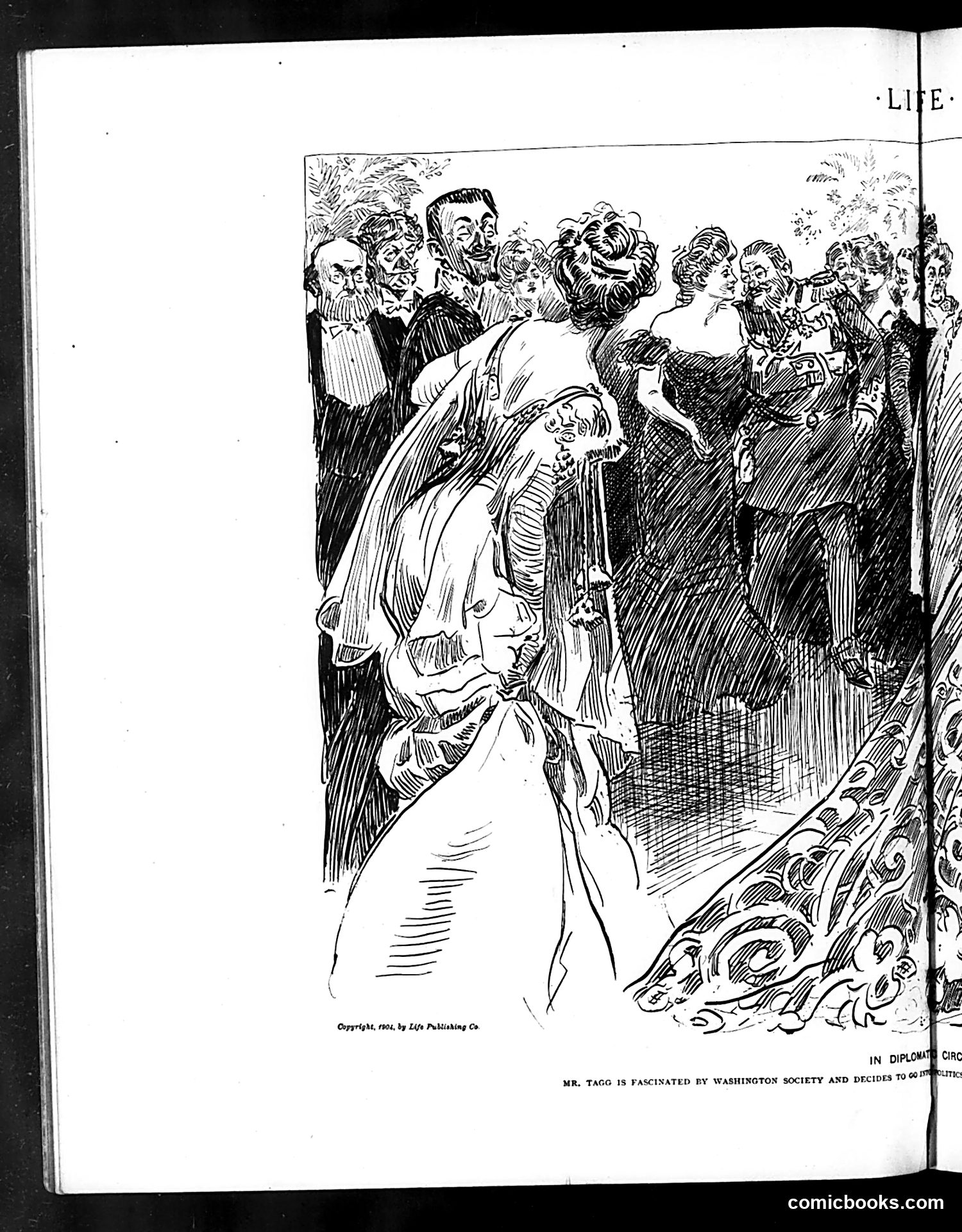
This satirical cartoon depicts a man identified as "Mr. Tagg" attending a Washington society gathering. The incomplete caption suggests he's "fascinated by Washington Society and decides to" pursue political connections. The cartoon satirizes social climbing in diplomatic circles—Tagg appears to be an outsider attempting to gain acceptance among well-dressed Washington elites. His exaggerated facial features and posture suggest the cartoonist's mockery of his ambitions. The ornate architectural detail (likely a doorway or mantelpiece) on the right emphasizes the formal, exclusive nature of Washington's upper circles. The crowded background figures suggest the competitive social hierarchy Tagg is trying to penetrate. The satire targets the pretentiousness of Washington society and those seeking political advancement through social maneuvering rather than merit.
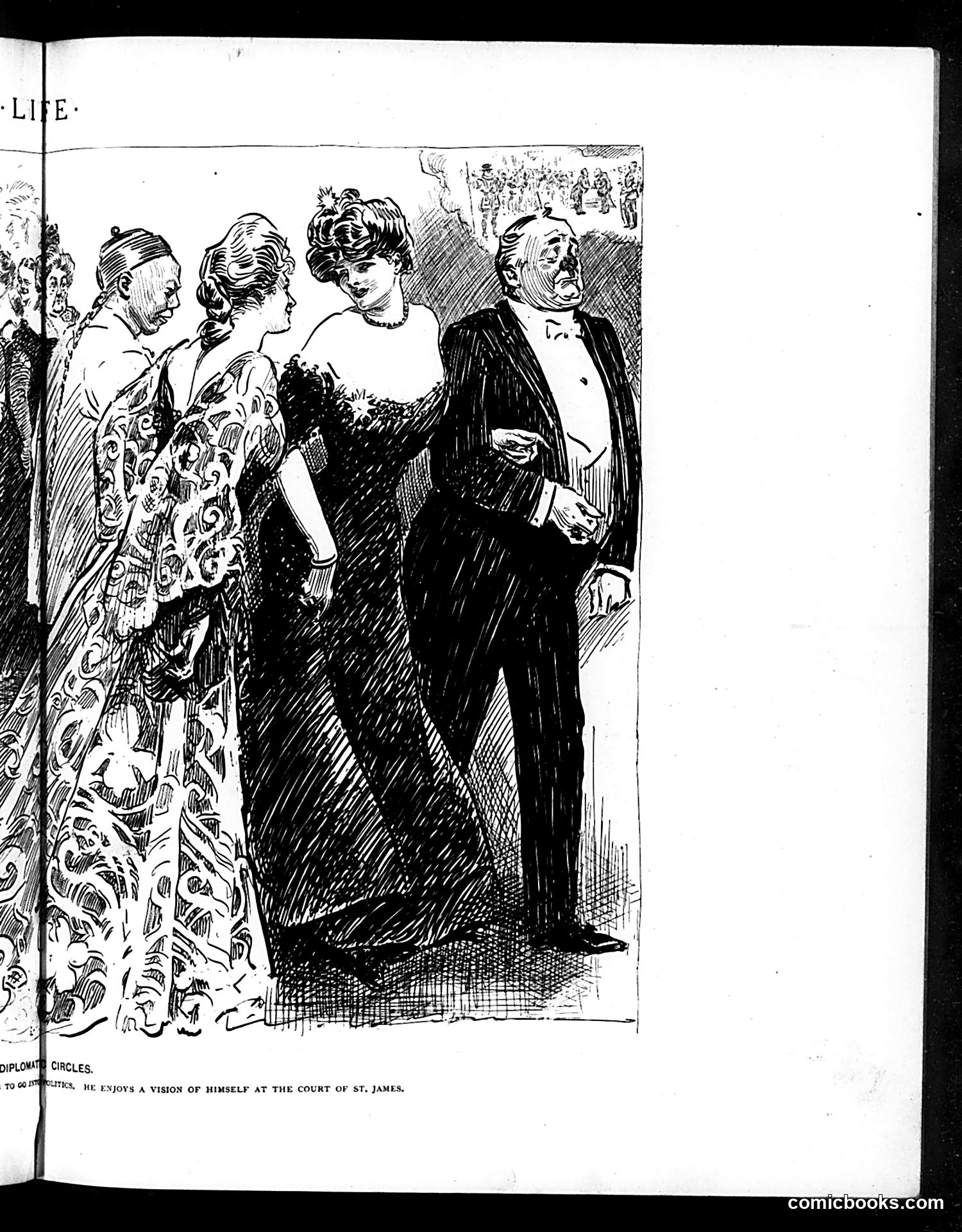
This is a page from *Life* magazine featuring a satirical illustration titled "Diplomatic Circles" with the caption "To Our Postlice [sic], He Enjoys a Vision of Himself at the Court of St. James." The cartoon depicts a man in formal evening dress (tuxedo and white tie) at what appears to be a high-society event, surrounded by elegantly dressed figures. The illustration uses the contrast between his modest reality and an imagined vision of himself in prestigious diplomatic circles—specifically at the British royal court ("Court of St. James"). The satire mocks social ambition and pretension: the subject fantasizes about attending exclusive diplomatic functions while his actual position is merely postal-related, suggesting aspiration far exceeding his actual status.
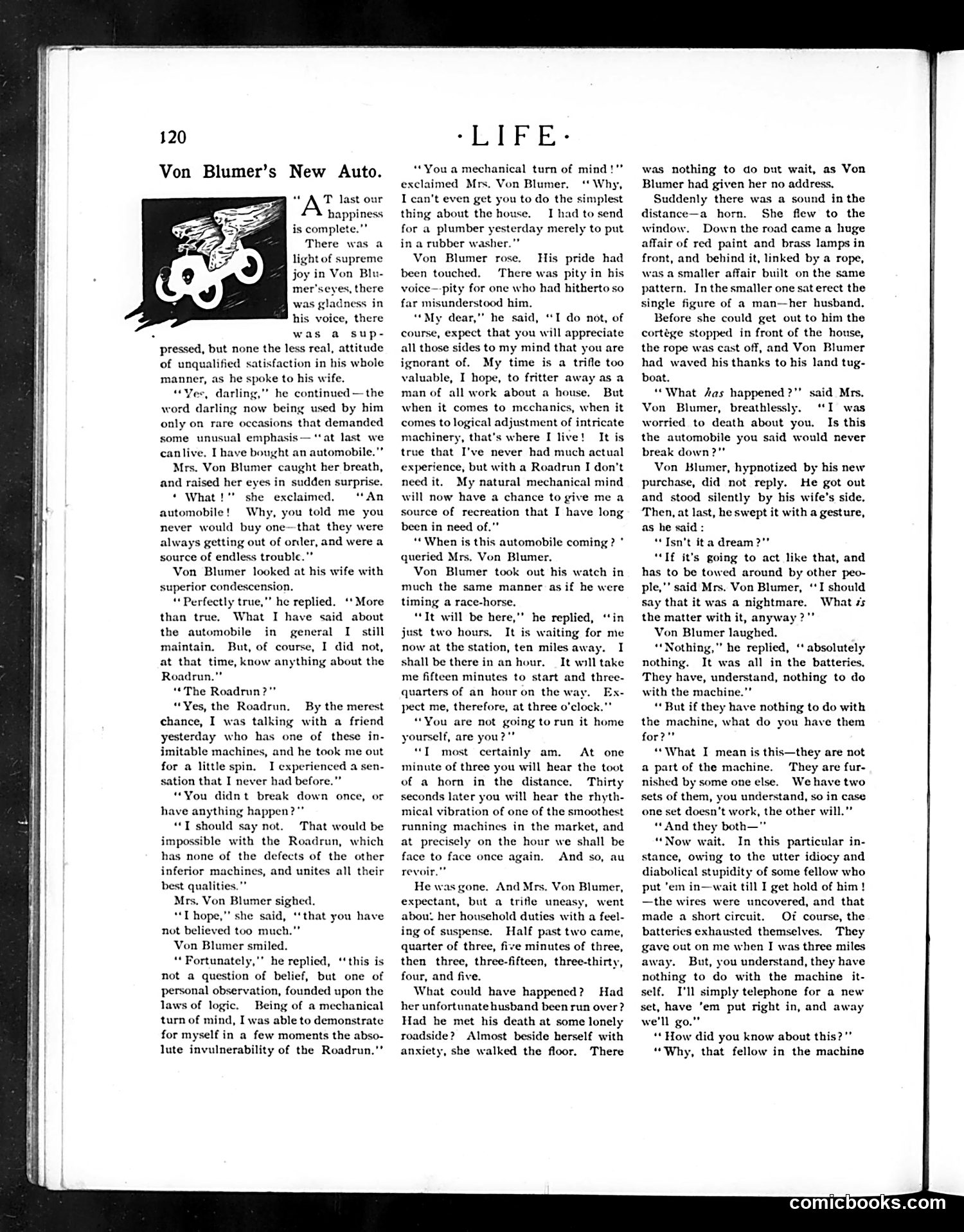
This satirical story mocks a type of Edwardian male hubris. Von Blumer, a pompous man who admits he can't even install a rubber washer at home, suddenly declares himself a mechanical genius upon purchasing an automobile (a "Roadrun"). He boasts of understanding "logical adjustment of intricate machinery" despite having no actual experience—relying instead on abstract "mechanical mind" and watching a friend's demonstration. The joke targets early-20th-century automotive culture: the automobile's mystique made ordinary men feel intellectually superior. Von Blumer's wife's skepticism mirrors readers' expected reaction to his obviously baseless confidence. The cartoon's decorative header featuring an ornate automobile emblem reinforces the absurdity of treating a car as a status symbol worthy of such pretension. The humor lies in the gap between his self-assessed competence and demonstrated incompetence—a common Life magazine theme ridiculing male vanity.
This page is primarily **narrative fiction**, not a political cartoon. It depicts a domestic comedy about early automobile ownership, circa 1900s-1910s. **The Story's Point:** Von Blumer has purchased a new automobile (a "Roadrun"), but it has broken down and needs battery repairs. When his automobile-hating neighbor Caterby approaches, Von Blumer frantically hides the repair situation, fabricating an excuse that he's merely "trying to get my breath" after driving so fast from the station—implying his new car works magnificently. **The Satire:** The humor targets both automobile enthusiasm and male vanity. Von Blumer prioritizes impressing his skeptical neighbor over honesty, while Caterby's predictable skepticism about automobiles proves justified when the vehicle immediately breaks down. The scene mocks the nouveau riche enthusiasm for automobiles as status symbols and the lengths people go to maintain appearances. **Social Context:** This reflects early-1900s tensions between traditional (horse-loving) and modern (automobile-embracing) lifestyles, with automobiles still unreliable luxury goods that signaled wealth.
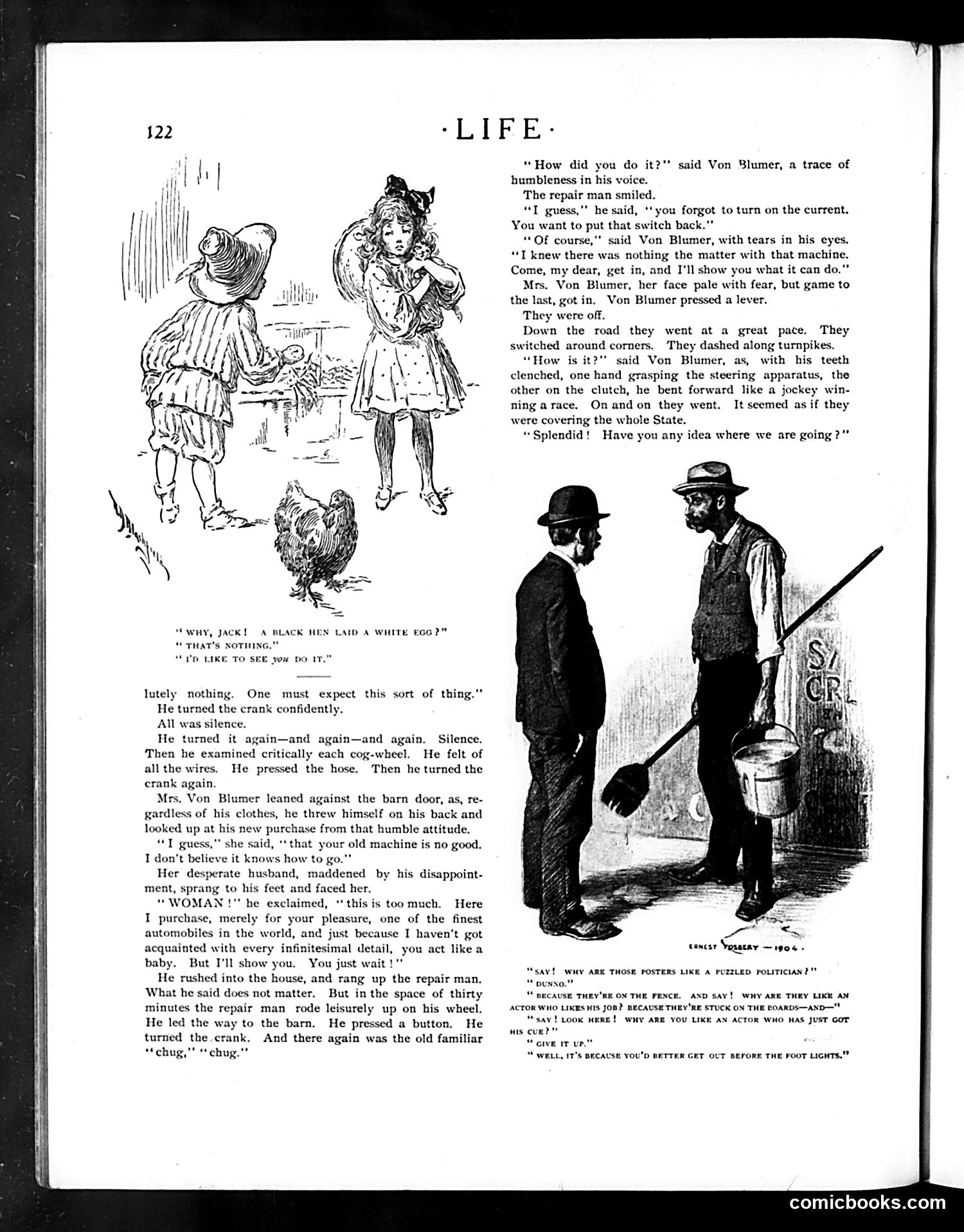
This page contains two separate satirical pieces from Life magazine: **Top Story: "Von Blumer and the Automobile"** A newly wealthy man (Von Blumer) purchases one of the earliest automobiles but cannot operate it. His wife mocks him; he angrily insists he knows what he's doing. A repair man arrives and solves the problem instantly—Von Blumer had simply forgotten to turn on the electrical current. The satire mocks nouveau riche pretension and male ego: Von Blumer blames the machine rather than admit ignorance, then recklessly drives his terrified wife at dangerous speed to prove his competence. **Bottom: "Poster Joke"** A visual pun dialogue comparing theatrical posters to puzzled politicians. The humor plays on "fence" (both literal fence boards and political fence-sitting) and references to stage actors and footlights—period vaudeville/theater humor now obscure to modern audiences. Both pieces satirize early-20th-century American social anxieties: rapid technological change, class aspiration, and masculine pride.
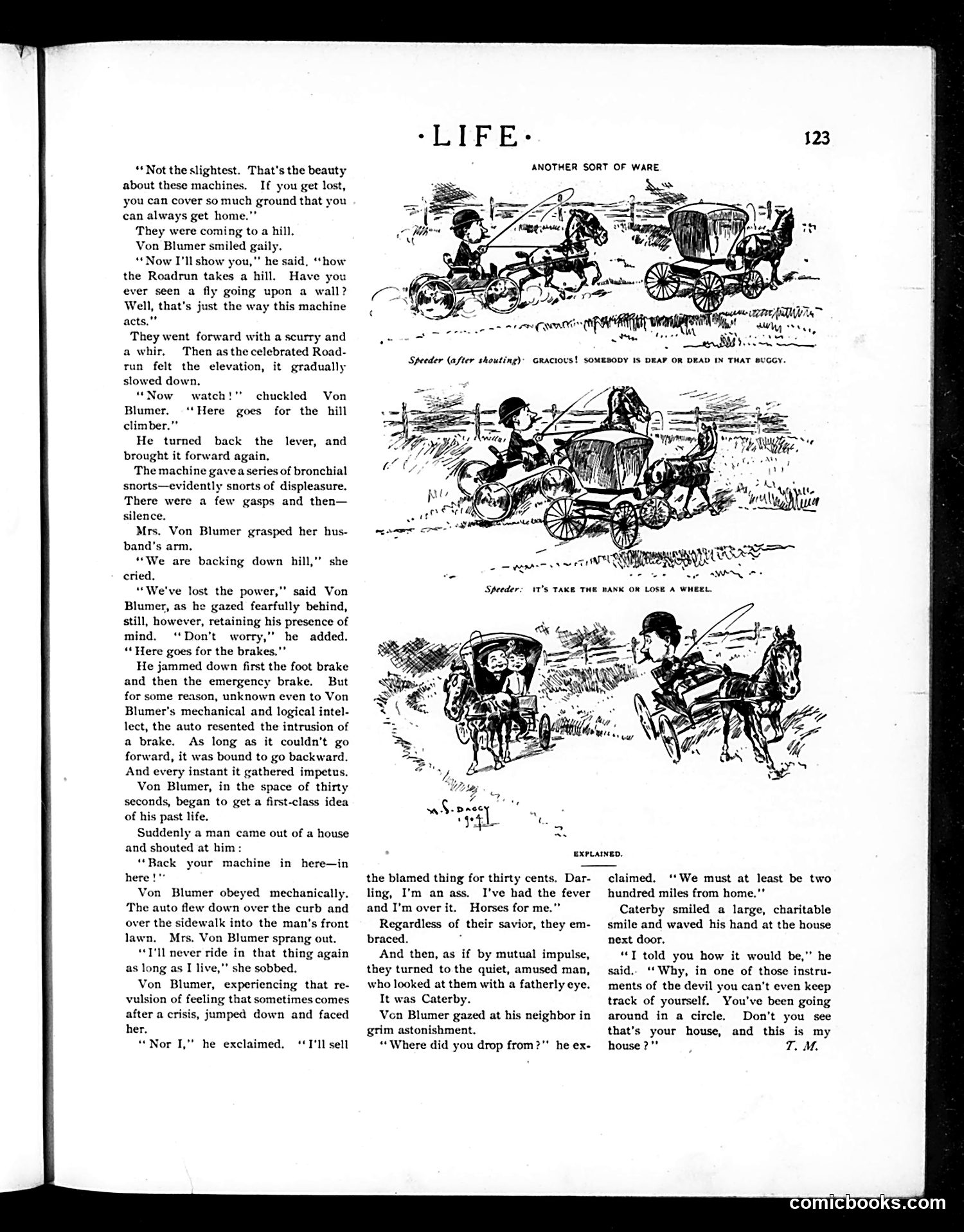
This is a comedic story mocking the newfangled automobile—likely from the early 1900s when cars were still novelties. Von Blumer, a proud early motorist, demonstrates his "Roadrun" automobile to his wife, boasting of its superiority over horses. When the car loses power climbing a hill, it rolls backward uncontrollably, the brakes fail mechanically, and it crashes into a neighbor's lawn. The satire targets automotive enthusiasm and mechanical overconfidence. Von Blumer's repeated assurances ("you can always get home") prove hollow when the machine malfunctions spectacularly. The punchline—they've traveled in circles back to their own neighborhood—underscores that despite the car's promised power and freedom, it's unreliable and disorienting compared to horses. The three cartoons above illustrate mishaps involving early automobiles and horse-drawn vehicles, reinforcing the joke that motorized transport creates chaos.
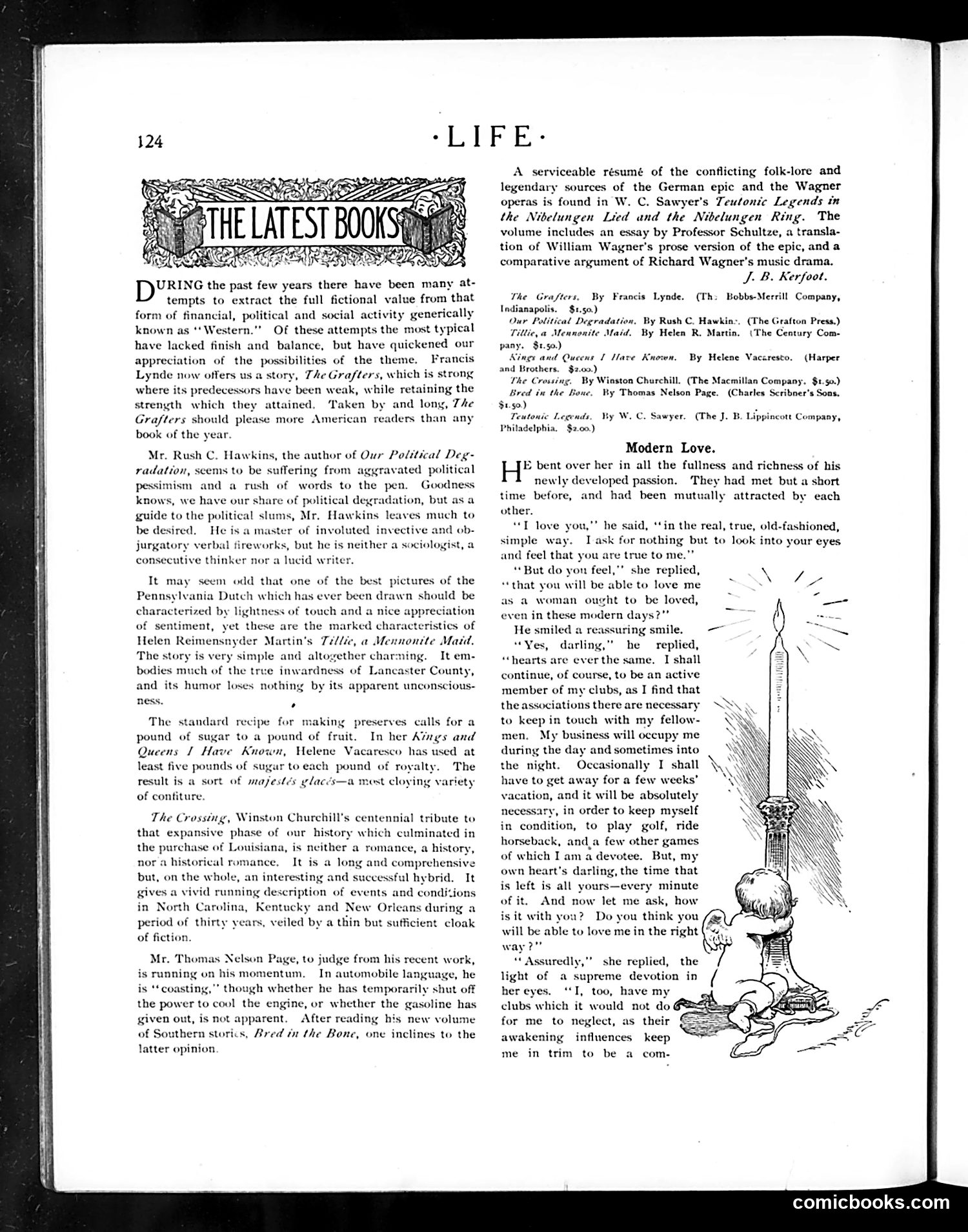
This is a book review section titled "The Latest Books." The page contains literary criticism of several contemporary novels, including *The Grafters* by Francis Lynde and Winston Churchill's *The Crossing*. The small illustration on the right depicts a romantic scene between a man and woman with a candle, accompanying a serialized story titled "Modern Love." The dialogue shown reflects period conventions—the man professes simple, old-fashioned love while the woman responds with practical concerns about maintaining her social clubs and independence, insisting he must respect her autonomy even in romantic commitment. This vignette satirizes modern (early 1900s) relationships, where traditional courtship ideals clash with women's emerging desires for personal freedom and social engagement. The contrast between his romantic idealism and her matter-of-fact insistence on maintaining separate spheres of activity gently mocks both rigid sentimentality and the new "modern" woman's priorities.
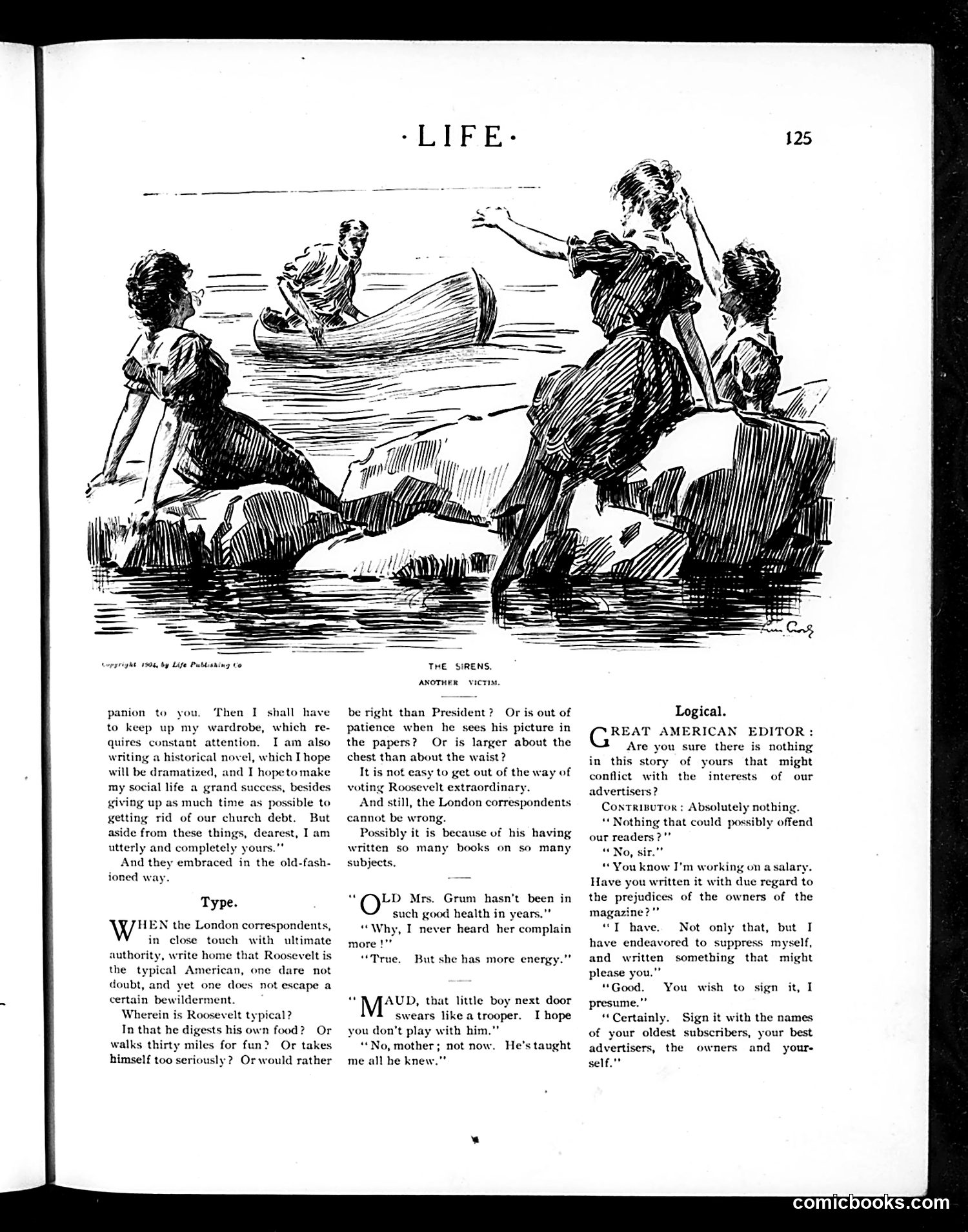
This cartoon satirizes the allure of romantic temptation. Women positioned as "sirens" on rocks by water attempt to lure a man in a boat toward them—classical mythology imagery suggesting seductive danger. The title's subtitle, "Another Victim," implies the man is destined to fall prey to their charms, much like sailors in legend. The accompanying text discusses President Theodore Roosevelt, questioning whether he represents the "typical American" despite London correspondents claiming so. It catalogs his unusual traits: long-distance walking, prolific writing, impatience with his own press coverage, and physical vigor. The page also includes a humorous exchange about editorial censorship, where a magazine editor presses a contributor to ensure their story won't offend advertisers or the magazine's owners—satirizing how commercial interests compromise editorial independence and artistic integrity in publications.
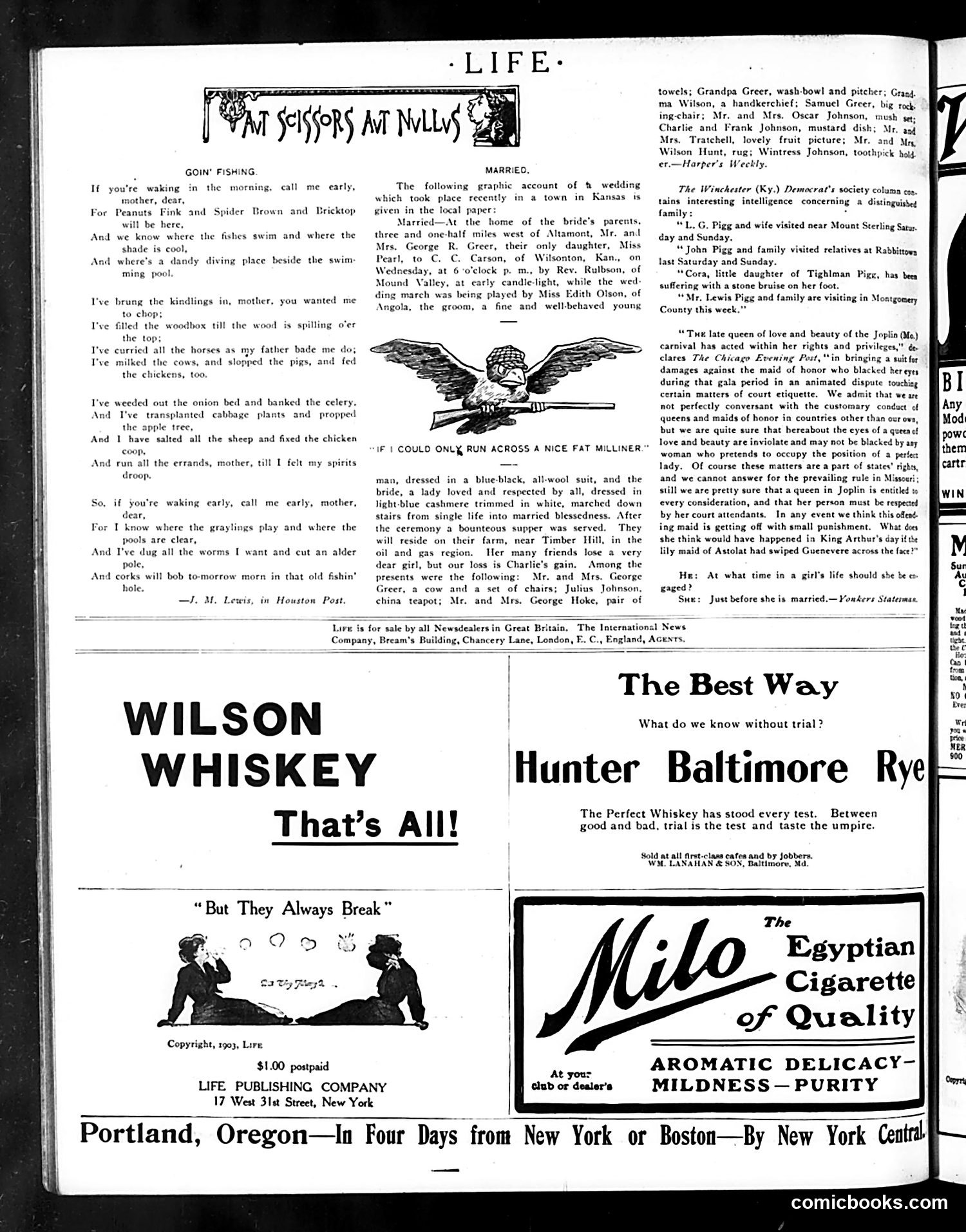
This page contains primarily **text and advertisements** rather than political cartoons. The main content includes: 1. **"Goin' Fishing"** — a sentimental poem (credited to I. M. Lewis, Houston Post) about a boy who's completed his farm chores and wants permission to go fishing. It's nostalgic Americana, not satire. 2. **"Married"** section — a humorous excerpt from a Kansas newspaper's wedding announcement, notable for its exhaustive listing of mundane gifts (cow, chairs, toothpick holder). The satire lies in the contrast between flowery wedding language and the extremely practical, unglamorous presents. 3. **Referenced humor about "Pigg" family** — a snippet from a Kentucky newspaper where the name "Pigg" appears repeatedly, creating unintentional comedy. 4. **Advertisements** — for Wilson Whiskey, Hunter Baltimore Rye, and Milo Egyptian Cigarettes occupy the lower half. The page isn't primarily satirical commentary on politics or current events, but rather showcases small-town newspaper oddities and everyday humor—typical of Life's feature content from this era.
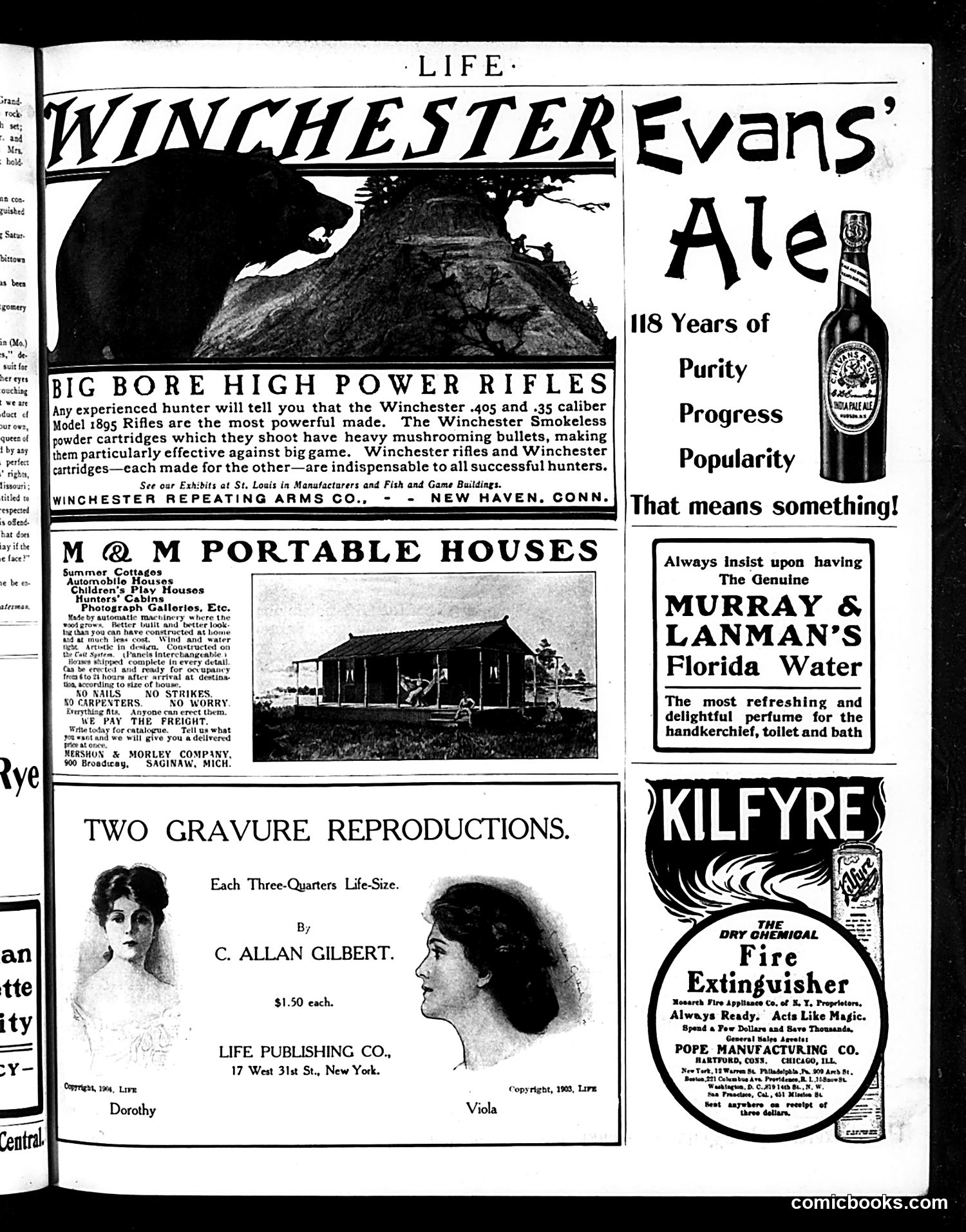
This is primarily an **advertising page** rather than satirical content. The page features four product advertisements typical of early 1900s Life magazine: 1. **Winchester Rifles** – promoting high-caliber hunting rifles (.405 and .35 caliber Model 1895), emphasizing their power for "big game" hunting 2. **M&M Portable Houses** – prefabricated structures marketed for summer cottages, hunting cabins, and temporary buildings; advertises "no strikes" and easy erection 3. **C. Allan Gilbert Gravures** – art reproductions (three-quarter life-size portraits of "Dorothy" and "Viola") sold by Life Publishing Co. for $1.50 each 4. **Various consumer products** – Murray & Lanman's Florida Water (perfume), Kilfyre Fire Extinguisher, and Pope Manufacturing Company products The page reflects **Edwardian-era consumer culture**: hunting equipment, portable leisure structures, fine art reproductions, and household goods marketed to affluent readers. There is no apparent political satire or social commentary visible.
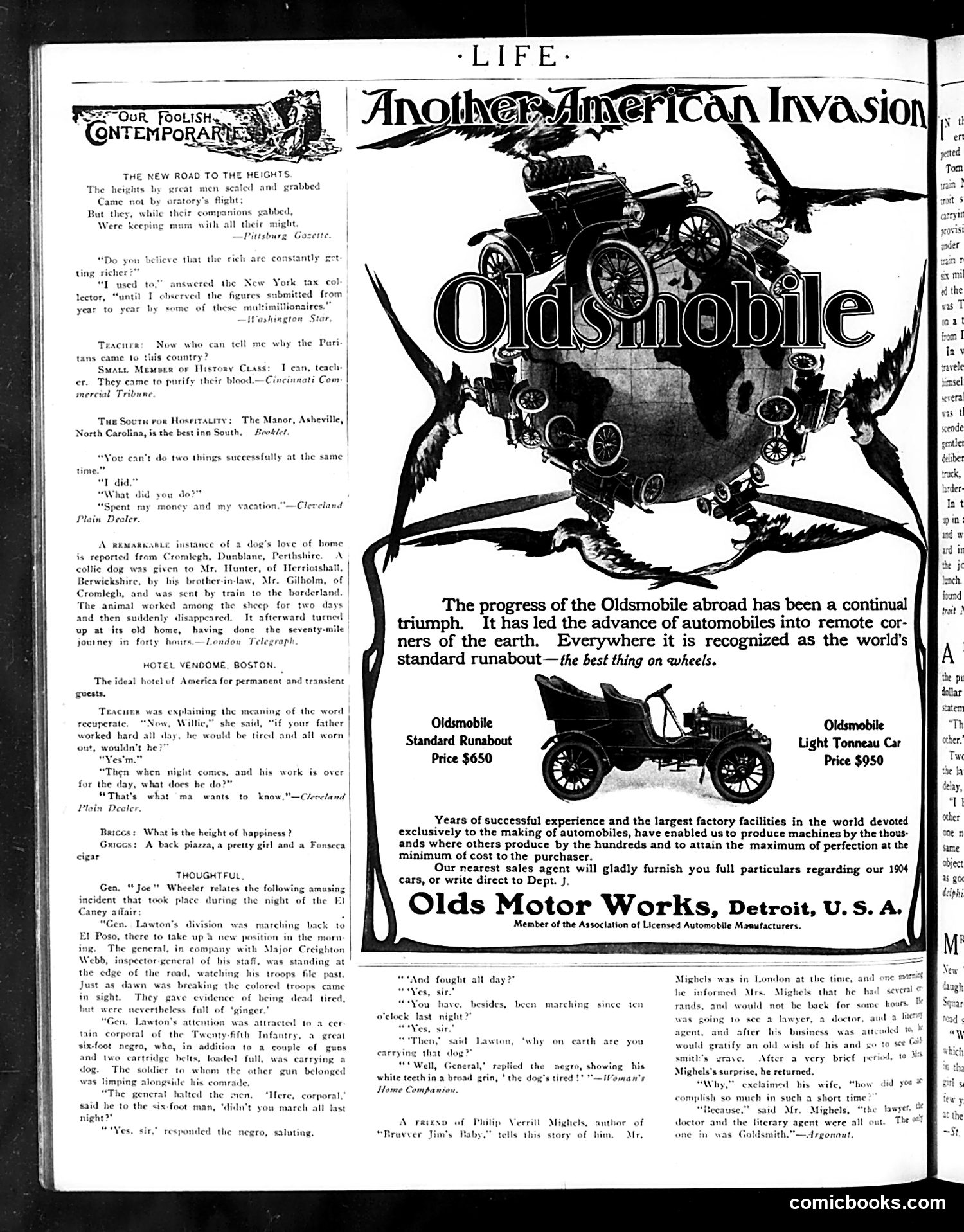
This page is primarily **advertising for Oldsmobile automobiles**, with the headline "Another American Invasion" depicting cars spreading across a map of the United States. The satire suggests automobiles are "invading" America like a conquering force—a tongue-in-cheek reference to the rapid commercialization and spread of motor vehicles into remote areas. The left side contains typical Life magazine humor sections ("Our Foolish Contemporaries"), featuring brief satirical jokes and anecdotes about wealth, social pretension, and human nature. One notable piece describes a collie dog that walked 40+ miles home after being relocated—meant to humorously illustrate animal instinct versus human behavior. An anecdote about General Joe Wheeler from the Spanish-American War includes what appears to be a **racial caricature and dialect humor** involving a Black soldier—reflecting the era's casual, offensive portrayal of African Americans common in early 1900s publications. The Oldsmobile ads emphasize the vehicle's "triumph" abroad and superior manufacturing, positioning it as a status symbol and technological achievement.
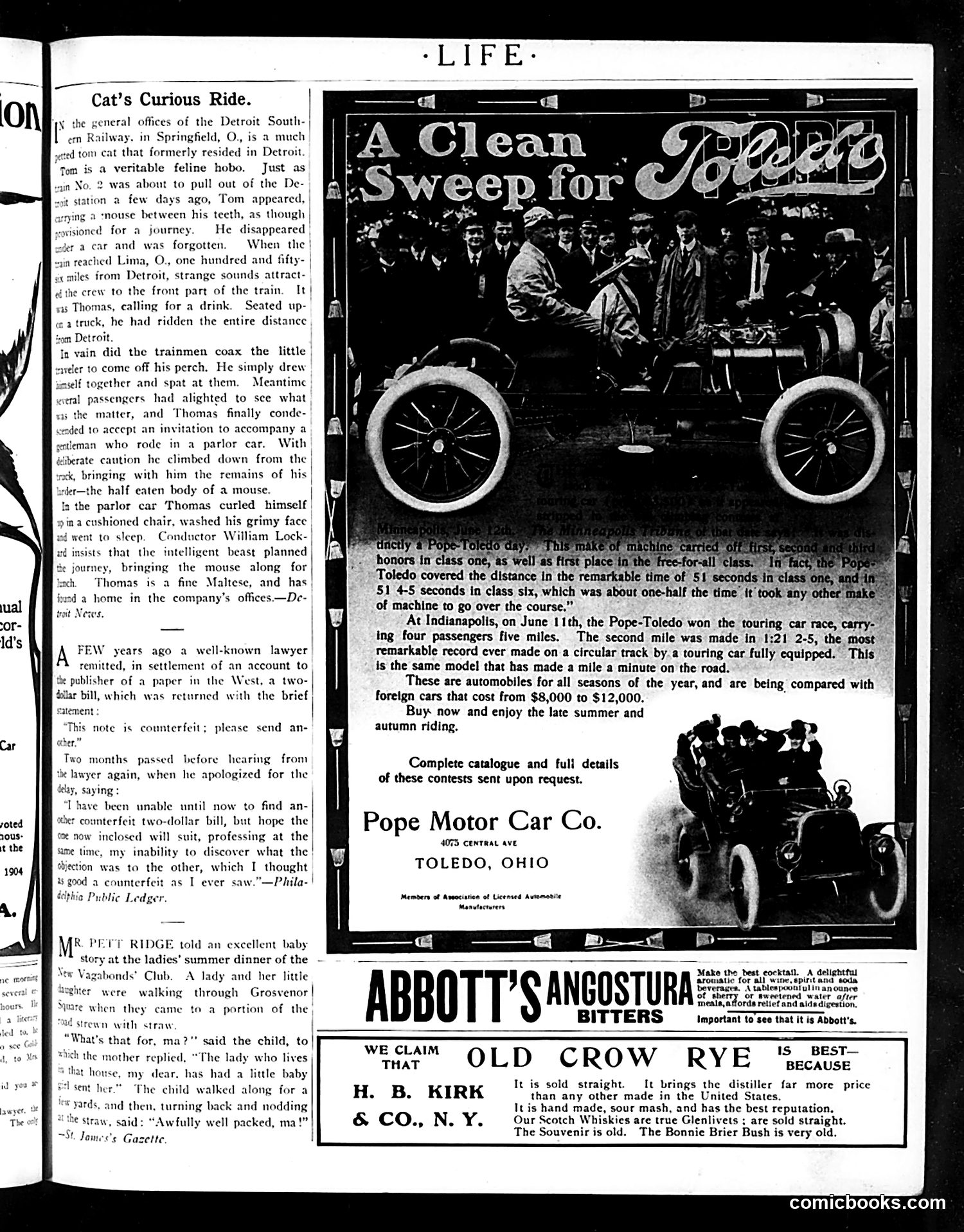
This page is primarily **advertising** for automobiles and spirits, with brief humorous anecdotes in the left column. The main content is a large advertisement for the **Pope-Toledo automobile**, promoting its racing victories. The image shows an early motorcar with passengers, celebrating that the Pope-Toledo won races at Indianapolis and covered distances in record times—claims designed to demonstrate reliability and performance to potential wealthy buyers (cars cost $8,000-$12,000, substantial sums in this era). The left column contains three brief comic stories: one about a cat that rode a train from Detroit to Lima, Ohio; another about a lawyer sending counterfeit money; and a child's observation about straw being "awfully well packed" after witnessing childbirth preparations. These are gentle, observational humor pieces typical of Life's satirical style—no political commentary is present. The remaining advertisements promote Abbott's Angostura Bitters and Old Crow Rye whiskey.
This page contains satirical commentary and advertisements from an early 20th-century American magazine. **The Main Cartoon ("Our Foolish Contemporary"):** A Washington school principal teaches students that three buttons represent Life, Liberty, and the Pursuit of Happiness. When asked to produce them the following week, the youngest boy tearfully reveals his mother sewed the "Pursuit of Happiness" button onto his pants—he's lost it. The satire mocks how ordinary people struggle to maintain the idealistic values the Declaration of Independence promises. **Additional Anecdotes:** Other brief humorous stories mock politicians and academics—a fat congressman's discomfort on a wire cot, and Professor William James of Harvard correcting a pompous student's atheism. **Advertisements:** The page features Trimble Whiskey, banking firms (Wassermann Brothers, Morton Trust Company), and Tom Masson's book *In Merry Measure*. The overall tone critiques American society's gap between noble ideals and messy reality.
This page mixes automotive advertising with satirical content typical of *Life* magazine's early 20th-century format. **The main satire** is the poem "Lines on a Fool Friend," which mockingly describes an accident-prone acquaintance—someone so incompetent he doesn't realize a gun is loaded or that machinery is dangerous. The final line, "He means well—but he doesn't know," captures the joke: he's well-intentioned but dangerously oblivious. **The other notable content** is "Cats Fear This Robin," a humorous anecdote about an aggressive Oregon robin that defends its nest by attacking cats and children, even tearing fur from a cat's face. It's presented as a nature oddity for entertainment. **The advertisements** (Cadillac, Rambler automobiles, Knox Hat, Vereder Odometer) are standard period marketing claiming superior performance and reliability—though the Cadillac ad humorously opens by questioning broken promises, then makes its own claims about exceeding specifications. The page reflects *Life's* role as a satirical weekly combining light humor, social commentary, and commercial content for educated middle-class readers.
This page is primarily **advertising** with a small story feature. The main content includes: **"The Dog Nursed the Cat"** — A sentimental anecdote about a widow's dog (Spry) and cat who were enemies. After the cat breaks her leg in a steel trap, the dog overcomes his dislike, retrieves choice food scraps from his own plate, and carries them to the injured cat under the house. The story celebrates animal compassion and was apparently a true local incident from Ohio that "witnesses still living" could verify. **Advertisements dominate the page**, promoting Gillette Safety Razors, various chocolate brands (Peter's, Whitman's, Cailler's Swiss Milk Chocolate), and other consumer products. These ads emphasize modern convenience and quality—typical early 20th-century marketing appeals. The page reflects *Life*'s mixed format: wholesome human-interest stories paired with commercial content targeting affluent readers of the era.
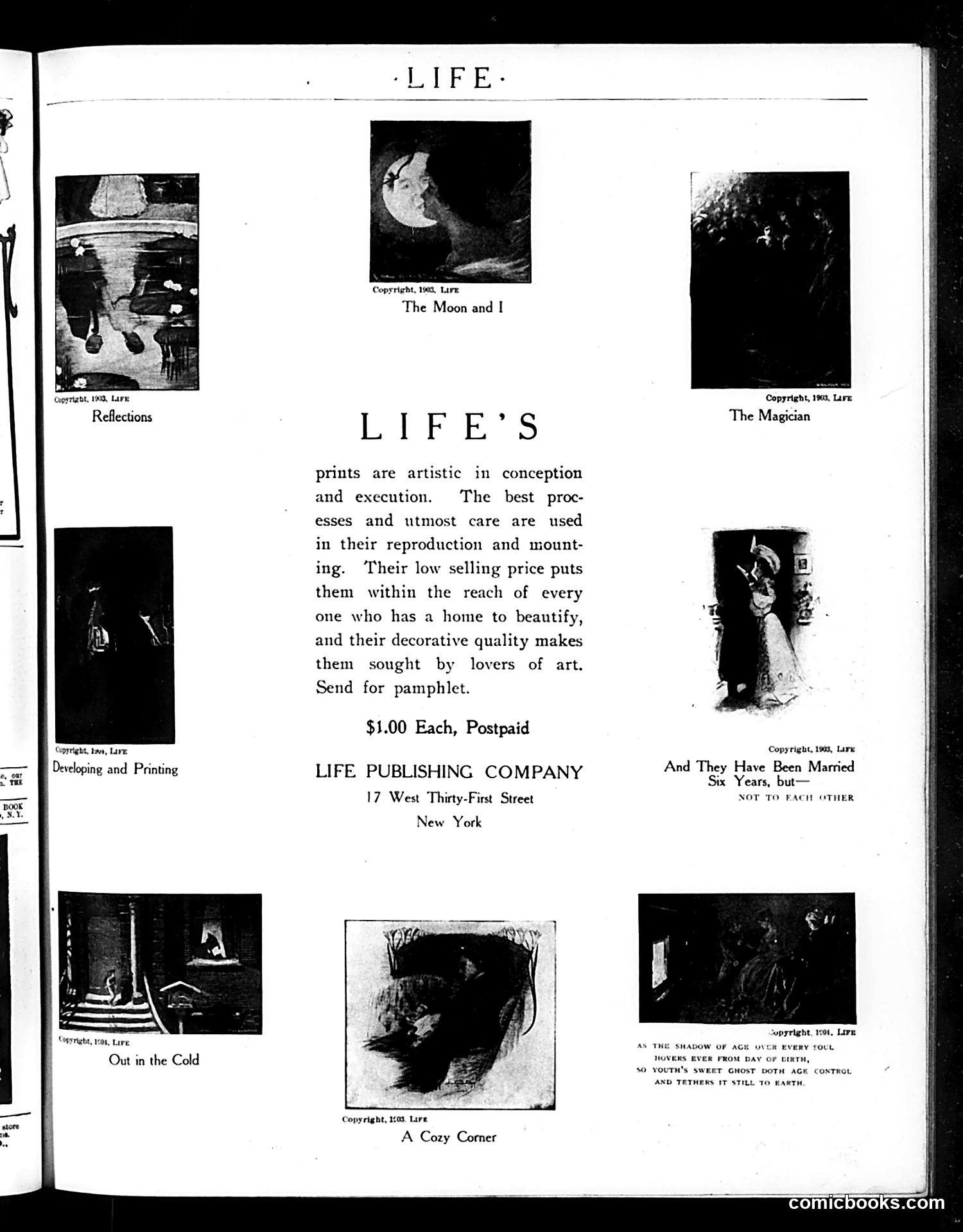
This is primarily an **advertisement for LIFE Publishing Company's art prints**, not political satire. The page showcases seven artistic prints available for $1.00 each, positioned as affordable home decoration for the middle class. The prints themselves appear to be **sentimental or melodramatic genre scenes** typical of early 1900s popular art: "Reflections" (possibly introspective), "The Moon and I" (romantic), "The Magician" (theatrical), "Out in the Cold" (poverty/hardship), "A Cozy Corner" (domestic comfort), and "And They Have Been Married Six Years, but—Not to Each Other" (suggesting marital infidelity or unhappiness—a common satirical subject in LIFE). The accompanying poetic text about "age" and "youth's sweet ghost" suggests melancholic themes common to the era's popular aesthetics. **The satire is minimal here**—this is largely a **commercial product advertisement** dressed in artistic language, targeting consumers seeking affordable sentimentality for home decoration.
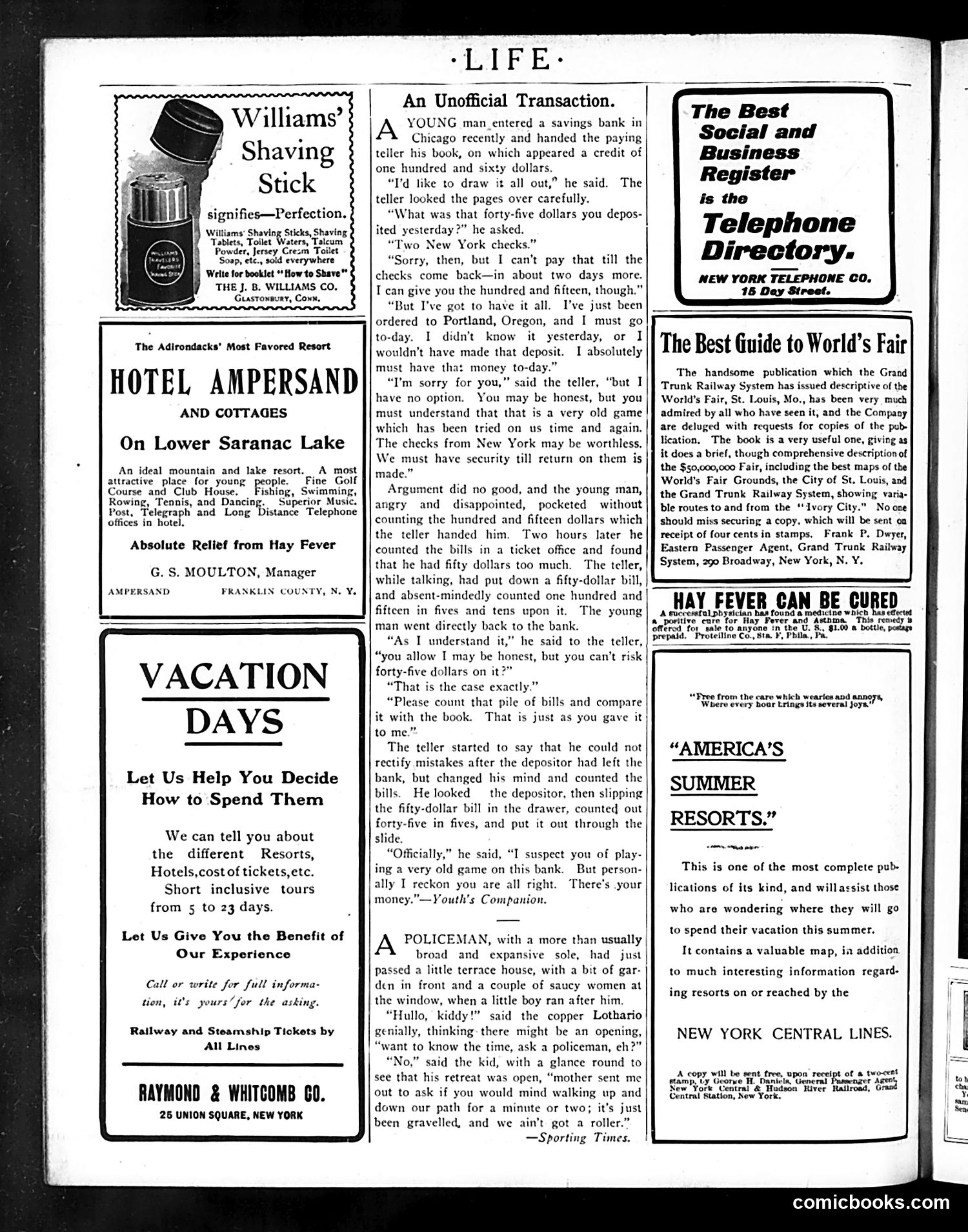
This page is primarily **advertisements and two humorous anecdotes** rather than political cartoons. The main story, "An Unofficial Transaction," satirizes **banking rigidity versus common sense**. A young man needs to withdraw his full savings for an urgent military transfer to Portland, Oregon. The teller refuses $45 (a recent deposit via uncleared New York checks), citing standard anti-fraud procedures—an "old game" scammers use. The irony: the teller accidentally overpays him by $50. When the man returns the excess money, the teller admits the customer was "all right," revealing that rigid rules and human judgment are at odds. The second fragment about a policeman appears to be setting up a joke about a streetwise child (context cut off). **Context for modern readers**: This reflects early-20th-century banking frustration—the tension between necessary fraud prevention and customer inconvenience, plus distrust of uncleared checks. The story celebrates honesty as its own reward, a common *Life* magazine theme. The surrounding ads promote vacation travel, hay fever remedies, and shaving products.
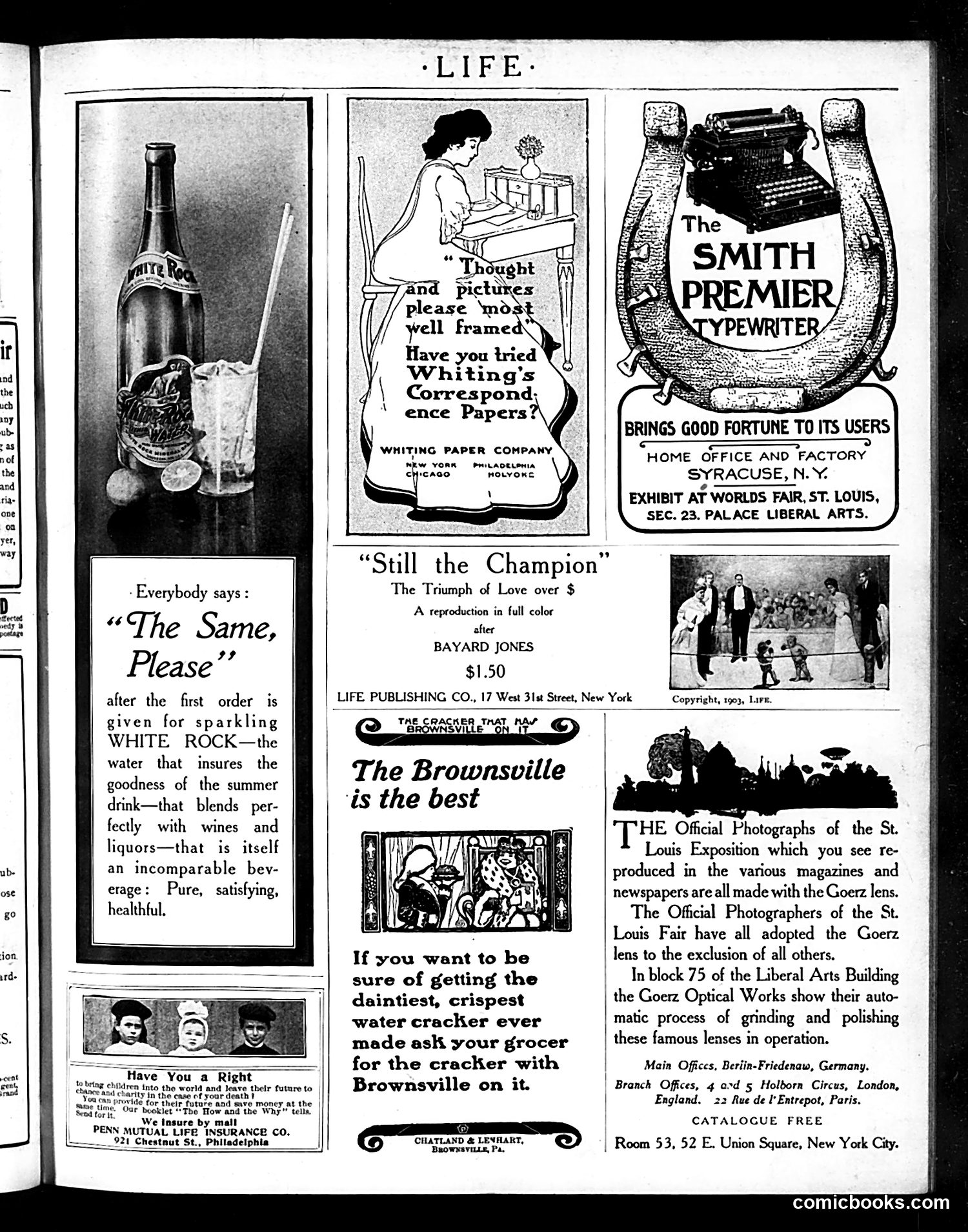
This is primarily an **advertising page** from Life magazine, circa 1903 (based on St. Louis World's Fair references). There is no political cartoon or satire. The page contains **five commercial advertisements**: 1. **White Rock sparkling water** — emphasizes that customers repeatedly request it by name, positioning it as a premium mixer for wines and liquors 2. **Whiting's Correspondence Papers** — stationery product 3. **Penn Mutual Life Insurance** — promotes financial security 4. **Smith Premier Typewriter** — advertised as bringing "good fortune," displayed at the 1904 St. Louis World's Fair 5. **Brownsville water crackers** and **Goerz optical lenses** — both emphasizing official/premium status at the St. Louis Exposition The page also advertises a color reproduction of "Still the Champion" (a painting by Bayard Jones about romantic love) for $1.50. This reflects turn-of-the-century consumer culture and the World's Fair as a venue for showcasing industrial and commercial products.
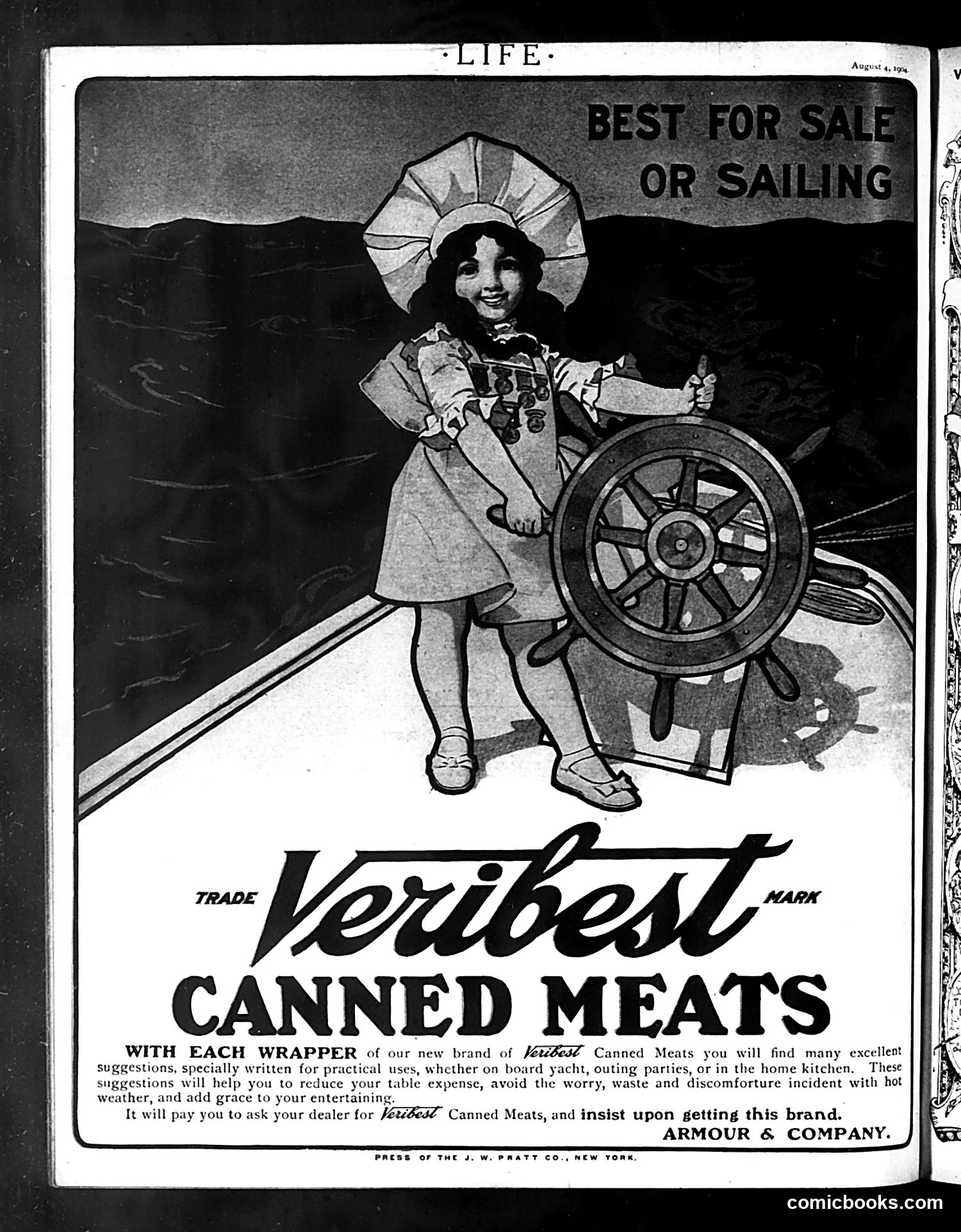
This is a **product advertisement**, not political satire. It promotes Armour & Company's "Veribest" brand canned meats, published in *Life* magazine (dated August 4, 1904). The illustration depicts a cheerful child in nautical attire at a ship's wheel, with the tagline "Best for Sale or Sailing." The imagery emphasizes versatility and leisure—suggesting the product suits both yacht outings and home kitchen use. The ad promises practical recipe suggestions included with wrappers to help consumers reduce food costs, avoid waste during hot weather, and facilitate entertaining. It's a straightforward early-20th-century marketing pitch targeting middle-class households seeking convenient, economical provisions. The charming illustration of the child sailor was typical advertising aesthetic of the era, designed to convey wholesomeness and reliability.