
Life, 1904-08-04 · page 23 of 36
Life — August 4, 1904 — page 23: what you’re looking at
What you’re looking at
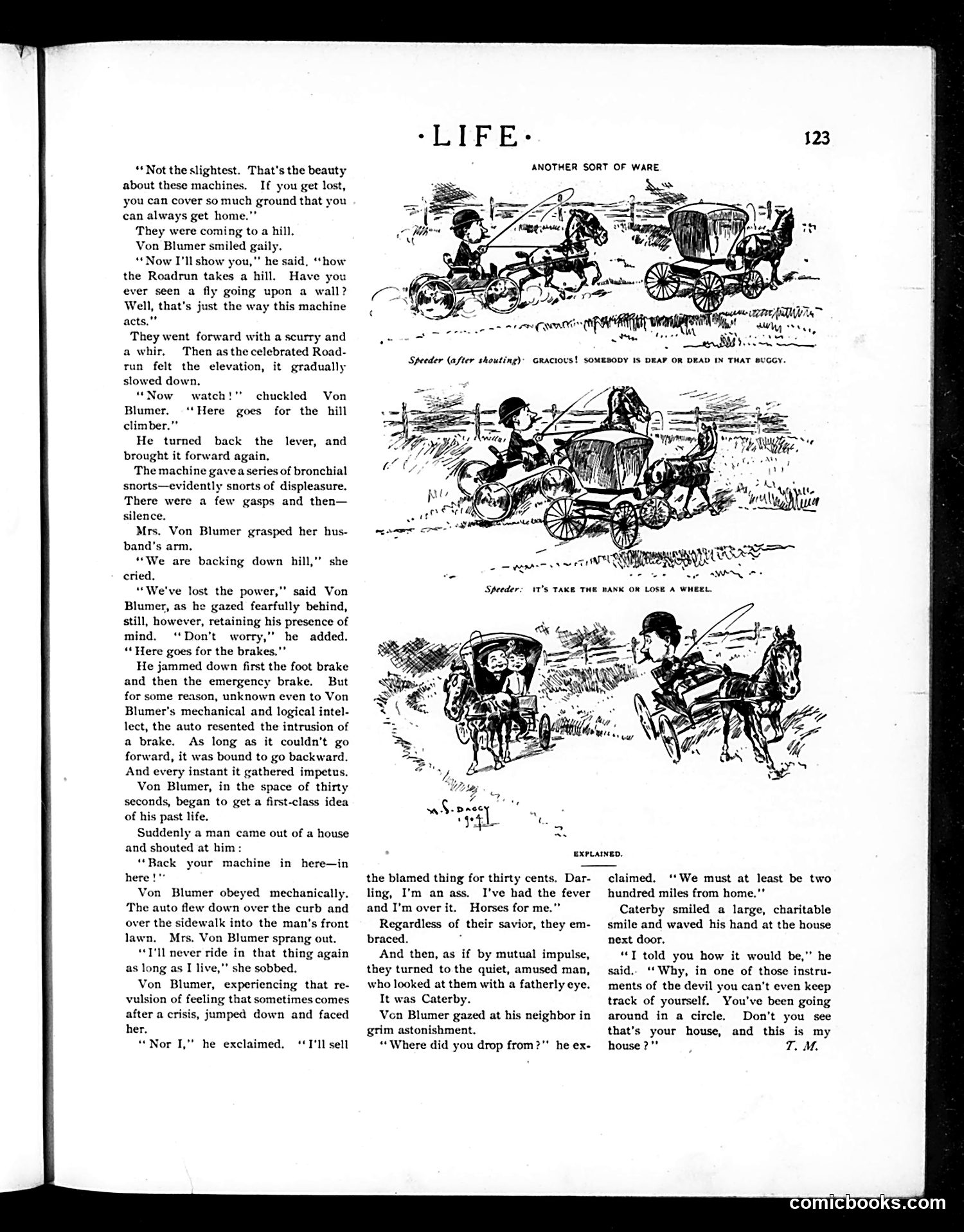
This is a comedic story mocking the newfangled automobile—likely from the early 1900s when cars were still novelties. Von Blumer, a proud early motorist, demonstrates his "Roadrun" automobile to his wife, boasting of its superiority over horses. When the car loses power climbing a hill, it rolls backward uncontrollably, the brakes fail mechanically, and it crashes into a neighbor's lawn. The satire targets automotive enthusiasm and mechanical overconfidence. Von Blumer's repeated assurances ("you can always get home") prove hollow when the machine malfunctions spectacularly. The punchline—they've traveled in circles back to their own neighborhood—underscores that despite the car's promised power and freedom, it's unreliable and disorienting compared to horses. The three cartoons above illustrate mishaps involving early automobiles and horse-drawn vehicles, reinforcing the joke that motorized transport creates chaos.
📄 Transcribed text from this page (OCR, searchable)
Machine-transcribed from the original scan — historical spelling and the odd misread are preserved.
‘Not the slightest. That's the beauty about these machines. If you get lost, you can cover so much ground that you can always get home.”’ ‘They were coming to a hill. Von Blumer smiled gaily. “Now I'll show you," he said, “how the Roadrun takes a hill, Have you ever seen a fly going upon a wall? Well, that’s just the way this machine acts," They went forward with a scurry and a whir, Then asthe celebrated Road- run felt the elevation, it gradually slowed down, “Now watch!"’ chuckled Von Blumer. ‘Here goes for the hill climber.”” He turned back the brought it forward again. The machine gave a series of bronchial snorts—evidently snorts of displeasure. There were a few gasps and then— silence. Mrs. Von Blumer grasped her hus- band’s arm. “We are backing down hill,” she cried. “We've lost the power,” said Von Blumer, as he gazed fearfully behind, still, however, retaining his presence of mind, ‘Don't worry,” he added. “Here goes for the brakes.” He jammed down first the foot brake and then the emergency brake. But for some reason, unknown even to Von Blumer's mechanical and logical intel- lect, the auto resented the intrusion of a brake. As long as it couldn't go forward, it was bound to go backward. And every instant it gathered impetus. Von Blumer, in the space of thirty seconds, began to get a first-class idea of his past life. Suddenly a man came out of a house and shouted at him: “Back your machine in here—in here !"" Von Blumer obeyed mechanically. The auto flew down over the curb and over the sidewalk into the man’s front lawn. Mrs. Von Blumer sprang out. “T'll never ride in that thing again as long as I live," she sobbed. Von Blumer, experiencing that re- vulsion of feeling that sometimes comes after a crisis, jumped down and faced her. “Nor I," he exclaimed. lever, and “Tl sell Speeder (after shouting) aa =. Ara eZ 4 Speeder: GRACIOUS! SOMEBODY IS DRAY OR DEAD IN THAT BUGGY. "Tee" ee AW + IT'S TAKE THE BANK O8 LOSE A WHEEL. EXPLAINED. the blamed thing for thirty cents. Dar- ling, I’m an ass. I’ve had the fever and I’m over it. Horses for me.” Regardless of their savior, they em- braced. . And then, as if by mutual impulse, they turned to the quiet, amused man, who looked at them with a fatherly eye. It was Caterby. Von Blumer gazed at his neighbor in grim astonishment. “Where did you drop from?"’ he ex- claimed, ‘*We must at least be two hundred miles from home." Caterby smiled a large, charitable smile and waved his hand at the house next door. “T told you how it would be,” he said. ‘Why, in one of those instru- ments of the devil you can’t even keep track of yourself. You've been going around in a circle. Don't you see that's your house, and this is my house ?"" T. M. comicbooks.com