
Life, 1904-08-04 · page 8 of 36
Life — August 4, 1904 — page 8: what you’re looking at
What you’re looking at
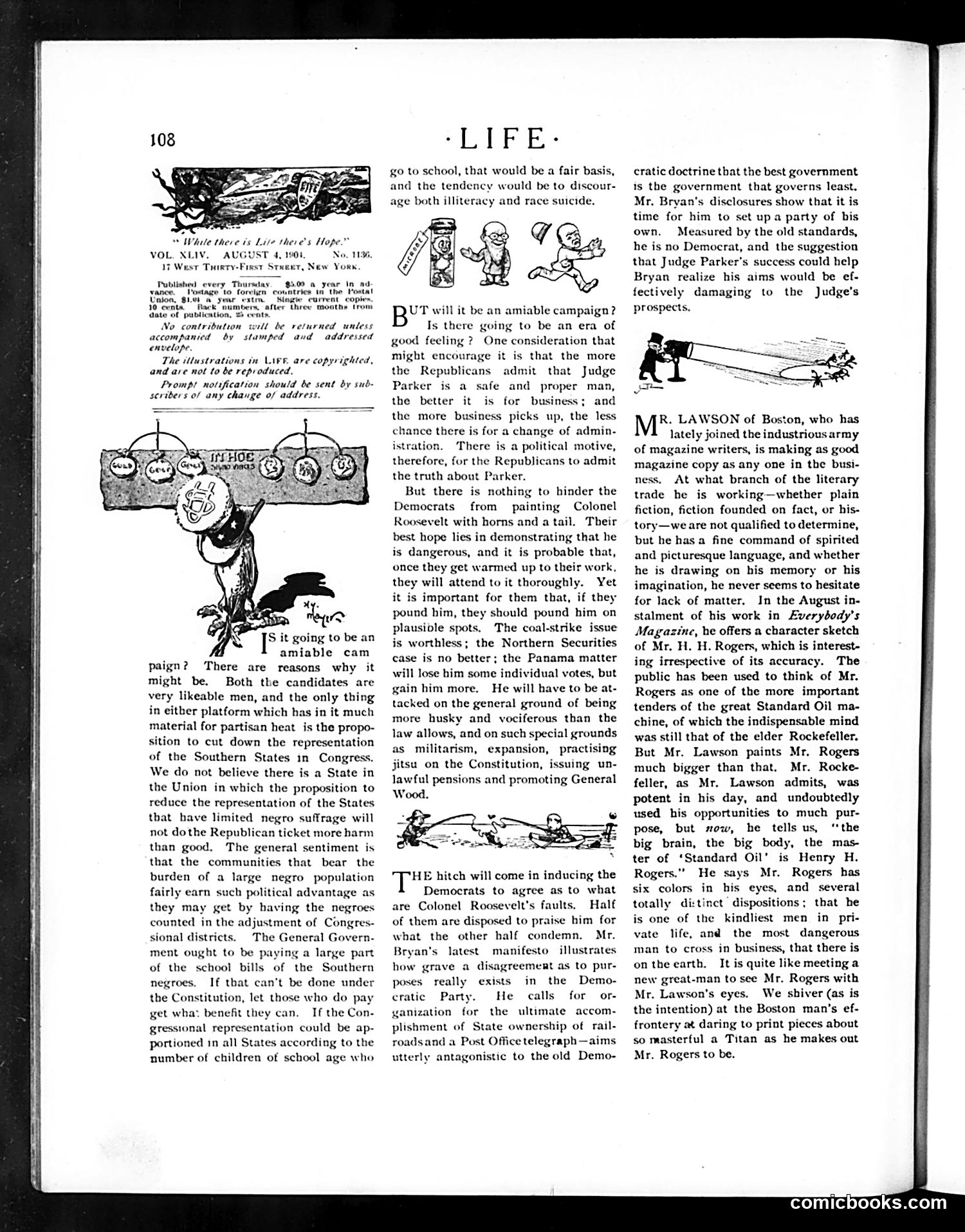
This page discusses the 1904 presidential campaign. The text critiques both candidates, suggesting Republicans admit Judge Parker (the Democratic nominee) is "safe and proper" for business—implying the GOP fears him less than expected. The cartoons mock campaign tactics. One depicts a political "machine" with gears labeled with politicians' names, suggesting mechanical manipulation of the nomination process. Another shows figures being thrown or tumbled, likely representing campaign chaos or candidates being discarded. The text references Colonel Roosevelt, comparing him unfavorably to standard business figures like H.H. Rogers and Rockefeller. The piece argues the Democrats' real disagreement isn't about Roosevelt's faults but organizational philosophy—particularly state ownership of railroads and telegraph systems versus private control.
📄 Transcribed text from this page (OCR, searchable)
Machine-transcribed from the original scan — historical spelling and the odd misread are preserved.
$5.09 a year In ad. ‘ont tes in the Postal Union, 81.01 4 year 10 Rack” eum! UL be returned untess stamped and addressed accompanied by envelope. The illustrations in LAFF. are copyrighted, and are not to be reproduced. Prompt notification should be sent by sub- seribers of any change of address. S it going to be an fa amiable cam paign? There are reasons why it might be. Both the candidates are very likeable men, and the only thing in either platform which has in it much material for partisan heat is the propo- sition to cut down the representation of the Southern States in Congress. We do not believe there is a State in the Union in which the proposition to reduce the representation of the States that have limited negro suffrage will not dothe Republican ticket more harm than good, The general sentiment is that the communities that bear the burden of a large negro population fairly earn such political advantage as they may get by having the negroes counted in the adjustment of Congres- sional districts. The General Govern- ment ought to be paying a large part of the school bills of the Southern negroes. If that can’t be done under the Constitution, let those who do pay get wha: benefit they can. If the Con- gressional representation could be ap- portioned in all States according to the number of children of school age who ‘LIF Es go to school, that would be a fair basis, and the tendency would be to discour- age both illiteracy and race suicide. Hit be an amiable campaign? Is there going to be an era of good feeling ? One consideration that might encor that the more the Republicans admit that Judge Parker is a fe and proper man, the better it is for business; and the more business picks up, the less chance there is for a change of admin- istration. There is a poli al motive, therefore, for the Republicans to admit the truth about Parker. But there is nothing to hinder the Democrats from painting Colonel Roosevelt with horns and a tail. Their best hope lies in demonstrating that he is dangerous, and it is probable that, once they get warmed up to their work, they will attend to it thoroughly. Yet it is important for them that, if they pound him, they should pound him on plausiole spots. The coal-strike issue is worthless; the Northern Securities case is no better; the Panama matter will lose him some individual votes, but gain him more. He will have to be at- tacked on the general ground of being more husky and vociferous than the law allows, and on such special grounds as militarism, expansion, practising jitsu on the Constitution, issuing un- lawful pensions and promoting General Wood. HE hitch will come in inducing the Democrats to agree as to what are Colonel Roosevelt's faults, Half of them are disposed to praise him for what the other half condemn. Mr. Bryan's latest manifesto illustrates how grave a disagreement as to pur- poses really exists in the Demo- cratic Party. He calls for or- ganization for the ultimate accom- plishment of State ownership of rail- roadsand a Post Office telegraph —aims utterly antagonistic to the old Demo- cratic doctrine that the best government is the government that governs least. Mr. Bryan's disclosures show that it is time for him to set up a party of bis own. Measured by the old standards, he is no Democrat, and the suggestion that Judge Parker's success could help Bryan realize his aims would be ef- fectively damaging to the Judge's prospects. R. LAWSON of Boston, who has lately joined the industrious army of magazine writers, is making as good magazine copy as any one in the busi- ness, At what branch of the literary trade he is working—whether plain fiction, fiction founded on fact, or his- tory—we are not qualified to determine, but he has a fine command of spirited and picturesque language, and whether he is drawing on his memory or his imagination, he never seems to hesitate for lack of matter, In the August in- stalment of his work in Everybody's Magazine, he offers a character sketch of Mr. H. H. Rogers, which is interest- ing irrespective of its accuracy. The public has been used to think of Mr. Rogers as one of the more important tenders of the great Standard Oil ma- chine, of which the indispensable mind was still that of the elder Rockefeller, But Mr. Lawson paints Mr. Rogers much bigger than that. Mr. Rocke- feller, as Mr. Lawson admits, was potent in his day, and undoubtedly used his opportunities to much pur- pose, but now, he tells us, ‘the big brain, the big body, the mas- ter of ‘Standard Oil’ is Henry H. Rogers." He says Mr. Rogers has six colors in his eyes, and several totally distinct dispositions; that he is one of the kindliest men in pri- vate life, and the most dangerous man to cross in business, that there is on the earth. It is quite like meeting a new great-man to see Mr. Rogers with Mr. Lawson's eyes. We shiver (as is the intention) at the Boston man’s ef- frontery at daring to print pieces about so masterful a Titan as he makes out Mr. Rogers to be. comicbooks.com