
Life, 1904-08-04 · page 24 of 36
Life — August 4, 1904 — page 24: what you’re looking at
What you’re looking at
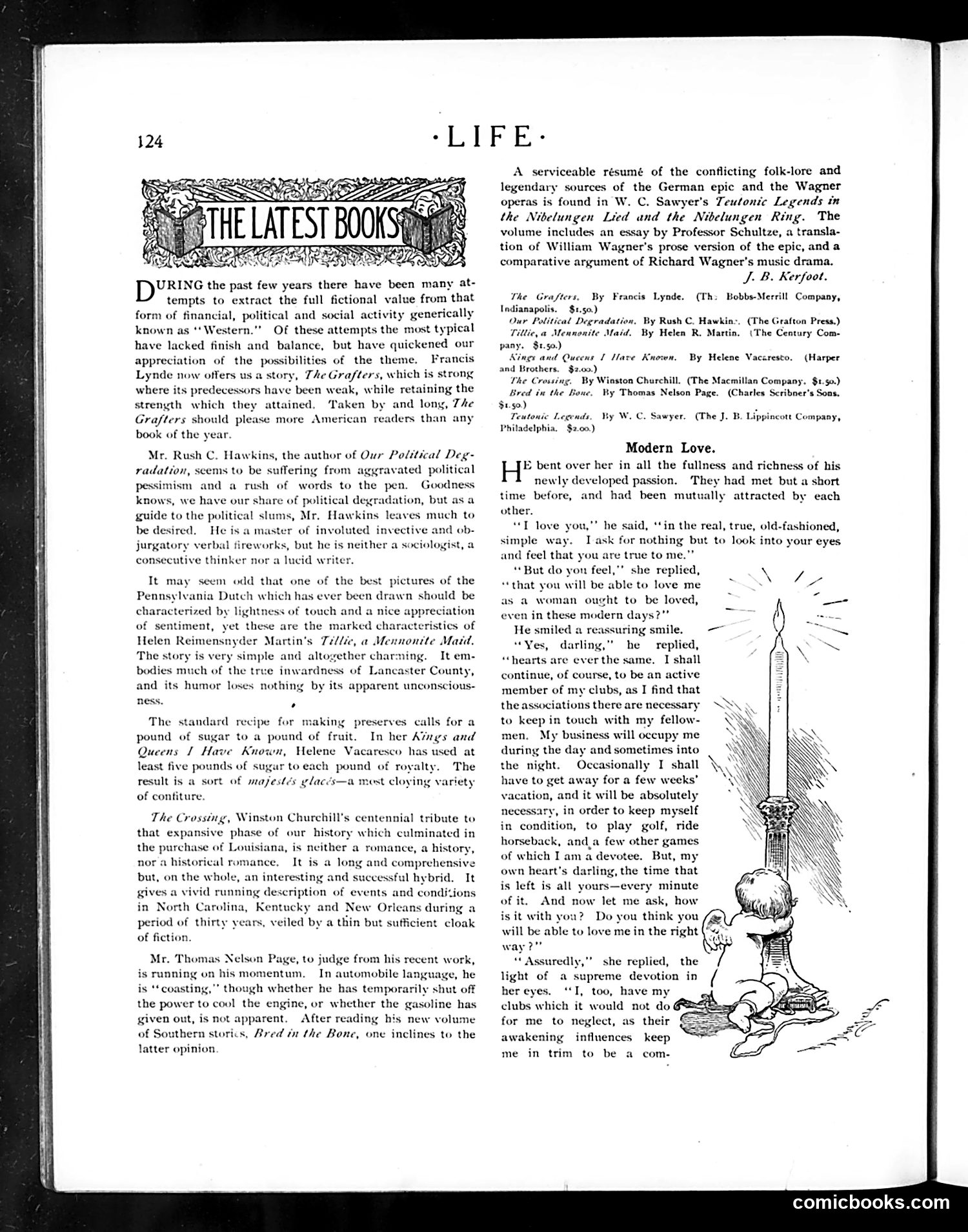
This is a book review section titled "The Latest Books." The page contains literary criticism of several contemporary novels, including *The Grafters* by Francis Lynde and Winston Churchill's *The Crossing*. The small illustration on the right depicts a romantic scene between a man and woman with a candle, accompanying a serialized story titled "Modern Love." The dialogue shown reflects period conventions—the man professes simple, old-fashioned love while the woman responds with practical concerns about maintaining her social clubs and independence, insisting he must respect her autonomy even in romantic commitment. This vignette satirizes modern (early 1900s) relationships, where traditional courtship ideals clash with women's emerging desires for personal freedom and social engagement. The contrast between his romantic idealism and her matter-of-fact insistence on maintaining separate spheres of activity gently mocks both rigid sentimentality and the new "modern" woman's priorities.
📄 Transcribed text from this page (OCR, searchable)
Machine-transcribed from the original scan — historical spelling and the odd misread are preserved.
-LIFE- D RING the past few years there have been many at- tempts to extract the full fictional value from that form of financial, political and social activity generically known as ‘* Western.’ Of these attempts the most typical have lacked finish and balance, but have quickened our ation of the possibilities of the theme. Francis Lynde now offers us a story, The Grafters, which is strong where its predecessors have been weak, while retaining the strength which th ttained, Taken by and lony, The Grafters should please more American readers than any book of the year. Mr. Rush C. Hawkins, the author of Our Political Deg- radation, scems to be suffering from aggravated political pessimism and a rush of words to the pen. Goodness knows, we have our share of political degradation, but as a guide to the political slums, Mr. Hawkins leaves much to be desired. He is a master of involuted invective and ob- jurgatory verbal fireworks, but he is neither a sociologist, consecutive thinker nor a lucid writer. It may seem odd that one of the best pictures of the Pennsylvania Dutch which has ever been drawn should be characterized by lightness of touch and a nice appreciation of sentiment, yet these are the marked characteristics of Helen Reimensnyder Martin's Ti/lée, a Mennonite Maid. The story is very simple and altogether charming. It em- bodies much of the troe inwardness of Lancaster County, and its humor loses nothing by its apparent unconscious- ness . The standard recipe for making preserves calls for a pound of sugar to a pound of fruit. In her Afiys and Queens | Have Known, Helene Vacaresco has used at least five pounds of sugur to each pound of royalty. The result is a sort of mafestés ylacés—a most cloyi of contiture. The Crossing, Winston Churchill's centennial tribute to that expansive phase of our history which culminated in the purchase of Louisiana, is neither a romance, a history, nor a historical romance, It is a long and comprehensive but, on the whole, an interesting and successful hybrid. It gives a vivid running description of events and conditions in North Carolina, Kentucky and ans during a period of thirty years, veiled by a thin but sufficient cloak of fiction. Mr. Thomas Nelson Page, to judge from his recent work, is running on his momentum. In automobile language, he is coasting,” though whether he has temporarily shut off the power to cool the engine, or whether the gasoline has given out, is not apparent. After reading his new volume of Southern storics, Bred in the Bone, one inclines to the latter opinion. A serviceable résumé of the conflicting folk-lore and legendar yurces of the German epic and the Wagner operas is found in W. C. Sawyer’s Teutonic Legends in the Nibelungen Lied and the Nibelungen Ring. The volume includes an essay by Professor Schultze, a transla- tion of William Wagner's prose version of the epic, and a comparative argument of Richard Wagner’s music drama, SJ. B. Kerfoot. By Francis Lynde. (Th: Bobbs-Merrill Company, $1.50.) < Degradation, By Rush C. Hawkins, (The Grafton Press.) Tillie, a Mennonite Maid. By Helen R. Martin, (The Century Com- pany. $1.50.) Nings and Queens I Have Known, $2.00.) The Crossing. By Winston Churchill. (The Macmillan Company. $1.50.) Bred in the Bone, Wy Thomas Nelson Page. (Charles Scribner's Sons, Sts) Teutonic Legends, Philadelphia. By Helene Vaccresto, (Harper and Brothers. Ny W. C. Sawyer. (The J. B. Lippincott Company, $2.00.) Modern Love. H® bent over her in all the fullness and richness of his newly developed passion. They had met but a short time before, and had been mutually attracted by each other. id, ‘‘in the real, true, old-fashioned, I ask for nothing but to look into your eyes and feel that you are true to me.” “But do you feel,’ she replied, ‘that you will be able to love me as a woman ought to be loved, even in these modern da He smiled “Yes, darling,” he — replied, “hearts are everthe same. I shall continue, of course, to be an active member of my clubs, as I find that the associations there are necessary to keep in touch with my fellow- men. My business will occupy me during the day and sometimes into the night. Occasionally I shall have to get away for a few weeks’ vacation, and it will be absolutely y, in order to keep myself in condition, to play golf, ride horseback, and_a few other games of which Iam a devotee. But, my own heart's darling, the time that is left is all yours—every minute of it. And now let me ask, how is it with you? Do you think you will be able to love me in the right way?” Assuredly,” she replied, the light of a supreme devotion in ( her eyes. ‘I, too, have my clubs which it would not do @ for me to neglect, as their influences keep me in trim to be a com- “T love you,” he simple way. reassuring awakening comicbooks.com