
Life, 1904-08-04 · page 13 of 36
Life — August 4, 1904 — page 13: what you’re looking at
What you’re looking at
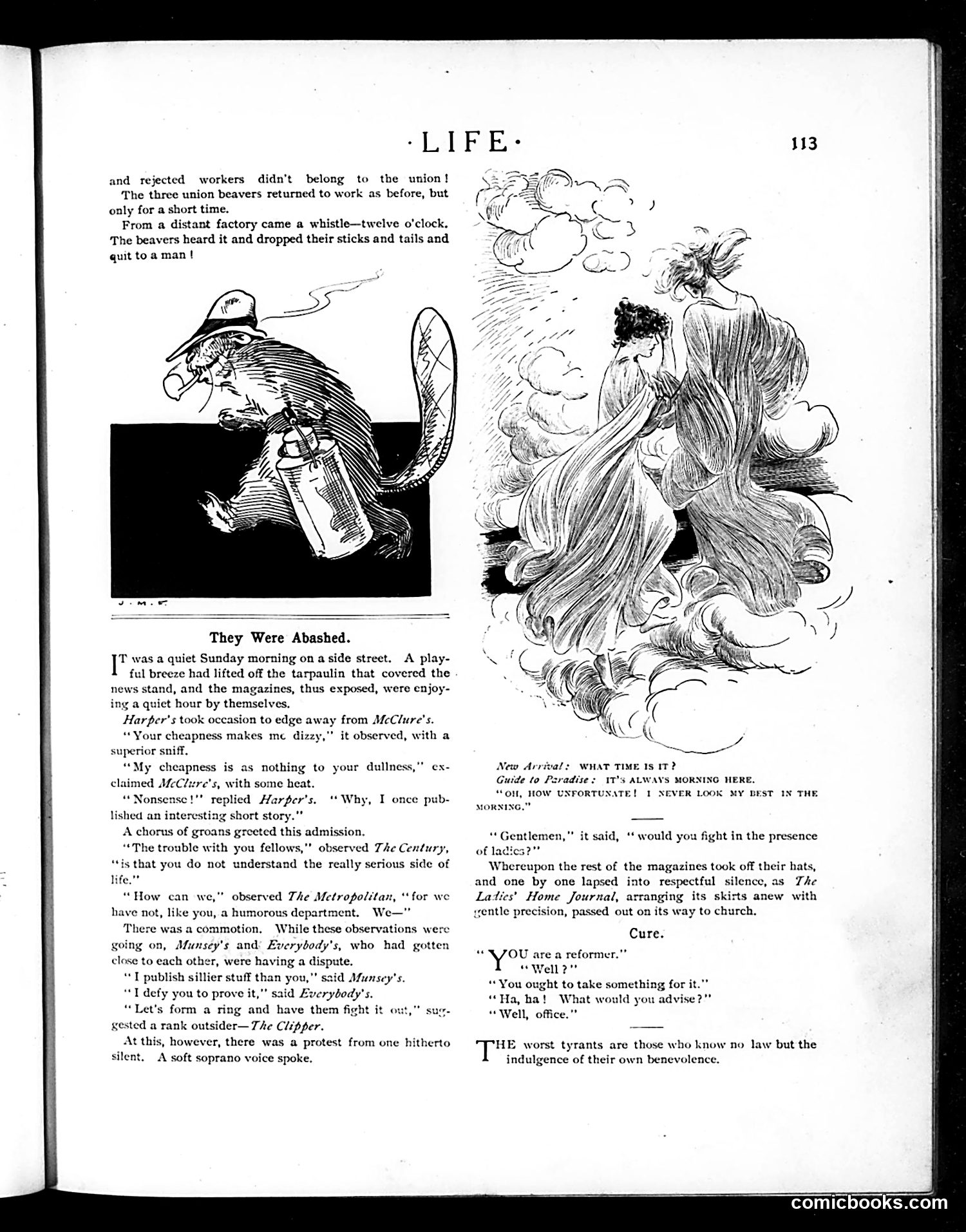
This page contains two satirical pieces about American magazines of the early 20th century. **Top cartoon:** Shows a beaver (representing union labor) abandoning work when a factory whistle sounds at noon, illustrating the tension between union solidarity and workers' desire to leave at scheduled times. **Main story:** A personified debate among competing magazines—*Harper's*, *McClure's*, *The Century*, *Metropolitan*, *Munsey's*, and *Everybody's*—each boasting about their editorial quality while insulting rivals. *Harper's* claims superiority through serious content; *McClure's* counters about cheapness versus dullness; *The Metropolitan* boasts a humor department. The satire mocks magazine competition and pretension. The joke's climax occurs when *The Ladies' Home Journal*—entering as a "new arrival"—immediately commands deference from all male-oriented publications, who respectfully silence themselves. This jokes about the magazine's popularity and the era's gender conventions, while gently poking fun at male editors' gallantry toward "ladies' " publications. The closing aphorism about tyranny appears unrelated to the preceding content.
📄 Transcribed text from this page (OCR, searchable)
Machine-transcribed from the original scan — historical spelling and the odd misread are preserved.
and rejected workers didn't belong to the union! ‘The three union beavers returned to work as before, but only for a short time. From a distant factory came a whistle—twelve o'clock. The beavers heard it and dropped their sticks and tails and quit toa man! They Were Abashed. T was a quiet Sunday morning on a side street. A play- ful breeze had lifted off the tarpaulin that covered the news stand, and the magazines, thus exposed, were enjoy- ing a quiet hour by themselves. Harper's took occasion to edge away from McClure's. it observed, with a “Your cheapness makes me dizzy,” superior sniff. “My cheapness is as nothing to your dullness,” cx- claimed MeClirc's, with some heat. ““Nonsense!"" replied Harper's. “Why, I once pub- lished an interesting short story.”" A chorus of groans greeted this admission. “‘The trouble with you fellows," observed The Century, is that you do not understand the really serious side of ife.”” “How can we," observed The Metropolitan, ‘for we have not, like you, a humorous department. We—" There was a commotion. While these observations were going on, Munsey's and Everybody's, who had gotten close to each other, were having a dispute. “| publish sillier stuff than you,” said Munsey’s. "defy you to prove it,” said Everybody’ “Let's form a ring and have them fight it « * sug. gested a rank outsider— The Clipper. At this, however, there was a protest from one hitherto silent. A soft soprano voice spoke. New Arrival: WAT TIME Is IT? Guide to Paradise; T'S ALWAYS MORNING HERE. “OM, HOW UNFORTUNATE! 1 NEVER LOOK MY DEST IN THE MORNING,” “Gentlemen,” of ladies?” Whereupon the rest of the magazines took off their hats, and one by one lapsed into respectful silence, as The Latics’ Home Journal, arranging its skirts anew with it said, ‘* would you fight in the presence yentle precision, passed out on its way to church, Cure. “\YOU are a reformer.’ “Well ?"" “You ought to take something for “Ha, ha! What would you advise?” “Well, office. HE worst tyrants are those who know no law but the indulgence of their own benevolence. comicbooks.com