
Life, 1904-08-04 · page 14 of 36
Life — August 4, 1904 — page 14: what you’re looking at
What you’re looking at
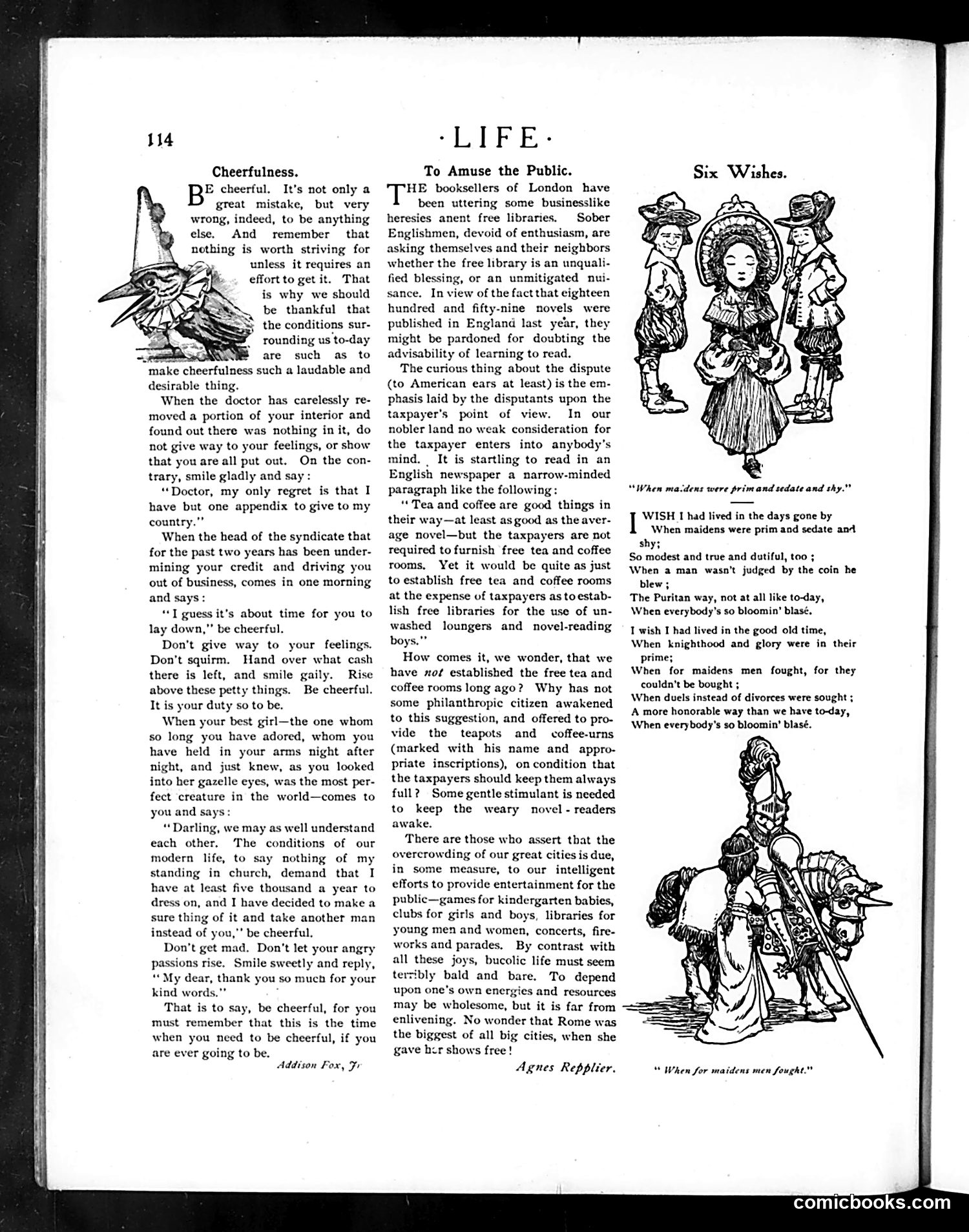
This page contains three satirical pieces attacking different targets: **"Cheerfulness"** (left): Mocks the era's toxic positivity culture by depicting absurd scenarios where one should remain cheerful despite catastrophe—a failed surgery, business ruin, and romantic betrayal. The satire is straightforward: the advice to "be cheerful" in genuinely awful circumstances is ridiculous. **"To Amuse the Public"** (center): Ridicules English debates over free public libraries. English taxpayers questioned whether subsidizing libraries for "unwashed loungers and novel-reading boys" was worthwhile, especially given the 1,859 novels published annually. The American author sarcastically wonders why free tea and coffee rooms haven't been funded—implying Americans wouldn't quibble over such public goods. **"Six Wishes"** (right): Three illustrated vignettes showing idealized past scenarios ("When maidens were prim and sedate," "When a man wasn't judged by the coin he has," "When knighthood and glory were in their prime"). This nostalgic piece contrasts with modern life's materialistic concerns. The page satirizes contemporary social hypocrisy, class anxieties, and nostalgia for simpler times.
📄 Transcribed text from this page (OCR, searchable)
Machine-transcribed from the original scan — historical spelling and the odd misread are preserved.
Cheerfulness. E cheerful, It’s not only a great mistake, but very wrong, indeed, to be anything else. And remember that nothing is worth striving for unless it requires an effort to get it. That is why we should Qe. be thankful that SS the conditions sur- sees rounding us to-day are such as to desirable thing. When the doctor has carelessly re- moved a portion of your interior and found out there was nothing in it, do not give way to your feelings, or show that you are all put out. On the con- trary, smile gladly and say : “Doctor, my only regret is that I have but one appendix to give tomy country.” When the head of the syndicate that for the past two years has been under- mining your credit and driving you out of business, comes in one morning and says: “T guess it’s about time for you to lay down,” be cheerful. Don’t give way to your feeling: Don't squirm. Hand over what cash there is left, and smile gaily. Ri above these petty things. Be cheerful. It is your duty so to be. When your best girl—the one whom so long you have adored, whom you have held in your arms night after night, and just knew, as you looked into her gazelle eyes, was the most per- fect creature in the world—comes to you and says: “Darling, we may as well understand each other. The conditions of our modern life, to say nothing of my standing in church, demand that I have at least five thousand a year to dress on, and I have decided to make a sure thing of it and take another man instead of you,"’ be cheerful, Don’t get mad. Don't let your angry passions rise. Smile sweetly and reply, “My dear, thank you so much for your kind words."" That is to say, be cheerful, for you must remember that this is the time when you need to be cheerful, if you are ever going to be. Addison Fox, F1 ‘LIFE To Amuse the Public. HE booksellers of London have been uttering some businesslike heresies anent free libraries. Sober Englishmen, devoid of enthusiasm, are asking themselves and their neighbors whether the free library is an unquali- fied blessing, or an unmitigated nui- sance. In view of the fact that cighteen hundred and fifty-nine novels were published in England last year, they might be pardoned for doubting the advisability of learning to read. The curious thing about the dispute (to American ears at least) is the em- phasis laid by the disputants upon the taxpayer's point of view. In our nobler land no weak consideration for the taxpayer enters into anybody’s mind. | It is startling to read in an English newspaper a narrow-minded paragraph like the following: ‘Tea and coffee are good things in their way—at least as good as the aver- age novel—but the taxpayers are not required to furnish free tea and coffee rooms, Yet it would be quite as just to establish free tea and coffee rooms at the expense of taxpayers as toestab- lish free libraries for the use of un- washed loungers and novel-reading boys.” How comes it, we wonder, that we have xo¢ established the free tea and coffee rooms long ago? Why has not some philanthropic citizen awakened to this suggestion, and offered to pro- vide the teapots and coffee-urns (marked with his name and appro- priate inscriptions), on condition that the taxpayers should keep them always full? Some gentle stimulant is needed to keep the weary novel - readers awake. There are those who assert that the overcrowding of our great cities is due, in some measure, to our intelligent efforts to provide entertainment for the public—games for kindergarten babies, clubs for girls and boys, libraries for young men and women, concerts, fire- works and parades, By contrast with all these joys, bucolic life must seem terribly bald and bare. To depend upon one's own energies and resources may be wholesome, but it is far from enlivening. No wonder that Rome was the biggest of all big cities, when she gave hcr shows free! Agnes Repplier. Six Wishes. “When maidens were prim and sedate and shy.” WISH I had lived in the days gone by When maidens were prim and sedate and shy; So modest and true and dutiful, too ; When a man wasn't judged by the coin he blew ; The Puritan way, not at all like to-day, When everybody's so bloomin’ blasé. I wish I had lived in the good old time, When knighthood and glory were in their prime; When for maidens men fought, for they couldn't be bought ; When duels instead of divorces were sought ; A more honorable way than we have to-day, When everybody's so bloomin’ blasé. “ When for maidens men fought.” comicbooks.com