
A complete issue · 44 pages · 1904
Life — July 14, 1904
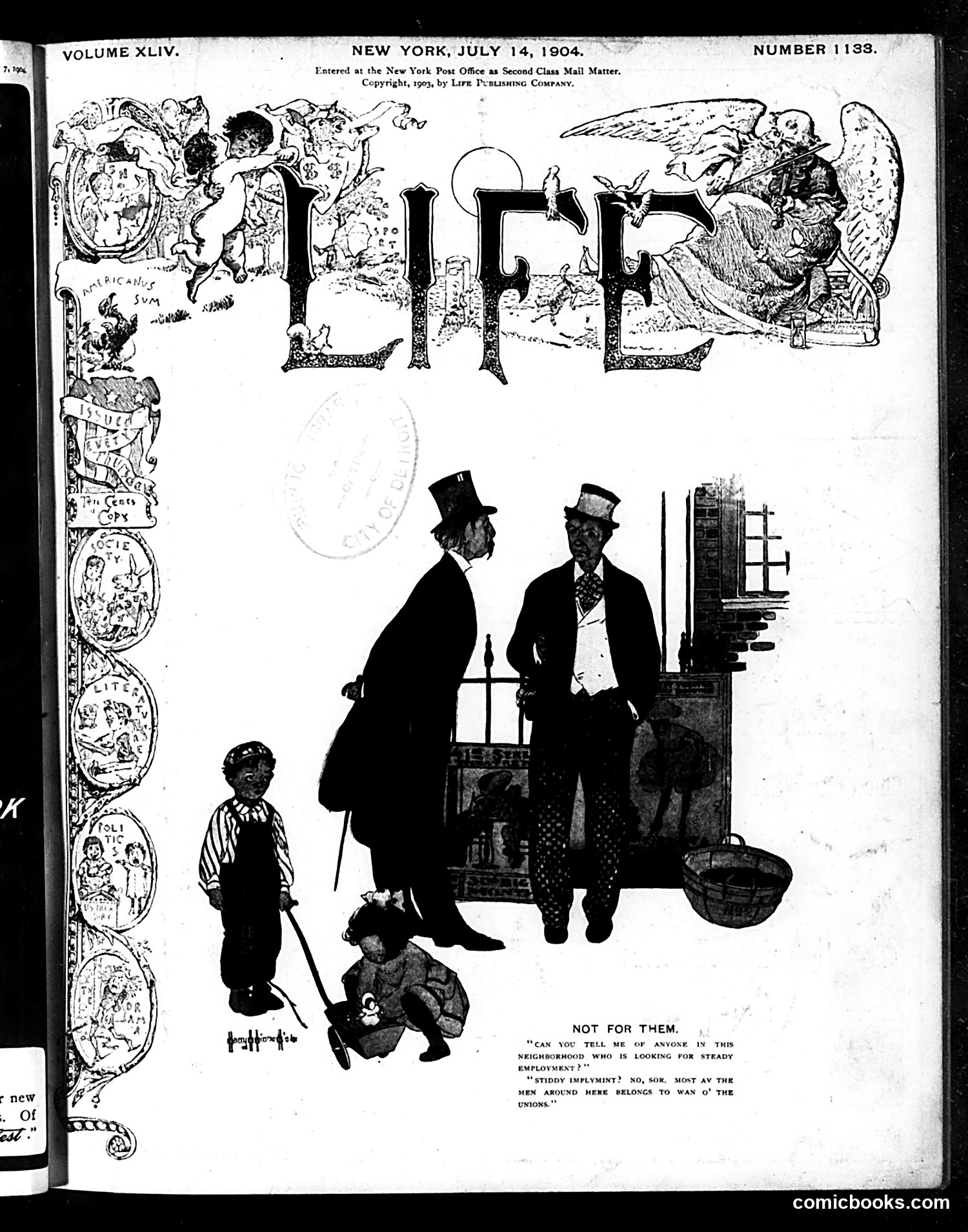
This cartoon satirizes union exclusionism. Two well-dressed men (likely union officials or employers) stand outside a building, discussing employment. Below them, two children sit in poverty—one appearing to search through refuse. The caption reads: "Can you tell me of anyone in this neighborhood who is looking for steady employment?" The response: "Steady employment? No, sir. Most at the men around here belongs to wan o' the unions." The satire targets unions for protecting jobs for their members while excluding outsiders—particularly vulnerable populations like children—from employment opportunities. The contrast between the well-fed officials and desperate children emphasizes the human cost of such exclusionary practices. This reflects Progressive Era debates about labor organization's social impact.
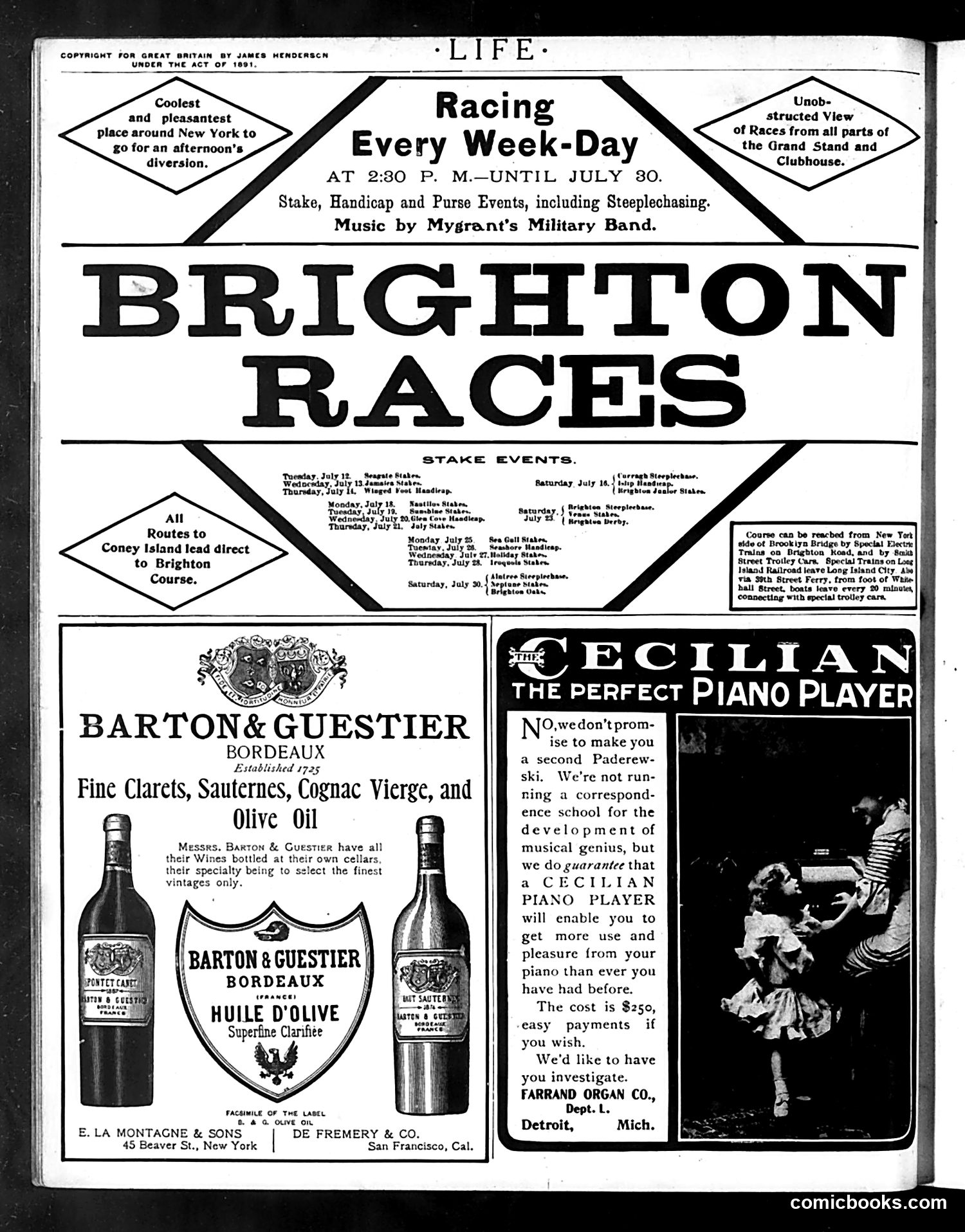
This page is primarily **commercial advertising**, not political satire. The main content promotes Brighton Races, a horse-racing venue near London, with racing events scheduled "every week-day at 2:30 P.M.—until July 30." The page emphasizes practical details: convenient transportation routes from New York to the course, viewing amenities ("Unobstructed View of Races"), and entertainment (Migrant's Military Band). Below are advertisements for luxury goods: **Barton & Guestier** wine from Bordeaux, and a **Cecilian Piano Player** (an early automatic piano device). The diamond-shaped callout boxes highlight tourist attractions and travel logistics—this appears designed to encourage affluent American readers to visit Brighton. There is **no political cartoon or satire present** on this page.
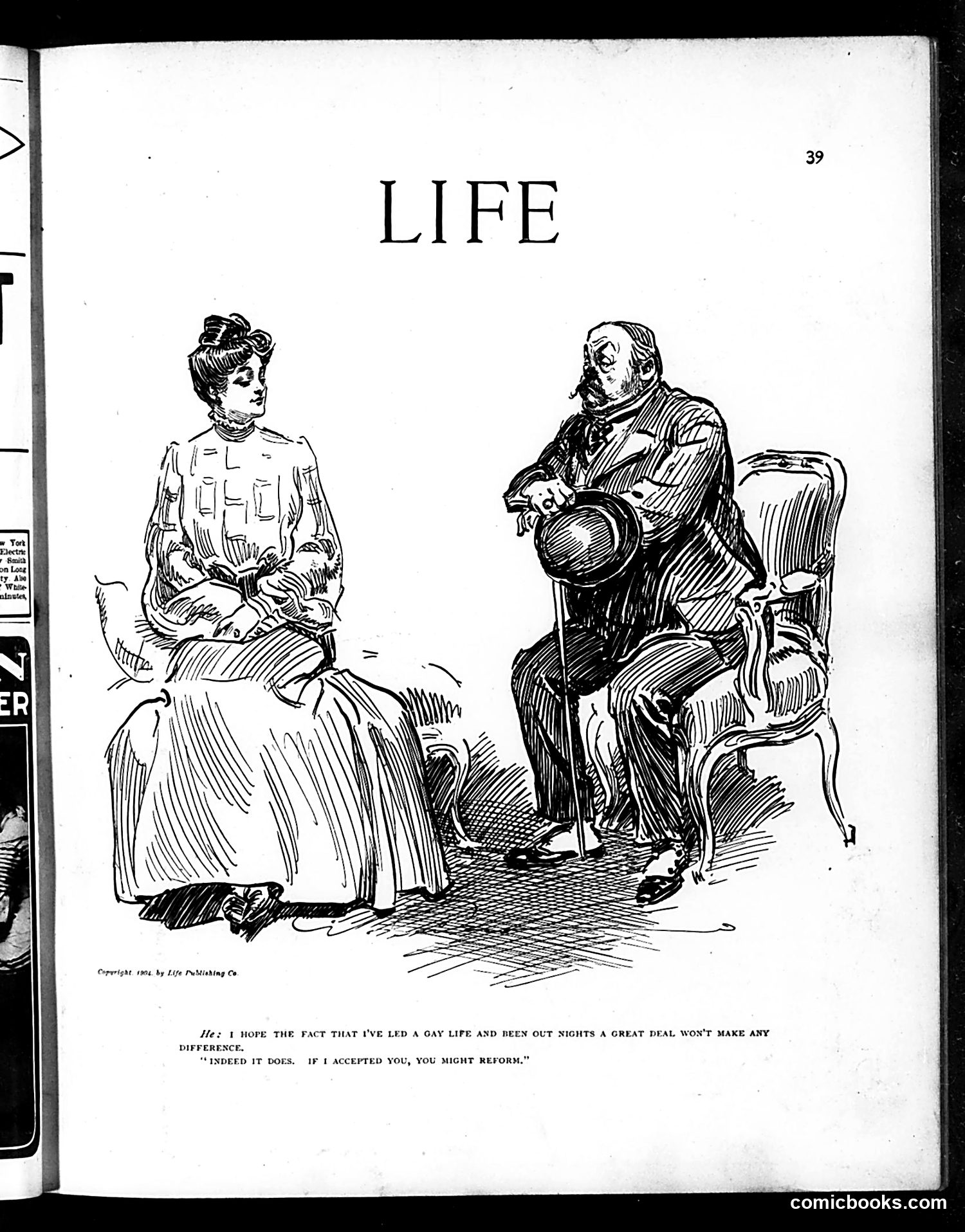
This cartoon depicts a social commentary on courtship and marriage prospects. A woman sits across from an older man in what appears to be a parlor setting. The dialogue reveals the man's concern that his past—"a gay life and been out nights a great deal"—might disqualify him as a suitable husband. The woman reassures him that this wouldn't matter, adding "Indeed it does. If I accepted you, you might reform." The satire targets Victorian-era marriage conventions, specifically the double standard regarding men's social behavior. While men were expected to have experienced "gay" social lives before marriage, women were pressured to reform them through matrimony. The cartoon mocks both the man's anxiety and the woman's resigned acceptance of rehabilitating her husband through marriage.
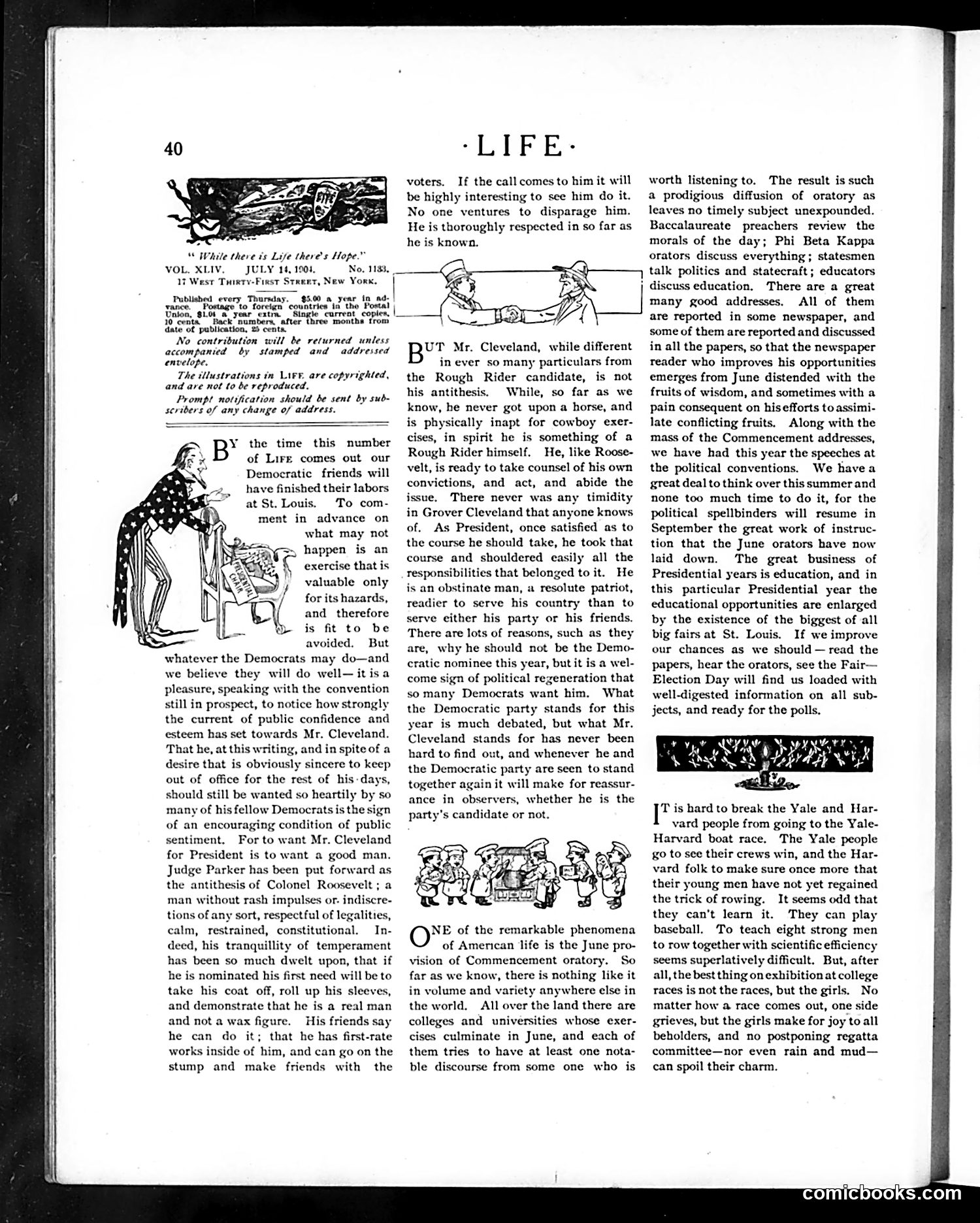
This page discusses Grover Cleveland as a Democratic presidential candidate, contrasting him favorably with the "Rough Rider" (Theodore Roosevelt). The text argues Cleveland is a genuine public servant—"an obstinate man, a resolute patriot"—who doesn't need to perform stunts to prove his character, unlike Roosevelt, who is criticized for theatrical self-promotion. The illustration shows a figure in work clothes (representing Cleveland's laborer image), contrasting with the implication that others must dramatize themselves through dramatic acts or displays. The second cartoon mocks Yale and Harvard's competitive boat race and rowing traditions, suggesting the spectacle is more about social performance and "girls" cheering than genuine athletic merit. The satire critiques elite college culture as superficial pageantry rather than serious competition.
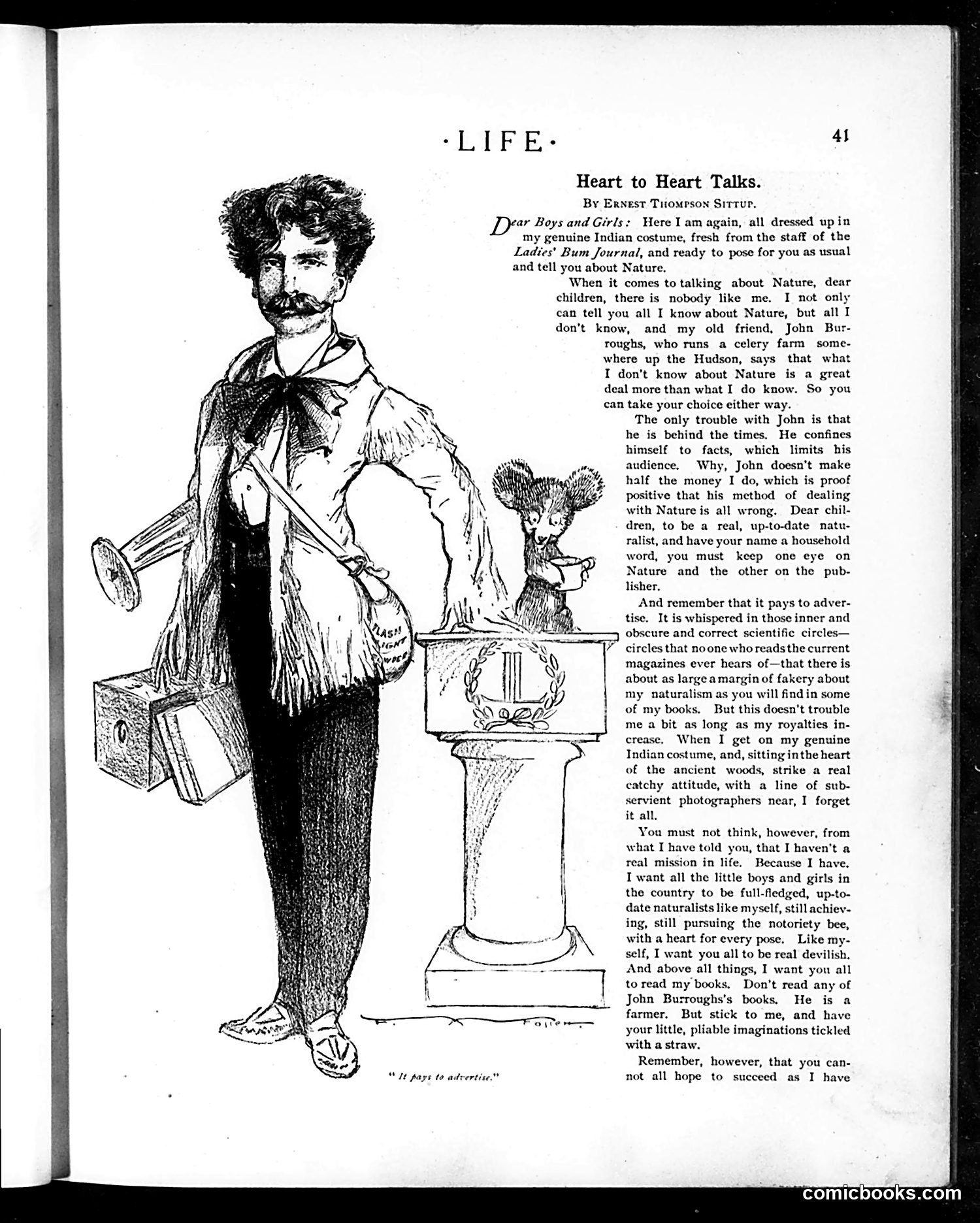
This page features "Heart to Heart Talks" by Ernest Thompson Seton, a naturalist and writer. The illustration shows a man in Native American costume holding educational materials, with a small animal (appears to be a possum or similar creature) beside a pedestal. Seton humorously addresses his credibility as a nature educator, contrasting himself with "John the Roughs," who runs a celery farm and restricts himself to facts. Seton admits he doesn't know everything about nature but positions his imaginative approach as superior for inspiring children. He references "his royalties" from advertising within his books and explicitly instructs readers to buy his works while avoiding competitors like John Burroughs. This is **self-promotional satire**—Seton mocks his own commercialism while selling his brand of nature education to young readers.
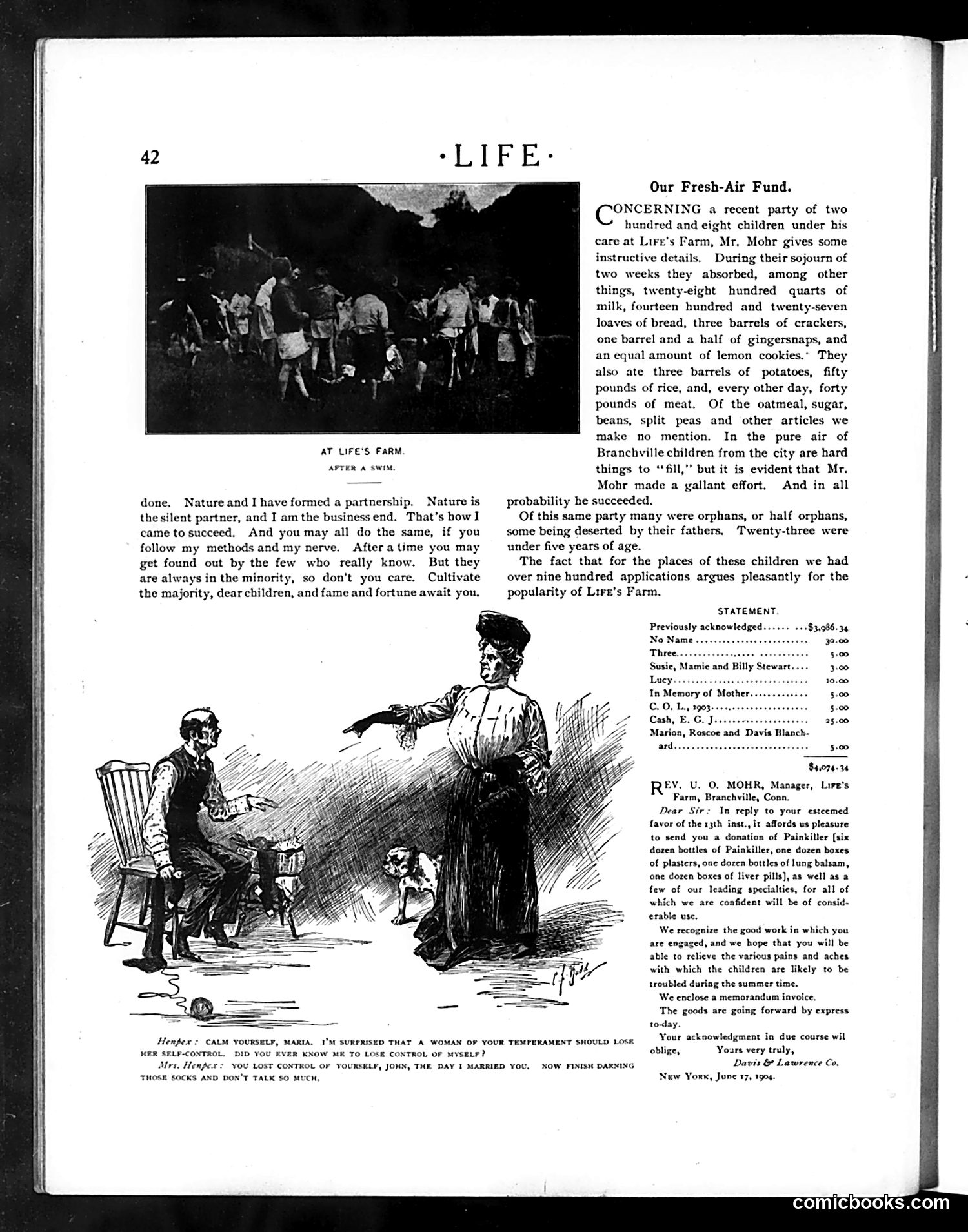
This page contains two distinct items: **Upper Section - "Our Fresh-Air Fund"**: A article and photograph documenting children from the city staying at Life's Farm in Branchville, Connecticut. The text details the children's consumption of food during their stay (milk, bread, crackers, potatoes, rice, meat) and notes that many were orphans or children from disadvantaged backgrounds. It's a earnest account of a charitable program providing rural respite for urban children. **Lower Section - Cartoon**: A domestic scene depicting a woman (Maria) being scolded by a man (Hopkins) about self-control and darning socks. The satire appears to mock Victorian gender expectations and marital dynamics—the man lecturing the woman on proper wifely duties while she maintains composure. The humor lies in the absurdity of the moralistic lecture. Both items reflect Progressive Era concerns with child welfare and social reform.
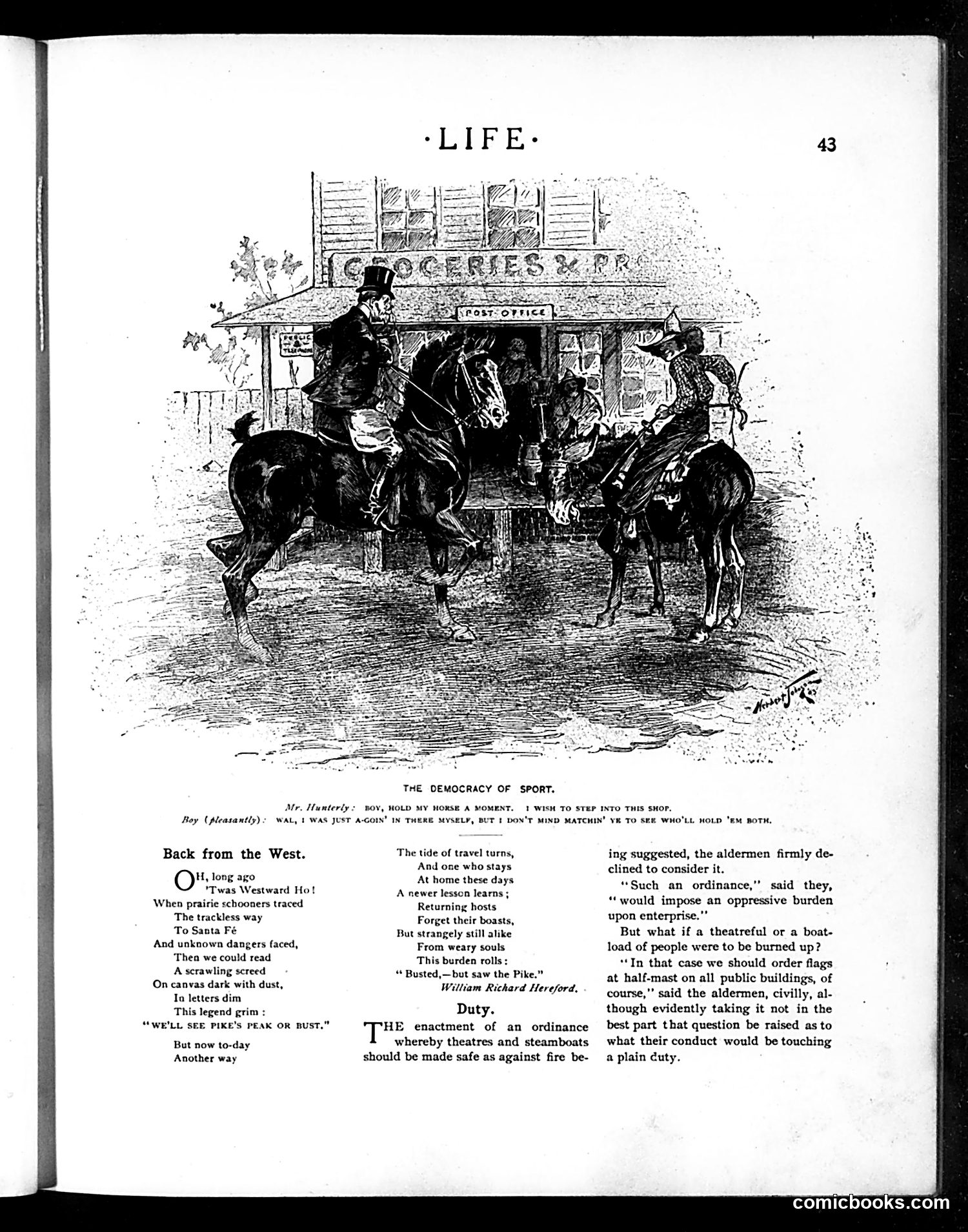
The main cartoon depicts "The Democracy of Sport"—a satirical scene outside a groceries and post office where well-dressed gentlemen on horseback are blocking entry. The caption reveals the joke: a boy asks to enter the shop, but a man on horseback refuses, saying he won't move his horse "a moment" and threatens violence ("I don't mind matchin' ye to see who'll hold 'em both"). The satire critiques aristocratic entitlement and hypocrisy: these "gentlemen" claim to embody democratic sporting values, yet behave tyrannically toward ordinary people, physically preventing access to public spaces. The humor lies in exposing how the privileged class's "democracy" is actually authoritarian—they dominate shared spaces without regard for common citizens' rights.
This page contains three distinct pieces: 1. **"A Popular Song"** — A humorous poem about nightmares and comedic misadventures, unrelated to politics. 2. **"All the Same"** — A satirical dialogue featuring "St. Peter" and a chief secretary discussing immigrants arriving at the gates. The joke mocks bureaucratic classification systems: St. Peter wants to organize newcomers by nationality, but the secretary points out they're "all kind of mixed up" and speak the same languages—suggesting that national distinctions are meaningless. This likely satirizes early 1900s immigration debates and the futility of strict classification systems. 3. **"In New York"** and **"Is This Malicious?"** — A brief item questioning why a newspaper would publish a disparaging anecdote about a wealthy widow (Mrs. R. Vanderbilt III), suggesting the publication was unnecessarily cruel to a prominent figure. The page reflects Life's satirical approach to contemporary social and political issues of its era.
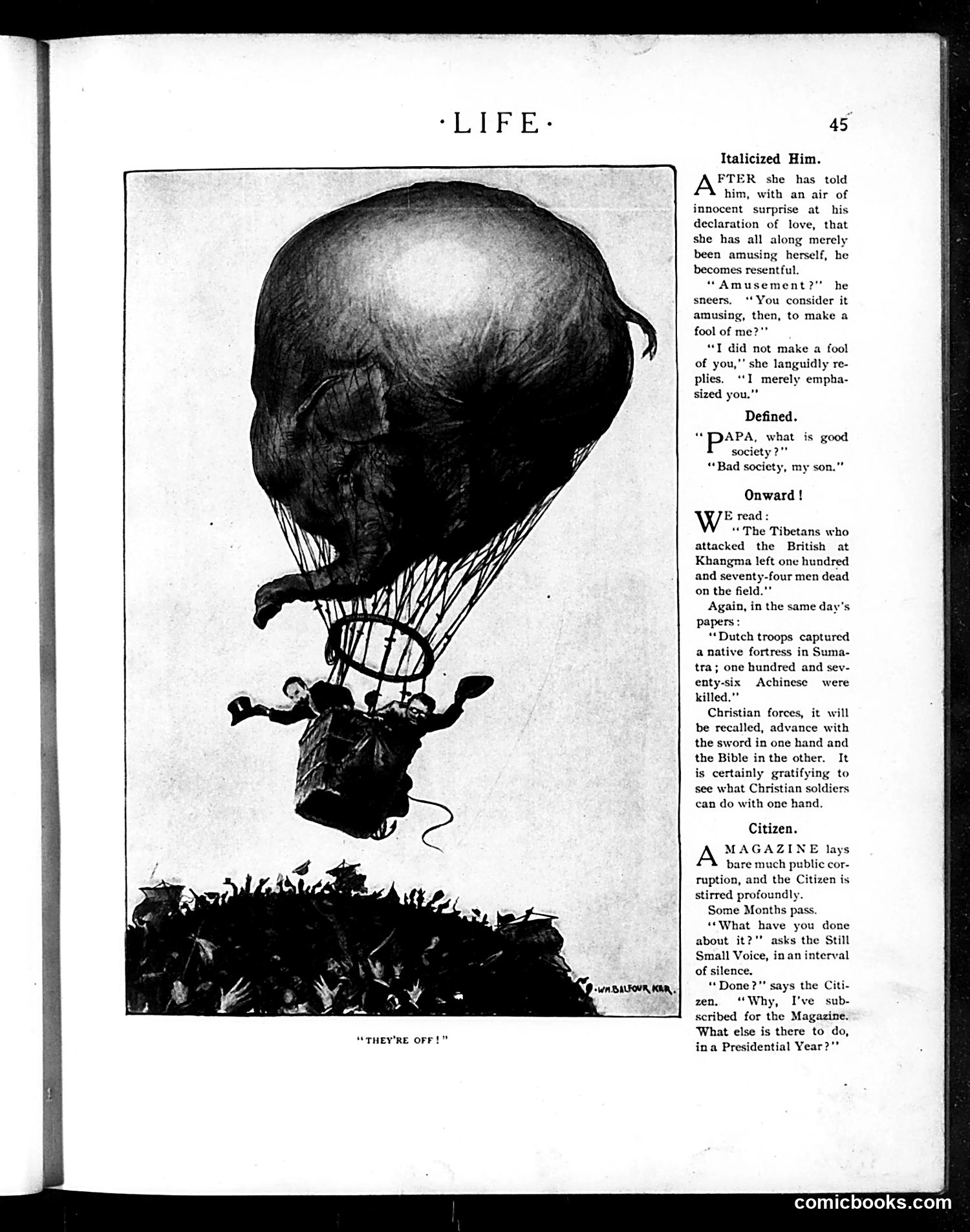
This page features a satirical illustration titled "They're Off!" showing a hot air balloon ascending above a crowd. The balloon appears to represent an escape or departure, likely satirizing a political or social figure attempting to flee a situation. The surrounding text contains three short dialogue sections: "Italicized Him" (about romantic deception), "Defined" (a father-son exchange on "good society"), and "Onward!" (discussing war casualties and Christian military conduct). A final section titled "Citizen" depicts a magazine editor being questioned about editorial decisions during a "Presidential Year." The exact political figure or event referenced in the balloon cartoon remains unclear without additional context, though the overall tone suggests critique of someone abandoning responsibility or evading consequences.
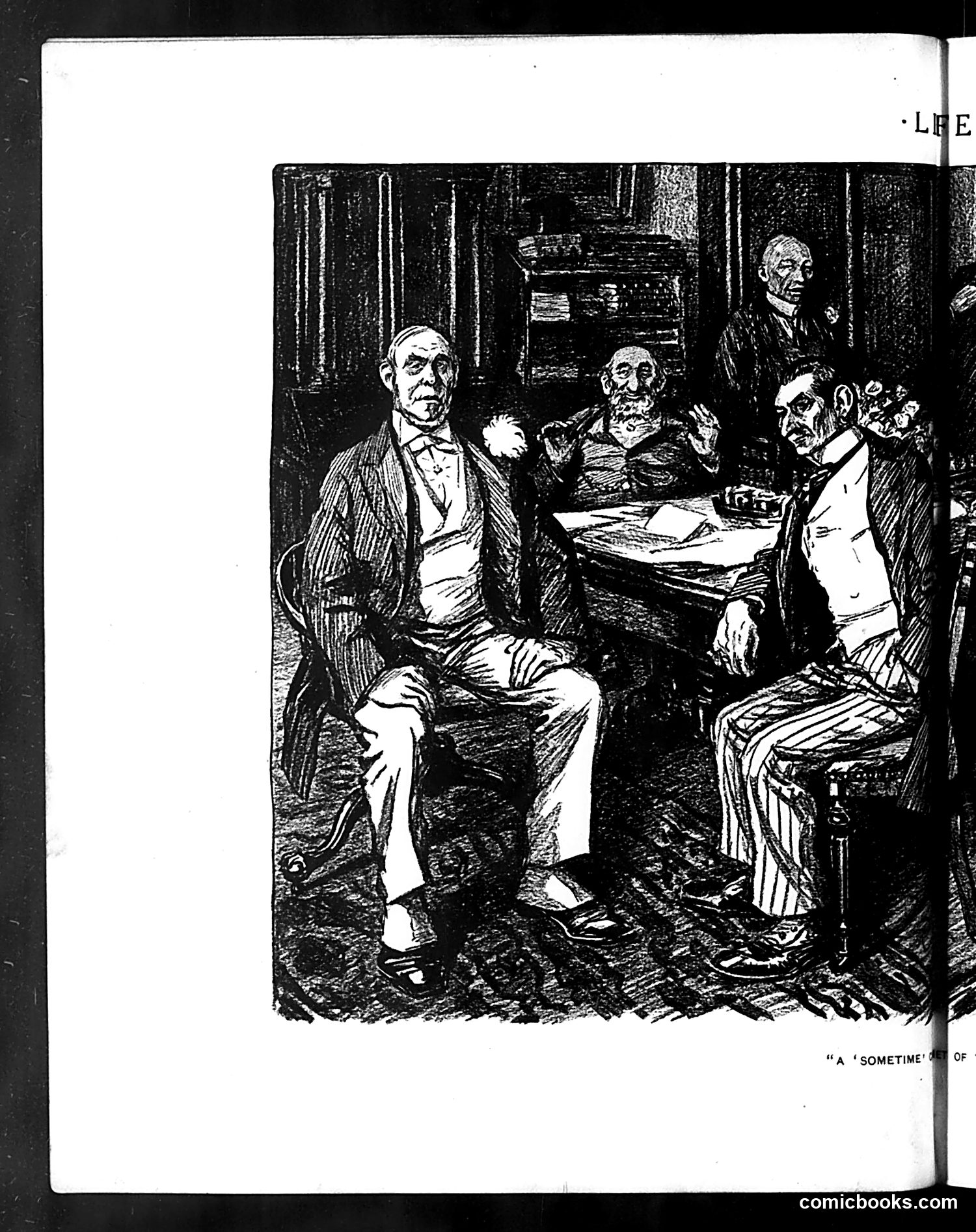
This is a black and white satirical illustration from *Life* magazine showing five men in what appears to be an official or legal setting. The men are dressed in formal 19th-century attire, seated around what looks like a desk or table with papers. The partial caption visible reads "A 'SOMETIME'" suggesting these figures represent people with intermittent or former positions of authority. The artistic style and composition suggest this is political satire, likely mocking officials or politicians of questionable legitimacy or temporary standing. However, **without the complete caption and publication date, I cannot definitively identify the specific figures or the exact political situation being satirized.** The image appears to reference a particular scandal or controversy involving government officials, but the specific context remains unclear from the visible information alone.
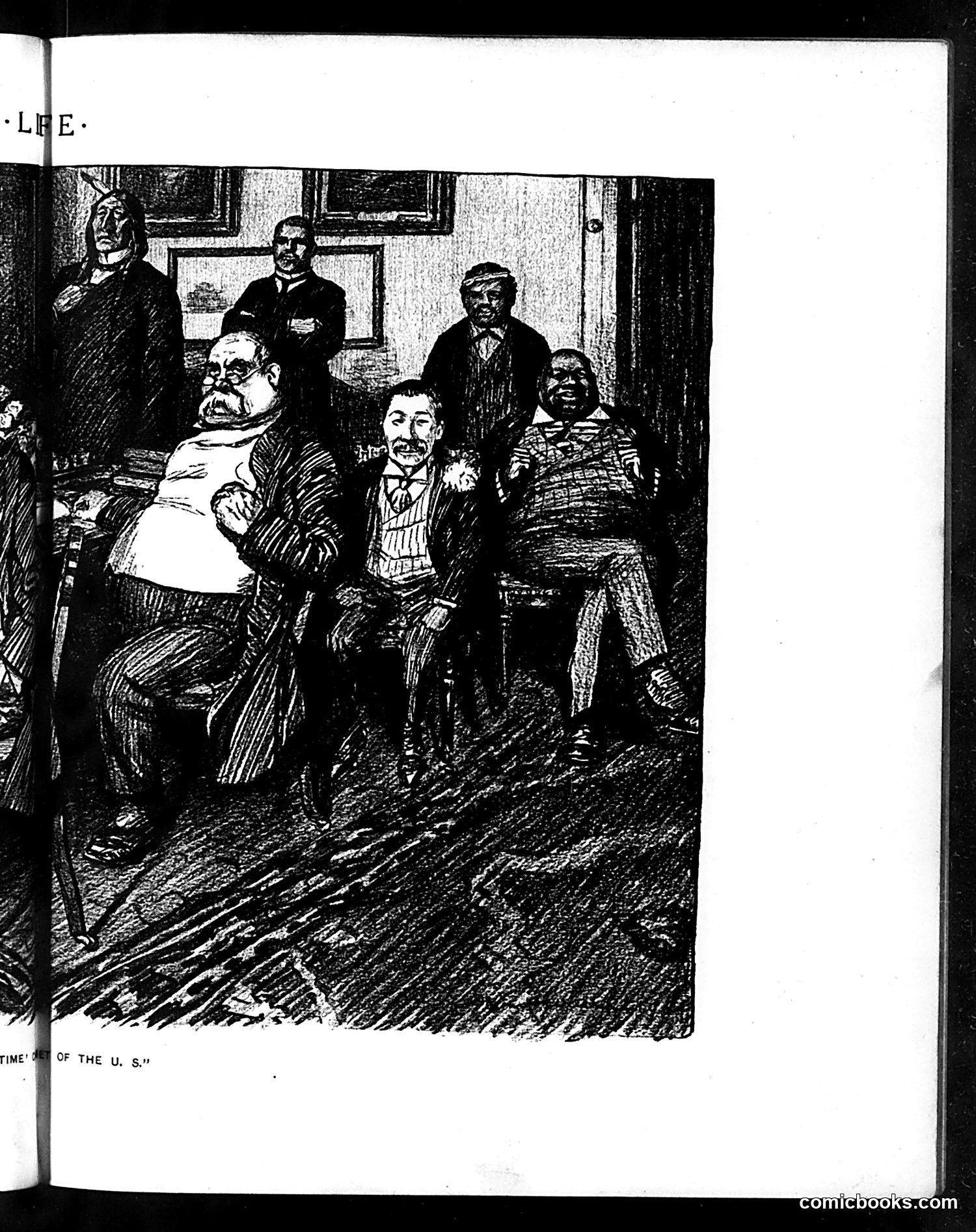
This appears to be a satirical illustration from *Life* magazine showing an interior domestic scene. The image depicts several men of varying body types and appearances gathered indoors, seemingly in casual or convivial circumstances. The art style uses heavy cross-hatching typical of late 19th or early 20th-century woodcut or engraving techniques. Without clearer caption text visible in the image, the specific political or social commentary remains unclear. The OCR text fragment ("OF THE U.S.") suggests this relates to American society, but I cannot definitively identify the specific figures, events, or satirical point being made. The gathering's purpose and the intended satirical message would require additional context or legible captions to interpret accurately.
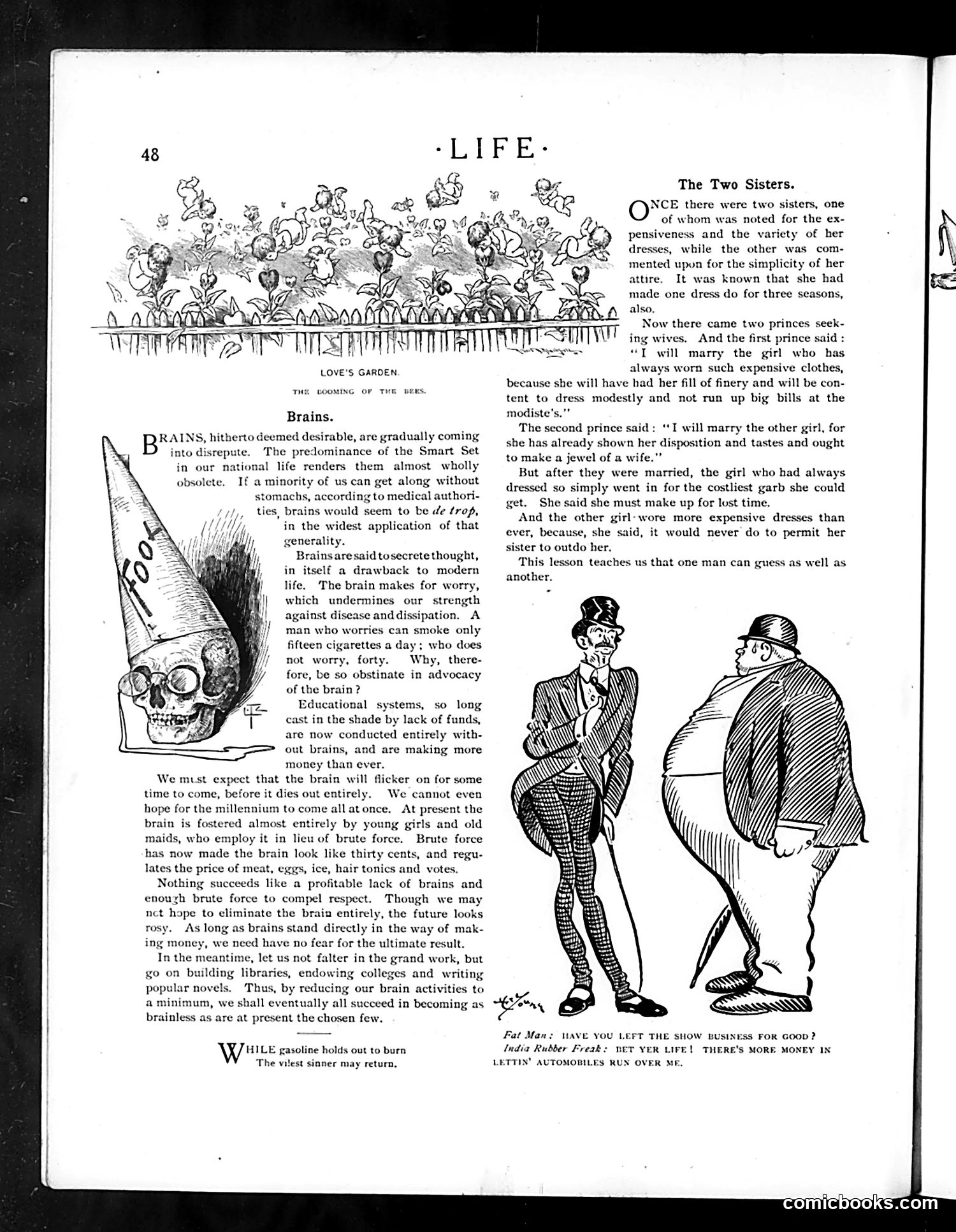
**"The Two Sisters"** (right): A fairy-tale moral story contrasting two sisters' marriage strategies. One sister dresses expensively to attract a prince seeking finery; the other dresses modestly but wins a prince who values character. The satire critiques women's competitive materialism and the notion that expensive appearance determines marital success—suggesting that substance matters more than display. **"Brains"** (left): A satirical essay with skull illustration arguing that intellect is becoming obsolete in modern society. It criticizes how education systems, brute force, and money now supersede reasoning. The piece sardonically suggests that as society devalues brains, we'll eventually succeed by abandoning intellectual pursuits entirely—a dark commentary on anti-intellectualism in early 20th-century America.
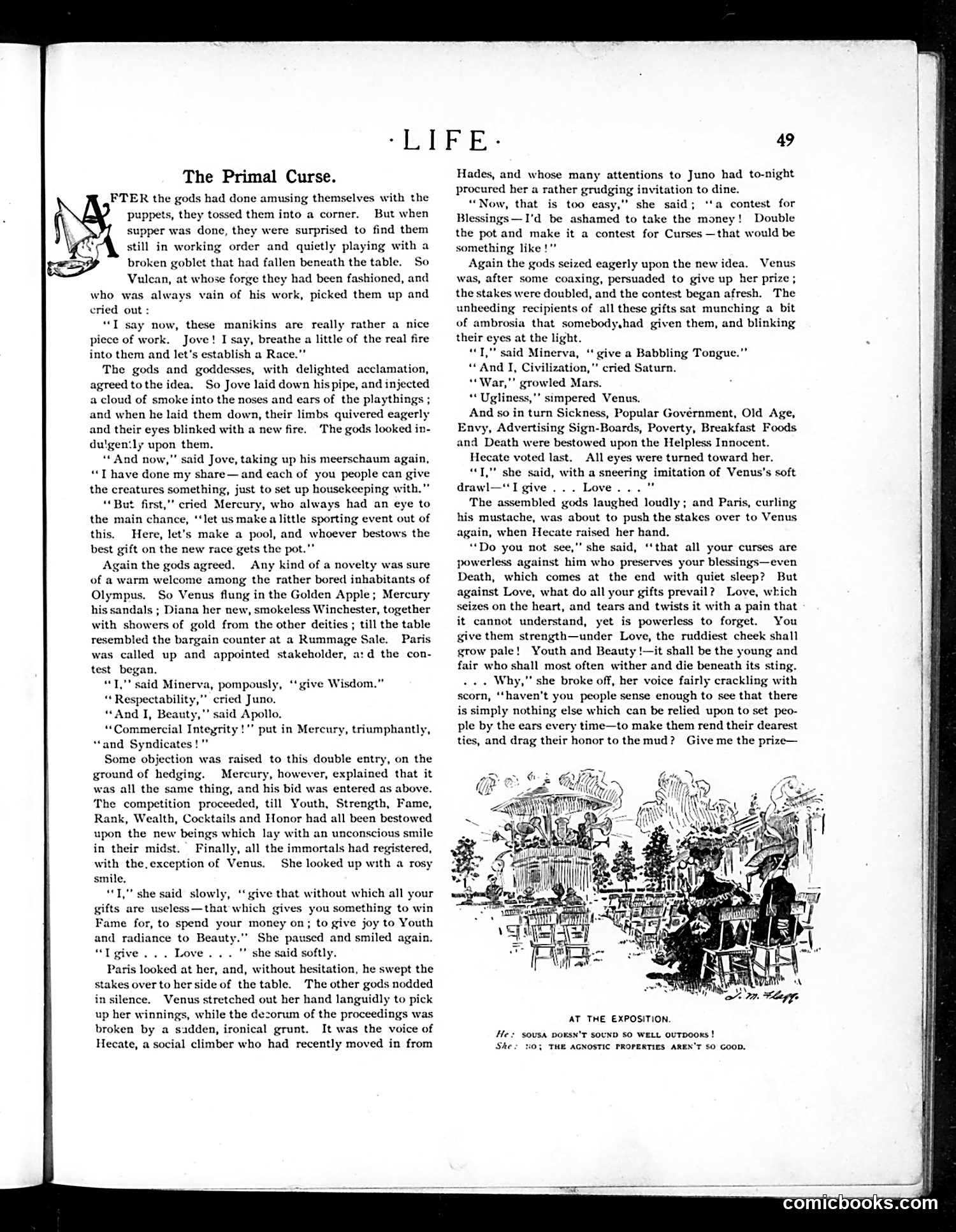
This allegorical story satirizes humanity's actual condition by framing it as a divine wager. The gods create mankind and bestow gifts—Strength, Youth, Beauty, Wealth, Love—betting on which proves most valuable. Venus wins by offering Love. However, Hecate, a nouveau-riche goddess ("social climber who had recently moved in"), objects the contest was too easy. She proposes doubling stakes to award *Curses* instead—a darkly humorous inversion suggesting human suffering outweighs divine blessings. The satire critiques both human nature (we're prone to curse-worthy behaviors) and social pretension (Hecate's vulgar challenge mirrors the era's nouveau riche vulgarity). The illustration "At the Exposition" shows gods observing humanity at a fair, emphasizing humanity as objects of divine amusement—powerless and foolish. The piece suggests life's fundamental condition is cursed, not blessed, despite our romantic notions of love and prosperity.
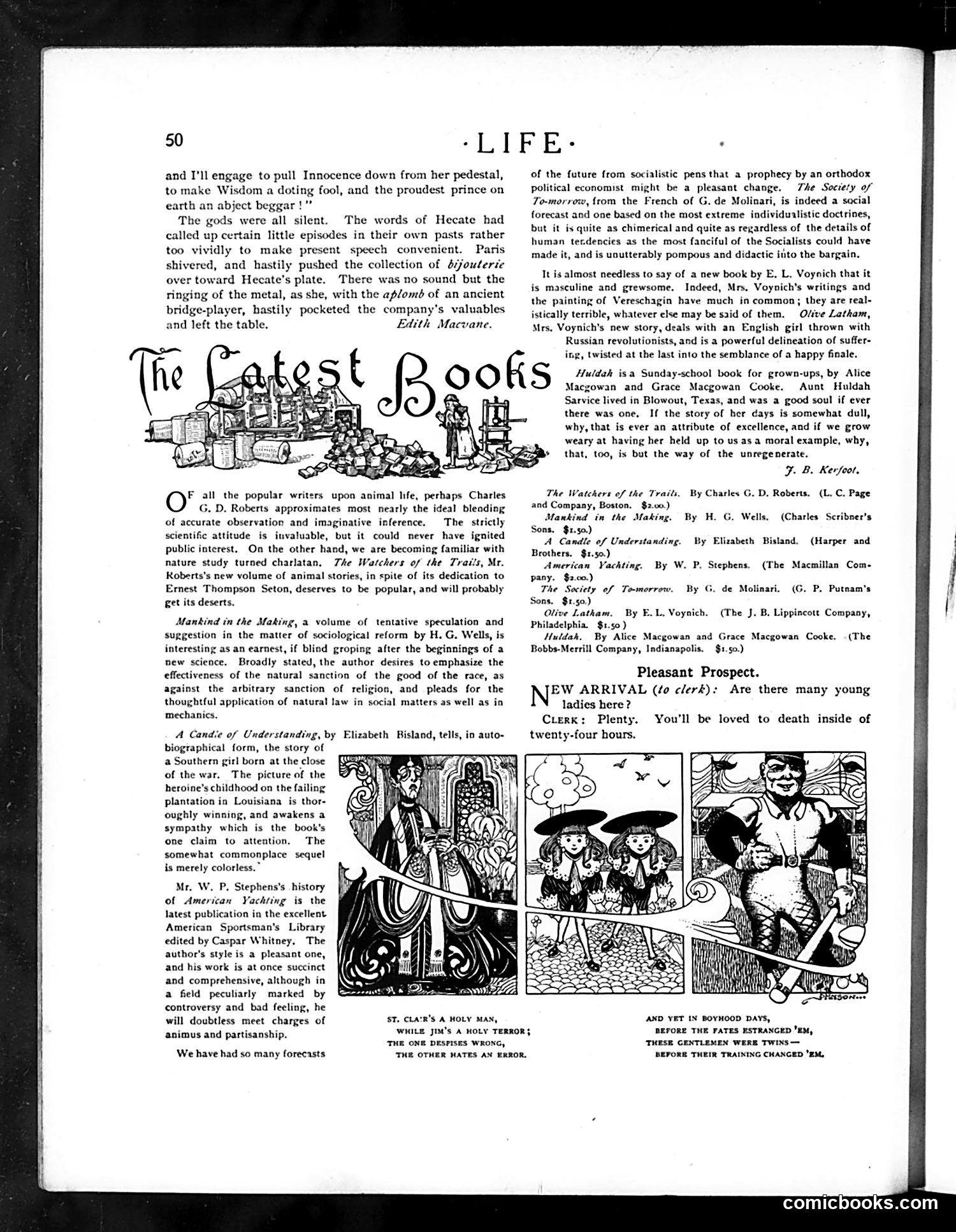
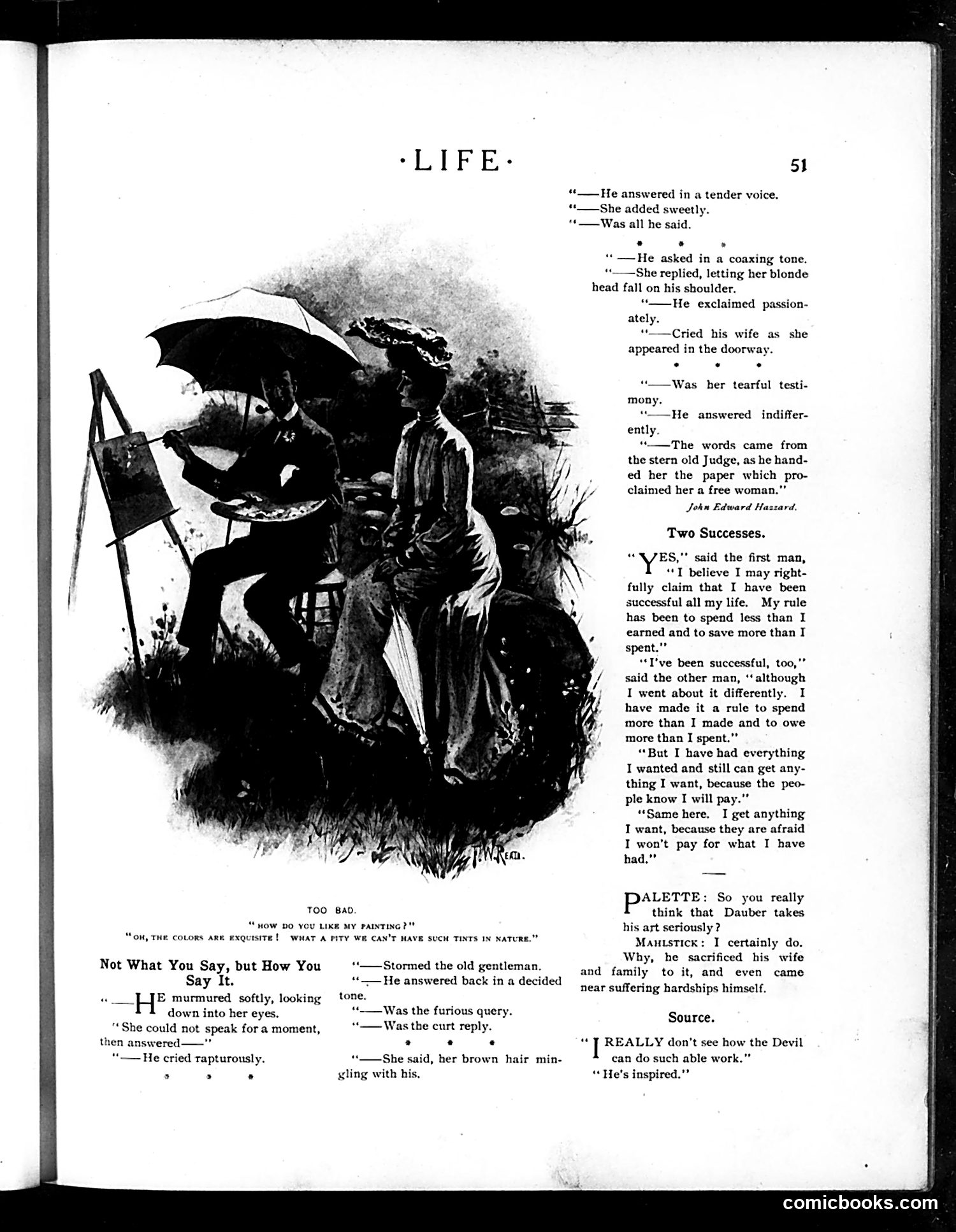
This page contains three separate satirical pieces typical of early 20th-century American humor: **"Too Bad"** mocks pretentious artists. A painter asks about his work; the viewer compliments the colors but notes nature doesn't actually display such garish tints—satirizing both artistic vanity and insincere flattery. **"Not What You Say, but How You Say It"** illustrates how tone matters more than content. The same dialogue is presented multiple times with different emotional framings (tender, passionate, angry, curt), showing how delivery transforms meaning—a commentary on social performance and dishonesty. **"Two Successes"** presents opposing financial philosophies: one man succeeds through thrift and saving; another through spending beyond his means and relying on creditors' fear. Both claim satisfaction, satirizing how people rationalize contradictory life choices and self-deception about success. **"Source"** is a brief joke about the Devil inspiring artistic talent, mocking both the Romantic notion of artistic genius and moral compromise in pursuit of art. The overall theme: surface versus substance in social interaction, art, and personal narrative.
This page contains two satirical pieces mocking contemporary fads and social absurdities: **"The Skipper's Wooing"** ridicules the "skipping party" craze—a fashionable social activity where upper-class adults obsessively jumped rope. The poem sarcastically presents rope-skipping as the replacement for traditional entertainments (dancing, cards), claiming it transforms even portly matrons and sedentary businessmen into the vigorous and slim. The satire targets society's gullible embrace of health fads and the pretentiousness of wealthy socialites abandoning established customs for novelties. **Secondary items** include an anecdote about a six-year-old's literal confusion about mourning dress (why wear black only during day?), and a story about a newspaper publisher paying writers per letter—leading one writer to deliberately introduce a stuttering character to increase word count through repetition. The overall message: satire of modern social follies, from fashionable exercise crazes to journalistic penny-pinching. The ads (Wilson Whiskey, Evans' Ale, Esterbrook Pens) are period contemporary.
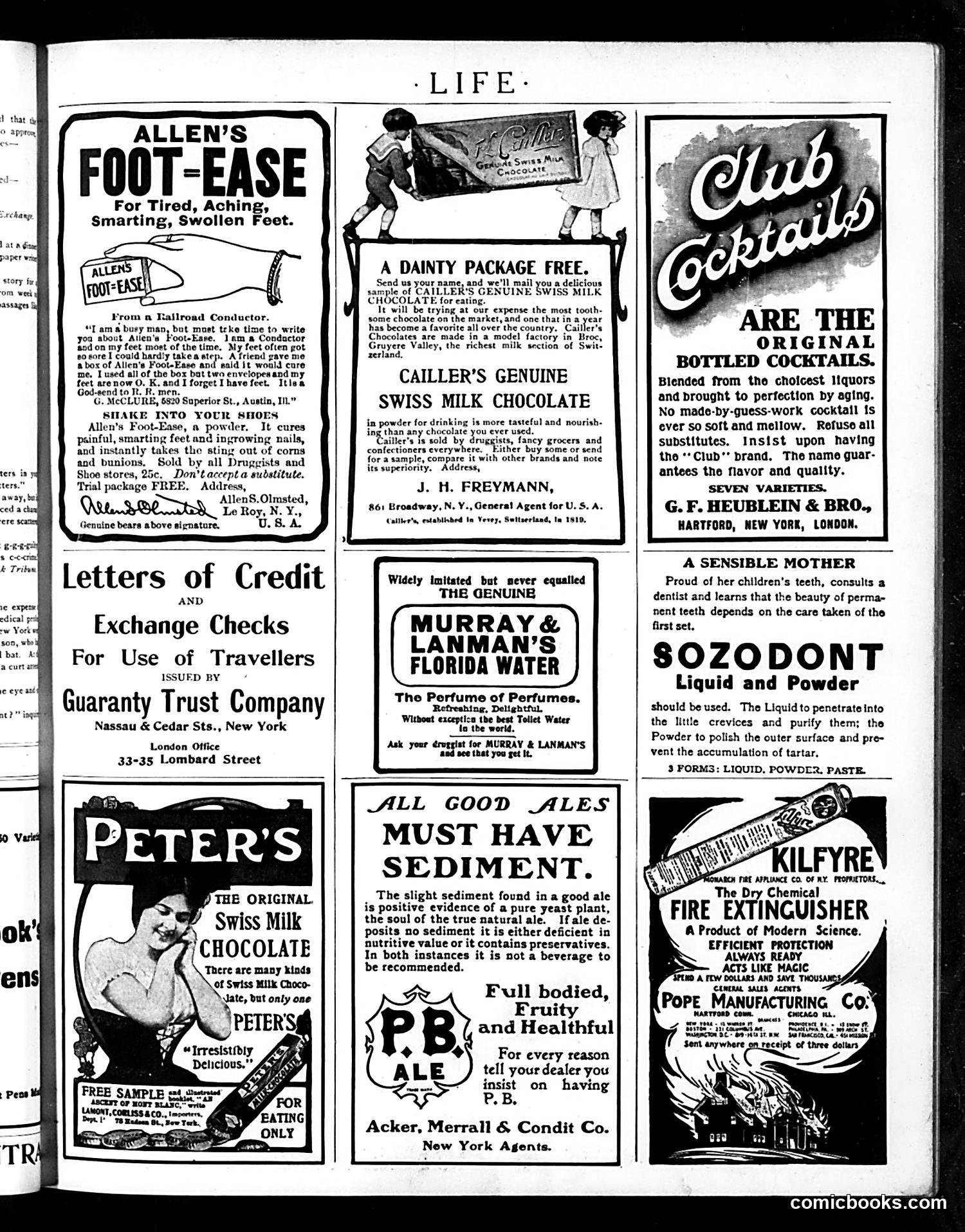
This is an **advertisement page** from Life magazine, not a cartoon or satirical piece. It contains roughly a dozen commercial ads typical of early 20th-century publications. The ads promote consumer products addressing common complaints: Allen's Foot-Ease powder for sore feet (endorsed by a railroad conductor testimonial), Swiss milk chocolate, bottled cocktails, traveler's checks, toothpaste (Sozodont), and a fire extinguisher. Several ads emphasize product authenticity—"The Genuine" Murray & Lanman's Florida Water and P.B. Ale stress they're widely imitated but superior to substitutes. Most notable for modern readers: the casual inclusion of alcohol advertising (cocktails and ale) and the assumption that people needed mail-order samples mailed to them—reflecting pre-internet consumer culture. The railroad conductor's broken English in the Foot-Ease ad appears intentional, possibly reflecting period ethnic humor conventions. There is **no political satire or cartoon content** on this page.
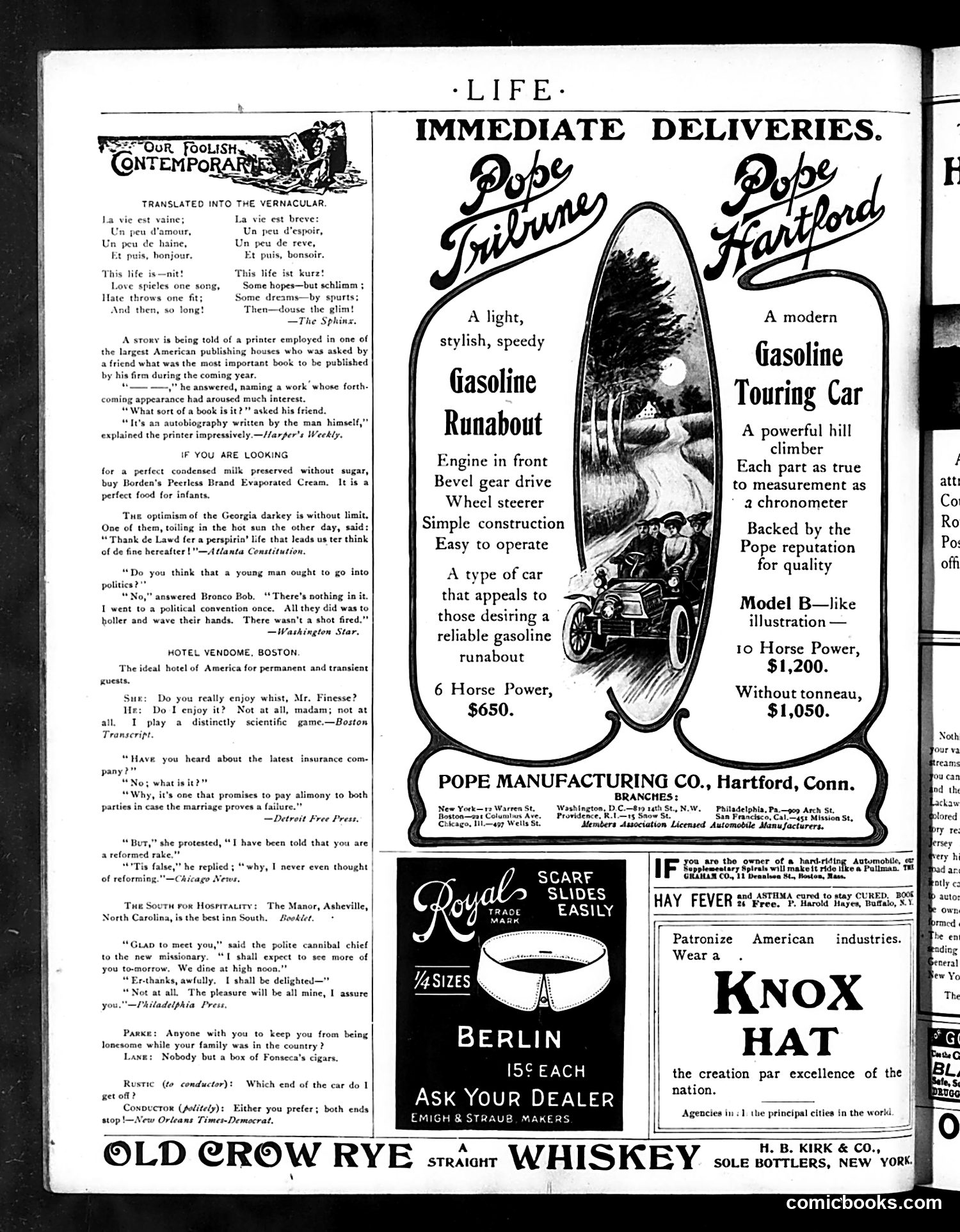
This page is primarily **advertising**, not political satire. It contains multiple advertisements for products popular in the early 1900s: - **Pope automobiles** (two models advertised) - **Royal scarf slides** - **Knox Hat** ("creation par excellence of the nation") - **Old Crow Rye whiskey** - **Borden's evaporated cream** and other consumer goods The left column contains brief humorous anecdotes and social commentary typical of *Life* magazine's satirical content—jokes about marriage insurance, hotels, and small talk—but these are isolated quips, not unified political cartoons. The page reflects early 20th-century advertising and consumer culture rather than substantive political commentary.
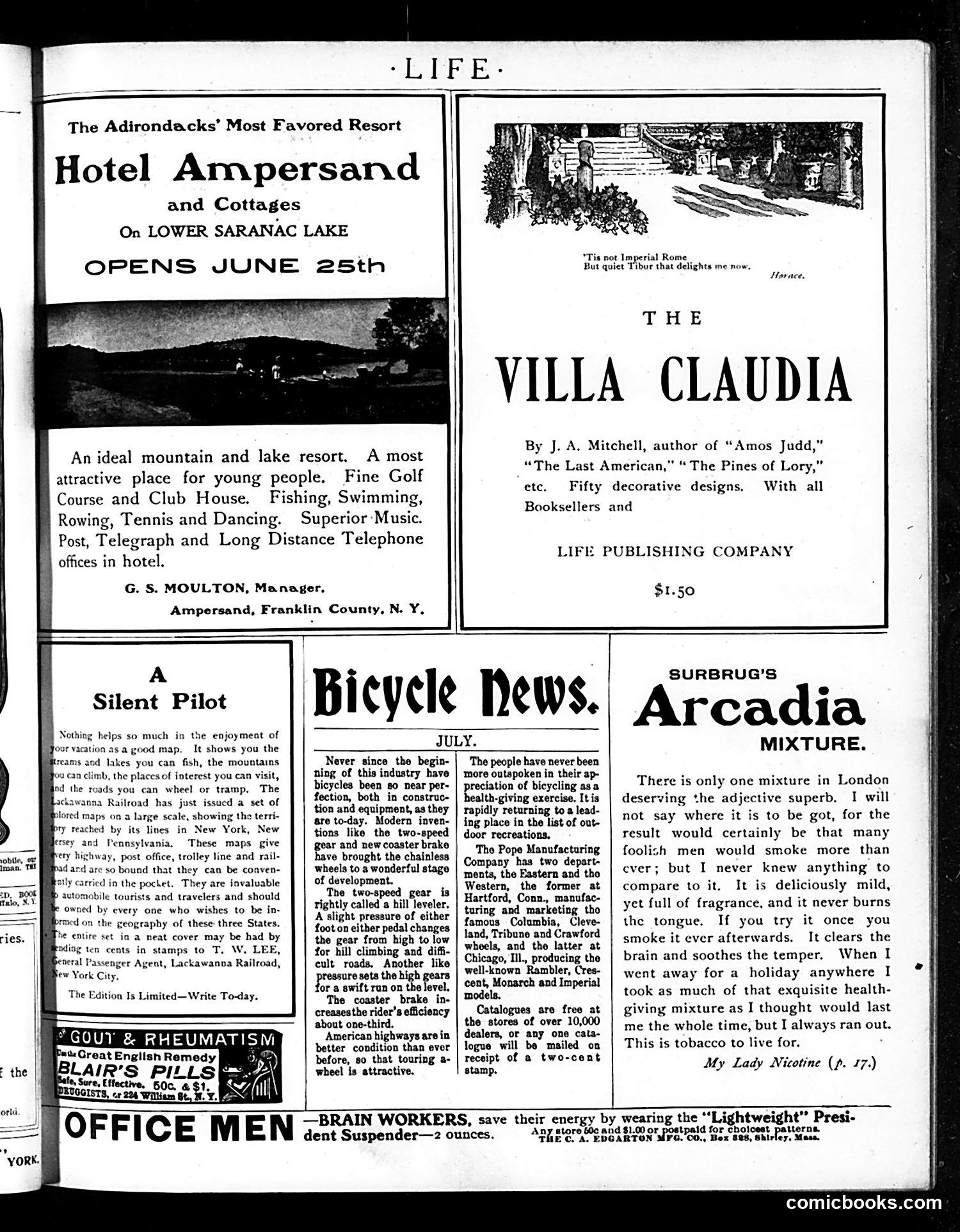
This is primarily an **advertising page** from Life magazine, not a satirical cartoon page. It contains several hotel and product advertisements typical of early 20th-century publications. The main content includes: - **Hotel Ampersand** advertisement for an Adirondack resort - **"The Villa Claudia"** — a book advertisement by J.A. Mitchell, priced $1.50 - **"A Silent Pilot"** — promoting railroad maps for tourists - **Bicycle News** column discussing the state of bicycle manufacturing (Pope Manufacturing Company bicycles: Columbia, Rambler, etc.) - **Surbrug's Arcadia Mixture** — a tobacco product advertisement using testimonial style - **Blair's Pills** — patent medicine advertisement - **Office Men** advertisement (partially visible) There is **no political cartoon or satire evident** on this page. It reflects commercial interests of the era: tourism, cycling popularity, tobacco use, and patent medicines — all marketed to middle and upper-class readers.
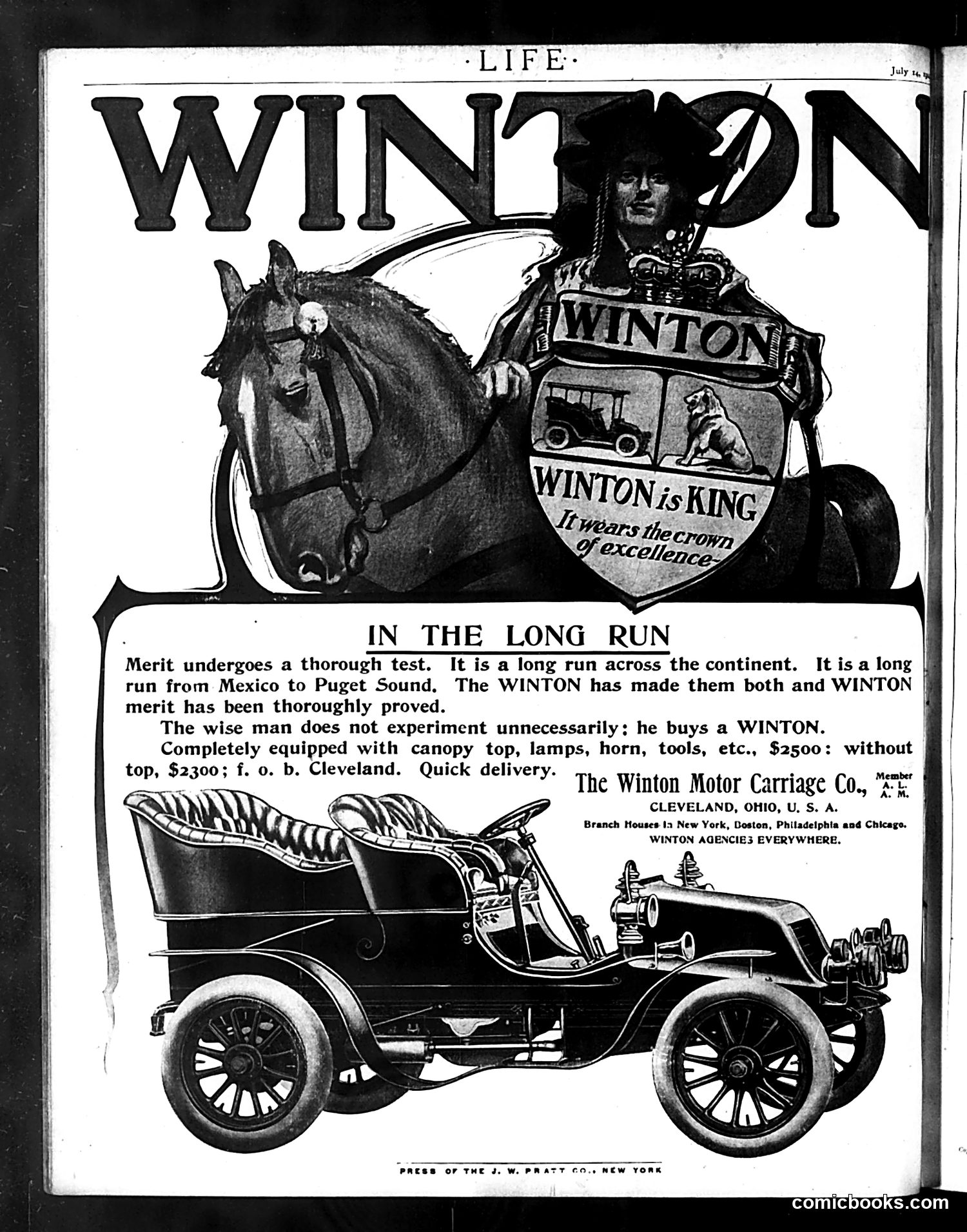
This is a full-page advertisement for the Winton Motor Carriage, a Cleveland-based automobile manufacturer. The ad uses a cowboy figure on horseback alongside the vehicle to suggest reliability through endurance testing. The key sales pitch: "Merit undergoes a thorough test...It is a long run from Mexico to Puget Sound. The WINTON has made them both and WINTON merit has been thoroughly proved." This claims the car has proven itself across transcontinental distances—a major selling point in the early automobile era when long-distance reliability was uncertain. The tagline "WINTON is KING: It wears the crown of excellence" positions the brand as superior. The cowboy imagery evokes American frontier toughness and proven durability, appealing to masculine buyers skeptical of newfangled technology. The price—$2,500 fully equipped—targets wealthy consumers. This is straightforward product advertising rather than satire.
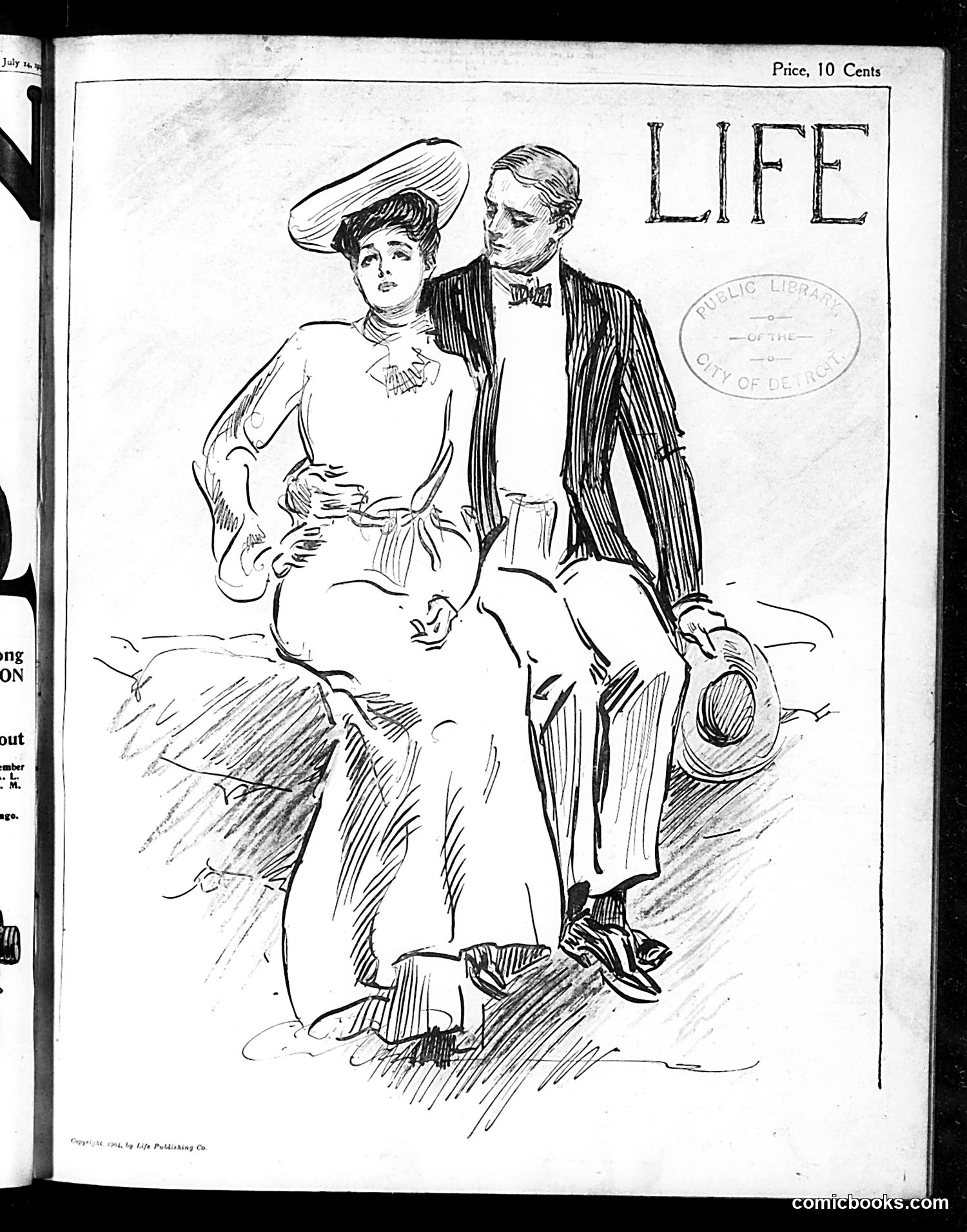
This appears to be a cover illustration from *Life* magazine (priced at 10 cents, suggesting early 20th century). The image depicts an elegantly dressed couple in a romantic pose, seated together outdoors. The woman wears a fashionable hat and dress characteristic of the Edwardian era, while the man is dressed formally in a suit and bow tie. The title "LIFE" is prominently displayed. Without additional visible text identifying specific figures or satirical commentary, this appears to be a general illustration reflecting contemporary social life and courtship customs of the period, rather than political satire. The artistic style and composition suggest commentary on romance, leisure, or social etiquette of the era.
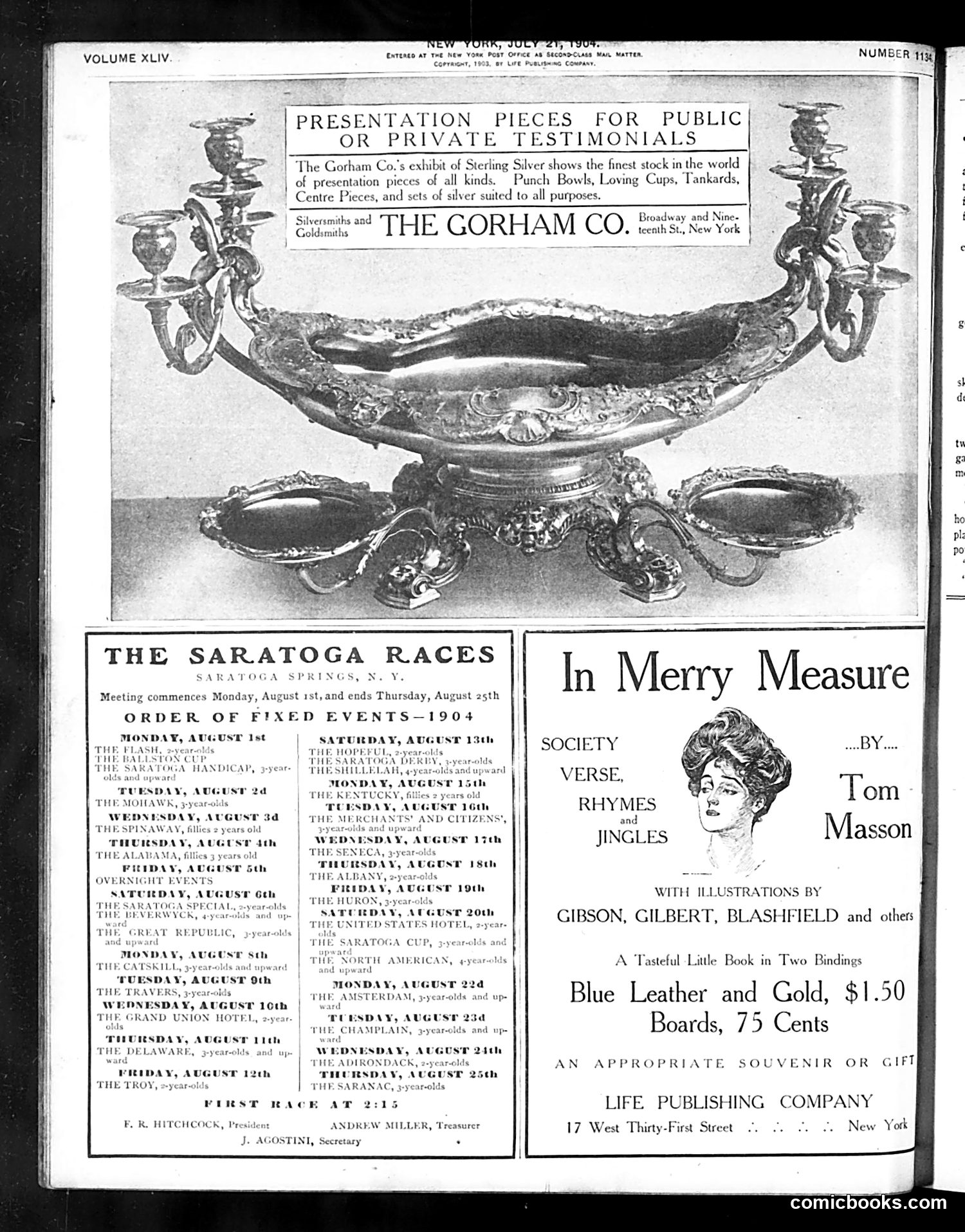
This page is primarily **advertising and event listings**, not political satire or editorial cartoon content. The top features an ad for **The Gorham Company's sterling silver presentation pieces**—ornamental bowls and cups for gifts or commemorations. The image shows elaborate decorative vessels typical of Gilded Age luxury goods. Below that is a **racing schedule for the Saratoga Springs horse races** (August 1904), listing events like "The Flash," "The Alabama," and "The Saratoga Cup"—major American thoroughbred competitions of the era. On the right, an ad promotes **"In Merry Measure" by Tom Masson**—a book of society verse and humorous jingles illustrated by period cartoonists Gibson, Gilbert, and Blashfield, published by Life Publishing Company. There is **no political cartoon or satirical content** on this page. It's a commercial/events section typical of *Life* magazine's revenue-generating content in 1904.
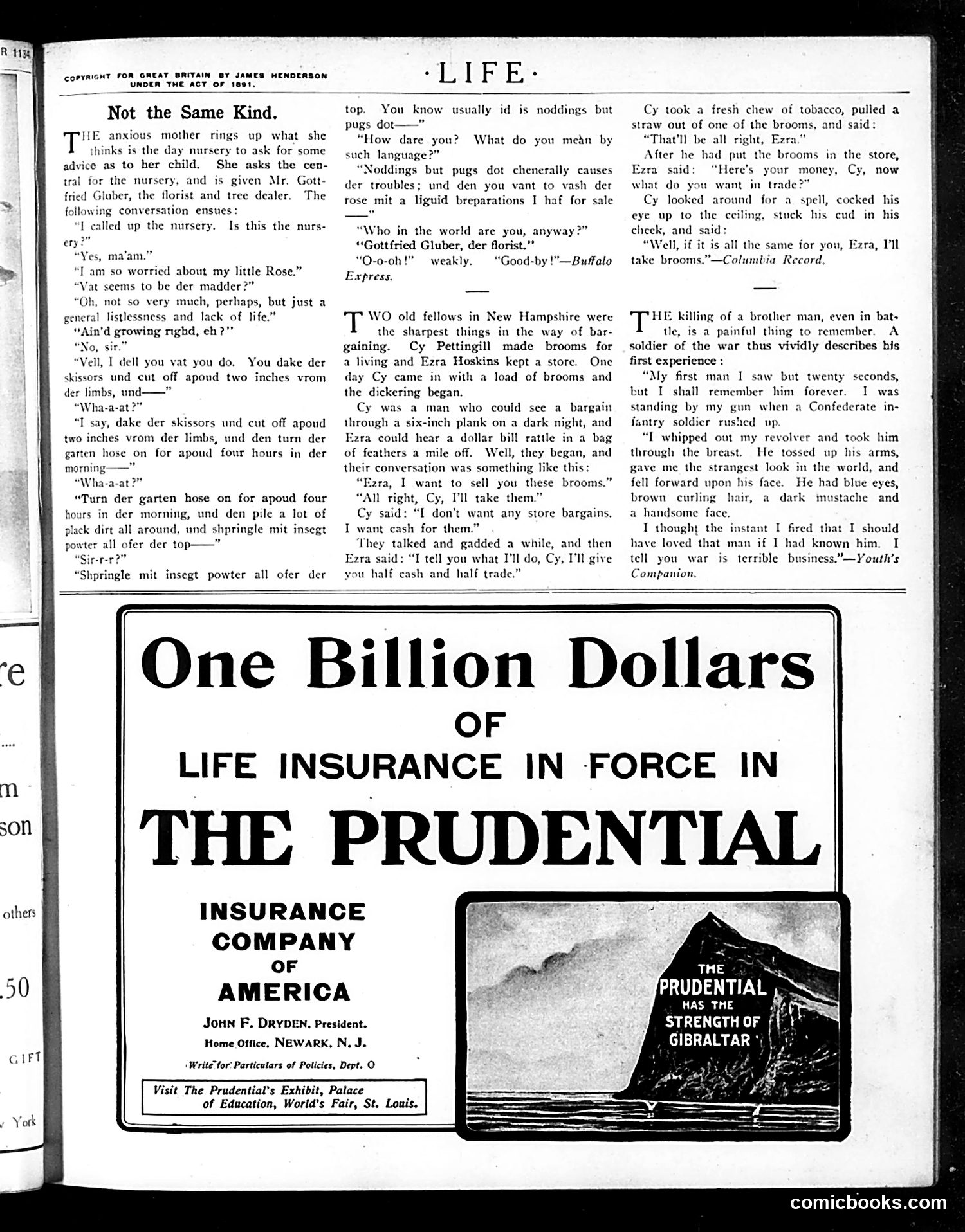
This page contains three short humor pieces and an insurance advertisement. **"Not the Same Kind"** is a telephone mix-up joke: an anxious mother calls what she thinks is a day nursery seeking advice about her sickly child named Rose, but reaches Gottfried Gluber, a florist with a thick German accent. The humor derives from the miscommunication—Gluber gives horticultural advice (pruning, watering, insecticide) appropriate for plants but grotesquely inappropriate for children. The exaggerated German dialect adds comedic effect typical of early 20th-century American humor. The other two pieces are brief anecdotes about shrewd New Hampshire bargaining and a soldier's memory of killing an enemy soldier in war. **The Prudential Insurance advertisement** occupies the lower half, promoting one billion dollars of life insurance in force, using the Rock of Gibraltar as a symbol of strength and stability—a common advertising metaphor of the era. The page reflects pre-WWI American humor conventions: ethnic caricature, domestic comedy, and sentimental war reflection.
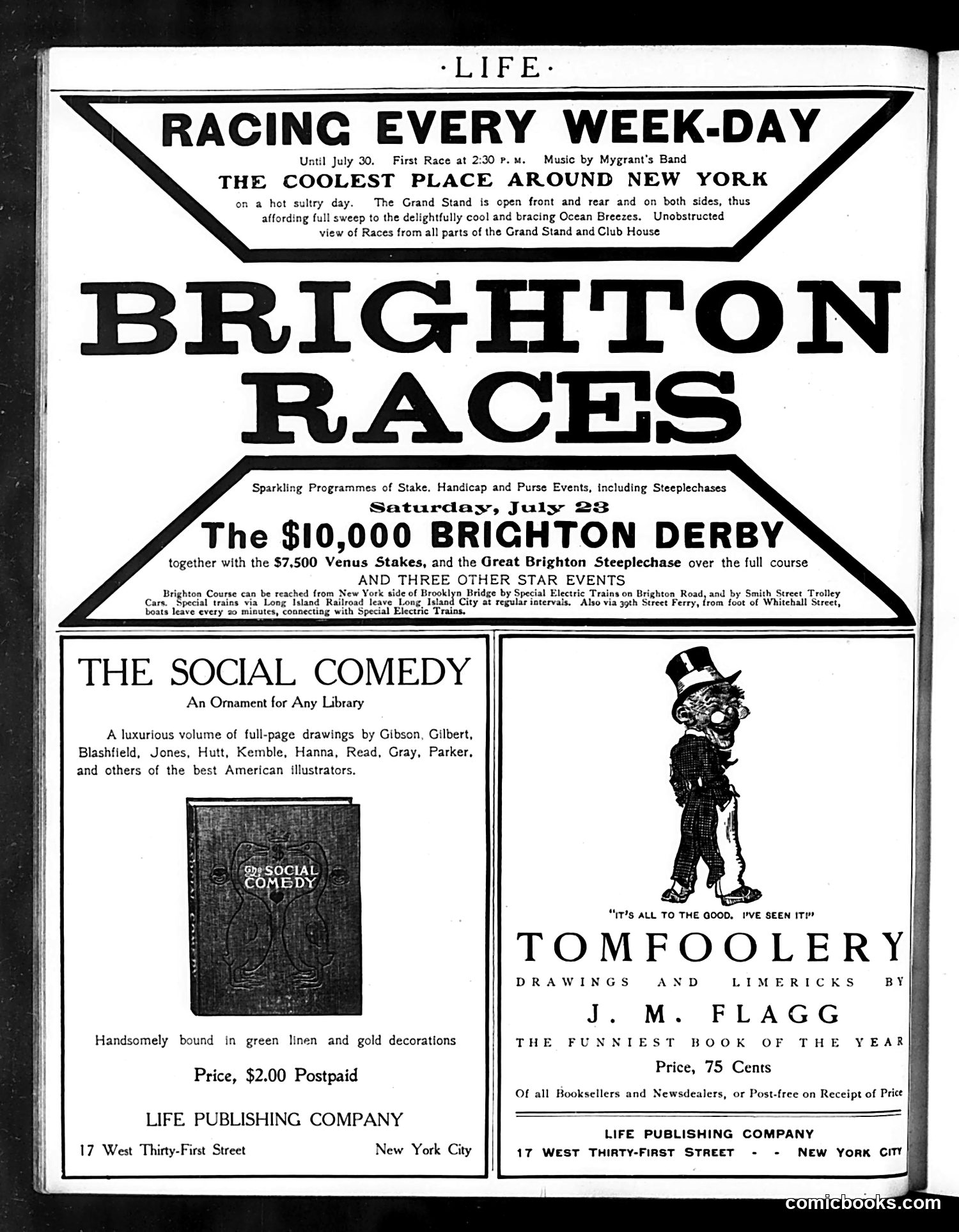
This is primarily an **advertising page**, not a satirical cartoon page. It contains three distinct advertisements: 1. **Brighton Races** (top): An ad promoting horse racing at Brighton Beach near New York, running weekdays until July 30, with the $10,000 Brighton Derby scheduled for Saturday, July 23. It emphasizes the venue as "the coolest place around New York" on hot days. 2. **The Social Comedy** (bottom left): An advertisement for a $2.00 illustrated book by Life Publishing Company, featuring full-page drawings by prominent American illustrators including Charles Dana Gibson and others. 3. **Tomfoolery** (bottom right): An ad for a 75-cent book of drawings and limericks by J.M. Flagg, featuring a cartoon character in top hat with the caption "It's all to the good, I've seen it!"—promoting it as "the funniest book of the year." The page lacks satirical political content; it's a commercial product showcase typical of Life's revenue model.
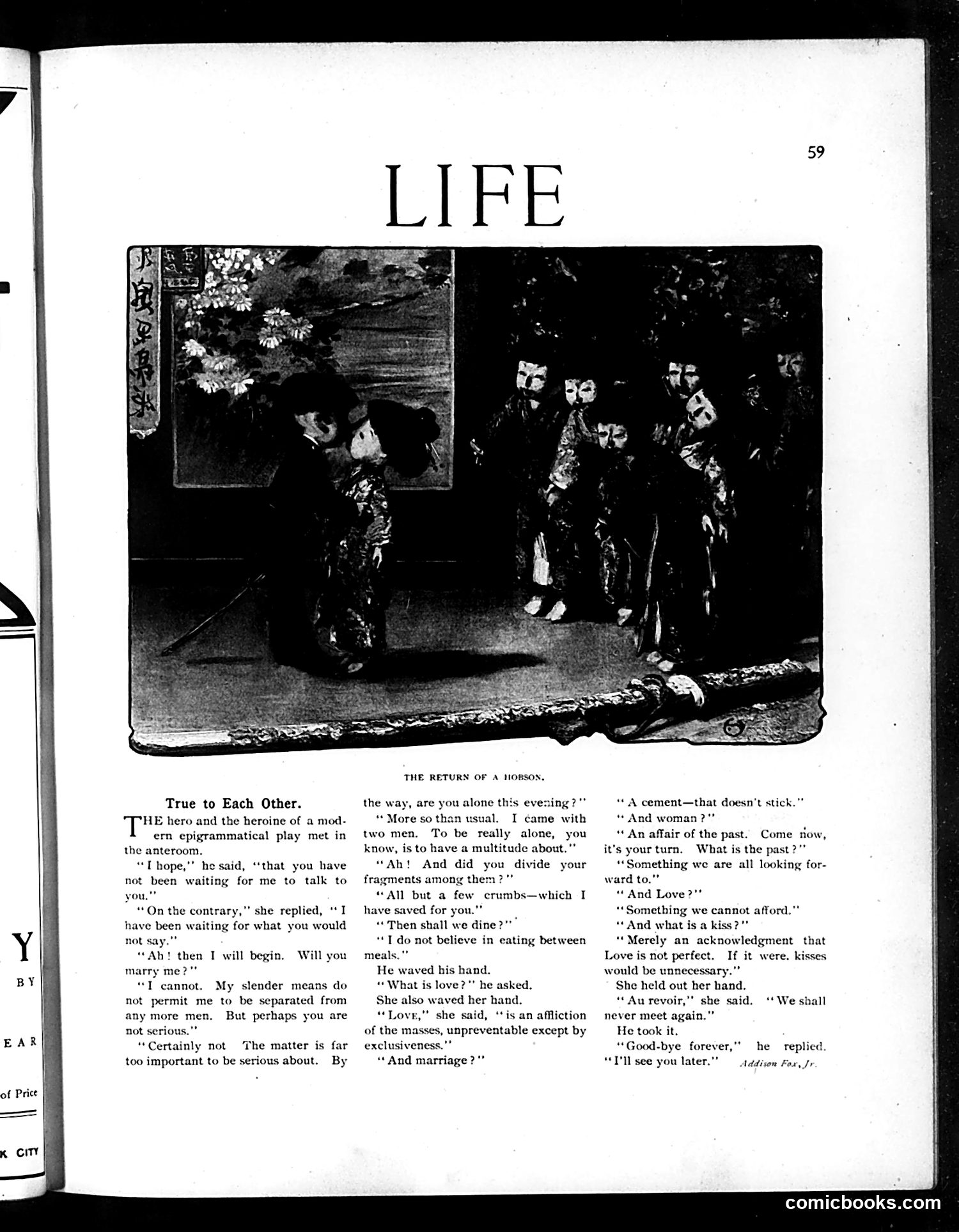
This is a satirical dialogue mocking early 20th-century avant-garde theater and the affected sophistication of modern intellectuals. Two characters meet in a theater anteroom and conduct an absurdly clever conversation filled with paradoxes and pseudo-philosophical pronouncements—speaking in riddles where every statement contradicts itself. The satire targets the pretentious wordplay and emotional coldness of "modern epigrammatical" drama: love is "an affliction," marriage "a cement that doesn't stick," a kiss merely "an acknowledgment that Love is not perfect." Their final exchange—exchanging declarations of permanent farewell while promising to meet later—encapsulates the joke: all this intellectual posturing about love and commitment amounts to meaningless performance. The title "True to Each Other" is ironic; they're devoted only to being clever. The satire ridicules audiences who found such self-consciously witty, emotionally detached dialogue profound rather than hollow.
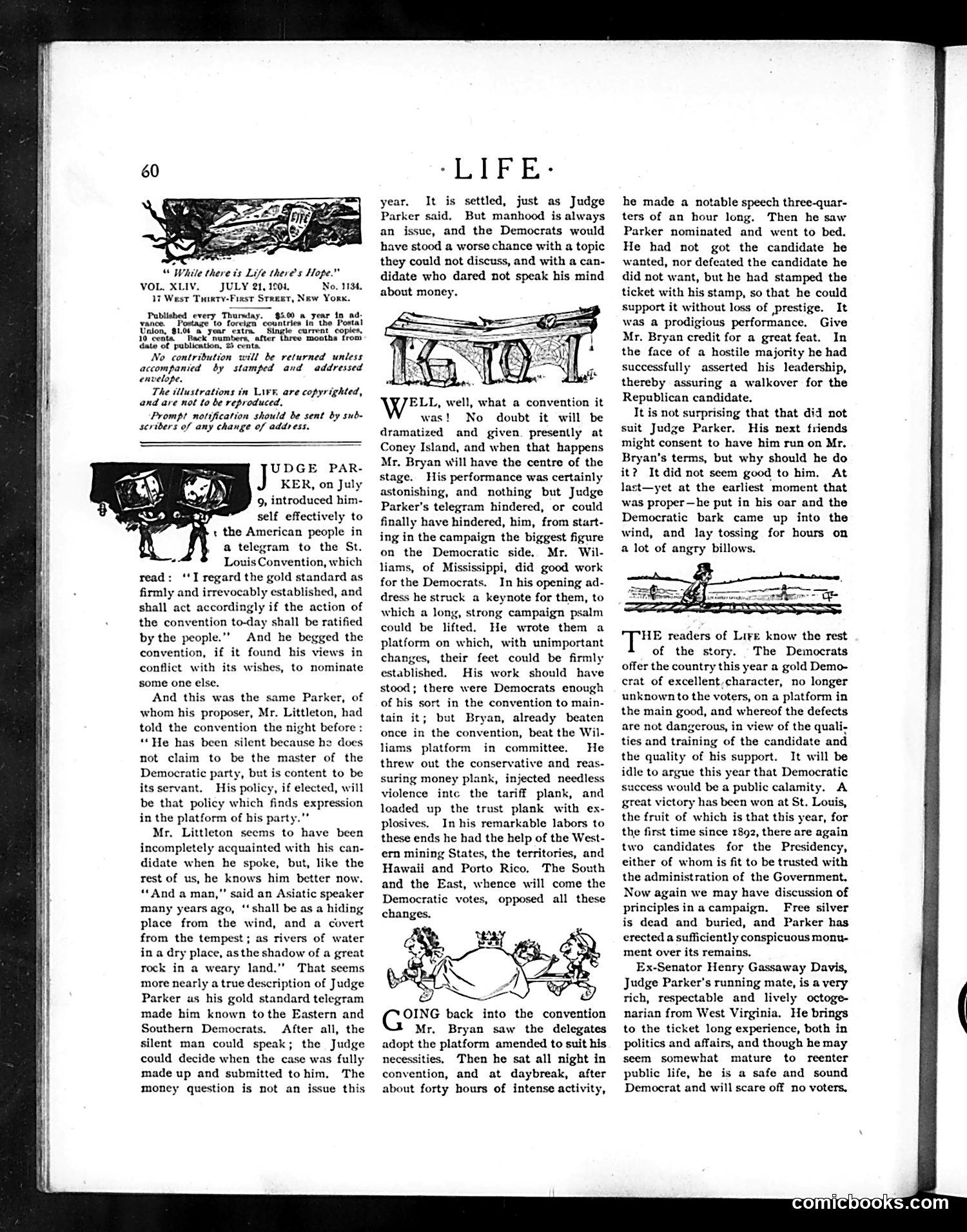
This *Life* magazine article (July 21, 1904) critiques Judge Alton B. Parker, the Democratic presidential nominee, and William Jennings Bryan's influence at the convention. **The Figures:** Judge Parker is the main subject—characterized as overly cautious and evasive. Bryan appears as a disruptive force within the party. **The Satire:** Parker introduced himself with a telegram asserting commitment to the gold standard, which the article mocks as weak leadership. Life sarcastically compares him to Biblical descriptions of shelter—implying he offers only passive refuge rather than active leadership. **The Political Context:** The article criticizes Bryan for dominating the convention despite previous electoral defeats, pushing aggressive planks on money and tariffs that alienated Southern and Eastern Democrats (who controlled actual votes). Parker's silence on substantive issues is presented as cowardly, while Bryan's activism is portrayed as reckless. **The Point:** Life suggests the Democrats nominated a cipher (Parker) while allowing Bryan—whom they'd rejected before—to dictate platform positions, guaranteeing defeat.
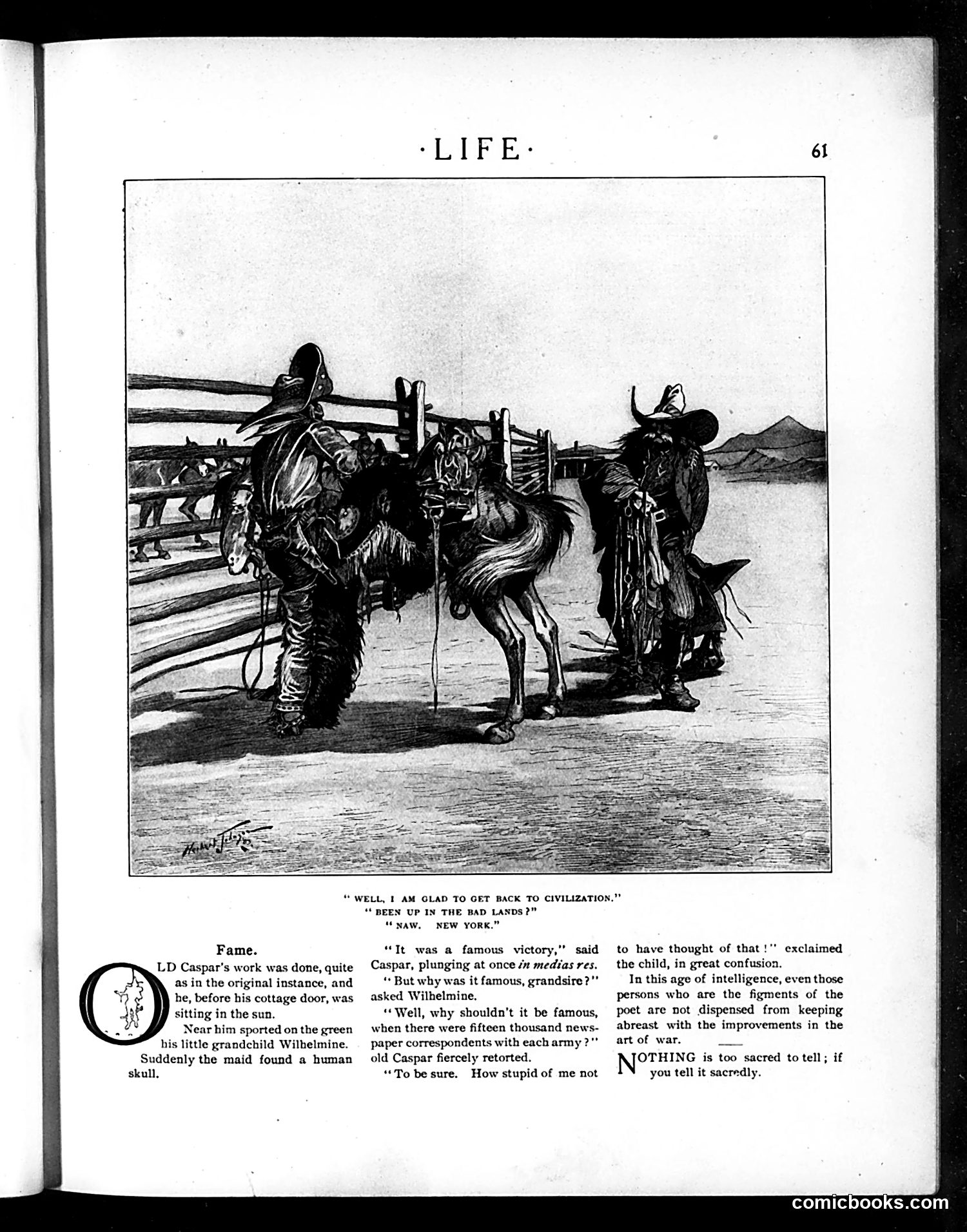
This satirical story mocks the media saturation of modern warfare. An old man named Caspar returns from "the Bad Lands" (a reference to the American frontier, likely the Dakota territory) and claims his victory was "famous" solely because fifteen thousand newspaper correspondents covered it with each army. The joke targets two things: (1) **war journalism's trivialization**—a victory's fame depends not on actual significance but on press coverage, and (2) **the absurdity of modern communication**—even fictional characters can't escape the news cycle's demands to "keep abreast with improvements in the art of war." The discovery of a human skull reinforces the grim reality beneath the media spectacle. Life magazine uses this to critique how contemporary war reporting prioritizes sensationalism and quantity of coverage over genuine understanding of conflict's human cost. The satire suggests that in the modern age, if an event isn't reported by mass media, did it really matter?
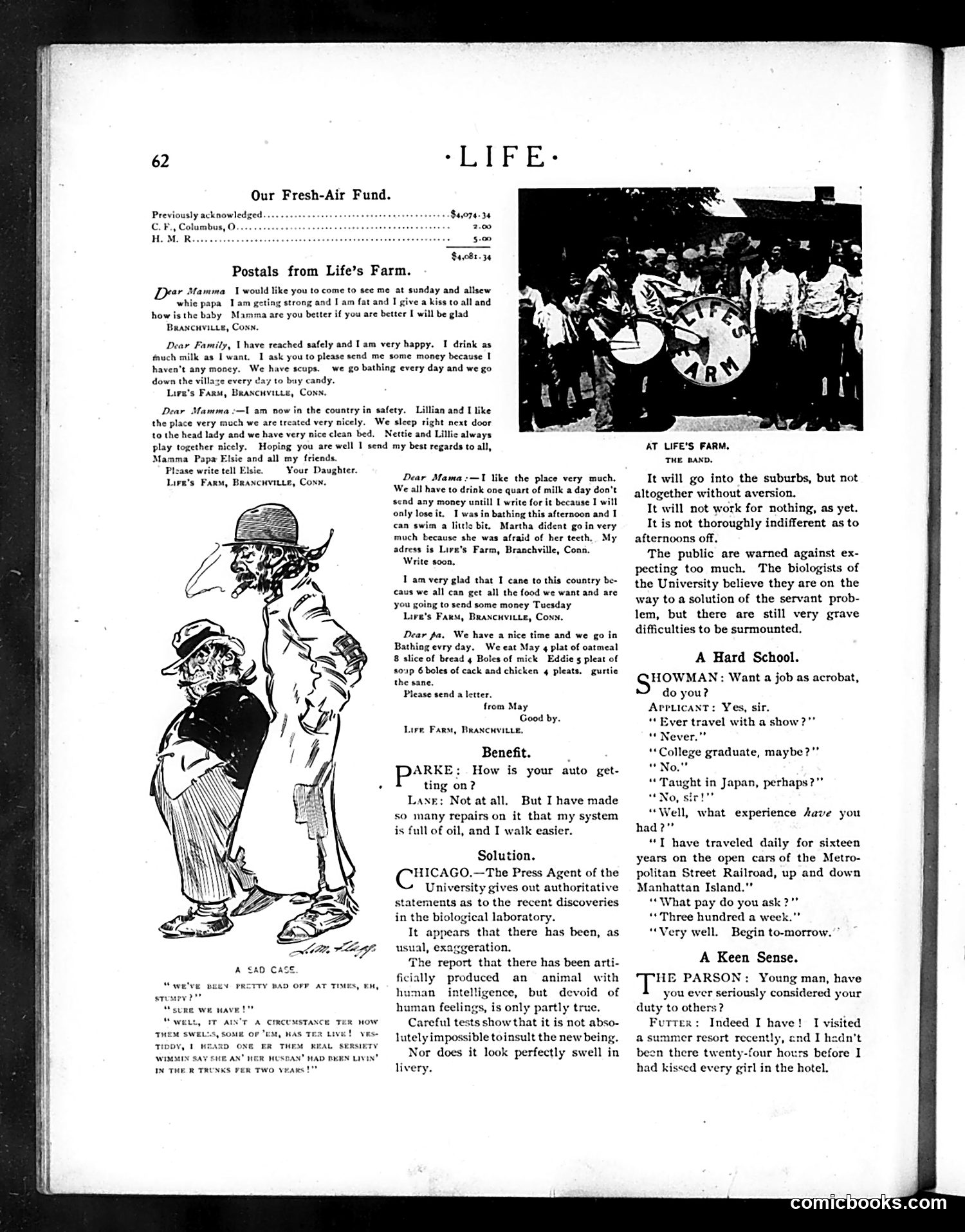
This page features satire about urban poverty and labor exploitation circa early 1900s. **"Our Fresh-Air Fund"** documents a charitable program sending poor city children to a farm for health and recreation—letters from grateful children describe milk, bathing, and food. The underlying satire: these children's desperate gratitude for basic nutrition exposes urban poverty's severity. **"A Sad Case"** (left cartoon) depicts two working-class men discussing hardship. One notes a woman has lived "in the r trunks [trunks/poverty] fer two years"—mocking upper-class obliviousness to working-class suffering. **"The Solution"** sarcastically reports a University of Chicago claim about artificially creating intelligent servants without human feelings. The joke: universities promote absurd pseudo-scientific solutions to the "servant problem" (labor shortage), when actual servants still demand wages, time off, and dignity—revealing the fantasy of servitude without human cost. The page overall critiques early-1900s America's class divisions, pseudo-scientific justifications for exploitation, and wealthy society's disconnection from working-class reality.
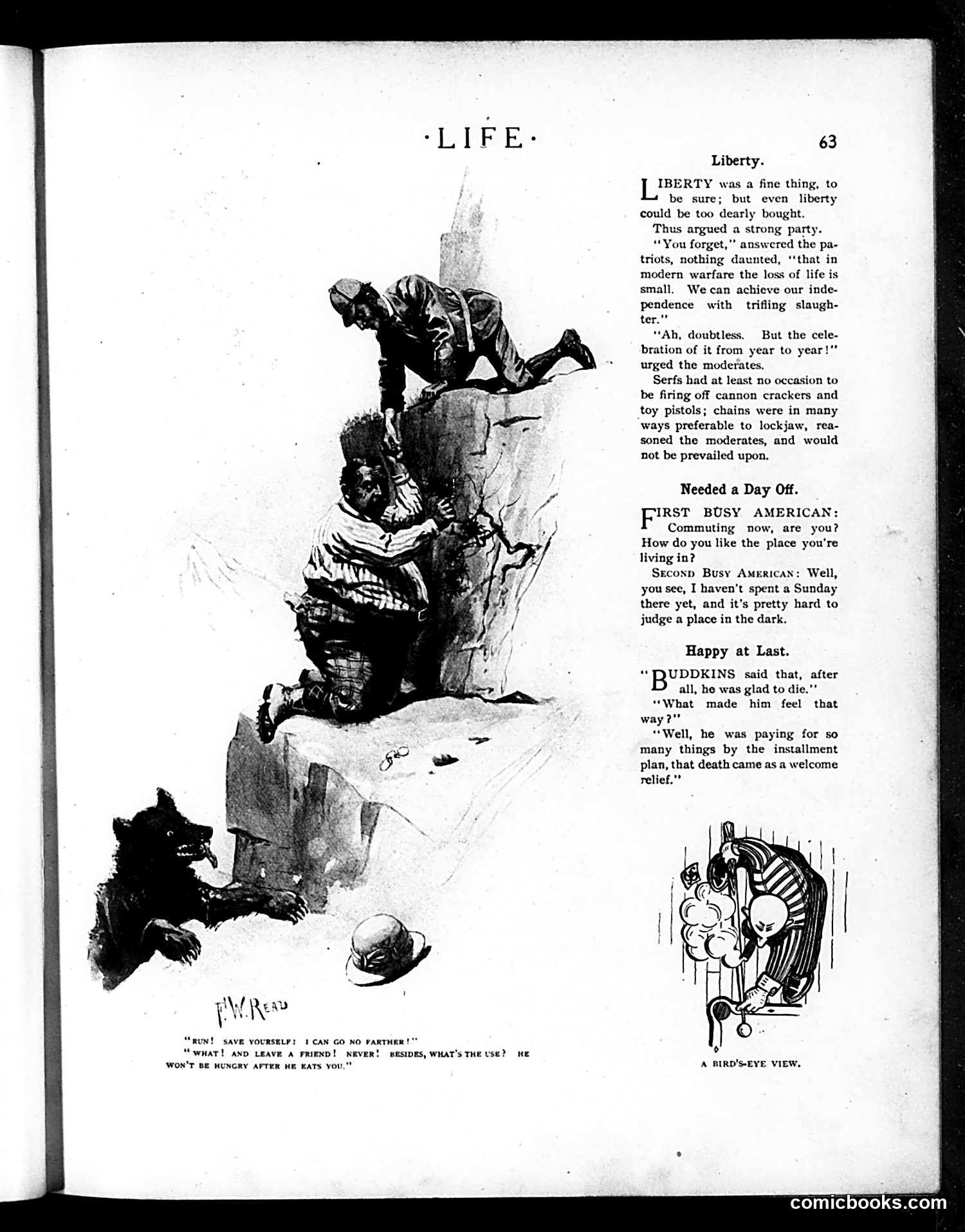
This page contains three distinct satirical pieces critiquing American life circa early 20th century: **"Liberty"** (top): Debates whether independence is worth its human cost. Patriots argue wars cause minimal casualties; moderates counter-argue that annual Fourth of July celebrations with fireworks and toy cannons are annoying enough that servitude might be preferable—a tongue-in-cheek jab at American patriotic excess. **"Needed a Day Off"**: Mocks the modern commuter's exhausting schedule, suggesting he can't properly judge his new residence because he's never actually *there* during daylight—satirizing the grueling work culture of urban Americans. **"Happy at Last"** (right): Dark humor about a man relieved to die because he was drowning in installment plan debt—critiquing consumer culture and predatory lending practices. The main illustration (signed F.W. Reed) depicts a man-eating scenario, captioned with gallows humor about friendship versus self-preservation—likely another commentary on modern anxieties or human nature.
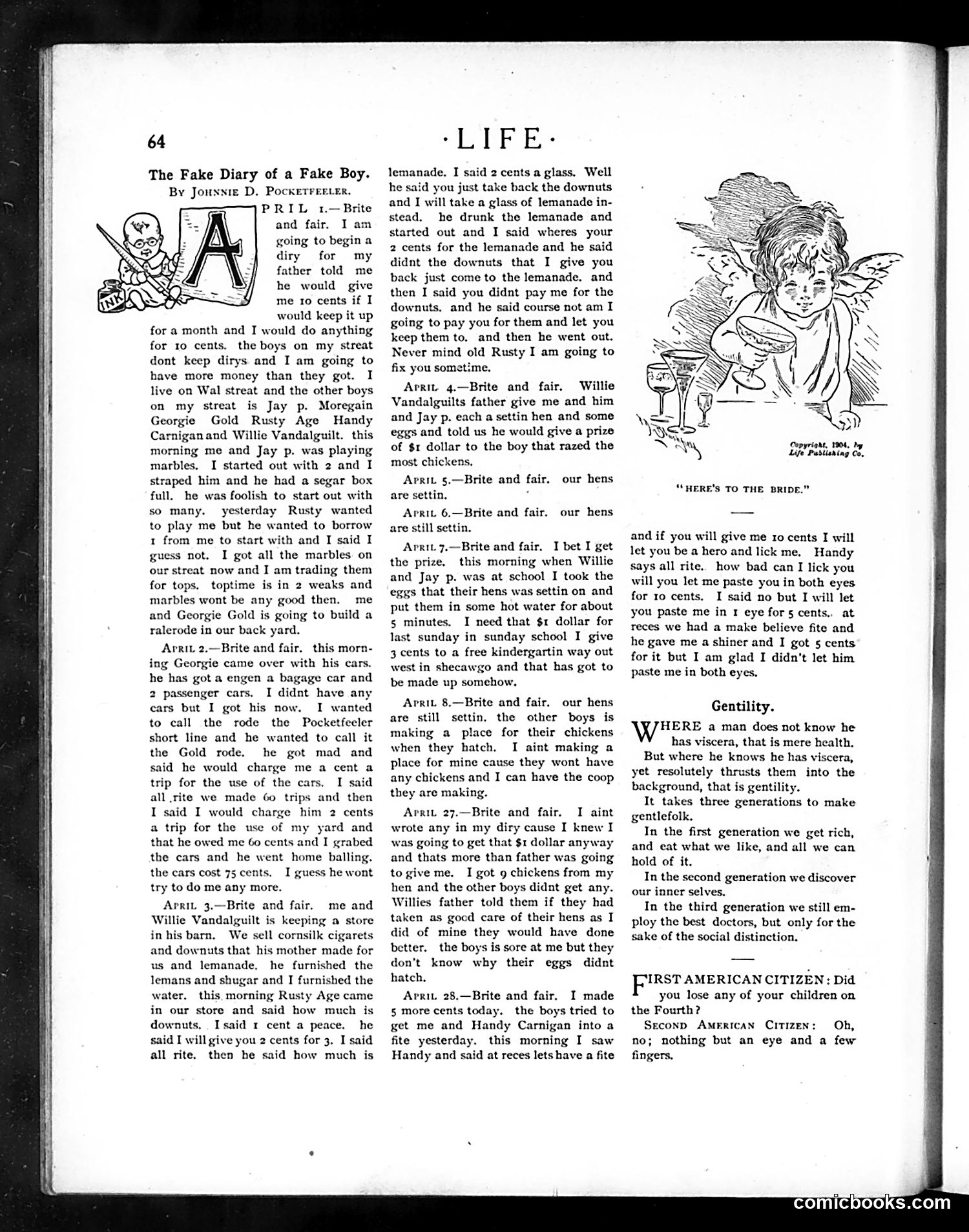
This satirical piece mocks a dishonest child narrator who keeps a diary for monetary reward. The humor lies in the boy's petty swindling and moral flexibility: he manipulates playmates in marble trades, cheats his friend Georgie over railroad toll rights, tricks customers at his lemonade stand, and—most damningly—*boils the eggs* of his competitors' hens to sabotage their chances at winning a chicken-raising prize, ensuring he alone collects the promised dollar. The satire targets Gilded Age values: get-rich-quick schemes, competitive self-interest over friendship, and rationalization of dishonesty. The misspellings ("diry," "segar," "engen") reinforce the child's voice. The narrator sees no moral problem with his actions—he even justifies stealing eggs by referencing his Sunday school donation—exposing how capitalist ambition corrupts even youth. The joke is that this "fake boy" embodies very real American economic behavior.
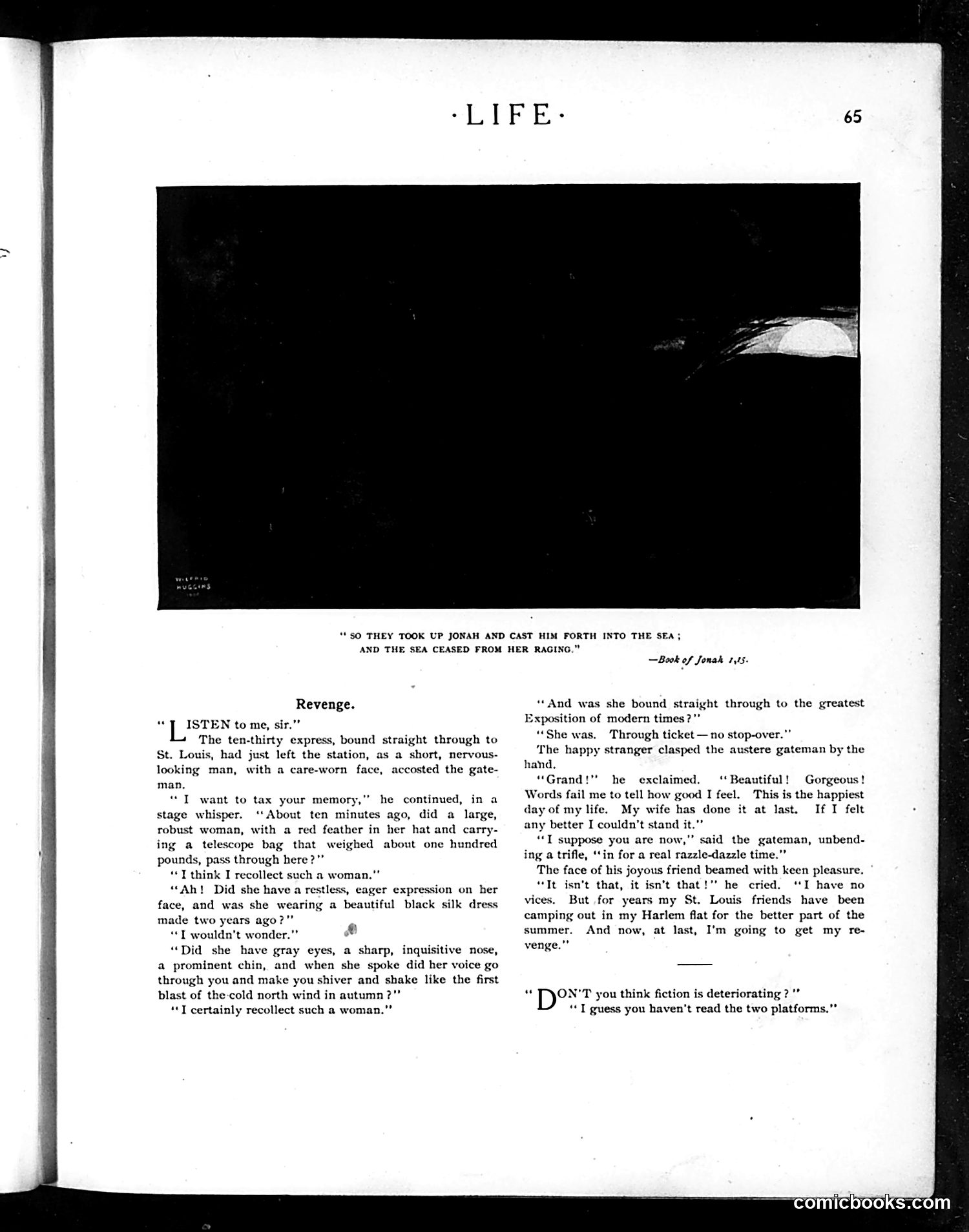
This is a humorous short story rather than a political cartoon. The narrative depicts a man's delight at finally rid of unwanted houseguests—his St. Louis friends who have been occupying his Harlem apartment throughout summers. The "revenge" is sending his wife (described in detail: gray eyes, sharp nose, red-feathered hat, telescope bag) on a one-way ticket to "the greatest Exposition of modern times" (likely the 1893 World's Columbian Exposition in Chicago, given the reference to St. Louis connections). The joke: he's gleefully shipping her away to finally have peace and quiet in his home. The page's closing exchange about "fiction deteriorating" versus "the two platforms" appears to be a separate satirical quip, likely referencing contemporary political party platforms—suggesting even fictional narratives are more entertaining than real politics. The biblical epigraph comparing the scenario to Jonah being cast into the sea adds mordant religious humor to the domestic complaint.
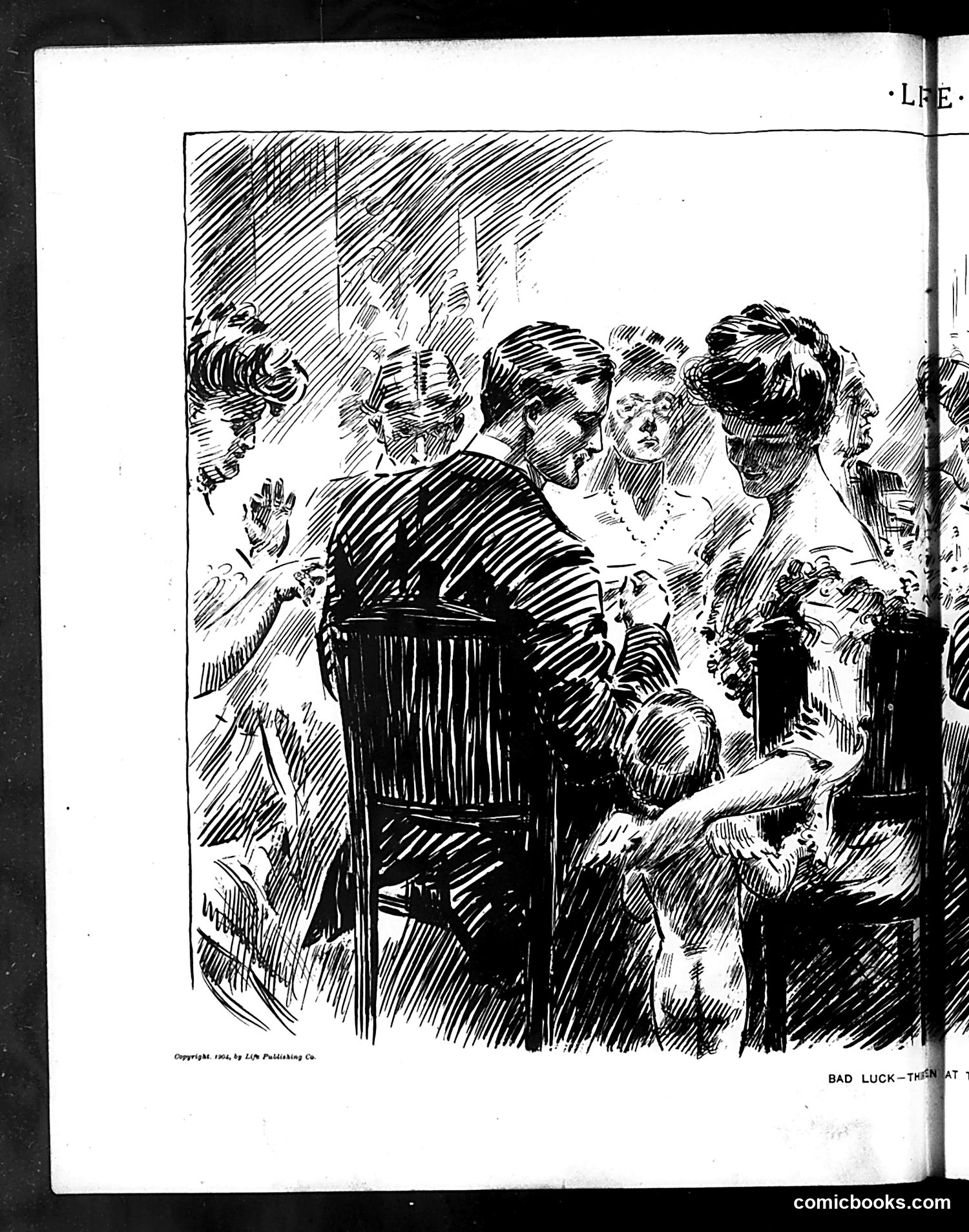
This is a satirical cartoon from Life magazine (copyright 1904, by Life Publishing Co., as shown). The incomplete caption reads "BAD LUCK—THIS[?] AT..." which obscures the full joke. The image shows a well-dressed man in dark clothing surrounded by several women in an interior setting. The style and composition suggests a social satire about romantic or social misfortune—likely depicting a gentleman experiencing "bad luck" in some domestic or social situation involving women. Without the complete caption text, the specific target of the satire remains unclear. The drawing style is typical of early-1900s American editorial cartooning. The humor appears to rely on the visual situation rather than identification of specific political figures, suggesting this may be social rather than political satire.
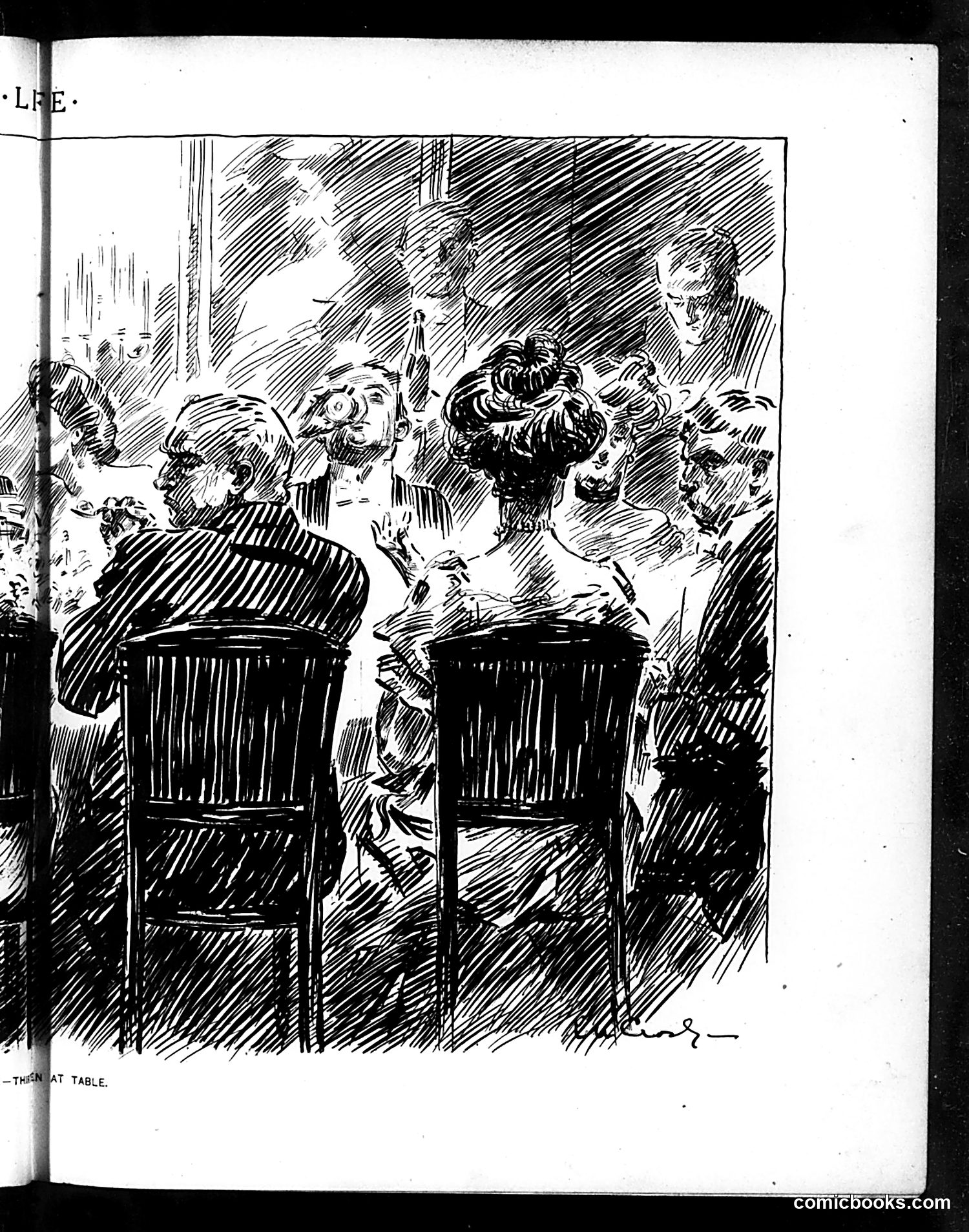
This ink sketch depicts a dinner party scene with multiple figures seated and standing around a table. The caption reads "Them at Table," suggesting social satire about dining etiquette or class behavior. The drawing style—loose, gestural crosshatching—is typical of Life magazine's satirical illustration. The composition shows what appears to be well-dressed individuals in various states of animated conversation or dining, with exaggerated facial expressions characteristic of period caricature. Without clearer OCR text or identifying details, the specific targets of satire remain unclear. It likely mocks contemporary social pretensions, dining customs, or particular public figures of its era, but the exact reference cannot be determined from the image alone.
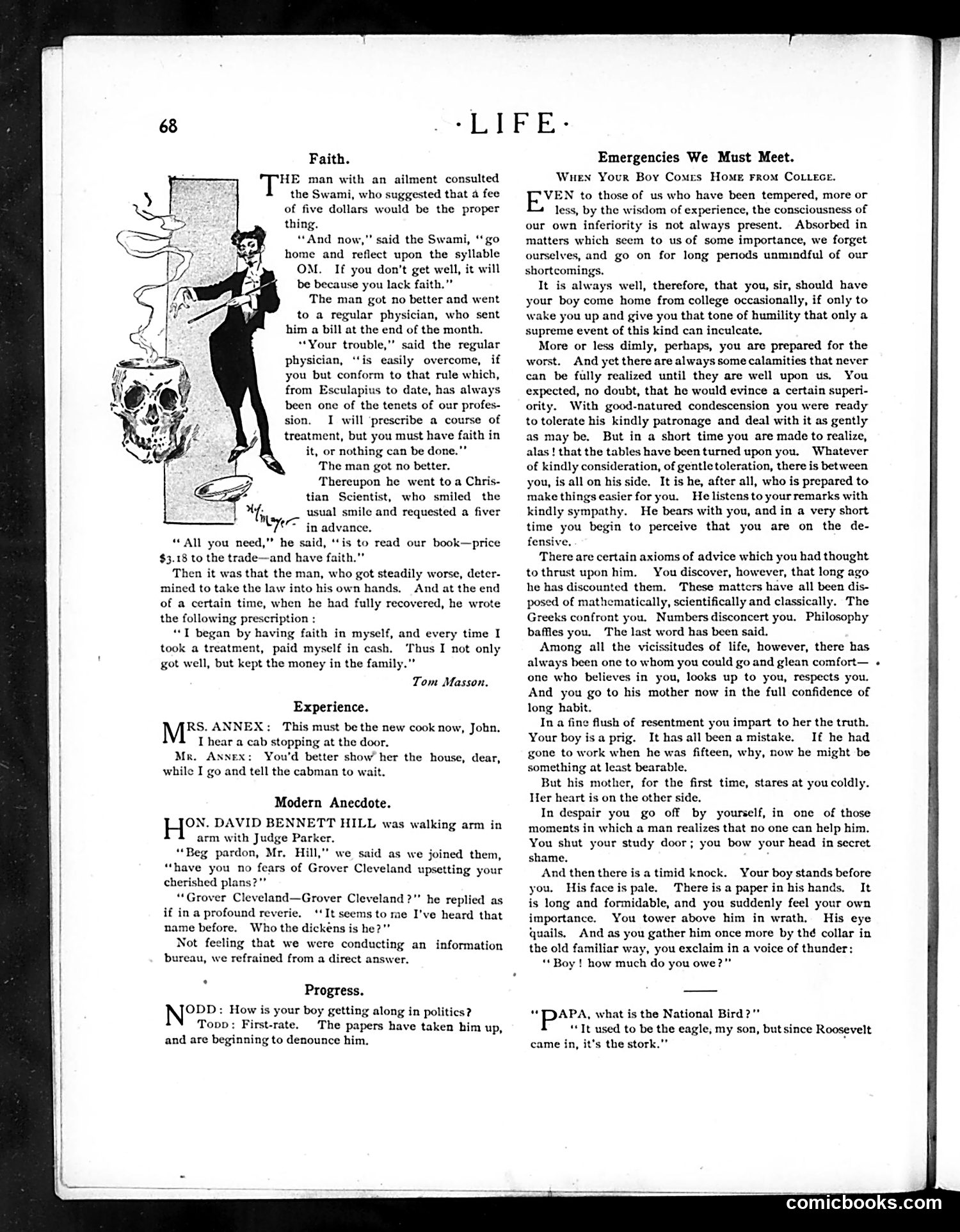
**"Faith" Cartoon (Top Left):** This satirizes faith-healing practitioners. A man consults three practitioners—a Swami, a regular physician, and a Christian Scientist—each demanding payment and insisting faith is essential. All fail. The joke: the man recovers only after deciding to "have faith in myself" and pay himself instead of the practitioners. This mocks the era's proliferation of alternative healers who exploited patients' desperation while promising miracle cures through belief alone. **"Modern Anecdote":** References David B. Hill and Judge Parker (likely Alton B. Parker, 1904 Democratic presidential nominee) discussing Grover Cleveland. Hill's feigned amnesia about Cleveland—a major political figure and two-term president—is absurdist humor mocking political pretense and the fleeting nature of political fame. **"When Your Boy Comes Home from College":** A humorous essay about role-reversal: the college-educated son becomes the intellectual superior, leaving parents feeling defensive rather than authoritative. This satirizes the generational gap and anxiety about education's social mobility effects.
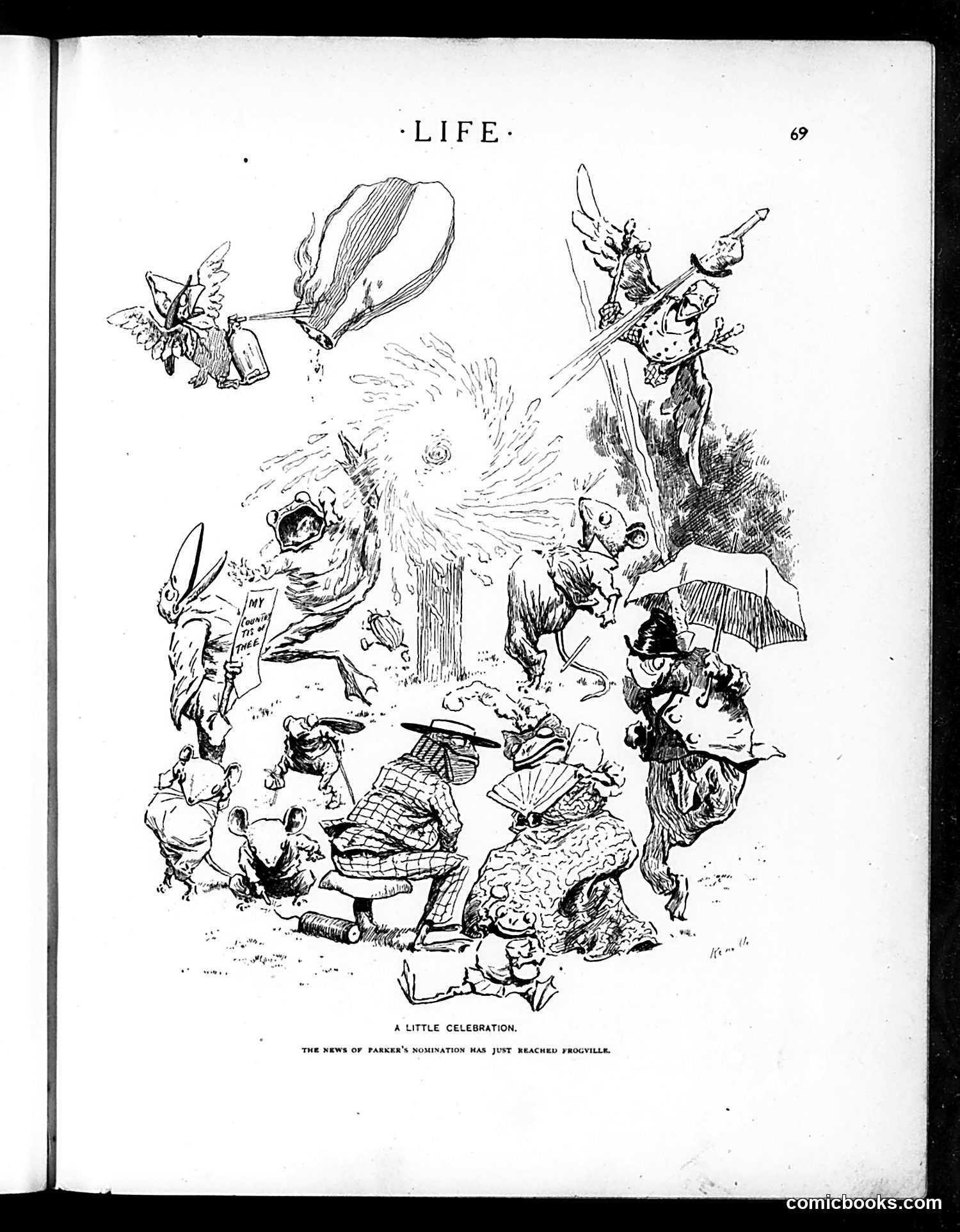
This is a satirical cartoon depicting animals in "Frogville" celebrating news of Parker's nomination. The caption references Alton B. Parker's nomination as a U.S. presidential candidate (likely 1904). The cartoon shows various anthropomorphized animals—frogs, toads, and other creatures—in an excited, chaotic celebration with musical instruments, balloons, and festive props. The satire appears to mock either: 1. Parker's candidacy itself as laughable or unworthy of serious attention, or 2. His supporters as provincial, unsophisticated, or "small-time" (hence the rural "Frogville" setting) The deliberate use of animals and a backwater location suggests the cartoonist intended ridicule of Parker's nomination or his political base. Without additional context about Life magazine's 1904 editorial stance, the exact target remains somewhat unclear, but the tone is clearly derisive.
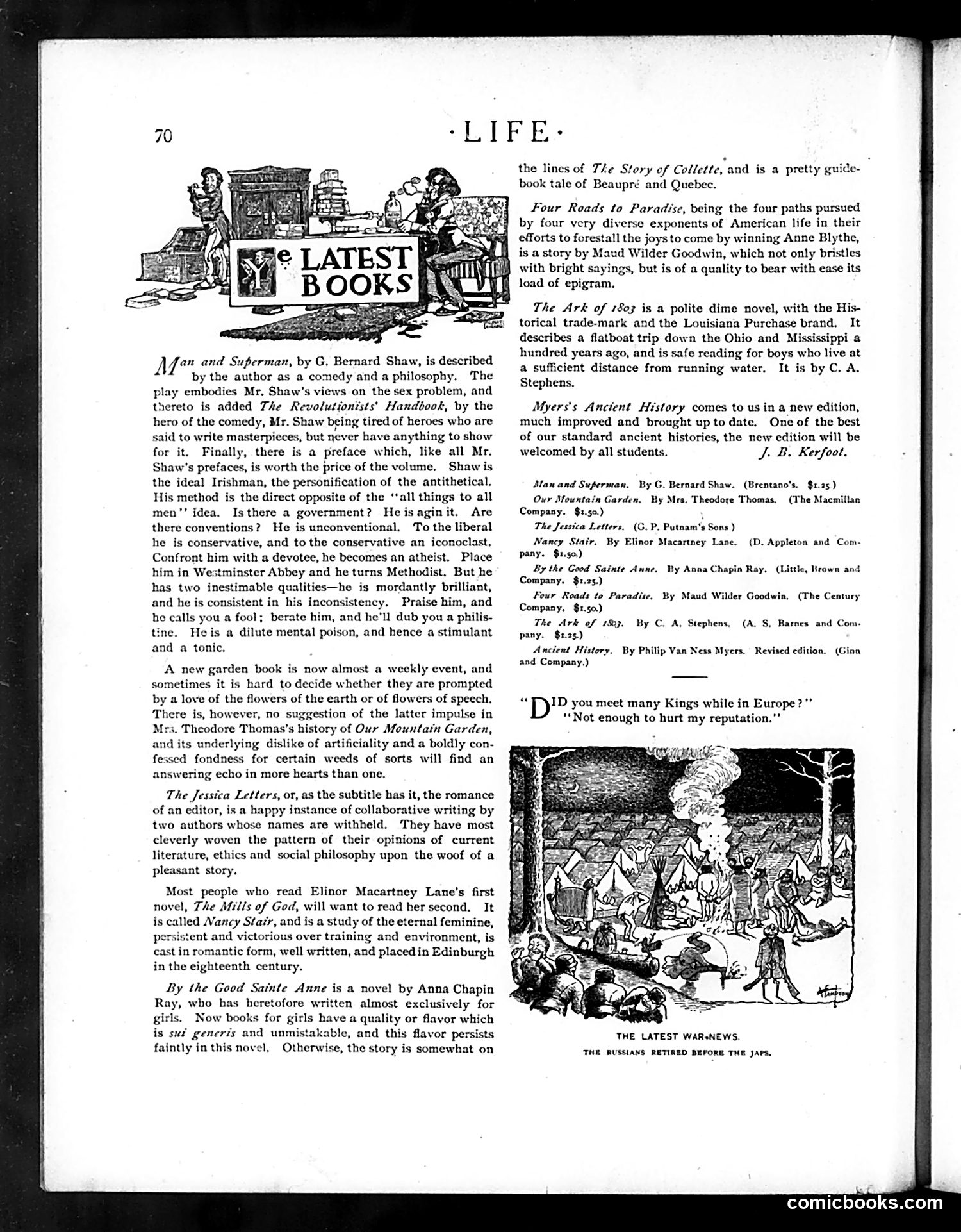
This page is primarily a **book review section**, not political satire. It discusses recent literary publications from the early 1900s. The main content reviews G. Bernard Shaw's *Man and Superman*, characterizing Shaw himself as the archetypal Irish intellectual: a contrarian who opposes whatever exists. If there's government, he's against it; confront a devotee and he becomes an atheist; praise him and he calls you a fool. The reviewer presents this as Shaw's defining trait—he's "consistent in his inconsistency" and functions as "a dilute mental poison" and stimulant. The page also reviews gardening books, novels by Elinor Macartney Lane and Anna Chapin Ray, and educational texts. A small illustration captioned "The Latest War-News: The Russians Retired Before the Japs" appears at bottom right, likely referencing the Russo-Japanese War. The content is straightforward literary criticism rather than political commentary or satire.
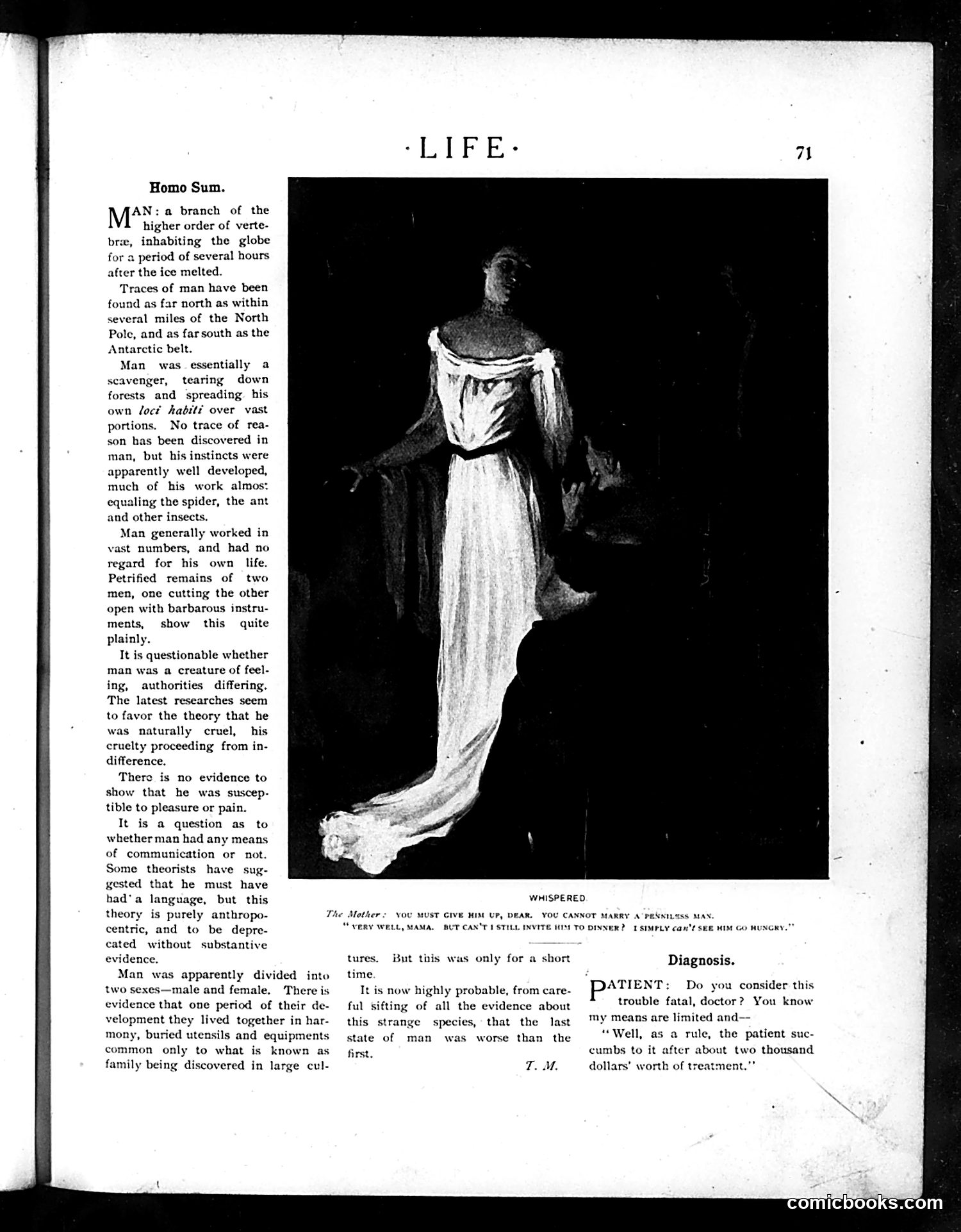
This Life magazine page contains social satire on two fronts: **"Homo Sum"** (left) is a mock-scientific definition of humanity written as if by future paleontologists examining extinct man. The satire attacks human nature itself—presenting mankind as a mindless scavenger without reason, feeling, or communication skills, whose sole accomplishments equal insects. The cruel irony is describing humans as naturally brutal and indifferent, with evidence of cannibalism. This biting critique of human civilization was likely a commentary on contemporary society's violence and destructiveness. **Two cartoon vignettes** (right) satirize romantic and medical hypocrisy: The first shows a mother forcing her daughter to reject a poor suitor, yet the daughter's concern is only that she still feed him. The second mocks doctors who exploit wealthy patients' hypochondria, extracting expensive "treatment" for psychosomatic ailments. Both target class prejudice and professional exploitation. The overall effect is cynical about human nature, social conventions, and institutions.
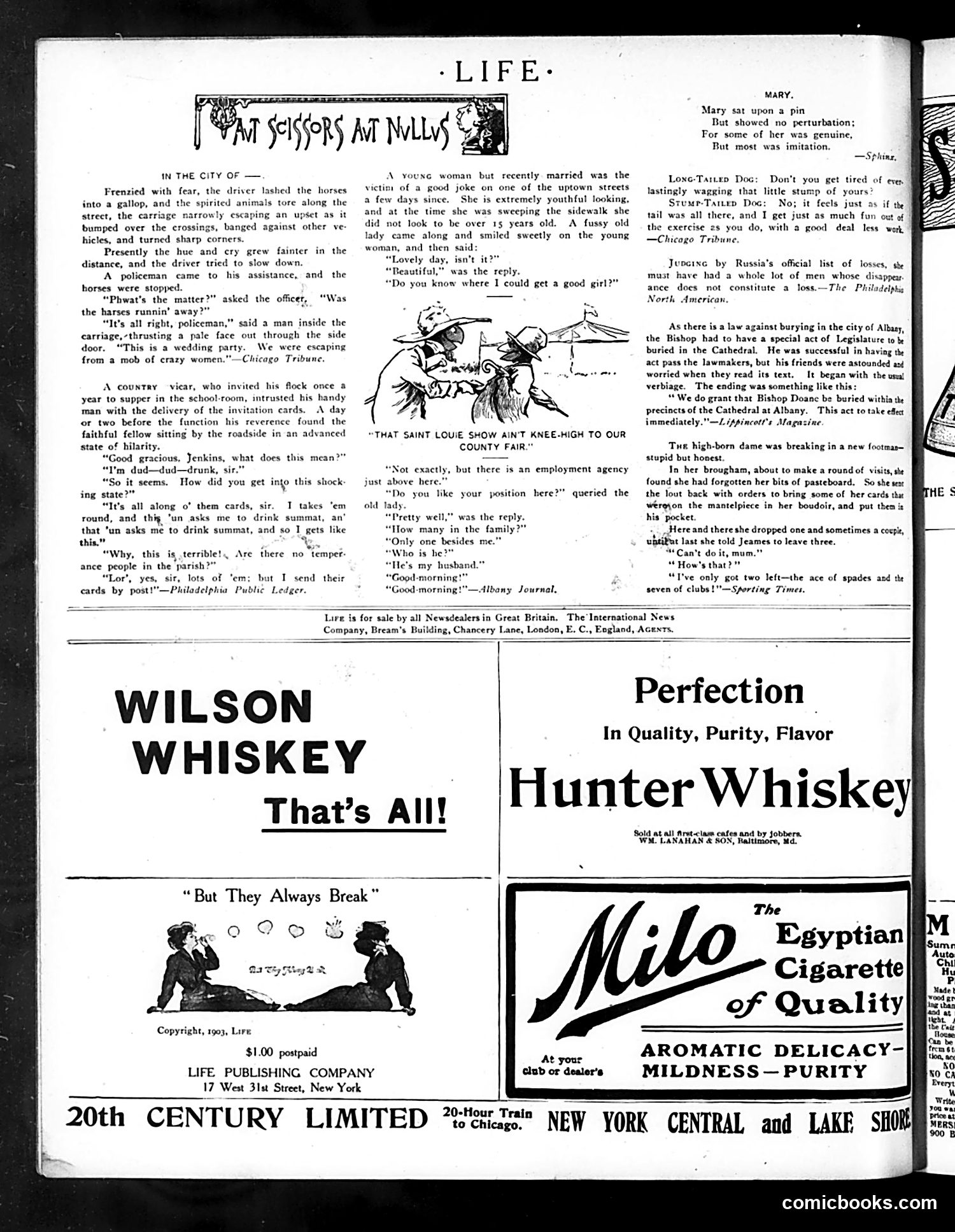
This page contains several brief humorous anecdotes typical of early 20th-century Life magazine's satirical humor: **Main cartoon**: A runaway carriage incident where a groom explains the horses bolted because they were "escaping from a mob of crazy women"—likely referring to suffragettes or women's rights activists, who were prominent and often portrayed as threatening/hysterical in period satire. **Other jokes include**: A drunken servant who delivered wedding invitations door-to-door and got drunk at each stop; a young married woman mistaken for a child servant; and various brief quips about Russian military losses, a bishop's burial legislation, and a forgetful society woman. The humor relies on class distinctions, gender stereotypes, and period-specific social anxieties. The page is primarily advertising and short comedy bits rather than sustained political commentary.
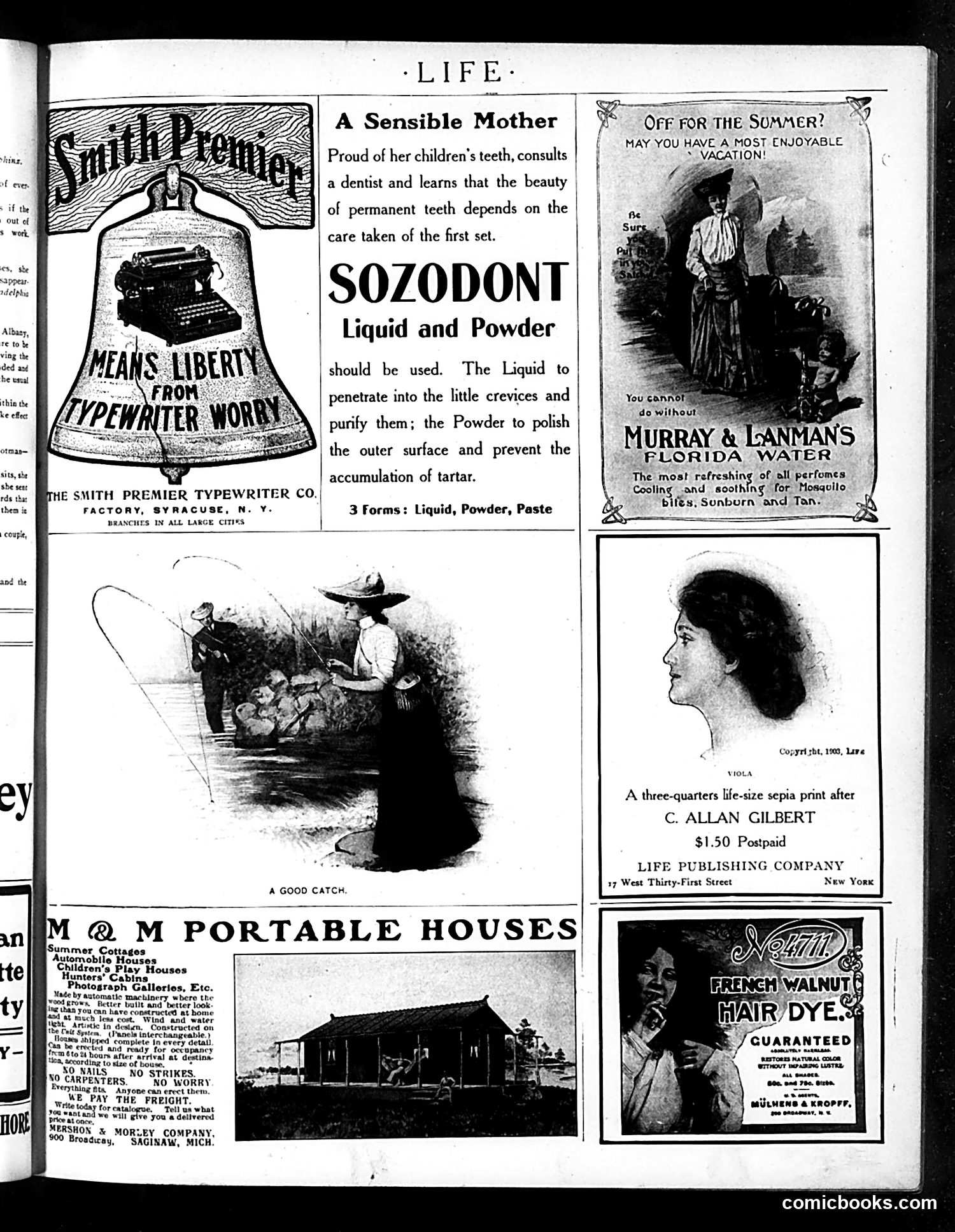
This page is primarily **advertising**, not editorial satire. It contains five distinct advertisements interspersed with one illustration titled "A Good Catch." **Key Advertisements:** - **Smith Premier Typewriter**: Promotes "liberty from typewriter worry" - **Sozodont**: A tooth-care product (liquid and powder) marketed to mothers concerned with children's dental health - **Murray & Lanman's Florida Water**: A perfume/cologne advertised as cooling relief for mosquito bites and sunburn—targeting summer travelers - **M & M Portable Houses**: Prefabricated homes shipped complete, emphasizing affordability and ease of construction - **Neith French Walnut Hair Dye**: Hair coloring product with guaranteed results The illustration "A Good Catch" depicts a woman fishing, appearing to be a generic humorous scene rather than political commentary. The page reflects early 20th-century consumer culture and advertising strategies targeting middle-class concerns: hygiene, convenience, summer leisure, home ownership, and personal appearance.
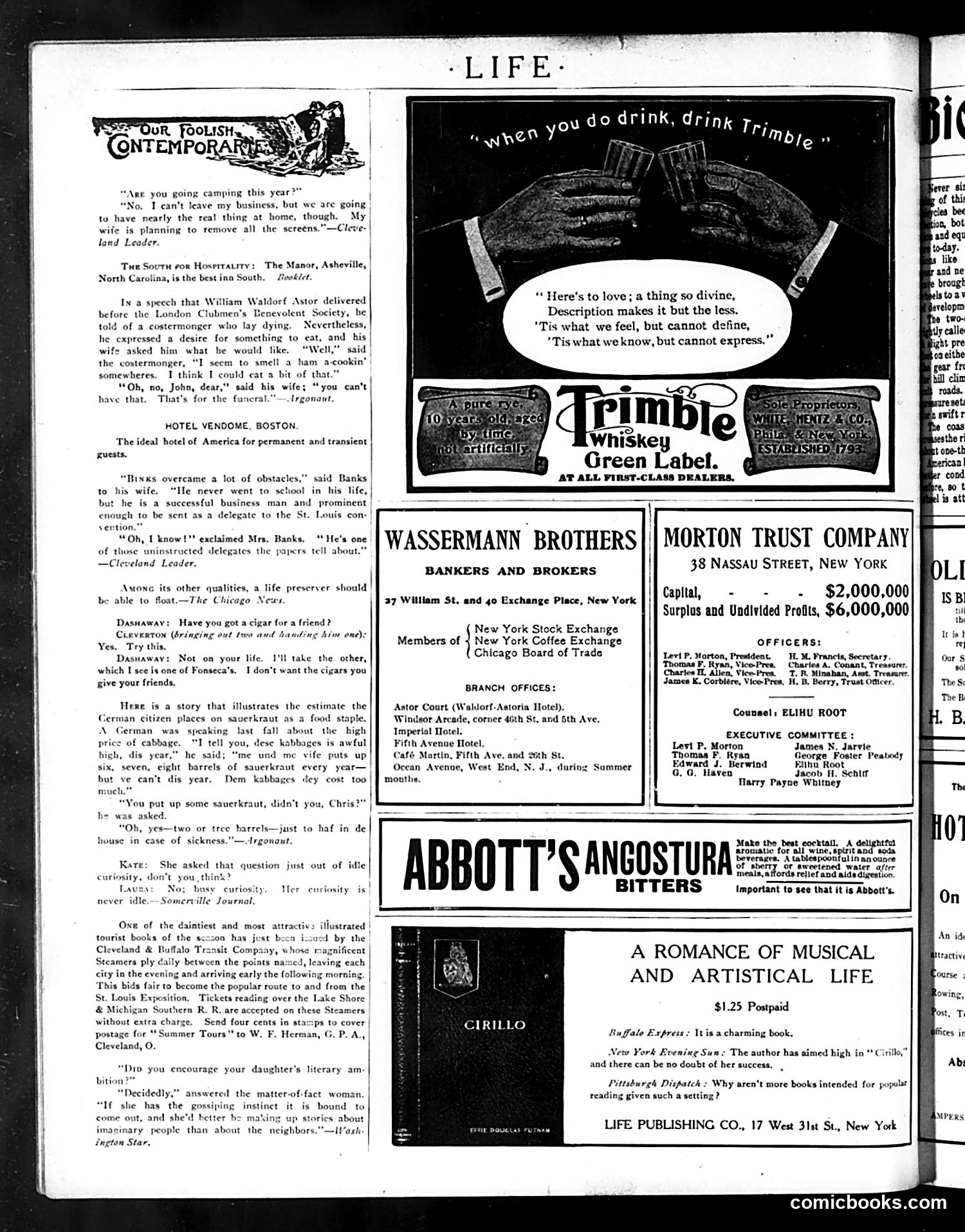
This page is primarily **advertisements and humorous anecdotes** rather than political cartoons. The content includes: **Main Advertisement**: Trimble Whiskey dominates the center with a romantic toast ("Here's to love..."), typical of early 20th-century liquor marketing that emphasized sophistication and emotion. **Financial/Business Ads**: Wassermann Brothers and Morton Trust Company advertise banking services—standard for Life's affluent readership. **Humorous Anecdotes**: The text features brief jokes satirizing American life: - A camping joke about removing window screens (implying mosquitoes/discomfort) - A story about a dying working-class man denied ham at his funeral - Social commentary on "uninstructed delegates" (likely referencing political conventions) - A German immigrant's sauerkraut stockpiling (ethnic humor about thrift and food preservation) **Abbott's Bitters Ad**: Promotes medicinal liquor as a digestive aid—common patent medicine marketing of the era. The page reflects early 1900s magazine culture: genteel humor for educated readers, advertisements targeting the wealthy, and mild ethnic/class-based comedy that was considered acceptable entertainment.
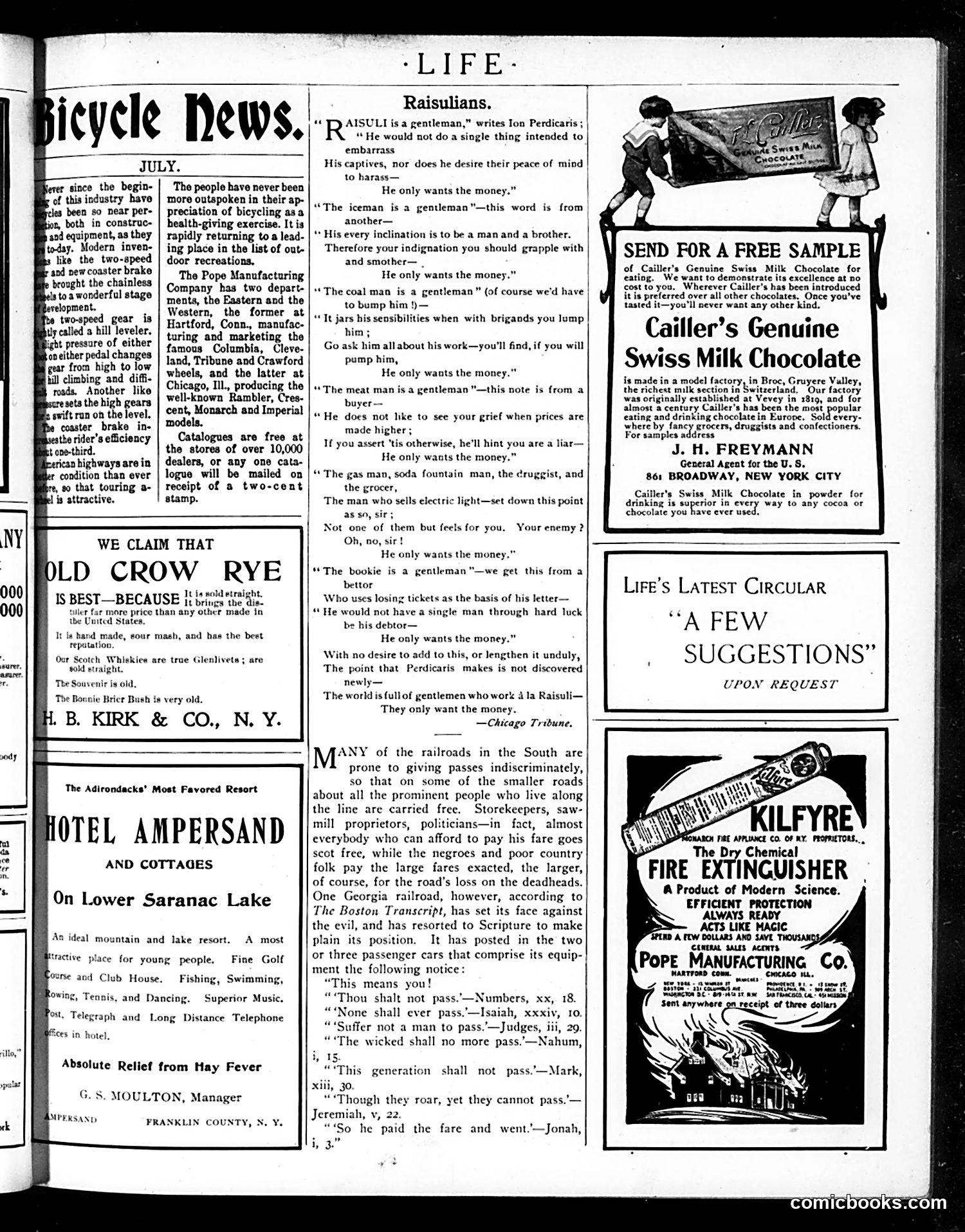
This page primarily contains **advertisements and satirical verse**, not political cartoons. The main satirical content is a poem titled "Raisulians," referencing the **1904 kidnapping of American Ion Perdicaris by Moroccan chieftain Raisuli**. The verse sarcastically claims various tradesmen—icemen, coal men, butchers, druggists—are "gentlemen" who only "want the money," using Perdicaris's polite language about his captor to mock everyday merchants and service workers who exploit customers for profit. The satire equates common commercial greed with kidnapping: ordinary businessmen are as mercenary as a brigand, just more socially acceptable. It's a commentary on American consumer culture and the hypocrisy of treating profit-driven exploitation as gentlemanly conduct. The remainder consists of bicycle industry news and period advertisements (Old Crow Rye whiskey, Hotel Ampersand, Cailler's Swiss Milk Chocolate).
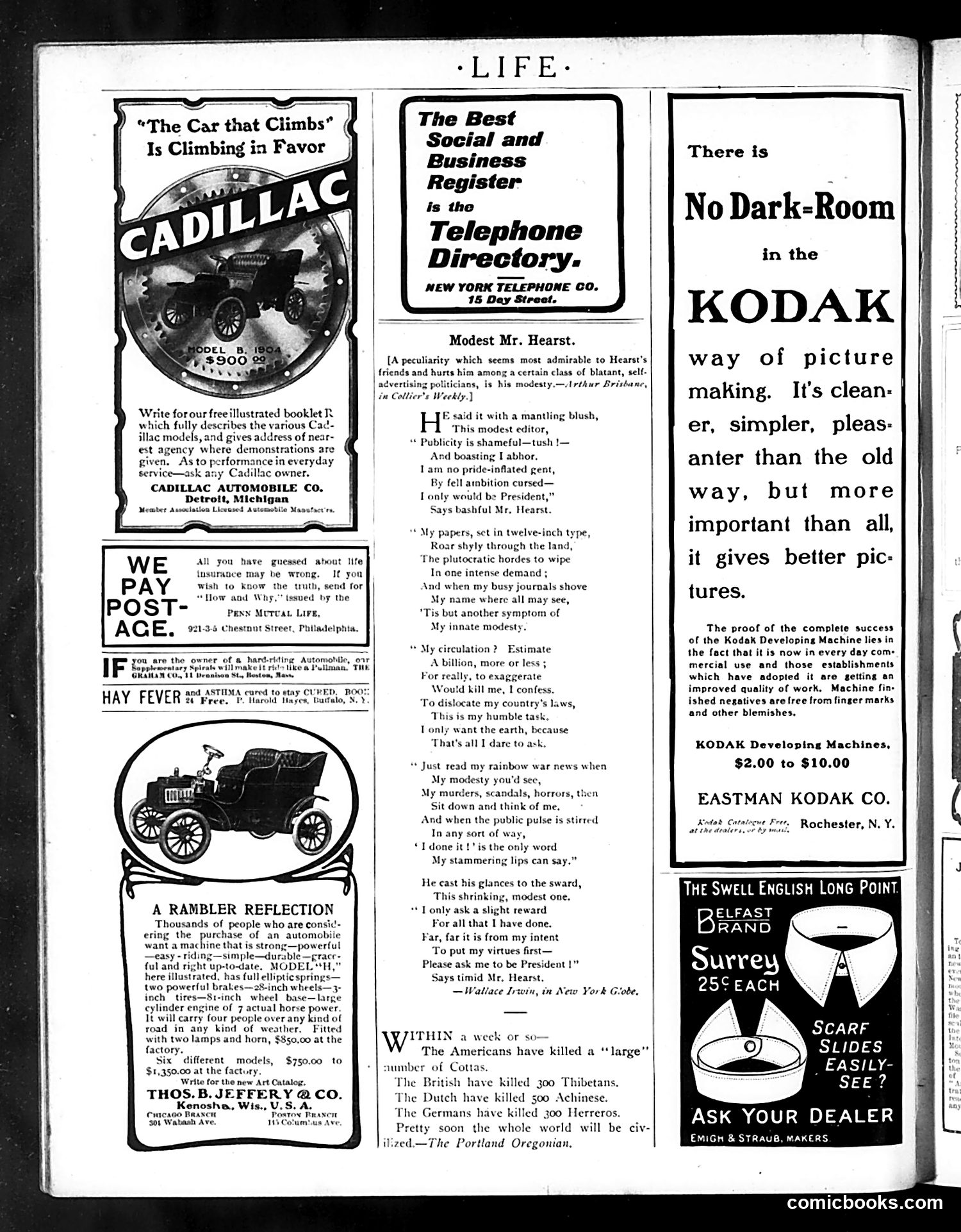
This page's central satire targets **William Randolph Hearst**, the powerful newspaper magnate, through a poem mocking his claimed modesty. The text, attributed to Wallace Irwin, is clearly ironic: Hearst professes humility while describing massive newspaper circulation, desires to reshape national laws, and seeks the presidency—all while insisting he "only want[s] the earth." The poem ridicules Hearst's self-aggrandizing journalism, particularly his sensationalist "rainbow war news" coverage of international conflicts. The closing section darkly lists recent colonial violence (Americans killing Cottas, British killing Thibetans, Dutch killing Achinese, Germans killing Herreros), suggesting Hearst's inflammatory war reporting contributes to global militarism. The satire exposes the contradiction between Hearst's professed reluctance for power and his obvious hunger for it—a common *Life* magazine critique of the publisher's outsized influence over American politics and public opinion.
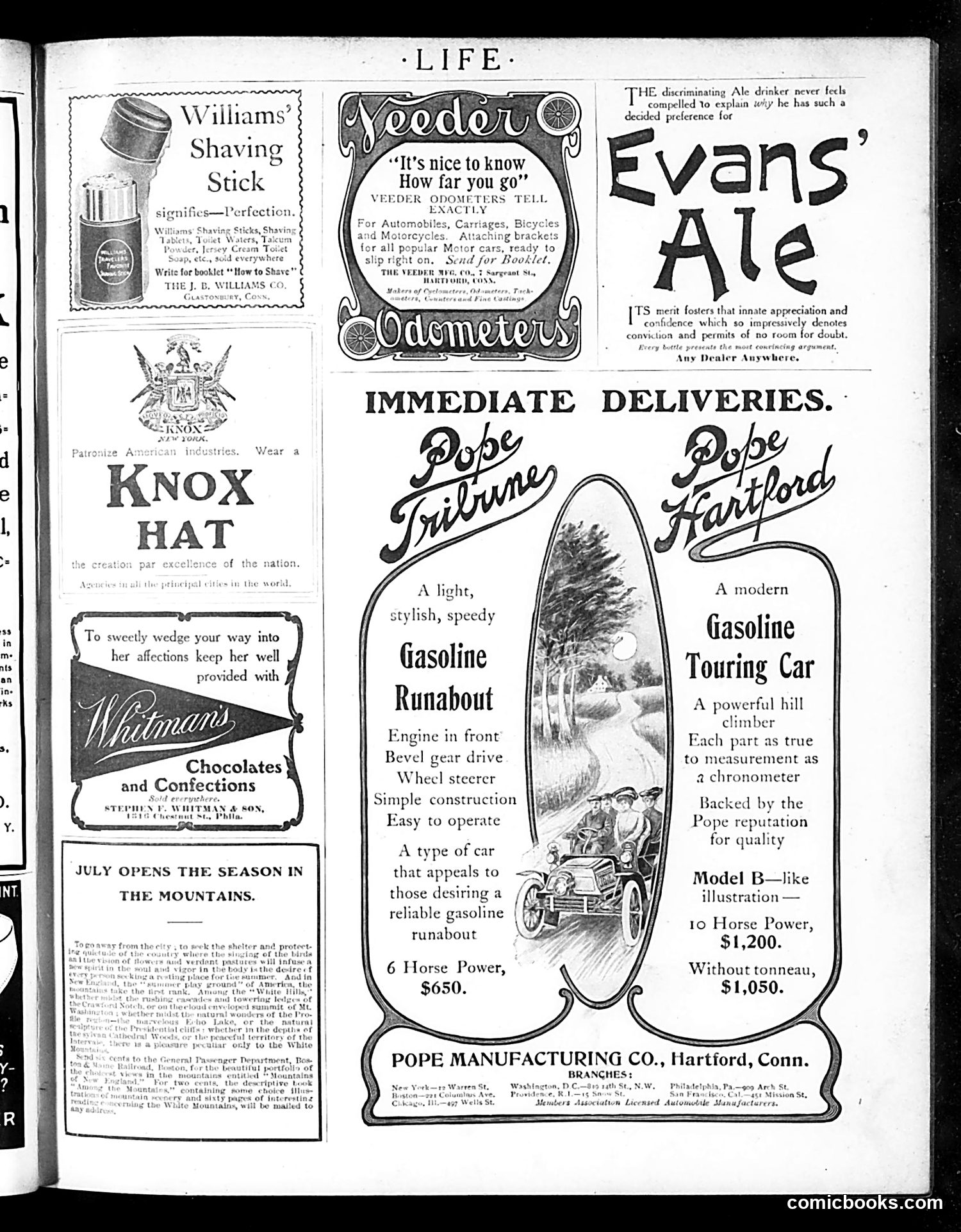
This is primarily an **advertising page** rather than satirical content. It features early 1900s consumer product ads with minimal cartoonish or political commentary. The notable exception is the **Evans' Ale advertisement** (top right), which uses a brief satirical angle: it jokes that discriminating ale drinkers never feel compelled to explain their preference—implying Evans' Ale is so obviously superior that defending the choice is unnecessary. This is mild mockery of competitive beers rather than political satire. The remaining content is straightforward product promotion: Williams Shaving Stick, Knox Hats, Whitman's Chocolates, Veeder Odometers, and Pope Manufacturing Company automobiles (the Tribine and Hartford models). The mountain-resort notice advertises summer travel. The ads reflect early automotive and consumer culture, with prices ($650-$1,200 for cars) and features (horse power, hill-climbing ability) typical of the era. No identifiable political figures or events are present.
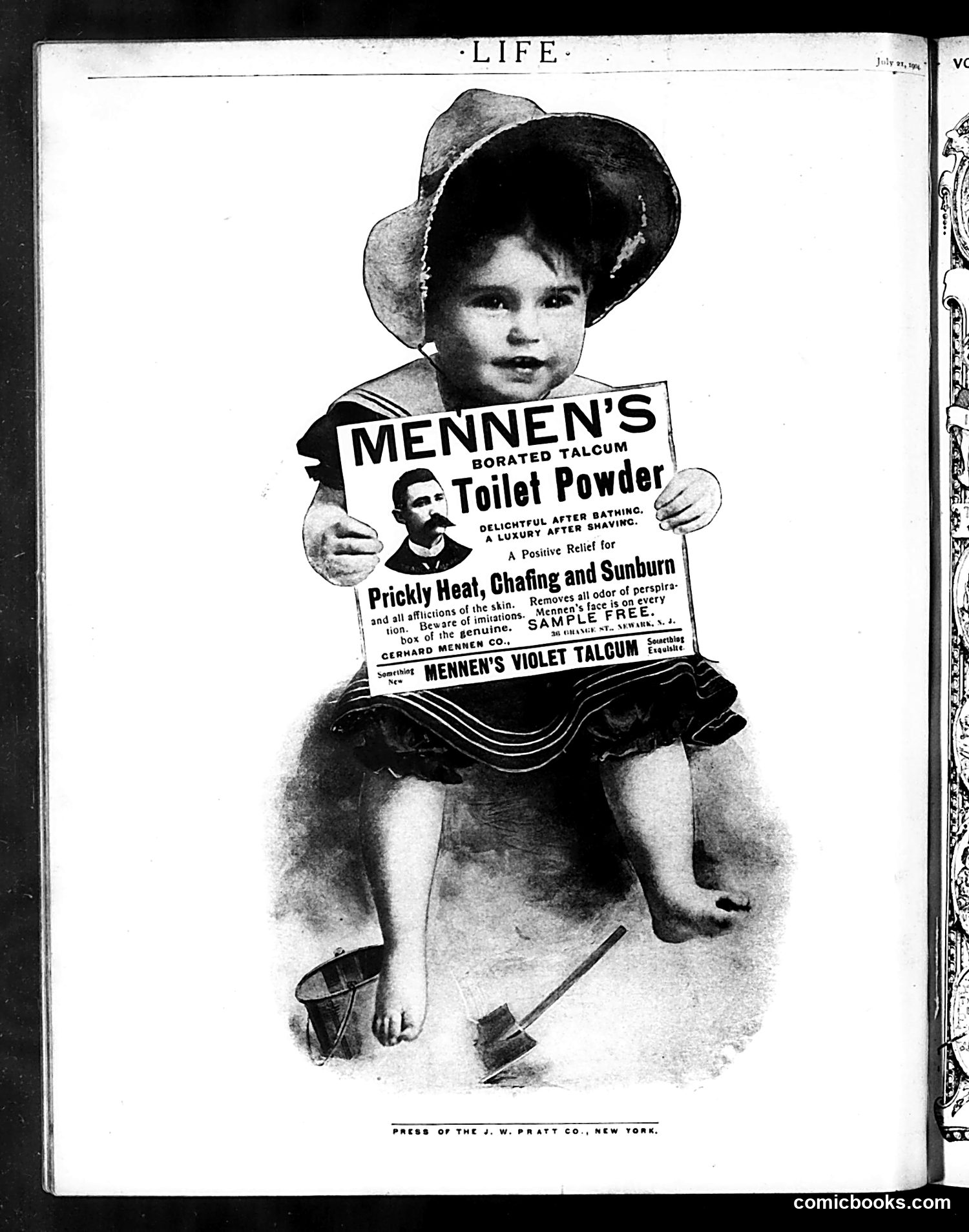
This is a **product advertisement**, not political satire. It shows a young child in a wide-brimmed hat holding a shovel, promoting **Mennen's Borated Talcum Toilet Powder**—a men's grooming product made by Gerhard Mennen Co. The ad copy emphasizes relief from "Prickly Heat, Chafing and Sunburn" and claims the powder removes perspiration odor. It mentions a sample is available free. The humor appears gentle and period-appropriate: using a child as an endorser to suggest innocence and wholesomeness of the product. The child's outdoor play (with shovel) and casual attire contrast with the formal product claims about grooming and hygiene. This reflects early 20th-century advertising conventions where children were commonly featured in product promotions without modern safety or ethical concerns. The ad ran in **Life**, which published both satirical content and conventional advertising.