
Life, 1904-07-14 · page 37 of 44
Life — July 14, 1904 — page 37: what you’re looking at
What you’re looking at
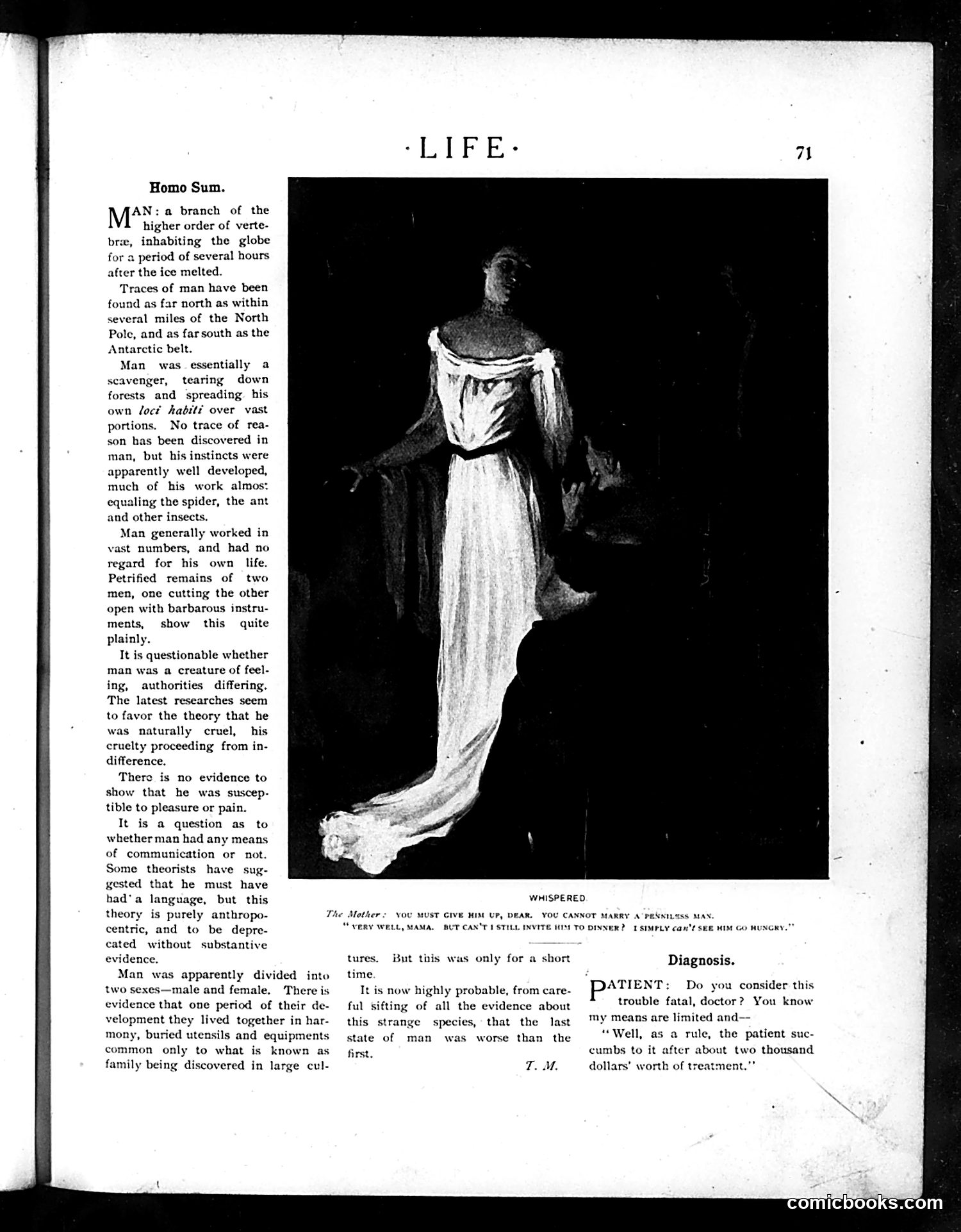
This Life magazine page contains social satire on two fronts: **"Homo Sum"** (left) is a mock-scientific definition of humanity written as if by future paleontologists examining extinct man. The satire attacks human nature itself—presenting mankind as a mindless scavenger without reason, feeling, or communication skills, whose sole accomplishments equal insects. The cruel irony is describing humans as naturally brutal and indifferent, with evidence of cannibalism. This biting critique of human civilization was likely a commentary on contemporary society's violence and destructiveness. **Two cartoon vignettes** (right) satirize romantic and medical hypocrisy: The first shows a mother forcing her daughter to reject a poor suitor, yet the daughter's concern is only that she still feed him. The second mocks doctors who exploit wealthy patients' hypochondria, extracting expensive "treatment" for psychosomatic ailments. Both target class prejudice and professional exploitation. The overall effect is cynical about human nature, social conventions, and institutions.
📄 Transcribed text from this page (OCR, searchable)
Machine-transcribed from the original scan — historical spelling and the odd misread are preserved.
Homo Sum. AN: a branch of the higher order of verte- bre, inhabiting the globe for a period of several hours after the ice melted. Traces of man have been found as far north as within several miles of the North Pole, and as farsouth as the Antarctic belt. Man was _ essentially a scavenger, tearing down forests and spreading his own oct habité over vast portions. No trace of rea- son has been discovered in man, but his instincts were apparently well developed, much of his work almos: equaling the spider, the ant and other insects. Man generally worked in vast numbers, and had no regard for his own life. Petrified remains of two men, one cutting the other open with barbarous instru- ments, show this quite plainly. It is questionable whether man was a creature of feel- ing, authorities differing. The latest researches seem to favor the theory that he was naturally cruel, his cruelty proceeding from in- difference, There is no evidence to show that he was suscep- tible to pleasure or pain. It is a question as to whether man had any means of communication or not. Some theorists have sug- gested that he must have had'a language, but this theory is purely anthropo- Th centric, and to be depre- cated without substantive evidence. Man was apparently divided into two sexes—male and female. There is evidence that one period of their de- velopment they lived together in har- mony, buried utensils and equipments common only to what is known as family being discovered in large cul- WHISPERED. he Mother: You MUST GIVE MIM UP, DEAR. “VERY WELL, MAMA. tures. time. It is now highly probable, from care- ful sifting of all the evidence about this s species, that the last state of worse than the first. But this was only for a short ange man was T. M. PATieNt : YOU CANNOT MARRY A PRENILESS ALAN, AUT CAN'T I STILL INVITE IM TO DINNER? SIMPLY can"? SEE HIM GO HUNGRY.” Diagnosis. Do you consider this trouble fatal, doctor? You know my means are limited and— “Well, as a rule, the patient suc- cumbs to it about two thousand dollars’ worth of treatment."" after