
Life, 1904-07-14 · page 8 of 44
Life — July 14, 1904 — page 8: what you’re looking at
What you’re looking at
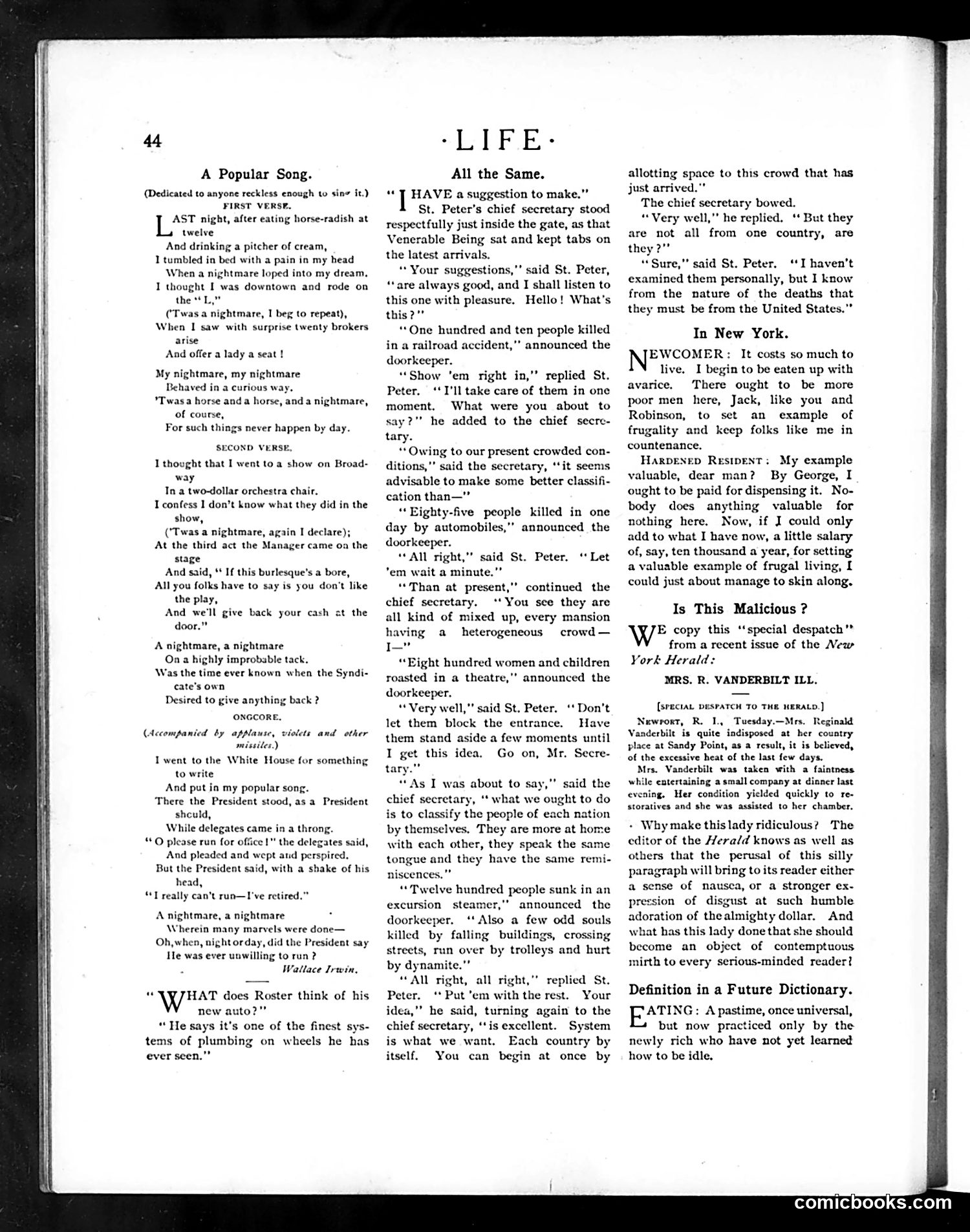
This page contains three distinct pieces: 1. **"A Popular Song"** — A humorous poem about nightmares and comedic misadventures, unrelated to politics. 2. **"All the Same"** — A satirical dialogue featuring "St. Peter" and a chief secretary discussing immigrants arriving at the gates. The joke mocks bureaucratic classification systems: St. Peter wants to organize newcomers by nationality, but the secretary points out they're "all kind of mixed up" and speak the same languages—suggesting that national distinctions are meaningless. This likely satirizes early 1900s immigration debates and the futility of strict classification systems. 3. **"In New York"** and **"Is This Malicious?"** — A brief item questioning why a newspaper would publish a disparaging anecdote about a wealthy widow (Mrs. R. Vanderbilt III), suggesting the publication was unnecessarily cruel to a prominent figure. The page reflects Life's satirical approach to contemporary social and political issues of its era.
📄 Transcribed text from this page (OCR, searchable)
Machine-transcribed from the original scan — historical spelling and the odd misread are preserved.
44 A Popular Song. (Dedicated to anyone reckless enough to sine it.) FIRST VERSE. AST night, after eating horse-radish at twelve And drinking a pitcher of cream, 1 tumbled in bed with a pain in my head When a nightmare loped into my dream, I thought I was downtown and rode on the * 1," (‘Twas a nightmare, I beg to repeat), When I saw with surprise twenty brokers arise And offer a lady a seat ! My nightmare, my nightmare Behaved in a curious way. 'Twasa horse anda horse, anda nightmare, of course, For such things never happen by day. SECOND VERSE, I thought that I went to a show on Broad- way In a two-dollar orchestra chair. I confess 1 don’t know what they did in the show, (‘Twas a nightmare, again I declare); At the third act the Manager came oa the stage And said, * If this burlesque's a bore, All you folks have to say is you don’t like the play, And we'll give back your cash at the door.” A nightmare, a nightmare On a highly improbable tack. Was the time ever known when the Syndi- cate’s own Desired to give anything back ? onccore. (Accompanied by applause, missiles.) jolets and other IT went to the White House for something tow And put in my popular song. There the President stood, as a President shuld, While delegates came in a throng. “0 please run for office 1" the delegates said, And pleaded and wept and perspired. But the President said, with a shake of his head, “T really can't run—I've retired.” A nightmare, a nightmare Wherein many marvels were done— Oh,when, night orday, did the President say Ie was ever unwilling to run ? Wallace Irwin, “Y/HAT does Roster think of his new auto?” “ He says it's one of the finest sys- tems of plumbing on wheels he has ever seen."" “TPE: All the Same. “T HAVE a suggestion to make.” St. Peter’s chief secretary stood respectfully just inside the gate, as that Venerable Being sat and kept tabs on the latest arrival “Your suggestions,"’ said St. Peter, “‘are always good, and I shall listen to this one with pleasure. Hello! What's this?"" “One hundred and ten people killed in a railroad accident,”” announced the doorkeeper. “Show ‘em right in,’ replied St. Peter. ‘I'll take care of them in one moment. What were you about to say?" he added to the chief secre- tary. “Owing to our present crowded con- ditions," said the secretary, ‘‘it seems advisable to make some better classifi- cation than—"" “Eighty-five people killed in one day by automobiles,”” announced the doorkeeper. ‘All right,” said St. Peter. ‘em wait a minute."" “Than at present," continued the chief secretary. ‘You see they are all kind of mixed up, every mansion having a heterogeneous crowd — I” “Eight hundred women and children roasted in a theatre," announced the doorkeeper. “Very well,” said St, Peter. ‘* Don’t let them block the entrance. Have them stand aside a few moments until I get this idea, Go on, Mr. Secre- tary.” “Let As I was about to say," said the chief secretary, ‘t what we ought to do is to classify the people of each nation by themselves. They are more at home with each other, they speak the same tongue and they have the same remi- niscences.”" “Twelve hundred people sunk in an excursion steamer,"’ announced the doorkeeper. ‘Also a few odd souls killed by falling buildings, crossing streets, run over by trolleys and hurt by dynamite.” “All right, all right,"’ replied St. Peter, ‘* Put'em with the rest. Your idea,"’ he said, turning again to the chief secretary, ‘tis excellent. System is what we want. Each country by itself. You can begin at once by allotting space to this crowd that has just arrived. The chief secretary bowed. “Very well,” he replied. ‘ But they are not all from one country, are they?” “Sure,” said St. Peter, “I haven't examined them personally, but I know from the nature of the deaths that they must be from the United States. In New York. EWCOMER: It costs so much to live. I begin to be eaten up with avarice. There ought to be more poor men here, Jack, like you and Robinson, to set an example of frugality and keep folks like me in countenance. Harpenep Restpent: My example valuable, dear man? By George, I ought to be paid for dispensing it. No- body does anything valuable for nothing here. Now, if J could only add to what I have now, a little salary of, say, ten thousand a year, for setting a valuable example of frugal living, I could just about manage to skin along. Is This Malicious ? WF copy this ‘special despatch’* from a recent issue of the Mew York Herald: MRS. R. VANDERBILT ILL. [srectaL DEsratcn 70 THE MERALD.) Newrort, R. 1, Tuesday.—Mrs. Reginald Vanderbilt is quite indisposed at her country place at Sandy Point, as a result, it is believed, of the excessive heat of the last few day: Mrs. Vanderbilt was taken with a faintness le entertaining a small company at dinner last evening, Her condition yielded quickly to re storatives and she was assisted to her chamber. + Why make this lady ridiculous? The editor of the Hera/d knows as well as others that the perusal of this silly paragraph will bring to its reader either a sense of nausca, or a stronger ex- pression of disgust at such humble adoration of thealmighty dollar. And what has this lady done that she should become an object of contemptuous mirth to every serious-minded reader? Definition in a Future Dictionary. ATING: A pastime, once universal, but now practiced only by the newly rich who have not yet learned how to be idle, comicbooks.com