
Life, 1904-07-14 · page 34 of 44
Life — July 14, 1904 — page 34: what you’re looking at
What you’re looking at
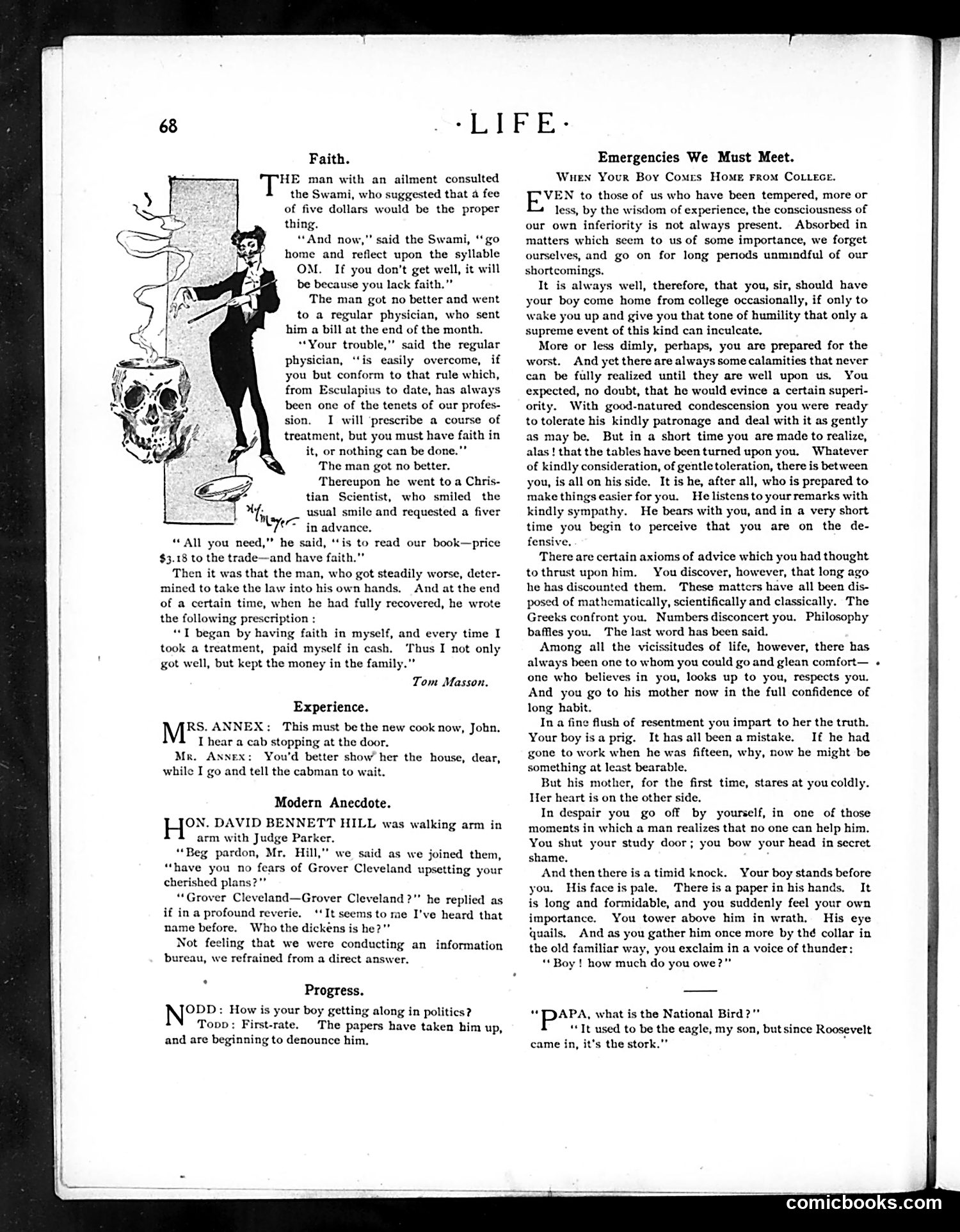
**"Faith" Cartoon (Top Left):** This satirizes faith-healing practitioners. A man consults three practitioners—a Swami, a regular physician, and a Christian Scientist—each demanding payment and insisting faith is essential. All fail. The joke: the man recovers only after deciding to "have faith in myself" and pay himself instead of the practitioners. This mocks the era's proliferation of alternative healers who exploited patients' desperation while promising miracle cures through belief alone. **"Modern Anecdote":** References David B. Hill and Judge Parker (likely Alton B. Parker, 1904 Democratic presidential nominee) discussing Grover Cleveland. Hill's feigned amnesia about Cleveland—a major political figure and two-term president—is absurdist humor mocking political pretense and the fleeting nature of political fame. **"When Your Boy Comes Home from College":** A humorous essay about role-reversal: the college-educated son becomes the intellectual superior, leaving parents feeling defensive rather than authoritative. This satirizes the generational gap and anxiety about education's social mobility effects.
📄 Transcribed text from this page (OCR, searchable)
Machine-transcribed from the original scan — historical spelling and the odd misread are preserved.
~LIFE-: Faith. HE man with an ailment consulted the Swami, who suggested that a fee of five dollars would be the proper thing. “And now,” said the Swami, ‘go home and reflect upon the syllable OM. If you don’t get well, it will be because you lack faith.” The man got no better and went to a regular physician, who sent him a bill at the end of the month. “Your trouble,” said the regular physician, ‘‘is easily overcome, if you but conform to that rule which, from Esculapius to date, has always been one of the tenets of our profes- sion. I will ‘prescribe a course of treatment, but you must have faith in it, or nothing can be done.”” The man got no better. Thereupon he went toa Chris- tian Scientist, who smiled the usual smile and requested a fiver in advance. “All you need,” he said, ‘is to read our book—price $3.18 to the trade—and have faith."" Then it was that the man, who got steadily worse, deter- mined to take the law into his own hands. And at the end of a certain time, when he had fully recovered, he wrote the following prescription : “I began by having faith in myself, and every time I took a treatment, paid myself in cash. Thus I not only got well, but kept the money in the family.” “type Tom Masson. Experience. RS. ANNEX: This must be the new cook now, John. I hear a cab stopping at the door. Mr. Annex: You'd better show her the house, dear, while I go and tell the cabman to wait. Modern Anecdote. ON. DAVID BENNETT HILL was walking arm in arm with Judge Parker. “Beg pardon, Mr. Hill," we said as we joined them, “have you no fears of Grover Cleveland upsetting your cherished plans?” “Grover Cleveland—Grover Cleveland?” he replied as if in a profound reverie. ‘‘It seems to me I've heard that name before. Who the dickens is he?" Not feeling that we were conducting an information bureau, we refrained from a direct answer. . Progress. ODD: How is your boy getting along in politics? Toop: First-rate. The papers have taken him ‘up, and are beginning to denounce him, Emergencies We Must Meet. Wuen Your Boy Comes Home From CoLtece. EVEN to those of us who have been tempered, more or less, by the wisdom of experience, the consciousness of our own inferiority is not always present. Absorbed in matters which seem to us of some importance, we forget ourselves, and go on for long periods unmindful of our shortcomings. It is always well, therefore, that you, sir, should have your boy come home from college occasionally, if only to wake you up and give you that tone of humility that only a supreme event of this kind can inculcate, More or less dimly, perhaps, you are prepared for the worst. And yet there are always some calamities that never can be fully realized until they are well upon us. You expected, no doubt, that he would evince a certain superi- ority. With good-natured condescension you were ready to tolerate his kindly patronage and deal with it as gently as may be. But in a short time you are made to realize, alas! that the tables have been turned upon you. Whatever of kindly consideration, of gentlc toleration, there is between you, is all on his side. It is he, after all, who is prepared to make things easier for you. He listens to your remarks with kindly sympathy. He bears with you, and in a very short time you begin to perceive that you are on the de- fensive. There are certain axioms of advice which you had thought to thrust upon him. You discover, however, that long ago he has discounted them. These mattcrs have all been dis- posed of mathematically, scientifically and classically. The Greeks confront you, Numbers disconcert you. Philosophy baffles you. ‘The last word has been said. Among all the vicissitudes of life, however, there has always been one to whom you could go and glean comfort— one who believes in you, looks up to you, respects you. And you go to his mother now in the full confidence of long habit. Ina fine flush of resentment you impart to her the truth. Your boy isa prig. It has all beena mistake. If he had gone to work when he was fifteen, why, now he might be something at least bearable. But his mother, for the first time, stares at you coldly. Mer heart is on the other side. In despair you go off by yourself, in one of those moments in which a man realizes that no one can help him. You shut your study door; you bow your head in secret shame. And then there is a timid knock. Your boy stands before you. His faceis pale. There isa paperin his hands, It is long and formidable, and you suddenly feel your own importance. You tower above him in wrath. His eye quails. And as you gather him once more by th¢ collar in the old familiar way, you exclaim in a voice of thunder: “Boy ! how much do you owe?" “DAPA, what is the National Bird?" ‘Tt used to be the eagle, my son, but since Roosevelt came in, it's the stork.” ‘comicbooks.com