
Life, 1904-07-14 · page 27 of 44
Life — July 14, 1904 — page 27: what you’re looking at
What you’re looking at
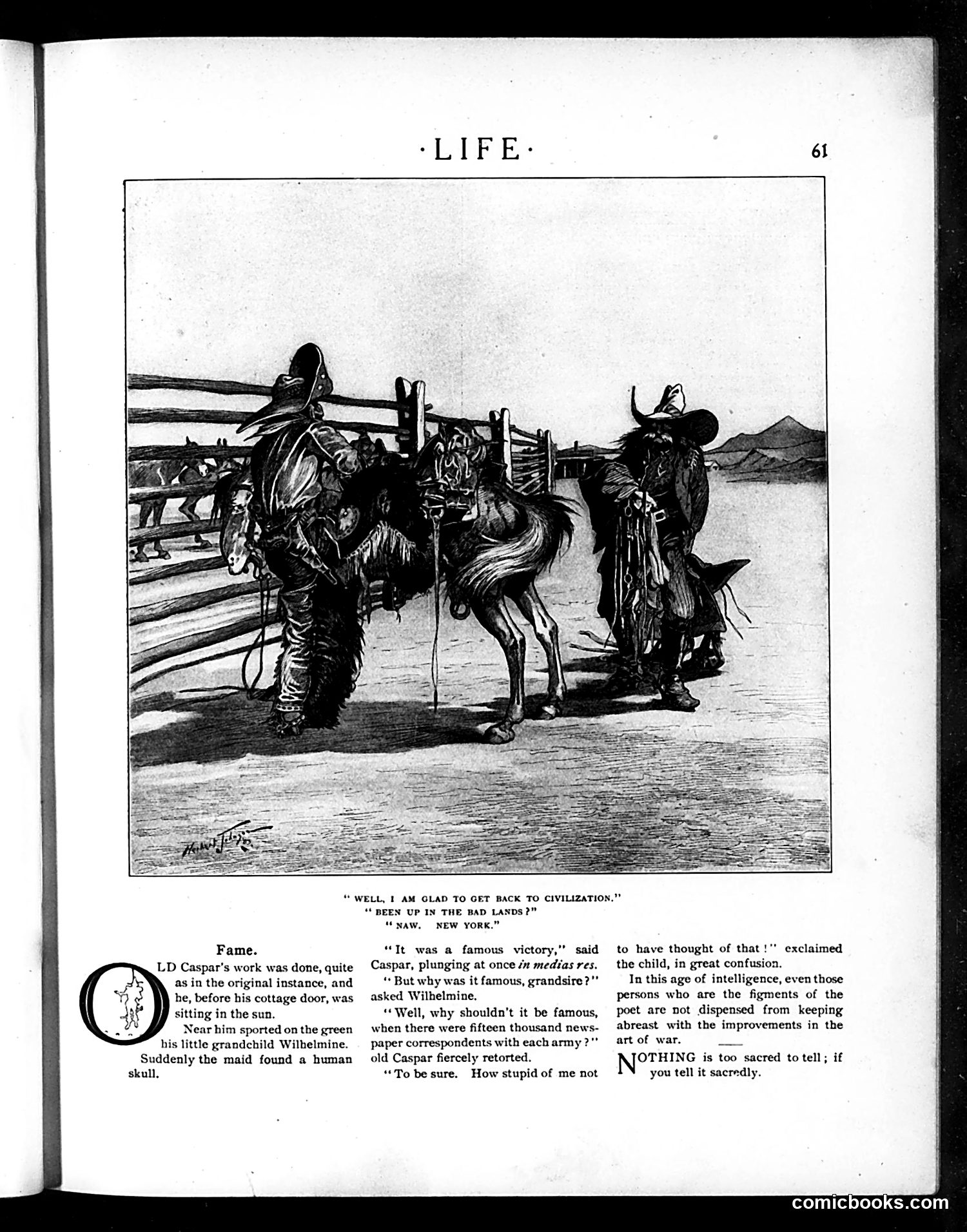
This satirical story mocks the media saturation of modern warfare. An old man named Caspar returns from "the Bad Lands" (a reference to the American frontier, likely the Dakota territory) and claims his victory was "famous" solely because fifteen thousand newspaper correspondents covered it with each army. The joke targets two things: (1) **war journalism's trivialization**—a victory's fame depends not on actual significance but on press coverage, and (2) **the absurdity of modern communication**—even fictional characters can't escape the news cycle's demands to "keep abreast with improvements in the art of war." The discovery of a human skull reinforces the grim reality beneath the media spectacle. Life magazine uses this to critique how contemporary war reporting prioritizes sensationalism and quantity of coverage over genuine understanding of conflict's human cost. The satire suggests that in the modern age, if an event isn't reported by mass media, did it really matter?
📄 Transcribed text from this page (OCR, searchable)
Machine-transcribed from the original scan — historical spelling and the odd misread are preserved.
“ WELL, 1 AM GLAD TO GET BACK TO CIVILIZATION.” Fame. LD Caspar's work was done, quite as in the original instance, and he, before his cottage door, was sitting in the sun. Near him sported on the green his little grandchild Wilhelmine. Suddenly the maid found a human skull. “BEEN UP IN THE BAD LANDS?” “NAW. NEW YORK.” “It was a famous victory,"’ said Caspar, plunging at once ¢” medias res. “But why was it famous, grandsire?"" asked Wilhelmine, ‘Well, why shouldn't it be famous, when there were fifteen thousand news- paper correspondents with each army?" old Caspar fiercely retorted. “To be sure. How stupid of me not to have thought of that!" exclaimed the child, in great confusion. In this age of intelligence, even those persons who are the figments of the poet are not dispensed from keeping abreast with the improvements in the art of war. : il OTHING is too sacred to tell; if you tell it sacredly. comicbooks.com