
Life, 1904-07-14 · page 14 of 44
Life — July 14, 1904 — page 14: what you’re looking at
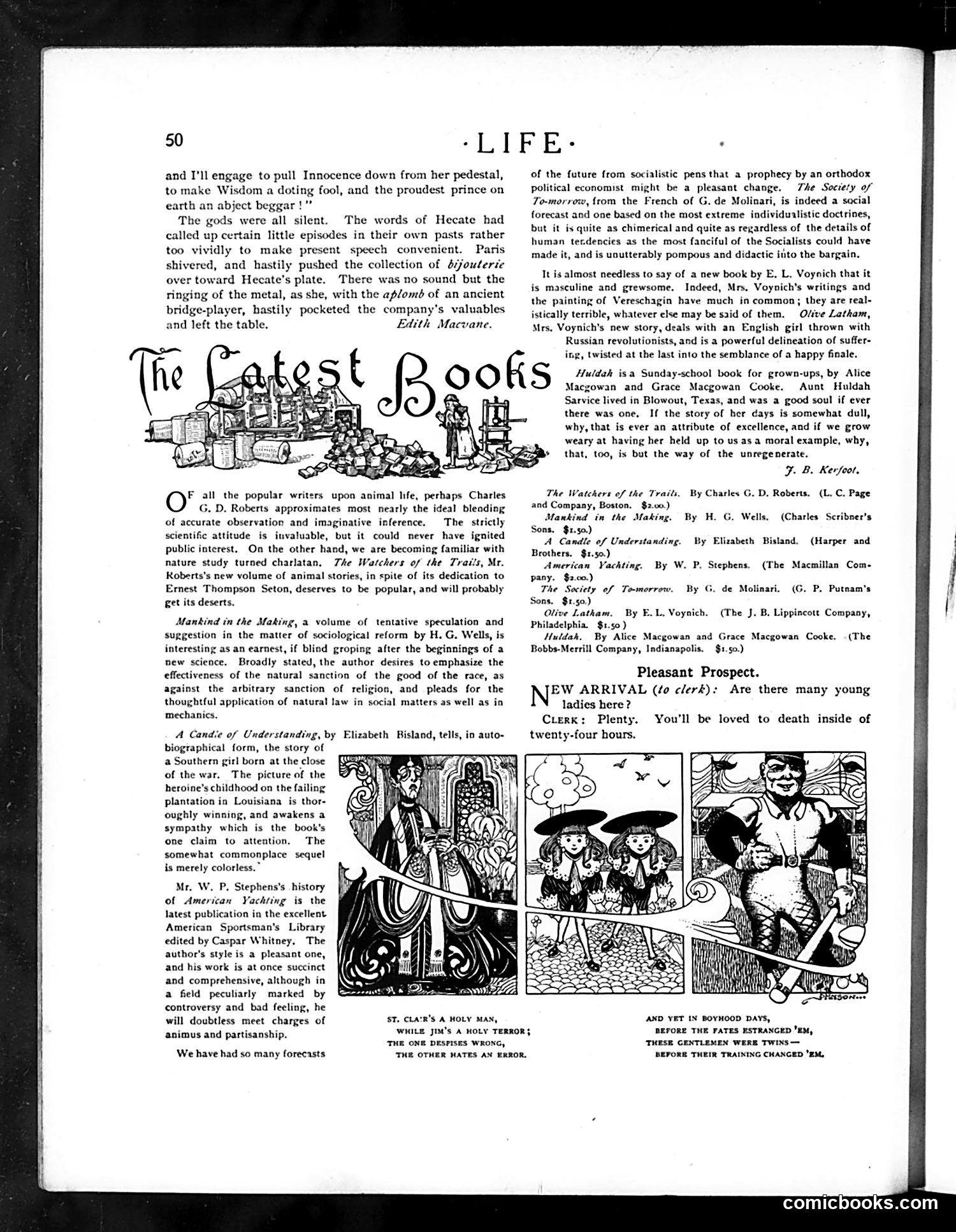
A restored page from Life, 1904-07-14. Page through the whole issue in the reader above.
📄 Transcribed text from this page (OCR, searchable)
Machine-transcribed from the original scan — historical spelling and the odd misread are preserved.
and I'll engage to pull Innocence down from her pedestal, to make Wisdom a doting fool, and the proudest prince on earth an abject beggar !"” The gods were all silent. The words of Hecate had called up certain little episodes in their own pasts rather too vividly to make present speech convenient. Paris shivered, and hastily pushed the collection of dijouterée over toward Hecate’s plate. There was no sound but the ringing of the metal, as she, with the af/omé of an ancient bridge-player, hastily pocketed the company's valuables and left the table. Edith Macvane. F all the popular writers upon animal Ife, perhaps Charles G. D, Roberts approximates most nearly the ideal bleading of accurate observation and imaginative inference. The strictly scientific attitude is invaluable, but it could never have ignited public interest. On the other hand, we are becoming fami with nature study turned charlatan, The Watchers of the Traits, Mr. Roberts's new volume of animal stories, in spite of its dedication to Ernest Thompson Seton, deserves to be popular, and will probably get its deserts. Mankind in the Making, a volume of tentative speculation and suggestion in the matter of sociological reform by H. G. Wells, is interesting as an earnest, if blind groping after the beginnings of a new science. Broadly stated, the author desires to emphasize the effectiveness of the natural sanction of the good of the race, as against the arbitrary sanction of religion, and pleads for the thoughtful application of natural law in social matters as well as in mechanics. A Candie of Understanding, by Elizabeth Bisland, tells, io auto- biographical form, the story of a Southern girl born at the close of the war, The picture of the heroine’s childhood on the failing plantation in Louisiana is thor- oughly winning, and awakens a sympathy which is the book's one claim to attention. The somewhat commonplace sequel is merely colorless.” Mr. W. P. Stephens's history of American Yachting is the latest publication in the excellent American Sportsman's Library edited by Caspar Whitney, The author's style is a pleasant one, and his work is at once succinct and comprehensive, although in a field peculiarly marked by controversy and bad feeling, he will doubtless meet charges of animus and partisanship. ST. CLA:R'S A MOLY MAN, ‘TE ONE DESPISES WRONG, We have had so many forecasts WHILE JIMS A HOLY TERROR} ‘TUE OTHER HATES AN ERROR. of the future from socialistic pens that a prophecy by an orthodox political economist might be a pleasant change, he Society of To-morrow, {rom the French of G. de Molinari, is indeed a social forecast and one based on the most extreme individualistic doctrines, but it is quite as chimerical and quite as regardless of the details of human terdencies as the most fanciful of the Socialists could have made it, and is uoutterably pompous and didactic into the bargain. It is almost needless to say of a new book by E. L. Voynich that it is masculine and grewsome. Indeed, Mrs. Voynich's writings and the painting of Vereschagin have much in common; they are real- istically terrible, whatever else may be said of them. Olive Latham, Mrs. Voynich's new story, deals with an English girl thrown with Russian revolutionists, and is a powerful delineation of suffer- ing, twisted at the last into the semblance of a happy finale. Huldah is a Sunday-school book for grown-ups, by Alice Macgowan and Grace Macgowan Cooke. Aunt Huldah Sarvice lived in Blowout, Texas, and was a good soul if ever there was one, If the story of her days is somewhat dull, why, that is ever an attribute of excellence, and if we grow weary at having her held up to us asa moral example, why, that, too, is but the way of the unregenerate. J. B. Kerfoot, The Watchers ef the Trails. By Charles G. D. Roberts, (L. C. Page and Company, Boston. $2.00.) Mankind in the Making. Sons. $1.50.) A Candle of Understanding. Brothers. $1.50.) American Yachting. pany. $2.00.) The Society of To-morrow. Sons. $1.50.) Olive Latham. By ¥. 1. Voynich. Philadelphia. $1.50) Huldak, By Alice Macgowan and Grace Macgowan Cooke. (The Bobbs-Merrill Company, Indianapolis. $1.50.) By H. G. Wells. (Charles Scribner's By Elizabeth Bisland. (Harper and By W. P. Stephens. (The Macmillan Com- By G. de Molinari, (G. P. Putnam's (The J. B. Lippincott Company, Pleasant Prospect. EW ARRIVAL (fo clerk): Are there many young ladies here ? Cierk: Plenty. twenty-four hours, You'll be loved to death inside of 1N BOYHOOD DAYS, BEFORE THE FATES ESTRANGED "EM, ‘THESE GENTLEMEN WERE TWIXs— BEYORE THEIR TRAINING CHANGED "EM, comicbooks.com