
Life, 1904-07-14 · page 26 of 44
Life — July 14, 1904 — page 26: what you’re looking at
What you’re looking at
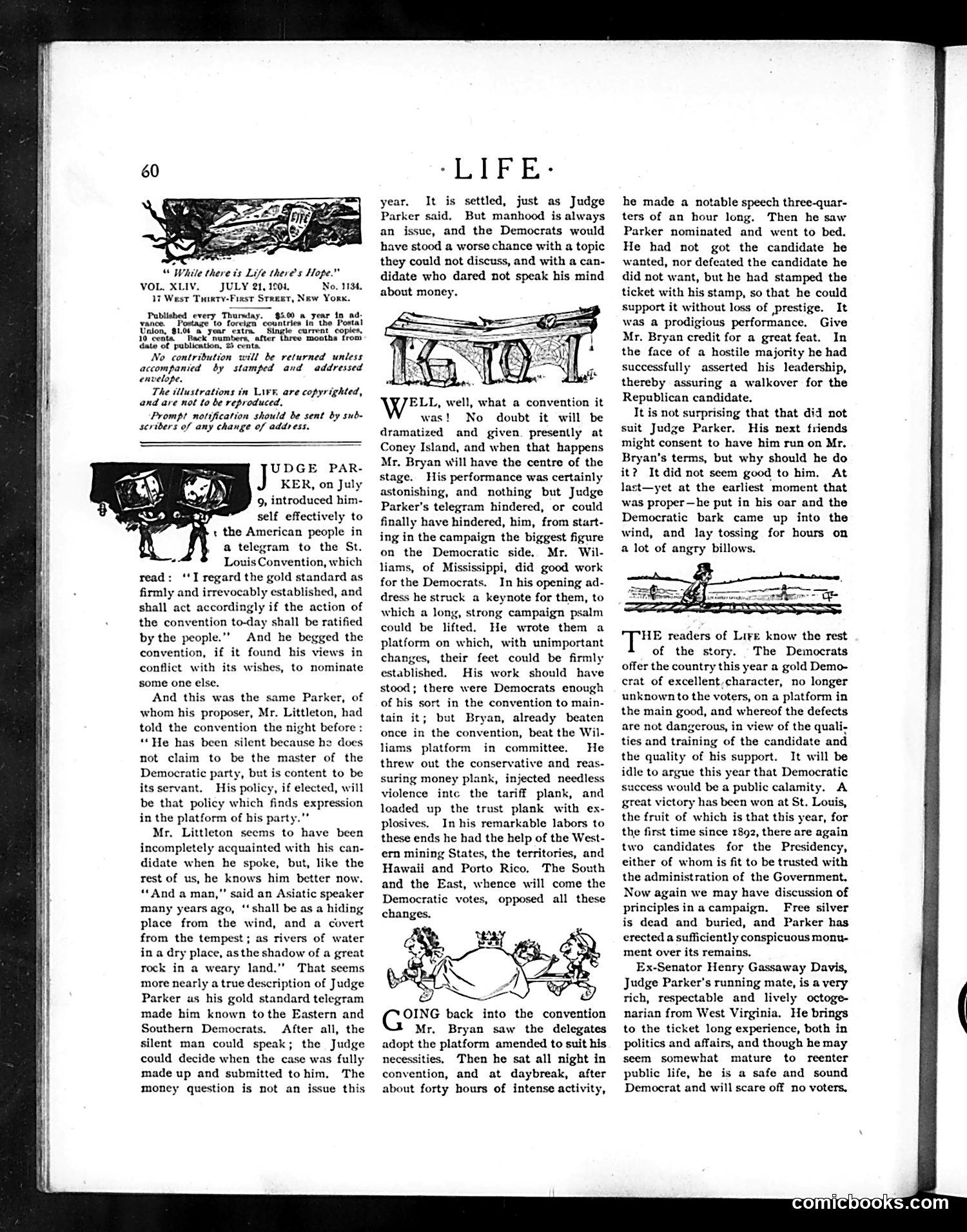
This *Life* magazine article (July 21, 1904) critiques Judge Alton B. Parker, the Democratic presidential nominee, and William Jennings Bryan's influence at the convention. **The Figures:** Judge Parker is the main subject—characterized as overly cautious and evasive. Bryan appears as a disruptive force within the party. **The Satire:** Parker introduced himself with a telegram asserting commitment to the gold standard, which the article mocks as weak leadership. Life sarcastically compares him to Biblical descriptions of shelter—implying he offers only passive refuge rather than active leadership. **The Political Context:** The article criticizes Bryan for dominating the convention despite previous electoral defeats, pushing aggressive planks on money and tariffs that alienated Southern and Eastern Democrats (who controlled actual votes). Parker's silence on substantive issues is presented as cowardly, while Bryan's activism is portrayed as reckless. **The Point:** Life suggests the Democrats nominated a cipher (Parker) while allowing Bryan—whom they'd rejected before—to dictate platform positions, guaranteeing defeat.
📄 Transcribed text from this page (OCR, searchable)
Machine-transcribed from the original scan — historical spelling and the odd misread are preserved.
“ While there is Life there's Hope.” VOL. XLIV. JULY 21, 1904, No. 1134. 17 West Tuuxty-Fiest Street, Naw Yorx. lute a Thurstay. i id ary age to foreign “counties 1d the Postal current. copies, uimbera after ‘tres months froai ‘publication, 2 cent ‘No contribution will Be returned unless accompanied by stamped and addressed envelope. The illustrations in Lit. are copyrighted, and are not to be reproduced, Prompt notification should be sent by sub- seribers of any change of address. UDGE PAR- KER, on July 9, introduced him- self effectively to t the American people in a telegram to the St. Louis Convention, which read: ‘I regard the gold standard as firmly and irrevocably established, and shall act accordingly if the action of the convention to-day shall be ratified by the people.” And he begged the convention, if it found his views in conflict with its wishes, to nominate some one else, And this was the same Parker, of whom his proposer, Mr. Littleton, had told the convention the night before : “‘He has been silent because he does not claim to be the master of the Democratic party, but is content to be its servant. His policy, if elected, will be that policy which finds expression in the platform of his party.”” Mr, Littleton seems to have been incompletely acquainted with his can- didate when he spoke, but, like the rest of us, he knows him better now. “‘And a man,” said an Asiatic speaker many years ago, ‘shall be as a hiding place from the wind, and a covert from the tempest; as rivers of water in a dry place, as the shadow of a great rock in a weary land.” That seems more nearly a true description of Judge Parker us his gold standard telegram made him known to the Eastern and Southern Democrats. After all, the silent man could speak; the Judge could decide when the case was fully made up and submitted tohim, The money question is not an issue this “LIF Be year. It is settled, just as Judge Parker said. But manhood is always an issue, and the Democrats would have stood a worse chance with a topic they could not discuss, and with a can- didate who dared not speak his mind about money. ELL, well, what a convention it was! No doubt it will be dramatized and given. presently at Coney Island, and when that happens Mr. Bryan will have the centre of the stage. His performance was certainly astonishing, and nothing but Judge Parker's telegram hindered, or could finally have hindered, him, from start- ing in the campaign the biggest figure on the Democratic side. Mr. Wil- liams, of Mississippi, did good work for the Democrats. In his opening ad- dress he struck a keynote for them, to which a long, strong campaign psalm could be lifted. He wrote them a platform on which, with unimportant changes, their fect could be firmly established. His work should have stood; there were Democrats enough of his sort in the convention to main- tain it; but Bryan, already beaten once in the convention, beat the Wil- liams platform in committee. He threw out the conservative and reas- suring money plank, injected needless violence intc the tariff plank, and loaded up the trust plank with ex- plosives. In his remarkable labors to these ends he had the help of the West- ern mining States, the territories, and Hawaii and Porto Rico, The South and the East, whence will come the Democratic votes, opposed all these OING back into the convention Mr. Bryan saw the delegates adopt the platform amended to suit his necessities, Then he sat all night in convention, and at daybreak, after about forty hours of intense activity, he made a notable speech three-quar- ters of an hour long. Then he saw Parker nominated and went to bed. He had not got the candidate he wanted, nor defeated the candidate he did not want, but he had stamped the ticket with his stamp, so that he could support it without loss of prestige. It was a prodigious performance. Give Mr. Bryan credit for a great feat. In the face of a hostile majority he had successfully asserted his leadership, thereby assuring a walkover for the Republican candidate. It is not surprising that that did not suit Judge Parker. His next friends might consent to have him run on Mr, Bryan's terms, but why should he do it? It did not seem good to him, At last—yet at the earliest moment that was proper—he put in his oar and the Democratic bark came up into the wind, and lay tossing for hours on a lot of angry billows. HE readers of Lire know the rest. of the story. The Democrats offer the country this year a gold Demo- crat of excellent-character, no longer unknown to the voters, on a platform in the main good, and whereof the defects are not dangerous, in view of the quali- ties and training of the candidate and the quality of his support. It will be idle to argue this year that Democratic success would be a public calamity. A great victory has been won at St. Louis, the fruit of which is that this year, for the first time since 1892, there are again two candidates for the Presidency, either of whom is fit to be trusted with the administration of the Government, Now again we may have discussion of principles in a campaign. Free silver is dead and buried, and Parker has erected a sufficiently conspicuous monu- ment over its remains, Ex-Senator Henry Gassaway Davis, Judge Parker's running mate, is a very rich, respectable and lively octoge- narian from West Virginia. He brings to the ticket long experience, both in politics and affairs, and though he may seem somewhat mature to reenter public life, he is a safe and sound Democrat and will scare off no voters,