
Life, 1904-07-14 · page 36 of 44
Life — July 14, 1904 — page 36: what you’re looking at
What you’re looking at
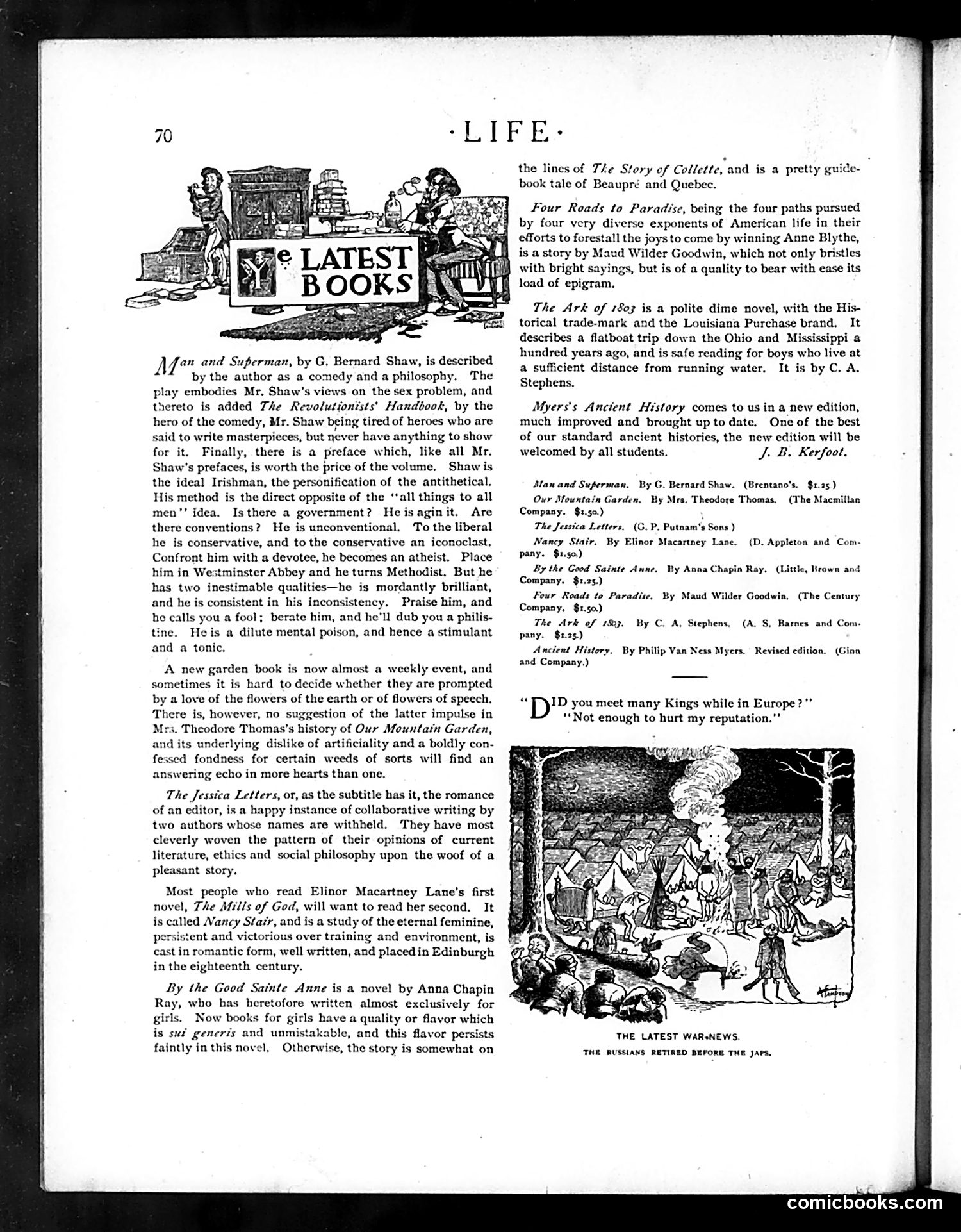
This page is primarily a **book review section**, not political satire. It discusses recent literary publications from the early 1900s. The main content reviews G. Bernard Shaw's *Man and Superman*, characterizing Shaw himself as the archetypal Irish intellectual: a contrarian who opposes whatever exists. If there's government, he's against it; confront a devotee and he becomes an atheist; praise him and he calls you a fool. The reviewer presents this as Shaw's defining trait—he's "consistent in his inconsistency" and functions as "a dilute mental poison" and stimulant. The page also reviews gardening books, novels by Elinor Macartney Lane and Anna Chapin Ray, and educational texts. A small illustration captioned "The Latest War-News: The Russians Retired Before the Japs" appears at bottom right, likely referencing the Russo-Japanese War. The content is straightforward literary criticism rather than political commentary or satire.
📄 Transcribed text from this page (OCR, searchable)
Machine-transcribed from the original scan — historical spelling and the odd misread are preserved.
“Lo l'F Ee the lines of The Story of Collette, and is a pretty guide- book tale of Beaupré and Quebec. A ‘an and Superman, by G. Bernard Shaw, is described by the author as a comedy anda philosophy. The play embodies Mr. Shaw's views on the sex problem, and thereto is added The Revolutionists' Handbook, by the hero of the comedy, Mr. Shaw being tired of heroes who are said to write masterpieces, but never have anything to show for it. Finally, there is a preface which, like all Mr. Shaw's prefaces, is worth the price of the volume. Shaw is the ideal Irishman, the personification of the antithetical. His method is the direct opposite of the ‘‘all things to all men'’ idea, Isthere a government? He isaginit. Are there conventions? He is unconventional. To the liberal he is conservative, and to the conservative an iconoclast, Confront him with a devotee, he becomes an atheist. Place him in Westminster Abbey and he turns Methodist. But he has two inestimable qualities—he is mordantly brilliant, and he is consistent in his inconsistency. Praise him, and he calls you a fool; berate him, and he'll dub you a philis- tine. Heis a dilute mental poison, and hence a stimulant and a tonic. A new garden book is now almost a weekly event, and sometimes it is hard to decide whether they are prompted by a love of the flowers of the earth or of flowers of speech. There is, however, no suggestion of the latter impulse in Mrs. Theodore Thomas's history of Our Mountain Garden, and its underlying dislike of artificiality and a boldly con- fessed fondness for certain weeds of sorts will find an answering echo in more hearts than one. The Jessica Letters, or, as the subtitle has it, the romance of an editor, is a happy instance of collaborative writing by two authors whose names are withheld. They have most cleverly woven the pattern of their opinions of current literature, ethics and social philosophy upon the woof of a pleasant story, Most people who read Elinor Macartney Lane's first novel, The Mills of God, will want to read her second. It is called Nancy Stazr, and is a study of the eternal feminine, persistent and victorious over training and environment, is cast in romantic form, well written, and placed in Edinburgh in the eighteenth century. By the Good Sainte Anne is a novel by Anna Chapin Ray, who has heretofore written almost exclusively for girls. Now books for girls have a quality or flavor which is sué gener’s and unmistakable, and this flavor persists faintly in this no Otherwise, the story is somewhat on Four Roads to Paradise, being the four paths pursued by four very diverse exponents of American life in their efforts to forestall the joys to come by winning Anne Blythe, is a story by Maud Wilder Goodwin, which not only bristles with bright sayings, but is of a quality to bear with ease its load of epigram. The Ark of 1803 is a polite dime novel, with the His- torical trade-mark and the Louisiana Purchase brand. It describes a flatboat trip down the Ohio and Mississippi a hundred years ago, and is safe reading for boys who live at a sufficient distance from running water. It is by C. A. Stephens. Myers's Ancient History comes to us in a new edition, much improved and brought up to date. One of the best of our standard ancient histories, the new edition will be welcomed by all students. J. B. Kerfoot. Man and Superman. By G. Bernard Shaw. (Brentano's. $1.25) Our Mountain Garden. By Mrs. Theodore Thomas. (The Macmillan Company. $1.50.) The Jessica Letters, (G.P. Putnam's Sons ) Nancy Stair, By Elinor Macartney Lane. pany. $1.50.) By the Good Sainte Anne. By Anna Chapin Ray, (Little, Brown and Company. $1.25.) Four Reads to Paradise. By Maud Wilder Goodwin. (The Century Company. $1.50.) The Ark of 183. pany. $1.25.) Ancient History. By Philip Van Ness Myers. Revised edition. (Ginn and Company.) (D, Appleton and Com- By C. A. Stephens. (A. S, Barnes and Com- ‘ D”® you meet many Kings while in Europe?" ‘Not enough to hurt my reputation."” THE LATEST WARNEWS, THR RUSSIANS RETIRED BEVORE THE JAPS. comicbooks.com