
A complete issue · 77 pages · 1902
Life — December 25, 1902
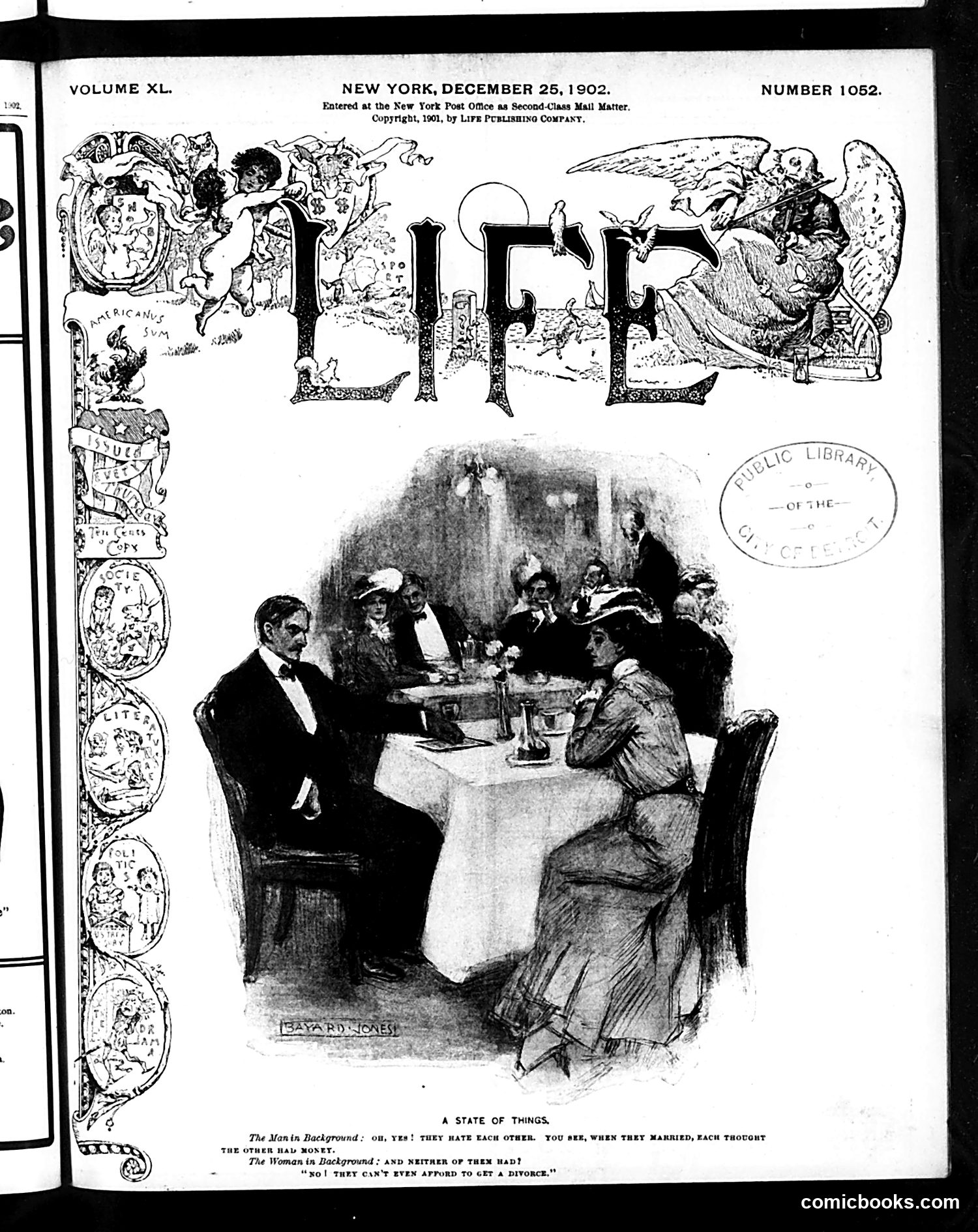
This satirical cartoon titled "A State of Things" depicts a domestic dining scene with social commentary. The caption states: "The Man in Background: 'Oh, yes! They hate each other. You see, when they married, each thought the other had money. The Woman in Background: 'And neither of them had!' 'So I they can't even afford to get a divorce.'" The joke satirizes upper-class marriage expectations and marital discord among the wealthy. It mocks couples who marry assuming their spouse possesses wealth, only to discover mutual financial disappointment. The punchline—that the couple cannot even afford divorce—was a sharp contemporary jab at how legal separation was an expensive luxury available only to the truly wealthy, trapping the poor and middle-class in unhappy marriages.
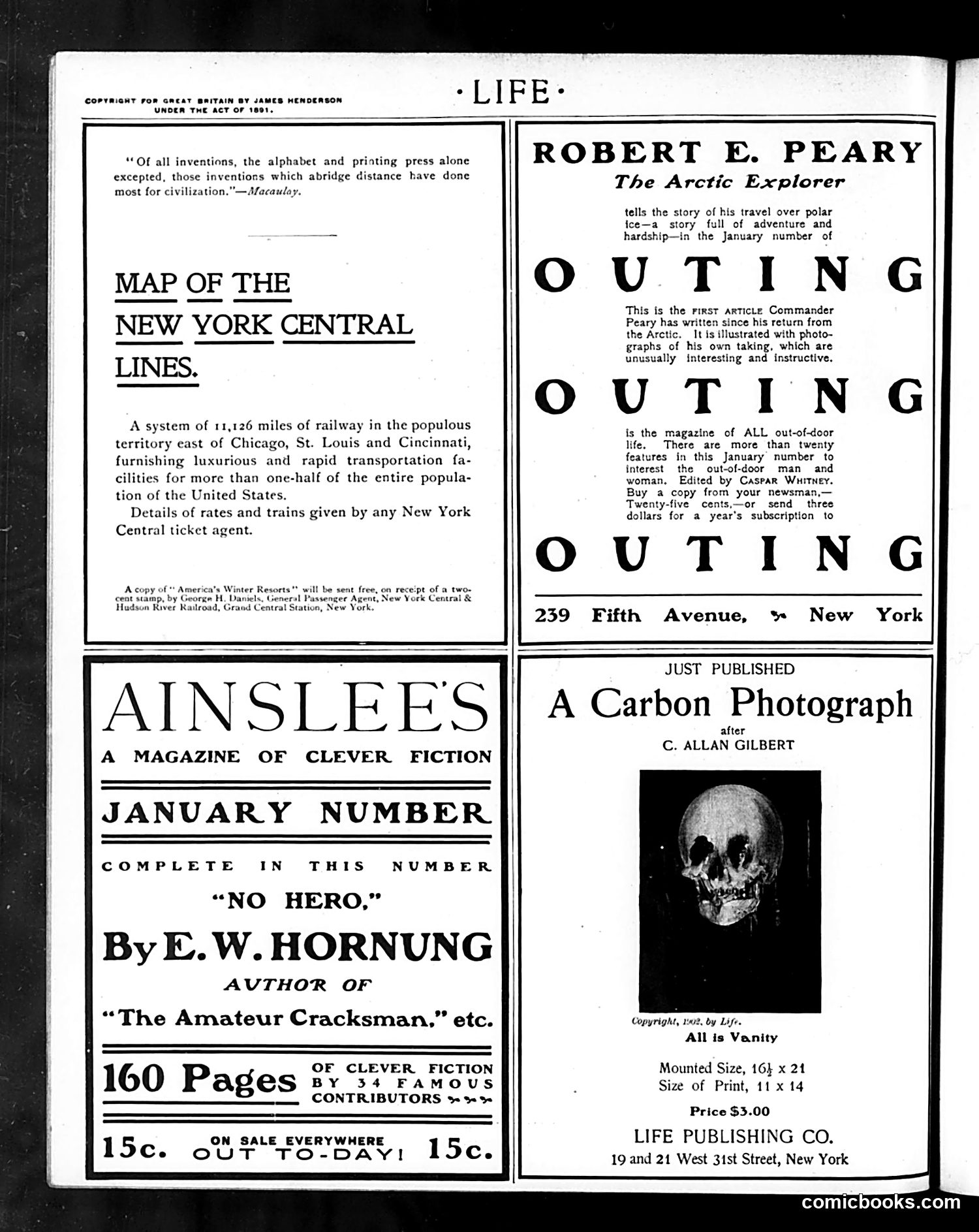
This page is **primarily advertising**, not editorial content or political satire. The advertisements promote: 1. **New York Central Lines** — railroad service across 11,126 miles 2. **Life Magazine** — featuring Robert E. Peary's article about Arctic exploration, presented as the magazine's January issue highlight 3. **Outing Magazine** — an outdoor lifestyle publication edited by Caspar Whitney 4. **Ainslee's Magazine** — promoting a fiction story "No Hero" by E.W. Hornung (author of Raffles) 5. **A Carbon Photograph** — a skull image titled "All is Vanity," available from Life Publishing Co. for $3.00 There are **no political cartoons or social satire** visible on this page. It represents standard early-20th-century magazine advertising layout.
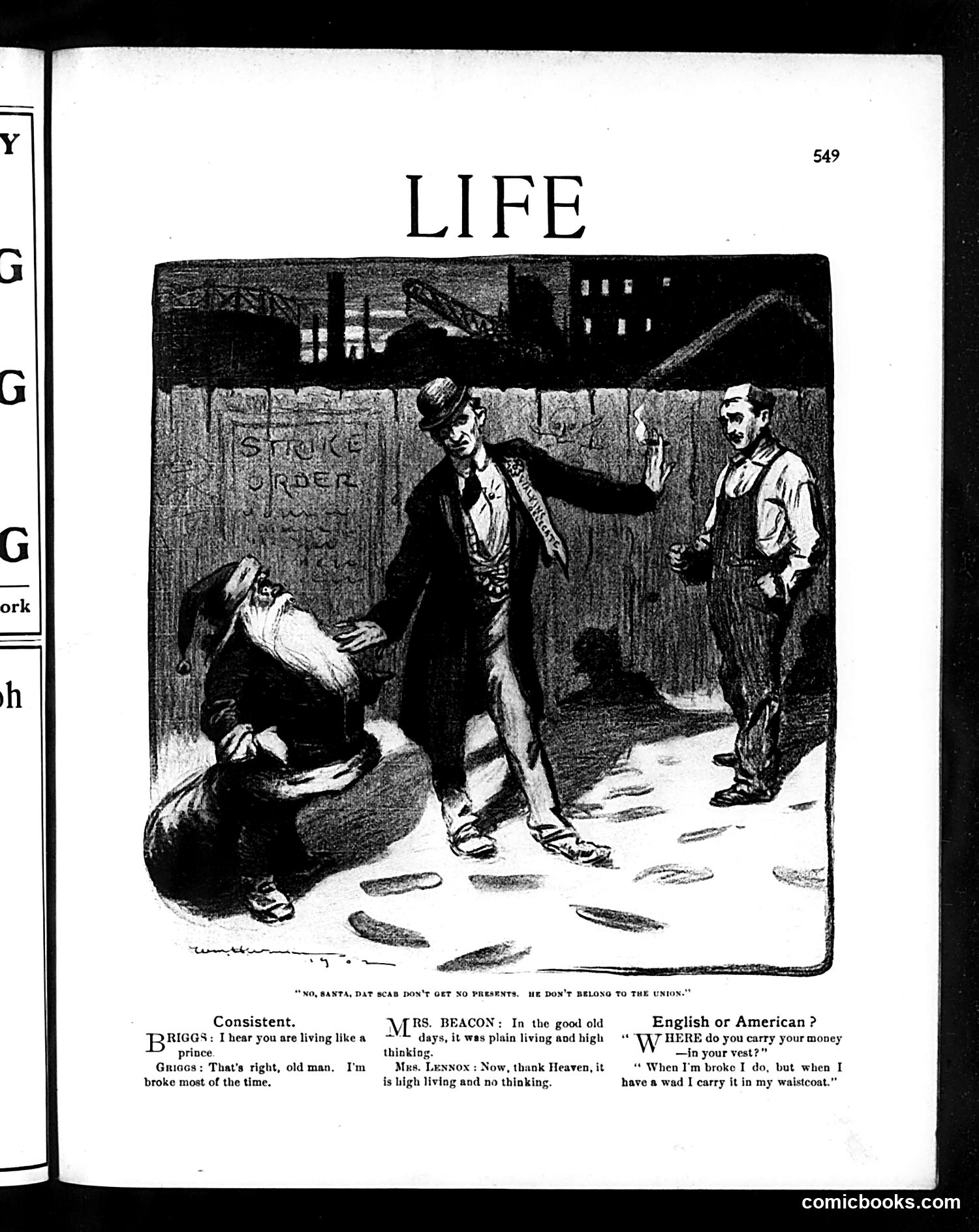
This page contains three brief satirical vignettes about working-class life and poverty, typical of Life's social commentary humor. **"No Santa"**: The main cartoon depicts a street scene where a man appears to refuse giving presents to poor children, with the caption suggesting union membership as a barrier to generosity—likely satirizing labor disputes of the era. **"Consistent"**: A joke about poverty: Briggs claims to live like a prince despite being broke; Gnoggs agrees, noting he's also "broke most of the time"—the humor lies in redefining poverty as a lifestyle choice. **"English or American?"**: A money-carrying joke contrasting British waistcoats with American pockets, poking fun at national stereotypes about financial habits and clothing conventions. All three reflect early 20th-century American attitudes toward class and immigrant communities.
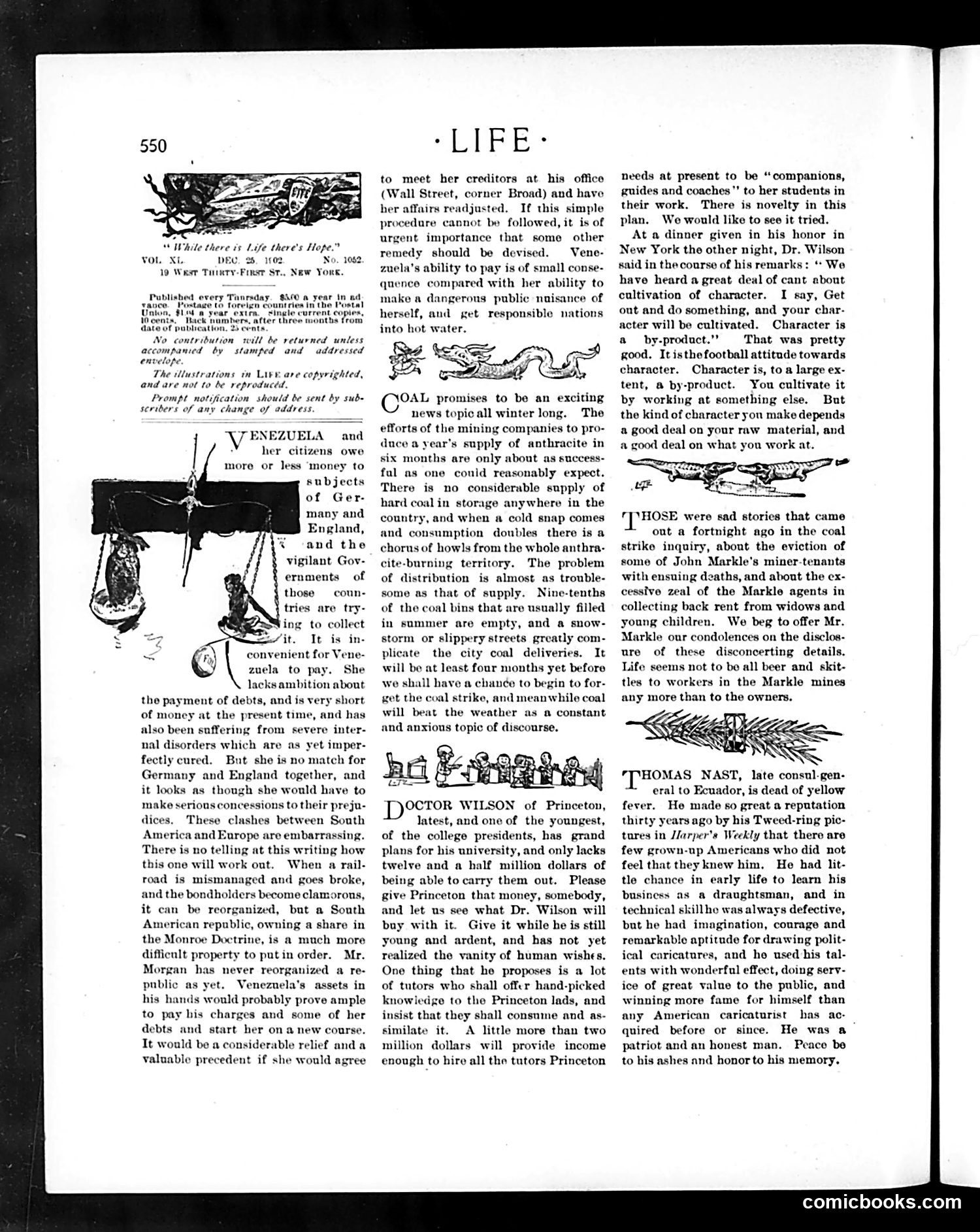
The page contains three separate editorial pieces rather than political cartoons. The main illustrated item shows a **Venezuelan figure suspended by ropes** — this references Venezuela's debt crisis and foreign intervention. The accompanying text discusses Venezuela's financial troubles and suggests the country should agree to debt restructuring to avoid further international complications. Other sections praise **Dr. Wilson of Princeton** for his educational reform plans, and eulogize **Thomas Nast**, the famous political cartoonist who recently died. The Venezuela cartoon satirizes the nation's precarious financial position by depicting it literally hanging by a thread — a visual metaphor for its economic vulnerability during the era of European imperial intervention in Latin America.
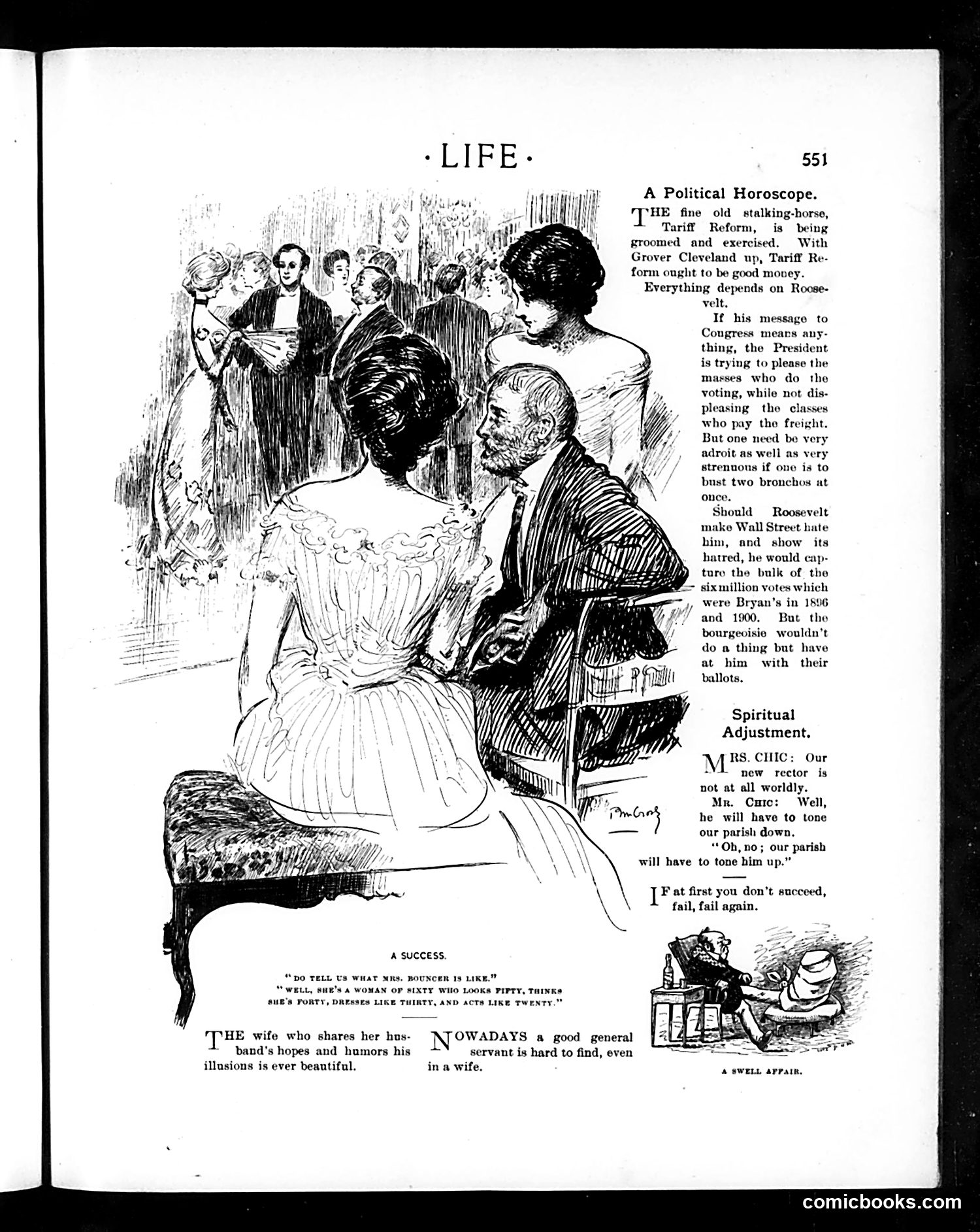
The main cartoon depicts a society gathering where someone reads a "Political Horoscope." The satire concerns President Roosevelt's tariff reform efforts and their political consequences. The text suggests Roosevelt faces an impossible balancing act: pleasing working-class voters through tariff reform while avoiding antagonizing wealthy business interests ("the classes who pay the freight"). The horoscope implies Roosevelt must "bust two brouches at once"—satisfy contradictory constituencies simultaneously. The secondary pieces mock social pretension ("A Success") and clergy adjustments ("Spiritual Adjustment"), with commentary on finding good servants and wives who tolerate their husbands' behavior. The overall page satirizes Gilded Age social hierarchies and political compromise.
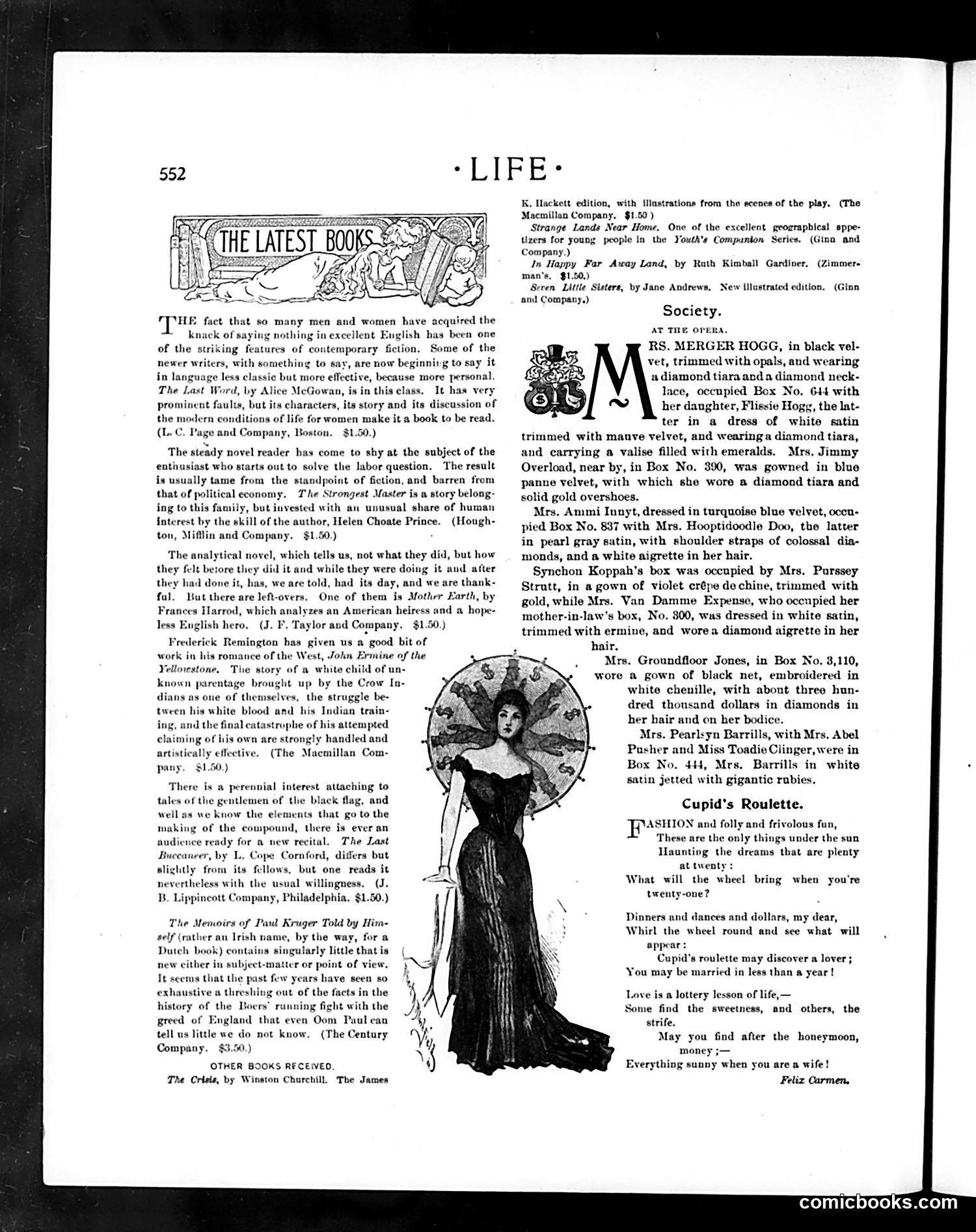
This page contains a book review section ("The Latest Books") and a society column ("At the Opera"), with an accompanying illustration of an elegant woman holding a parasol. The content is primarily **literary criticism and social reporting**, not political satire. The reviews discuss novels like *The Last Word* and *The Strongest Instinct*, praising contemporary fiction's engagement with modern life and labor questions. The society column humorously catalogs wealthy opera attendees' elaborate jewelry and clothing—a satirical commentary on **ostentatious display among the wealthy**. The humor lies in the specificity: noting exact box numbers, fabric types, and diamond values mocks the pretension of high society. "Cupid's Roulette," a poem about marriage as chance, appears at bottom—light romantic satire rather than political commentary.
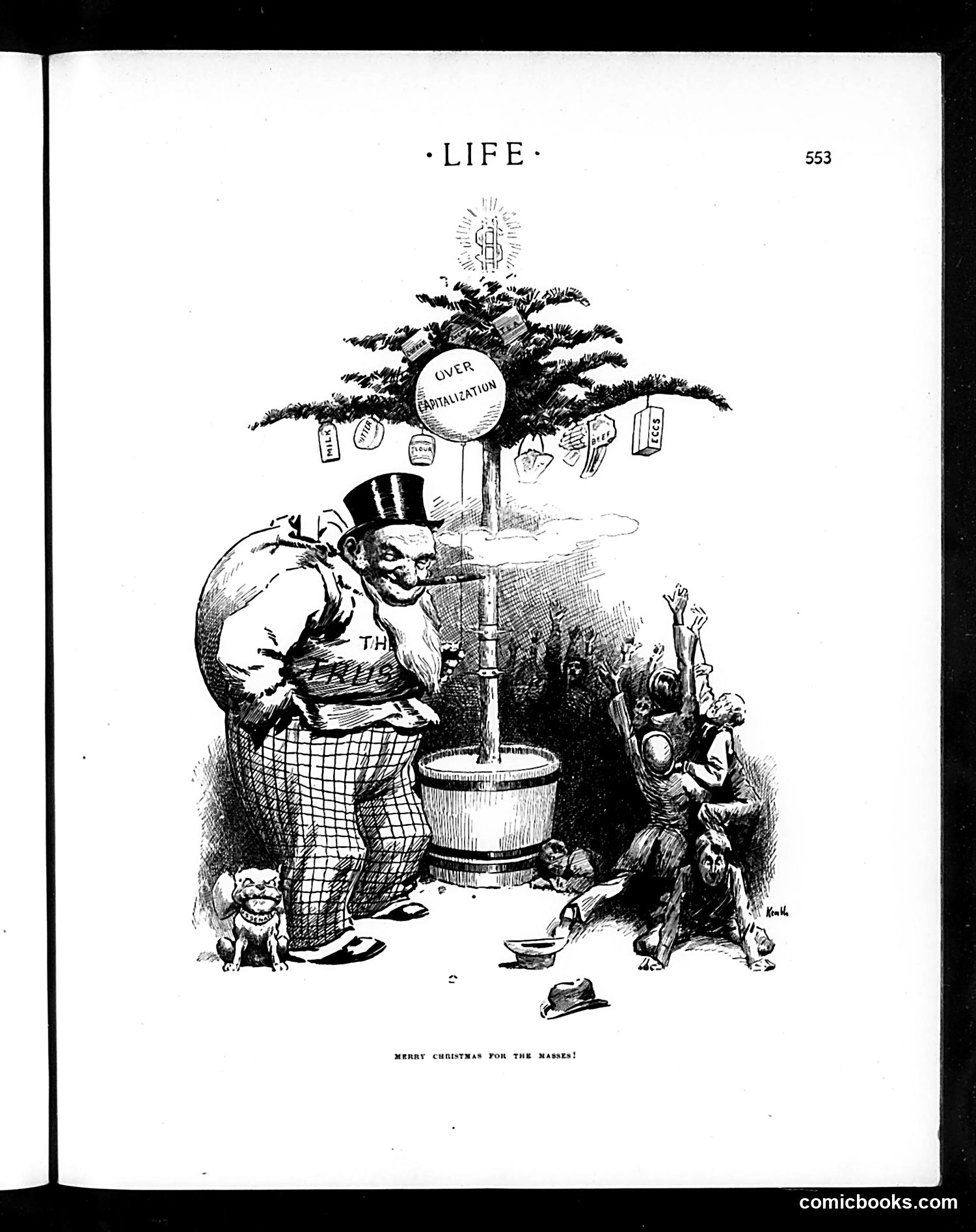
This is a satirical Christmas cartoon from *Life* magazine titled "Merry Christmas for the Masses!" The central figure appears to be a wealthy capitalist or plutocrat wearing a top hat, distributing money from a tree labeled "Over Capitulation." The cartoon critiques economic inequality during what appears to be the early 20th century. The well-dressed figure dispensing minimal charity to poor children and workers below represents token generosity from the wealthy elite—suggesting that capitalists' Christmas "gifts" to the working classes are mere crumbs compared to their vast wealth accumulated through capitalist systems. The tree's label "Over Capitulation" suggests the artist views this charitable distribution as symbolic surrender or appeasement rather than genuine reform of exploitative economic structures.
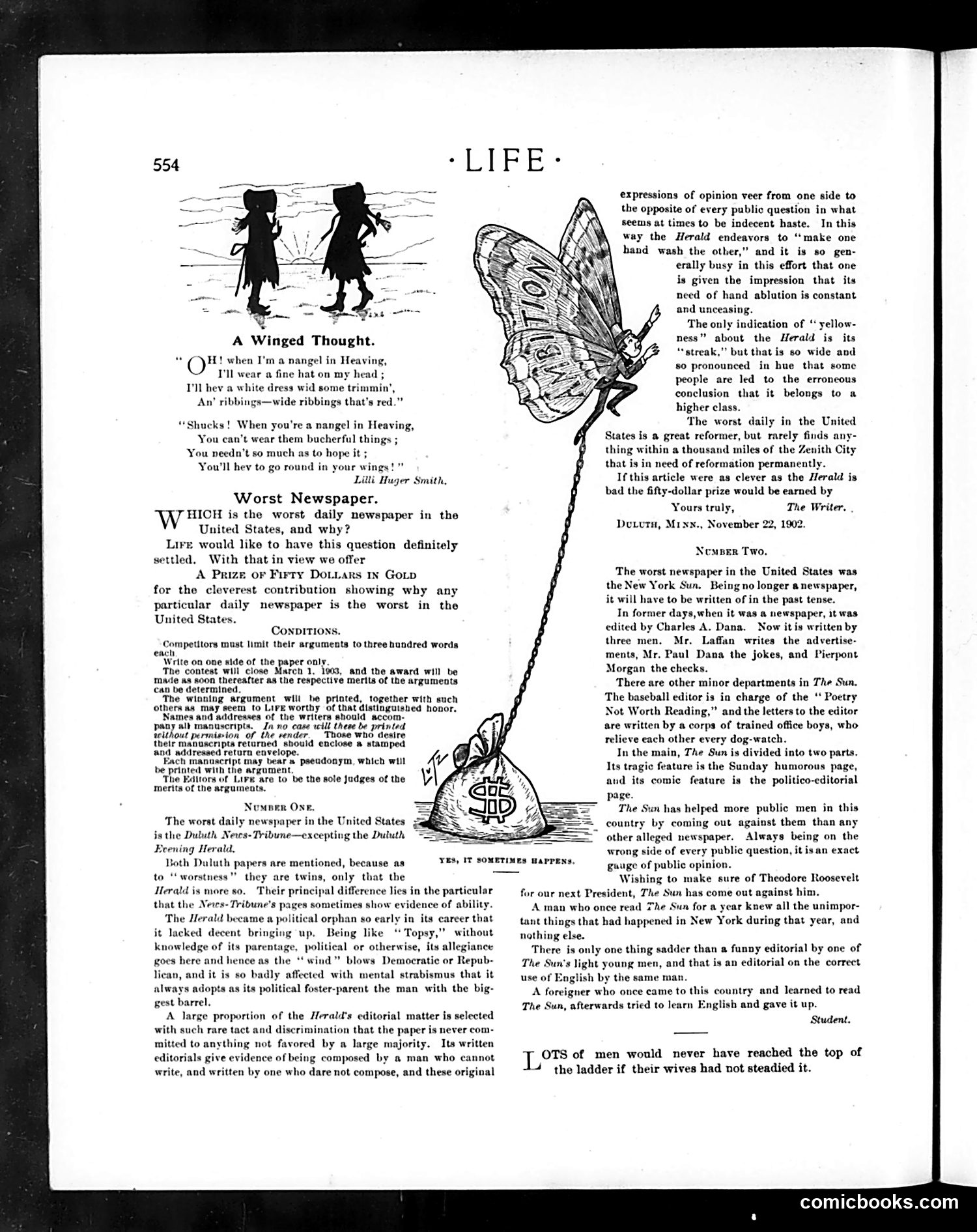
This page contains a poetry section titled "A Winged Thought" (depicting two silhouetted figures) and a satirical article debating which is "the Worst Daily Newspaper" in the United States. The main satire critiques the **New York Herald** as the worst daily paper, with responses defending it and nominating alternatives like the **New York Sun** and the **Evening Herald**. The arguments focus on editorial bias, poor composition, and questionable judgment. One responder suggests the Herald is "more Democratic" in its political allegiance, while another claims the Sun "helped more public men" through exposure of wrongdoing. The illustration of a butterfly on a money bag likely symbolizes the papers' commercial interests versus journalistic integrity—a recurring concern throughout the debate. This represents early 20th-century newspaper criticism within American literary circles.
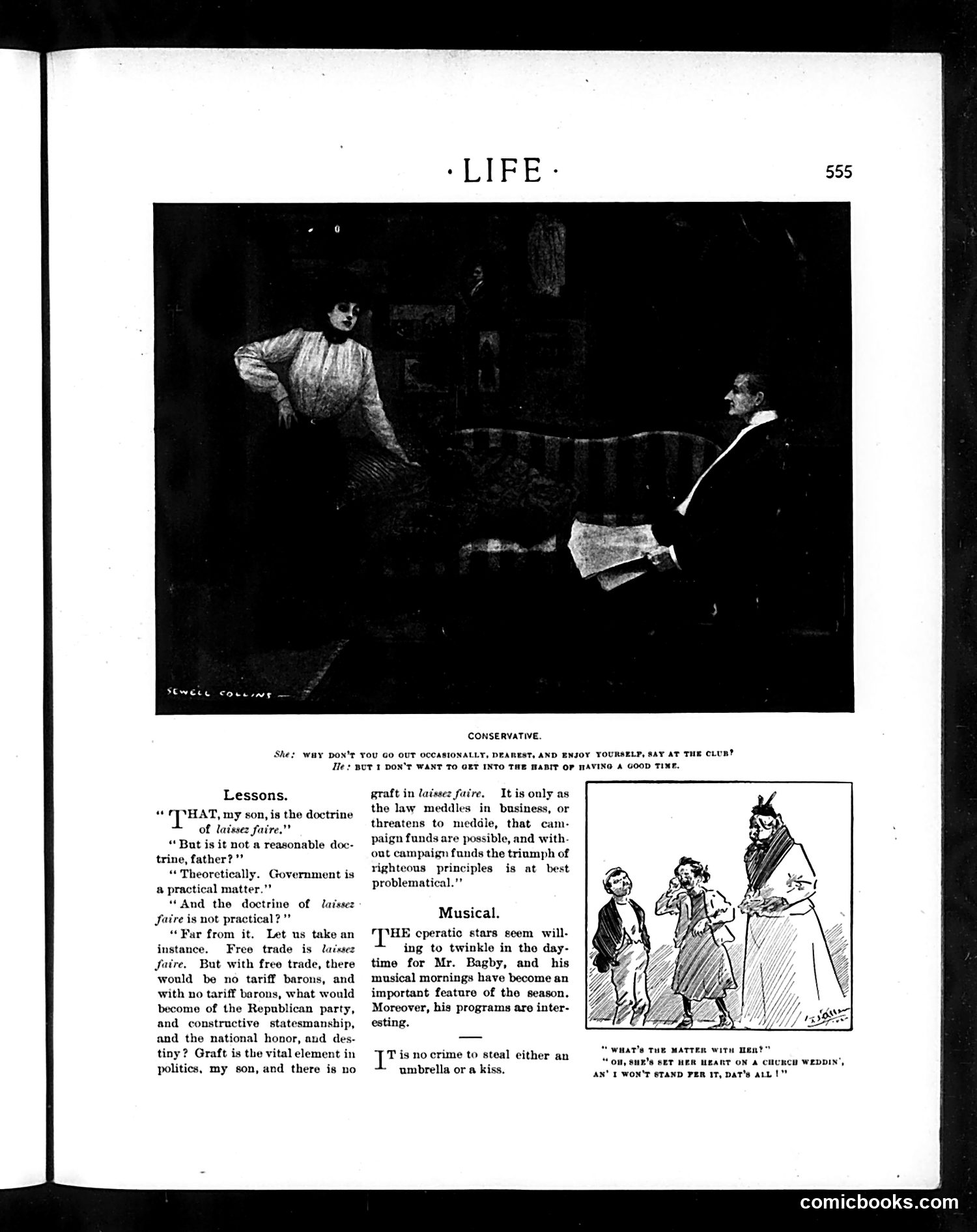
**Top Image:** A dramatic scene labeled "Conservative" shows a woman in an elegant dress confronting a seated man, with the caption: "Why don't you go out occasionally, dearest, and enjoy yourself, say at the club? But I don't want to get into the habit of having a good time." This satirizes conservative attitudes about marriage and leisure—the irony being that a wife encourages her husband to enjoy himself socially, yet he refuses for fear of developing bad habits. It mocks both Victorian prudishness and the contradictory logic of excessive self-denial. **Lower Sections:** Include sections titled "Lessons" (discussing laissez-faire economics and free trade) and "Musical" (mentioning operatic stars and Mr. Bagby's musical programs). A small cartoon depicts three figures in conversation with the caption about stealing umbrellas or kisses at church weddings—another satirical jab at social hypocrisy.
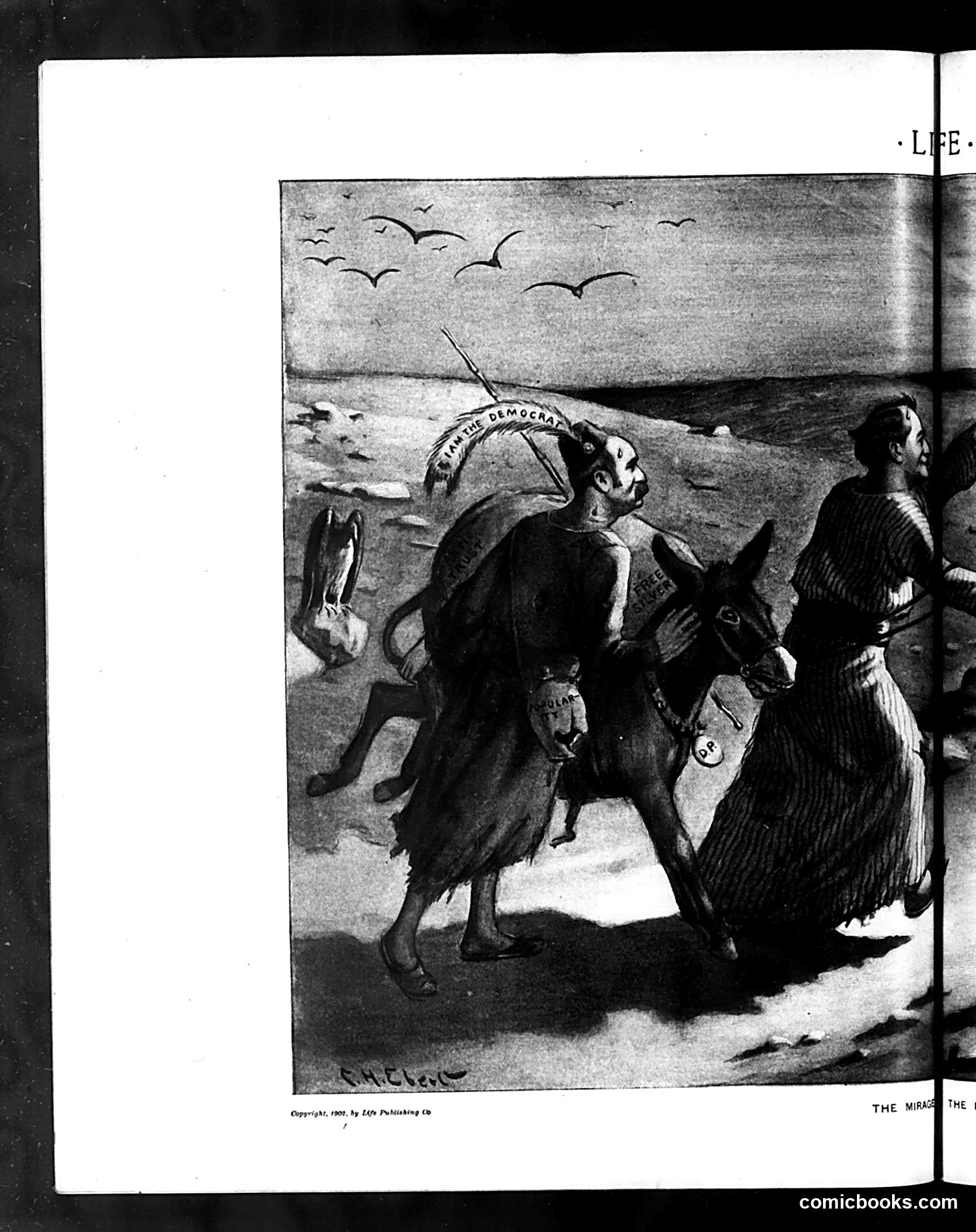
This political cartoon depicts a donkey (symbol of the Democratic Party) labeled "SAVE THE DEMOCRAT" being led or guided by two men in suits along a beach. The donkey appears distressed or struggling. A wolf lurks in the background on the left, while birds fly overhead in a barren landscape. The satire likely comments on efforts to "save" or preserve the Democratic Party during a period of political difficulty or decline. The threatening wolf and desolate setting suggest danger or crisis facing the party. However, without the publication date visible in this image, the specific historical context—which election, which Democratic crisis, or which political figures are represented—cannot be definitively determined from the image alone.
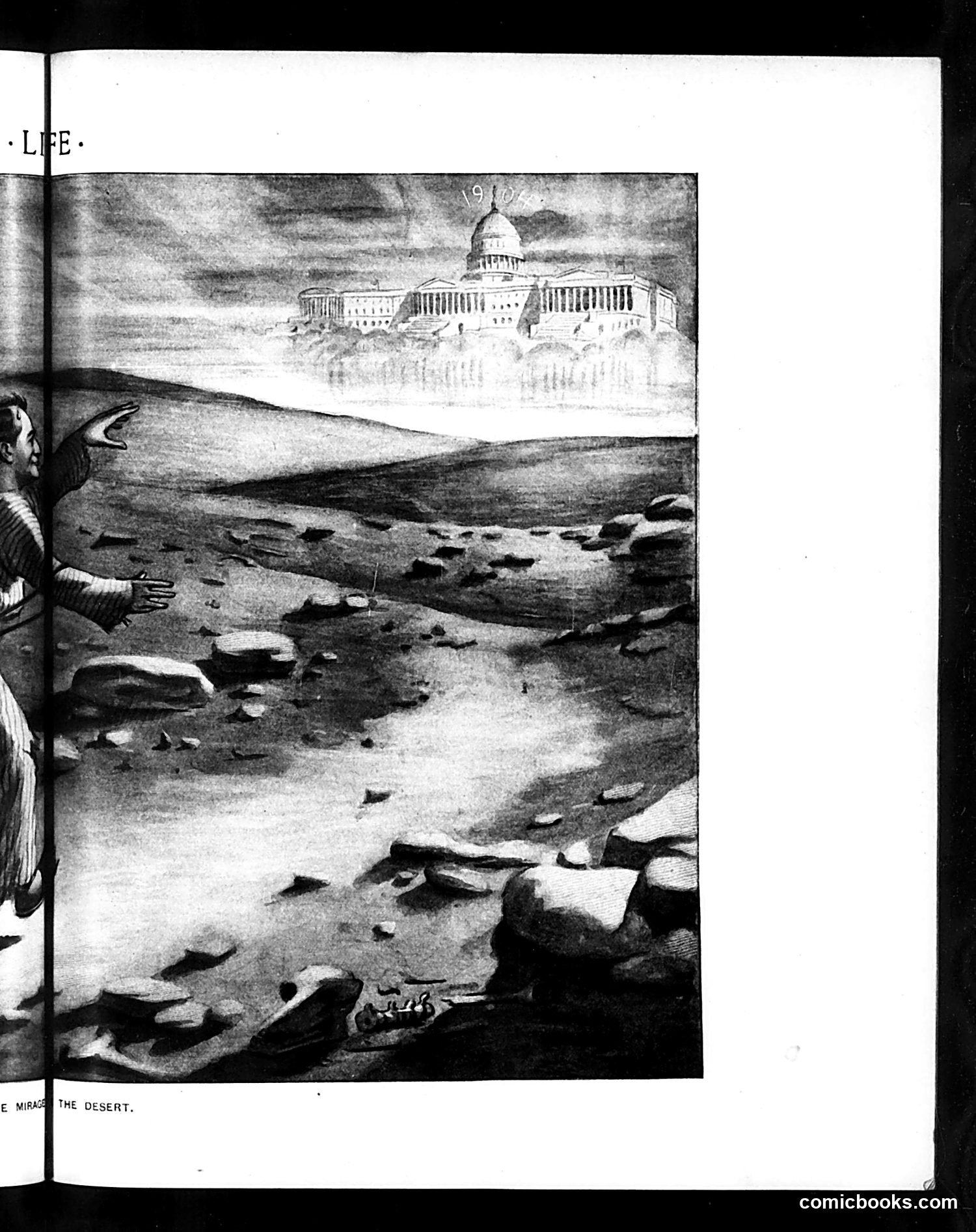
This illustration shows a figure in a desert landscape gazing at a distant Capitol building. The caption reads "The Desert," suggesting the building is a mirage or illusion. The satire appears to critique the distance between ordinary Americans and their government, or perhaps the futility of seeking aid/attention from Washington. The desolate, rocky foreground contrasts sharply with the gleaming Capitol in the distance—emphasizing the gap between the common person's harsh reality and the idealized seat of power. Without additional context or date information visible, the specific political situation remains unclear, but the cartoon likely comments on government responsiveness during an economic hardship period, possibly the Great Depression era when Life magazine was prominent.
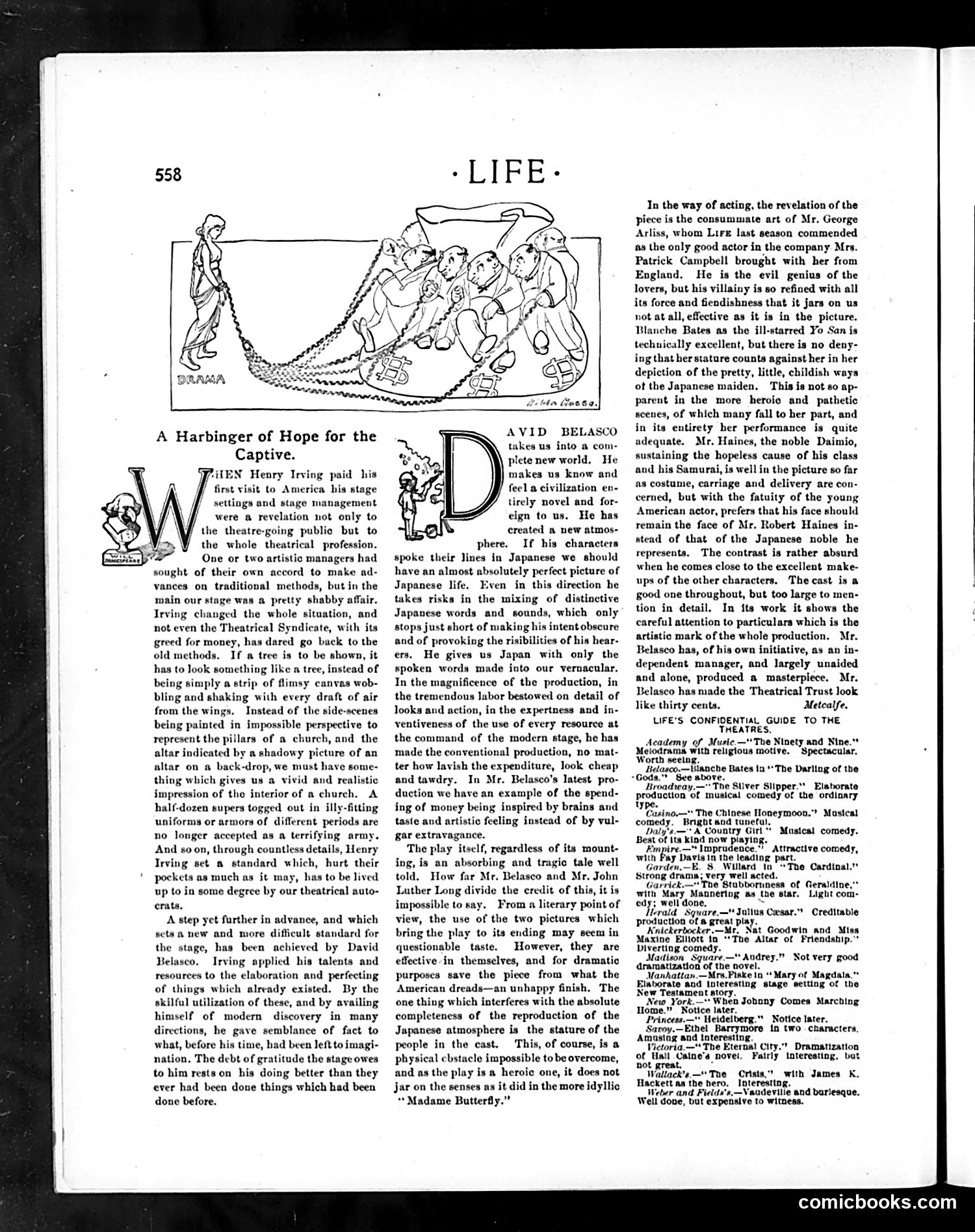
This page reviews Henry Irving's theatrical production of "Avid Belasco," which appears to be a new play bringing Japanese themes to the American stage. The cartoon depicts Irving (likely the figure on the left) presenting Japanese characters and aesthetics to an American audience (shown gathered on the right, appearing somewhat captive or confined). The satire critiques Irving's theatrical methods—specifically his elaborate, expensive staging and scenic design choices borrowed from contemporary stage innovation. The review suggests Irving has applied his talents to bring Japanese culture to Western audiences, though the text notes tensions between authentic artistic vision and practical theatrical constraints. The "captive" reference appears ironic, suggesting audiences are held by Irving's ambitious but sometimes overwrought productions.
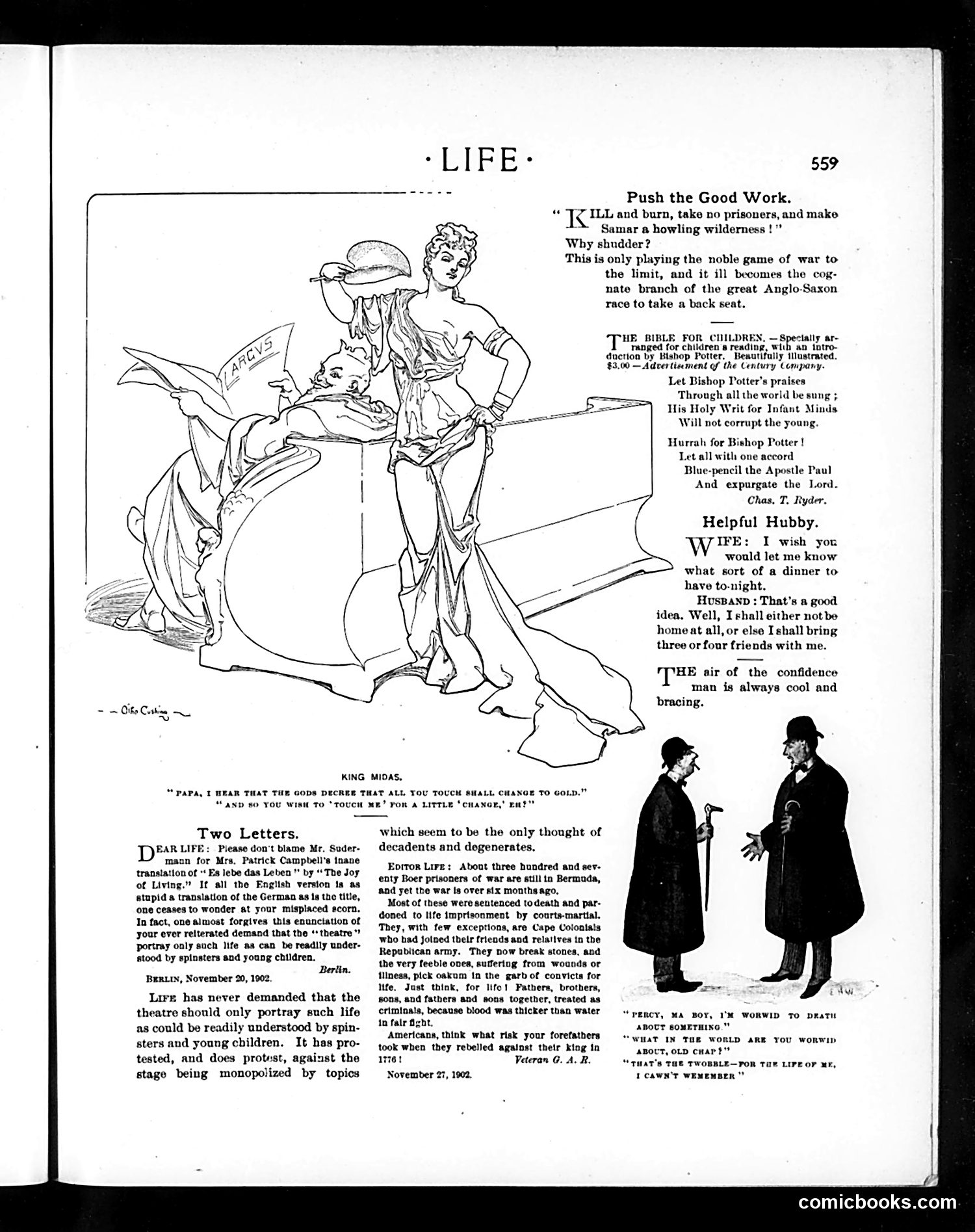
The main cartoon, "King Midas," satirizes American imperial ambitions. A figure representing America (depicted as a wealthy woman) touches a child labeled "Samar" (a Philippine island), with the caption referencing the King Midas myth—everything touched turns to gold. The reference is to the brutal American suppression of the Moro Rebellion in Samar (1901-1902), where U.S. forces killed thousands of civilians. Life sarcastically critiques the justification for this violence as part of the "Anglo-Saxon race" spreading civilization. Below, two letters debate appropriate theater content. One criticizes Life's calls for "moral" drama; Life defends itself against charges of censorship. A separate letter protests the indefinite imprisonment of Boer War prisoners in Bermuda—300+ soldiers held long after the war's 1902 conclusion—drawing parallels to American Revolutionary rebels. The bottom cartoons are humorous domestic sketches unrelated to politics.
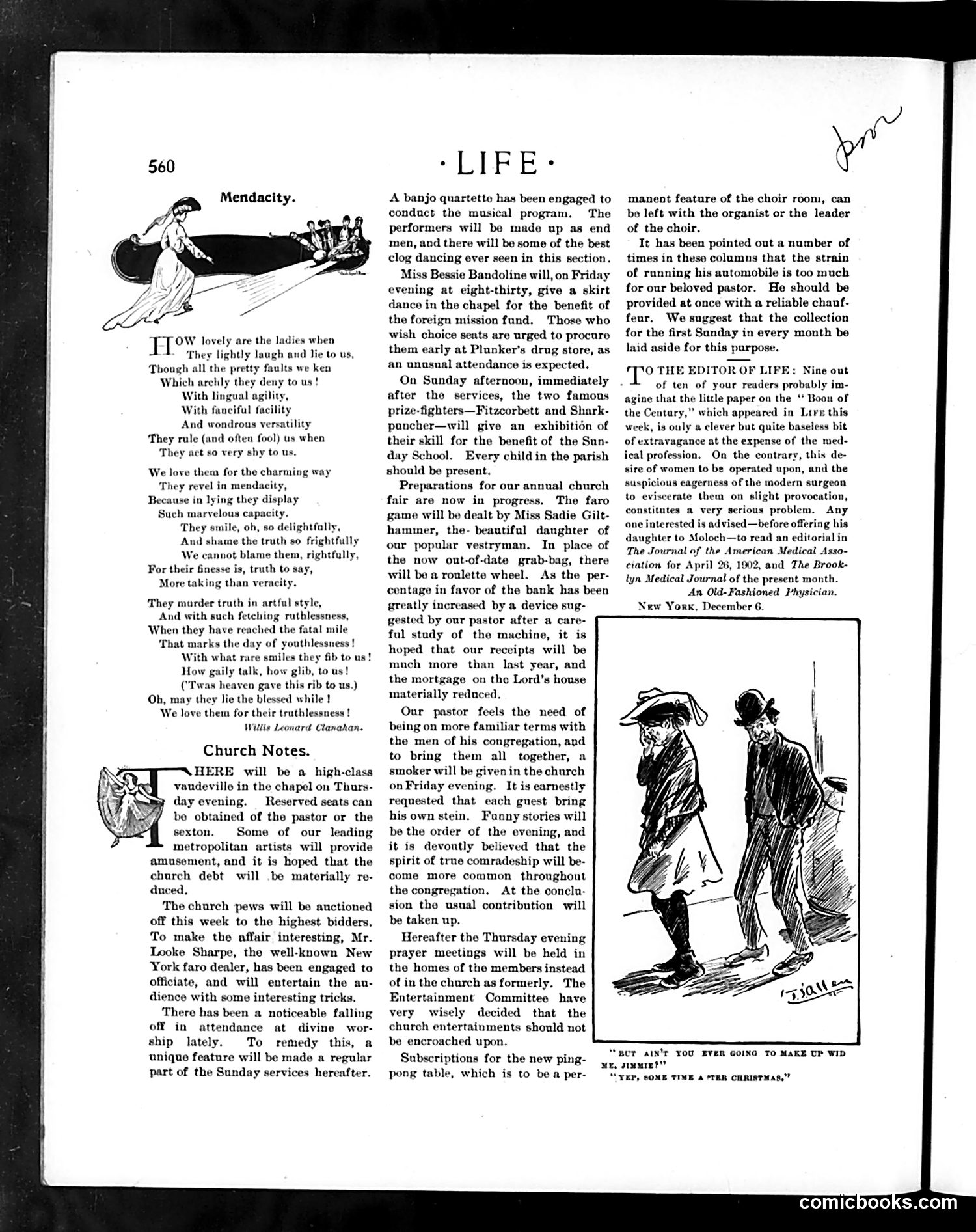
This page satirizes hypocrisy within organized religion through two main pieces: **The Poem "Mendacity"** celebrates women's deceptiveness as charming rather than condemning it—a lighthearted commentary on gender and truthfulness. **"Church Notes"** is the sharper satire. It mocks a church's fund-raising methods through mock-serious announcements that reveal moral contradictions: - Hiring a faro dealer (professional gambler) to auction pews - Featuring prize-fighters and skirt dancing as church entertainment - Operating a roulette wheel at the church fair with odds "greatly increased" by the pastor - Holding a men's "smoker" (drinking event) at church The cartoon below shows two men in conversation, likely commenting on these absurdities. The satire targets how churches compromise their values by adopting secular entertainment and gambling schemes to reduce mortgage debt—implying that financial desperation leads to theological inconsistency. The earnest church-bulletin tone makes the contradictions more biting.
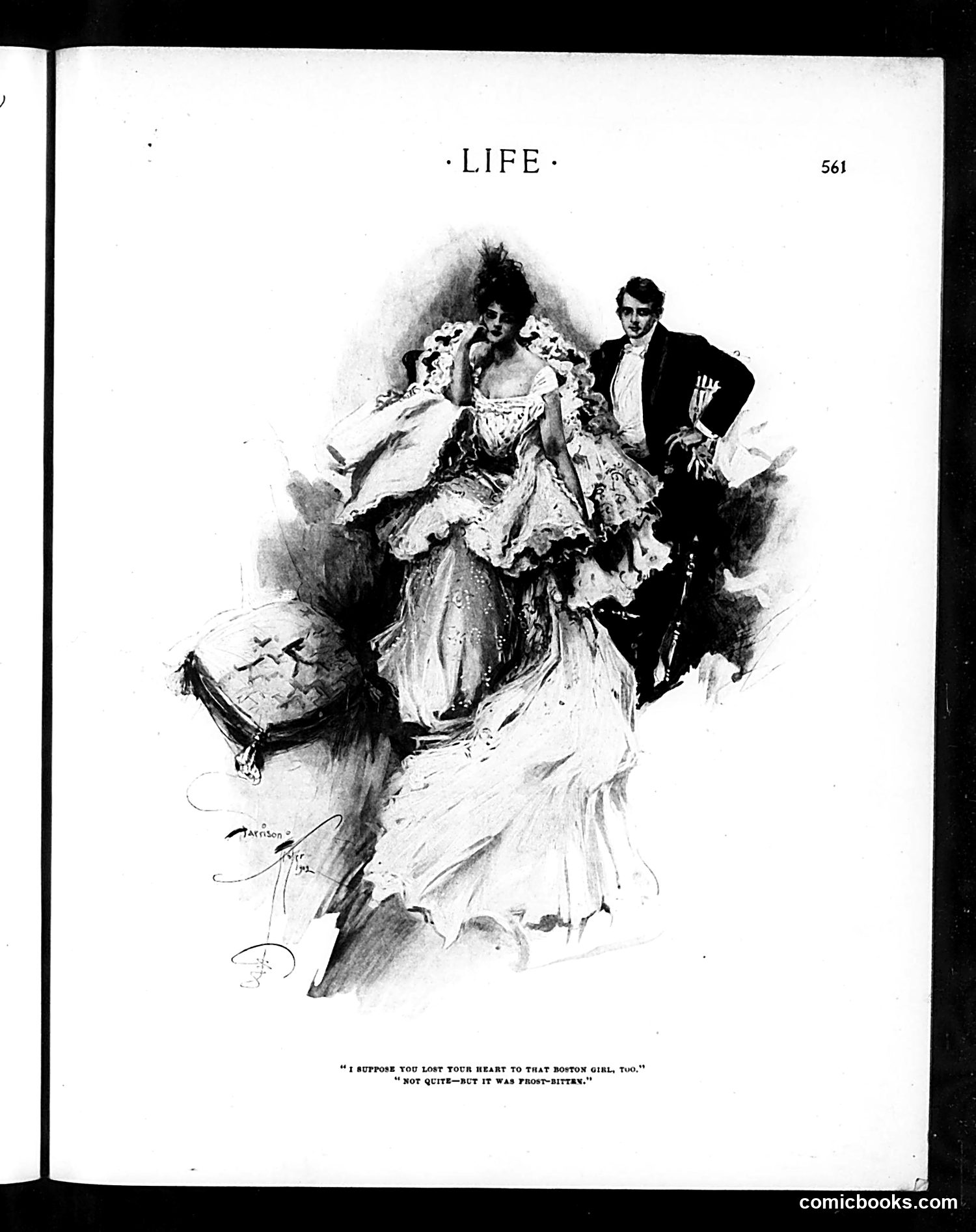
This page features a sketch-style illustration of a well-dressed couple in what appears to be early 20th-century formal attire. The woman wears an elaborate dress with decorative details, while the man is in evening wear. The caption presents a flirtatious dialogue about a "Boston girl," with one figure teasing another about lost hearts. The phrase "frost-bitten" appears to be a pun—suggesting the Boston girl gave him a cold reception rather than romantic warmth, playing on Boston's reputation for reserved New England propriety. The illustration style and romantic subject matter are typical of Life's satirical commentary on courtship and social dynamics of the era, using wordplay to joke about regional personality stereotypes.
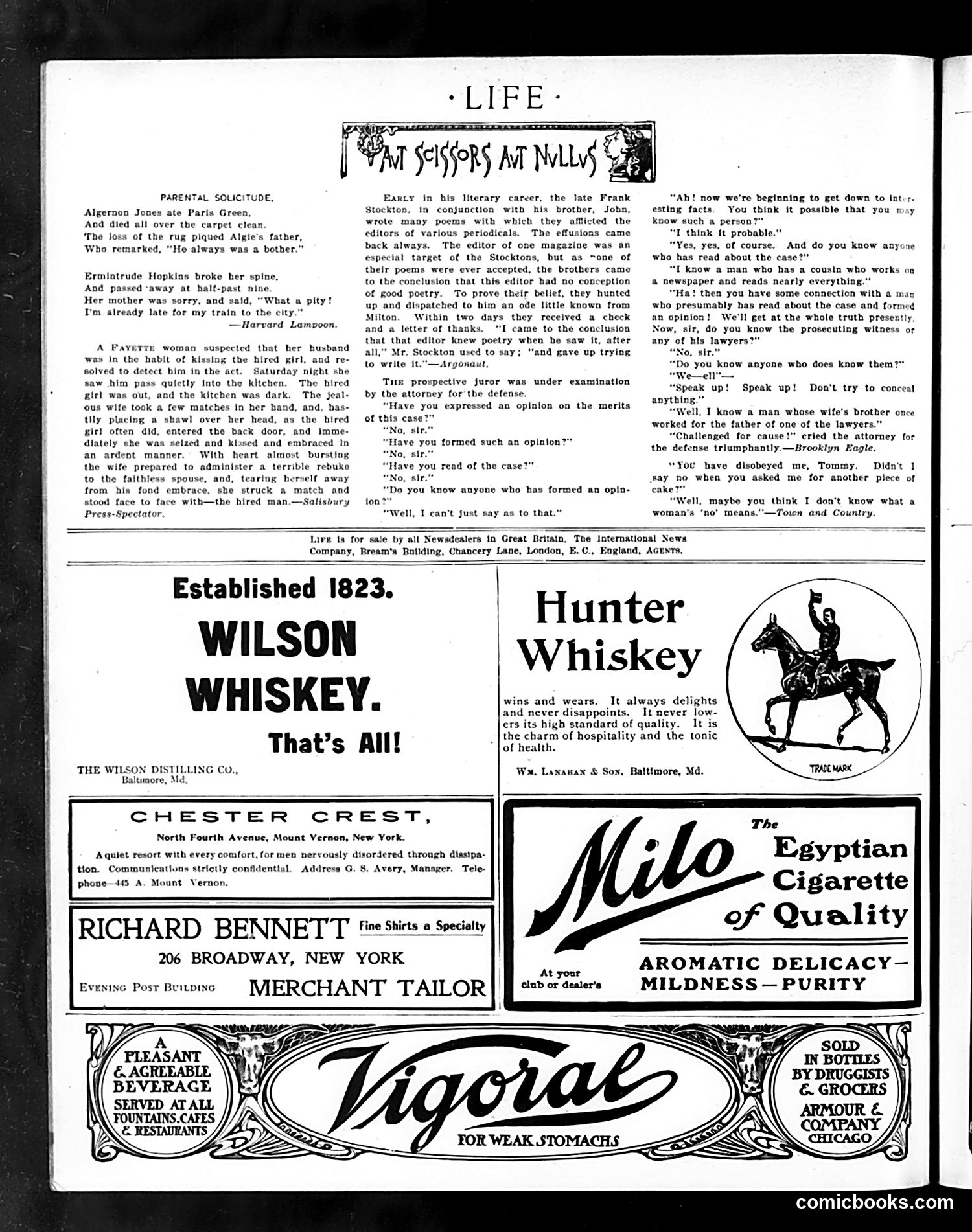
This page contains primarily **humorous short stories and advertisements** rather than political cartoons. The main content includes four brief comedic anecdotes: 1. **"Parental Solicitude"**: Dark humor about parents' indifferent reactions to their children's deaths 2. **A mistaken-identity story**: A jealous wife catches her husband kissing in the dark—but it's the hired *man*, not girl 3. **The Frank Stockton anecdote**: A literary joke about a poet tricking an editor into accepting Milton by falsely attributing it to him 4. **Jury examination**: Satirizes how a prospective juror's vague answers ("I know a man whose wife's brother...") keep revealing indirect connections, making him unfit for duty The satire targets **human folly**: parental callousness, marital mistrust, literary pretension, and the absurdity of jury qualification standards. The page is otherwise filled with **period advertisements** for whiskey, shirts, and cigarettes—reflecting early 20th-century magazine content. No identifiable political figures appear.
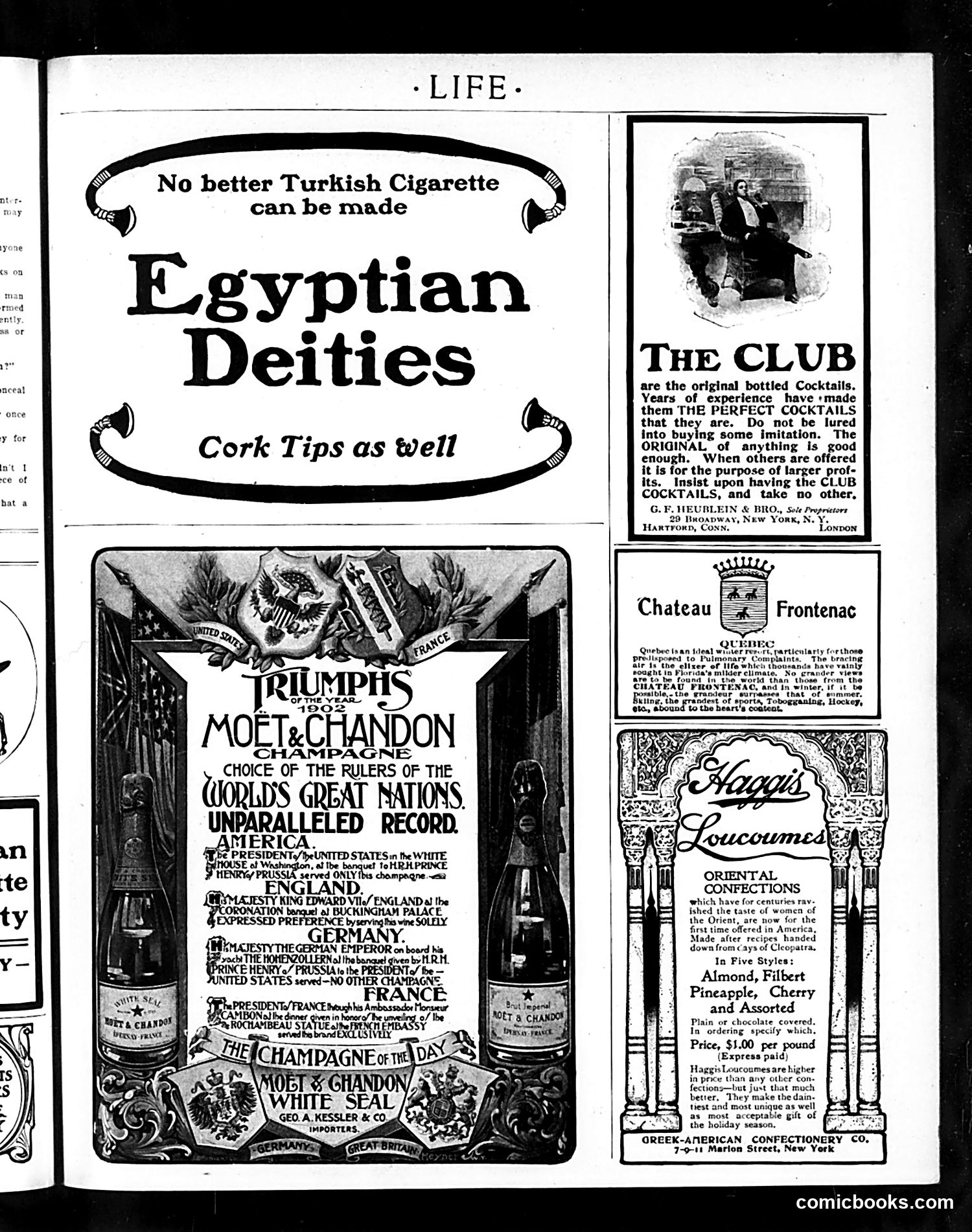
This is primarily an **advertisement page**, not a political cartoon. The content consists of luxury product advertisements from the early 20th century, arranged to appeal to wealthy consumers. The main advertisement features **Moët & Chandon champagne**, which emphasizes its prestige by claiming it was "the choice of the rulers of the world's great nations"—listing America, England, Germany, and France with references to their respective monarchs and leaders. This appeals to aspirational consumers through association with power and nobility. Surrounding ads promote **Egyptian Deities cigarettes** (with cork tips), **The Club brand cocktails** (positioned as "original" and superior to imitations), **Chateau Frontenac wine**, and **Haggis Loucoumes** (Oriental confections marketed as exotic luxury items from "days of Cleopatra"). The page reflects **turn-of-the-century consumer culture**: emphasis on authenticity, prestige through royal/international association, and marketing of imported "exotic" goods as status symbols for the affluent American market.
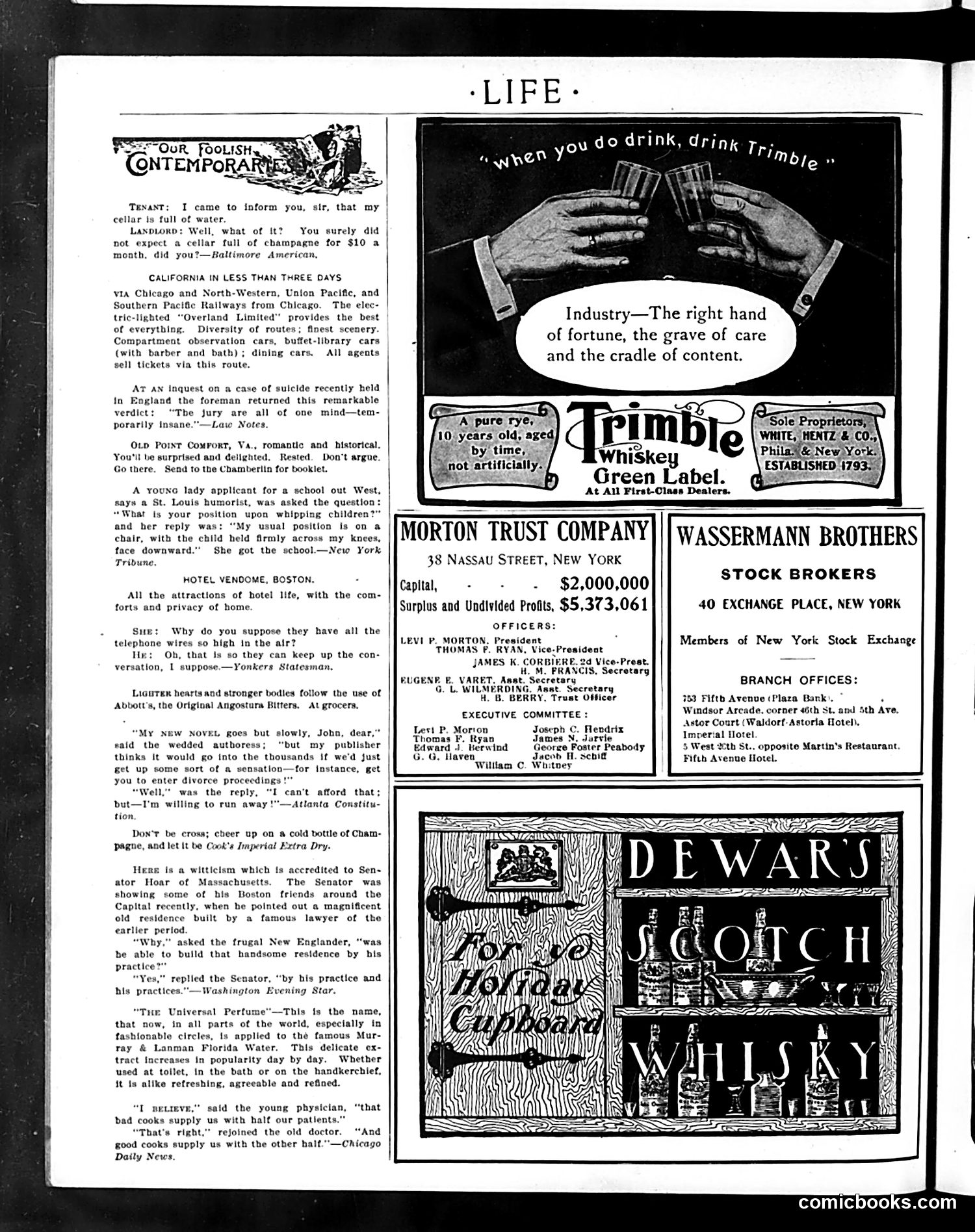
This page consists primarily of **brief satirical jokes and advertisements** rather than political cartoons. The main cartoon ("Our Foolish Contemporary") is a simple one-panel joke: a tenant complains to his landlord that the cellar is flooded with water. The landlord responds sarcastically that the tenant shouldn't expect a cellar full of *champagne* for only $10/month—mocking the tenant's complaint by implying unrealistic entitlement. The page's other content is mostly **humorous anecdotes** poking fun at domestic life, education, and relationships. For example, a young schoolteacher describes whipping children while sitting in a chair; a wife suggests her husband create a divorce scandal to help her novel sell; and a physician blames bad cooks for half his patients. The remaining space is **commercial advertising** for railroads (California travel), hotels, liquor (Trimble Whiskey, Dewar's Scotch), and financial services (Morton Trust Company), typical of *Life* magazine's revenue model in this era.
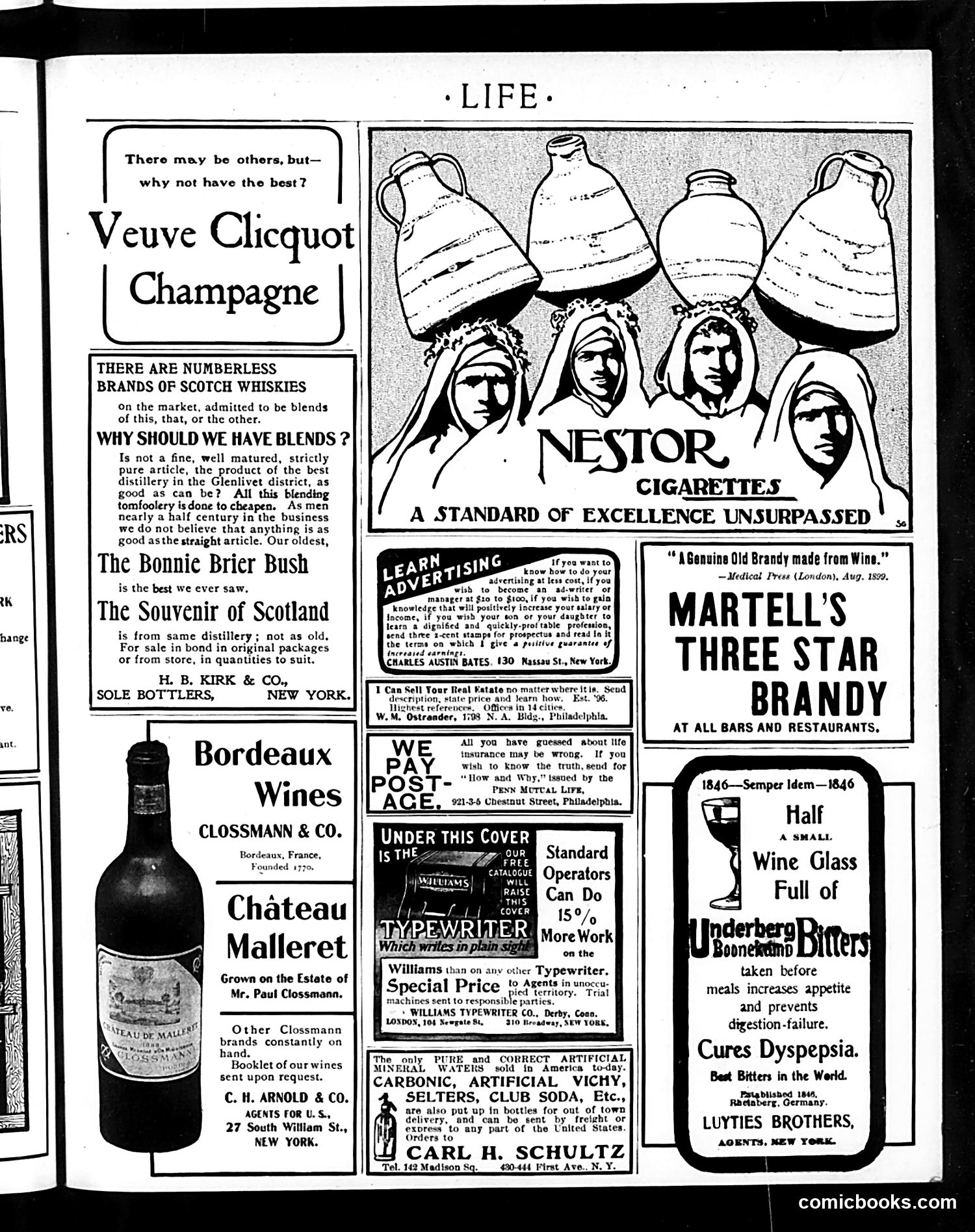
This page is primarily **advertising**, not editorial cartoon content. It showcases luxury consumer goods popular in the early 1900s: **Featured Products:** - **Veuve Clicquot Champagne** and other wines/spirits (Bordeaux, Scotch whisky) - **Nestor Cigarettes** (center image: four women's faces beneath champagne bottles, claiming "excellence unsurpassed") - **Martell's Three Star Brandy** - **Underberg Bitters** (marketed as a digestive aid) **Social Context:** The ads reflect Gilded Age consumer culture emphasizing imported European luxury goods as markers of refinement. The Nestor cigarettes ad uses female imagery—a common advertising trope of the era. The Underberg ad addresses "dyspepsia" (indigestion), reflecting period concerns about digestive health. **Notable:** One small ad offers instruction in advertising writing as a profession, suggesting Life's educated, affluent readership. There is **no political satire or cartoon** on this page—it's a straightforward commercial publication.
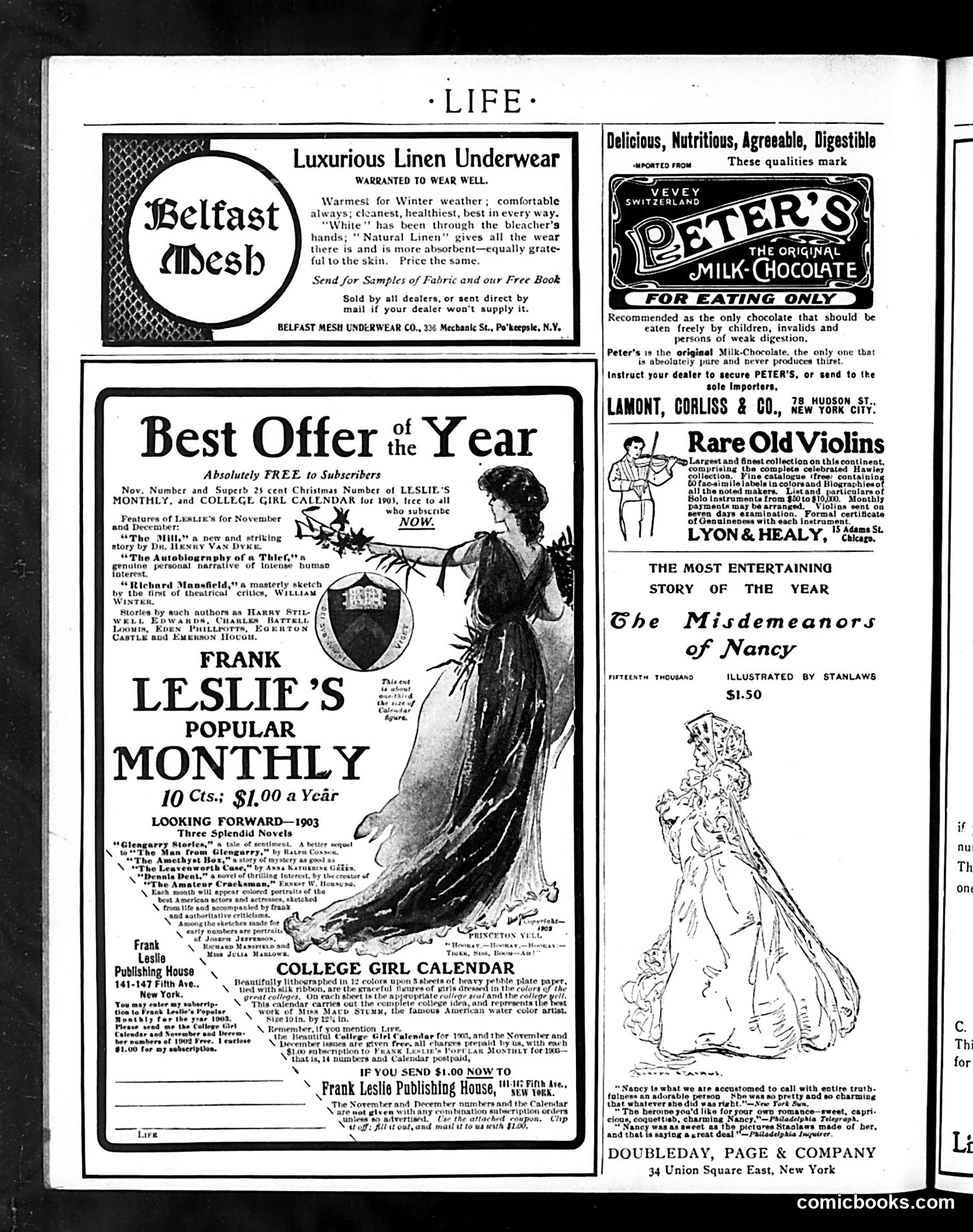
This is primarily an **advertising page** from Life magazine, not a satirical cartoon page. It consists entirely of period advertisements and promotional content from circa 1902-1903. The page advertises: - **Belfast Mesh underwear** (emphasizing durability and comfort) - **Frank Leslie's Popular Monthly** magazine subscription offer, featuring a dramatic illustration of a woman in classical dress - **Peter's Milk Chocolate** (marketed as safe for children and invalids) - **Lyon & Healy violins** (luxury instruments) - **"The Misdemeanors of Nancy"** book by Doubleday, Page & Company The only illustration with potential satirical content is the large classical female figure promoting Leslie's Monthly, but no clear political or social satire is evident. The page reflects early 1900s consumer culture and magazine publishing practices, with emphasis on quality products and holiday gift subscriptions. No specific political figures or events are referenced or caricatured.
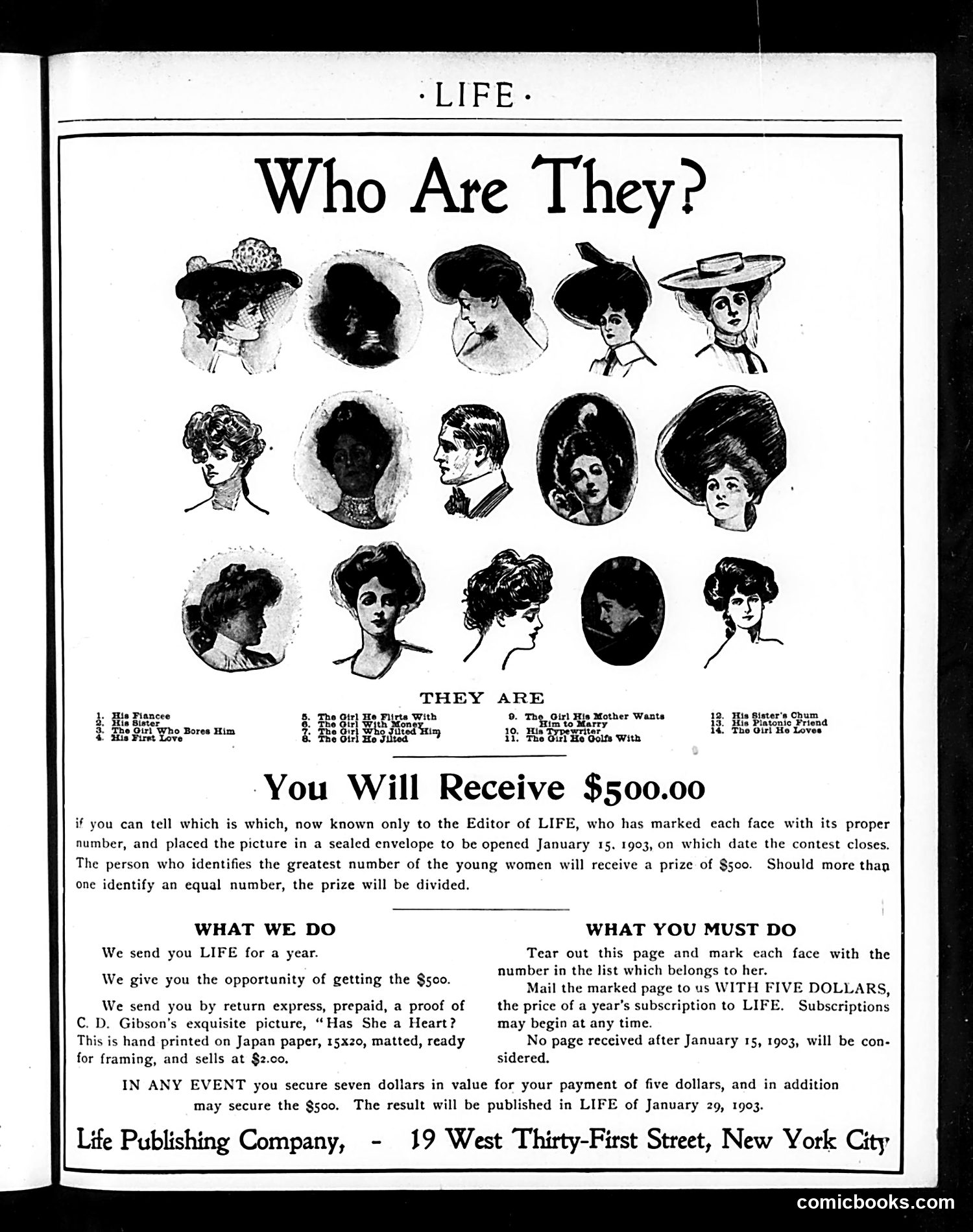
This is a **contest advertisement**, not a political cartoon. Life magazine published 15 sketched portraits of young women's faces by illustrator C.D. Gibson (famous for the "Gibson Girl" ideal), each labeled only by number. Readers were challenged to match each face to her corresponding "type" from a numbered list—including categories like "His Fiancée," "The Girl Who Bores Him," "His Sister's Chum," and "The Girl He Loves." For five dollars (a year's subscription to Life), contestants received a Gibson print valued at two dollars, plus the chance to win $500 by correctly identifying the most faces. The contest closed January 15, 1903. **The satire**: This mocks early-1900s romantic archetypes and masculine anxieties about women—the implicit joke being that women's social roles were so standardized that their "type" could be read from appearance alone. It's less about individual women than about commodifying and categorizing femininity.
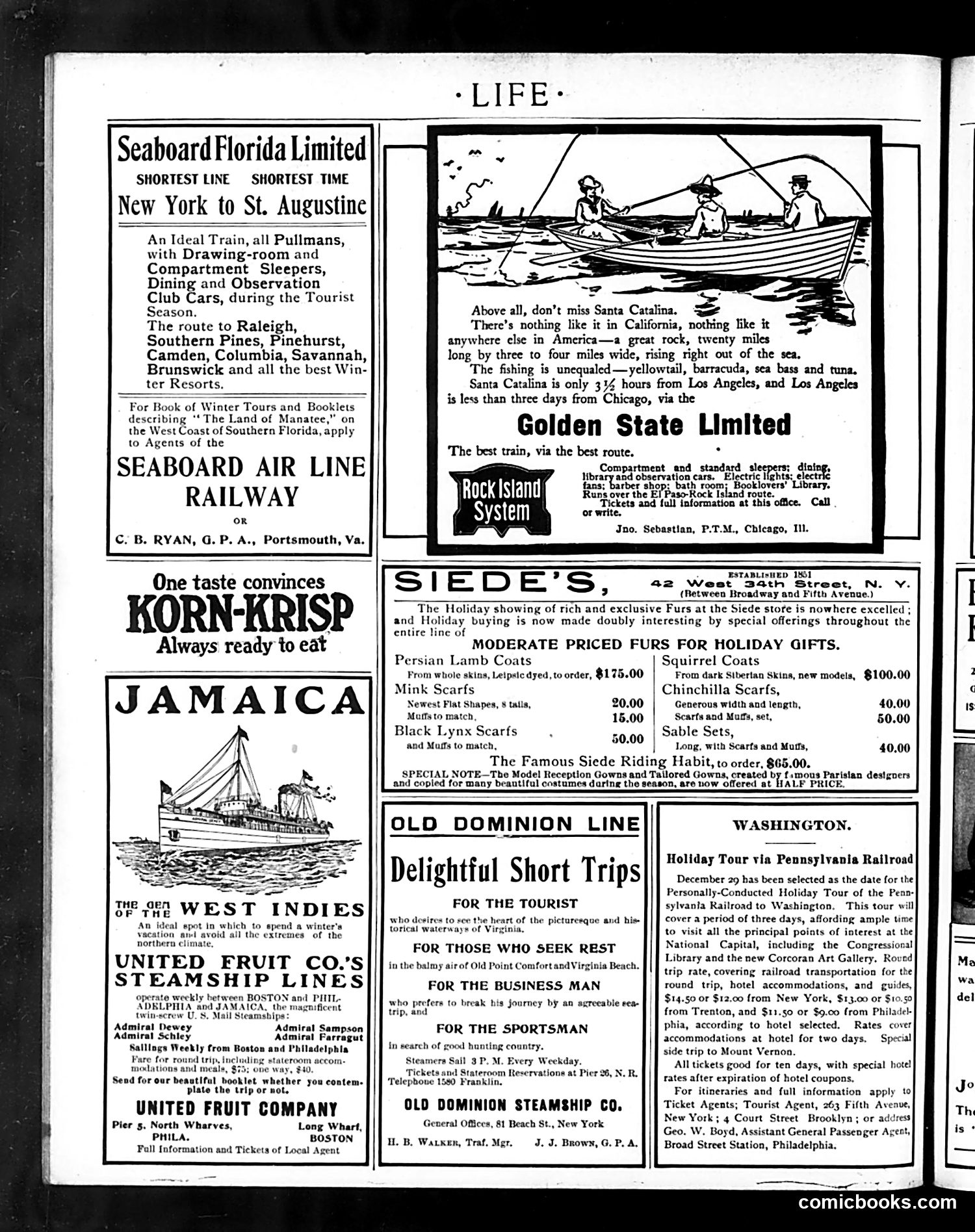
This page is primarily **advertising** for various travel companies and luxury goods from the early 1900s. The only illustration with narrative content shows **three men fishing in a small boat**, accompanying an advertisement for Santa Catalina island off California—promoting it as an unmatched destination for sport fishing. The image supports the text's claims about excellent fishing (yellowtail, barracuda, sea bass, tuna). Most of the page contains travel ads: the Seaboard Railroad to Florida, Golden State Limited train service, United Fruit Company steamship lines to Jamaica, and the Old Dominion Line cruises along Virginia's waterways. There is also advertising for luxury goods (Siede's furs, Korn-Krisp cereal) and a Pennsylvania Railroad tour to Washington, D.C. This appears to be a commercial publication page aimed at wealthy Winter-season tourists and holiday shoppers—no political satire or social commentary is evident.
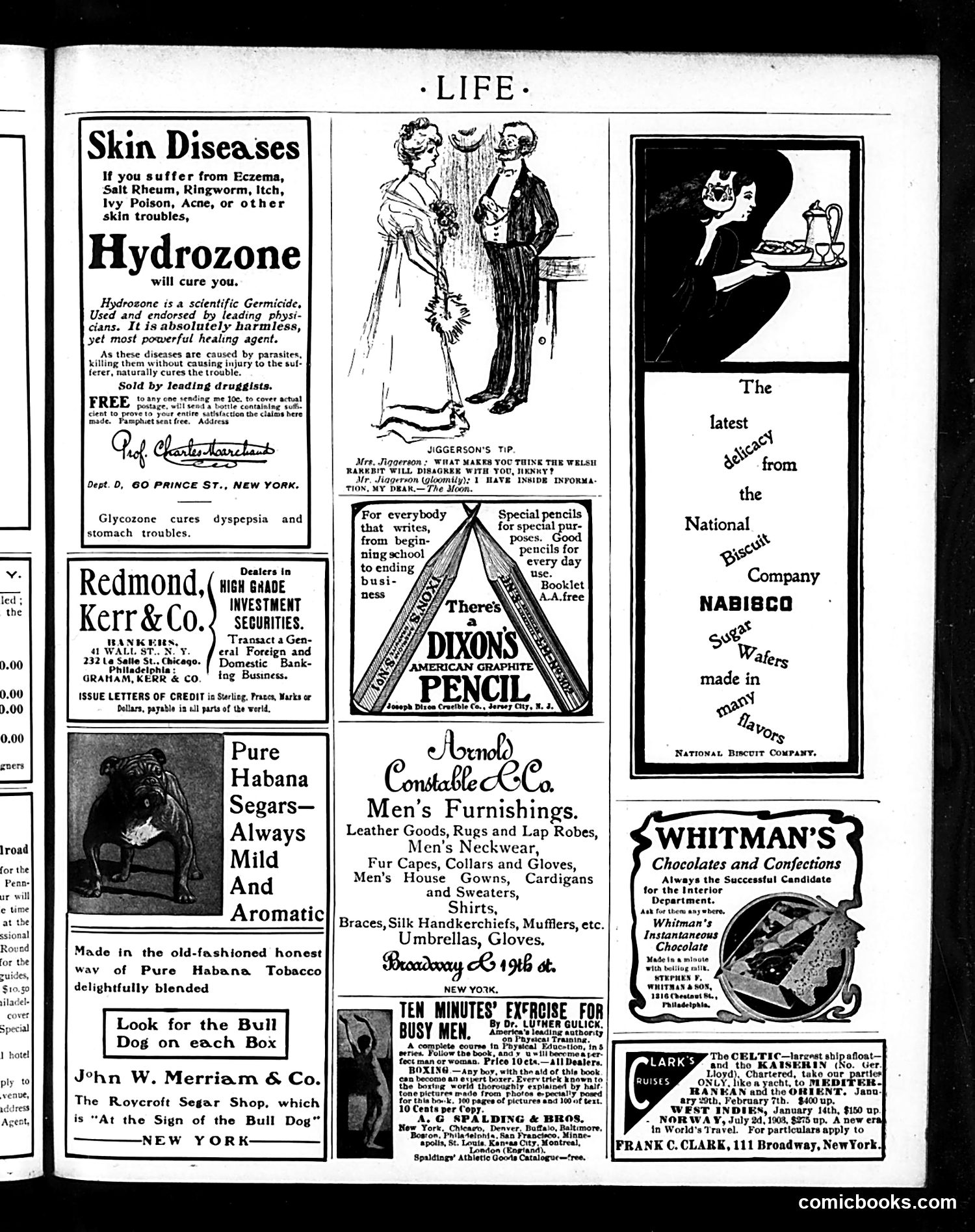
This page is primarily **advertising**, typical of early 20th-century magazines. The single cartoon item is "Jiggerson's Tip," a brief joke about a man named Jiggerson discussing a Welsh rarebit (a cheese dish). When asked why he thinks it will disagree with him, he cryptically claims to have "inside information" from "the Moon"—implying either supernatural knowledge or humorous pessimism about his digestion. The surrounding advertisements promote patent medicines (Hydrozone for skin diseases), cigars, investment services, men's clothing, pencils, biscuits, chocolates, and cruise ship travel. These ads reflect turn-of-the-century consumer culture and the prevalence of unregulated medical claims. The cartoon itself is merely a mild digestive-humor gag with no political significance.
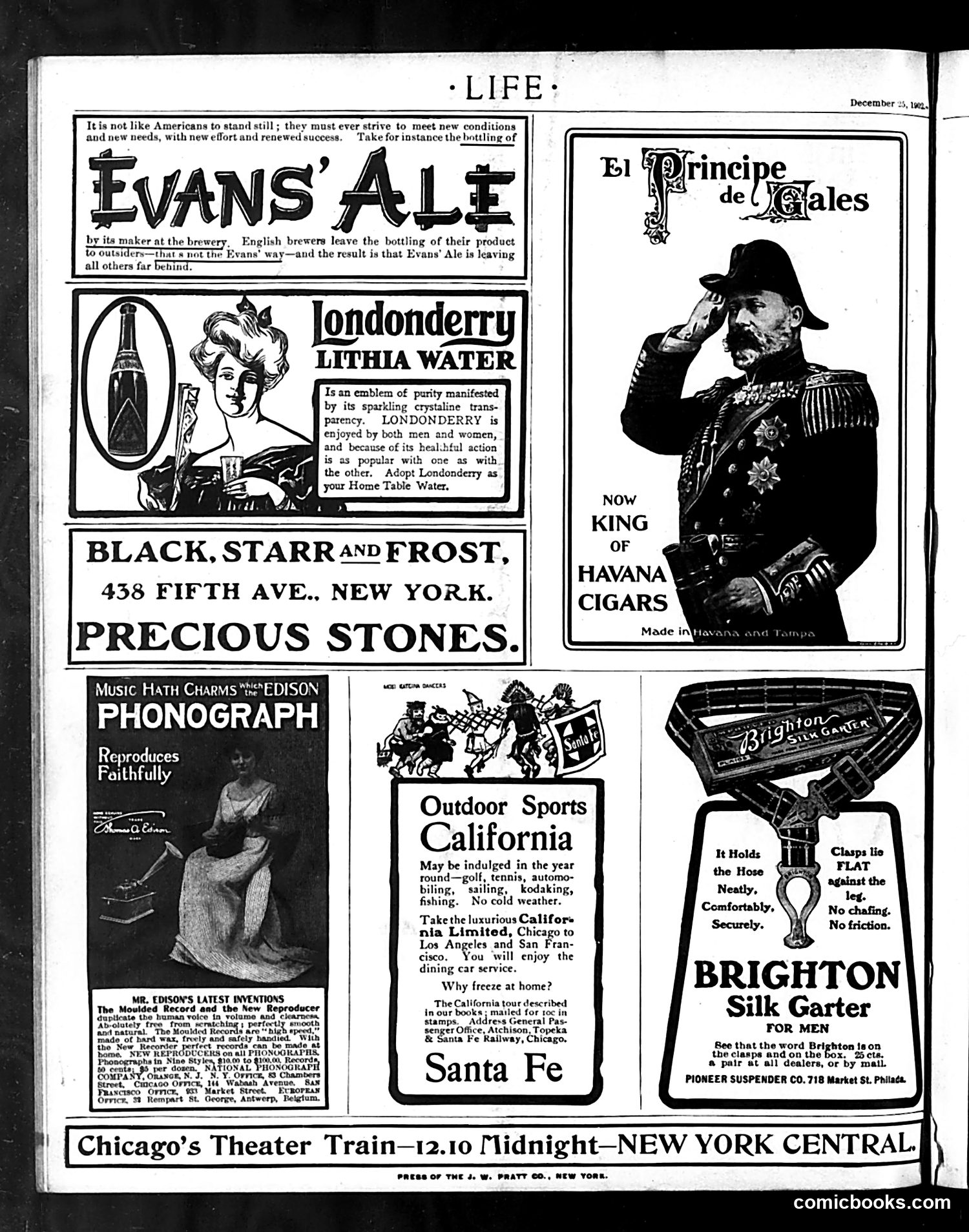
This is primarily an **advertising page** rather than satirical content. The ads reflect early-1900s American consumer culture and values: **Key advertisements include:** - **Evans' Ale**: Boasts American manufacturing superiority—bottled by the maker (not outsourced like English brands), exemplifying American industrial progress and competitive advantage. - **Londonderry Lithia Water**: Markets mineral water's "purity" and health benefits to both sexes, reflecting contemporary health-conscious consumerism. - **Edison Phonograph**: Advertises the latest recording technology as faithfully reproducing sound. - **Santa Fe Railway**: Promotes California tourism and year-round outdoor recreation (golf, tennis, sailing, fishing) as escape from harsh northern winters—appealing to leisure travel. - **Brighton Silk Garter**: Practical men's accessory with functional benefits (holds hose, no chafing). The page's overarching theme emphasizes **American innovation, progress, and consumer abundance** during the prosperous Edwardian era.
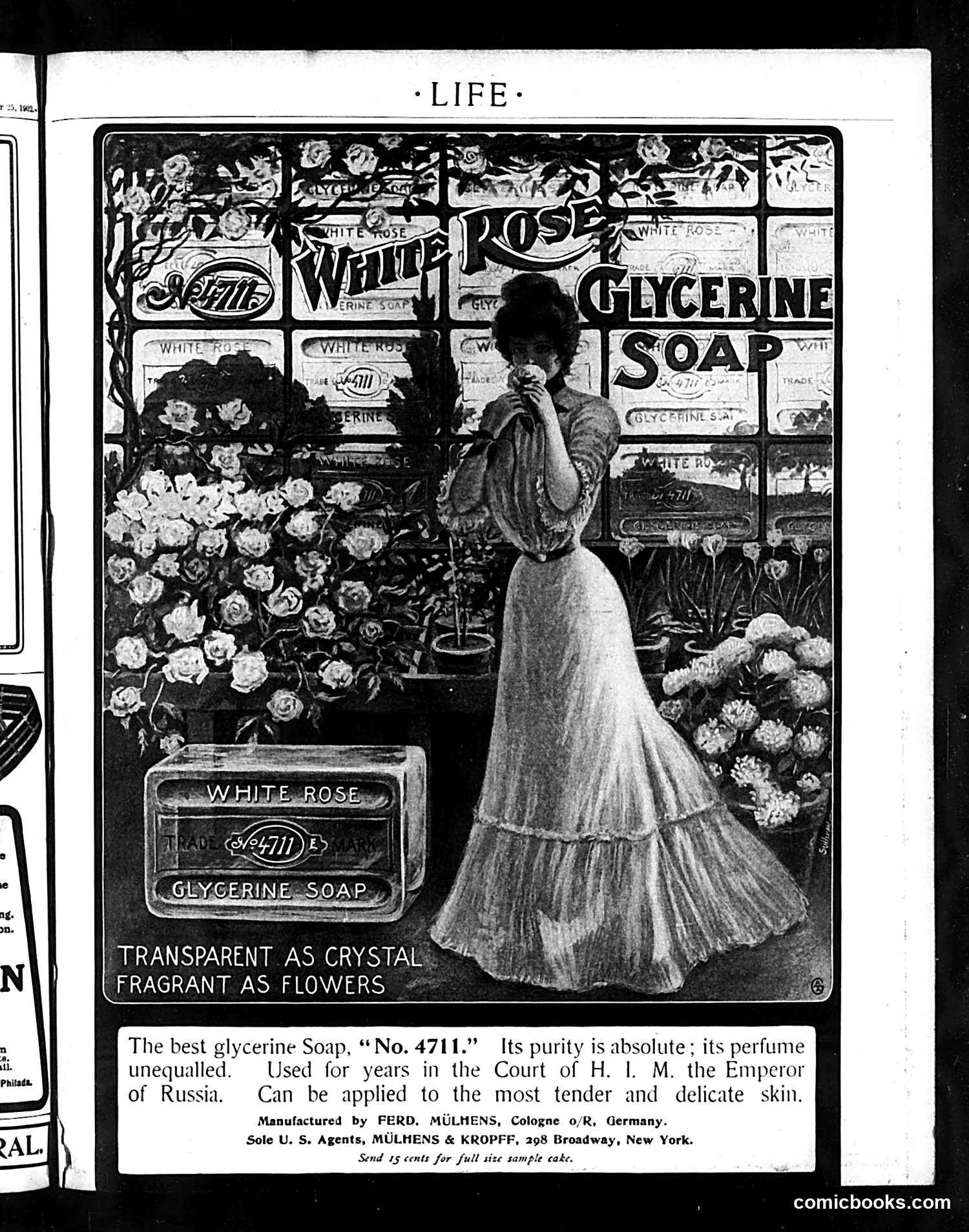
This is a **soap advertisement**, not political satire. It promotes "No. 4711" glycerine soap, manufactured in Cologne, Germany, by Ferd. Mülhens. The advertisement uses a romanticized illustration of a woman in an elegant dress examining flowers and soap boxes. The tagline "Transparent as Crystal / Fragrant as Flowers" emphasizes the product's purity and fragrance. The marketing leverages prestige by claiming the soap was "used for years in the Court of H.I.M. the Emperor of Russia"—suggesting royal approval enhanced the product's luxury appeal to American consumers. The ad emphasizes the soap's gentleness for delicate skin, a common sales pitch for Victorian-era beauty products. This represents early 20th-century consumer advertising rather than editorial content or satire.
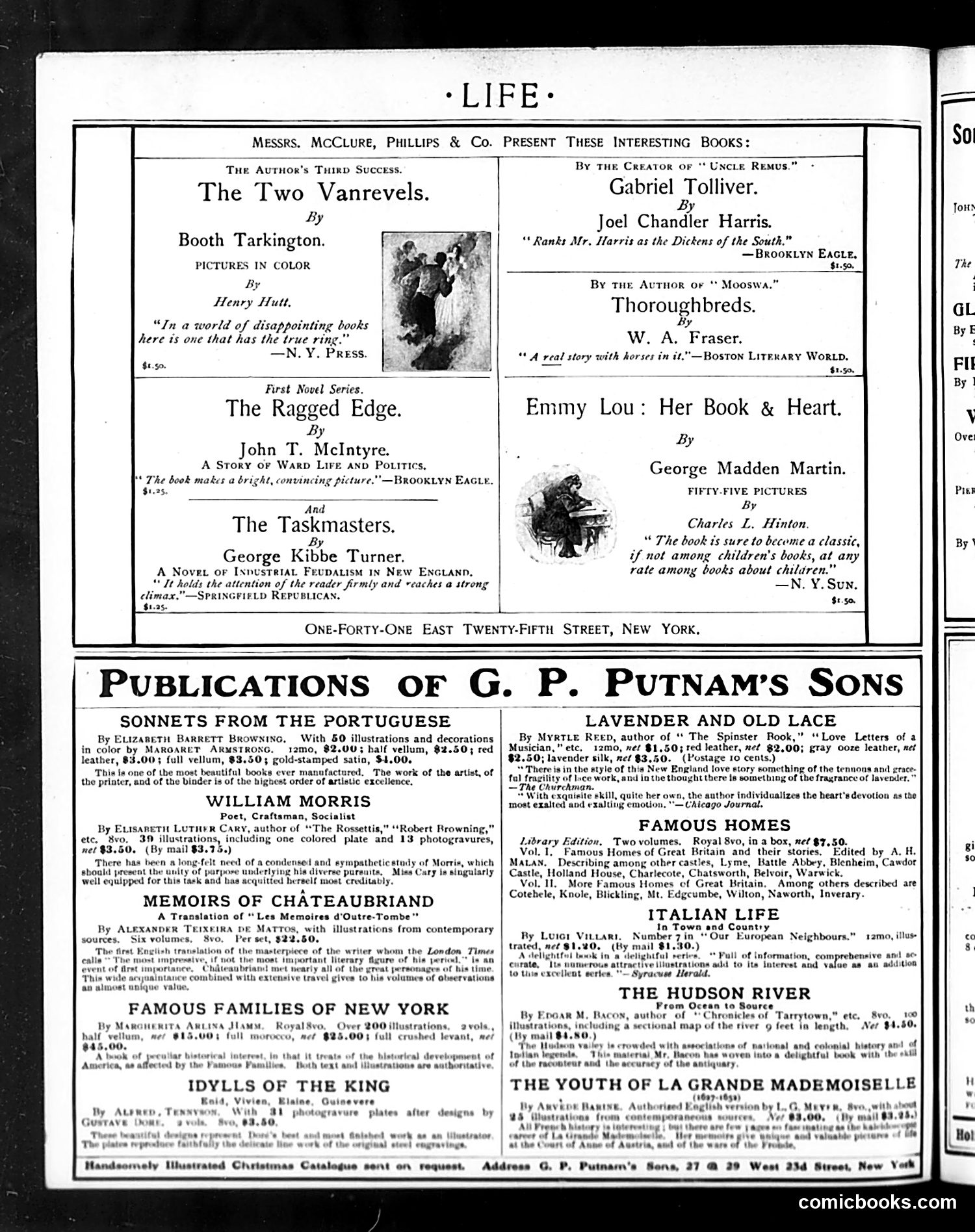
This page is primarily **book advertising** rather than editorial content or political satire. It presents new publications from two major publishers: McClure, Phillips & Co. and G. P. Putnam's Sons. The advertised titles reflect early 1900s literary tastes: novels by established authors like Booth Tarkington and Joel Chandler Harris (creator of Uncle Remus), poetry collections, and historical works. Publishers emphasized illustrations and fine production values—gold-stamped satin bindings, photogravures, colored plates—suggesting these were luxury items for educated readers. Notable is the absence of political commentary; this is a commercial publishing showcase. The quoted endorsements from newspapers like the *Brooklyn Eagle* and *N.Y. Sun* were standard marketing tactics. The page demonstrates how Life magazine monetized its audience of literate, affluent Americans through premium book advertising.
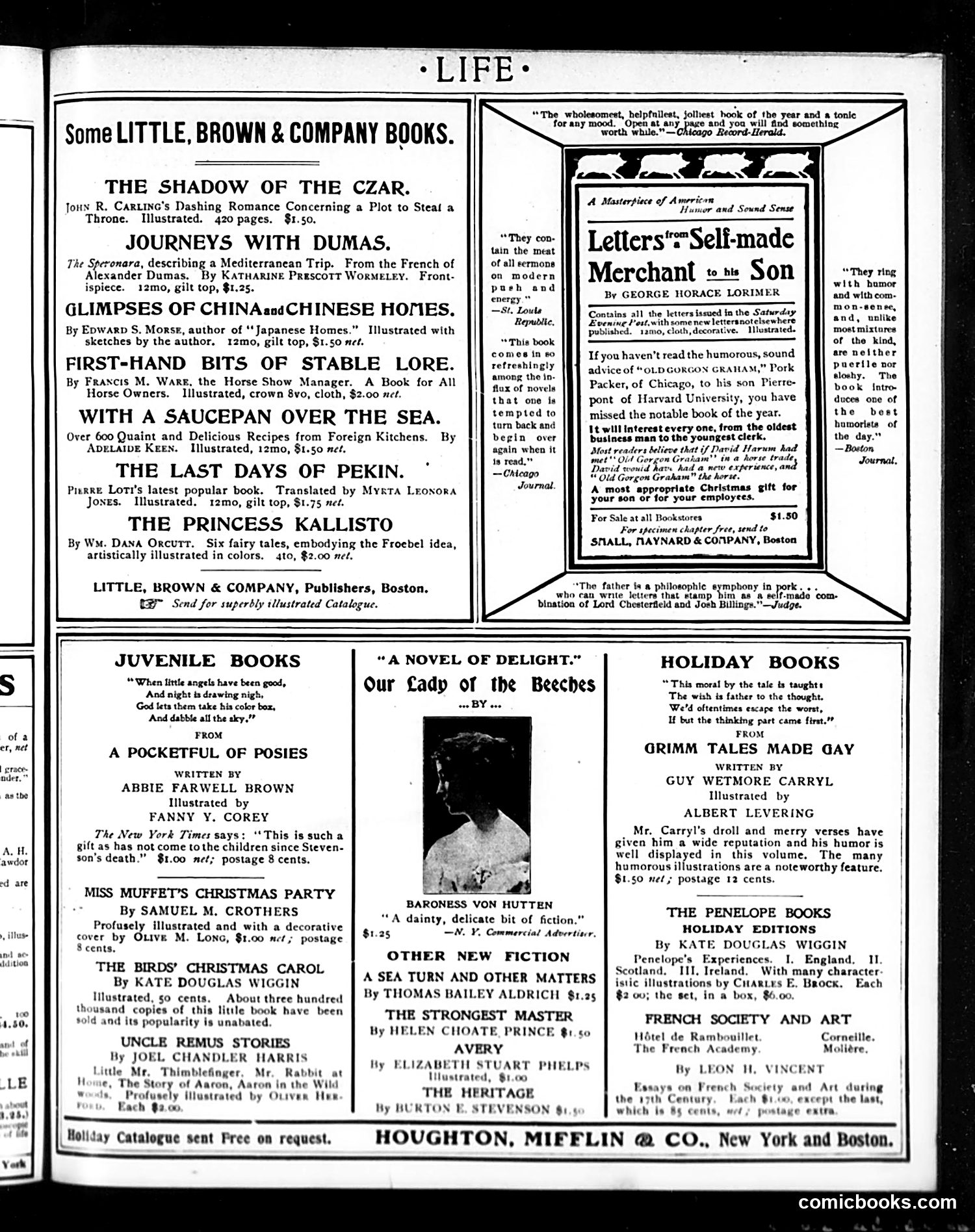
This is primarily a **book advertisement page** from Life magazine, not a political cartoon. It showcases publications from Little, Brown & Company and other publishers. The page advertises works spanning multiple genres: travel narratives (Dumas, Pekin), practical guides (stable care, Chinese homes, recipes), and children's literature. The central feature promotes "Letters from a Self-Made Merchant to His Son" by George Horace Lorimer—a humorous advice book positioning a fictional Chicago pork packer ("Old Gorgon Graham") as a modern sage dispensing business wisdom to his Harvard-attending son. The framing compares Graham to classic figures of worldly counsel (Lord Chesterfield, Josh Billings), suggesting the book's appeal as both humor and practical guidance. Holiday and juvenile sections promote gift-appropriate titles. This reflects turn-of-the-century American publishing: practical self-help wrapped in humor, appeals to masculine business culture, and the commercialization of Christmas gift-giving.

I can see this is a mostly black page from what appears to be a Life magazine publication, with very limited visible content. The page is heavily darkened or degraded, making it nearly impossible to discern specific cartoon imagery, text, or satirical content with any clarity. On the right edge, there appears to be a white margin or binding with some faint text or markings, but the content is not legible enough to identify figures, political references, or the intended satirical point. Without being able to read the OCR text reliably or see the actual cartoon artwork, I cannot accurately explain what this page's satire or humor references. I would need a clearer image to provide the historical context a modern reader would need.
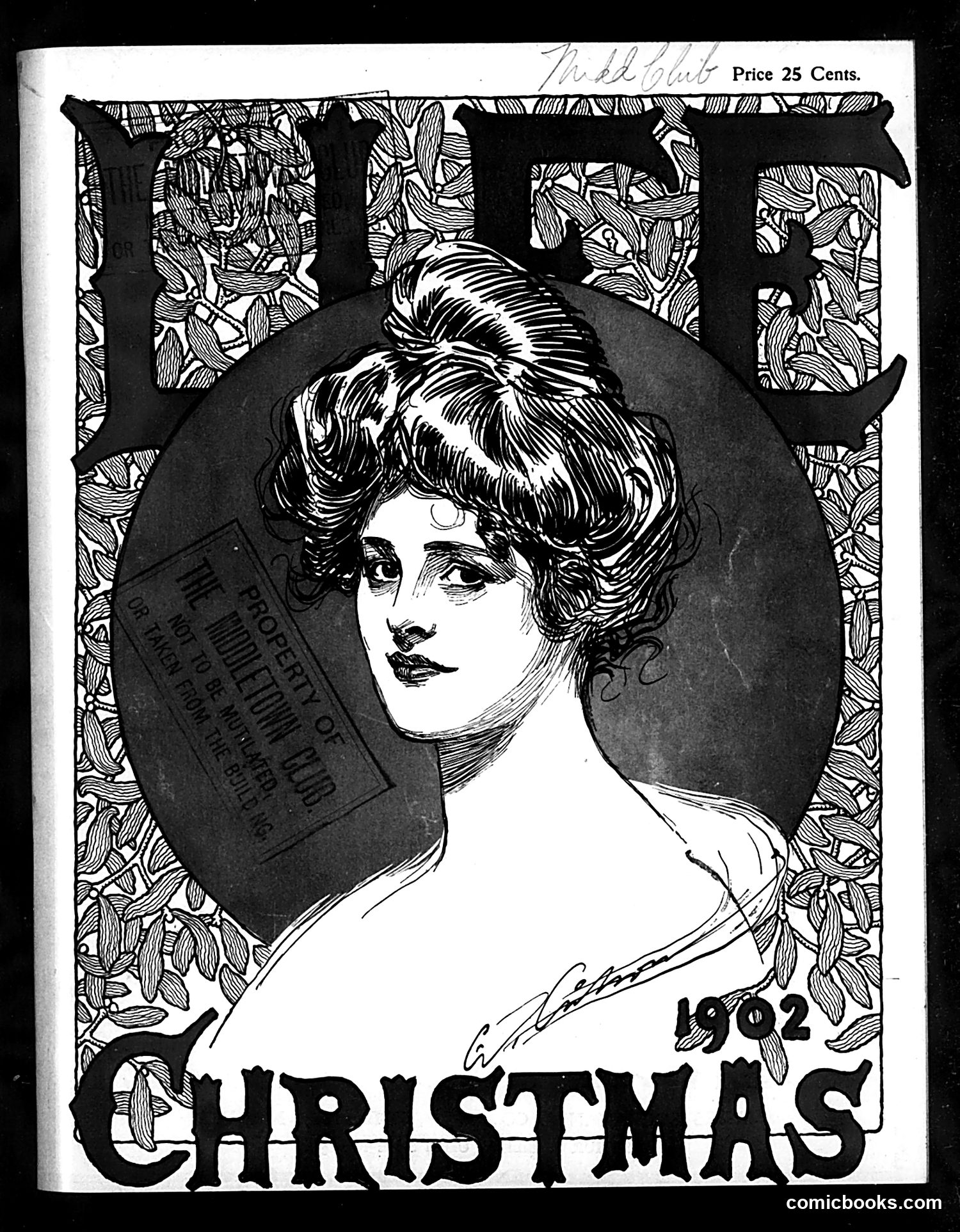
This is a **1902 Christmas cover** for *Life* magazine priced at 25 cents. The illustration depicts an elegantly styled woman in profile, her hair styled in the fashionable Gibson Girl manner of the era. Behind her head is a large dark oval (possibly representing a halo or decorative frame) containing text that appears to reference "property" or similar messaging—though the OCR is unclear on exact wording. The ornate decorative border of leaves and botanical elements frames the entire composition. The artwork exemplifies the *Life* magazine's typical turn-of-the-century aesthetic: sophisticated line work, satirical wit directed at high society, and the idealized feminine beauty standard of the Edwardian period. The specific satirical message of the text on the oval remains illegible in this reproduction.
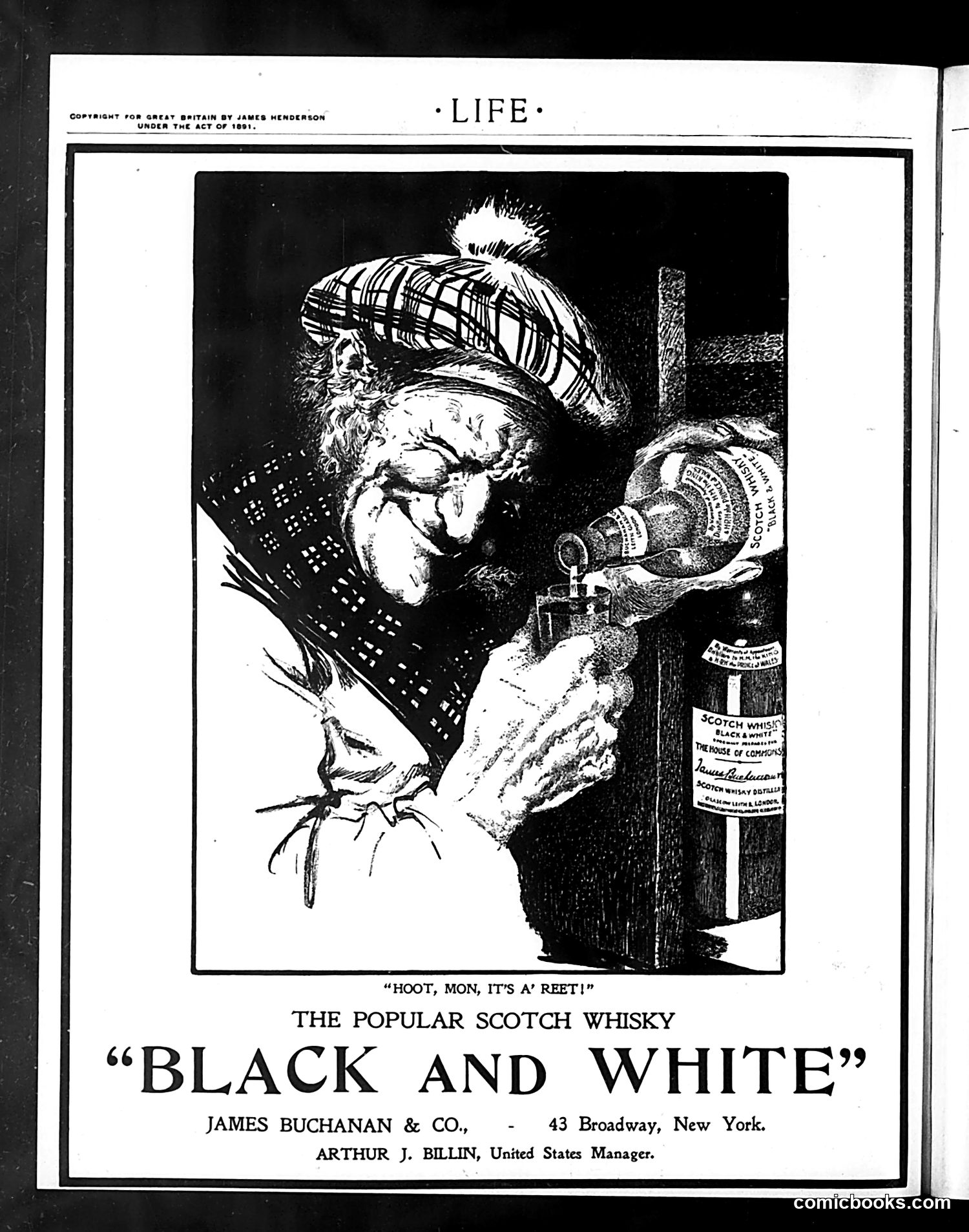
This is a **whisky advertisement** rather than political satire. It depicts a caricatured Scottish man with exaggerated facial features, wearing a tartan cap and checkered shirt, pouring Black and White Scotch whisky. The caption "Hoot, mon, it's a' reet!" uses Scottish dialect for comedic effect ("Look, man, it's all right!"). The ad relies on **ethnic stereotyping common to early 20th-century marketing**—presenting a grotesquely caricatured Scot to sell whisky to American consumers. The visual humor derives from the broad physical caricature and broad accent, appealing to period audiences' familiarity with such stereotypes. James Buchanan & Co. marketed this product from their New York office to American customers.
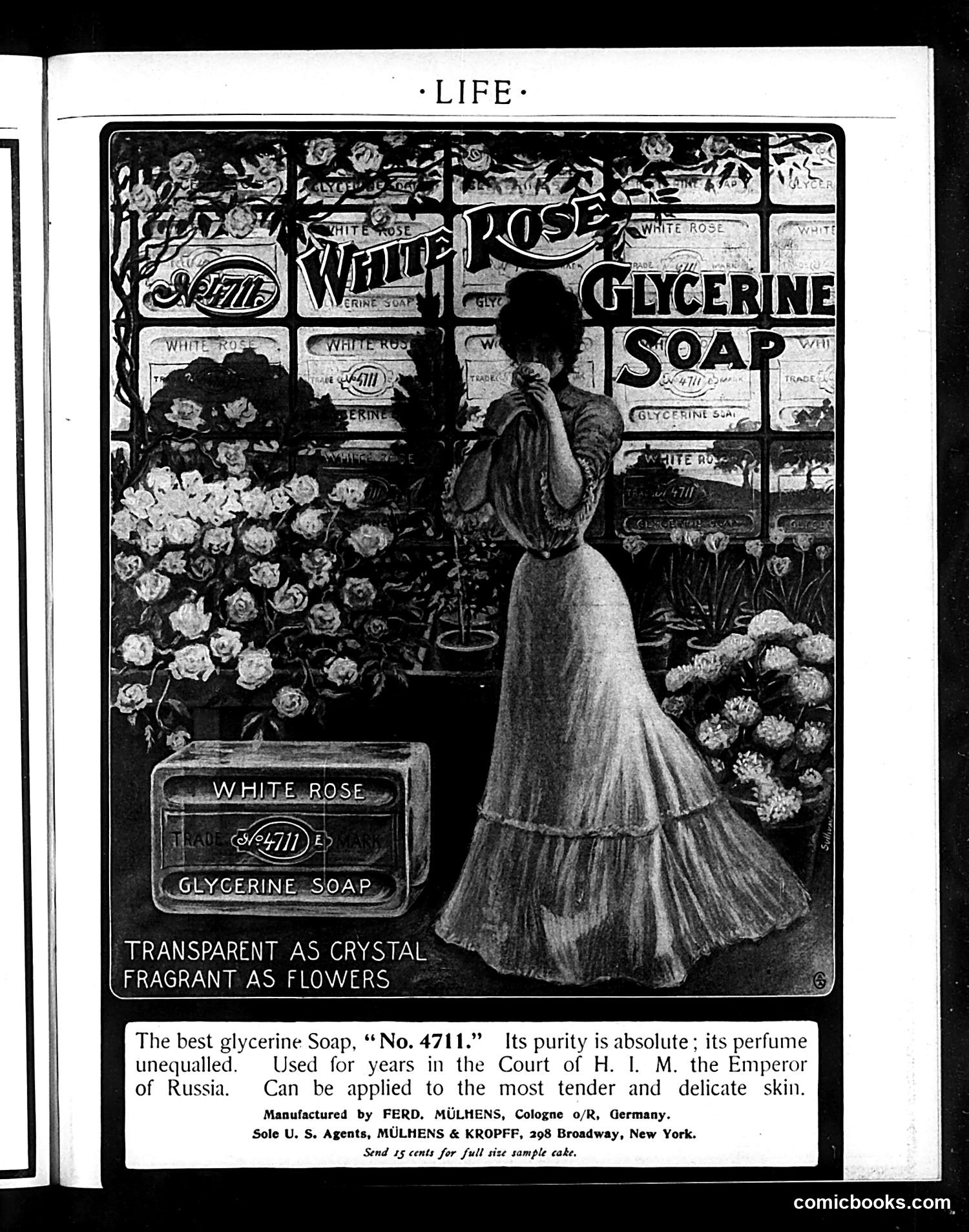
This is a **full-page advertisement**, not a political cartoon or satire. It promotes "No. 4711" glycerine soap manufactured by Ferd. Mülhens of Cologne, Germany. The ad features an elegant woman in an Edwardian-era dress viewing a shop window display of White Rose branded products and glycerine soap boxes. The image emphasizes luxury and refinement through the woman's fashionable silhouette and the floral setting. The marketing claims include purity, superior perfume, and a notable endorsement: the soap was "used for years in the Court of H.I.M. the Emperor of Russia"—a status symbol suggesting imperial approval and exclusivity. The tagline "Transparent as crystal / Fragrant as flowers" appeals to contemporary beauty standards. This represents early 20th-century advertising's reliance on aristocratic prestige and femininity to sell personal care products to middle-class consumers.
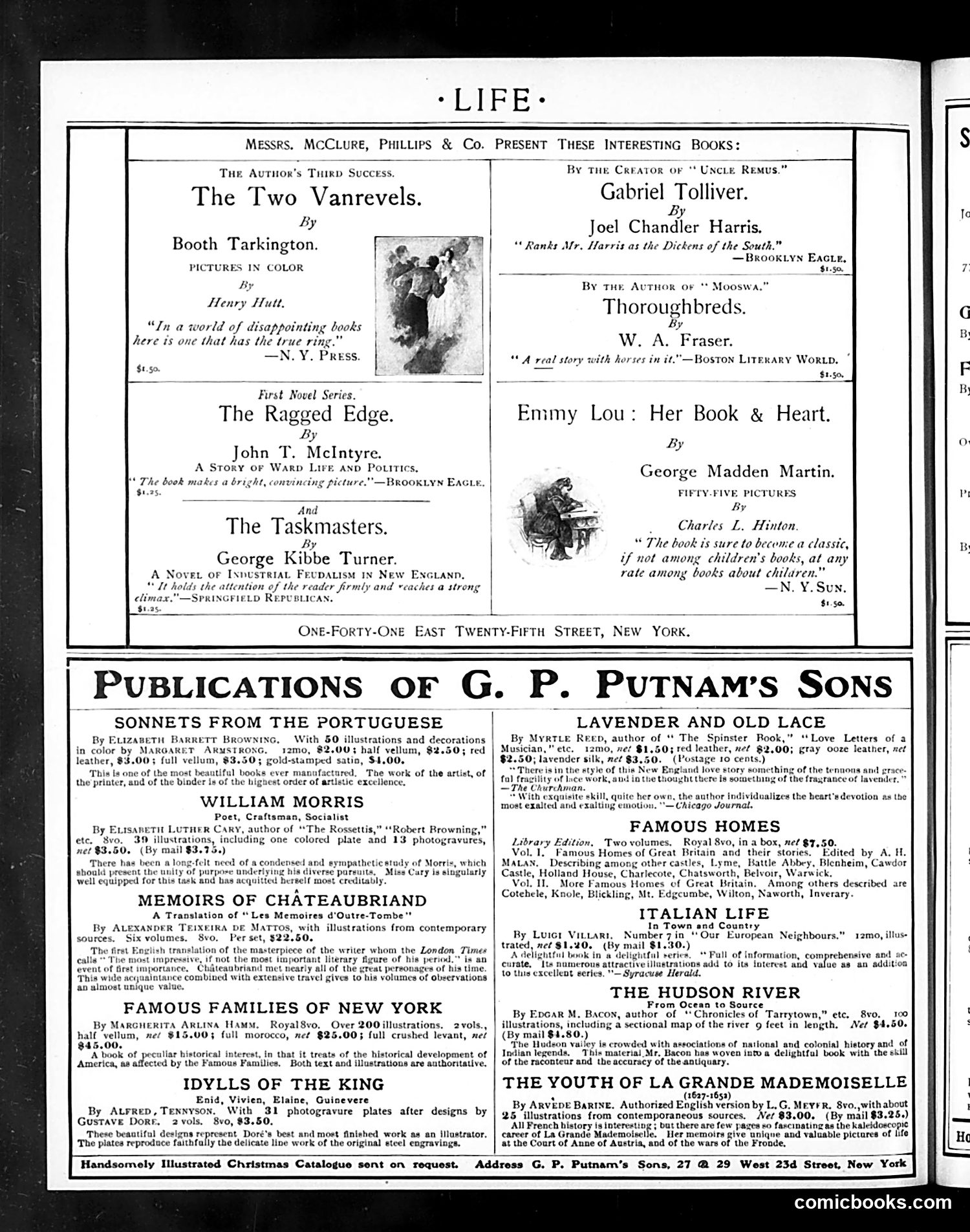
This page is primarily **advertising** for books published by McClure, Phillips & Co. and G. P. Putnam's Sons, rather than satirical content. The upper section features new novels by contemporary American authors—Booth Tarkington's *The Two Vanrevels*, works by Joel Chandler Harris (creator of Uncle Remus), and others. Critical quotes from newspapers endorse these books. The lower section catalogs Putnam's publications, including literary classics and beautiful illustrated editions: Elizabeth Barrett Browning's *Sonnets from the Portuguese*, Tennyson's *Idylls of the King* illustrated by Gustave Doré, and biographical works on William Morris and famous New York families. This represents early-1900s book marketing—publishers competing for educated readers' attention through prestigious author names, quality production values, and endorsements. There is **no political satire or cartoon content** visible on this page.
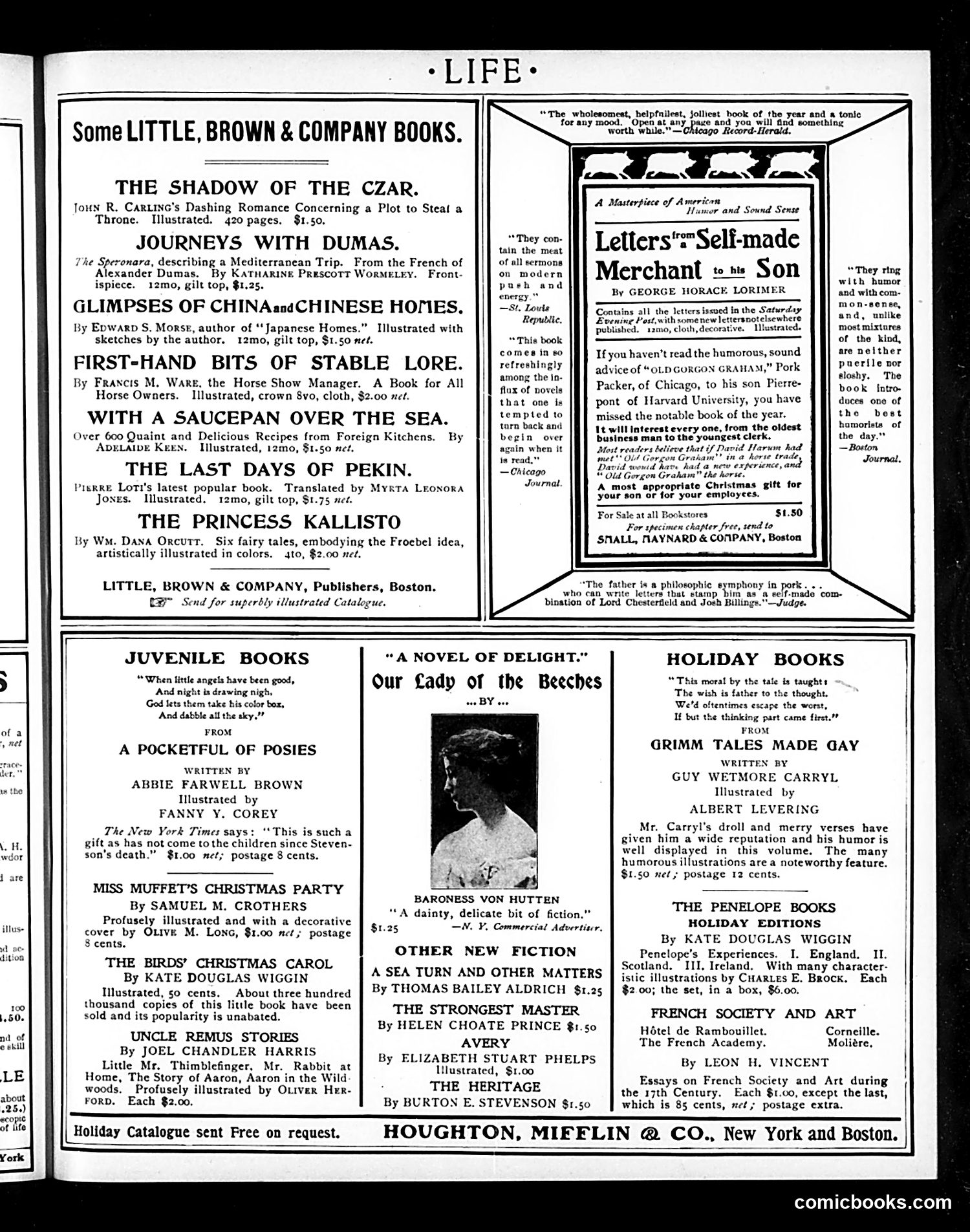
This is primarily a **book advertisement page**, not a satirical cartoon. It showcases holiday and children's books from major publishers (Little, Brown & Company; Houghton, Mifflin & Co.; Small, Maynard & Company) circa early 1900s. Key featured titles include *Letters from a Self-made Merchant to His Son* by George Horace Lorimer—a business advice book presented as fatherly correspondence—and children's works like *Grimm Tales Made Gay* and *A Pocketful of Posies*. The page includes one illustration: a photograph or portrait accompanying "Our Lady of the Beeches," described as "a novel of delight." **No political satire is present.** This is commercial publishing promotion targeting holiday gift-buyers, emphasizing books' moral and educational value for children and practical wisdom for adults. The tone reflects turn-of-the-century genteel publishing culture.
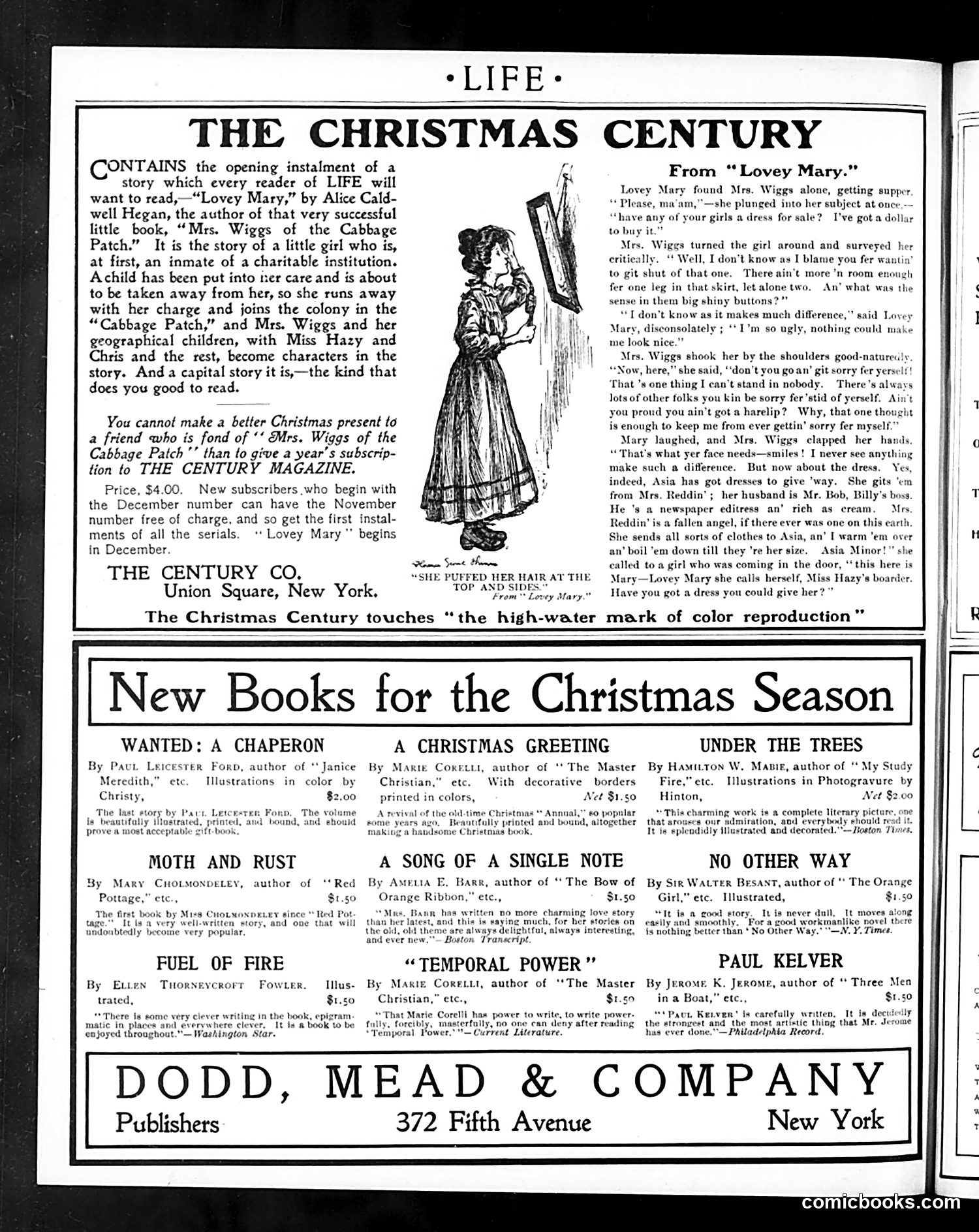
This is primarily a **book advertisement and serialization announcement**, not a political cartoon. The page promotes *Life* magazine's December issue, which will begin serializing "Lovey Mary" by Alice Caldwell Hegan, author of the popular novel *Mrs. Wiggs of the Cabbage Patch*. The excerpt shown depicts a dialogue between Lovey Mary (a poor orphan girl) and Mrs. Wiggs, a working-class charitable character. The scene illustrates **early 1900s sentimental fiction about urban poverty**: a girl worries about her shabby dress, and Mrs. Wiggs responds with folksy wisdom and kindness, emphasizing gratitude and self-respect over material concerns. The page uses this extract to entice *Life* readers to subscribe. The accompanying illustration shows a young woman in period dress. Below are advertisements for other Christmas books from various publishers, including works by Paul Leicester Ford and Ellen Thorneycroft Fowler. This reflects the era's popular taste for **wholesome, morality-tinged stories about poor children** and charitable institutions—common themes in Edwardian-era literature.
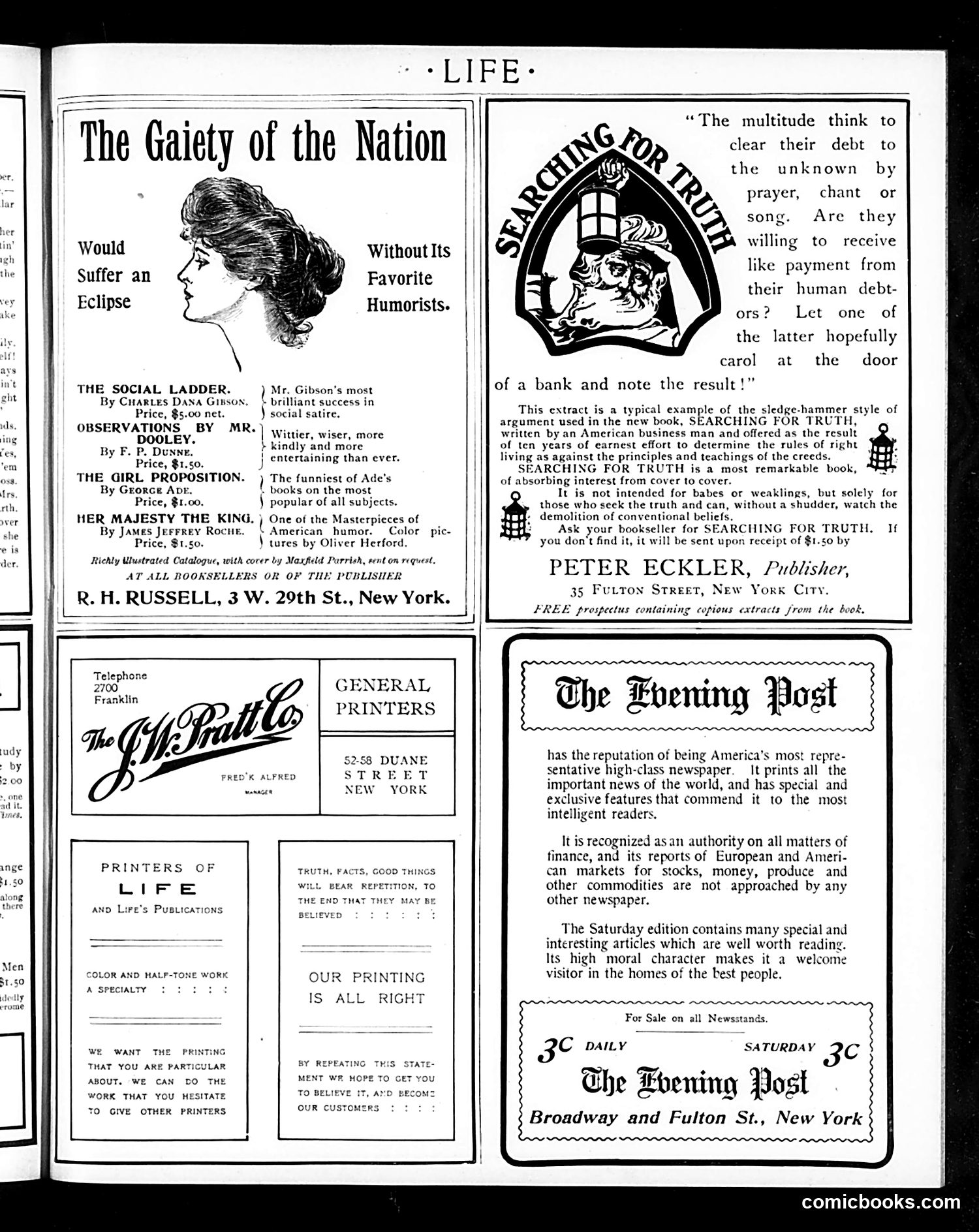
This is primarily an **advertising page** from Life magazine, not a political cartoon. The page promotes books by popular American humorists of the era—Charles Dana Gibson, F.P. Dunne, George Ade, and James Jeffrey Roche—whose illustrated works were bestsellers emphasizing social satire and humor. The main illustrated content shows a woman's profile labeled "The Gaiety of the Nation," referencing Gibson's celebrated social commentary through drawings. The largest advertisement promotes *Searching for Truth*, a polemical book attacking religious creeds in favor of rational "business man" philosophy—reflecting early 20th-century skepticism toward organized religion. Additional ads feature printing companies and *The Evening Post* newspaper, emphasizing its authority on finance and "high moral character." The page reflects Life's audience: educated, affluent readers interested in social criticism, literature, and respectable journalism—not explicit political satire.
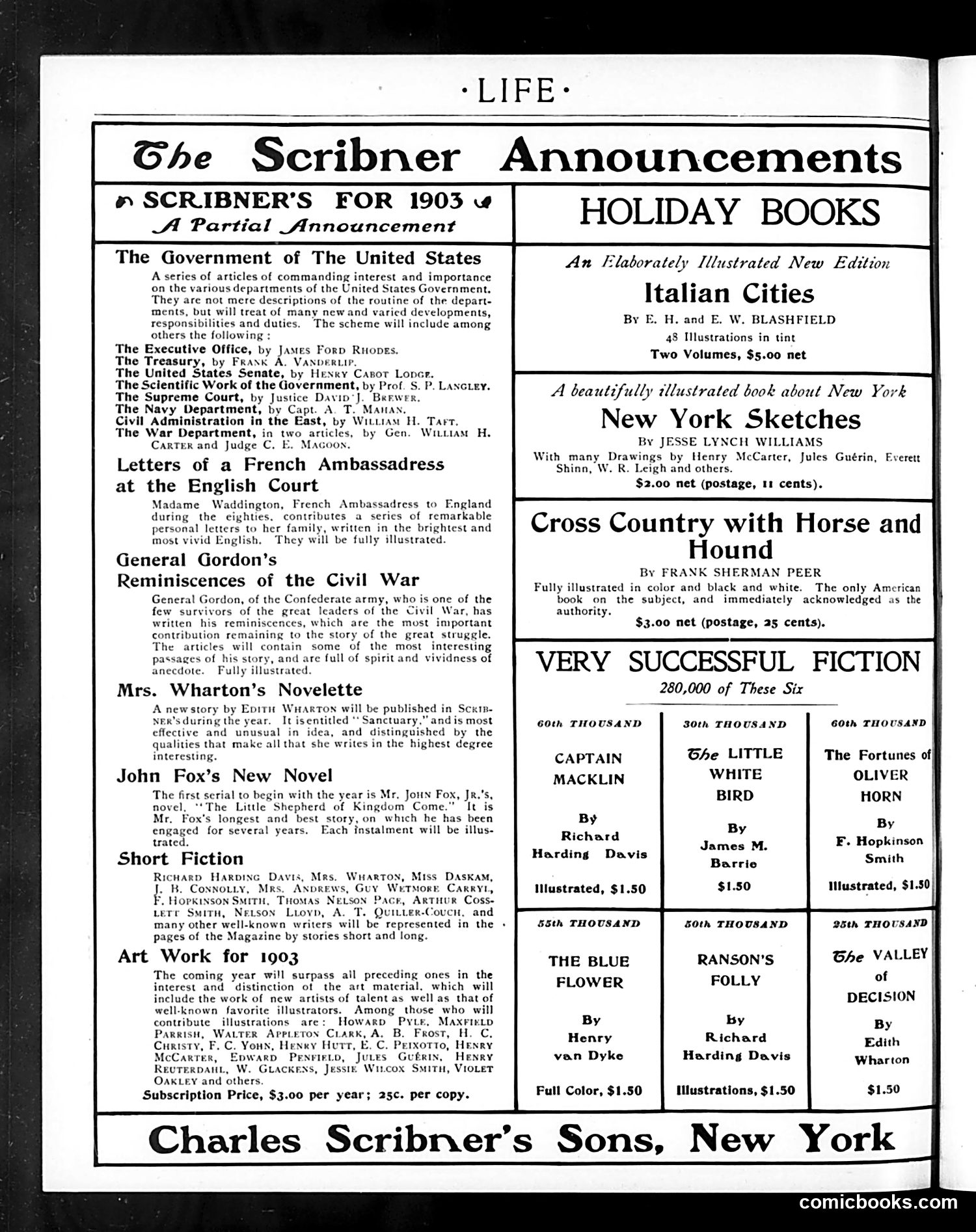
This is a publisher's announcement page, not a cartoon or satirical content. It contains advertisements for *Scribner's* magazine and *Charles Scribner's Sons* books for 1903. The left column announces upcoming magazine articles on U.S. government departments, Confederate General Gordon's Civil War reminiscences, and stories by noted authors like Edith Wharton and John Fox Jr. The right column promotes holiday books: illustrated editions of *Italian Cities* and *New York Sketches*, plus sporting and fiction titles. The page reflects early 1900s American publishing: emphasis on illustrated editions, serialized fiction in magazines, and prominent male and female literary figures of the era. There is no satirical content visible—it is straightforward commercial advertising aimed at educated, affluent readers.
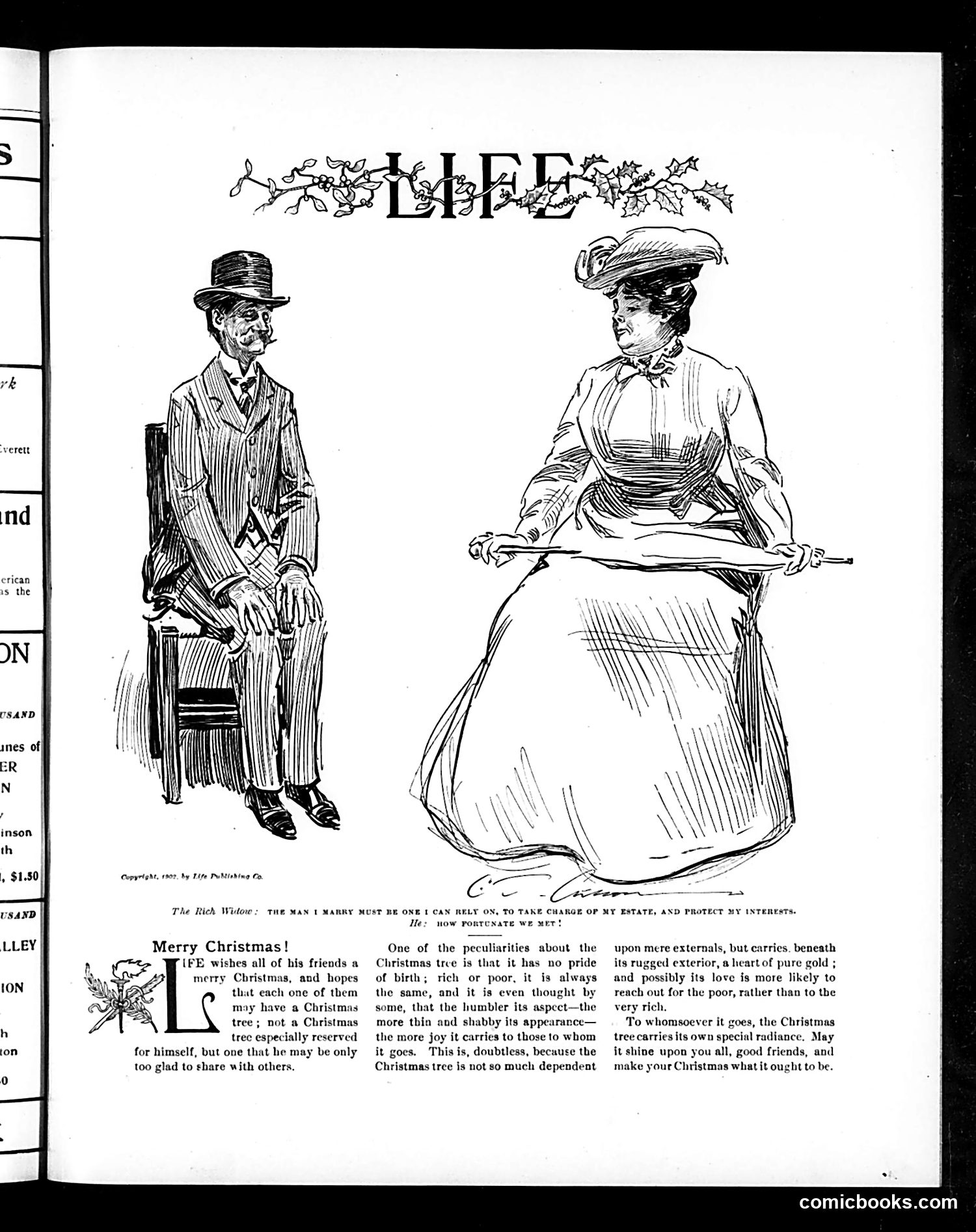
This 1902 *Life* magazine page presents a satirical cartoon about marriage and wealth. The illustration shows a wealthy widow (right, seated with a parasol) and a thin, shabby-dressed man (left, standing). The widow's dialogue reveals the satire's target: she seeks a husband primarily to "take charge of my estate, and protect my interests"—viewing marriage as a business transaction rather than a romantic union. The man's desperate response ("How fortunate we are!") mocks his willingness to marry for money despite his obvious poverty. The accompanying Christmas editorial appears ironic counterpoint: it praises the humble Christmas tree's capacity for generosity and reaching "the poor, rather than to the very rich." This contrasts sharply with the widow's materialistic, self-interested approach to matrimony—suggesting that even the wealthy should embody the tree's humble, generous spirit rather than mercenary calculation. The satire critiques both gold-digging and the wealthy's self-centered attitudes toward marriage and charity.
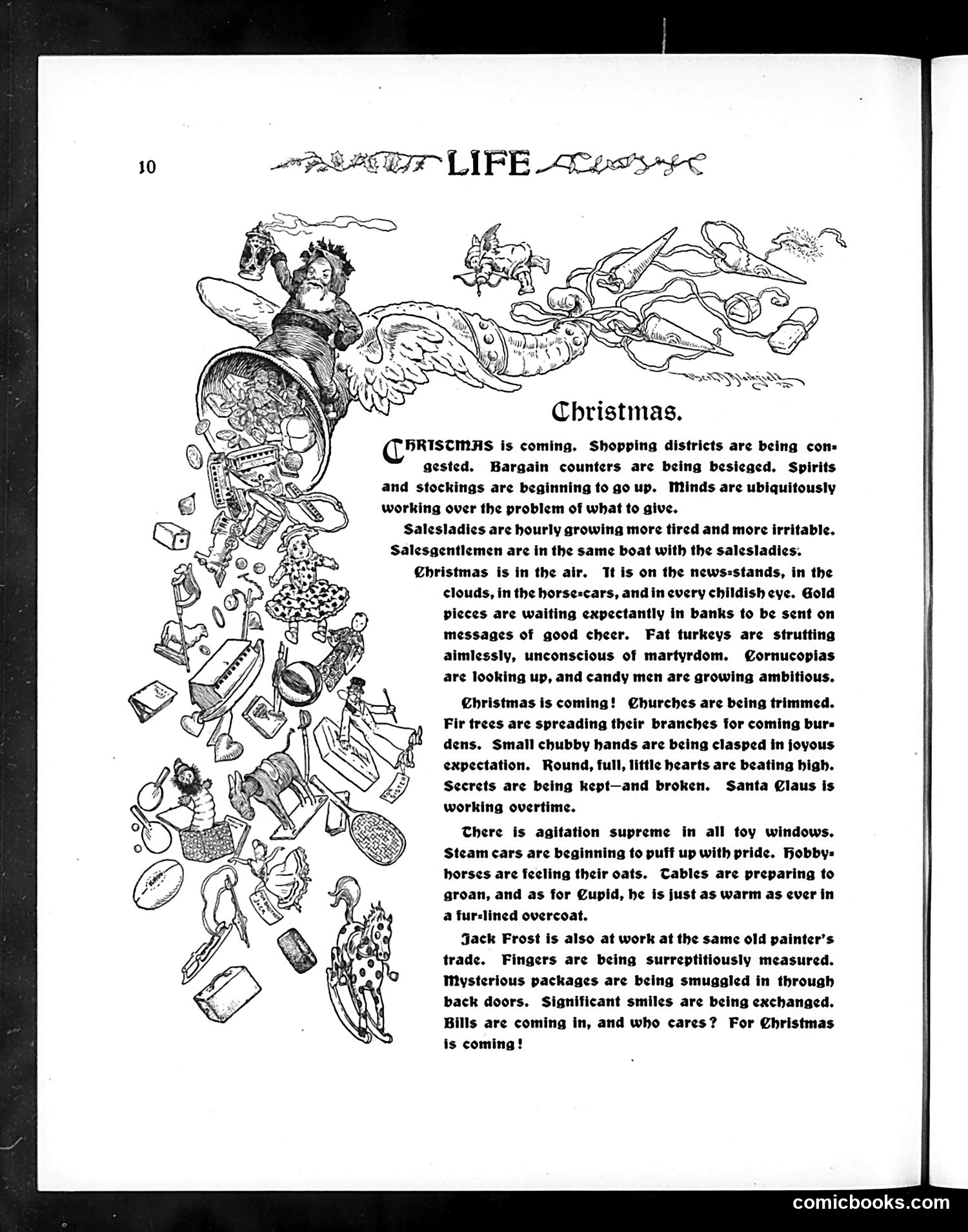
This is a humorous essay celebrating the commercial and social frenzy of approaching Christmas. The accompanying illustration shows a winged figure (likely representing Christmas spirit or Father Time) spilling a cornucopia of holiday goods—toys, gifts, food, decorations. The text satirizes the predictable chaos of the season: exhausted retail workers, shopping crowds, gift-giving anxiety, and the pervasive commercial atmosphere. It personifies various elements (turkeys "unconscious of martyrdom," toy windows in "agitation," steam cars "puffing with pride") for comic effect. References to "Jack Frost," "Cupid," and "Santa Claus" invoke traditional holiday figures. The final line—"Bills are coming in, and who cares? For Christmas is coming!"—captures the satirical point: holiday spending fever overrides financial concern. This reflects early 20th-century American consumer culture and the commercialization of Christmas, presented with affectionate, gentle mockery typical of Life magazine's tone.
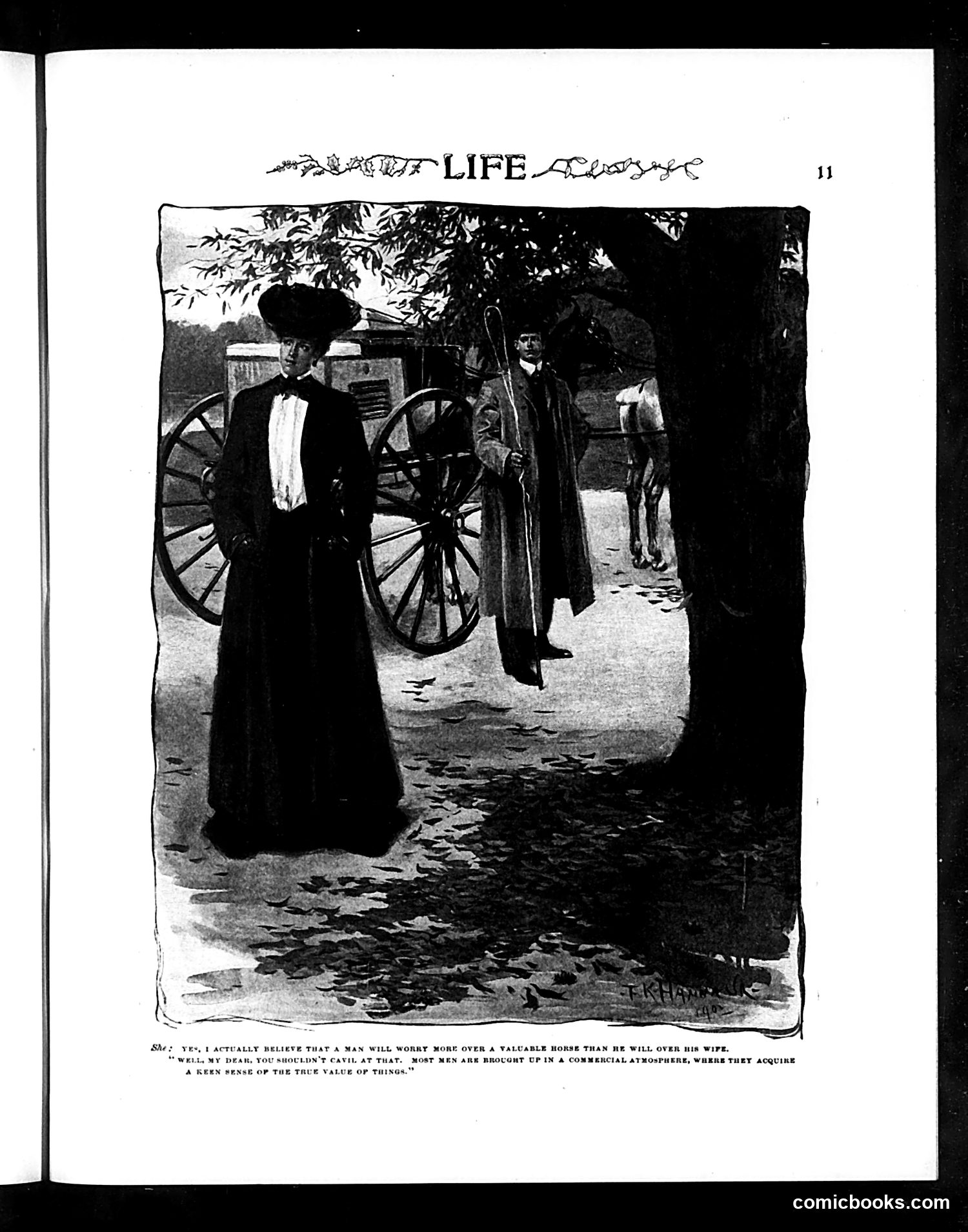
This cartoon satirizes early 20th-century attitudes toward women and commerce. A well-dressed couple appears to be in conversation—likely the husband and wife referenced in the caption. The joke critiques men's economic priorities: the husband claims men naturally worry more about valuable horses than wives because they're raised in a "commercial atmosphere" where they learn "the true value of things." The satire is sharp: by accepting this logic, he's essentially equating his wife's value to a commodity, and suggesting commercial training makes men better judges of *material* worth than of human relationships. The cartoon mocks both masculine materialism and the wife's resigned acceptance of this devaluation. It's social commentary on how industrial capitalism and business culture supposedly corrupted male priorities, reducing everything—including marriage—to economic calculation rather than emotional bonds.
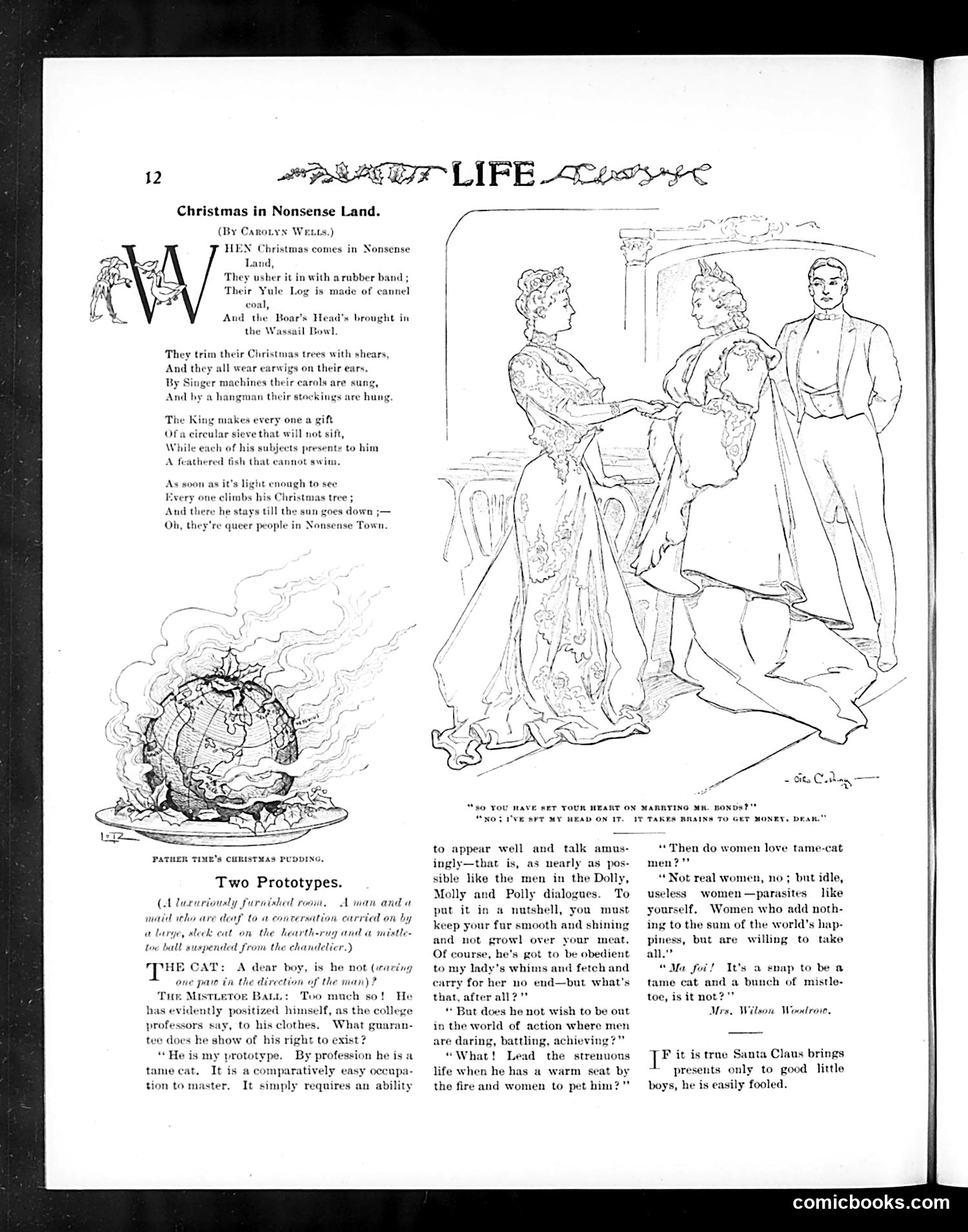
This page contains whimsical holiday satire and social commentary typical of early 20th-century *Life* magazine. The top poem by Carolyn Wells parodies Christmas traditions in an absurdist "Nonsense Land"—decorating with rubber bands, trimming trees with shears, stockings hung by hangman, a Yule Log of camel. The accompanying illustration shows a genteel domestic scene. Below, "Two Prototypes" presents a dialogue between a Cat and Mistletoe Ball discussing a young man. The satire targets idle, decorative masculinity: the man is a "tame cat"—ornamental, obedient, content by the fireside. The speakers mock women who love such parasitic men, calling them "useless women—parasites" themselves who contribute nothing to society but accept comfort. The bottom illustration depicts this conversation, while the final quip suggests Santa's generosity is wasted on misbehaving boys—a mild jab at childhood morality tales.
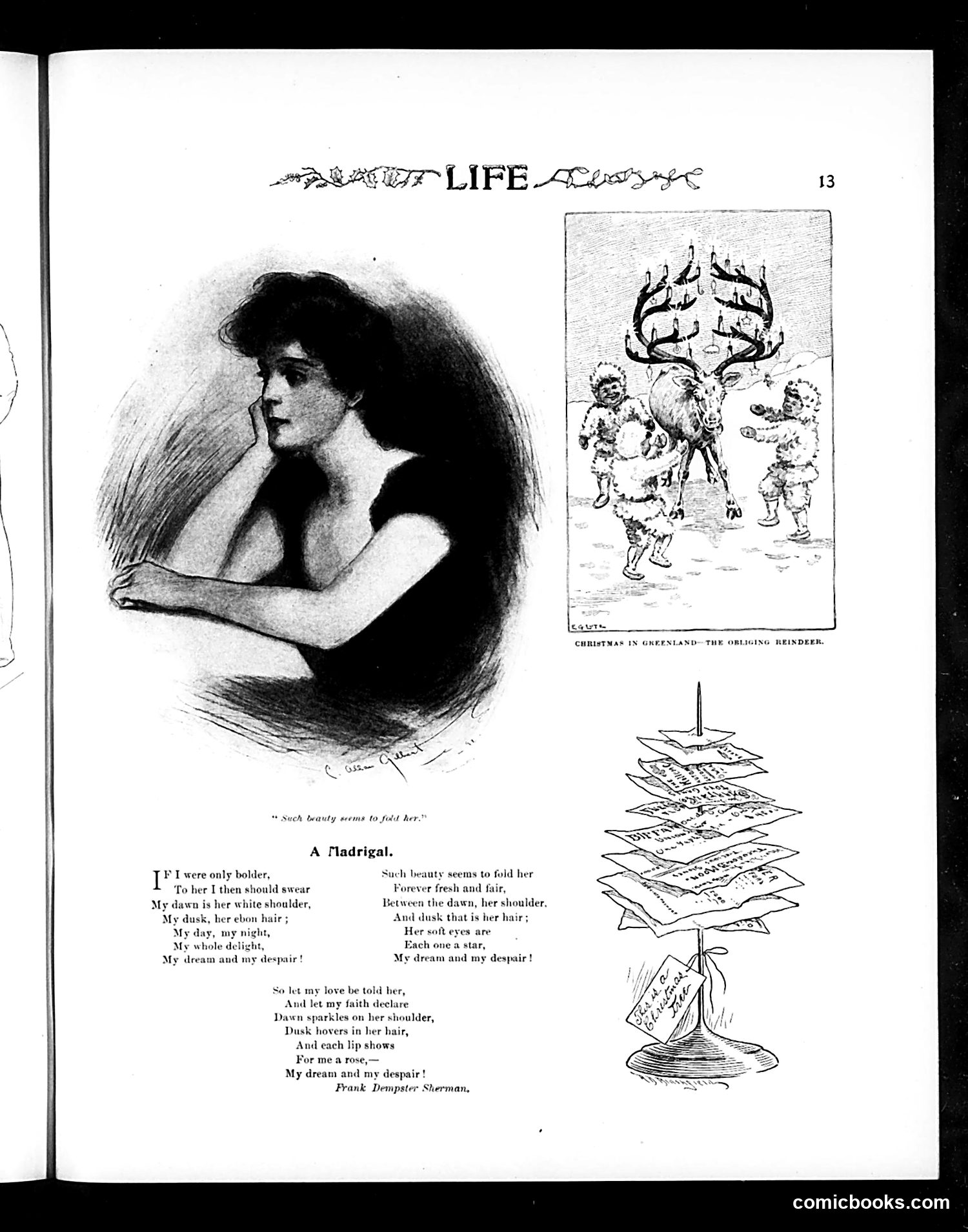
This page combines romantic and humorous content typical of early Life magazine. The left features a **portrait sketch** of a woman with long hair and a contemplative pose, captioned "Such beauty seems to fold her"—illustrating the accompanying madrigal (love poem) by Frank Dempster Sherman below. The poem is conventional Victorian romantic verse expressing romantic longing and admiration. The upper right shows a **satirical cartoon titled "Christmas in Greenland: The Obliging Reindeer,"** depicting what appears to be indigenous Greenlandic people gathered around a reindeer with prominent antlers. This likely mocks exotic "Christmas customs" from distant lands—a common satirical subject reflecting early 20th-century attitudes toward non-European cultures. The lower right contains a **decorative illustration of a Christmas tree** made of stacked plates or discs. The page blends sentimental poetry with gentle satire about cultural exoticism and holiday traditions.
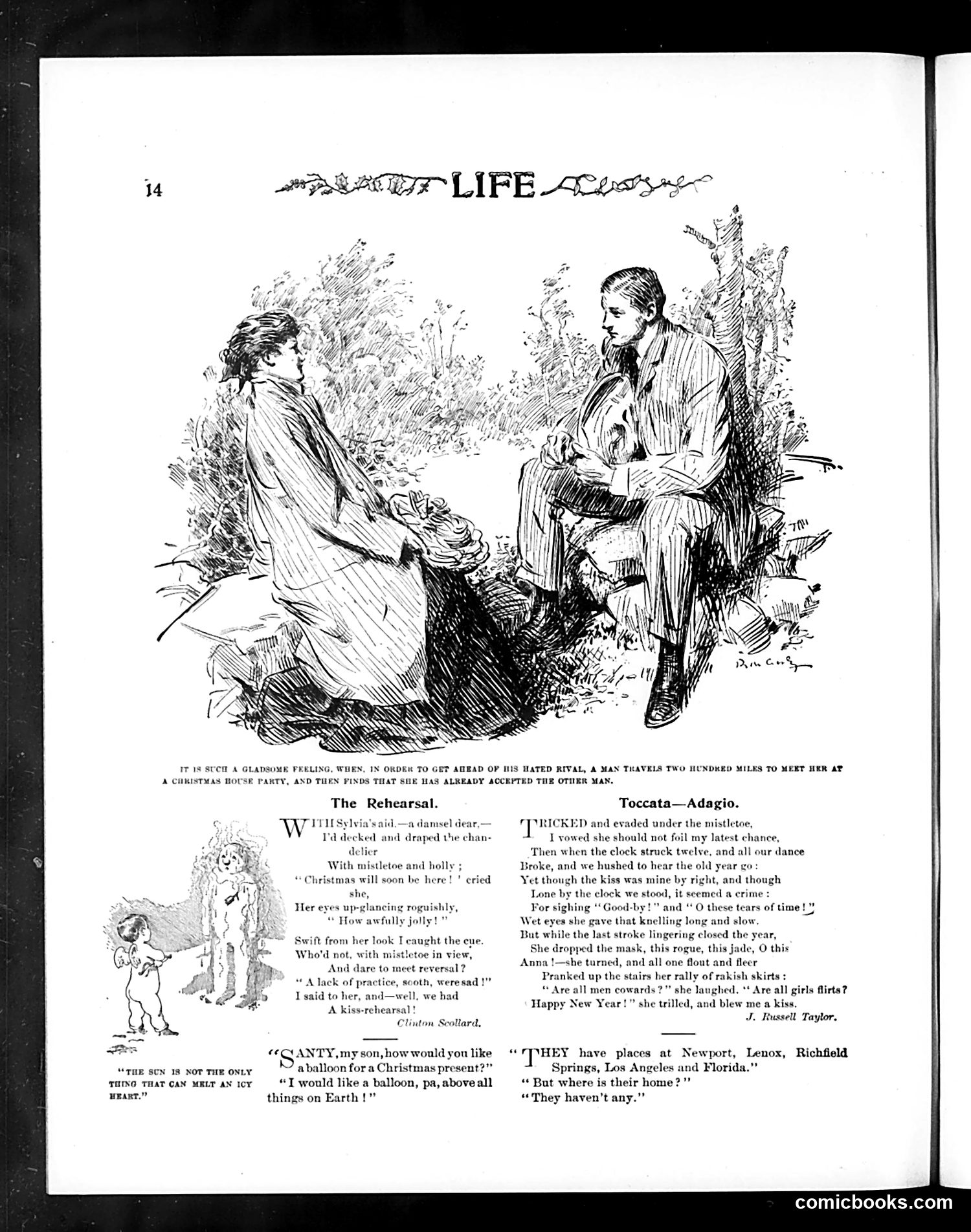
This Life magazine page presents romantic satire centered on Christmas courtship rituals among the wealthy leisure class. **The Main Cartoon** (top) depicts a man who traveled 200 miles to a Christmas house party to compete with a rival for a woman's affections—only to discover she's already accepted the other man. It's satirizing the absurd lengths gentlemen go to for romantic advantage. **The Poetry Sections** ("The Rehearsal" and "Toccata—Adagio") humorously recount flirtations involving mistletoe kisses and New Year's Eve romantic maneuvering. The humor relies on the tension between Victorian propriety and actual desire—characters "rehearse" kisses under mistletoe as social cover. **The Bottom Dialogue** mocks the homeless wealthy: a child wants a balloon for Christmas, while parents discuss owning multiple seasonal residences (Newport, Lenox, Florida) but having "no home." It satirizes the disconnection of the ultra-rich from normal life. **Overall Point**: The page gently ridicules upper-class romantic games and the absurdities of gilded-age society, where wealthy people lack genuine belonging despite material abundance.
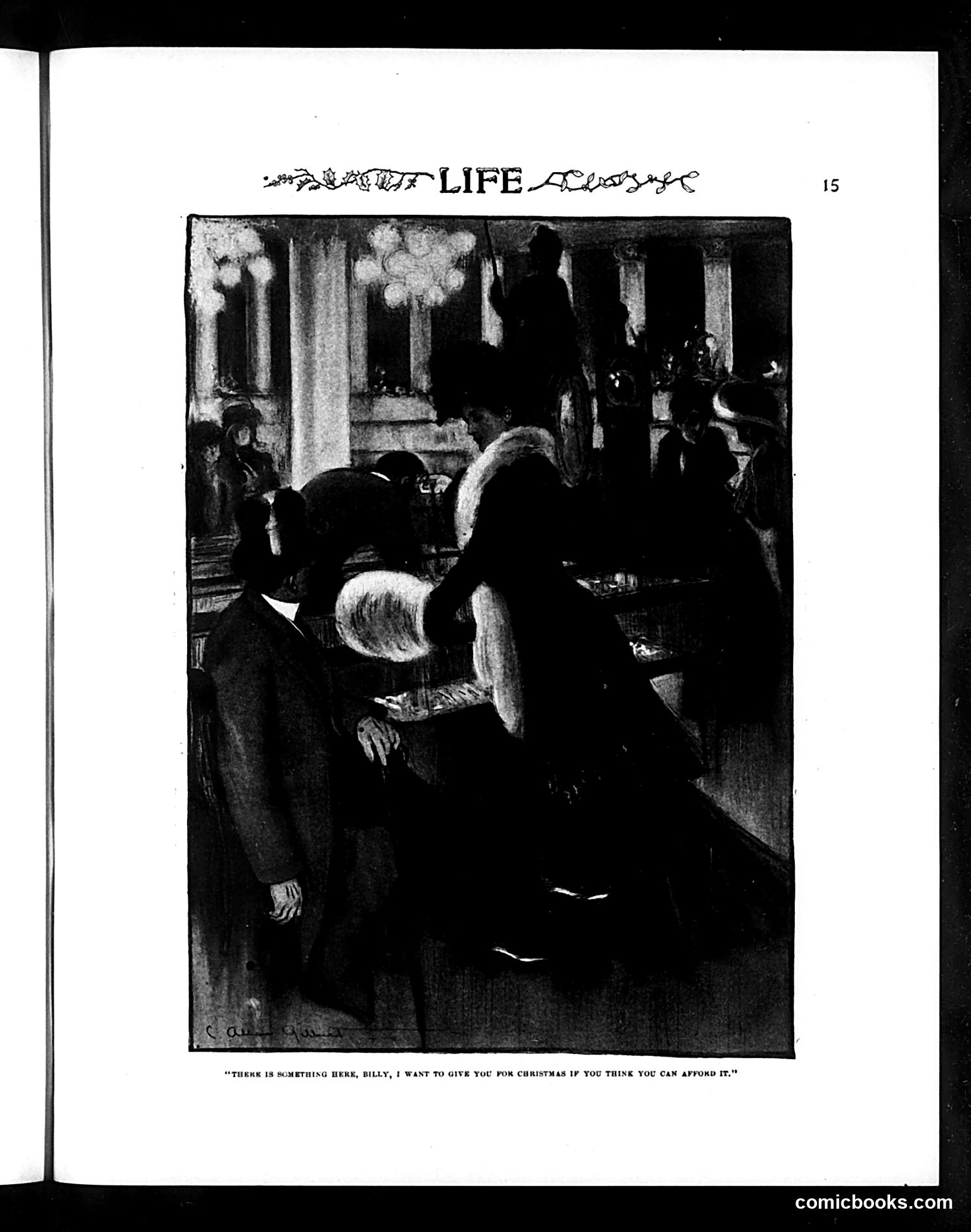
This appears to be a satirical cartoon depicting a scene of economic hardship during what was likely the Great Depression era. The caption shows an adult (possibly a parent or relative named Billy) offering a Christmas gift with a conditional caveat—the recipient must be able to "afford it," suggesting ironic poverty. The silhouetted figures in formal dress gathered in an elegant interior setting contrast sharply with the message of financial struggle. The satire lies in this juxtaposition: even in wealthy or refined environments, people faced such severe economic constraints that gift-giving required assurance of financial capability. The cartoon critiques the economic desperation of the period, where basic holiday generosity became contingent on ability to pay.
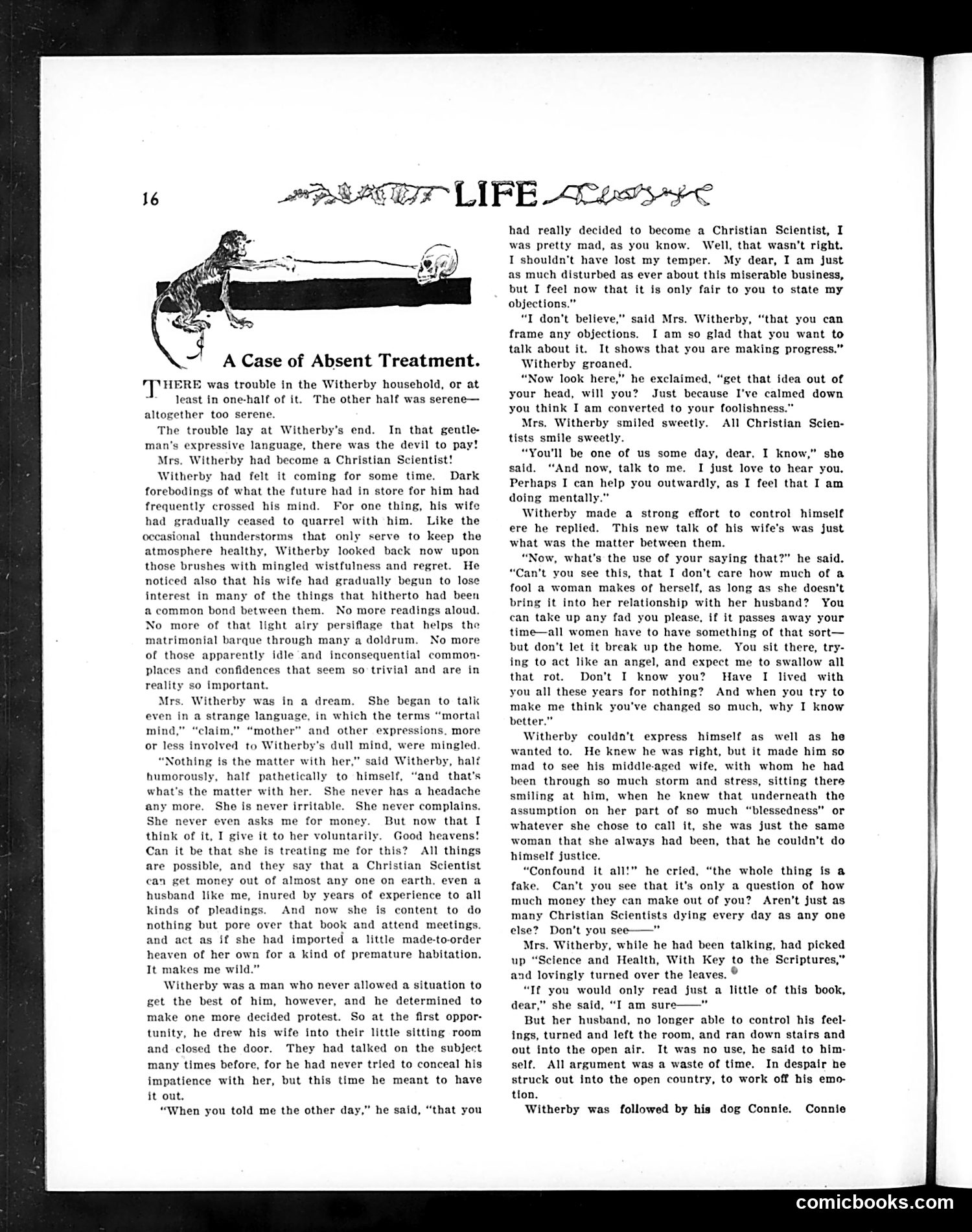
This illustrated story satirizes Christian Science, a popular early-20th-century religious movement. The cartoon shows a man (Witherby) stretched uncomfortably over a skeletal figure, humorously depicting his predicament. The satire's target: Witherby's wife has converted to Christian Science, and her newfound serenity is driving him mad. She's stopped quarreling with him, lost interest in marital companionship, and spends time reading "Science and Health" instead of engaging with him. The joke is that her "treatment" (Christian Science's term for spiritual healing) has made her *too* perfect—eerily passive and distant. The author mocks Christian Science's claims of curing all ailments through mental discipline, suggesting it's actually destroying their marriage. Witherby's frustration represents skeptical husbands watching their wives embrace this religion, which promised health and harmony but instead created alienation through devotional detachment.
This page from *Life* magazine is a satirical short story mocking Christian Science, the religious movement founded by Mary Baker Eddy in the 1870s-80s. The protagonist, Witherby, is skeptical of Christian Science until his dog's injured leg mysteriously heals after he concentrates his thoughts on it. He interprets this as proof that mind-power can cure physical ailments—the core claim of Christian Science practitioners. The satire works on multiple levels: Witherby's wife appears to be a Christian Scientist ("gotten off her trolley"), and the story ridicules how believers attribute all healing to mental suggestion rather than medicine. The humor culminates when Witherby, now convinced, attempts to use "mind power" to prevent his cook from quitting—revealing how absurd and self-serving the doctrine becomes when applied to everyday problems. The piece critiques both Christian Science's medical claims and its cultish appeal to ordinary people seeking miraculous solutions.
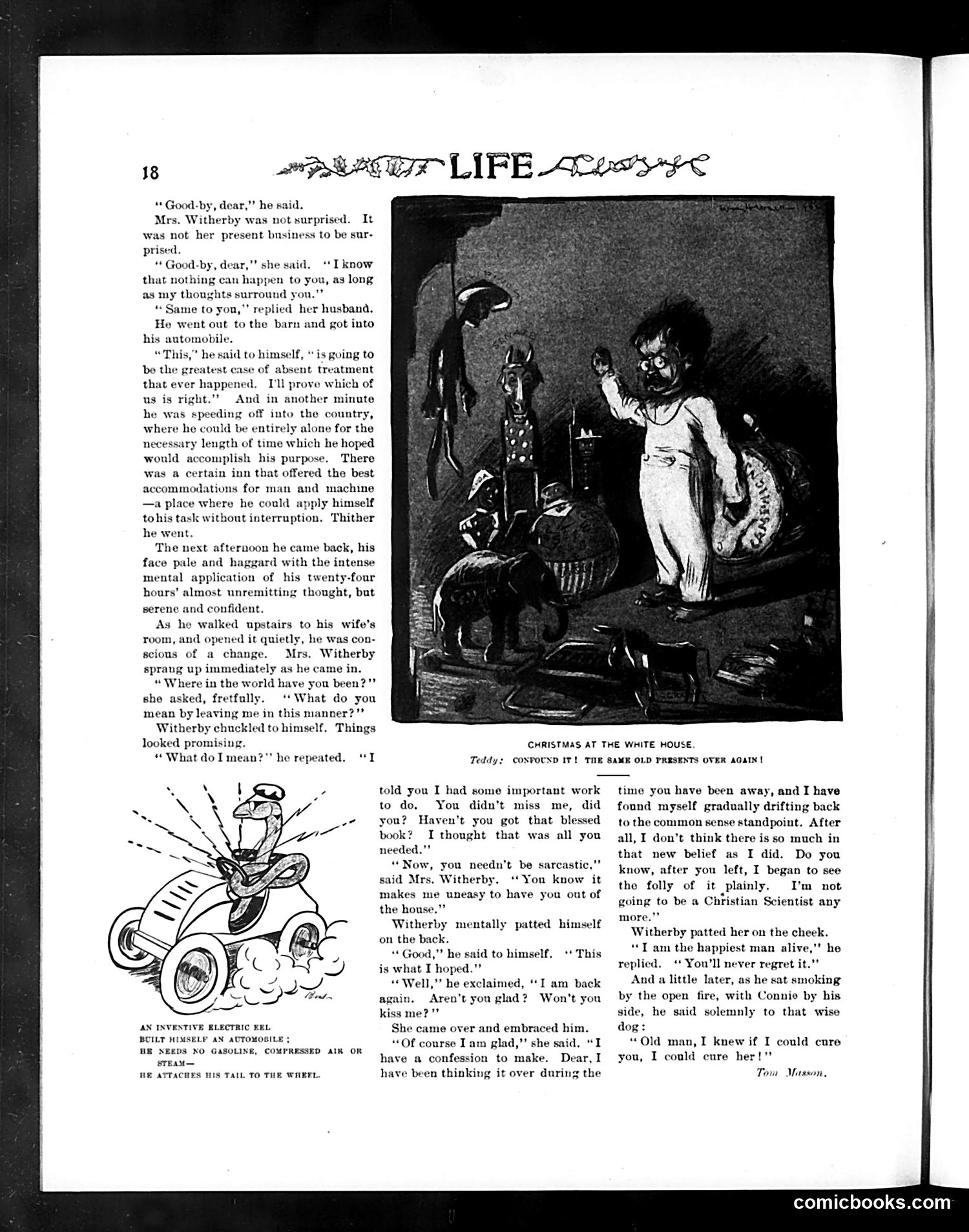
This page contains two distinct satirical pieces: **Main Story: "The Witherby Couple"** A husband-wife dispute over Christian Science. Mrs. Witherby believes her positive thoughts can protect her absent husband. He secretly stays away 24 hours to "test" whose protective power works—essentially an experiment in "absent treatment" (a Christian Science practice). When he returns, she's already abandoned the belief, having realized its folly. The joke: he thinks *he* cured her through his absence, when she actually self-corrected. The satire mocks both Christian Science's claims and male obliviousness. **Cartoon: "An Inventive Electric Eel"** A humorous non-sequitur showing an eel that built itself an automobile powered by attaching its tail to the wheel—a visual pun on the phrase "attach one's tail to the wheel." **Secondary Caption: "Christmas at the White House"** "Teddy" (President Theodore Roosevelt) complains about receiving identical presents repeatedly—likely satirizing the repetitive gift-giving at official functions or the predictability of presidential gift protocols during Roosevelt's administration.
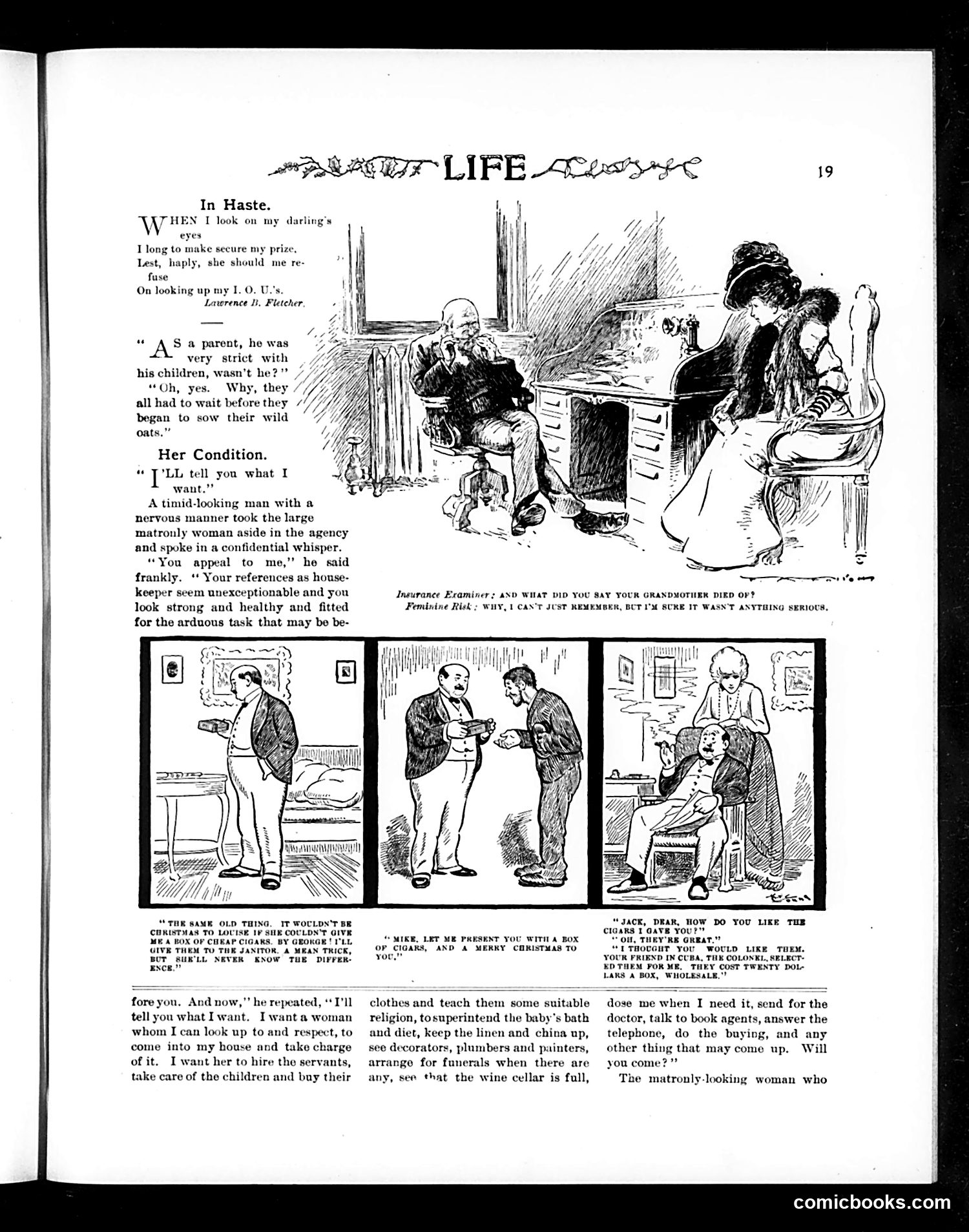
This page from *Life* magazine contains several satirical pieces about domestic life and male behavior around the turn of the 20th century. **"In Haste"** and **"Her Condition"**: These paired pieces mock the hypocrisy of men seeking household help. A nervous man claims to want a housekeeper he can "look up to and respect," then immediately lists an exhausting array of domestic duties—hiring servants, managing children, overseeing repairs, arranging funerals, maintaining the wine cellar. The satire exposes how men delegated nearly all household management to women while claiming to seek their intellectual respect. **The three-panel cigar comic**: This satirizes cheap gift-giving among men. One character receives inexpensive cigars as a Christmas gift, planning to regift them to the janitor. He then gives similar cigars to another man, who claims they cost twenty dollars wholesale and were selected by a Cuban colonel—a transparent lie meant to impress. The joke mocks male vanity and dishonesty in social interactions. The underlying theme: gender roles and masculine pretense in Edwardian-era society.
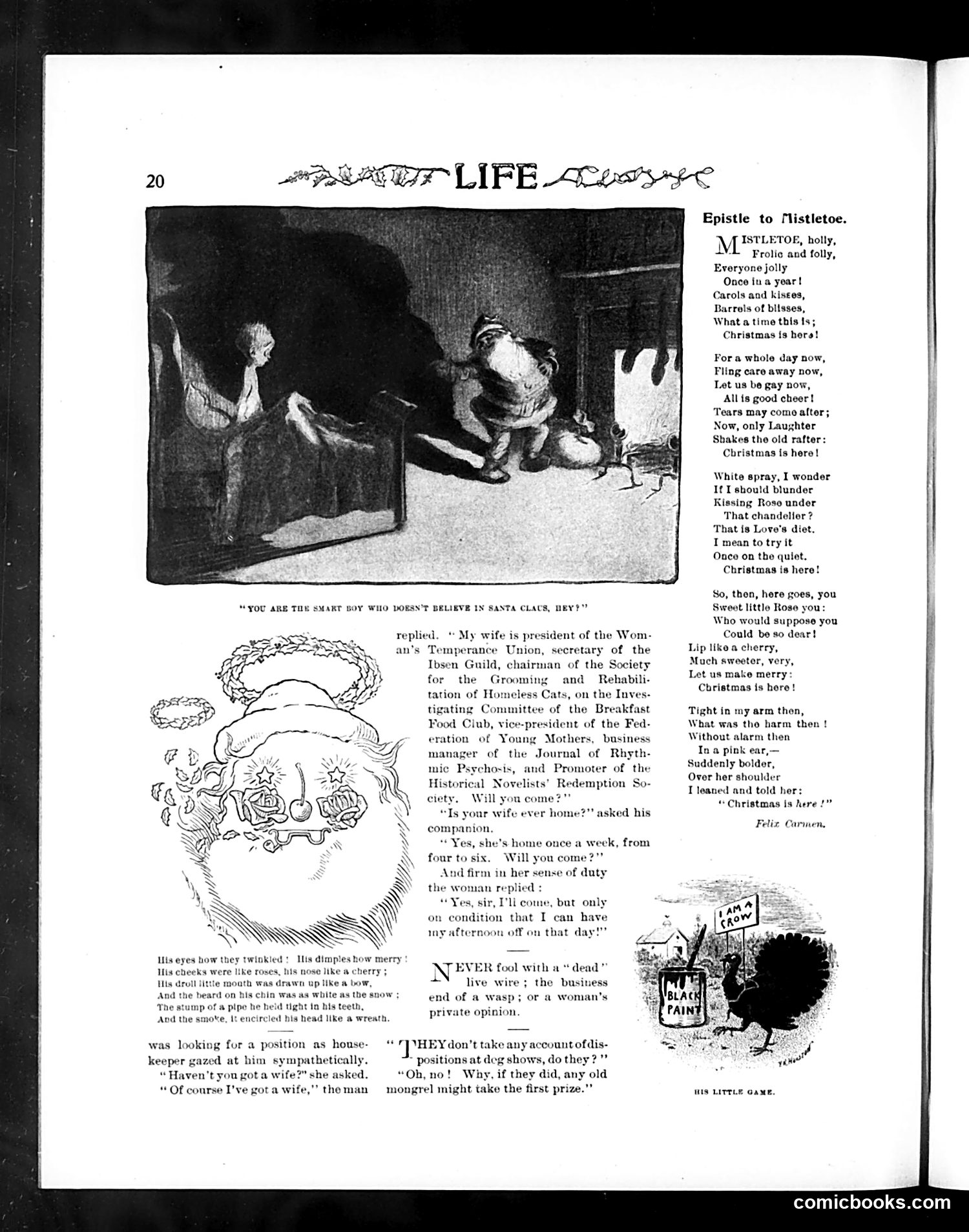
This page contains **two main satirical pieces**: 1. **Top cartoon**: Shows a man confronted by a woman asking if he's the boy who doesn't believe in Santa Claus. The accompanying dialogue satirizes the "New Woman" of the early 1900s—a woman juggling excessive social activism. A man explains his wife holds numerous positions (temperance union president, Ibsen Guild secretary, homeless cat rehabilitation chair, etc.) and is only home once weekly, 4-6 PM. When invited to visit, she agrees only if she can have that afternoon off. The satire mocks how women's expanding social roles and club memberships left them perpetually unavailable, turning Victorian domestic expectations upside down. 2. **Bottom cartoon**: A Santa Claus illustration with a cynical aphorism: "Never fool with a dead live wire; the business end of a wasp; or a woman's private opinion"—mocking women's independent judgment. 3. **Right side**: "Epistle to Mistletoe," a sentimental Christmas poem about kissing, contrasts with the satirical content. The humor targets anxieties about changing gender roles and women's autonomy.
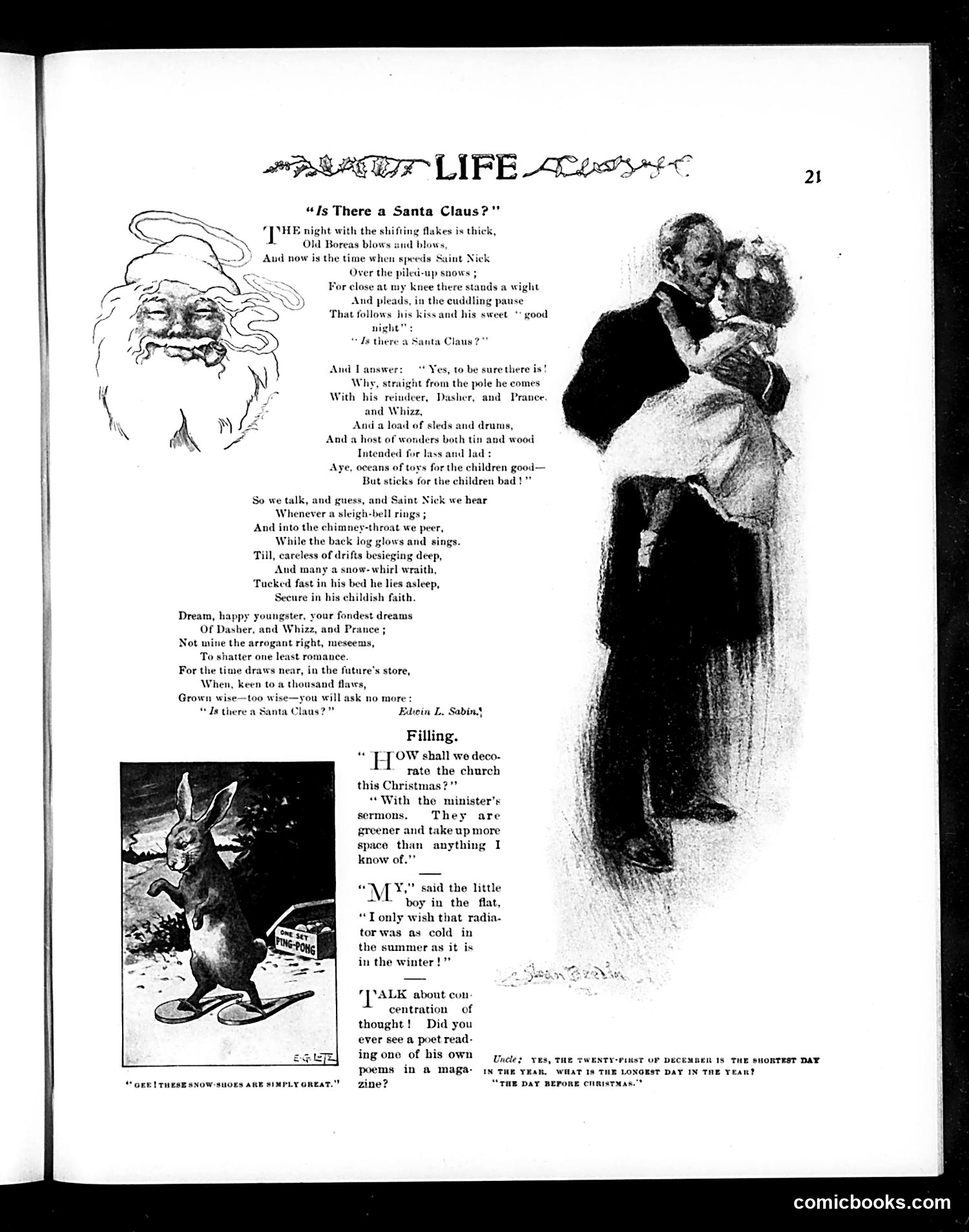
This page features a sentimental poem by Edwin L. Sabin about a child asking whether Santa Claus exists. The poet affirms Santa's reality while acknowledging the bittersweet knowledge that childhood belief is temporary—the child will eventually learn the truth. The accompanying illustrations show a father figure holding a child and a reindeer in snow, supporting the nostalgic Christmas theme. Below the poem are three brief humorous "fillers"—short jokes mocking: 1. **Clerical verbosity**: Ministers' sermons are so lengthy and boring they could decorate a church better than actual decorations 2. **Apartment heating**: Radiators that malfunction seasonally 3. **Poet self-readings**: The awkwardness of poets reading their own work aloud A trivia question about winter solstice appears at bottom. This mix of sentimental verse and light satirical humor was typical of *Life*'s editorial approach—blending sentiment with social commentary and comedic relief.
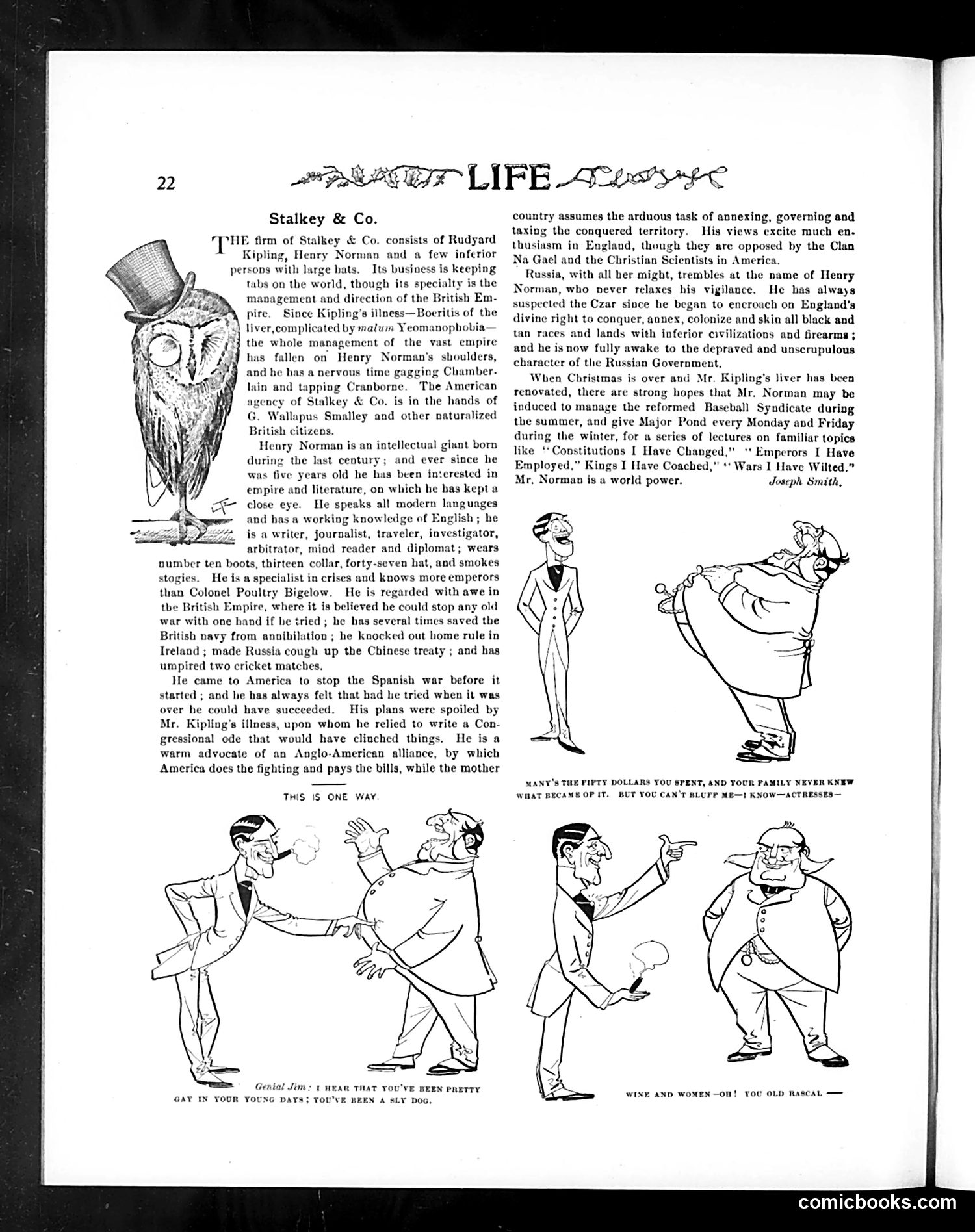
This page satirizes British imperialism and Anglo-American relations through a mock-serious profile of Henry Norman, a real journalist and politician. The text portrays him as absurdly self-important—credited with preventing wars single-handedly, controlling emperors, and forcing Russia into treaties. The satire targets Norman's advocacy for an "Anglo-American alliance" where America does the fighting and pays while Britain annexes territory and "governs" colonized peoples. Life mocks this arrangement as exploitative of American resources for British imperial benefit. The lower cartoons use humorous vignettes to mock wealthy men's hypocrisy: one shows a man bragging about youthful indiscretions; another depicts a man confronted about spending fifty dollars on "wine and women" his family never knew about. The overall message: British imperialists like Norman promote self-serving alliances while their own moral character is questionable.
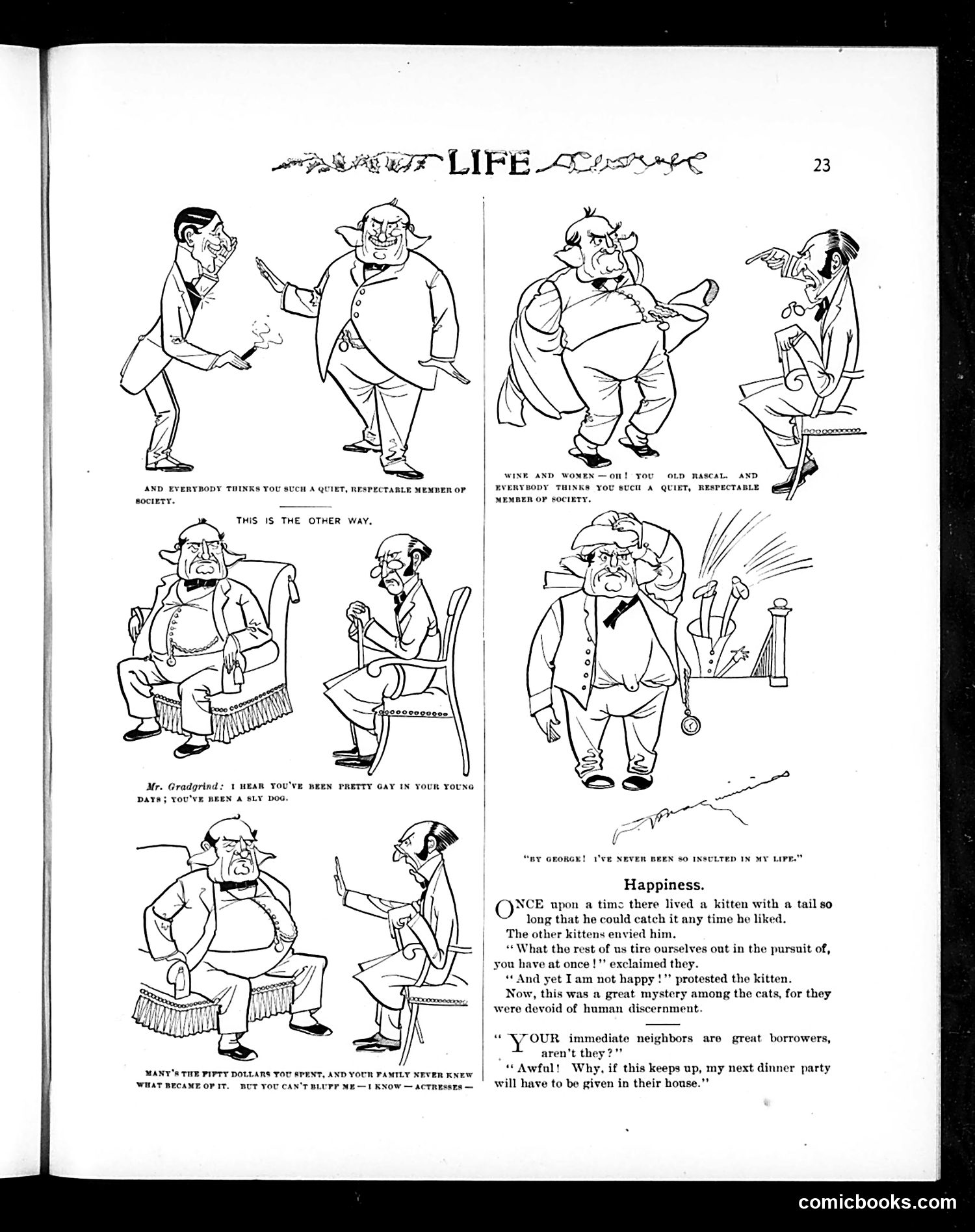
This page contains two distinct satirical pieces about hypocrisy and happiness. **Top cartoons:** Depict the contrast between respectable public personas and private behavior. A man appears respectable to society while secretly indulging in "wine and women." The humor targets the gap between Victorian social propriety and actual conduct—a common theme in satirical magazines. **"Mr. Gradgrind" reference:** Likely alludes to the Charles Dickens character from *Hard Times*, suggesting pompous respectability masking questionable past behavior. **"Happiness" fable:** Uses a kitten parable to satirize human discontent—specifically, neighbors who constantly borrow things. The joke is that people pursue what they lack while ignoring present comforts; the neighbor's borrowing habit spoils the narrator's social standing so thoroughly that dinner parties would occur at the *neighbors'* house instead. The underlying satire critiques both hidden hypocrisy in social climbing and the anxiety caused by inconsiderate neighbors, framed through animal allegory for witty effect.
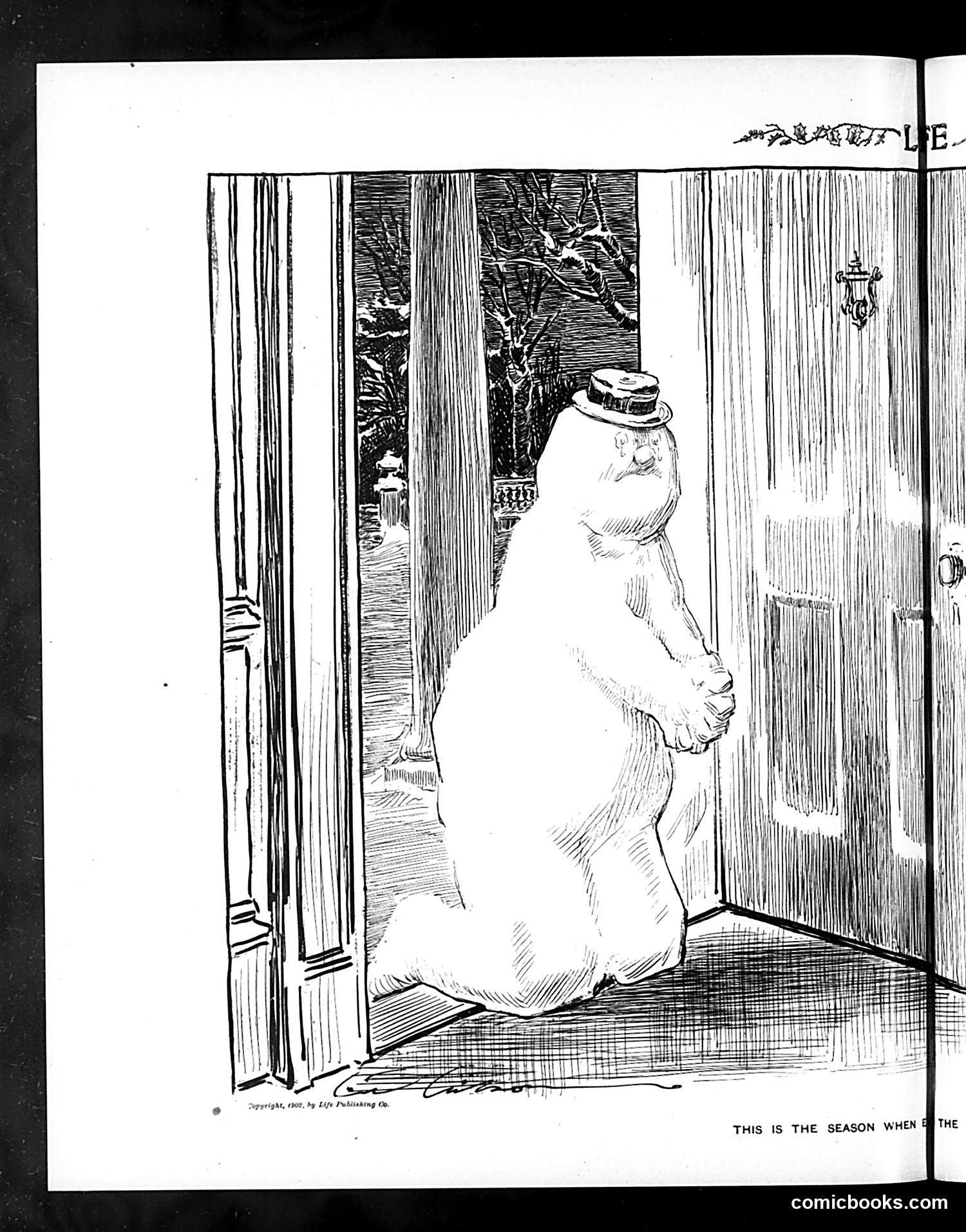
This is a satirical cartoon showing a rotund, well-dressed figure wearing a straw hat, standing in a doorway peering outside. The figure appears anthropomorphized or caricatured—possibly representing a type or social class rather than a specific person. The caption reads "THIS IS THE SEASON WHEN..." but is cut off, preventing full interpretation of the joke's target. The seasonal reference suggests commentary on summer behavior or fashion (the straw hat implies warm weather). The figure's posture—hesitantly looking out—combined with their portly appearance suggests the satire concerns social anxiety, reluctance, or perhaps mockery of wealthy leisure habits during a particular season. Without the complete caption, the specific satirical point remains unclear, though it likely comments on contemporary social conventions or behavioral oddities.
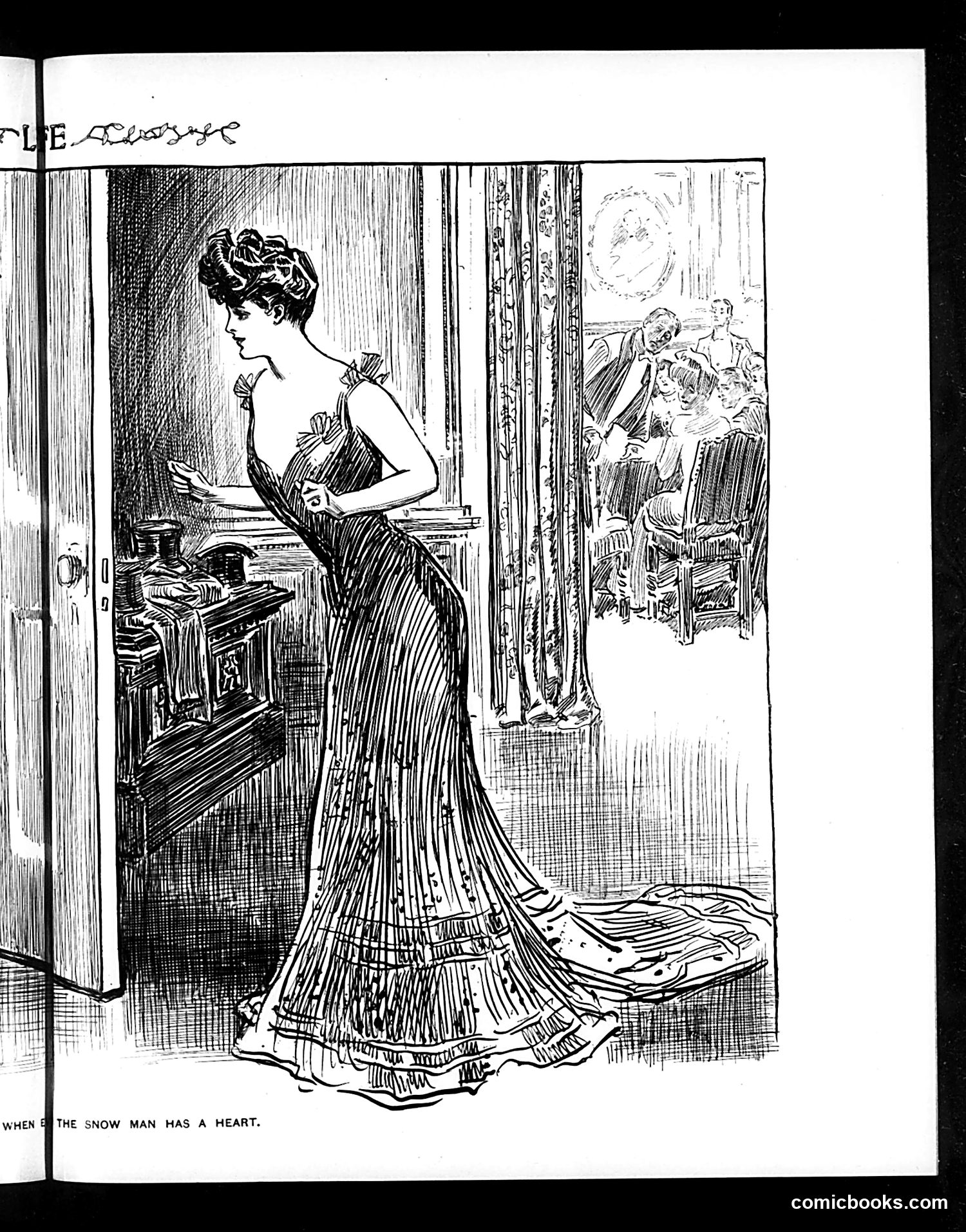
This illustration depicts a fashionable woman in an elegant evening gown at her dressing table, preparing for what appears to be a social gathering visible through the doorway behind her. The caption reads "WHEN THE SNOW MAN HAS A HEART." The satire appears to play on the phrase "cold-hearted" — suggesting that a woman's elaborate grooming and social participation represents evidence of emotional warmth or sentimentality, contrasting with the metaphorical "snow man" (someone emotionally frozen or indifferent). The joke likely critiques either feminine vanity, social pretense, or perhaps comments on romantic relationships where emotional connection (having "a heart") manifests through outward social performance and appearance. The specific social or political context remains unclear without additional publication details.
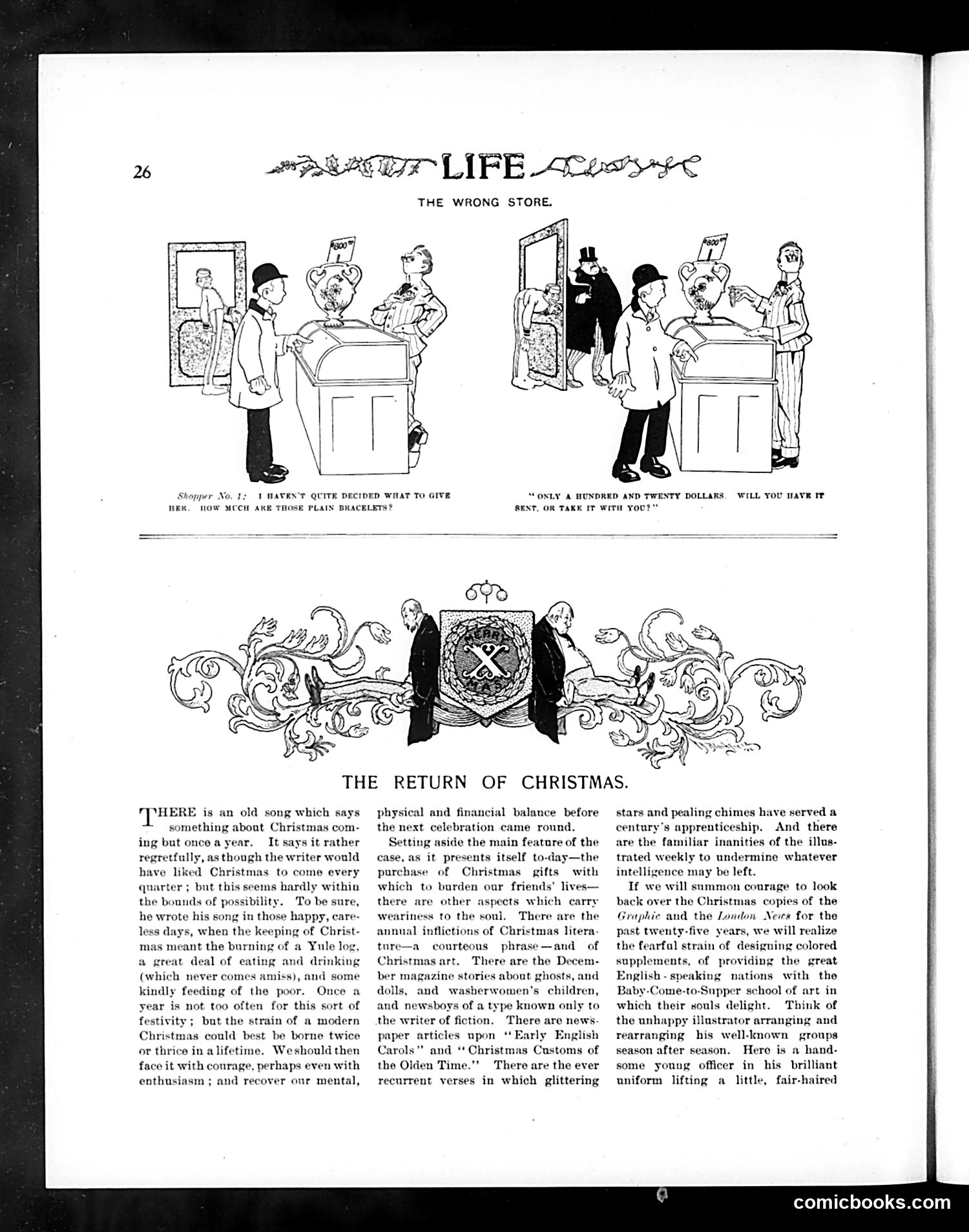
**The Wrong Store** (top): A satirical two-panel comic contrasting customer behavior. In panel one, a shopper asks a jeweler about plain bracelets' price. In panel two, the same customer, now in formal dress with a top hat (suggesting wealth or pretense), is asked if they want an expensive item for $120—and whether they'll "rent it or take it with you?" The joke mocks wealthy customers who haggle over luxury goods they can easily afford, or pretend they cannot. **The Return of Christmas** (below): An editorial essay lamenting modern Christmas commercialization. The author argues that while Victorian Christmas involved modest pleasures (Yule logs, charity), contemporary Christmas demands are exhausting—particularly the obligation to purchase expensive gifts for friends. The piece criticizes repetitive Christmas art, magazine stories, and "Graphic" and "London News" illustrations as creatively bankrupt. It suggests Christmas happens too frequently given modern financial and emotional strain. Both pieces critique consumer culture and commercialism of the era.
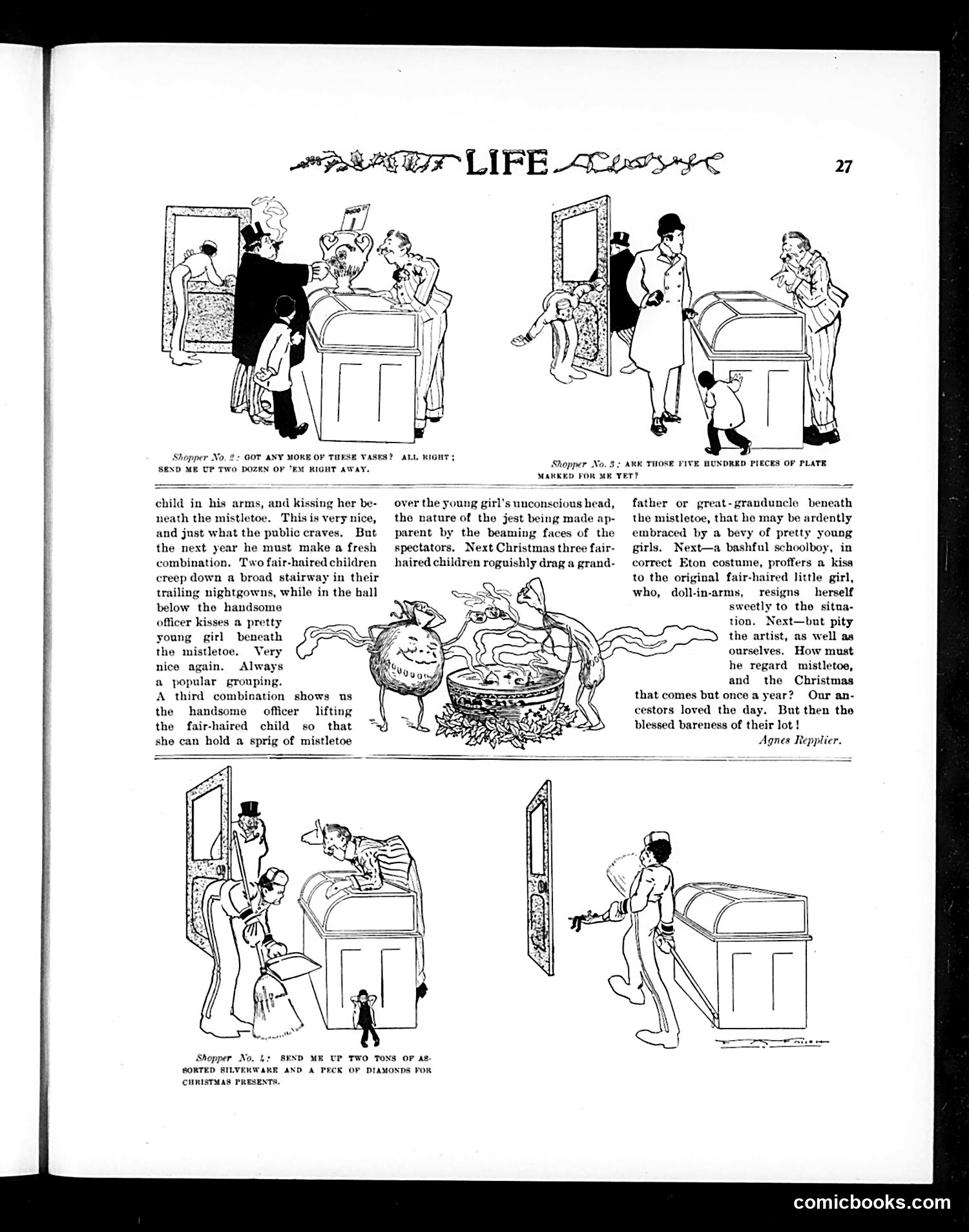
This page satirizes the commercialization of Christmas through two distinct critiques: **Upper cartoons**: Four panels mock wealthy shoppers' extravagant holiday gift-buying. "Shopper No. 2" casually orders multiple dozen vases; "Shopper No. 3" demands five hundred pieces of plate; "Shopper No. 4" requests tons of silverware and diamonds. The escalating absurdity ridicules conspicuous consumption among the wealthy during the holiday season. **Text essay** (by Agnes Repplier): A humorous commentary on Christmas imagery in art, lamenting how illustrators must repeatedly depict mistletoe scenes—officers kissing young women, children arranging romantic moments—year after year. The author contrasts modern commercial exhaustion with ancestors' simpler holiday joy. Together, the page critiques both wealthy excess in gift-giving and the repetitive sentimentality of Christmas imagery, suggesting the holiday has become drained of genuine meaning through commercialization and artistic cliché.
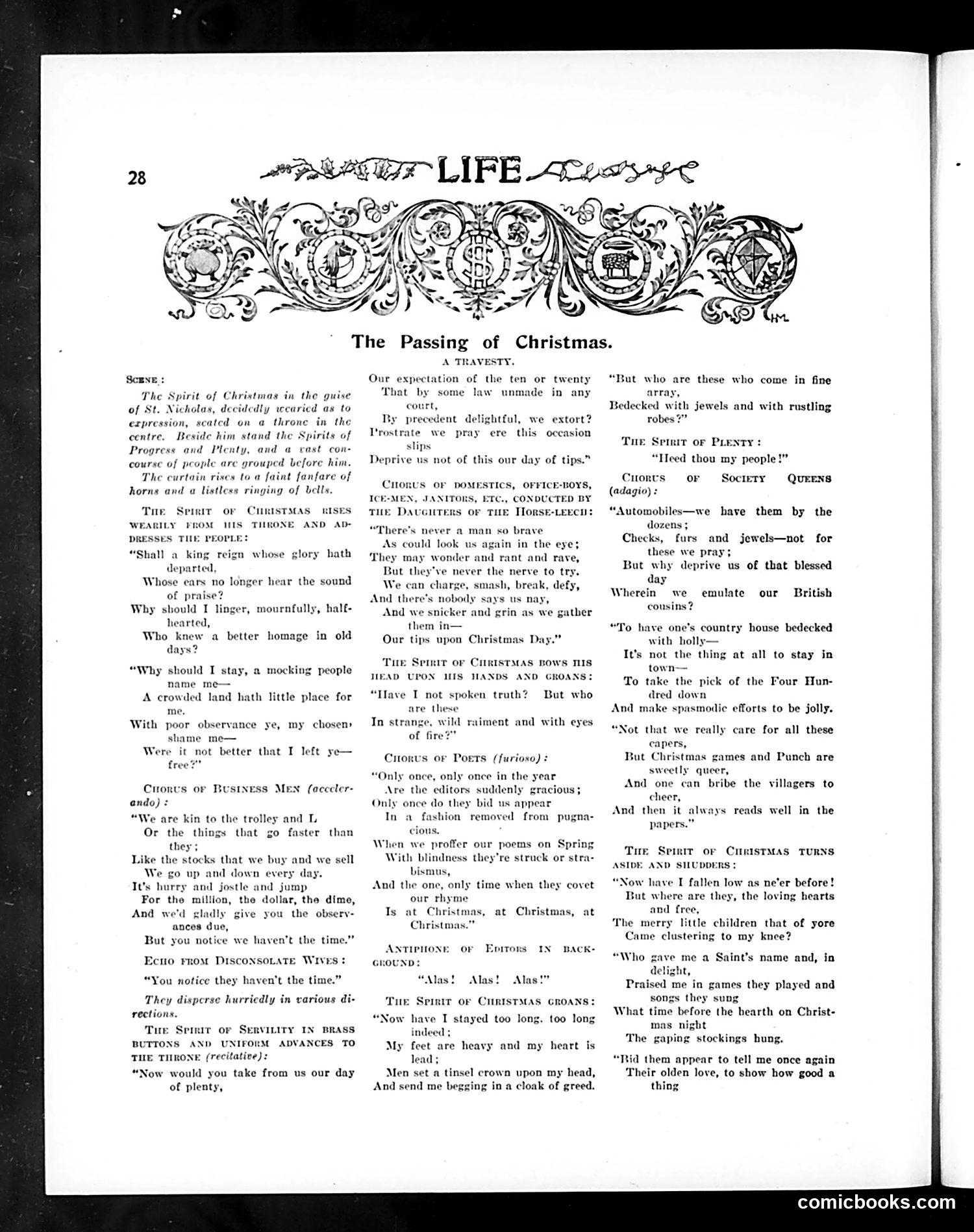
This is a dramatic satirical piece depicting **Christmas Spirit's decline** in modern (early 20th-century) America. The Spirit of Christmas, seated on a throne like a weary monarch, watches various social groups petition him—not from religious devotion but selfish interest. The satire targets: - **Business men and workers** obsessed with tips and money - **Society women** prioritizing country houses and status over genuine celebration - **Editors** who exploit poets one day yearly - **Servants** ("Horse-Leech's Daughters") who exploit their positions The central irony: everyone claims they're "too busy" for Christmas observance while simultaneously demanding its material benefits. The Spirit laments that genuine love and children's wonder have vanished, replaced by greed masquerading as tradition. The piece critiques **commercialization and hypocrisy** eroding Christmas's spiritual meaning—a relevant social commentary for its era about how rapidly industrialization and capitalism were transforming American holidays.
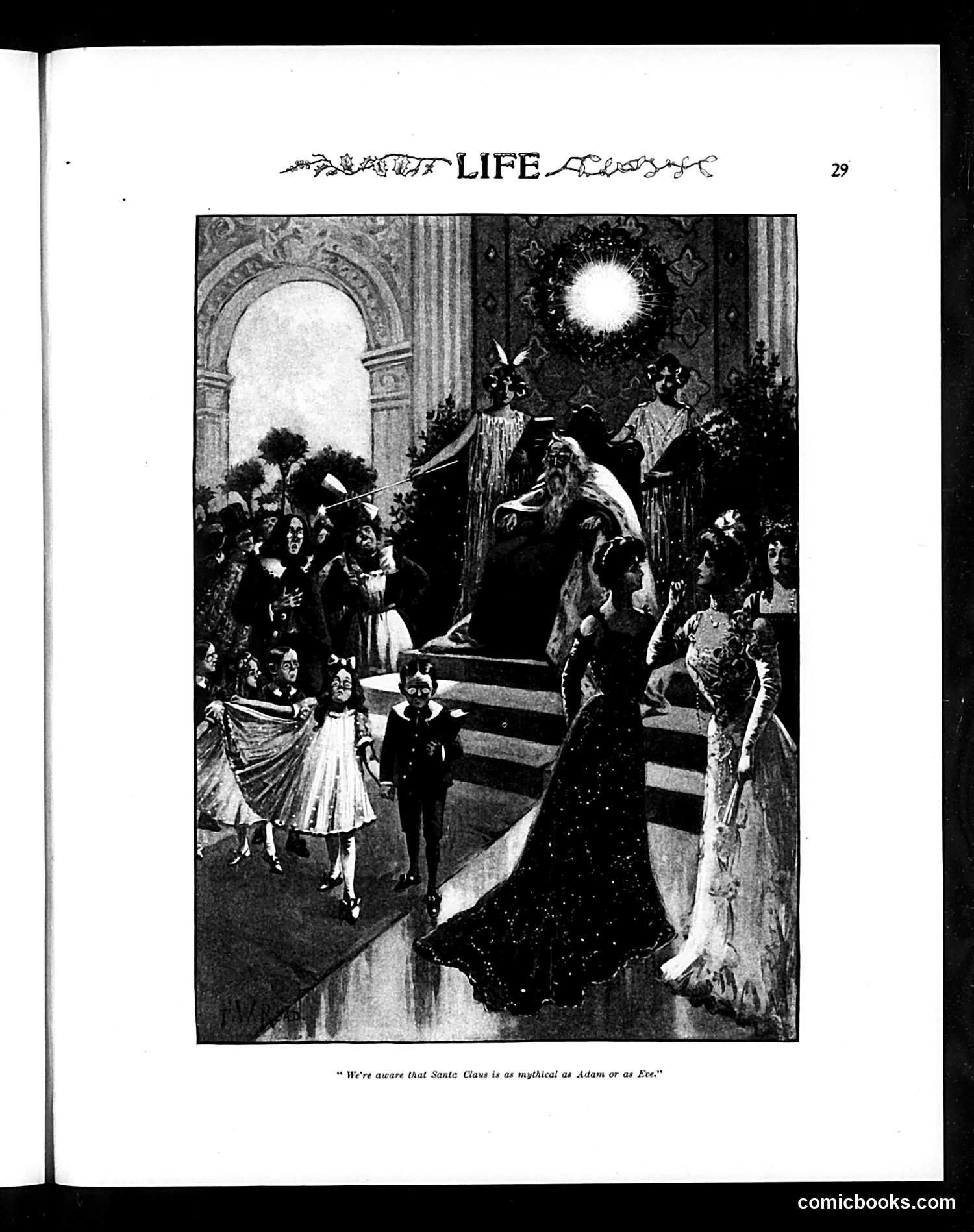
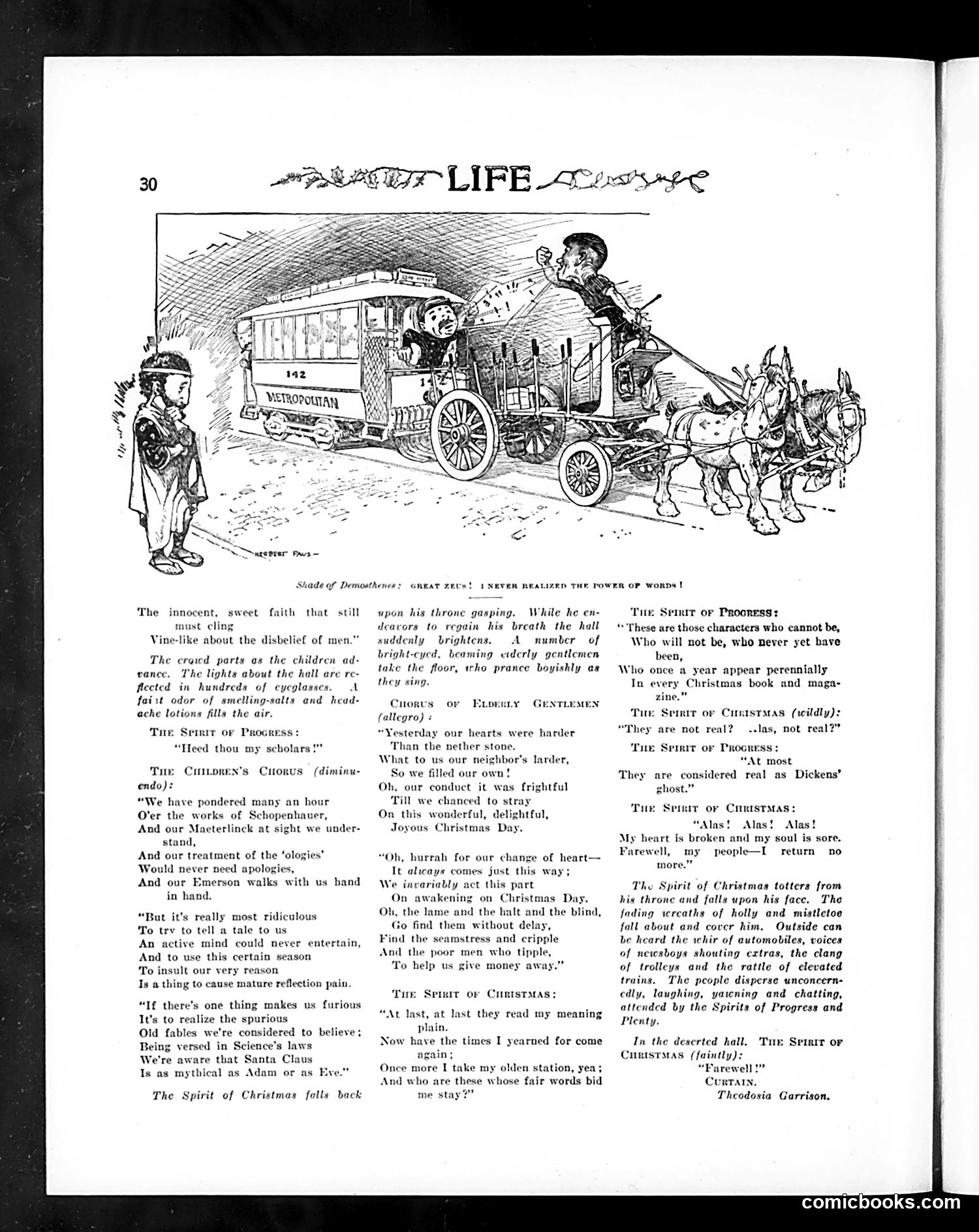
This black-and-white illustration depicts an indoor formal gathering with elegantly dressed figures, including women in flowing gowns and what appears to be a bearded central figure (possibly meant to represent Santa Claus or a similar character). The caption reads: "We're aware that Santa Claus is as mythical as Adam or as Eve." The satire targets religious skepticism or modernist attitudes dismissing traditional beliefs. By equating Santa Claus with Adam and Eve—foundational biblical figures—the cartoon mocks those who treat religious narratives with the same dismissal they'd show toward childhood myths. The formal, sophisticated setting suggests this represents educated or intellectual society debunking religious foundations alongside children's stories, a commentary on early 20th-century secularism and rationalism challenging traditional faith.
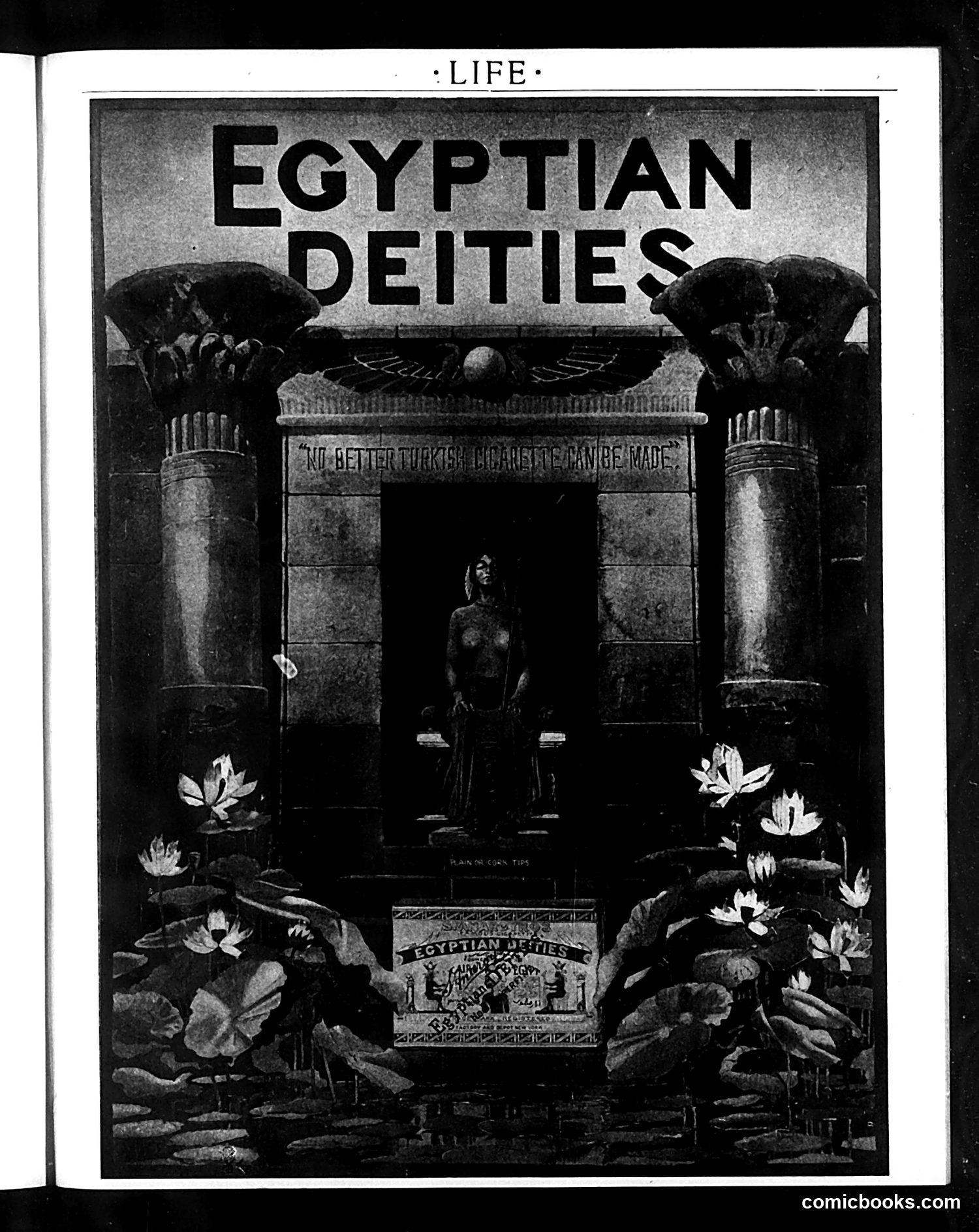
This appears to be a title page or advertisement featuring Egyptian-themed imagery. The image depicts an Egyptian temple entrance with lotus flowers, a statue of what looks like an Egyptian deity, and ornamental columns topped with lotus capitals. The text visible on the temple reads "NO BETTER TURKISH CIGARETTE MADE," indicating this is **advertising for Turkish cigarettes** using Egyptian aesthetic appeal. The "Egyptian Deities" title is marketing language connecting the exotic, ancient Egyptian imagery to the product. This reflects early 20th-century advertising that capitalized on popular fascination with Egyptology (particularly following Tutankhamun's tomb discovery in 1922) to sell consumer goods. The satire likely mocks how advertisers exploited exotic cultural imagery for commercial purposes.
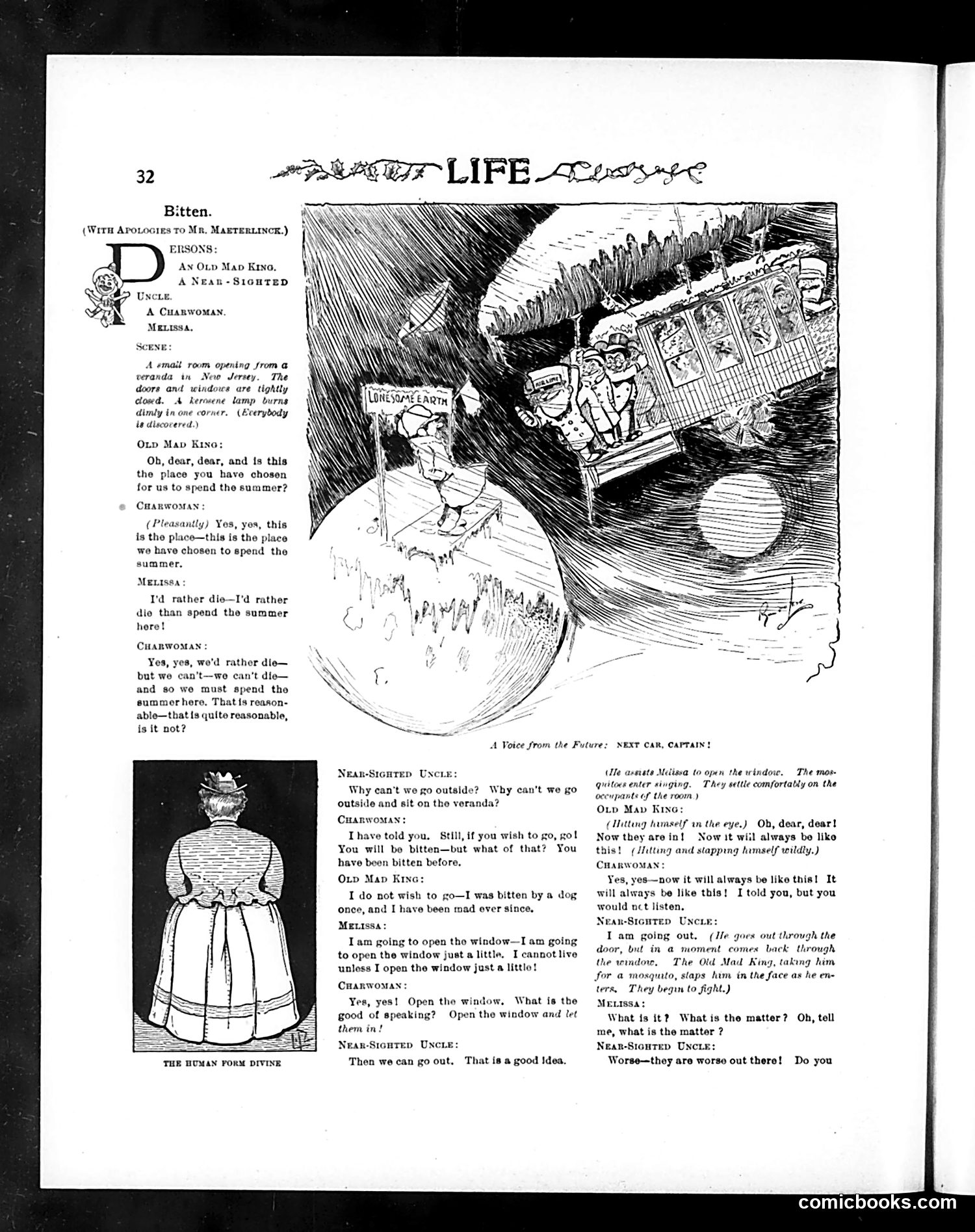
This is a comedic sketch parodying the heavily symbolic, pessimistic style of Belgian playwright Maurice Maeterlinck (noted in the subtitle). The joke: a family trapped indoors in New Jersey during summer, unable to open windows because of mosquitoes—yet when they do, the insects invade anyway, creating chaos. The satire works on two levels. First, it mocks Maeterlinck's theatrical gloom, where characters speak in resigned, philosophical tones about inevitable suffering ("we must spend the summer here. That is reasonable"). Second, it ridicules the pretentious, fatalistic art of the period by applying it to an absurdly ordinary American problem: summer bugs. The characters—an Old Mad King (appears to be an everyman figure), a Charwoman, and young Melissa—speak in overwrought, accepting resignation about an utterly mundane domestic inconvenience, treating mosquitoes as existential doom. The humor lies in the contrast between high theatrical language and low, trivial subject matter.
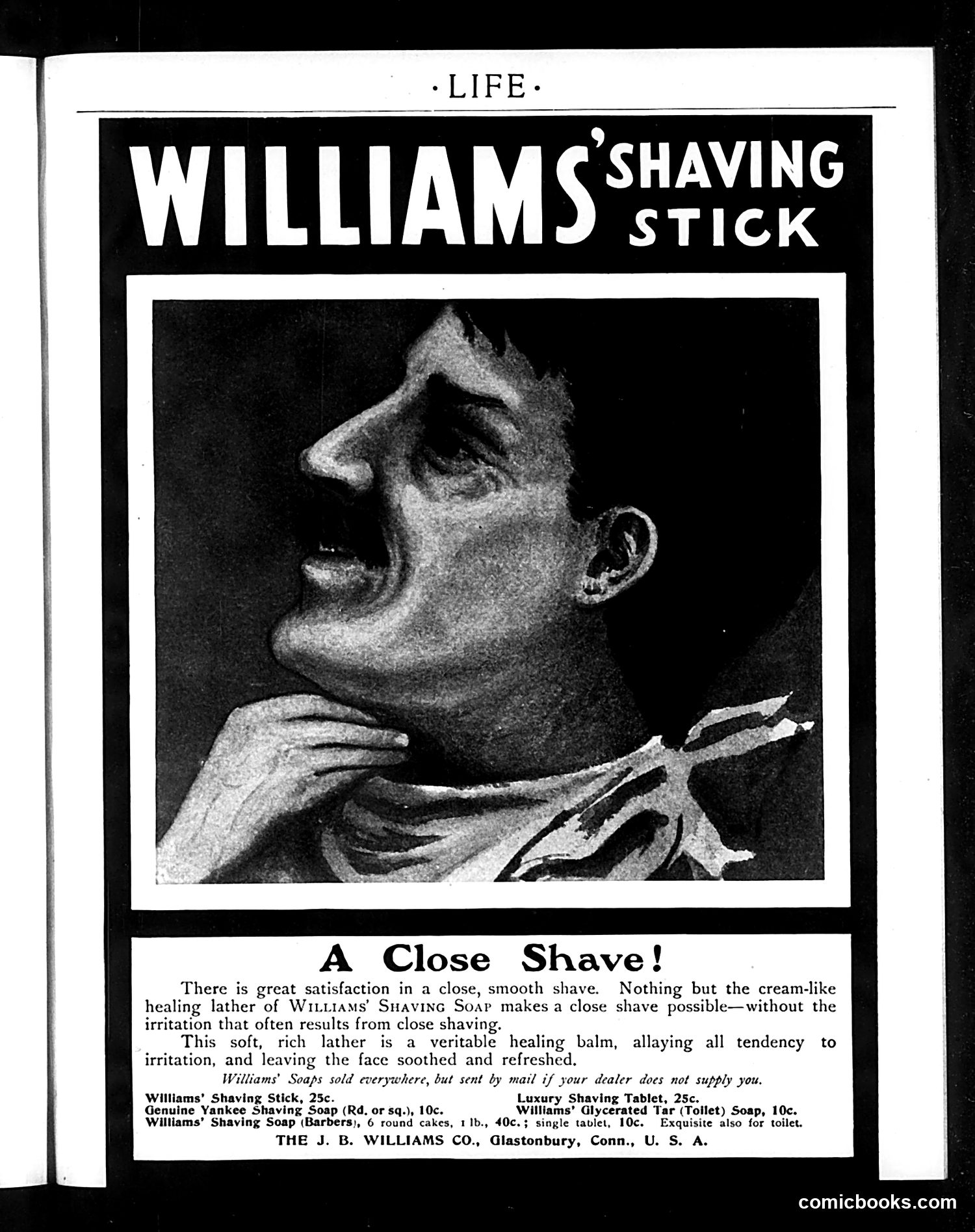
This is a **product advertisement**, not political satire. It promotes Williams' Shaving Stick and related grooming products from J.B. Williams Co. (Glastonbury, Connecticut). The image shows a man in profile demonstrating a close shave with the product. The advertisement emphasizes that Williams' soap creates a "cream-like healing lather" that enables a close shave without skin irritation—a significant selling point when safety razors were still relatively new technology. The ad lists multiple product variants and prices (ranging from 10 to 40 cents), indicating various consumer options. The phrase "A Close Shave!" is a pun: both literal (the shaving result) and colloquial (meaning a narrow escape from danger). This represents typical early-20th-century magazine advertising in *Life*, which mixed satirical editorial content with commercial pages.
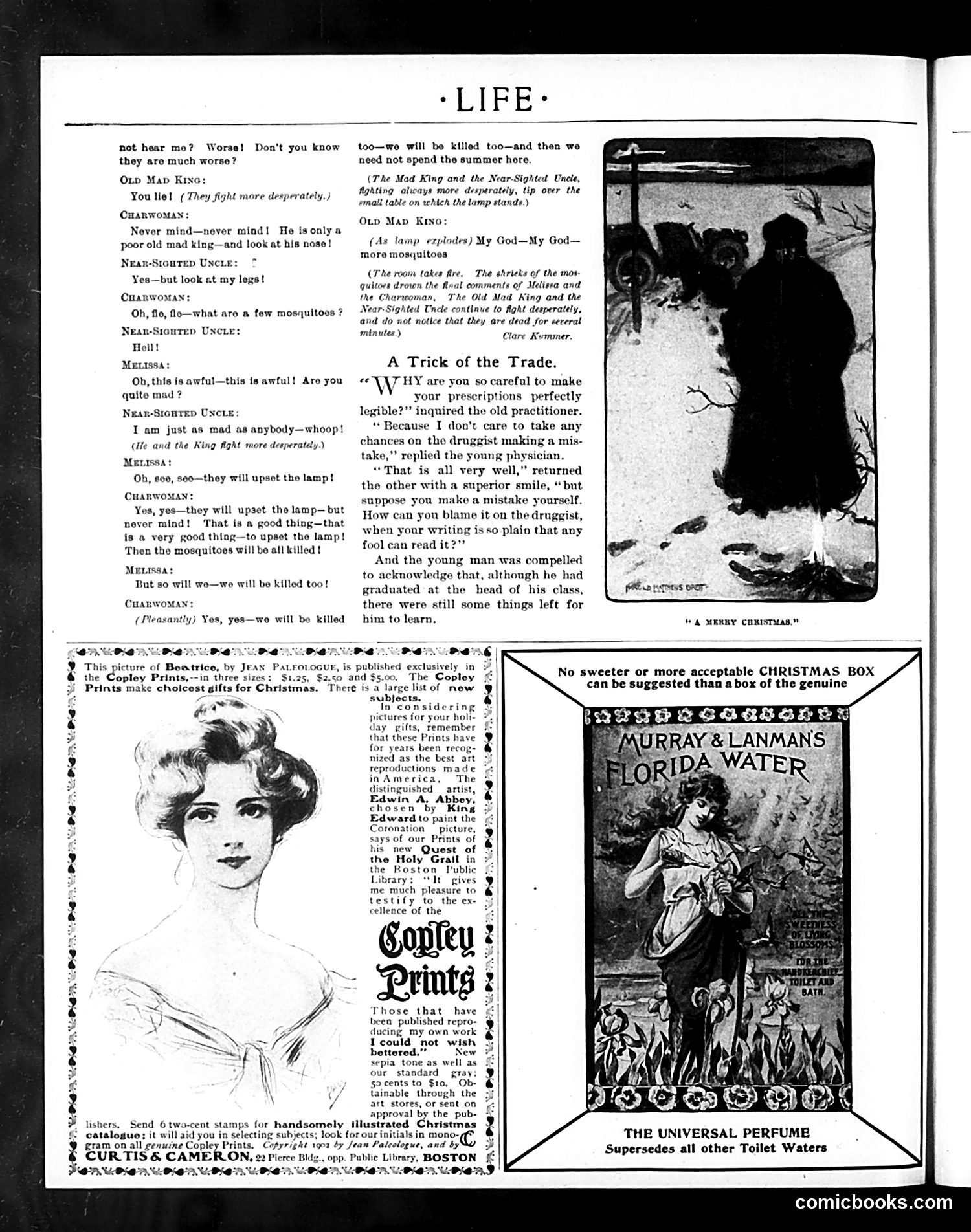
This page contains two distinct pieces of satirical content: **"A Trick of the Trade"** (center): A humorous dialogue between an experienced physician and a young doctor about prescription writing. The joke exposes professional cynicism—the older doctor reveals he deliberately writes illegibly so if a druggist makes an error, he can blame the pharmacist rather than himself. The young physician, despite graduating first in his class, is naively caught off guard by this admission of unethical practice. The satire mocks both medical dishonesty and the gap between academic achievement and real-world professional conduct. **The surrounding content** consists primarily of advertisements (Copley Prints, Murray & Lanmans Florida Water, and other products) and what appears to be dialogue from a dramatic piece involving a "Mad King" and mosquitoes—likely theatrical content. The page is typical of *Life* magazine's early 20th-century format: mixing satirical short stories with commercial advertising, aimed at educated middle-class readers amused by gentle critiques of professional hypocrisy.
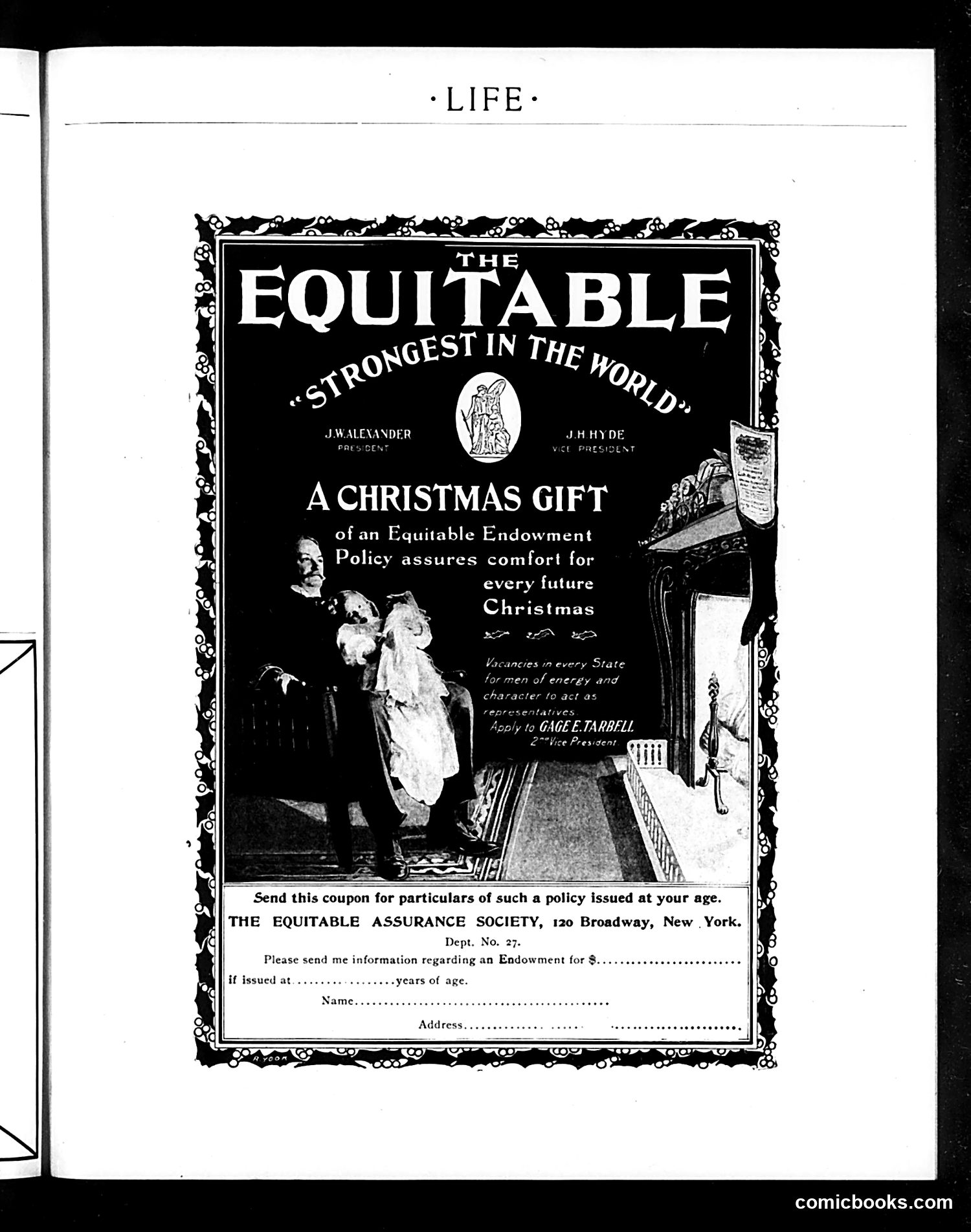
This is a Life magazine advertisement, not a political cartoon. It promotes the Equitable Assurance Society's endowment insurance policies as Christmas gifts. The ad features a sentimental scene of a man and children by a fireplace, suggesting financial security for families' futures. The "strongest in the world" tagline emphasizes the company's reliability. Names visible include J.W. Alexander (President) and J.H. Hyde (Vice President). The coupon at bottom invites readers to request policy information based on their age. This reflects early 20th-century insurance marketing that pitched financial products through emotional appeals to family security and comfort—a common advertising strategy of the era.
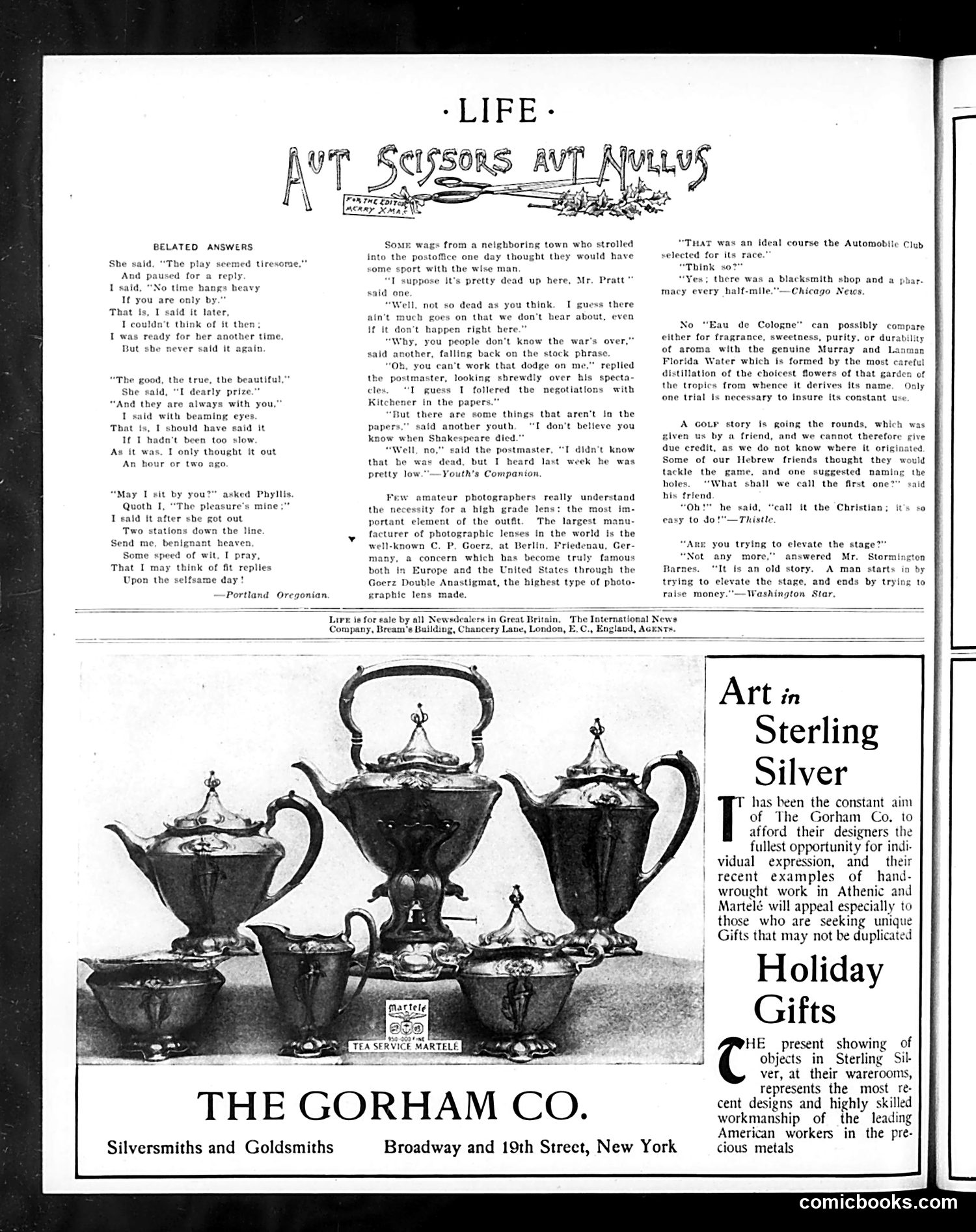
This page contains primarily **humor columns and advertisements** rather than political cartoons. The title "Ant Scissors Ant Annllus" appears to be decorative wordplay. The humor pieces are lighthearted anecdotes about small-town life and human nature. One sketch depicts a visitor to a rural post office patronizingly suggesting the town is "dead," only to be told by the local postmaster that they actually hear all the important news. Another involves a failed attempt at witty repartee that only works retroactively. A golf anecdote jokes about Hebrew golfers naming holes after Christian figures—playing on ethnic stereotypes common in early 20th-century humor. The page's substantial real estate is devoted to **advertising**: a Gorham Company silver tea service and holiday gifts, and Murray and Lanmon Florida Water fragrance. This reflects Life's business model as a commercial publication balancing content with revenue. No specific political figures or events are referenced—the humor is domestic and social rather than satirical.
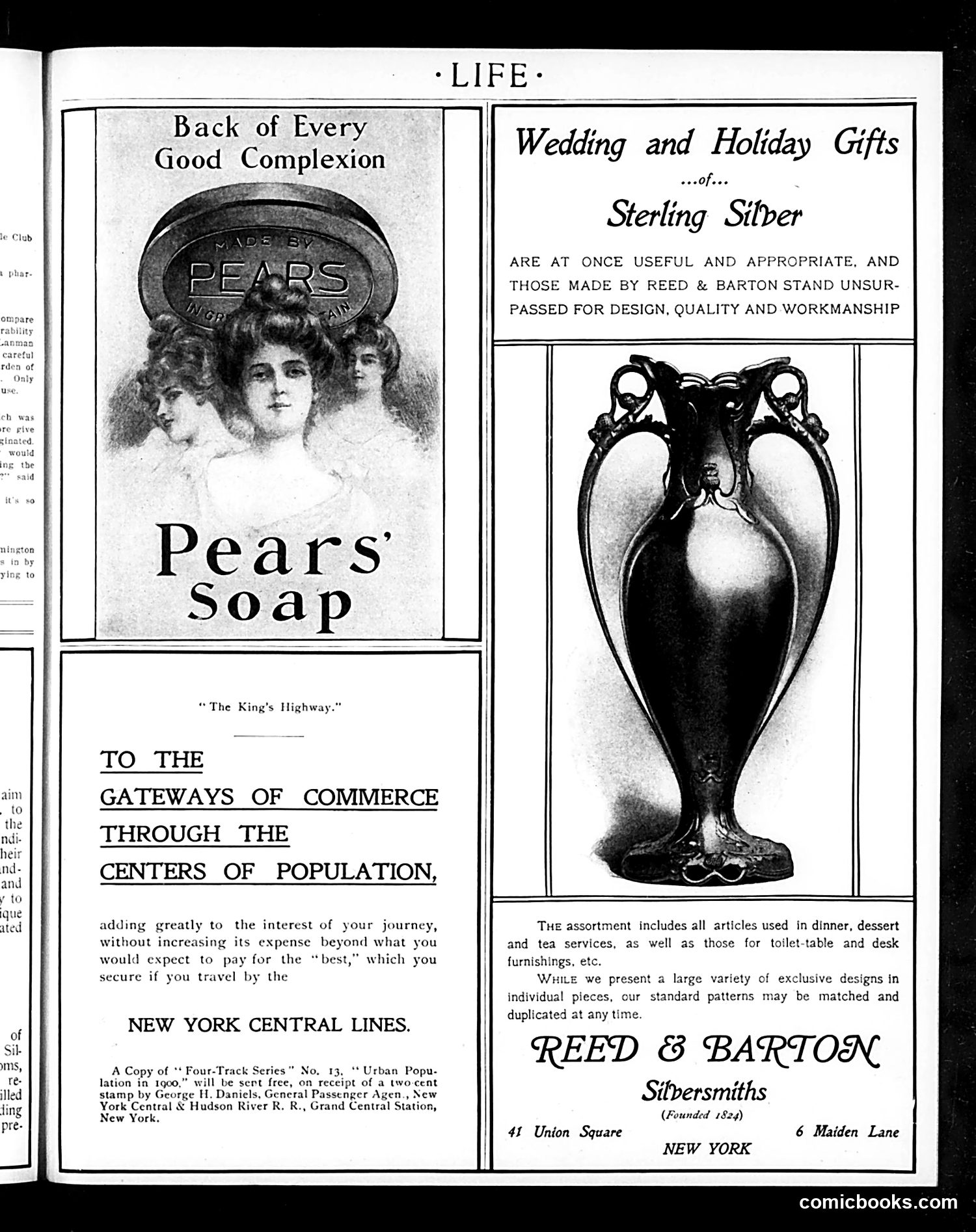
This is primarily a **commercial advertisement page**, not a political cartoon. It contains three separate ads: 1. **Pears' Soap** (left): Features three young women with the slogan "Back of Every Good Complexion." This reflects early 1900s beauty advertising emphasizing soap's role in achieving pale, refined complexions—a status symbol of the era. 2. **New York Central Lines** (center-left): A railroad advertisement promoting travel through commercial centers, positioning rail travel as both economical and prestigious. 3. **Reed & Barton Silversmith** (right): Advertises sterling silver housewares and tableware as appropriate wedding and holiday gifts, emphasizing quality and design exclusivity. **Historical context**: These ads reflect Gilded Age consumer culture, emphasizing refinement, commerce, and industrial progress. No satire is evident—this appears to be a standard advertising section of Life magazine.
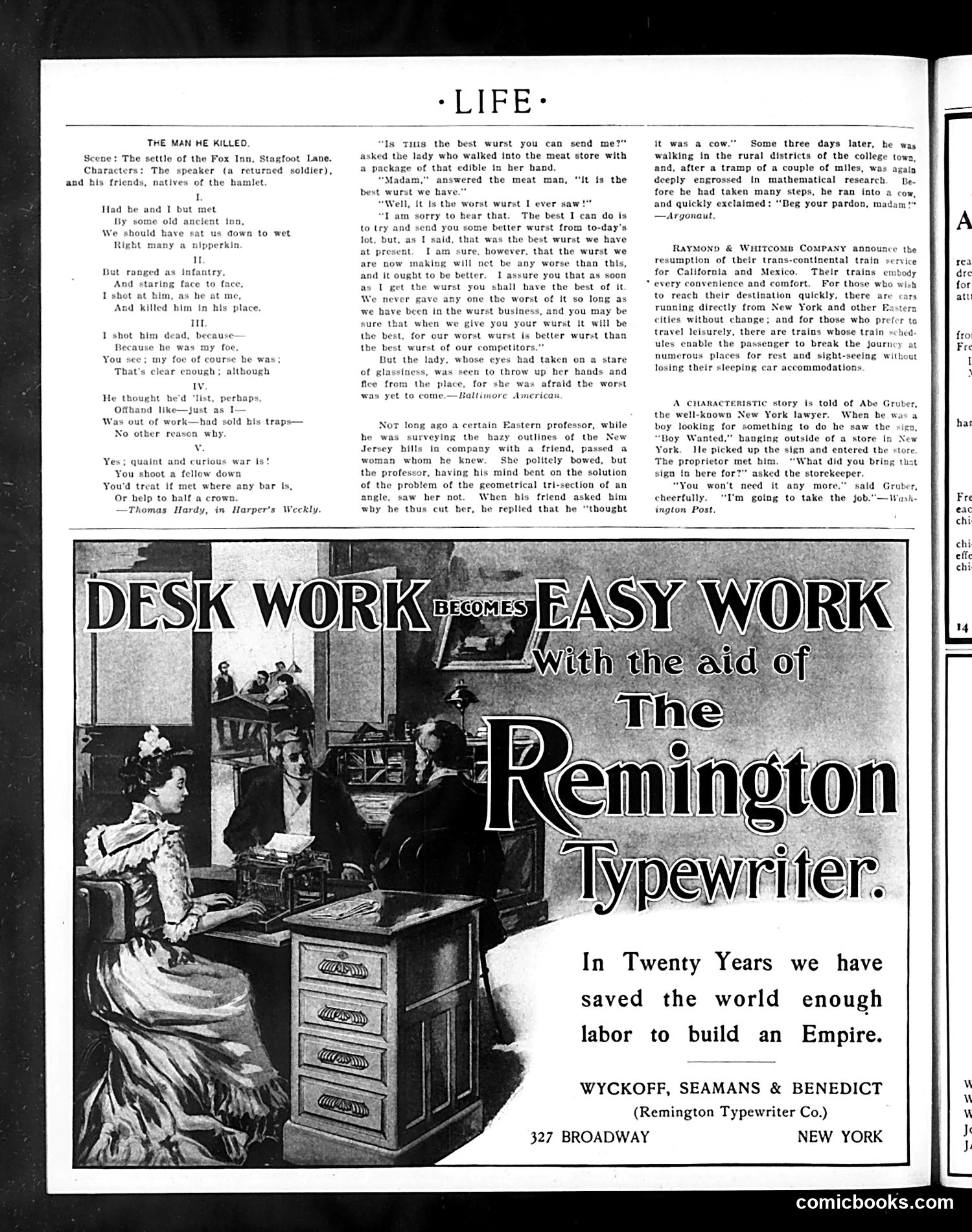
This page from *Life* magazine contains poetry, humorous anecdotes, and advertising typical of early 20th-century American humor publications. **Literary Content:** Thomas Hardy's poem "The Man He Killed" appears at top—a WWI-era reflection on the moral paradox of warfare, where a soldier killed an enemy he might have befriended in peacetime. **Humorous Anecdotes:** The page includes three brief jokes playing on wordplay and absent-mindedness: a customer complaining about "wurst" (sausage) to a bewildered butcher; a distracted mathematician apologizing to a cow; and lawyer Abe Gruber cleverly stealing a "Boy Wanted" sign to secure employment. **Advertisement:** The large Remington Typewriter ad uses the phrase "Desk Work Becomes Easy Work," marketing efficiency gains. The claim that typewriters have "saved the world enough labor to build an Empire" in twenty years reflects turn-of-the-century optimism about industrial progress and mechanization improving productivity. Together, these elements represent *Life*'s mix of literary satire, light comedy, and commercial messaging for educated, urban readers.
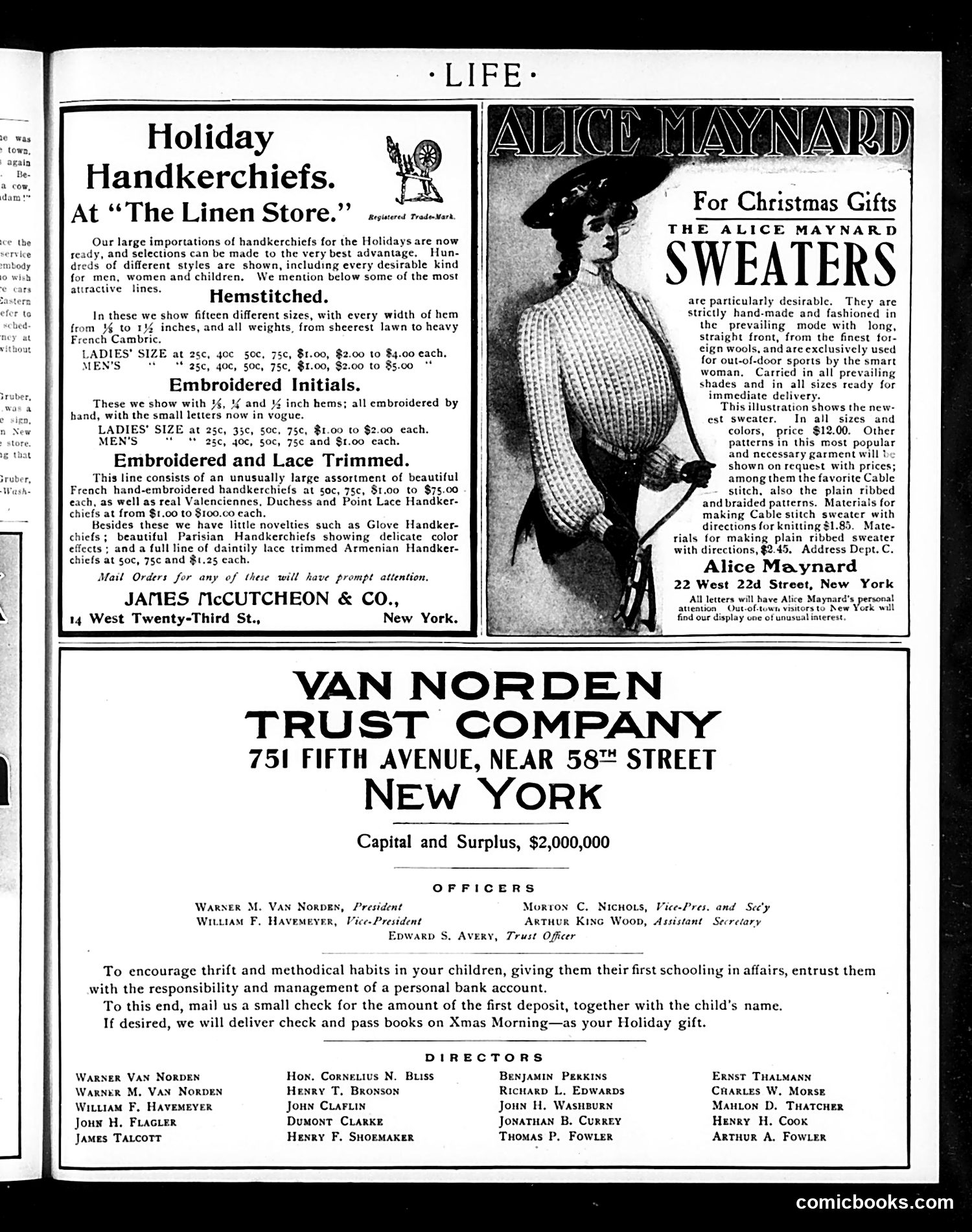
This page is primarily **advertising**, not satire or political cartooning. It contains three distinct advertisements from early-20th-century New York: 1. **"The Linen Store"** (top left): Holiday handkerchief sales, listing prices and styles for men and women. 2. **Alice Maynard Sweaters** (top right): Features an illustration of a woman modeling a hand-knitted sweater. The ad promotes hand-made, fashionable knitwear at $12.00, with materials and knitting instructions available. 3. **Van Norden Trust Company** (bottom): A bank advertisement encouraging parents to open savings accounts for children as a Christmas gift, promoting financial education and thrift. The page reflects early-1900s consumer culture and gift-giving traditions. There is no political satire or caricature present.
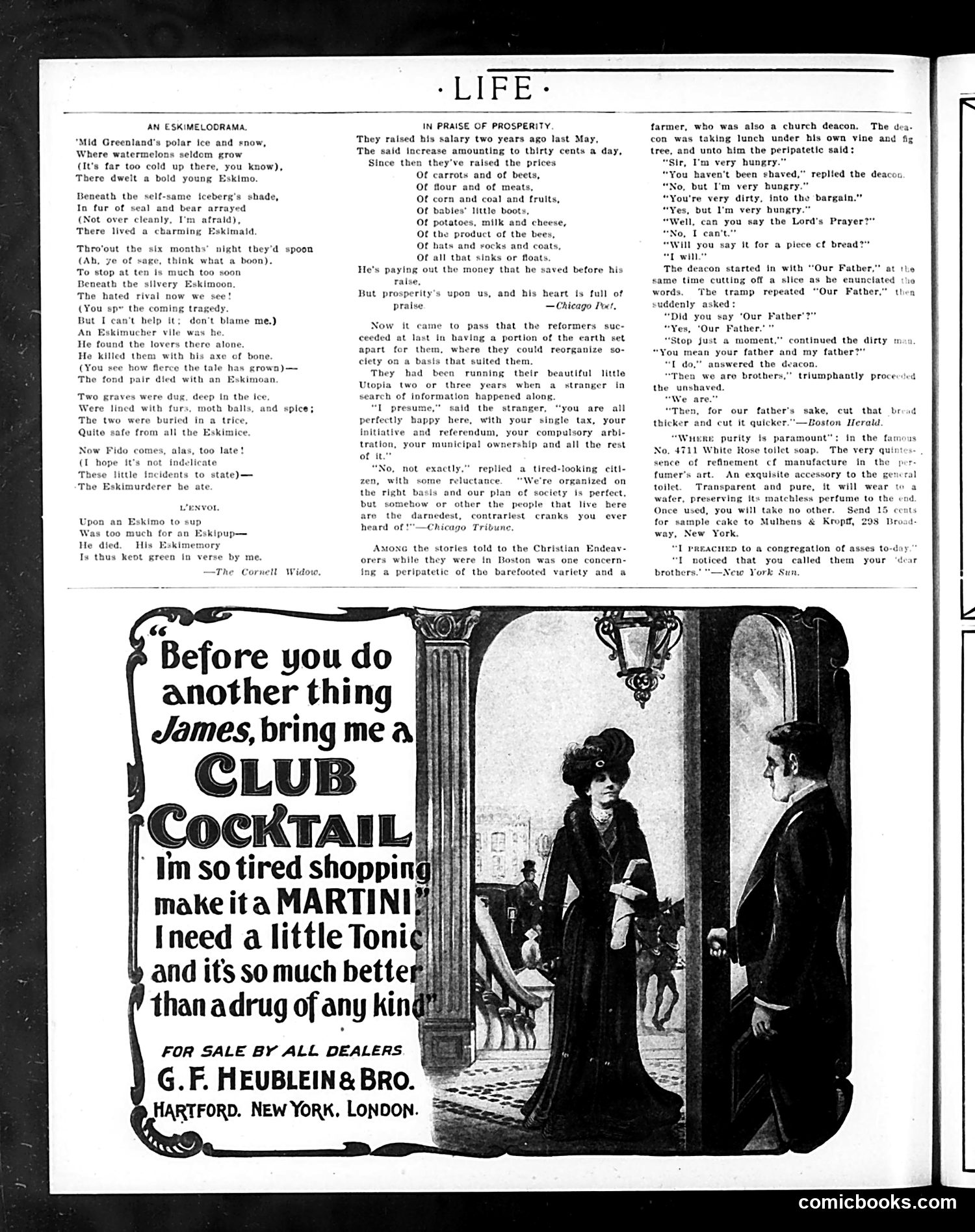
This page contains three satirical pieces typical of early 20th-century American humor: 1. **"An Eskimelodrama"**: A mock-tragic poem about Eskimo lovers, playing on melodramatic Victorian literary conventions while using exaggerated dialect humor ("Eskimoon," "Eskimurderer"). The joke relies on contemporary audiences finding exotic, "primitive" settings inherently comedic. 2. **"In Praise of Prosperity"**: Satirizes economic inequality—a worker receives a modest raise, but inflation immediately erases the benefit as all prices rise. The irony: he celebrates "prosperity" while remaining financially worse off. 3. **"The Deacon and the Tramp"**: A socially conscious joke about Christian hypocrisy. A self-righteous deacon conditions charity on the tramp's appearance/behavior rather than need. The tramp's clever response—claiming brotherhood through shared parentage ("Our Father")—exposes the deacon's un-Christian selfishness. The **Club Cocktail advertisement** below uses period-appropriate marketing connecting alcohol consumption to shopping exhaustion and sophistication.
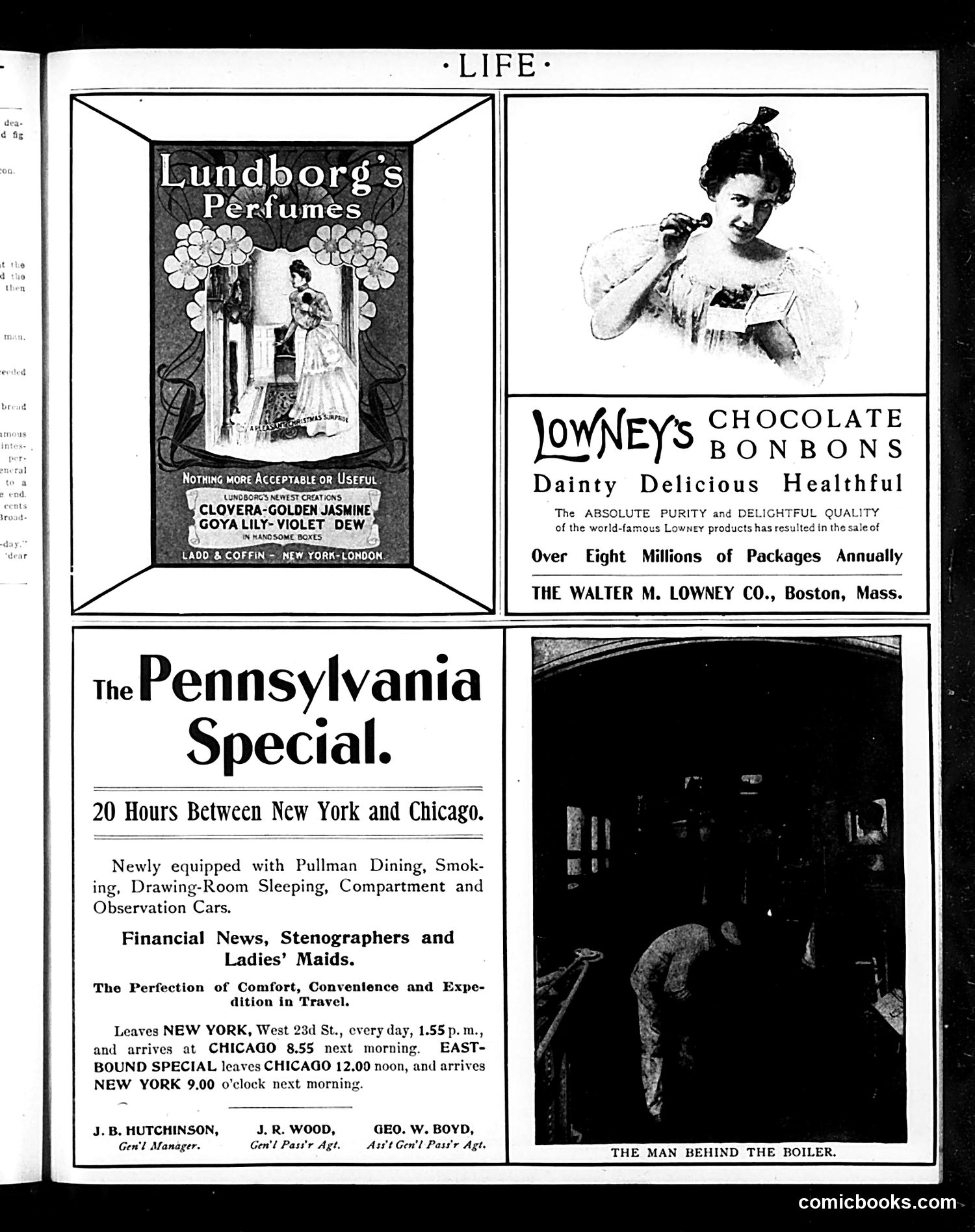
This is primarily an **advertising page**, not a satirical cartoon page. It contains four advertisements: 1. **Lundborg's Perfumes** — luxury fragrances marketed to affluent women, emphasizing exotic scents like "Clovera-Golden Jasmine" 2. **Lowney's Chocolate Bonbons** — positioned as refined confections for genteel consumers, claiming "absolute purity" and massive annual sales 3. **The Pennsylvania Special** — a luxury railroad service between New York and Chicago, featuring Pullman cars and amenities like dining and observation cars. The service targets affluent business travelers and includes services like "Financial News, Stenographers and Ladies' Maids" 4. **"The Man Behind the Boiler"** — an unlabeled photograph, likely illustrating working-class railroad labor (the boiler operator) The page reflects early-20th-century consumer culture targeting the wealthy, positioned against the labor that enabled their comfort. There is no apparent political satire on this particular page.
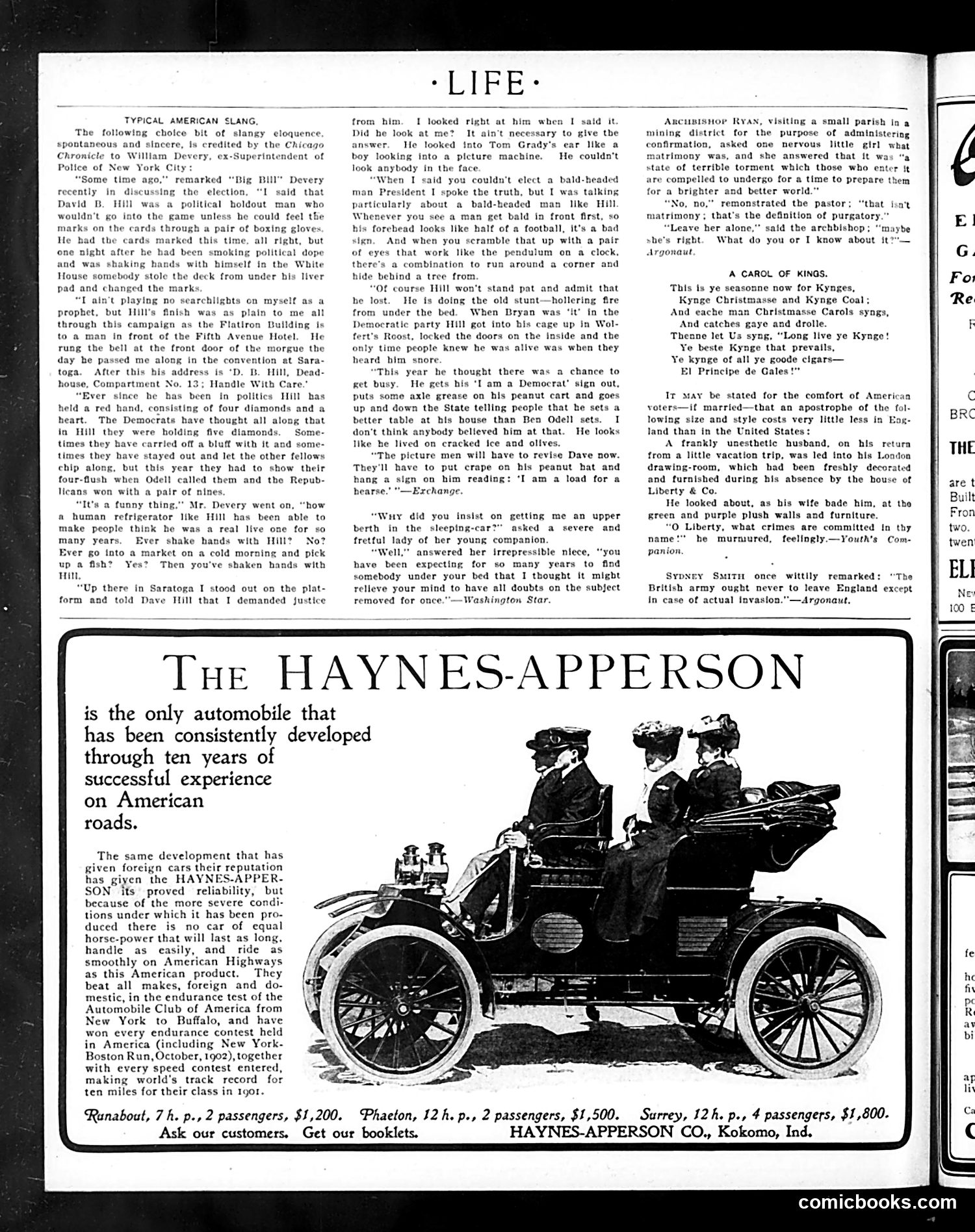
This page contains **political satire about David B. Hill**, a New York Democratic politician. William "Big Bill" Devery, a former NYC police superintendent, delivers an extended insult using gambling and card-playing metaphors to mock Hill's political incompetence and defeat. **The satire's points:** - Hill is a dishonest operator ("marked cards") whose deceptions were exposed - He's a coward who avoids confrontation ("couldn't look anybody in the face") - He's physically repulsive (bald, cold personality likened to a dead fish) - His political loss is total and deserved The humor relies on colorful slang ("four-flush," "peanut cart") and extended metaphors comparing politics to card games and con artistry—typical of early 1900s American political discourse. **Below the satire** is a Haynes-Apperson automobile advertisement claiming superiority through American road-testing, unrelated to the political content above.
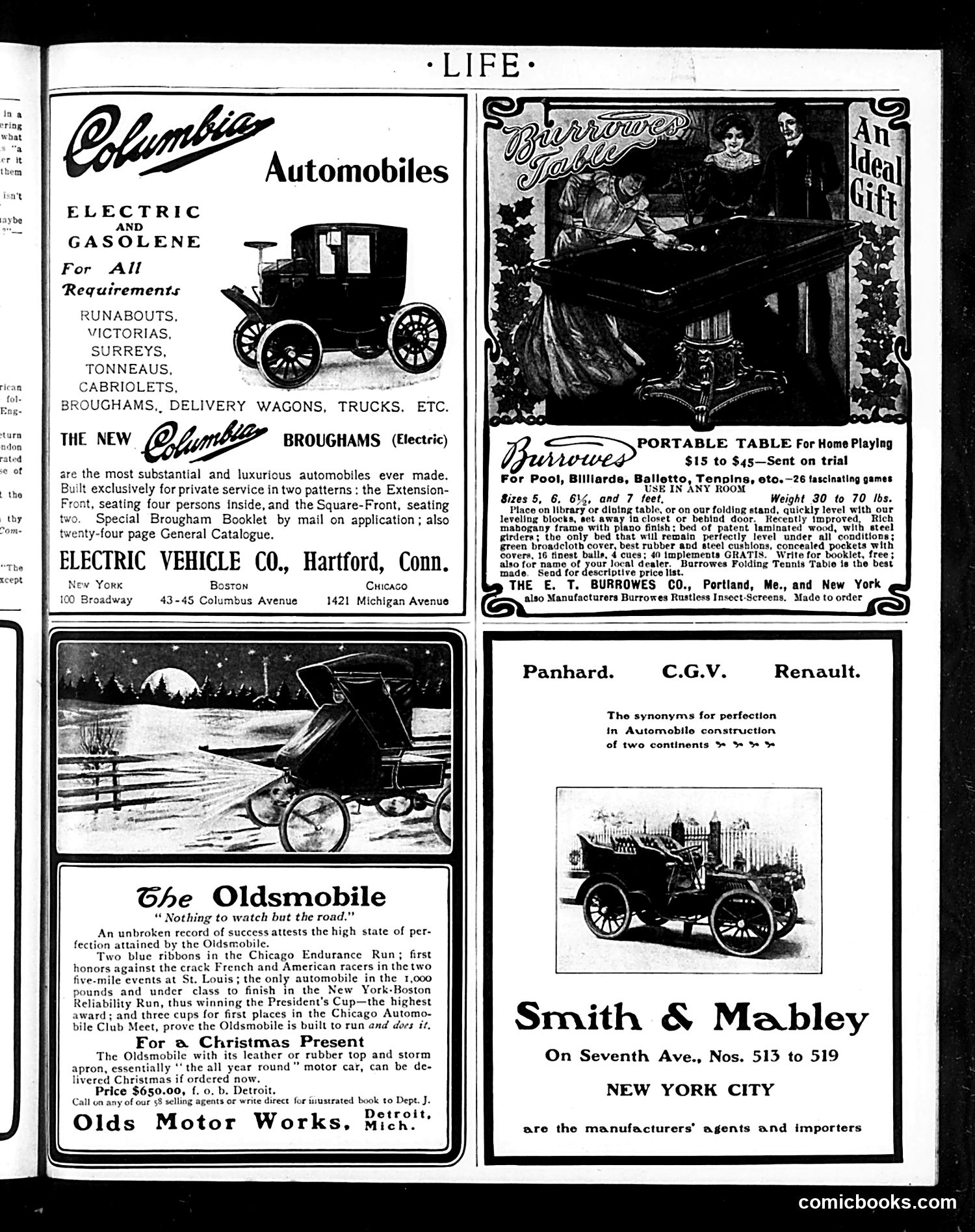
This is not a satirical cartoon page but rather an **automobile advertisement section** from Life magazine. The page contains multiple ads for early 1900s vehicles: **Key content:** Columbia electric and gasoline automobiles; Oldsmobile (emphasizing racing victories and Christmas delivery); Burrowes folding pool/billiards tables; and foreign car importers (Panhard, Renault, C.G.V.) via Smith & Mabley in New York. **Historical context for modern readers:** This reflects the era when automobiles were luxury goods, still competing between electric and gasoline power. The Oldsmobile's racing pedigree and Christmas marketing, plus emphasis on "all year round" reliability, show cars were novelties for the wealthy. The French car imports underscore America's early dependence on European auto expertise. No political satire or caricature is present—this is straightforward period advertising.
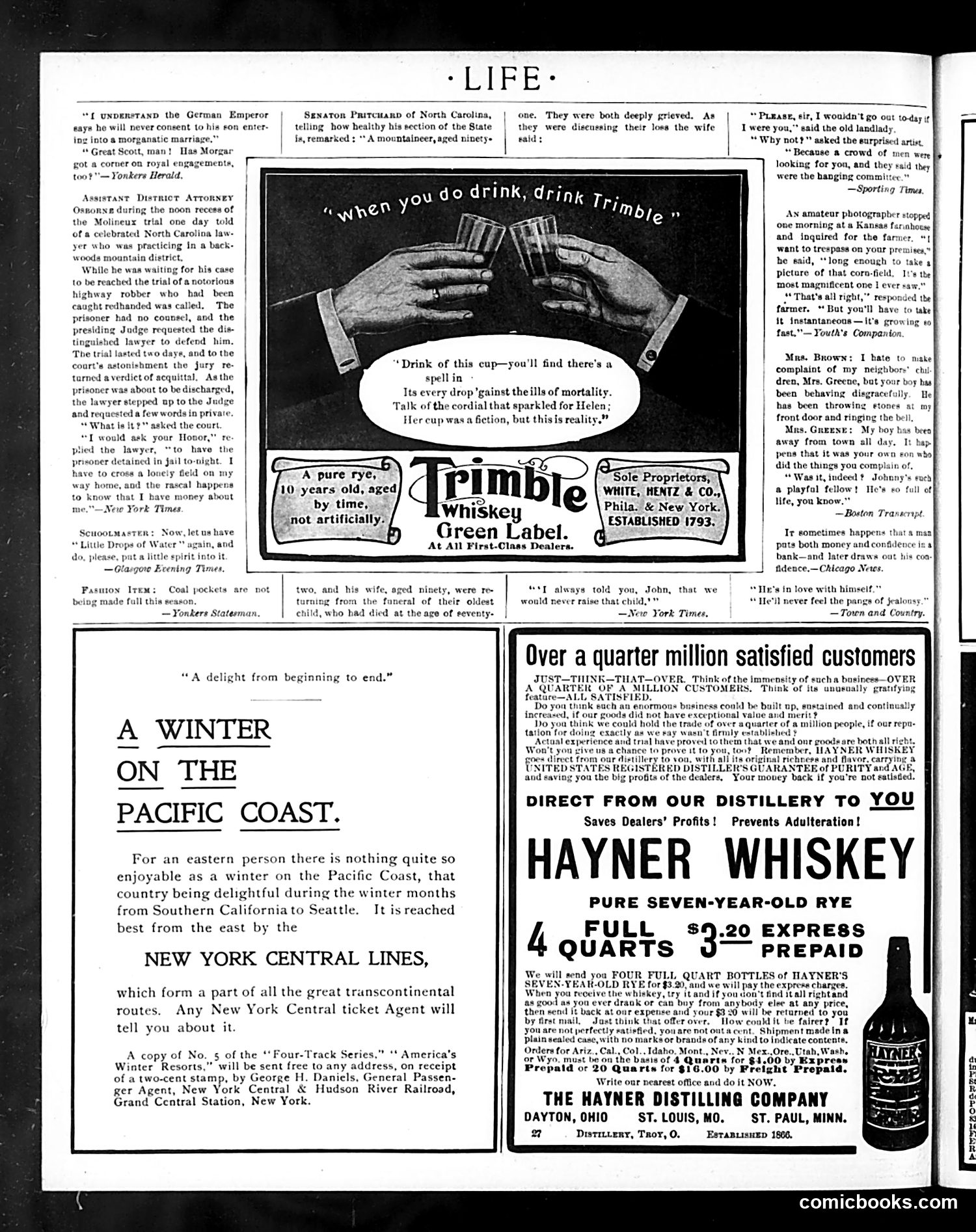
This page contains several brief anecdotes and jokes typical of Life magazine's satirical humor, plus two major advertisements. **The Cartoons/Jokes:** The page features no political cartoons, but rather short humorous stories and quips about everyday situations—a lawyer defending a highway robber, a photographer asking to photograph cornfields, neighbors complaining about children's behavior. These are gentle social satire focused on human folly and awkward situations rather than political commentary. **The Advertisements:** The dominant content is advertising for whiskey—Trimble Whiskey and Hayner Whiskey. These ads emphasize purity ("A pure rye, 10 years old, aged by time, not artificially") and direct-to-consumer sales ("Direct from Our Distillery to You"). A smaller ad promotes New York Central railroad routes to Pacific Coast winter resorts. **Historical Context:** This appears to be pre-Prohibition (likely early 1900s, given the "Established 1793" date and the magazine's style). Whiskey advertising was legal and commonplace. The content reflects turn-of-the-century American humor and commercial practices.
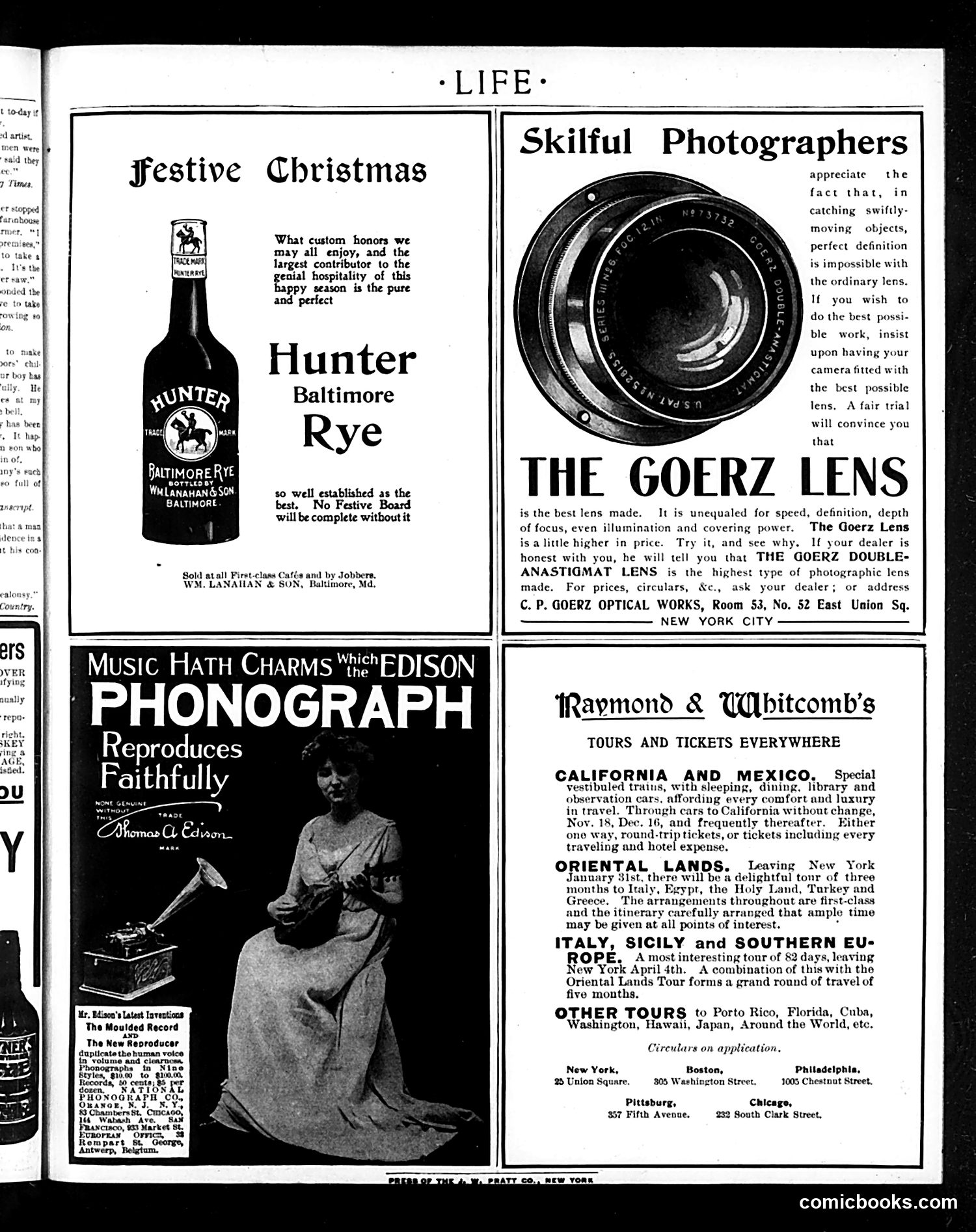
This is primarily an **advertising page** from Life magazine, not a satirical cartoon page. It contains four product advertisements: 1. **Hunter Baltimore Rye** whiskey — pitched as essential to a "Festive Christmas" celebration 2. **Goerz Lens** for cameras — emphasizing superior quality for photographing moving objects 3. **Edison Phonograph** — promoting faithful music reproduction, attributed to Thomas A. Edison 4. **Raymond & Whitcomb's Tours** — offering luxury travel packages to California, Mexico, Italy, Egypt, and worldwide destinations The page reflects early 20th-century consumer culture and leisure pursuits among affluent Americans. The advertisements emphasize technological advancement (cameras, phonographs) and aspirational experiences (exotic travel). There is no discernible political satire or social commentary — this is straightforward commercial messaging targeting Life's middle-to-upper-class readership during the holiday season.
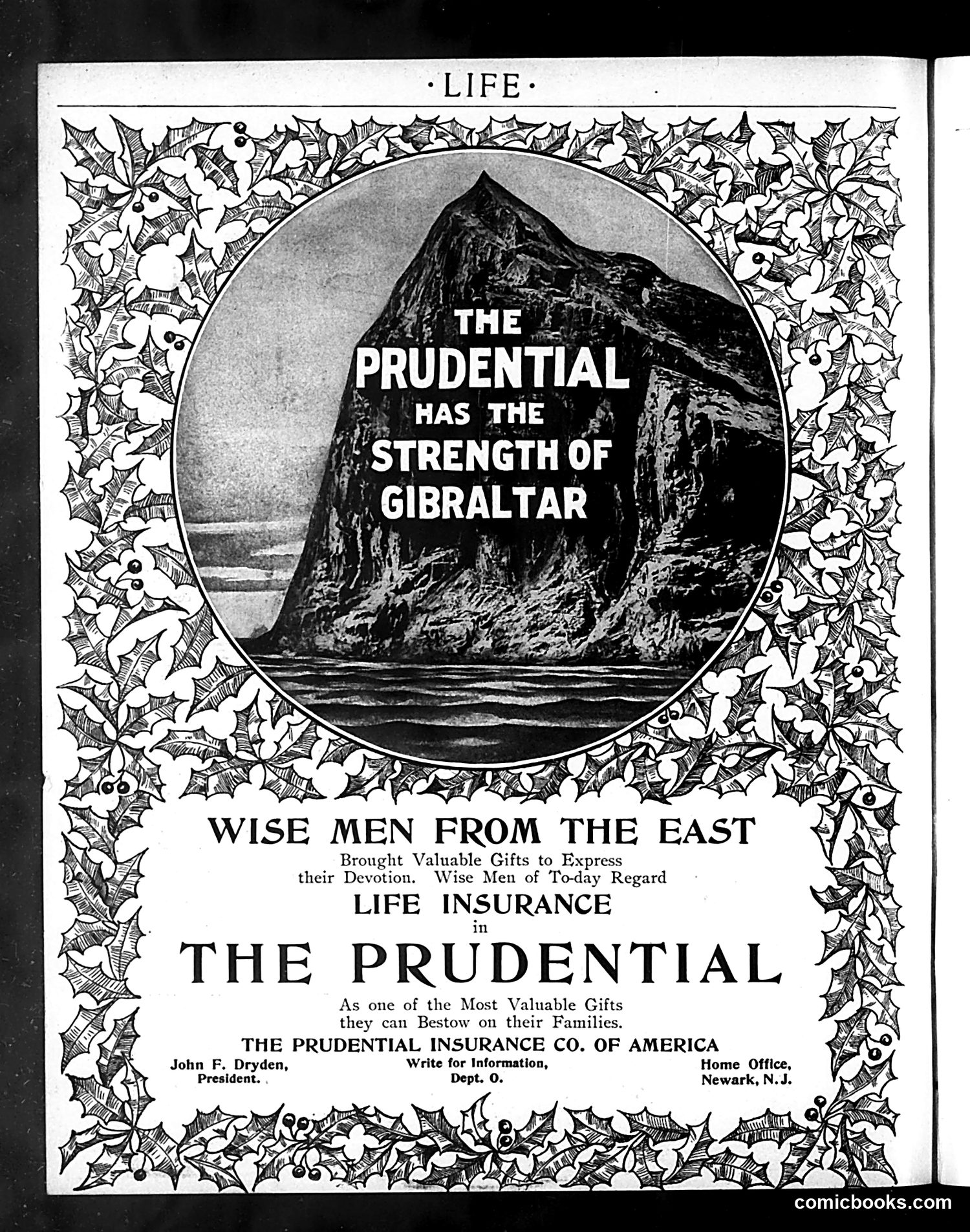
This is primarily a **Prudential Insurance advertisement**, not political satire. The page uses a religious reference to market life insurance to early 20th-century readers. The ad invokes the Biblical "Wise Men from the East" (the Magi who visited Jesus) to suggest that just as those ancient wise men brought valuable gifts, modern wise men should regard life insurance as a precious gift to their families. The image of Gibraltar—a famous, stable rock formation—reinforces the message of strength and security. The "satire" is gentle corporate messaging dressed in grandiose language: positioning life insurance as a morally righteous act comparable to acts of devotion. For modern readers, this reveals how insurance companies marketed financial products by appealing to duty, family obligation, and spiritual values rather than practical risk management.
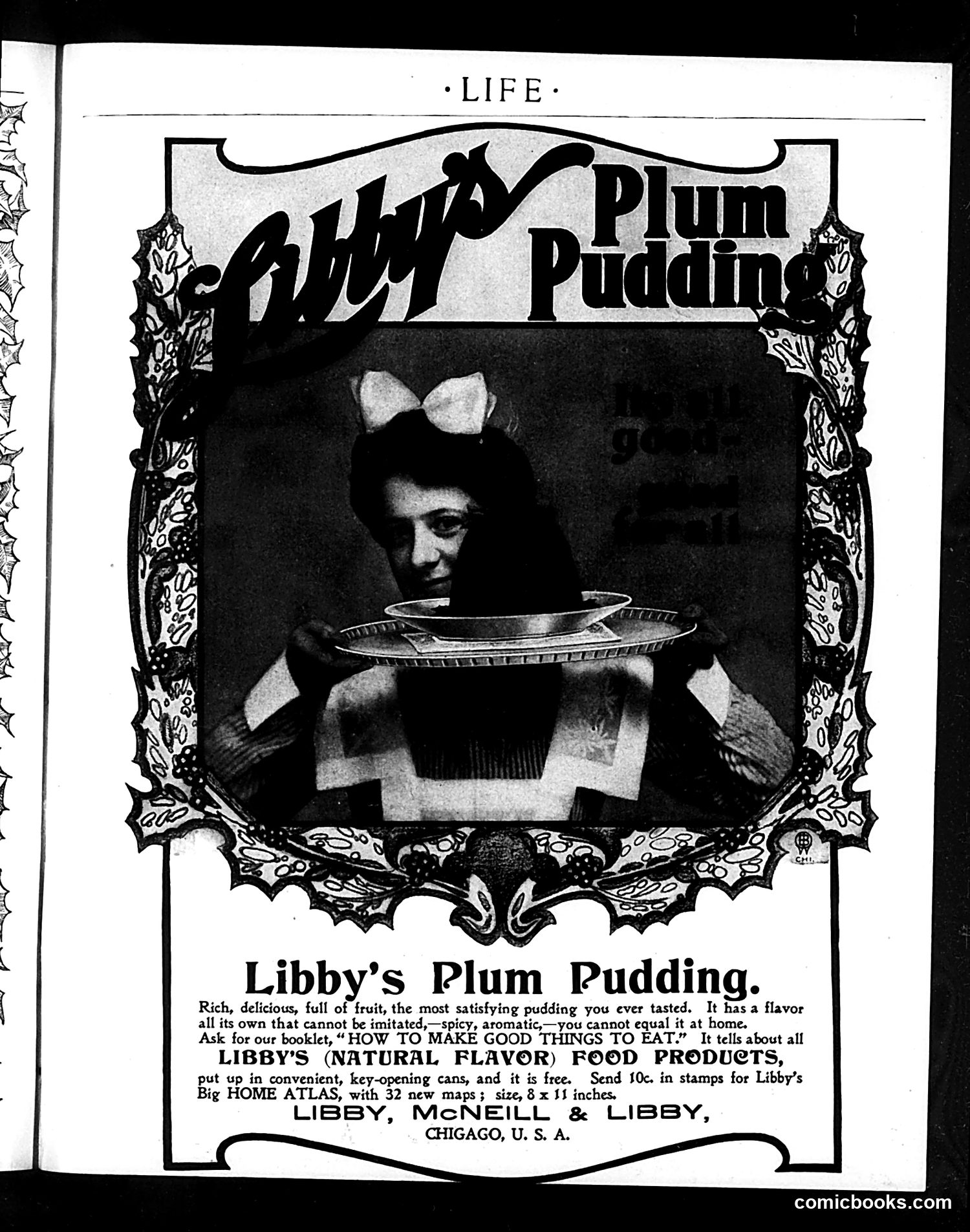
This is a **full-page advertisement**, not a cartoon or satire. It promotes Libby's canned plum pudding, a convenience food product. The image shows a young woman with a bow in her hair presenting a platter of the pudding. The ad emphasizes the product's appeal by claiming it has a flavor "all its own that cannot be imitated" and cannot be matched if made at home—a key selling point for canned goods in this era. The ad also cross-promotes related products: a free cookbook titled "How to Make Good Things to Eat" and a home atlas available for 10 cents in stamps. This was typical early 20th-century advertising strategy, bundling offers to build customer loyalty. The ornate decorative border and high-quality photography reflect the premium positioning of Libby's brand at that time.
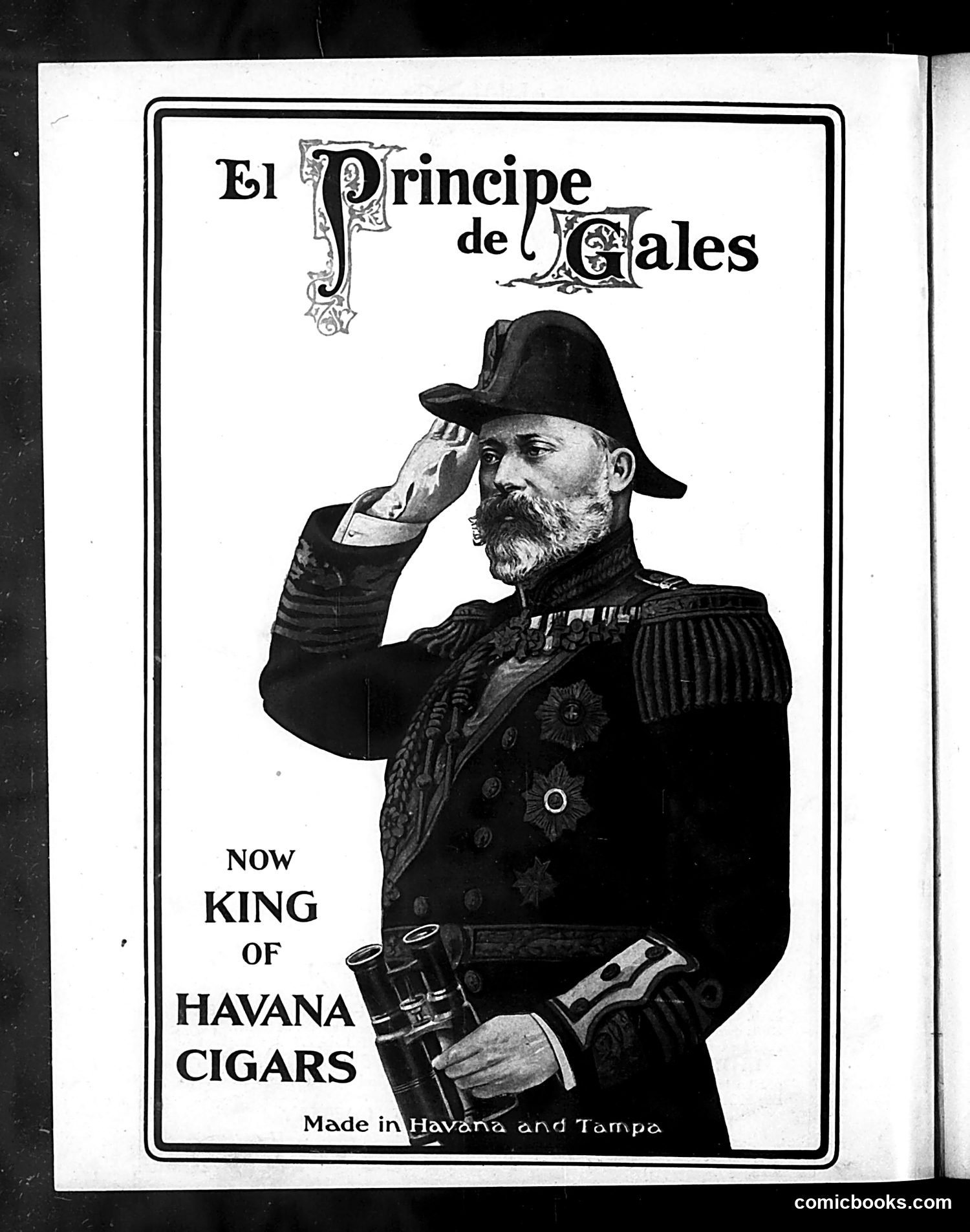
This is a cigar advertisement, not political satire. It depicts a bearded military officer in formal dress uniform with epaulettes, medals, and a bicorne hat, touching his hat in a salute. The text identifies him as "El Príncipe de Gales" (The Prince of Wales) and promotes him as "Now King of Havana Cigars." The ad plays on prestige associations—linking the product to royal imagery and aristocratic refinement. The figure's military regalia suggests authority and distinction. The notation "Made in Havana and Tampa" indicates the cigar's origin, referencing Tampa's significant Cuban cigar manufacturing industry in early 20th-century America. The humor likely rests on elevating a cigar product through mock-royal endorsement.

This appears to be a blank or nearly blank page from Life magazine, with only the "comicbooks.com" watermark visible at the bottom right. The page contains no discernible cartoon, illustration, or satirical content that would allow for historical analysis. It may be a blank filler page, a title page, or a page where the original content has not been successfully captured in this image. Without visible political figures, caricatures, or textual content beyond the watermark, it's impossible to identify the intended satire or social commentary that would have been present on the original publication.