
Life, 1902-12-25 · page 6 of 77
Life — December 25, 1902 — page 6: what you’re looking at
What you’re looking at
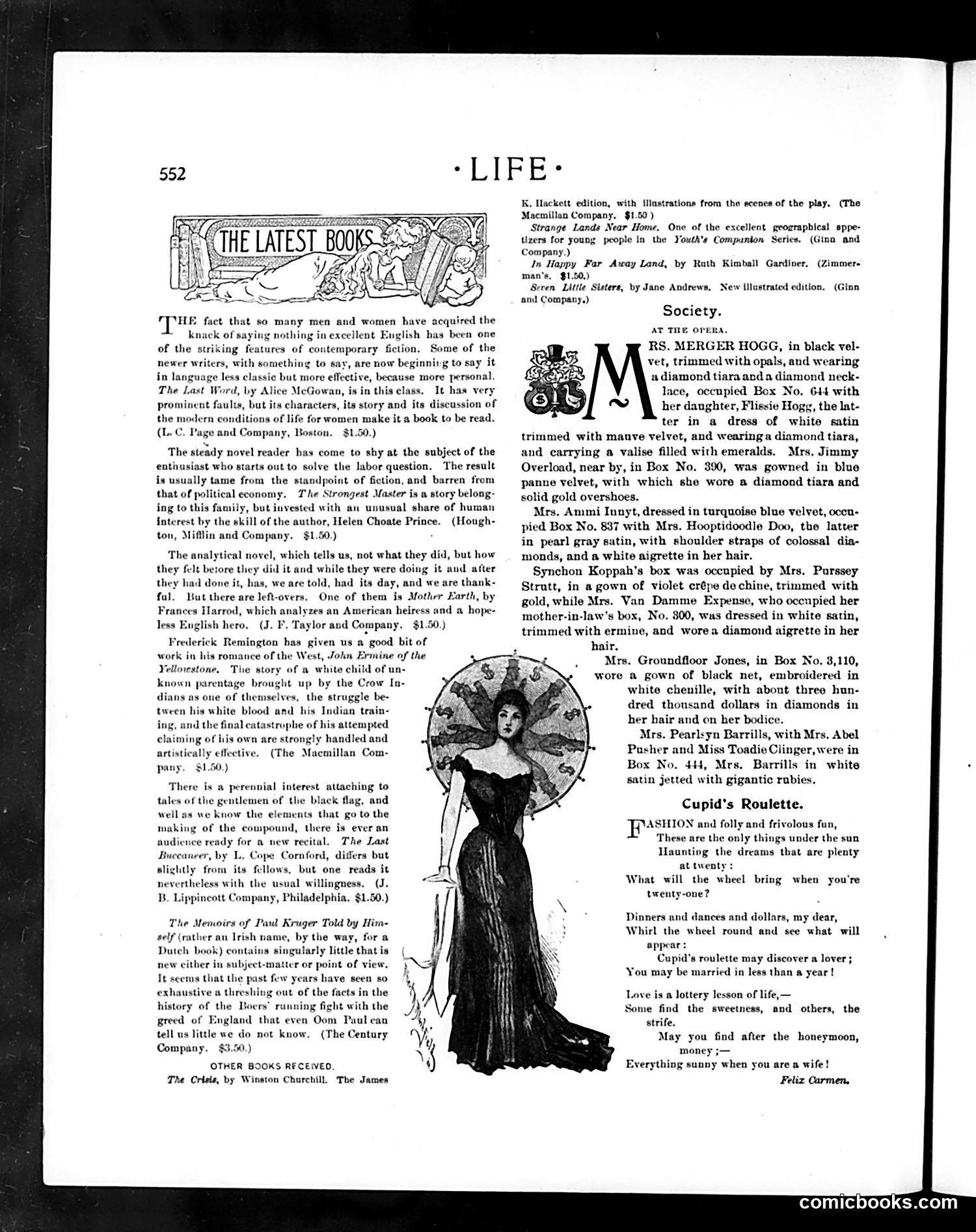
This page contains a book review section ("The Latest Books") and a society column ("At the Opera"), with an accompanying illustration of an elegant woman holding a parasol. The content is primarily **literary criticism and social reporting**, not political satire. The reviews discuss novels like *The Last Word* and *The Strongest Instinct*, praising contemporary fiction's engagement with modern life and labor questions. The society column humorously catalogs wealthy opera attendees' elaborate jewelry and clothing—a satirical commentary on **ostentatious display among the wealthy**. The humor lies in the specificity: noting exact box numbers, fabric types, and diamond values mocks the pretension of high society. "Cupid's Roulette," a poem about marriage as chance, appears at bottom—light romantic satire rather than political commentary.
📄 Transcribed text from this page (OCR, searchable)
Machine-transcribed from the original scan — historical spelling and the odd misread are preserved.
‘LIFE: fact that so many men and women have acqui in excellent English has been one of the striking features of contemporary fiction. Some of the newer writers, with something to say, are now beginnirg to say it in language less classic but more effective, because more personal. The Last Word, by Alice McGowan, is in this class. It has very prominent faults, but its characters, its story and its discussion of the modern conditions of life for women make it a book to be read. (L. C. Page and Company, Boston. $1.50.) The steady novel reader has come to shy at the subject of the enthusiast who starts out to solve the labor question. The result is usually tame from the standpoint of fiction, and barren from that of political economy. The Strongest Master is a story belong- ing to this family, but invested with an unusual share of human interest by the skill of the author, Helen Choate Prince. (Hough- ton, Miflin and Company. $1.50.) The analytical novel, which tells us, not what they did, but how they felt betore they did it and while they were doing it and after they had done it, has, we are told, had its day, and we are thank- ful. But there are left-overs. One of them is Mother Earth, by Frances Harrod, which analyzes an American heiress and a hope- less English hero. (J. F. Taylor and Company. $1.50.) Frederick Remington has given us a good bit of k in his romance of the West, John Ermine of the Yellowstone, The story of a white child of un- known parentage brought up by the Crow In- dians as one of themselves, the struggle be- tween his white blood and his Indian train- ing, and the final catastrophe of his attempted claiming of his own are strongly handled and artistically effective. (The Macmillan Com- pany, $1.50.) There is a perennial interest attaching to tales of the gentlemen of the black flag, and well as we know the elements that go to the making of the compound, there is ever an audience ready for a new recital. The Last Buccaneer, by L. Cope Cornford, diifers but slightly from its fellows, but one reads it nevertheless with the usual willingness. (J. B. Lippincott Company, Philadelphia, $1.50.) The Memoirs of Paul Kruger Told by Hira self (rather an Irish name, by the way, for a. Dutch book) contains singularly little that is new cither in subject-matter or point of view. It seems that the past few years have seen so exhaustive a threshing out of the facts in the history of the Boers’ running fight with the greed of England that even Oom Paul can tell us little we do not know. (The Century Company. $3.50.) OTHER BOOKS RECEIVED. The Crisis, by Winston Churchill. The James K. Hackett edition, with {lnstrations from the ecenes of the play. (The Macmillan Company. $1.50) Strange Lands Near Home, One of the excellent geograpbical eppe- tizers for young people in the Youth's Compunton Series, (Gina and Company.) In Happy Far Away Land, by Rath Kimball Gardiner. (Zimmer- man’s, $1.50.) Seren Little Sisters, by Jane Andrews, New illustrated edition. (Ginn and Company.) Society. AT THE OPERA. RS. MERGER HOGG, in black vel- vet, trimmed with opals, and wearing a diamond tiara anda diamond neck- lace, occupied Box No. 644 with her daughter, Flissie Hogg, the lat- ter in a dress of white satin trimmed with mauve velvet, and wearing a diamond tiara, and carrying a valise filled with emeralds. Mrs. Jimmy Overload, near by, in Box No. 390, was gowned in blue panne velvet, with which she wore a diamond tiara and solid gold overshoes. Mrs. Ammi Innyt, dressed in turquoise blue velvet, occn- pied Box No, 837 with Mrs. Hooptidoodle Doo, tho latter in pearl gray satin, with shoulder straps of colossal dia- monds, and a white aigrette in her hair. Synchon Koppah’s box was occupied by Mrs. Purssey Strutt, in a gown of violet crépe de chine, trimmed with gold, while Mrs. Van Damme Expense, who occupied her mother-in-law’s box, No. 800, was dressed in white satin, trimmed with ermine, and wore a diamond aigrette in her hair. Mrs. Groundfloor Jones, in Box No. 3,110, wore a gown of black net, embroidered in white chenille, with about three han- dred thousand dollars in diamonds in her hair and on her bodice. Mrs. Pearlsyn Barrills, with Mrs. Abel Pusher and Miss Toadie Clinger, were in Box No. 444, Mrs. Barrills in white satin jetted with gigantic rabies, Cupid's Roulette. JPPASHION and folly and frivolous fun, ‘These are the only things under the sun Haunting the dreams that are plenty at twent: What will the wheel bring when you're twenty-one? Dinners and dances and dollars, my dear, Whirl the wheel round and see what will appear: Cupid’s roulette may discover a lover ; You may be married in less than @ year! Love is a lottery lesson of life,— Some find the sweetness, and others, the strife. May you find after the honeymoon, money j— Everything sunny when you area wife! Feliz Carmen, comicbooks.com