
Life, 1902-12-25 · page 12 of 77
Life — December 25, 1902 — page 12: what you’re looking at
What you’re looking at
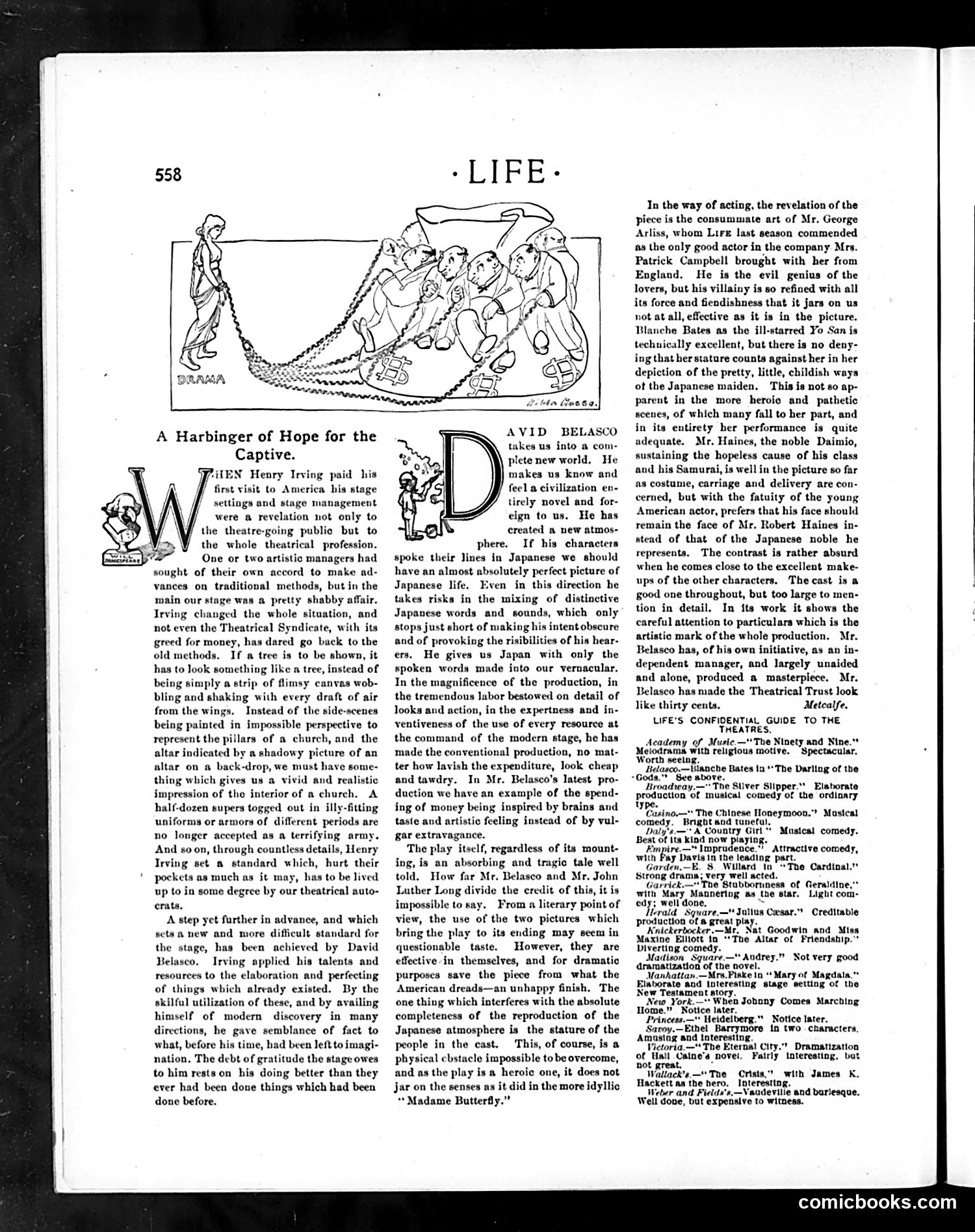
This page reviews Henry Irving's theatrical production of "Avid Belasco," which appears to be a new play bringing Japanese themes to the American stage. The cartoon depicts Irving (likely the figure on the left) presenting Japanese characters and aesthetics to an American audience (shown gathered on the right, appearing somewhat captive or confined). The satire critiques Irving's theatrical methods—specifically his elaborate, expensive staging and scenic design choices borrowed from contemporary stage innovation. The review suggests Irving has applied his talents to bring Japanese culture to Western audiences, though the text notes tensions between authentic artistic vision and practical theatrical constraints. The "captive" reference appears ironic, suggesting audiences are held by Irving's ambitious but sometimes overwrought productions.
📄 Transcribed text from this page (OCR, searchable)
Machine-transcribed from the original scan — historical spelling and the odd misread are preserved.
DRAMA A Harbinger of Hope for the Captive. ZEN Henry Irving paid his first visit to America his stage settings and stage management were a revelation not only to the theatre-going public but to the whole theatrical profession. One or two artistic managers had sought of their own accord to make ad- vances on traditional methods, but in the main our stage was a pretty shabby affair. Irving changed the whole situation, and not even the Theatrical Syndicate, with its greed for money, has dared go back to the old methods. If a tree is to be shown, it has to Jook something like a tree, instead of being simply a strip of flimsy canvas wob- bling and shaking with every draft of air from the wings. Instead of the side-scenes being painted in impossible perspective to represent the pillars of a church, and the altar indicated by a shadowy picture of an altar on a back-drop, we must have some- thing which gives us a vivid and realistic impression of the interior of a church, A half-dozen supers togged out in illy-fitting uniforms or armors of different periods are no longer accepted as a terrifying army, And soon, through countless details, Henry Irving set a standard which, burt their pockets as much as jt may, has to be lived up to in some degree by our theatrical auto- crate. A step yet further in advance, and which sets a new and more difficult standard for the stage, has been achieved by David Belasco. Irving applied his talents and resources to the elaboration and perfecting of things which already existed. By the skilful utilization of these, and by availing himself of modern discovery in many directions, he gave semblance of fact to what, before his time, had been left to imagi- nation. The debt of gratitude the stage owes to him rests on his doing better than they ever had been done things which had been done before. AVID BELASCO takes us into a com- plete new world, He makes us know and feel a civilization en- tirely novel and for- eign to us. He has created a new atmos- phere. If his characters spoke their lines in Japanese we should have an almost absolutely perfect picture of Japanese life. en in this direction he takes risks in the mixing of distinctive Japanese words and sounds, which only stops just short of making his intent obscure and of provoking the risibilities of his hear- ers, He gives us Japan with only the spoken words made into our vernacular. In the magnificence of the production, in the tremendous labor bestowed on detail of looks and action, in the expertness and in- ventiveness of the use of every resource at the command of the modern stage, he has made the conventional production, no mat- ter how lavish the expenditure, look cheap and tawdry. In Mr. Belasco’s latest pro- duction we have an example of the spend- ing of money being inspired by brains and taste and artistic feeling instead of by vul- gar extravagance. ‘The play itself, regardless of its mount- ing, is an absorbing and tragic tale well told. How far Mr. Belasco and Mr. John Luther Long divide the credit of this, it is impossible to say. From a literary point of view, the use of the two pictures which bring the play to its ending may seem in questionable taste. However, they are effective-in themselves, and for dramatic purposes save the piece from what the American dreads—an unhappy finish. The one thing which interferes with the absolute completeness of the reproduction of the Japanese atmosphere is the stature of the people in the cast. This, of course, is a physical cbstacle impossible tobe overcome, and as the play is a heroic one, it does not jar on the senses as it did in the more idyllic ** Madame Butterfly.” *Gods."* In the way of acting, the revelation of the piece is the consummate art of Mr. George Arliss, whom Lire last season commended as the only good actor in the company Mrs. Patrick Campbell brought with her from England. He is the evil genius of the lovers, but his villainy is so refined with all its force and fiendishness that it jars on us not at all, effective as it is in the picture. Blanche Bates as the ill-starred Yo San is technically excellent, but there is no deny- ing that her stature counts against her in her depiction of the pretty, little, childish ways ot the Japanese maiden. This is not so ap- parent in the more heroic and pathetic scenes, of which many fall to her part, and in its entirety her performance is quite adequate. Mr. Haines, the noble Daimio, sustaining the hopeless cause of his class and his Samurai, is well in the picture so far as costume, carriage and delivery are con- cerned, but with the fatuity of the young American actor, prefers that his face should remain the face of Mr. Robert Haines in- stead of that of the Japanese noble he represents. The contrast is rather absurd when he comes close to the excellent make- ups of the other characters. The cast is a good one throughout, but too large to men- tion in detail, In its work it shows the careful attention to particulars which is the artistic mark of the whole production. Mr. Belasco has, of his own initiative, as an in- dependent manager, and largely unaided and alone, produced a masterpiece. Mr. Belasco has made the Theatrical Trust look like thirty cents. Metcalfe, LIFE’S CONFIDENTIAL GUIDE TO THE THEATRE: Academy of Music. —“The Ninety and Nine. Melodrama with religious motive. Spectacular, Belasco.—Vianche Bates la “The Darling of the ‘See above. Broadway.—" The Stiver Slipper." Elaborate production of musical comedy of the ordinary type. Casino—* The Chinese Honeymoon." Musical comedy. Bright and tuneful, Daly's.—* A Country Girl Musteal comedy. Best of tts kind now playing. Empire— Imprudence."" Attractive comedy, ray Davis in the leading part. Garden,—E. 8. Willard tn “The Cardinal.” Strong drama; very well acted. Garrick.—"The Stabboruness of Geraldine,” with Mary Manneriog as the star. Light com- edy; well done, : Tieratd Square—" Sultus Cesar." Creditable production of a great play. Knickerbocker.—Mr, Nat Goodwin and Miss Maxine Elliott ta “The Altar of Friendship.” Diverting comedy. Madison Square.—" Audrey.” Not very good dramatization of the novel. Manhattan.—Mra.Plake 10 “Mary of Magdaia.” Elaborate and interesting stage wetting of the New Testament story. New York. hen Jobnny Comes Marching Home.” Notice tater. Princess.— Heidelberg.” Notice later. Saroy.—Ethel Barrymore in two characters, Amustog and Interestin; Victoria.—" The Eternal City." Dramatization of Hall Caine’ novel. Fairly Interesting, but not great. Wallack's—“ The Crisis,” with James K. Hackett as the hero. Interesting. Weber and Fields's,—Vaudeville and burlesque. Well done, but expensive to witness. with comicbooks.com