A complete issue · 52 pages · 1938
Judge — April 1938
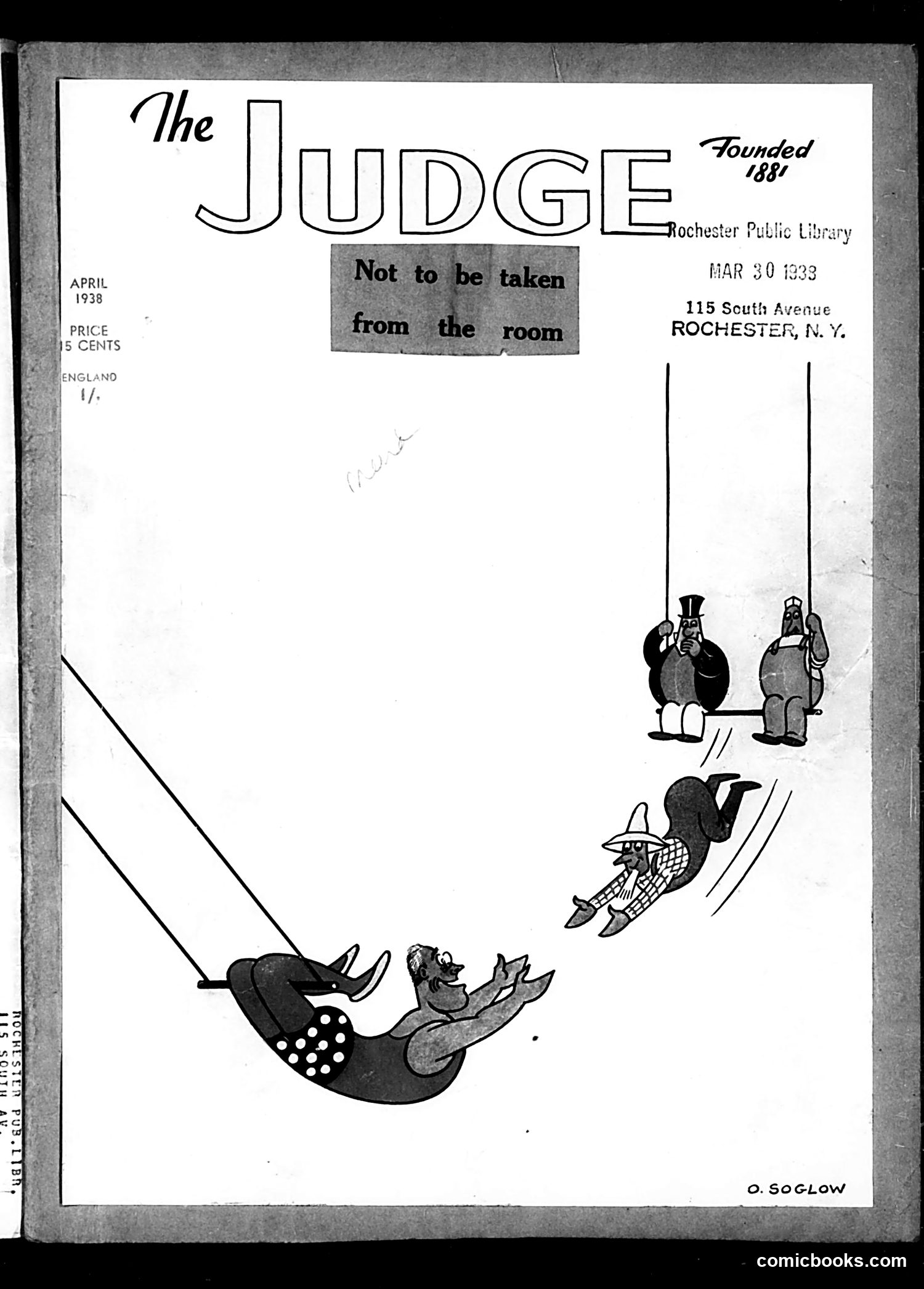
# Analysis of Judge Magazine Cover, April 1938 This cover by O. Soglow depicts a swing scene with caricatured figures. The largest figure at bottom-left appears to be an elephant—the Republican party symbol—swinging while others ride swings above. Given the April 1938 date, this likely comments on American politics during Franklin D. Roosevelt's presidency and New Deal era, when Republicans opposed Democratic policies. The specific political meaning is unclear without additional context, but the composition suggests commentary on power dynamics or shifting political fortunes—who's "up" and who's "down" in the political swing. The satire uses the playground metaphor to critique political maneuvering of the period.

I can see this is a page from *Judge* magazine, but the image quality is too poor for me to make out specific cartoon details, illustrations, or captions clearly enough to identify the figures, events, or satirical points with confidence. The right margin shows fragmentary OCR'd text that's largely illegible in this scan. Without being able to read the captions or see the cartoon artwork distinctly, I cannot reliably identify who is being caricatured, what political or social issue is being referenced, or what the satire intended to convey. To properly analyze this page's meaning for a modern reader, I would need a clearer image or legible text accompanying the illustrations.

# Analysis This page is **primarily an advertisement**, not a political cartoon. It promotes a "$1 a month" life insurance policy from the Postal Life Insurance Company of New York, marketed as affordable coverage for working people aged 21-45. The satirical element is minimal—the ad's framing suggests the policy targets those who "can't afford insurance," positioning it as a solution for financially struggling Americans. The emphasis on "direct by mail" and "no agents" suggests cost-cutting appeals to working-class readers suspicious of middlemen. The coupon at bottom indicates this is a mail-order sales pitch. There are no identifiable political figures or cartoon characters—just a straightforward, if somewhat patronizing, financial services advertisement typical of early 20th-century *Judge* magazine's commercial content.
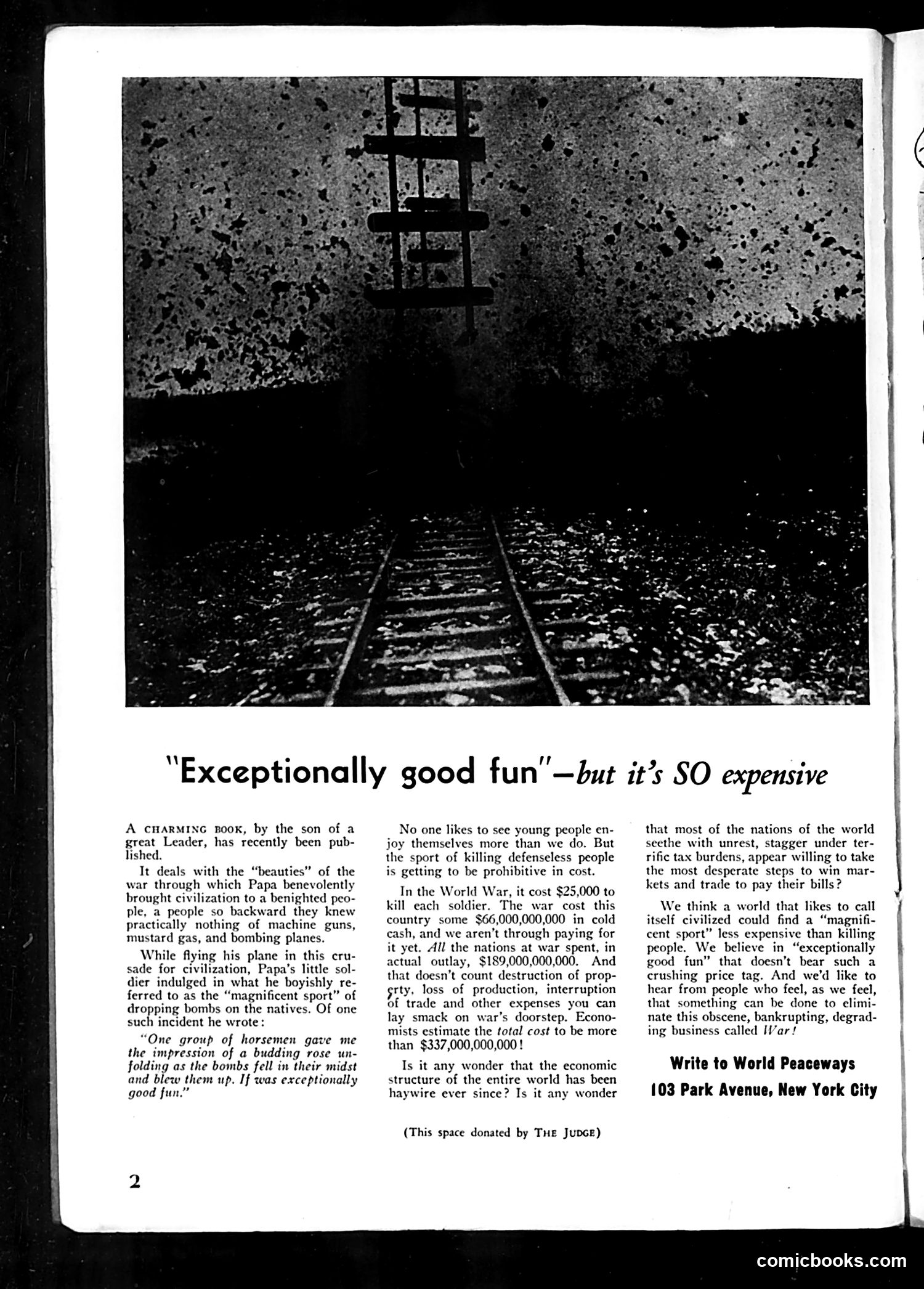
# Analysis This appears to be a World War I-era satirical article from *Judge* magazine criticizing the enormous financial cost of warfare. The image shows railroad tracks leading toward a wooden structure (possibly representing military infrastructure or a gallows), symbolizing the path to destruction. The text argues that while people enjoy entertainment, war's expense is prohibitive. It cites specific figures: $25,000 to kill one soldier, and a total war cost exceeding $337 billion. The author contrasts this with the economic devastation war causes—lost production, interrupted trade, and general societal breakdown. The satire's point: nations call themselves "civilized" while engaging in an obscenely expensive, destructive practice that bankrupts entire economies. The piece advocates for peace through "World Pathways," a peace organization listed at the bottom.
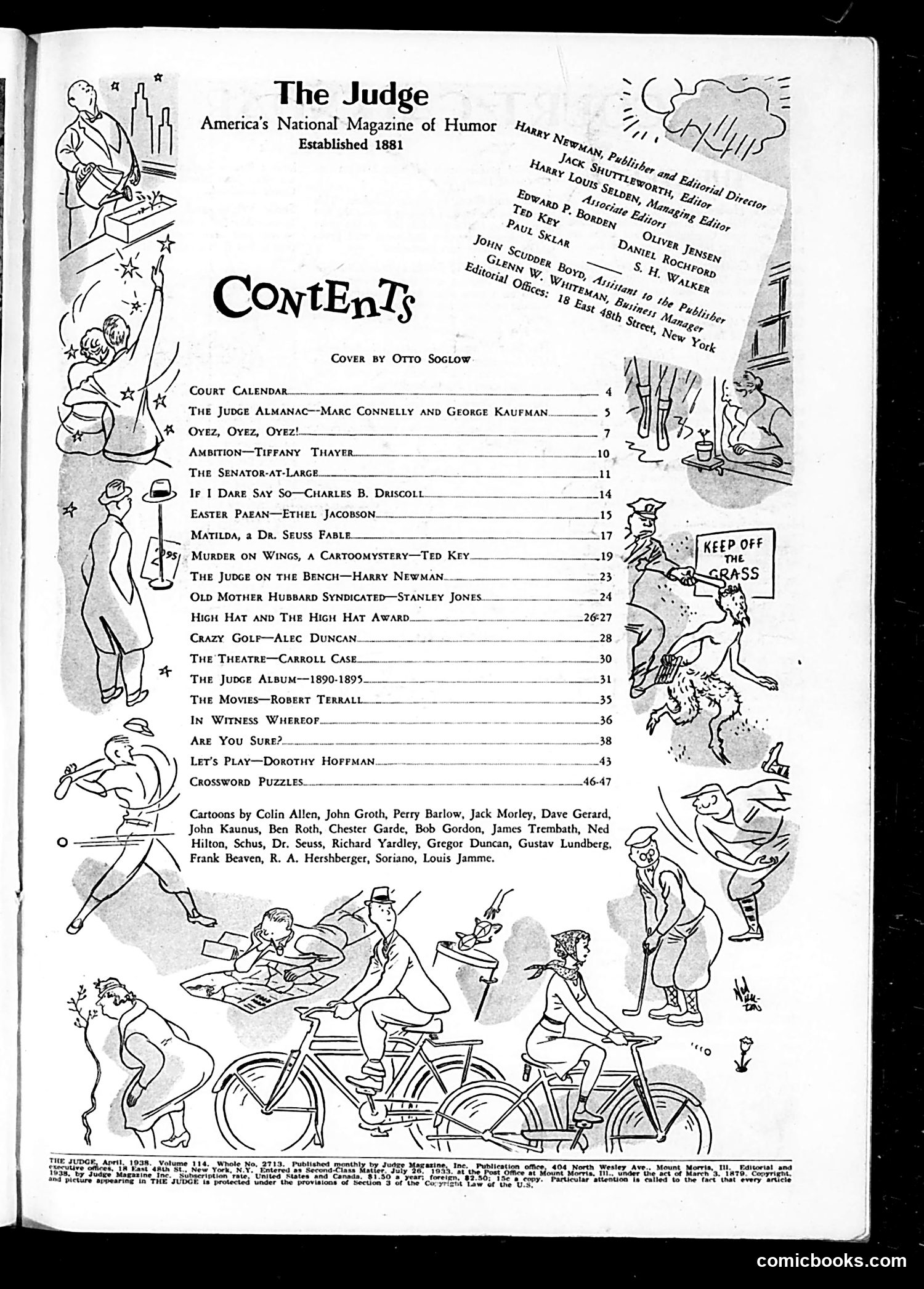
# The Judge Contents Page - April 1898 This is a contents/masthead page from *The Judge*, established 1881 as America's humor magazine. The page lists April 1898 articles and illustrations by various cartoonists. The decorative border illustrations show people engaged in leisure activities—cycling, picnicking, playing—reflecting turn-of-the-century recreation themes. One illustration includes a "Keep Off the Grass" sign, likely a gentle jab at park regulations or social propriety. Notable articles include pieces on political figures like "The Judge on the Bench" (Harry Newman) and social commentary like "Easter Parade" and "High Hat and the High Hat Award." The cartoonists credited include established names like Dr. Seuss (Theodor Geisel), suggesting *The Judge*'s role as a launching pad for American satirical talent. The overall tone reflects genteel, middle-class humor typical of the 1890s.
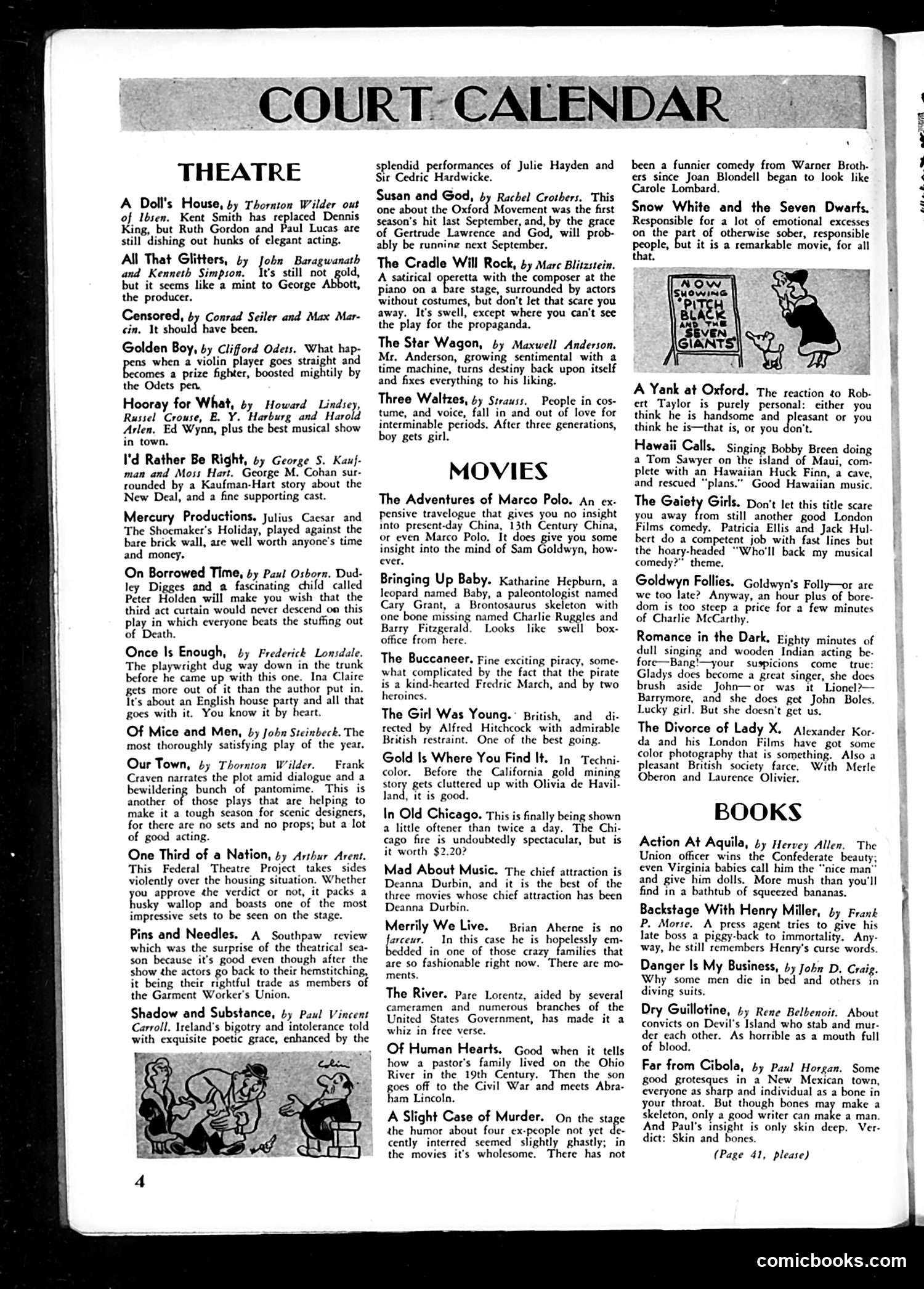
# Court Calendar Page Analysis This page from Judge magazine is primarily a **court calendar and entertainment review section**, not a political cartoon page. It lists current theatrical productions and films with brief critical commentary. The small cartoon visible at bottom left appears to be a generic humorous illustration of people in social situations, unrelated to political commentary. The page's content focuses on entertainment criticism rather than satire—reviewing plays like "A Doll's House" and films like "The Adventures of Marco Polo" and "Bringing Up Baby." The reviews offer modest praise or criticism of contemporary productions. Without clearer political references or identifiable caricatures of specific public figures, this appears to be a standard entertainment/leisure section rather than satirical commentary on current events or politics.
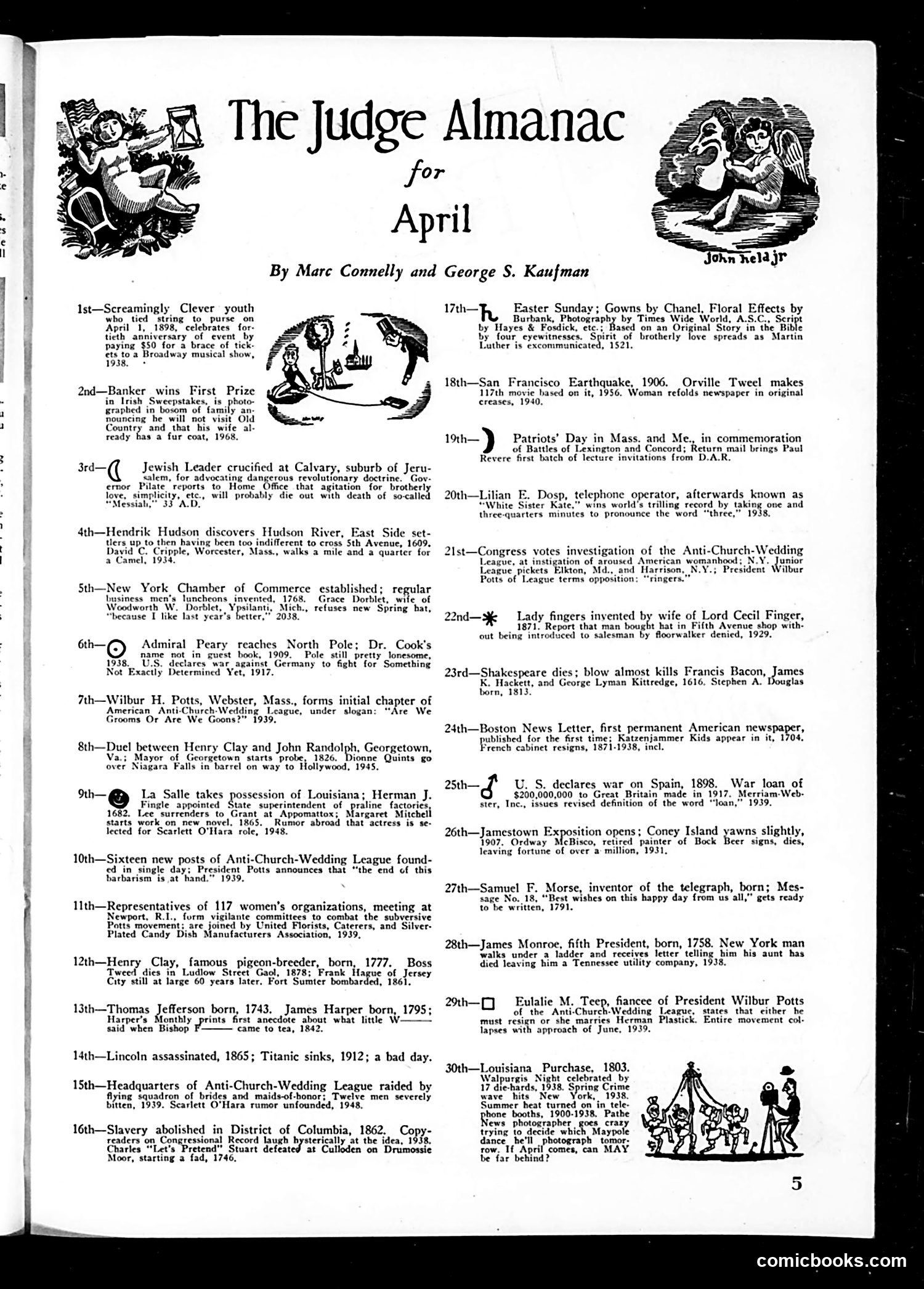
# The Judge Almanac for April This page is primarily an **almanac listing historical events and notable births for each day of April**, rather than a satirical cartoon page. The decorative header features cherubs and classical imagery typical of Judge magazine's ornamental style. The entries mix genuine historical facts (Lincoln's assassination on the 14th, the San Francisco Earthquake of 1906) with **fictional or satirical items** specific to Judge's running gag: the "Anti-Church-Wedding League." This fictitious organization appears repeatedly throughout April—with headquarters raided, investigations launched, and various members' activities chronicled—creating an ongoing joke about opposition to church weddings that modern readers would need to understand Judge's 1918-era satirical context to fully appreciate.
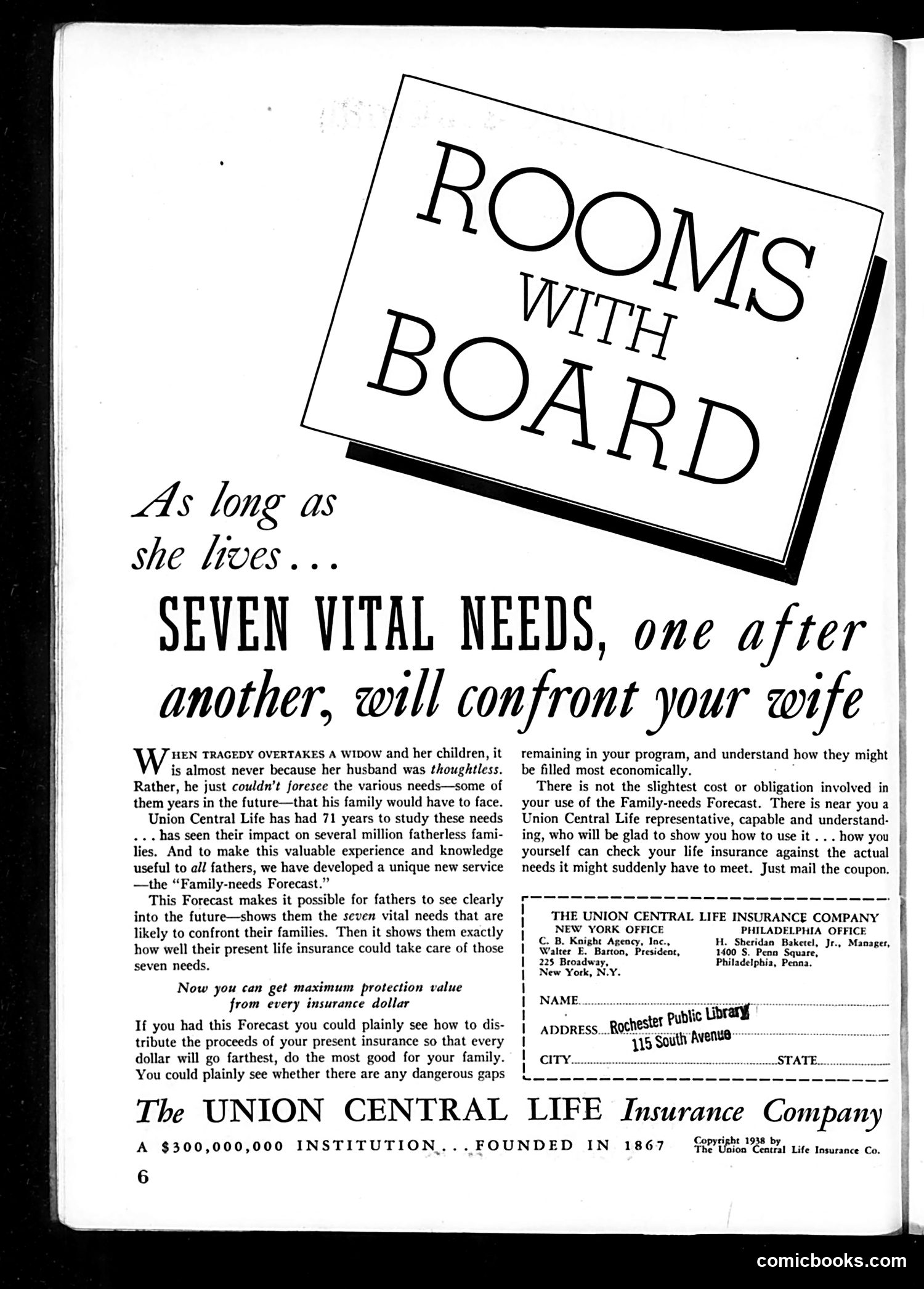
# Analysis This page is **primarily an advertisement**, not satire or political commentary. It's a 1928 insurance ad for Union Central Life Insurance Company promoting their "Family-needs Forecast" service. The ad's pitch targets **widows and bereaved families**, arguing that life insurance proceeds should be carefully distributed across "seven vital needs" rather than squandered. The ad emphasizes that Union Central has "71 years" of actuarial expertise to help calculate proper distributions. The small cartoon at top showing a sign reading "ROOMS WITH BOARD" appears to illustrate the kind of modest living situations widows might face—implying insurance planning prevents financial hardship. This reflects **1920s-30s anxieties about economic security** and widows' vulnerability, but the page is fundamentally a sales pitch, not political satire.
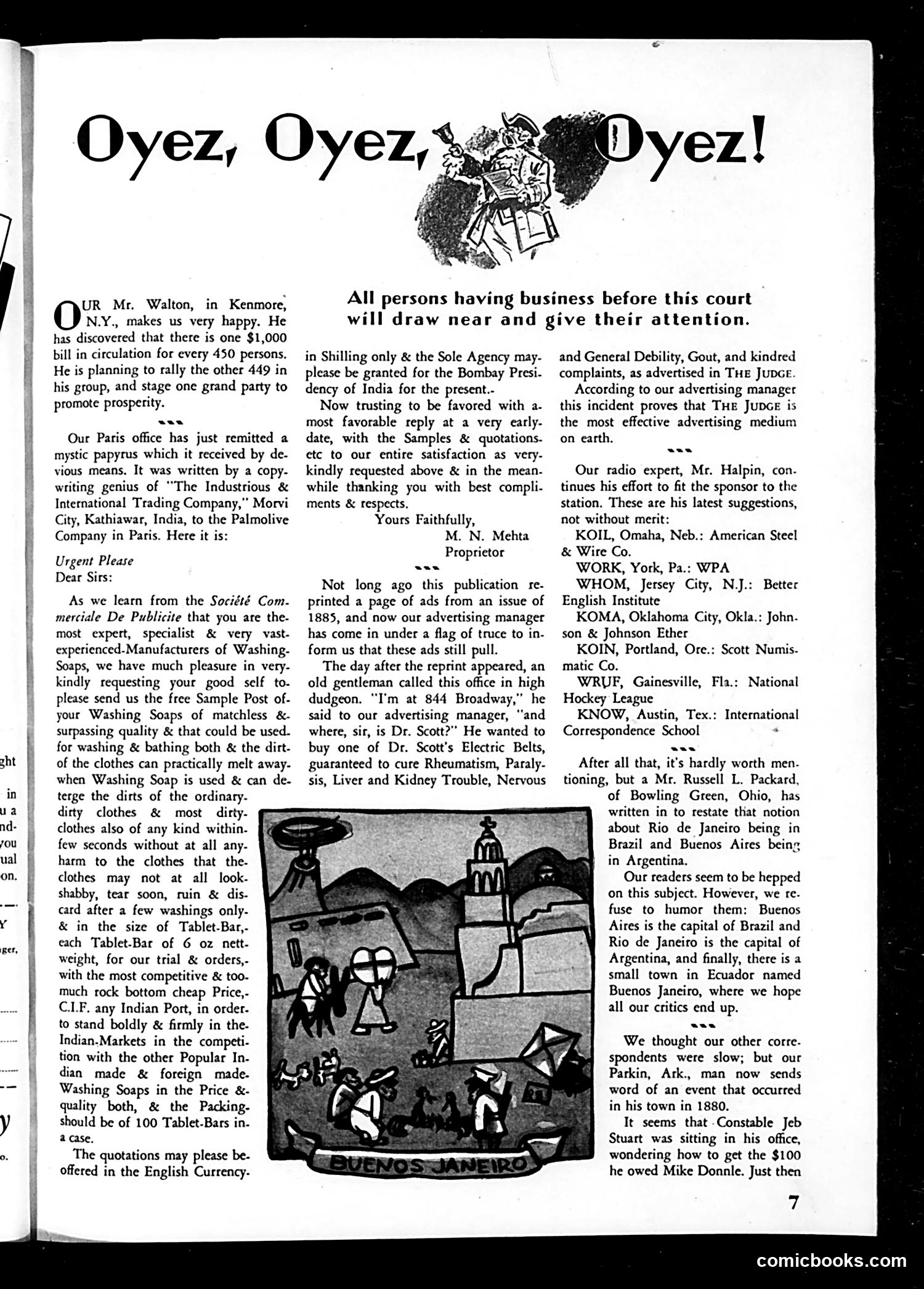
# Analysis of Judge Magazine Page This page is primarily **advertising and business notices** rather than political satire. The main content includes: 1. **"Oyez, Oyez, Oyez!"** - A mock court announcement heading advertising various products and services 2. **The illustration** labeled "BUENOS JANEIRO" depicts a colonial-era South American town scene, likely satirizing geographic confusion or misunderstanding of South American cities. The text references confusion about whether Buenos Aires is in Brazil or Argentina, suggesting contemporary American unfamiliarity with South American geography. 3. **Multiple advertisements** for soap products, wire goods, sporting equipment, and schools mixed throughout the page as "court business" The satire appears gentle—poking fun at American geographic ignorance—rather than sharp political commentary. The page reflects Judge's mixed content model of humor advertisements and product promotions.
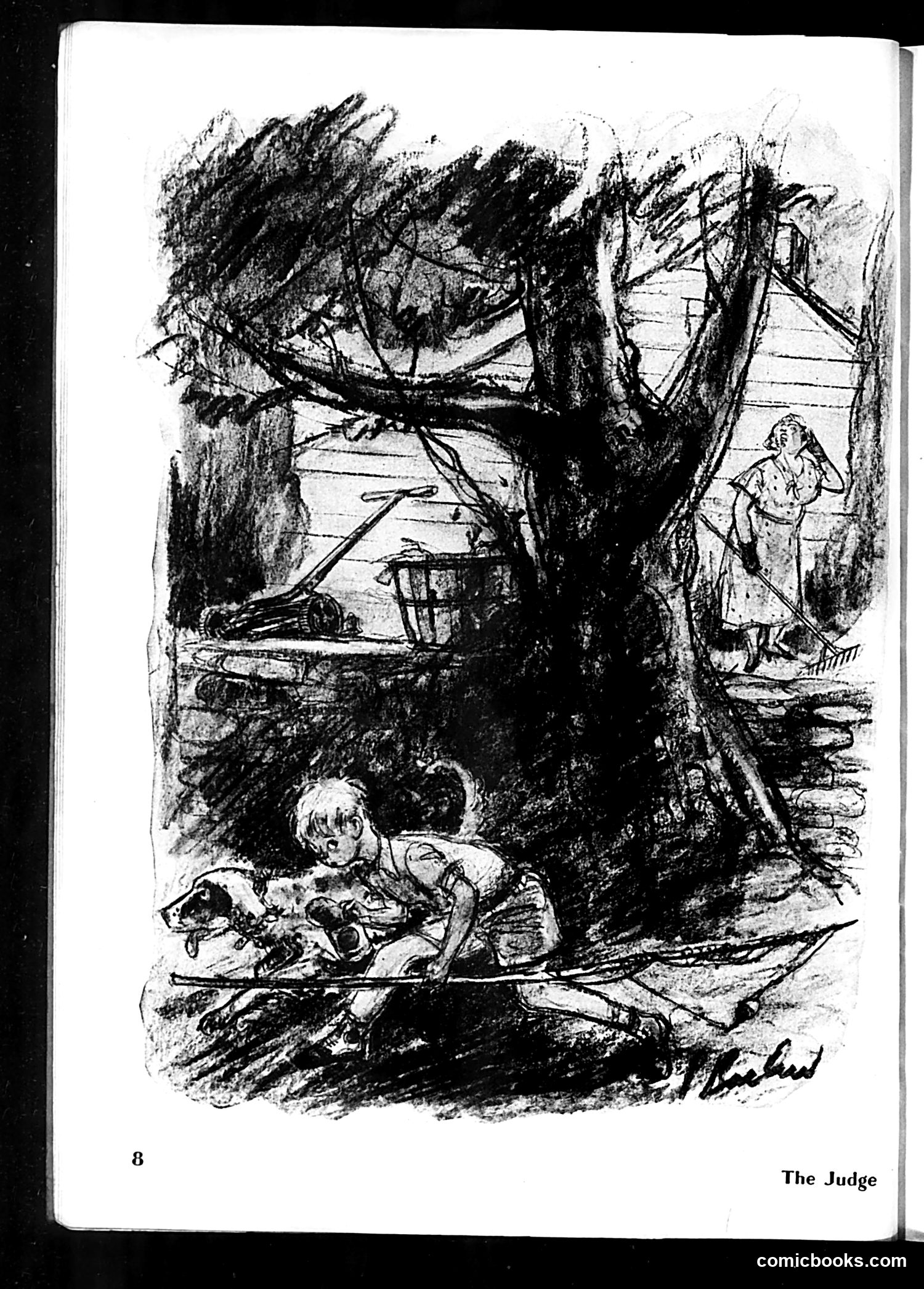
# Analysis This page from *Judge* magazine features an illustration labeled "The Judge" showing a woodland scene. A child and dog appear in the foreground near what looks like a fallen log or tree, with an adult figure visible in the background to the right, near a fence. The sketch style is typical of late 19th or early 20th-century editorial illustration. However, without additional context or caption text beyond the title, the specific satirical meaning remains unclear. The scene could reference a legal or moral judgment situation, given the title, but the exact political or social commentary it conveys is not evident from the image alone. The page number "8" suggests this is from a larger issue of the magazine.
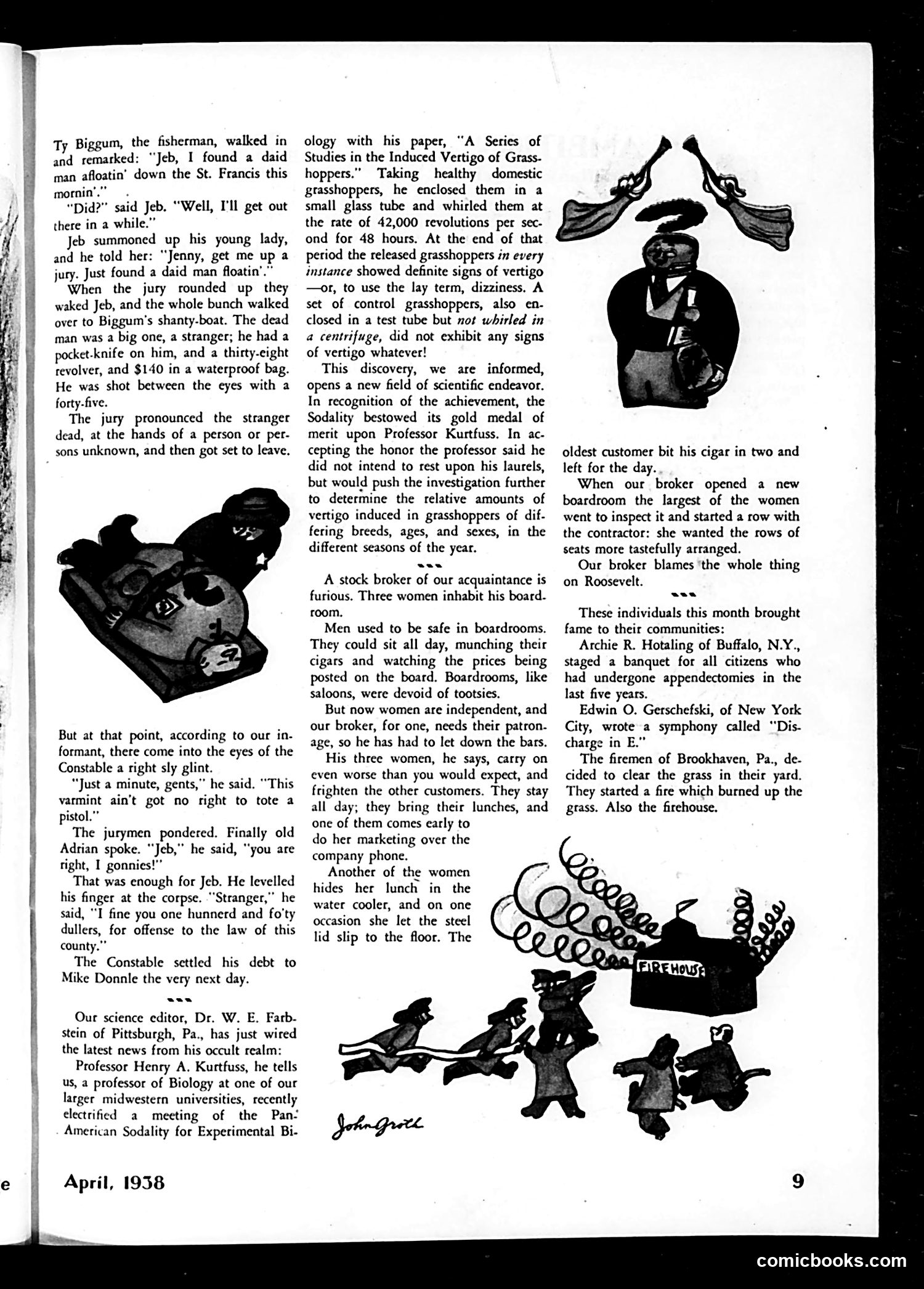
# Judge Magazine, April 1938: Social Satire This page contains two distinct satirical pieces: **1. "The Constable's Justice"** (left column): A folk-tale style story mocking rural/frontier legal corruption. A dead stranger is found with money and weapons, but the constable cleverly fines the *corpse* for illegally carrying a pistol—allowing him to pocket the $140 in "settlement." The satire targets how lawmen exploited their authority for personal gain in isolated communities. **2. "Scientific Absurdity"** (center): Judge ridicules academic pretension by describing Professor Kurtfuss's "groundbreaking" study: spinning grasshoppers at 42,000 revolutions per hour causes dizziness. The satire is obvious—the "discovery" is absurdly self-evident, yet celebrated as if revolutionary. **3. "Women in the Boardroom"** (right): Satirizes changing gender dynamics in 1938. A stock broker resents that independent women now frequent his previously all-male boardroom, conducting marketing calls, eating lunch, and—scandalously—rearranging furniture. The satire mocks both male anxiety about women's workplace presence and their trivial grievances.
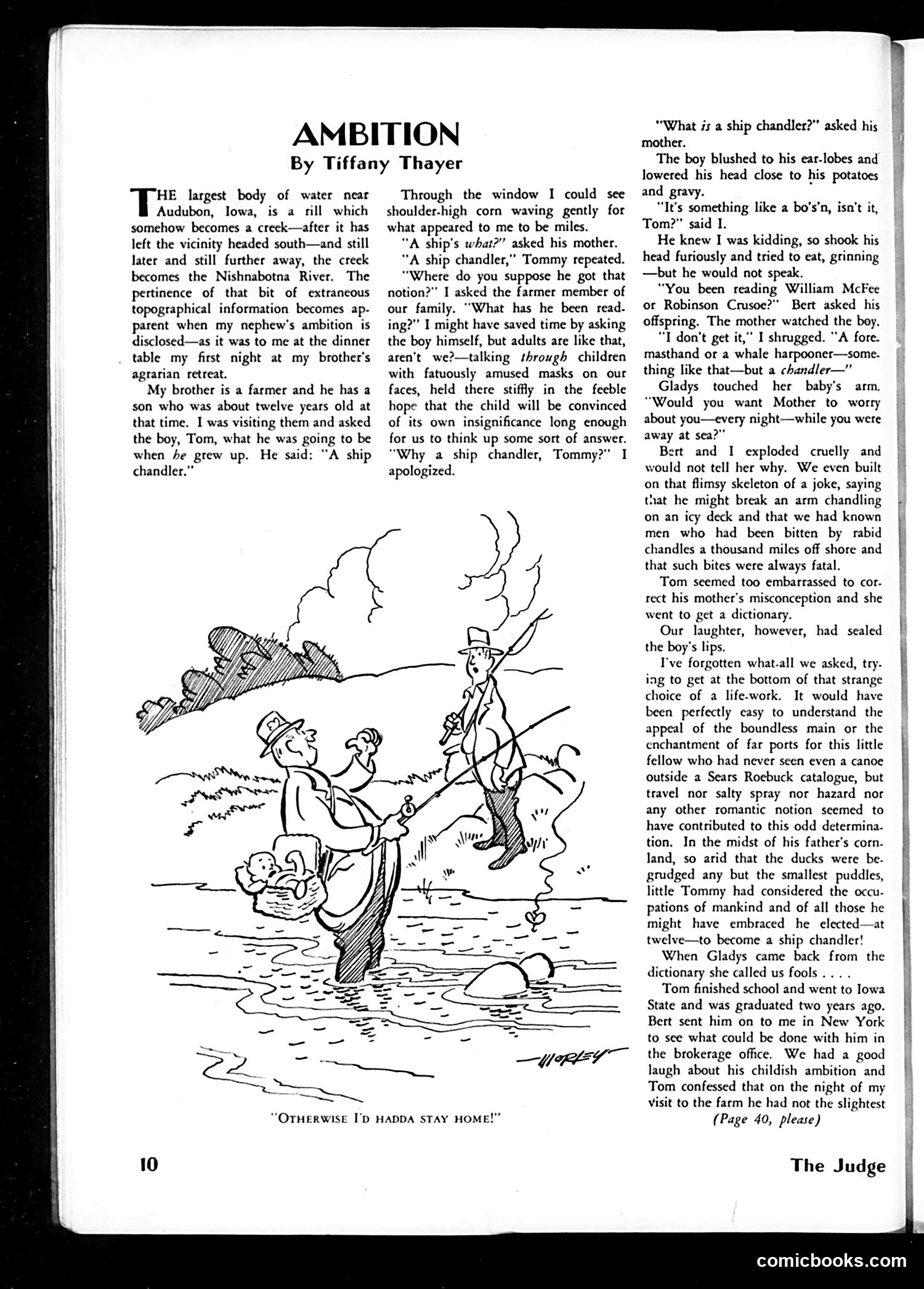
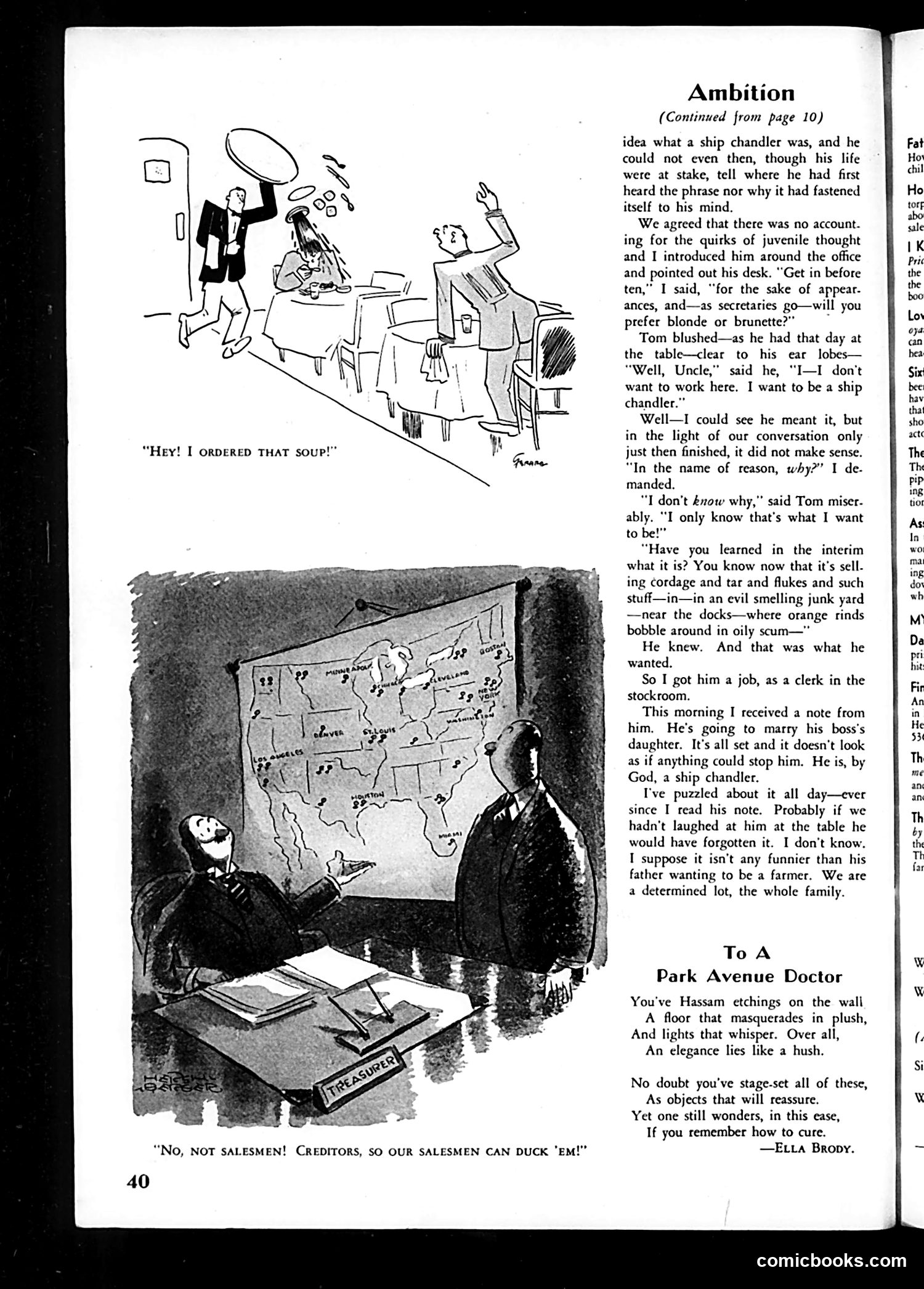
# "Ambition" by Tiffany Thayer This is a humorous short story, not a political cartoon. The joke centers on a rural Iowa boy's bizarre career ambition: becoming a "ship chandler" (a person who supplies provisions to ships). The comedy operates on multiple levels: First, the boy's mother mishears "chandler" as something nautical-related. Second, the adults find it absurd that a twelve-year-old in landlocked Iowa—surrounded only by cornfields and tiny puddles—aspires to a maritime trade he's never encountered. The cartoon illustrates the incongruity: a child daydreaming of seafaring while standing in a muddy farm landscape. The satire gently mocks both the boy's romantic naiveté and the adults' condescension toward children's unexplained ambitions. The story apparently continues on page 40, suggesting the boy's peculiar dream had unexpected consequences later in life.