
Judge, 1938-04 · page 35 of 52
Judge — April 1938 — page 35: what you’re looking at
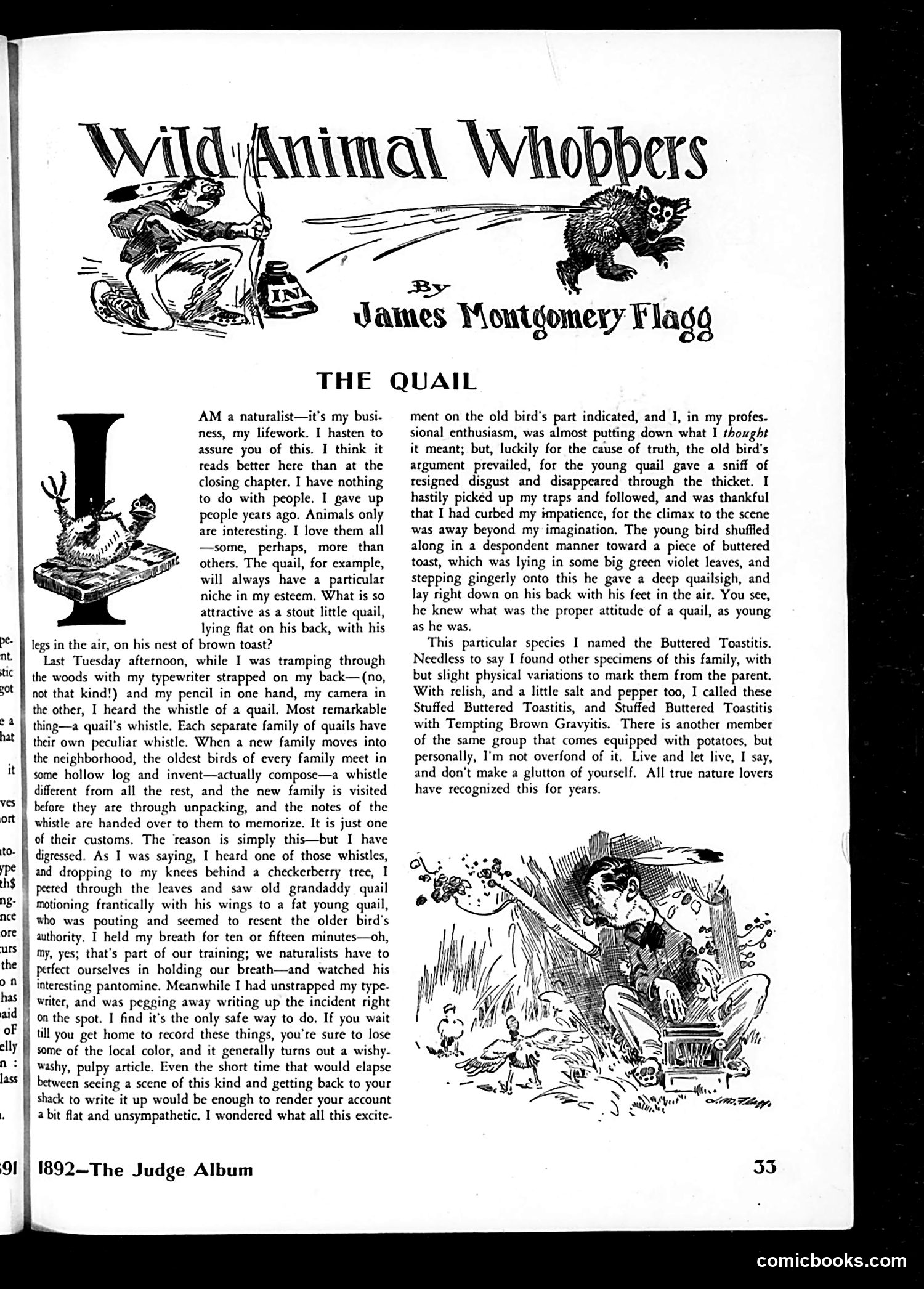
A restored page from Judge, 1938-04. Page through the whole issue in the reader above.
📄 Transcribed text from this page (OCR, searchable)
Machine-transcribed from the original scan — historical spelling and the odd misread are preserved.
Vaines Montgomery Flagg THE QUAIL AM a naturalist—it’s my busi- ness, my lifework. I hasten to assure you of this. I think it reads better here than at the closing chapter. I have nothing to do with people. I gave up people years ago. Animals only are interesting. I love them all —some, perhaps, more than others. The quail, for example, will always have a particular niche in my esteem. What is so attractive as a stout little quail, lying flat on his back, with his legs in the air, on his nest of brown toast? Last Tuesday afternoon, while I was tramping through the woods with my typewriter strapped on my back—(no, not that kind!) and my pencil in one hand, my camera in ) the other, I heard the whistle of a quail. Most remarkable thing—a quail’s whistle. Each separate family of quails have their own peculiar whistle. When a new family moves into the neighborhood, the oldest birds of every family meet in some hollow log and invent—actually compose—a whistle different from all the rest, and the new family is visited }) before they are through unpacking, and the notes of the whistle are handed over to them to memorize. It is just one of their customs. The ‘reason is simply this—but I have digressed. As I was saying, I heard one of those whistles, and dropping to my knees behind a checkerberry tree, I | peered through the leaves and saw old grandaddy quail motioning frantically with his wings to a fat young quail, who was pouting and seemed to resent the older bird's authority. I held my breath for ten or fifteen minutes—oh, my, yes; that's part of our training; we naturalists have to perfect ourselves in holding our breath—and watched his interesting pantomine. Meanwhile I had unstrapped my type- writer, and was pegging away writing up the incident right {} on the spot. I find it's the only safe way to do. If you wait till you get home to record these things, you're sure to lose Y } some of the local color, and it generally turns out a wishy- washy, pulpy article. Even the short time that would elapse een seeing a scene of this kind and getting back to your ) shack to write it up would be enough to render your account a bit flat and unsympathetic. I wondered what all this excite- | 1892—The Judge Album ment on the old bird's part indicated, and I, in my profes. sional enthusiasm, was almost putting down what I thought it meant; but, luckily for the cause of truth, the old bird's argument prevailed, for the young quail gave a sniff of resigned disgust and disappeared through the thicket. I hastily picked up my traps and followed, and was thankful that I had curbed my impatience, for the climax to the scene was away beyond my imagination. The young bird shuffled along in a despondent manner toward a piece of buttered toast, which was lying in some big green violet leaves, and stepping gingerly onto this he gave a deep quailsigh, and lay right down on his back with his feet in the air. You see, he knew what was the proper attitude of a quail, as young as he was. This particular species 1 named the Buttered Toastitis. Needless to say I found other specimens of this family, with but slight physical variations to mark them from the parent. With relish, and a little salt and pepper too, I called these Stuffed Buttered Toastitis, and Stuffed Buttered Toastitis with Tempting Brown Gravyitis. There is another member of the same group that comes equipped with potatoes, but personally, I'm not overfond of it. Live and let live, I say, and don’t make a glutton of yourself. All true nature lovers have recognized this for years. comicbooks.com