
Judge, 1938-04 · page 6 of 52
Judge — April 1938 — page 6: what you’re looking at
What you’re looking at
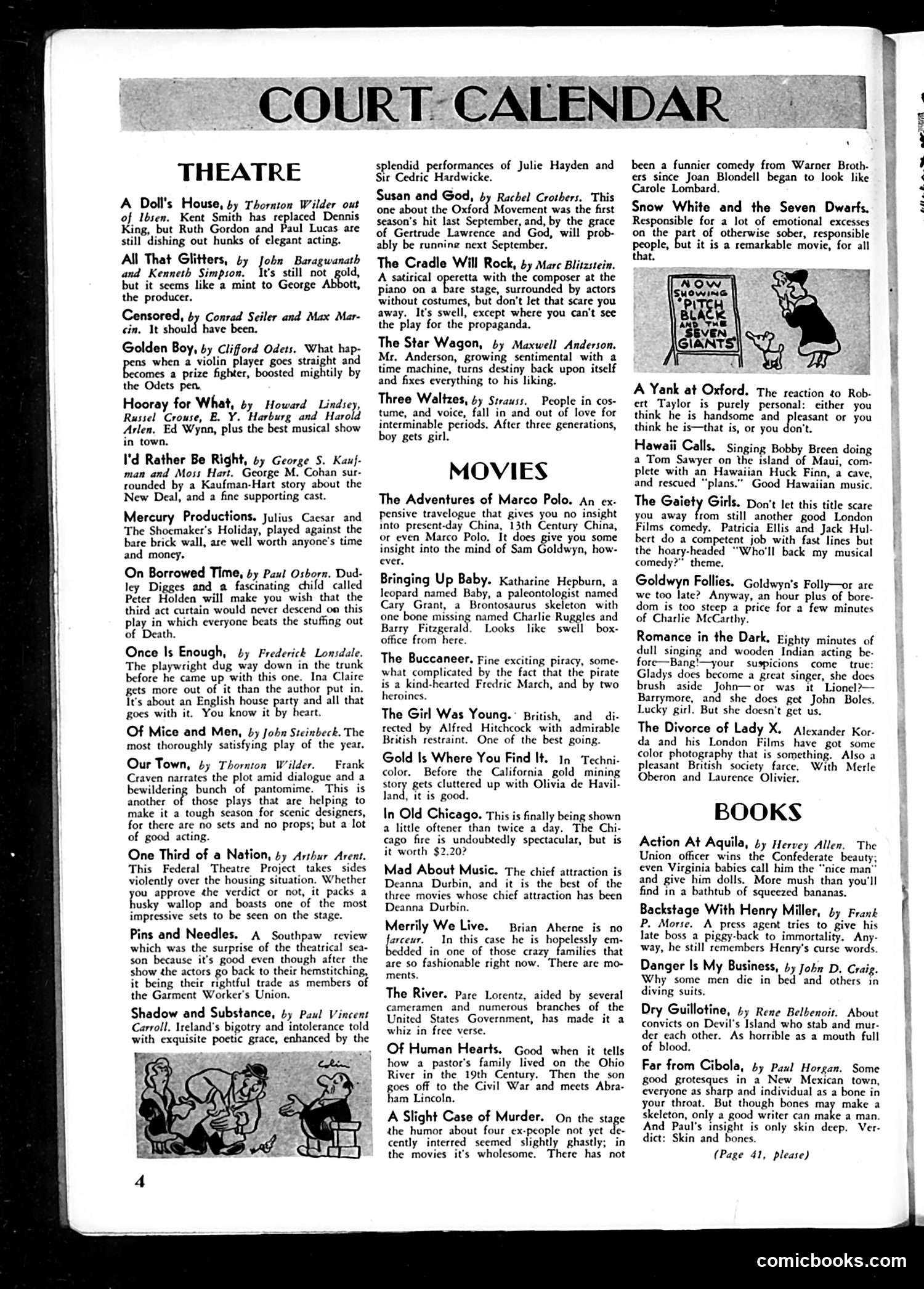
# Court Calendar Page Analysis This page from Judge magazine is primarily a **court calendar and entertainment review section**, not a political cartoon page. It lists current theatrical productions and films with brief critical commentary. The small cartoon visible at bottom left appears to be a generic humorous illustration of people in social situations, unrelated to political commentary. The page's content focuses on entertainment criticism rather than satire—reviewing plays like "A Doll's House" and films like "The Adventures of Marco Polo" and "Bringing Up Baby." The reviews offer modest praise or criticism of contemporary productions. Without clearer political references or identifiable caricatures of specific public figures, this appears to be a standard entertainment/leisure section rather than satirical commentary on current events or politics.
📄 Transcribed text from this page (OCR, searchable)
Machine-transcribed from the original scan — historical spelling and the odd misread are preserved.
THEATRE A Doll’s House, 4y Thornton Wilder out of Ibsen. Kent Smith has replaced Dennis King, but Ruth Gordon and Paul Lucas are still dishing out hunks of elegant acting. All That Glitters, by obn Baragwanath and Kenneth Simpson. W's still not gold, but it seems like a mint to George tt, the producer. Censored, by Conrad Seiler and Max Mar- cin. It should have been. Golden Boy, by Clifford Odets. What hap- ns when a violin player goes straight and Fescoes a prize fighter, boosted mightily by the Odets pen. Hooray for What, by Howard Lindsey, Russel Crouse, B. Y. Harburg and Harold Arlen. Ed Wynn, plus the best musical show in town. I'd Rather Be Right, by George S. Kauj- man and Moss Hart. George M. Cohan sur- rounded by a Kaufman-Hart story about the New Deal, and a fine supporting cast. Mercury Productions. Julius Caesar and The Shoemaker’s Holiday, played against the bare brick wall, are well worth anyone's time and money. On Borrowed Time, by Pau! Osborn. Dud- ley Digges and a fascinating child called Peter Holden will make you wish that the third act curtain would never descend on this play in which everyone beats the stuffing out of Death. Once Is Enough, by Frederick Lonsdale. The playwright dug way down in the trunk before he came up with this one. Ina Claire gets more out of it than the author put in. It’s about an English house party and all that goes with it. You know it by heart. Of Mice and Men, by Jobn Steinbeck. The most thoroughly satisfying play of the year. Our Town, by Thornton Wilder. Frank Craven narrates the plot amid dialogue and a bewildering bunch of pantomime. This is another of those plays that are helping to make it a tough season for scenic designers, for there are no sets and no props; but a lot of good acting. One Third of a Nation, by Arthur Arent. This Federal Theatre Project takes sides violently over the housing situation, Whether you approve the verdict or not, it packs a husky wallop and boasts one of the most impressive sets to be seen on the stage. Pins and Needles. A Southpaw review which was the surprise of the theatrical sea- son because it's good even though after the show the actors go back to their hemstitching, it being their rightful trade as members of the Garment Worker's Union. Shadow and Substance, by Pau! Vincent Carroll. Ireland's bigotry and intolerance told with exquisite poetic grace, enhanced by the splendid performances of Julie Hayden and Sir Cedric Hardwicke. Susan and God, by Rachel Crothers. This one about the Oxford Movement was the first season's hit last September, and, by the grace of Gertrude Lawrence and God, will prob- ably be running next September. The Cradle Will Rock, by Marc Blitzstein. A satirical operetta with the composer at the piano on a bare stage, surrounded by actors without costumes, but don’t let that scare you away. It’s swell, except where you can't see the play for the propaganda, The Star Wagon, by Maxwell Anderson. Mr. Anderson, growing sentimental with a time machine, turns destiny back upon itself and fixes everything to his liking. Three Waltzes, by Strauss. People in cos- tume, and voice, fall in and out of love for interminable periods. After three generations, boy gets girl. MOVIES The Adventures of Marco Polo. An ex- pensive travelogue that gives you no insight into present-day China, 13th Century China, or even Marco Polo, It does give you some insight into the mind of Sam Goldwyn, how- ever. Bringing Up Baby. Katharine Hepburn, a leopard named Baby, a paleontologist named Cary Grant, a Brontosaurus skeleton with one bone missing named Charlie Ruggles and Barry Fitzgerald, Looks like. swell box- office from here. The Buccaneer. Fine exciting piracy, some- what complicated by the fact that the pirate is a kind-hearted Fredric March, and by two heroines. The Girl Was Young.° British, and di- rected by Alfred Hitchcock with admirable British restraint. One of the best going. Gold Is Where You Find It. In ‘Techni- color. Before the California gold mining joy gets cluttered up with Olivia de Havil- land, it is good. In Old Chicago. This is finally being shown a little oftener than twice a day. The Chi- cago fire is undoubtedly spectacular, but is it worth $2.20? Mad About Music. The chief attraction is Deanna Durbin, and it is the best of the three movies whose chief attraction has been Deanna Durbin. Merrily We Live. Brian Aherne is no farceur. In this case he is hopelessly em- edded in one of those crazy families that are so fashionable right now. There are mo- ments, The River. Pare Lorentz, aided by several cameramen and_numerous branches of the United States Government, has made it a whiz in free verse. Of Human Hearts. Good when it tells how a pastor's family lived on the Ohio River in the 19th Century. Then the son goes off to the Civil War and meets Abra- ham Lincoln. A Slight Case of Murder. On the stage the humor about four ex-people not yet de- cently interred seemed slightly ghastly; in the movies it's wholesome. There has not been a funnier comedy from Warner Broth- ers since Joan Blondell began to look like Carole Lombard. Snow White and the Seven Dwarfs. Responsible for a lot of emotional excesses on the part of otherwise sober, responsible people, ut it is a remarkable movie, for all that, A Yank at Oxford. The reaction to Rob- ert Taylor is purely personal: either you think he is handsome and pleasant or you think he is—that is, or you don't. Hawaii Calls. singing Bobby Breen doing a Tom Sawyer on the island of Maui, com. plete with an Hawaiian Huck Finn, a cave, and rescued “plans.” Good Hawaiian music. The Gaiety Girls. Don't let this title scare you away from still another good London Films comedy. Patricia Ellis and Jack Hul- bert do a competent job with fast lines but the hoary-headed “Who'll back my musical comedy?” theme, Goldwyn Follies. Goldwyn's Folly—or are we too late? Anyway, an hour plus of bore- dom is too steep a price for a few minutes of Charlie McCarthy. Romance in the Dark. Eighty minutes of dull singing and wooden Indian acting be- fore—Bang!—your suspicions come true: Gladys does become a great singer, she docs brush aside John—or was it Lionel?2— Barrymore, and she does get John Boles. Lucky girl. But she doesn’t get us. The Divorce of Lady X. Alexander Kor- da and his London Films have got some color photography that is something. Also a pleasant British society farce. With Merle Oberon and Laurence Olivier, BOOKS Action At Aquila, by Hervey Allen. The Union officer wins the Confederate beauty; even Virginia babies call him the “nice man” and give him dolls. More mush than you'll find in a bathtub of squeezed bananas. Backstage With Henry Miller, by Frank P. Morse. A press agent tries to give his late boss a piggy-back to immortality. Any- way, he still remembers Henry's curse words. Danger Is My Business, by John D. Craig. Why some men die in bed and others in diving suits. Dry Guillotine, 4) Rene Belbenoit. About convicts on Devil's Island who stab and mur- der each other. As horrible as a mouth full of blood Far from Cibola, by Pau! Horgan. Some good grotesques in a New Mexican town, everyone as sharp and individual as a bone in your throat. But though bones may make a skeleton, only a good writer can make aman. And Paul's insight is only skin deep. Ver- dict: Skin and bones. (Page 41, please) comicbooks.com