
Judge, 1938-04 · page 12 of 52
Judge — April 1938 — page 12: what you’re looking at
What you’re looking at
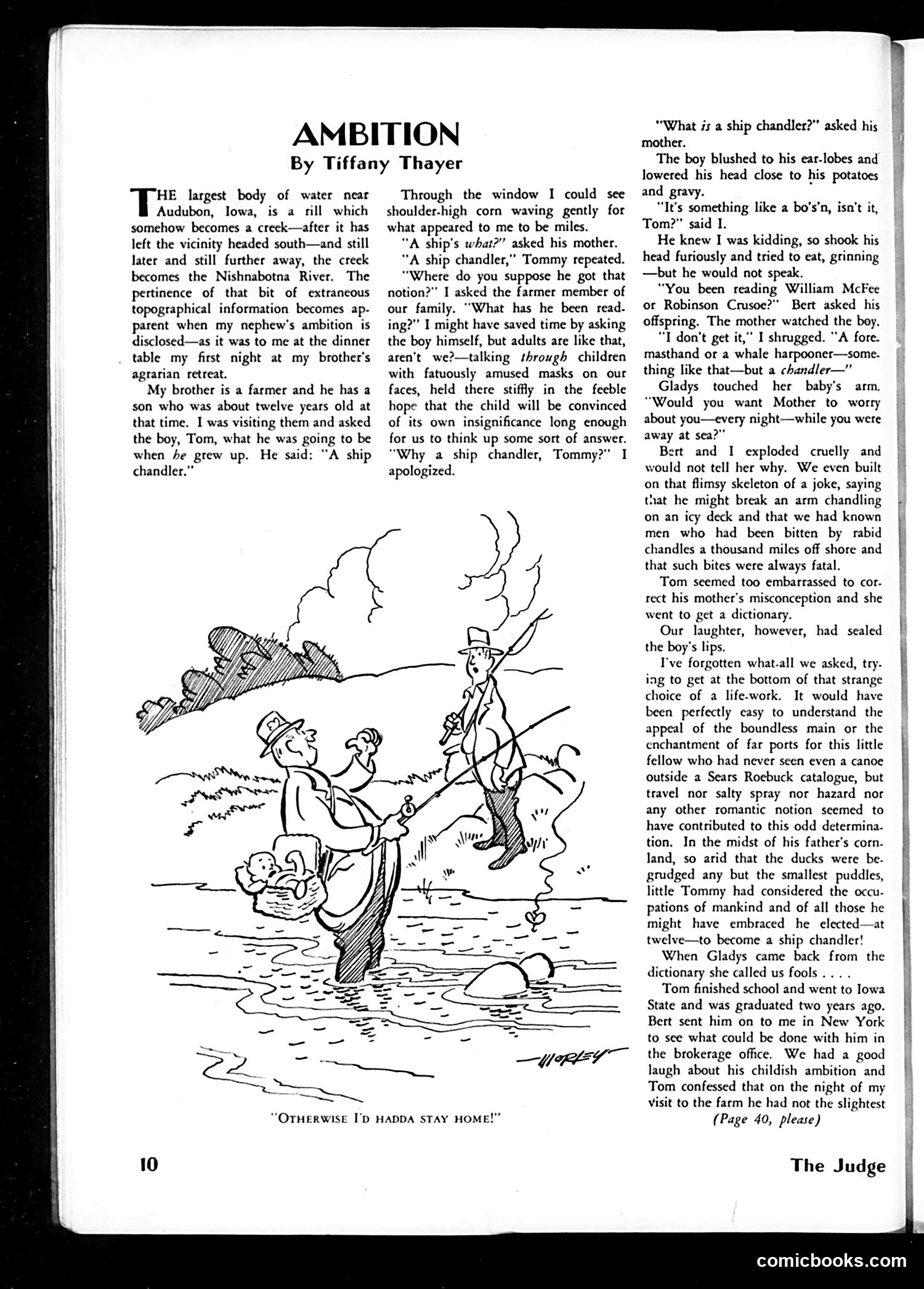
# "Ambition" by Tiffany Thayer This is a humorous short story, not a political cartoon. The joke centers on a rural Iowa boy's bizarre career ambition: becoming a "ship chandler" (a person who supplies provisions to ships). The comedy operates on multiple levels: First, the boy's mother mishears "chandler" as something nautical-related. Second, the adults find it absurd that a twelve-year-old in landlocked Iowa—surrounded only by cornfields and tiny puddles—aspires to a maritime trade he's never encountered. The cartoon illustrates the incongruity: a child daydreaming of seafaring while standing in a muddy farm landscape. The satire gently mocks both the boy's romantic naiveté and the adults' condescension toward children's unexplained ambitions. The story apparently continues on page 40, suggesting the boy's peculiar dream had unexpected consequences later in life.
📄 Transcribed text from this page (OCR, searchable)
Machine-transcribed from the original scan — historical spelling and the odd misread are preserved.
AMBITION By Tiffany Thayer HE largest body of water near Audubon, Iowa, is a rill which somehow becomes a creck—after it has left the vicinity headed south—and still later and still further away, the creek becomes the Nishnabotna River. The pertinence of that bit of extraneous topographical information becomes ap- parent when my nephew's ambition is disclosed—as it was to me at the dinner table my first night at my brother's agrarian retreat. My brother is a farmer and he has a son who was about twelve years old at that time. I was visiting them and asked the boy, Tom, what he was going to be when he grew up. He said: “A ship chandler,” Through the window I could see shoulder-high corn waving gently for what appeared to me to be miles. “A ship's what?” asked his mother. “A ship chandler,” Tommy repeated. “Where do you suppose he got that notion?” I asked the farmer member of our family. “What has he been read- ing?” I might have saved time by asking the boy himself, but adults are like that, aren't we?—talking through children with fatuously amused masks on our faces, held there stiffly in the feeble hope that the child will be convinced of its own insignificance long enough for us to think up some sort of answer. “Why a ship chandler, Tommy?” I apologized. “OTHERWISE I'D HADDA STAY HOME!” “What is a ship chandler?” asked his mother. The boy blushed to his ear-lobes and lowered his head close to his potatoes and gravy. “It's something like a bo’s'n, isn’t it, Tom?” said I. He knew I was kidding, so shook his head furiously and tried to eat, grinning —but he would not speak. “You been reading William McFee or Robinson Crusoe?” Bert asked his offspring. The mother watched the boy. “I don’t get it,” I shrugged. “A fore. masthand or a whale harpooner—some. thing like that—but a chandler—” Gladys touched her baby’s arm. “Would you want Mother to worry about you—every night—while you were away at sea?” Bert and 1 exploded cruelly and would not tell her why. We even built on that flimsy skeleton of a joke, saying that he might break an arm chandling on an icy deck and that we had known men who had been bitten by rabid chandles a thousand miles off shore and that such bites were always fatal. Tom seemed too embarrassed to cor- rect his mother’s misconception and she went to get a dictionary. Our laughter, however, had sealed the boy's lips. I've forgotten what-all we asked, try- ing to get at the bottom of that strange choice of a life-work. It would have been perfectly casy to understand the appeal of the boundless main or the enchantment of far ports for this little fellow who had never seen even a canoe outside a Sears Roebuck catalogue, but travel nor salty spray nor hazard nor any other romantic notion seemed to have contributed to this odd determina. tion, In the midst of his father’s corn. land, so arid that the ducks were be- grudged any but the smallest puddles, little Tommy had considered the occu- pations of mankind and of all those he might have embraced he elected—at twelve—to become a ship chandler! When Gladys came back from the Tom finished school and went to Iowa State and was graduated two years ago. Bert sent him on to me in New York to see what could be done with him in the brokerage office. We had a good laugh about his childish ambition and Tom confessed that on the night of my visit to the farm he had not the slightest (Page 40, please) The Judge | comicbooks.com