
Judge, 1938-04 · page 28 of 52
Judge — April 1938 — page 28: what you’re looking at
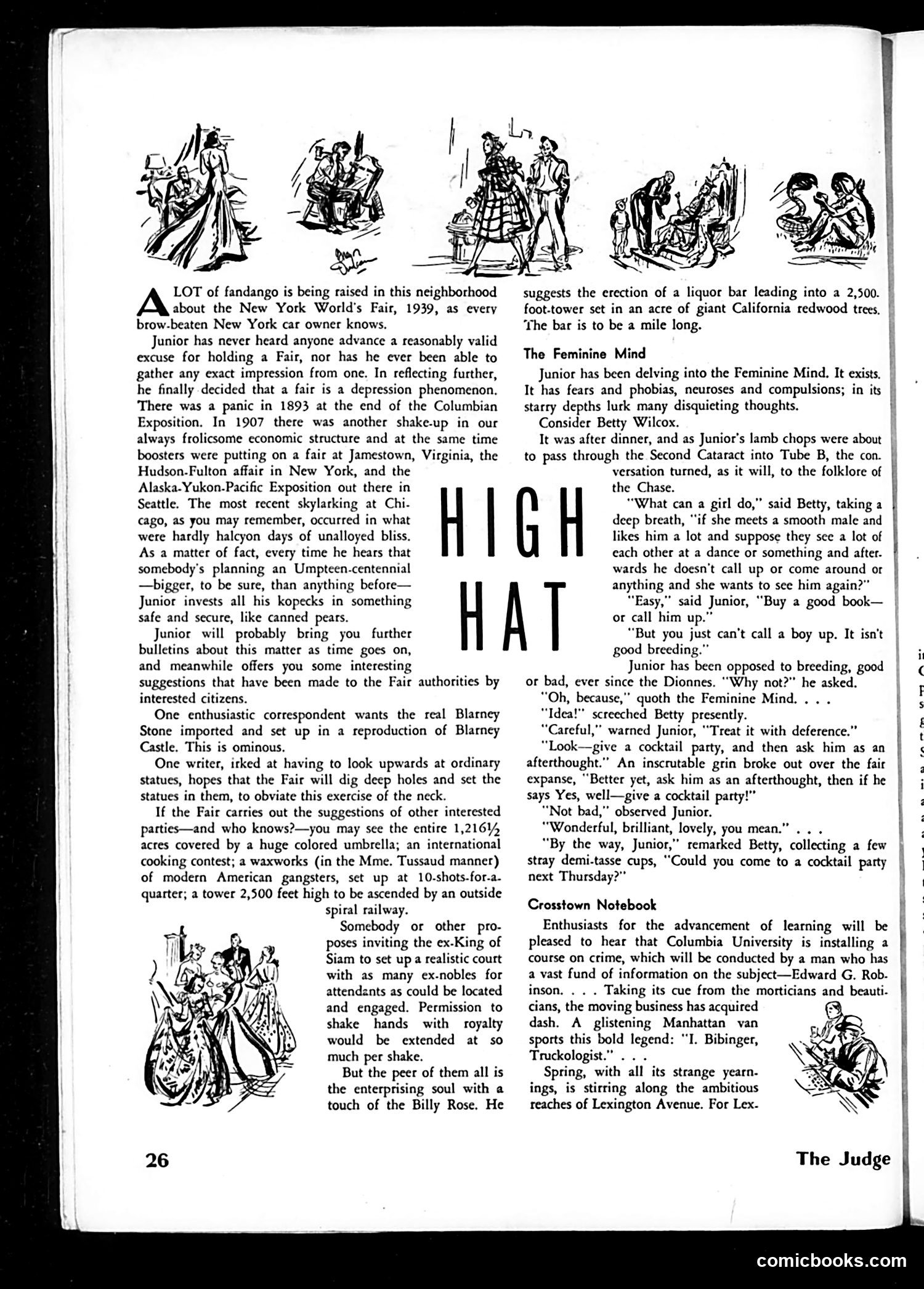
A restored page from Judge, 1938-04. Page through the whole issue in the reader above.
📄 Transcribed text from this page (OCR, searchable)
Machine-transcribed from the original scan — historical spelling and the odd misread are preserved.
LOT of fandango is being raised in this neighborhood Ane the New York World’s Fair, 1939, as every brow-beaten New York car owner knows. Junior has never heard anyone advance a reasonably valid excuse for holding a Fair, nor has he ever been able to gather any exact impression from one. In reflecting further, he finally decided that a fair is a depression phenomenon. There was a panic in 1893 at the end of the Columbian Exposition. In 1907 there was another shake-up in our always frolicsome economic structure and at the same time boosters were putting on a fair at Jamestown, Virginia, the Hudson-Fulton affair in New York, and the Alaska-Yukon-Pacific Exposition out there in Seattle. The most recent skylarking at Chi- cago, as you may remember, occurred in what were hardly halcyon days of unalloyed bliss. As a matter of fact, every time he hears that somebody's planning an Umpteen-centennial —hbigger, to be sure, than anything before— Junior invests all his kopecks in something safe and secure, like canned pears. Junior will probably bring you further bulletins about this matter as time goes on, and meanwhile offers you some interesting suggestions that have been made to the Fair authorities by interested citizens. One enthusiastic correspondent wants the real Blarney Stone imported and set up in a reproduction of Blarney Castle. This is ominous. One writer, irked at having to look upwards at ordinary statues, hopes that the Fair will dig deep holes and set the statues in them, to obviate this exercise of the neck. If the Fair carries out the suggestions of other interested parties—and who knows?—you may see the entire 1,21614 acres covered by a huge colored umbrella; an international cooking contest; a waxworks (in the Mme. Tussaud manner) of modern American gangsters, set up at 10-shots-for-a- quarter; a tower 2,500 feet high to be ascended by an outside spiral railway. Somebody or other pro- poses inviting the ex-King of Siam to set up a realistic court with as many ex-nobles for attendants as could be located and engaged. Permission to shake hands with royalty would be extended at so much per shake. But the peer of them all is the enterprising soul with a touch of the Billy Rose. He suggests the erection of a liquor bar leading into a 2,500. foot-tower set in an acre of giant California redwood trees, ‘The bar is to be a mile long. The Feminine Mind Junior has been delving into the Feminine Mind. It exists, It has fears and phobias, neuroses and compulsions; in its starry depths lurk many disquieting thoughts. Consider Betty Wilcox. Tt was after dinner, and as Junior's lamb chops were about | to pass through the Second Cataract into Tube B, the con. versation turned, as it will, to the folklore of the Chase. “What can a girl do,” said Betty, taking a deep breath, “if she meets a smooth male and likes him a lot and suppose they see a lot of cach other at a dance or something and after. wards he doesn’t call up or come around or anything and she wants to see him again?” “Easy,” said Junior, “Buy a good book— or call him up.” “But you just can’t call a boy up. It isn't good breeding.” Junior has been opposed to breeding, good or bad, ever since the Dionnes. “Why not?” he asked. “Oh, because,"’ quoth the Feminine Mind. . . . “Idea!” screeched Betty presently. “Careful,” warned Junior, “Treat it with deference.” “Look—give a cocktail party, and then ask him as an afterthought.” An inscrutable grin broke out over the fair expanse, “Better yet, ask him as an afterthought, then if he says Yes, well—give a cocktail party!” “Not bad,” observed Junior. “Wonderful, brilliant, lovely, you mean.” . . . “By the way, Junior,” remarked Betty, collecting a few stray demi-tasse cups, “Could you come to a cocktail party next Thursday?” Crosstown Notebook Enthusiasts for the advancement of learning will be pleased to hear that Columbia University is installing a course on crime, which will be conducted by a man who has a vast fund of information on the subject—Edward G. Rob. inson. . . . Taking its cue from the morticians and beauti- cians, the moving business has acquired dash. A glistening Manhattan van sports this bold legend: “I. Bibinger, Truckologist.” . . . Spring, with all its strange yearn- ings, is stirring along the ambitious reaches of Lexington Avenue. For Lex- The Judge | comicbooks.com