
Judge, 1938-04 · page 27 of 52
Judge — April 1938 — page 27: what you’re looking at
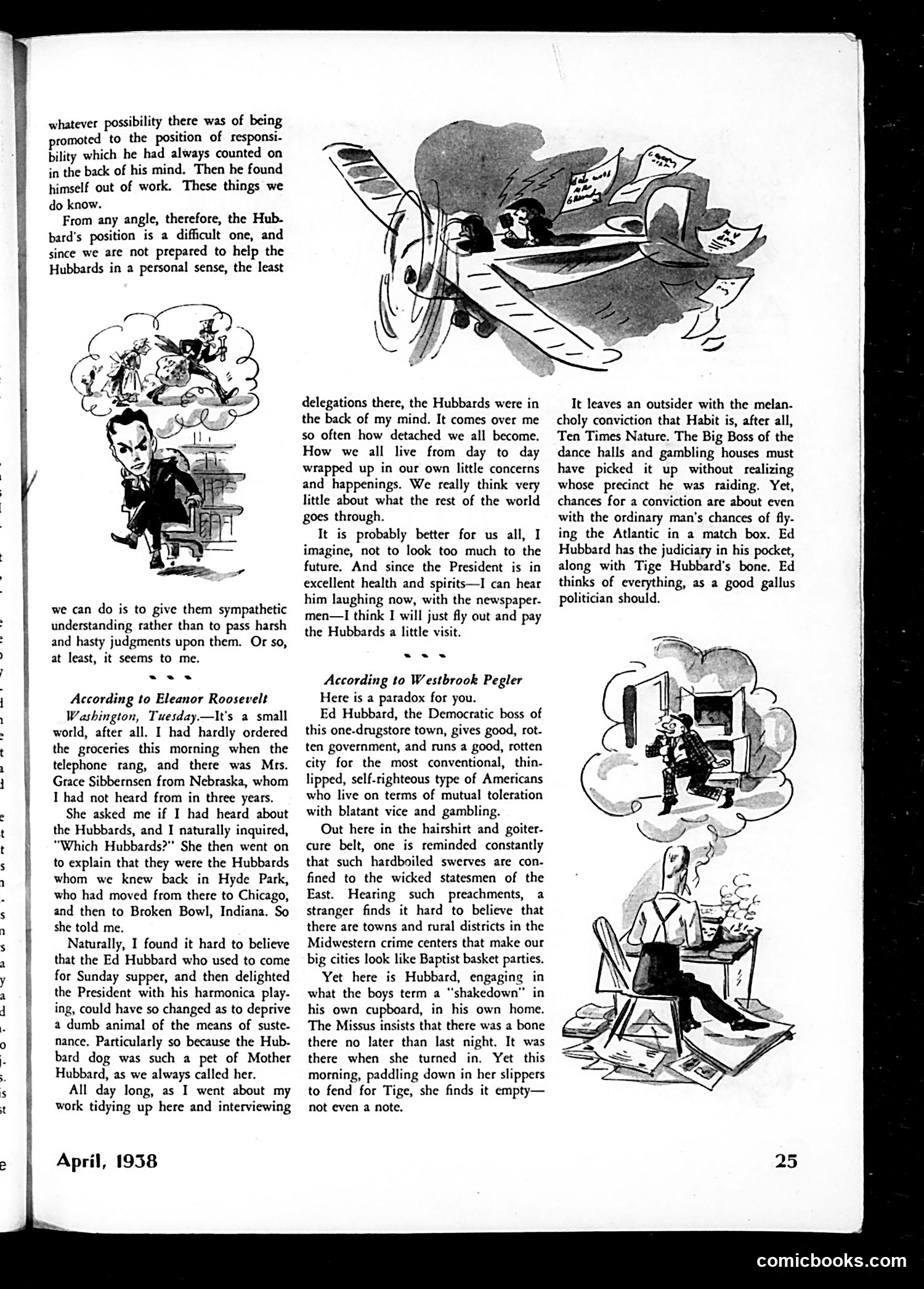
A restored page from Judge, 1938-04. Page through the whole issue in the reader above.
📄 Transcribed text from this page (OCR, searchable)
Machine-transcribed from the original scan — historical spelling and the odd misread are preserved.
whatever possibility there was of being romoted to the position of responsi- bility which he had always counted on in the back of his mind. Then he found himself out of work. These things we do know. From any angle, therefore, the Hub- bard's position is a difficult one, and since we are not prepared to help the Hubbards in a personal sense, the least we can do is to give them sympathetic understanding rather than to pass harsh and hasty judgments upon them. Or so, at least, it seems to me. sae According to Eleanor Roosevelt Washington, Tuesday.—lt’s a small world, after all. I had hardly ordered the groceries this morning when the telephone rang, and there was Mrs. Grace Sibbernsen from Nebraska, whom I had not heard from in three years. She asked me if I had heard about the Hubbards, and I naturally inquired, “Which Hubbards?” She then went on to explain that they were the Hubbards whom we knew back in Hyde Park, who had moved from there to Chicago, and then to Broken Bowl, Indiana. So she told me. Naturally, I found it hard to believe that the Ed Hubbard who used to come for Sunday supper, and then delighted the President with his harmonica play- ing, could have so changed as to deprive a dumb animal of the means of suste- nance. Particularly so because the Hub- bard dog was such a pet of Mother Hubbard, as we always called her. All day long, as I went about my work tidying up here and interviewing April, 1958 delegations there, the Hubbards were in the back of my mind. It comes over me so often how detached we all become. How we all live from day to day wrapped up in our own little concerns and happenings. We really think very little about what the rest of the world goes through. It is probably better for us all, I imagine, not to look too much to the future. And since the President is in excellent health and spirits—I can hear him laughing now, with the newspaper. men—I think I will just fly out and pay the Hubbards a little visit. According to Westbrook Pegler Here is a paradox for you. Ed Hubbard, the Democratic boss of this one-drugstore town, gives good, rot- ten government, and runs a good, rotten city for the most conventional, thin- lipped, self-righteous type of Americans who live on terms of mutual toleration with blatant vice and gambling. Out here in the hairshirt and goiter- cure belt, one is reminded constantly that such hardboiled swerves are con- fined to the wicked statesmen of the East. Hearing such preachments, a stranger finds it hard to believe that there are towns and rural districts in the Midwestern crime centers that make our big cities look like Baptist basket parties. Yet here is Hubbard, engaging in what the boys term a “shakedown” in his own cupboard, in his own home. The Missus insists that there was a bone there no later than last night. It was there when she turned in. Yet this morning, paddling down in her slippers to fend for Tige, she finds it empty— not even a note. It leaves an outsider with the melan- choly conviction that Habit is, after all, Ten Times Nature. The Big Boss of the dance halls and gambling houses must have picked it up without realizing whose precinct he was raiding. Yet, chances for a conviction are about even with the ordinary man’s chances of fly- ing the Atlantic in a match box. Ed Hubbard has the judiciary in his pocket, along with Tige Hubbard's bone. Ed thinks of everything, as a good gallus politician should. comicbooks.com