
Judge, 1938-04 · page 18 of 52
Judge — April 1938 — page 18: what you’re looking at
A restored page from Judge, 1938-04. Page through the whole issue in the reader above.
📄 Transcribed text from this page (OCR, searchable)
Machine-transcribed from the original scan — historical spelling and the odd misread are preserved.
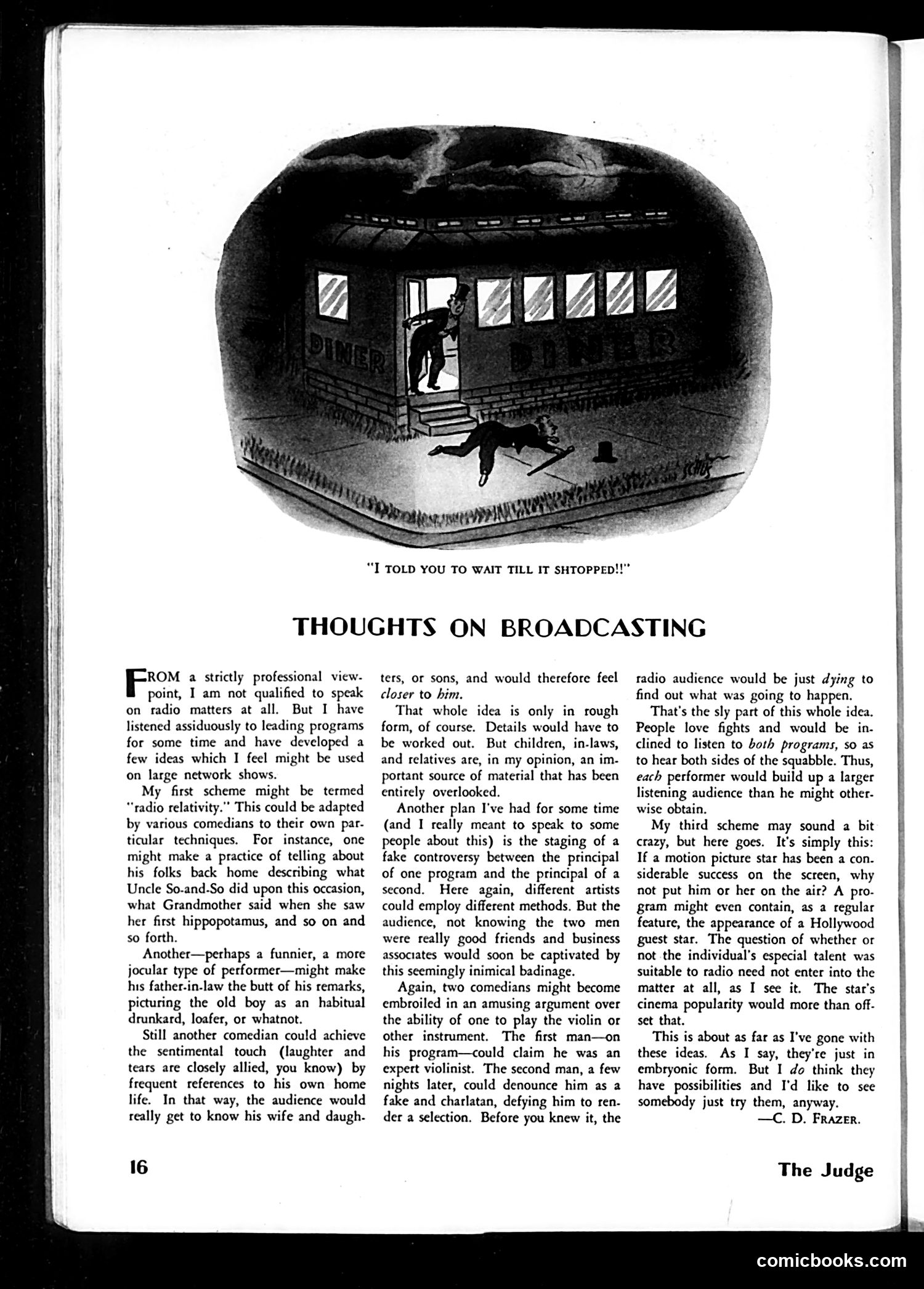
“I TOLD YOU TO WAIT TILL IT SHTOPPED!!” THOUGHTS ON BROADCASTING ROM a strictly professional view- point, I am not qualified to speak on radio matters at all. But I have listened assiduously to leading programs for some time and have developed a few ideas which I feel might be used on large network shows. My first scheme might be termed “radio relativity.” This could be adapted by various comedians to their own par- ticular techniques. For instance, one might make a practice of telling about his folks back home describing what Uncle So-and-So did upon this occasion, what Grandmother said when she saw her first hippopotamus, and so on and so forth. Another—perhaps a funnier, a more jocular type of performer—might make his father-in-law the butt of his remarks, picturing the old boy as an habitual drunkard, loafer, or whatnot. Still another comedian could achieve the sentimental touch (laughter and tears are closely allied, you know) by frequent references to his own home life. In that way, the audience would really get to know his wife and daugh. 16 ters, or sons, and would therefore feel closer to him. That whole idea is only in rough form, of course. Details would have to be worked out. But children, in-laws, and relatives are, in my opinion, an im. portant source of material that has been entirely overlooked. Another plan I've had for some time (and I really meant to speak to some people about this) is the staging of a fake controversy between the principal of one program and the principal of a second. Here again, different artists could employ different methods. But the audience, not knowing the two men were really good friends and business associates would soon be captivated by this seemingly inimical badinage. Again, two comedians might become embroiled in an amusing argument over the ability of one to play the violin or other instrument. The first man—on his program—could claim he was an expert violinist. The second man, a few nights later, could denounce him as a fake and charlatan, defying him to ren. der a selection. Before you knew it, the radio audience would be just dying to find out what was going to happen. That's the sly part of this whole idea. People love fights and would be in. clined to listen to both programs, so as to hear both sides of the squabble. Thus, each performer would build up a larger listening audience than he might other- wise obtain. My third scheme may sound a bit crazy, but here goes. It's simply this: If a motion picture star has been a con. siderable success on the screen, why not put him or her on the air? A pro- gram might even contain, as a regular feature, the appearance of a Hollywood guest star. The question of whether or not the individual's especial talent was suitable to radio need not enter into the matter at all, as I see it. The star's cinema popularity would more than off- set that. This is about as far as I've gone with these ideas. As I say, they're just in embryonic form. But I do think they have possibilities and I'd like to see somebody just try them, anyway. —C. D. Frazer. The Judge comicbooks.com