
Judge, 1938-04 · page 45 of 52
Judge — April 1938 — page 45: what you’re looking at
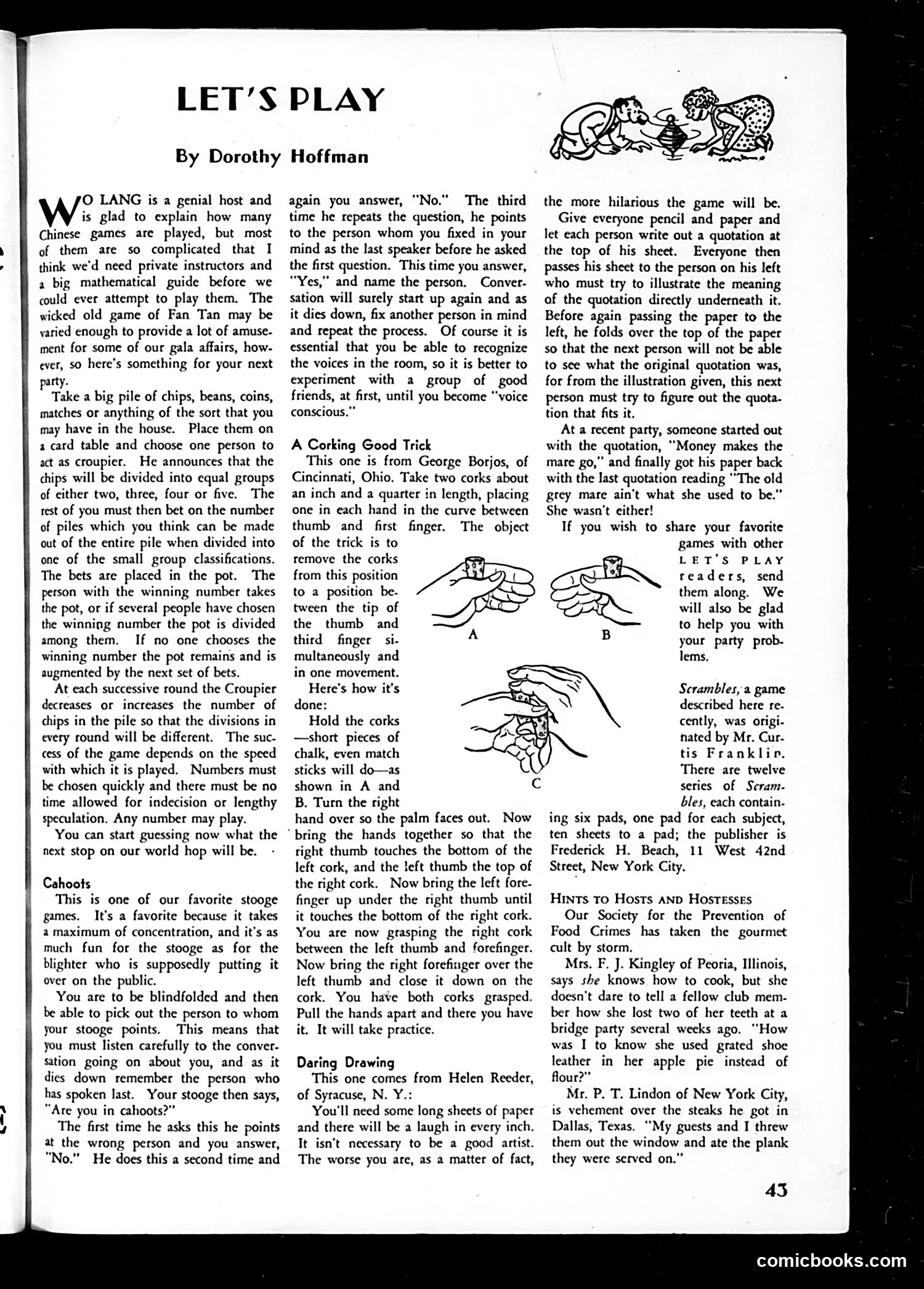
A restored page from Judge, 1938-04. Page through the whole issue in the reader above.
📄 Transcribed text from this page (OCR, searchable)
Machine-transcribed from the original scan — historical spelling and the odd misread are preserved.
LET’S PLAY By Dorothy Hoffman O LANG is a genial host and W: glad to explain how many Chinese games are played, but most of them are so complicated that I think we'd need private instructors and a big mathematical guide before we could ever attempt to play them. The wicked old game of Fan Tan may be varied enough to provide a lot of amuse- ment for some of our gala affairs, how- ever, so here's something for your next ke a big pile of chips, beans, coins, matches or anything of the sort that you may have in the house. Place them on a card table and choose one person to act as croupier. He announces that the chips will be divided into equal groups of either two, three, four or five. The test of you must then bet on the number of piles which you think can be made out of the entire pile when divided into one of the small group classifications. The bets are placed in the pot. The person with the winning number takes the pot, or if several people have chosen the winning number the pot is divided among them. If no one chooses the winning number the pot remains and is augmented by the next set of bets. At each successive round the Croupier decreases or increases the number of chips in the pile so that the divisions in every round will be different. The suc- cess of the game depends on the speed with which it is played. Numbers must be chosen quickly and there must be no time allowed for indecision or lengthy speculation. Any number may play. You can start guessing now what the next stop on our world hop will be. Cahoots This is one of our favorite stooge games. It's a favorite because it takes a maximum of concentration, and it's as much fun for the stooge as for the blighter who is supposedly putting it over on the public. You are to be blindfolded and then be able to pick out the person to whom your stooge points. This means that you must listen carefully to the conver- sation going on about you, and as it dies down remember the person who has spoken last. Your stooge then says, “Are you in cahoots?” The first time he asks this he points at the wrong person and you answer, “No.” He does this a second time and again you answer, “No.” The third time he repeats the question, he points to the person whom you fixed in your mind as the last speaker before he asked the first question. This time you answer, “Yes,” and name the person. Conver- sation will surely start up again and as it dies down, fix another person in mind and repeat the process. Of course it is essential that you be able to recognize the voices in the room, so it is better to experiment with a group of good friends, at first, until you become “voice conscious.”” A Corking Good Trick This one is from George Borjos, of Cincinnati, Ohio. Take two corks about an inch and a quarter in length, placing one in each hand in the curve between thumb and first finger. The object of the trick is to remove the corks from this position to a position be- tween the tip of the thumb and third finger si- multaneously and in one movement. Here's how it's done: Hold the corks —short pieces of chalk, even match sticks will do—as shown in A and B. Turn the right hand over so the palm faces out. Now “bring the hands together so that the right thumb touches the bottom of the left cork, and the left thumb the top of the right cork. Now bring the left fore- finger up under the right thumb until it touches the bottom of the right cork. You are now grasping the right cork between the left thumb and forefinger. Now bring the right forefinger over the left thumb and close it down on the cork. You have both corks grasped. Pull the hands apart and there you have it. It will take practice. Daring Drawing This one comes from Helen Reeder, of Syracuse, N. Y.: You'll need some long sheets of paper and there will be a laugh in every inch. It isn’t necessary to be a good artist. The worse you are, as a matter of fact, the more hilarious the game will be. Give everyone pencil and paper and let each person write out a quotation at the top of his sheet. Everyone then passes his sheet to the person on his left who must try to illustrate the meaning of the quotation directly underneath it. Before again passing the paper to the left, he folds over the top of the paper so that the next person will not be able to see what the original quotation was, for from the illustration given, this next person must try to figure out the quota- tion that fits it. At a recent party, someone started out with the quotation, “Money makes the mare go,” and finally got his paper back with the last quotation reading “The old grey mare ain't what she used to be.” She wasn't either! If you wish to share your favorite games with other LET'S PLAY readers, send them along. We will also be glad to help you with your party prob- lems. Scrambles, a game described here re- cently, was origi- nated by Mr. Cur- tis Franklin. There are twelve series of Scram- bles, each contain. ing six pads, one pad for each subject, ten sheets to a pad; the publisher is Frederick H. Beach, 11 West 42nd Street, New York City. Hints To Hosts AND HostesseEs Our Society for the Prevention of Food Crimes has taken the gourmet cult by storm. Mrs. F. J. Kingley of Peoria, Illinois, says she knows how to cook, but she doesn’t dare to tell a fellow club mem- ber how she lost two of her teeth at a bridge party several weeks ago. “How was I to know she used grated shoe leather in her apple pie instead of flour?” Mr. P. T. Lindon of New York City, is vehement over the steaks he got in Dallas, Texas. “My guests and I threw them out the window and ate the plank they were served on.” 43 comicbooks.com