
Judge, 1938-04 · page 13 of 52
Judge — April 1938 — page 13: what you’re looking at
What you’re looking at
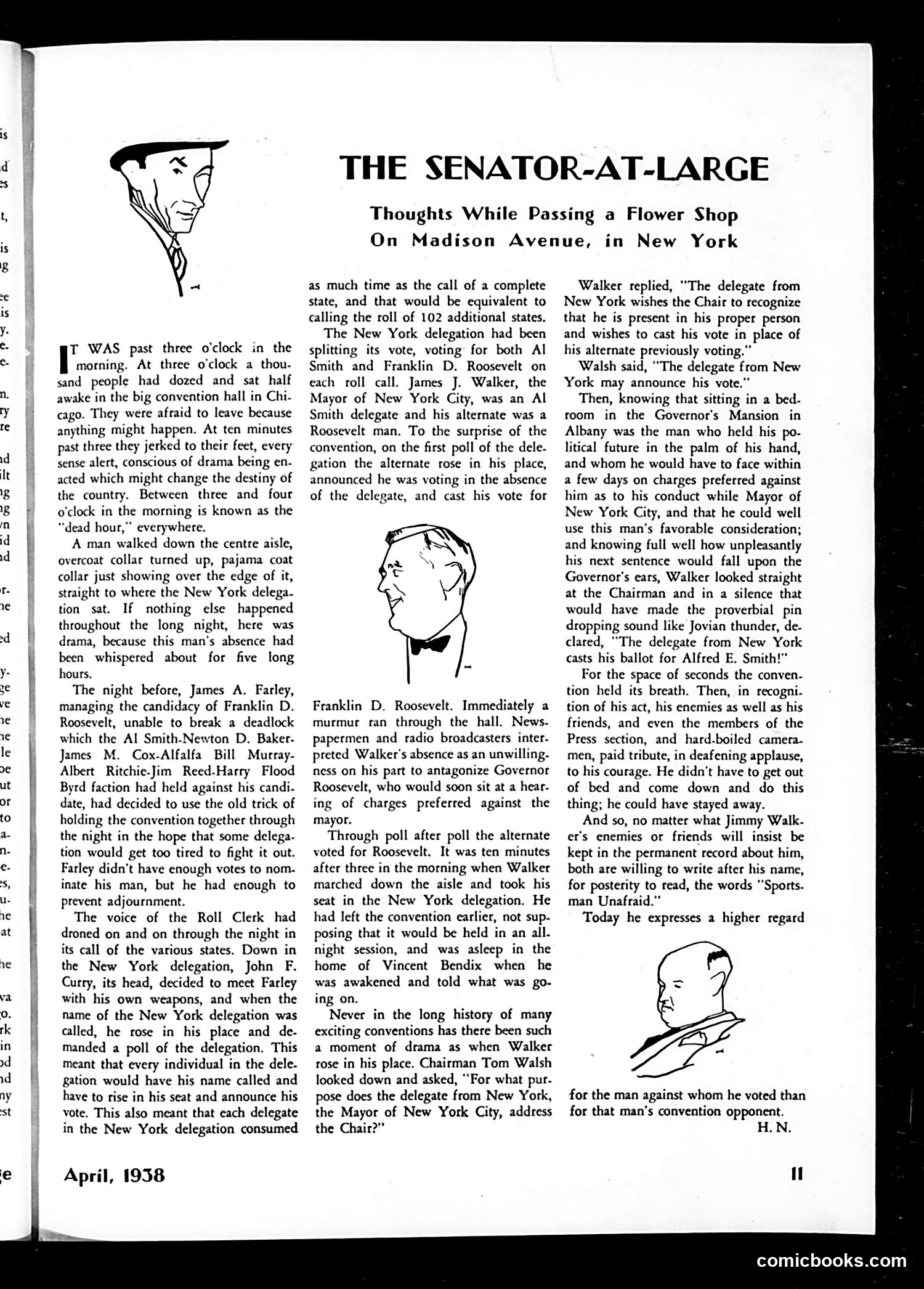
# Judge Magazine Satire Analysis (April 1938) This article satirizes a dramatic moment at the 1936 Democratic National Convention. **James J. Walker**, Mayor of New York City and an Al Smith delegate, was conspicuously absent during crucial voting rounds. His alternate voted for Franklin D. Roosevelt instead, which observers interpreted as Walker's tacit submission to Roosevelt (who had pending corruption charges against Walker). When Walker dramatically reappeared at 3 a.m.—having been asleep elsewhere—and reclaimed his seat to cast his own vote for Smith, it became convention theater. The satire mocks the political machinations: Farley's exhaustion tactics, factional splits within New York's delegation, and Walker's apparent capitulation to Roosevelt's power despite his public defiance. The "Senator-at-Large" title suggests Walker represents his own political interests above all else. The three caricature sketches punctuate the melodramatic narrative of ambition and backstabbing at the convention.
📄 Transcribed text from this page (OCR, searchable)
Machine-transcribed from the original scan — historical spelling and the odd misread are preserved.
id : T WAS past three o'clock in the morning. At three o'clock a thou- sand people had dozed and sat half awake in the big convention hall in Chi- cago. They were afraid to leave because anything might happen. At ten minutes past three they jerked to their feet, every sense alert, conscious of drama being en. acted which might change the destiny of the country. Between three and four o'clock in the morning is known as the “dead hour,” everywhere. A man walked down the centre aisle, overcoat collar turned up, pajama coat collar just showing over the edge of it, straight to where the New York delega- tion sat. If nothing else happened throughout the long night, here was drama, because this man’s absence had been whispered about for five long hours. The night before, James A. Farley, managing the candidacy of Franklin D. Roosevelt, unable to break a deadlock which the Al Smith-Newton D. Baker- James M. Cox-Alfalfa Bill Murray- Albert Ritchie-Jim Reed-Harry Flood Byrd faction had held against his candi- date, had decided to use the old trick of holding the convention together through the night in the hope that some delega- tion would get too tired to fight it out. Farley didn’t have enough votes to nom- inate his man, but he had enough to prevent adjournment. The voice of the Roll Clerk had droned on and on through the night in its call of the various states. Down in the New York delegation, John F. Curry, its head, decided to meet Farley with his own weapons, and when the name of the New York delegation was called, he rose in his place and de- manded a poll of the delegation. This meant that every individual in the dele. gation would have his name called and have to rise in his seat and announce his vote. This also meant that each delegate in the New York delegation consumed April, 1938 THE SENATOR-AT-LARGE Thoughts While Passing a Flower Shop On Madison Avenue, as much time as the call of a complete state, and that would be equivalent to calling the roll of 102 additional states. The New York delegation had been splitting its vote, voting for both Al Smith and Franklin D. Roosevelt on each roll call. James J. Walker, the Mayor of New York City, was an Al Smith delegate and his alternate was a Roosevelt man. To the surprise of the convention, on the first poll of the dele- gation the alternate rose in his place, announced he was voting in the absence of the delegate, and cast his vote for Franklin D. Roosevelt. Immediately a murmur ran through the hall. News- papermen and radio broadcasters inter- preted Walker's absence as an unwilling. ness on his part to antagonize Governor Roosevelt, who would soon sit at a hear- ing of charges preferred against the mayor. Through poll after poll the alternate voted for Roosevelt. It was ten minutes after three in the morning when Walker marched down the aisle and took his seat in the New York delegation. He had left the convention earlier, not sup- posing that it would be held in an all. night session, and was asleep in the home of Vincent Bendix when he was awakened and told what was go- ing on. Never in the long history of many exciting conventions has there been such a moment of drama as when Walker rose in his place. Chairman Tom Walsh looked down and asked, “For what pur- pose does the delegate from New York, the Mayor of New York City, address the Chair?” in New York Walker replied, “The delegate from New York wishes the Chair to recognize that he is present in his proper person and wishes to cast his vote in place of his alternate previously voting.” Walsh said, “The delegate from New York may announce his vote.” Then, knowing that sitting in a bed- room in the Governor's Mansion in Albany was the man who held his po- litical future in the palm of his hand, and whom he would have to face within a few days on charges preferred against him as to his conduct while Mayor of New York City, and that he could well use this man’s favorable consideration; and knowing full well how unpleasantly his next sentence would fall upon the Governor's ears, Walker looked straight at the Chairman and in a silence that would have made the proverbial pin dropping sound like Jovian thunder, de- clared, “The delegate from New York casts his ballot for Alfred E. Smith!” For the space of seconds the conven- tion held its breath. Then, in recogni- tion of his act, his enemies as well as his friends, and even the members of the Press section, and hard-boiled camera- men, paid tribute, in deafening applause, to his courage. He didn’t have to get out of bed and come down and do this thing; he could have stayed away. And so, no matter what Jimmy Walk- er's enemies or friends will insist be kept in the permanent record about him, both are willing to write after his name, for posterity to read, the words “Sports. man Unafraid.” Today he expresses a higher regard for the man against whom he voted than for that man’s convention opponent. H.N. comicbooks.com