
A complete issue · 36 pages · 1928
Judge — August 4, 1928
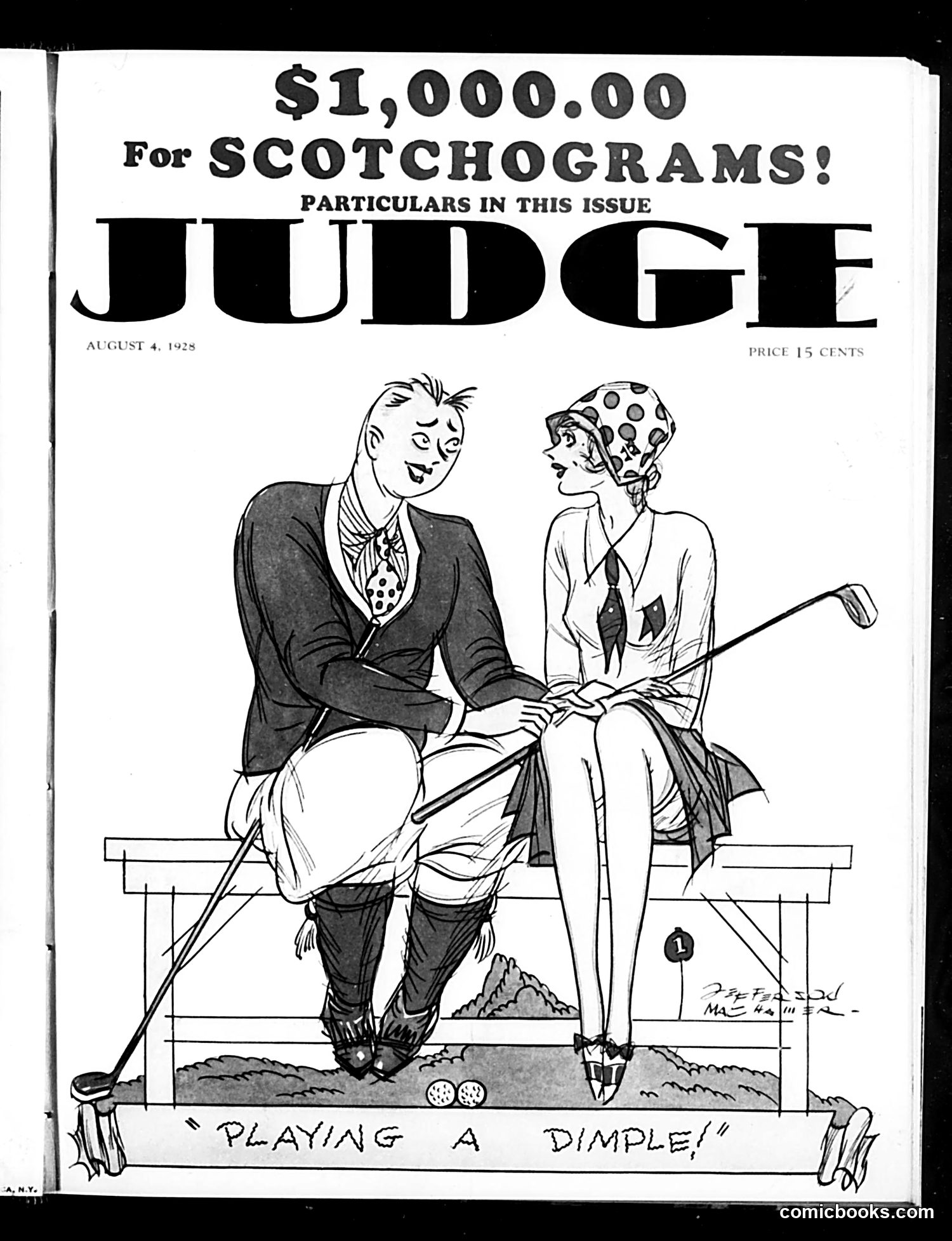
This cover depicts two golfers on a course with the caption "Playing a Dimple!" The humor plays on double meaning: "dimple" refers both to the indentations on golf balls and to facial dimples—particularly a woman's cheek dimples. The illustration shows a man and woman seated together at a golf course, their positioning suggestive of flirtation or romance rather than serious golf. The "dimple" caption creates a pun linking the golf equipment to the woman's appearance, treating her as an object of attraction. This reflects 1928 attitudes toward women in sports and leisure activities—depicted primarily as romantic interests rather than serious athletes. The satirical tone mocks both golf culture and gender dynamics of the era.
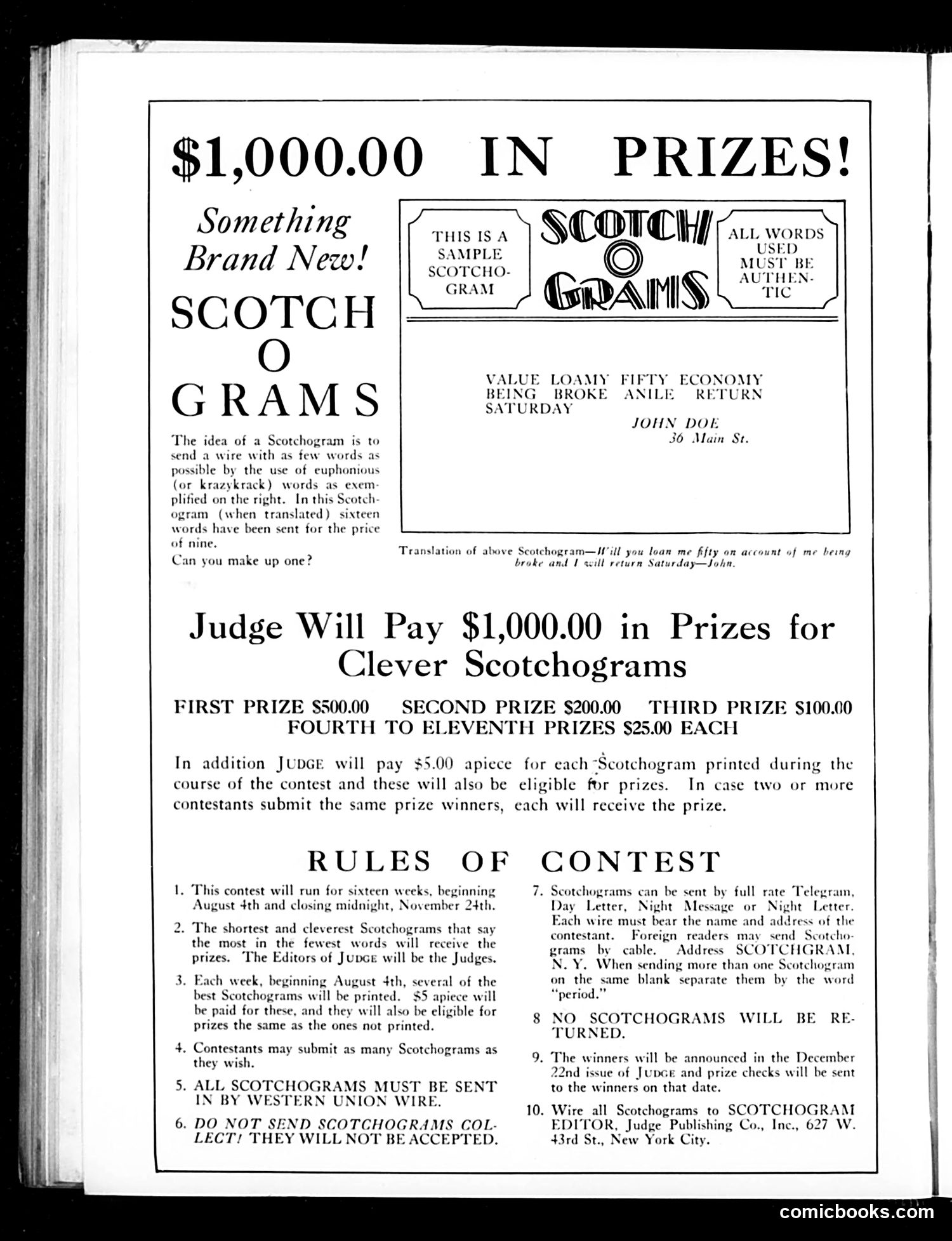
This page is primarily a **contest advertisement** rather than political satire. Judge magazine is promoting a "Scotchogram" competition—a word-puzzle game where users condense messages into abbreviated or coded language, similar to telegram economy. The contest offers $1,000 in prizes (substantial for the era) and runs 16 weeks from August 4th through November 24th. Entries must be sent by Western Union wire. The sample scotchogram shown translates a lengthy message into just sixteen words using abbreviated language. The joke is linguistic economy—making communication as brief as possible while remaining clear. This appears to be a **marketing gimmick** to boost reader engagement and Judge circulation rather than satirical commentary on politics or social issues.
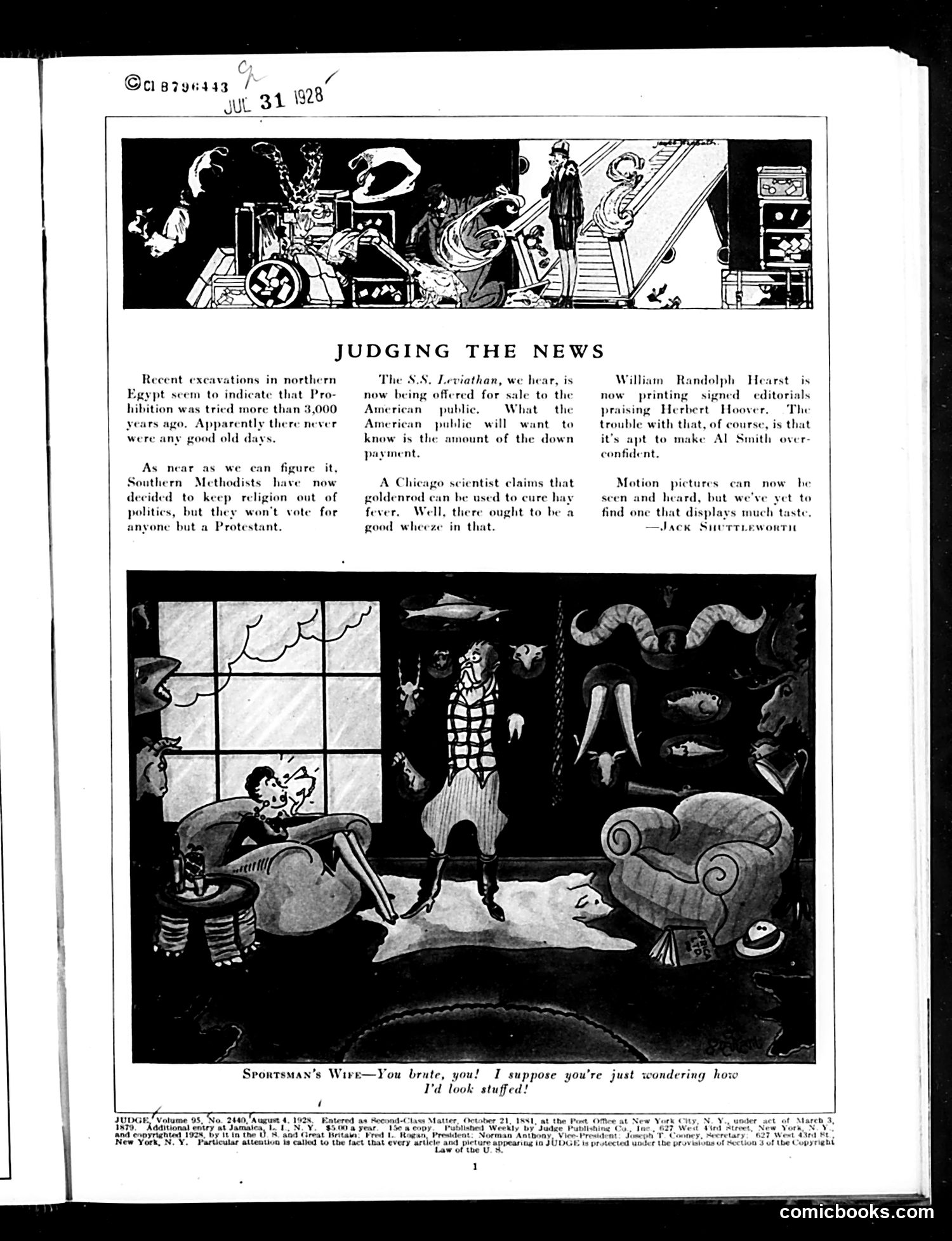
The page features "Judging the News," a satirical commentary section with brief topical jabs: - **Egyptian excavations**: Mocks the romantic notion that "good old days" existed in ancient Egypt - **Southern Methodists**: Jokes that Methodists want religion out of politics but won't vote for non-Protestants - **S.S. Leviathan ship sale**: Questions whether Americans will afford the down payment - **Goldenseal cure**: Suggests there's "a good wheeze" (con) behind the medical claim The main cartoon, "Sportsman's Wife," depicts a woman confronting her husband about taxidermied animal heads displayed in their home. Her comment "You brute, you! I suppose you're just wondering how I'd look stuffed!" is a humorous domestic complaint about his hunting trophies. The satire targets middle-class masculine leisure pursuits and spousal friction over home decoration choices.
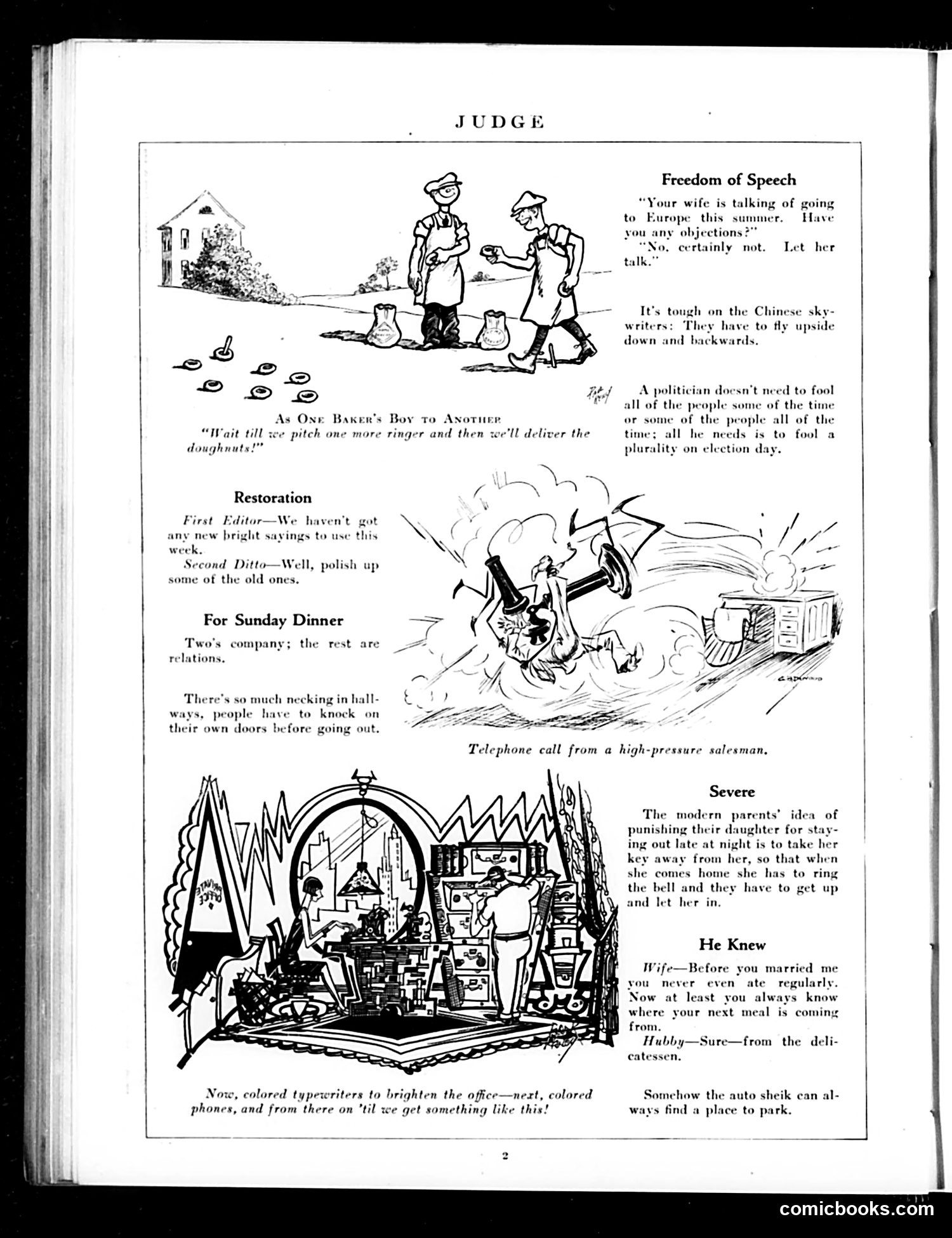
This page contains several disconnected satirical vignettes typical of Judge's format: **"Freedom of Speech"** depicts a baker's boy delivering doughnuts while two men discuss allowing the boy's wife to speak freely about traveling to Europe. The joke plays on domestic gender dynamics—husbands controlling wives' speech. **"Restoration"** jokes about editors recycling old material due to lack of new content. **"For Sunday Dinner"** contains brief quips about social etiquette and necking (kissing). The central cartoon shows a chaotic telephone scene labeled "Telephone call from a high-pressure salesman"—satirizing aggressive sales tactics. **"Severe,"** **"He Knew,"** and other sections mock modern parenting, courtship customs, and marital assumptions about predictable meal sources (delicatessens). The page reflects early 20th-century social anxieties about changing gender roles, commercialism, and courtship norms.
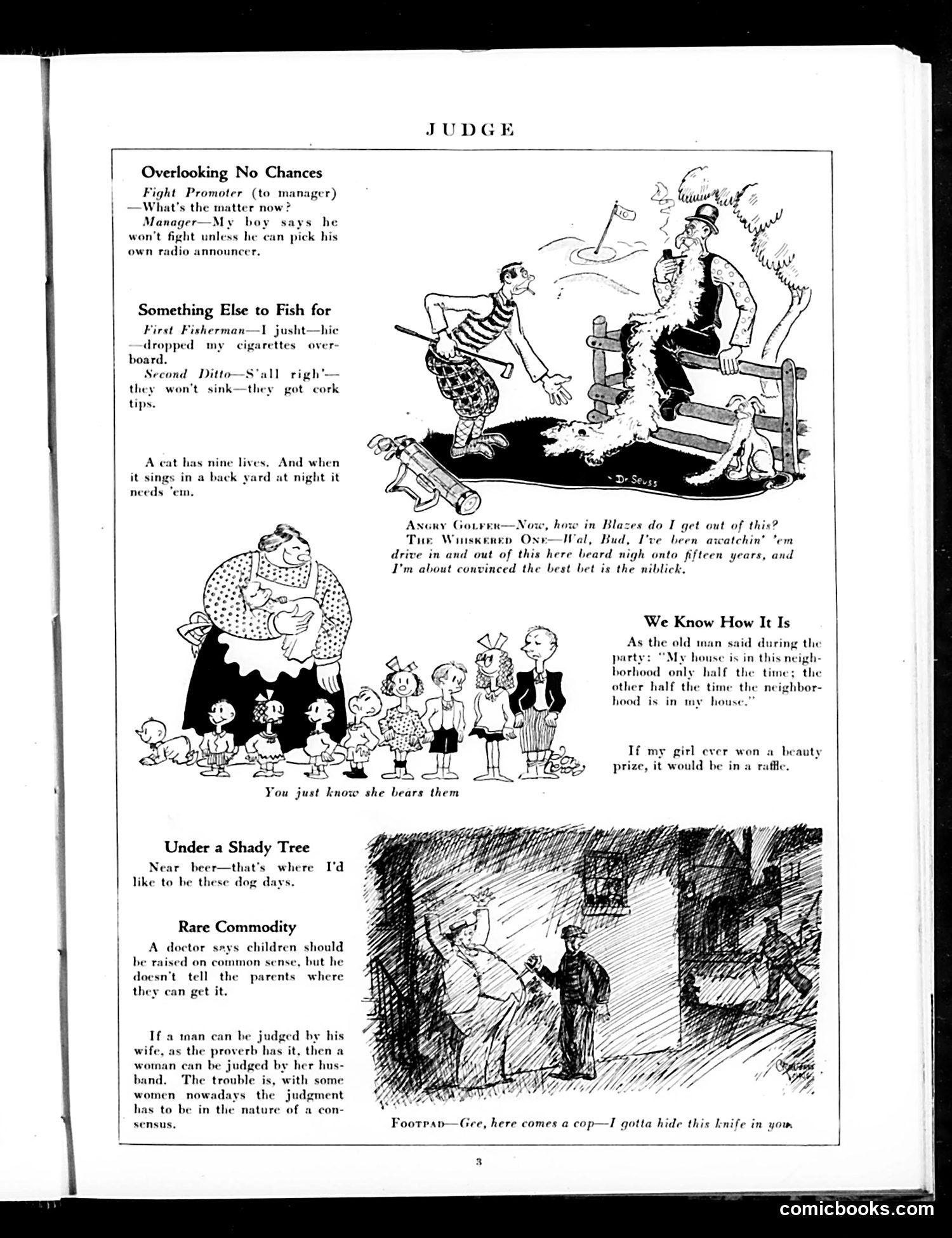
This page contains humorous social commentary rather than political cartoons. The jokes target everyday behavior and attitudes: **"Overlooking No Chances"** mocks a boy's demand to become a radio announcer before fighting—reflecting 1920s-30s radio's novelty appeal. **"Something Else to Fish For"** jokes about cigarette-dropping and cork-tipped cigarettes (then new technology). **"We Know How It Is"** satirizes neighbors' intrusiveness and domestic life being semi-public. **"Under a Shady Tree"** idealizes lazy leisure. **"Rare Commodity"** criticizes parents who can't teach common sense, and makes sexist observations about women's judgment. **"Footpad"** depicts a street robbery, with the victim hiding a knife—likely mocking criminal incompetence or victims' preparedness. The cartoons reflect working/middle-class anxieties about modern life, social propriety, and domestic relations of the early-to-mid 20th century.
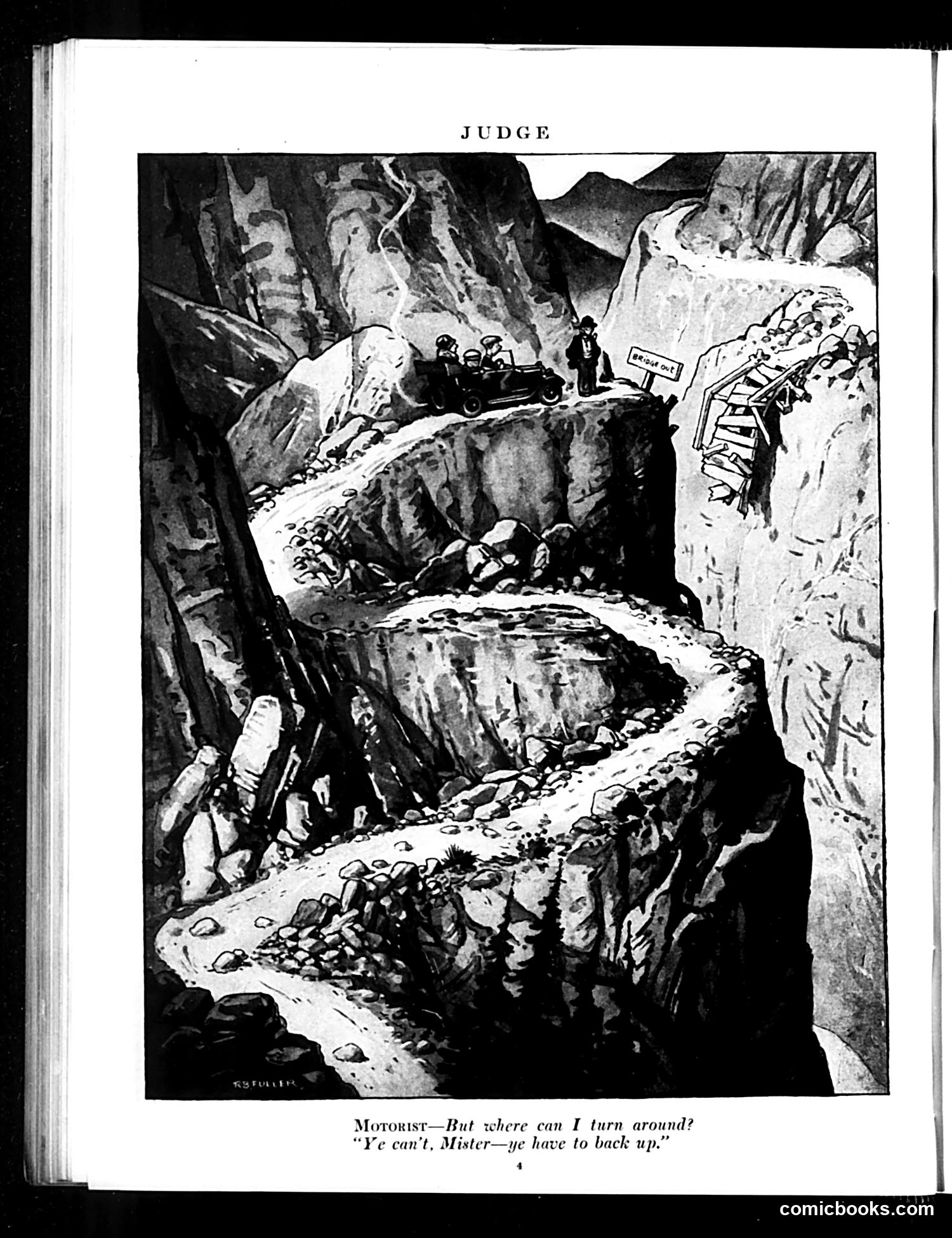
This cartoon depicts a motorist stuck in a narrow mountain canyon road, unable to proceed or turn around. The dialogue—"But where can I turn around?" / "Ye can't, Mister—ye have to back up"—illustrates the motorist's dilemma of having to reverse an entire vehicle down a treacherous, winding mountain passage. The satire likely comments on early automobile problems and the challenges of 1910s-1920s motoring infrastructure. Mountains had few developed roads, and drivers frequently encountered impassable terrain. The cartoon mocks both the motorist's poor planning and the impractical nature of automobile travel in underdeveloped areas, highlighting the limitations of early car ownership before modern road systems existed.
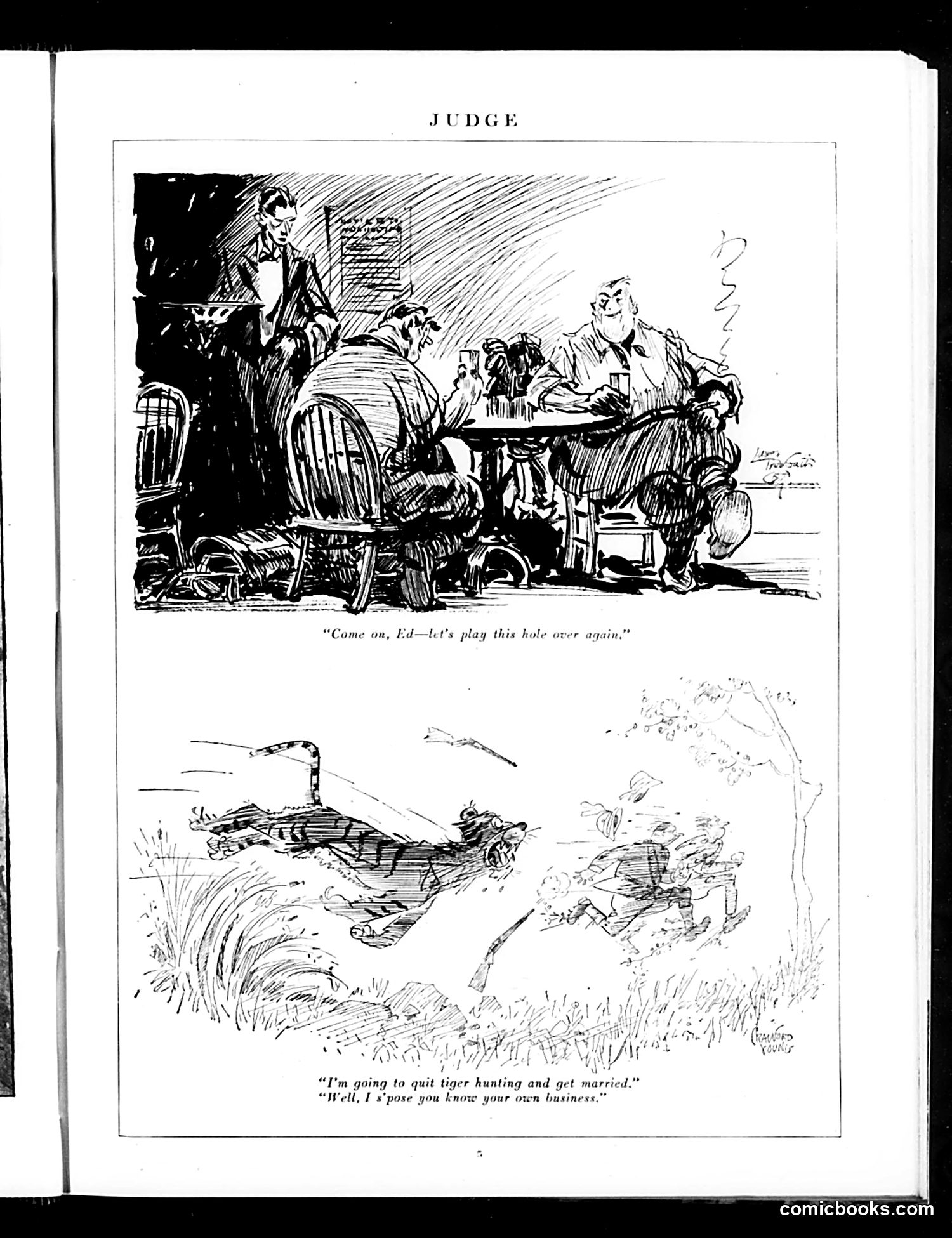
This page from *Judge* contains two separate cartoons satirizing different subjects: **Top cartoon:** Shows what appears to be a legal proceeding or court scene. The caption "Come on, Ed—let's play this hole over again" suggests someone named Ed is being given a second chance, likely mocking a judicial decision or legal outcome that allowed a "replay" of circumstances. **Bottom cartoon:** Depicts a man emerging from tall grass, apparently engaged in tiger hunting. The dialogue exchanges suggest he's abandoning dangerous hunting to get married, with the response implying he should focus on his own affairs. This appears to be satirizing either a specific public figure's shift in priorities or commenting humorously on the competing demands of adventure versus domesticity. Both cartoons use visual humor and wordplay typical of *Judge's* style.
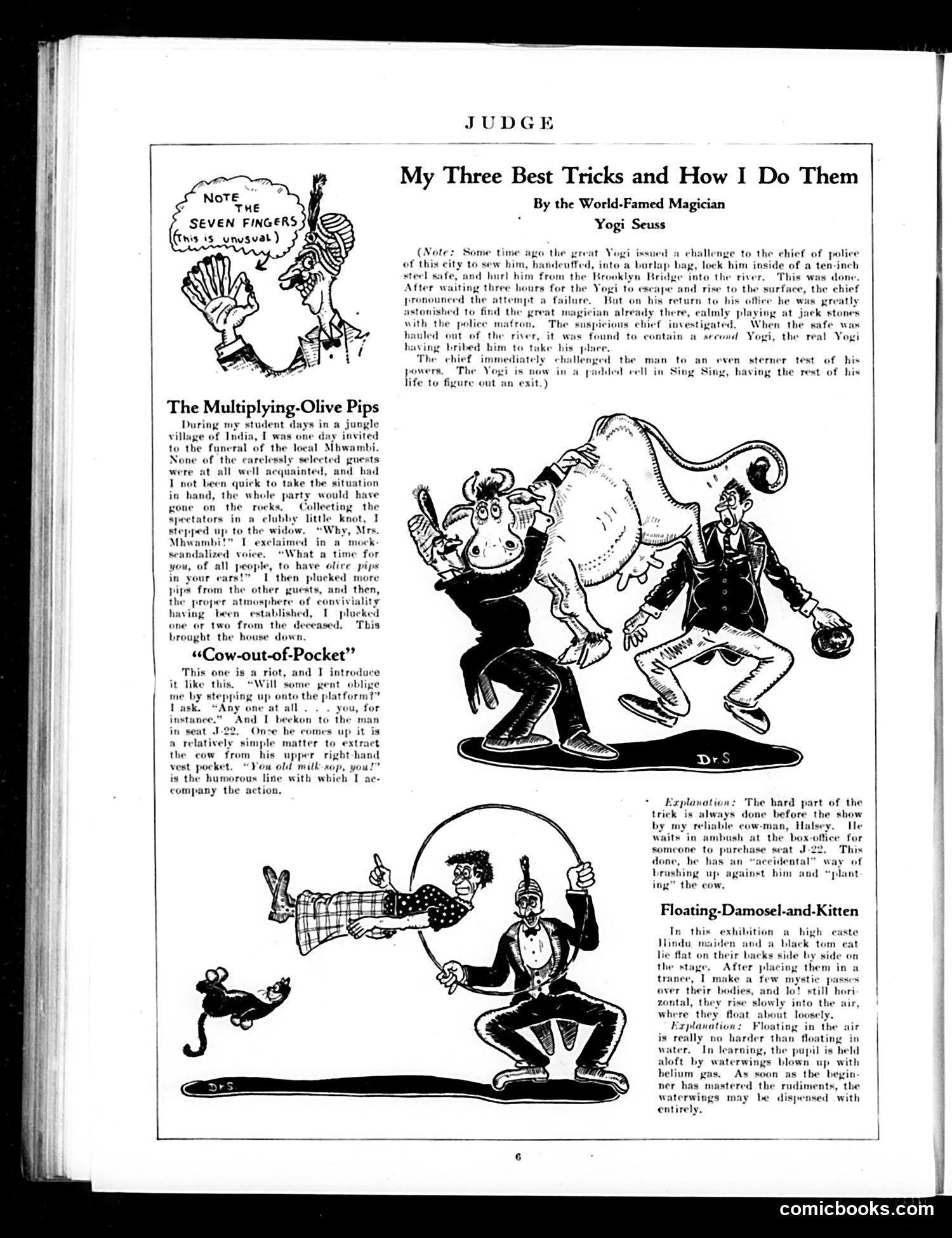
This page features "Yogi Seuss" (a fictional magician character) describing three magic tricks. The humor is straightforward performance-magic comedy rather than political satire. **The tricks described:** 1. **Multiplying-Olive Pips**: A classic sleight-of-hand illusion where the magician plucks olive pits from guests' ears, creating wonder at a funeral gathering. 2. **Cow-out-of-Pocket**: The magician extracts a live cow from his vest pocket, accompanying it with a humorous insult ("You old milk-sop, you!"). 3. **Floating-Damosel-and-Kitten**: A Hindu maiden and black cat float horizontally in air—explained as using helium-filled waterwings hidden beneath clothing. The framing note mocks Yogi Seuss's dubious reputation: he escaped from a police chief's elaborate trap (locked in a safe, thrown in a river), but was later imprisoned in Sing Sing for failing to escape a cell. **Context for modern readers**: This celebrates early 20th-century stage magic as entertainment, with exaggerated, impossible tricks presented matter-of-factly. The humor relies on the absurdity of the explanations and the magician's deadpan descriptions.
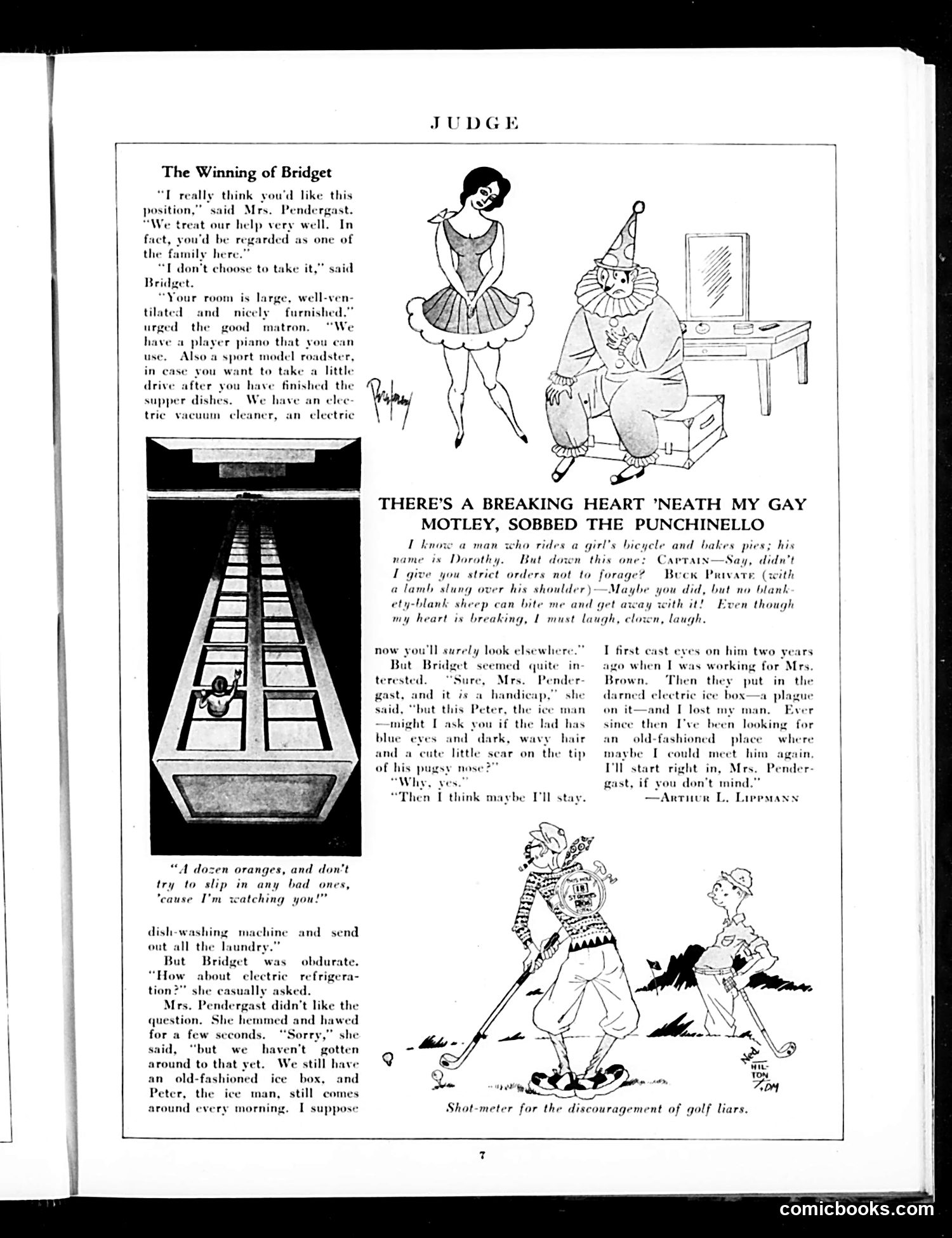
This domestic humor piece satirizes servant-employer relations and early-20th-century class dynamics. Mrs. Pendergast, a wealthy homeowner, attempts to recruit Bridget (an Irish domestic worker, indicated by the name and dialect) by listing modern conveniences: electric vacuum, player piano, electric refrigerator. The satire's point: Bridget initially rejects these amenities as unimpressive—until Mrs. Pendergast mentions the household *still uses an old-fashioned ice box* requiring daily visits from "Peter, the ice man." Bridget suddenly agrees to stay, revealing her true motivation is romance, not labor conditions or technology. The sidebar poem reinforces the theme: a heartbroken woman in service work, reminiscing about losing a man when her previous employer modernized to electric refrigeration (eliminating ice deliveries). The joke mocks both servants' priorities and the newly wealthy's assumption that modern appliances would impress working-class employees more than personal relationships.
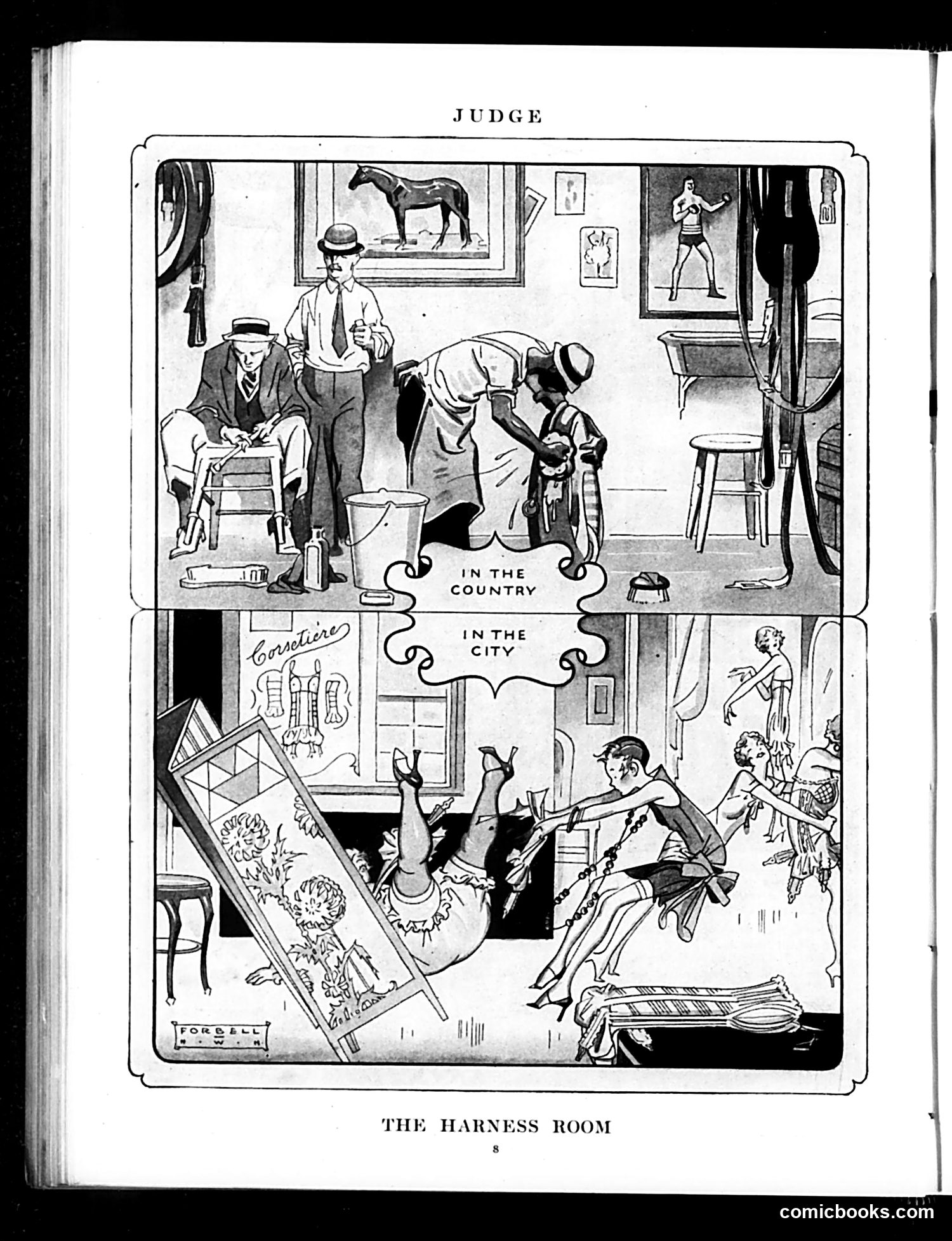
This two-panel satirical cartoon contrasts rural and urban life. The top panel ("In the Country") shows men casually evaluating a horse in a simple harness room setting, depicted as straightforward and unpretentious. The bottom panel ("In the City") transforms the same activity into an absurdly elaborate social performance—men and women in formal dress strike exaggerated poses around expensive furnishings and décor while examining what appears to be the same practical equipment. The satire mocks urban pretentiousness and affectation. City dwellers apparently cannot engage in simple, practical activities without performing sophistication and surrounding themselves with unnecessary luxury. The cartoon criticizes how urbanites complicate and dramatize everyday tasks that country folk handle plainly. It's a common Judge theme: rural authenticity versus urban artificiality.
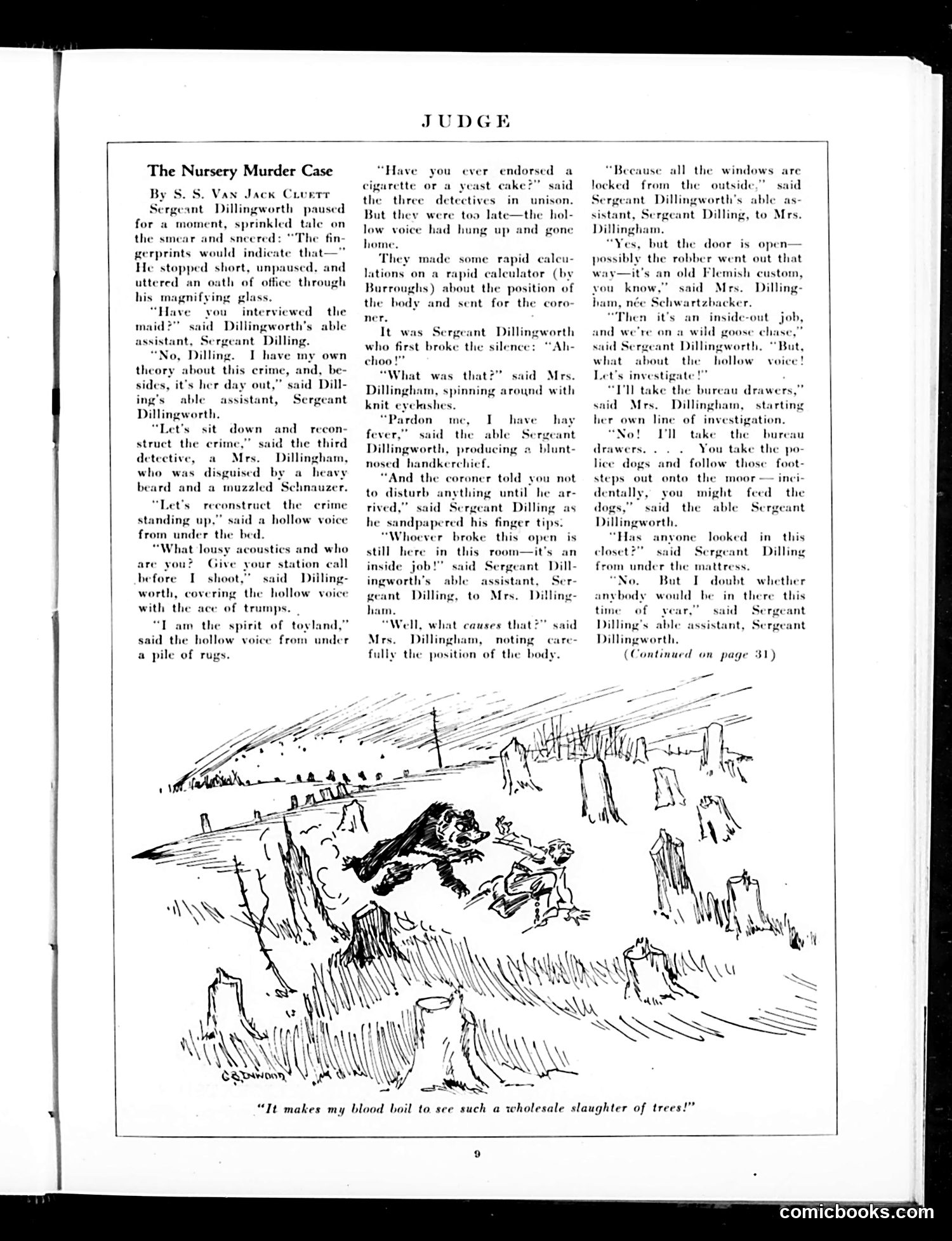
This is a humorous parody of detective fiction, a popular genre in early 20th-century magazines. The satire mocks the formulaic mystery story through absurdist logic: detectives investigate a crime while a mysterious "hollow voice" emanates from under furniture; characters make nonsensical deductions ("old Flemish custom" of exiting through open doors); and the investigation grows increasingly ridiculous (taking police dogs to the moor, searching closets despite doubt anyone's there). The joke targets readers' familiarity with serious detective narratives by replacing coherent mystery-solving with circular, illogical reasoning and pratfall humor. Names like "Sergeant Dillingworth" and "Sergeant Dilling" create intentional confusion. The illustration shows the body discovery scene, emphasizing the story's theatrical melodrama. This represents Judge magazine's satirical approach to mocking popular literary conventions of its era.
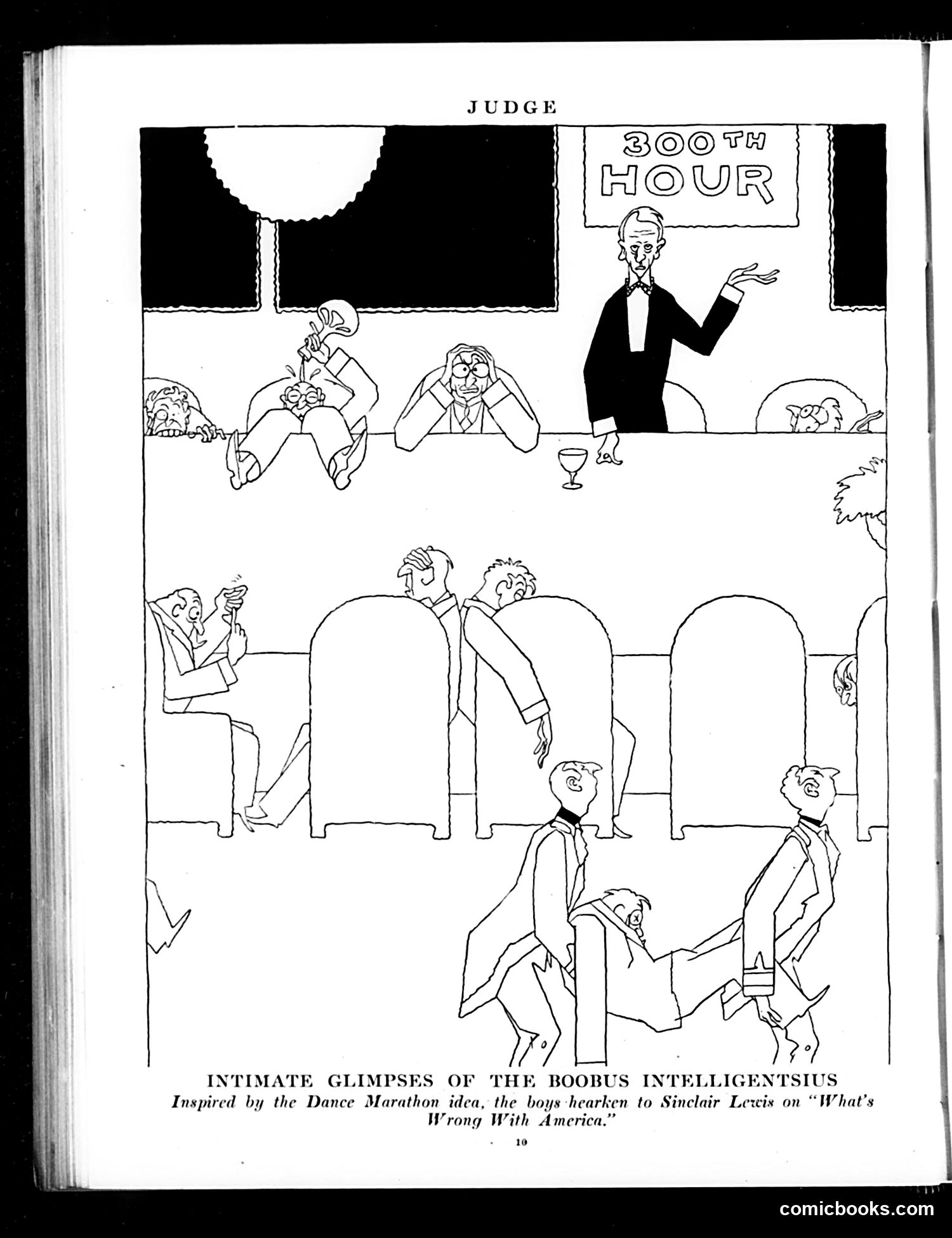
This cartoon satirizes intellectual pretension during the 1920s dance marathon craze. The "300th Hour" sign references the popular endurance dance competitions of that era. The satire targets "Boobus Intelligentsius" (a play on H.L. Mencken's term "booboisie")—educated people who consider themselves intellectually superior. The cartoon mocks them for treating a serious social critique by author Sinclair Lewis ("What's Wrong With America") as mere entertainment at a social gathering, treating it with the same frivolous energy as a dance marathon. The judge (authority figure) presides over an audience of well-dressed men and women, many appearing exhausted or distracted, suggesting they're more invested in the fashionable spectacle of intellectual discussion than genuine engagement with substantive ideas. The humor lies in exposing the gap between intellectual pretension and actual substance.
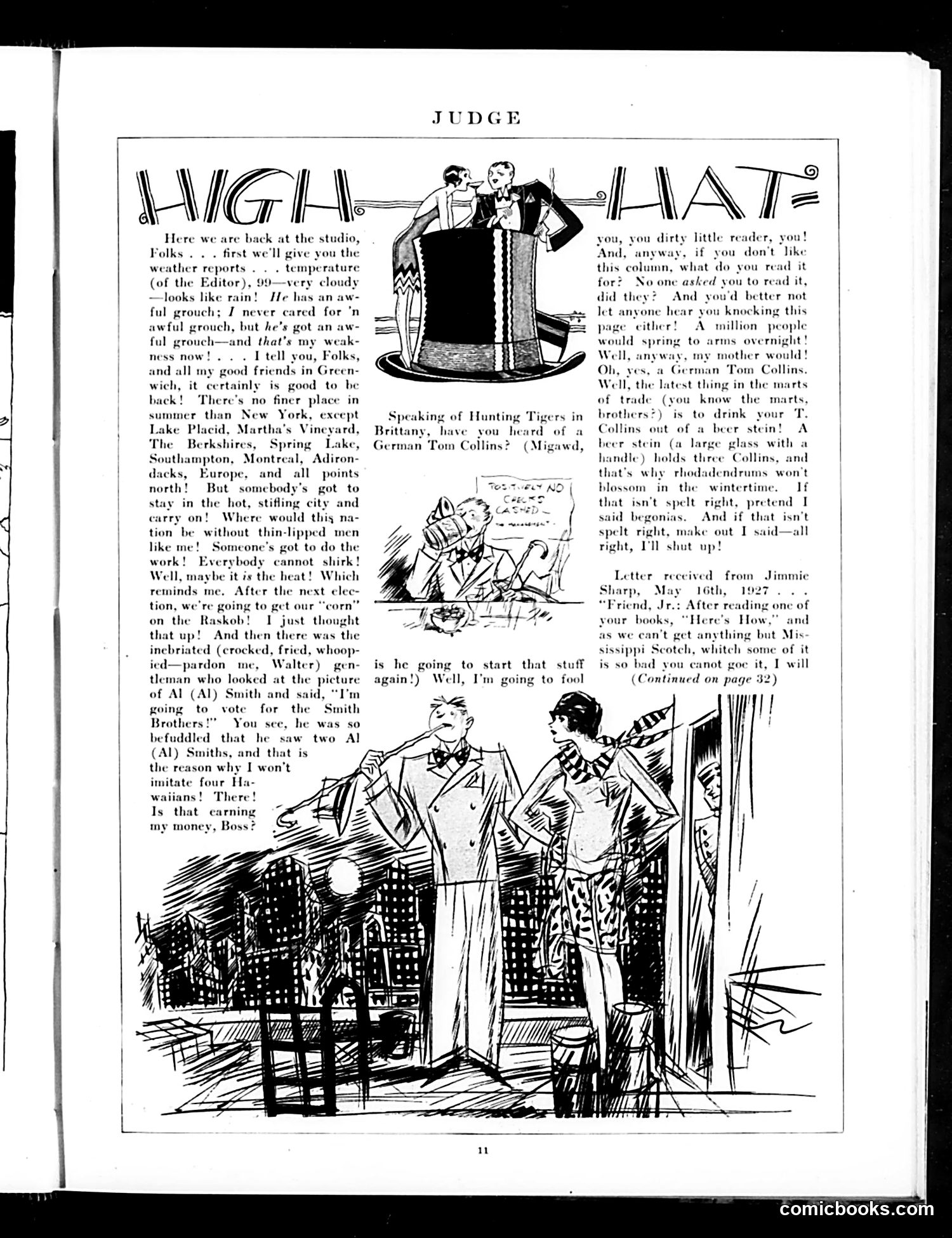
This is a humorous column from Judge's editorial section, circa 1927, written in a casual, rambling style typical of the magazine's satirical voice. The author (identity unclear from the page) uses self-deprecating comedy about returning to the hot city while others vacation in upscale destinations (Martha's Vineyard, the Berkshires, etc.). The satire targets: 1. **Al Smith**: References to "Al (Al) Smith" mock the 1928 presidential candidate, playing on a drunk man confusing one Al Smith with two "Al Smiths" and mistakenly voting for the "Smith Brothers" (a cough-drop brand). 2. **Raskob reference**: Likely Jake Raskob, DuPont executive and Democratic National Committee chair—apparently a contemporary political figure. 3. **Social drinking**: The "German Tom Collins" joke satirizes Prohibition-era cocktail culture and creative drinking methods. The cartoons illustrate the editor's complaints and the humorous anecdotes. The tone is self-mocking rather than viciously satirical—typical Judge fare mixing politics, social observation, and lowbrow humor.
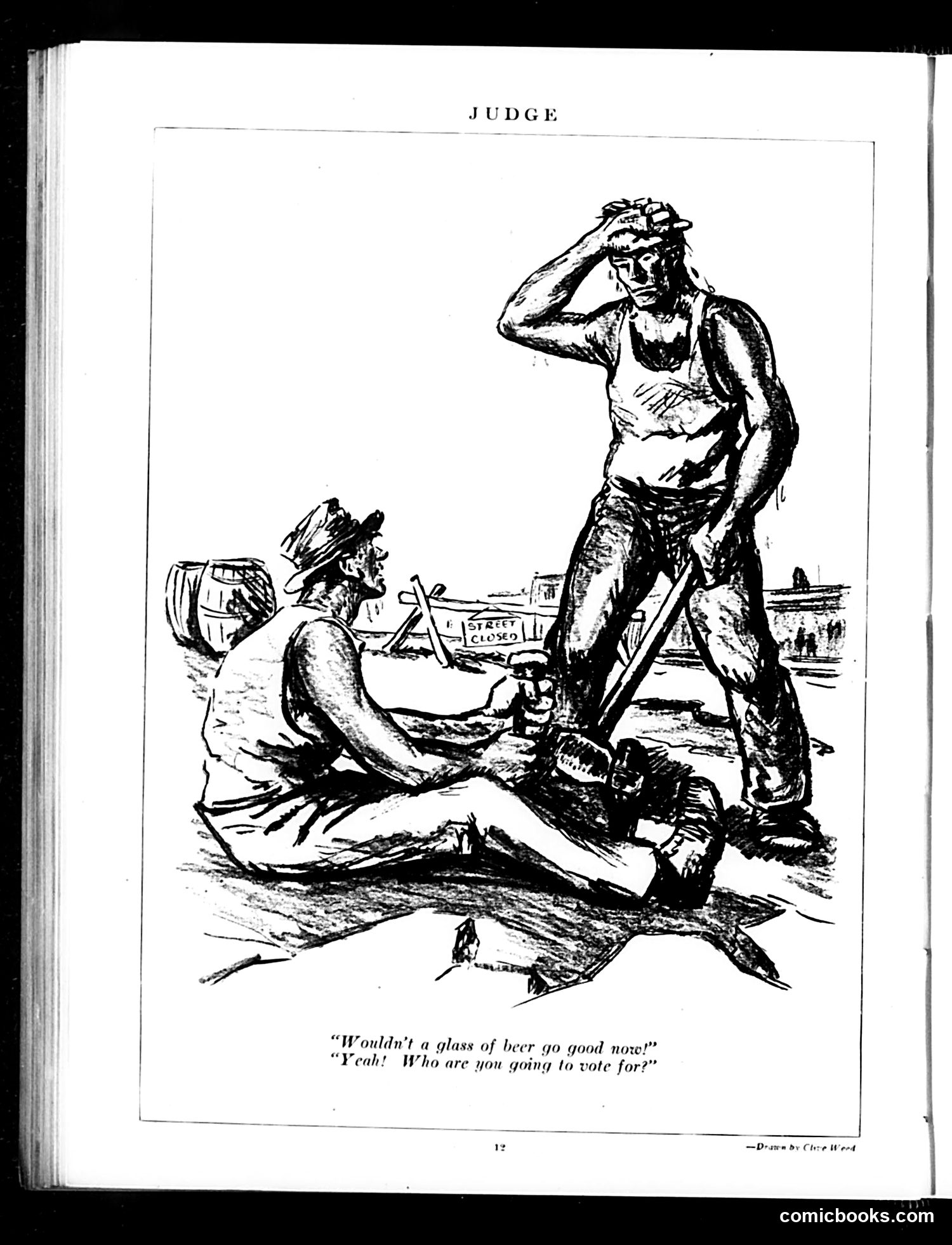
This cartoon satirizes political corruption and voter manipulation. A large, muscular figure—likely representing a political boss or "judge"—stands over a seated working-class man. The seated figure expresses desire for beer; the standing figure responds by asking whom he'll vote for, implying a transactional relationship: beer or favors in exchange for votes. The "STREET CLOSED" sign visible in the background suggests urban political machine operations. The cartoon mocks how politicians exploit workers' basic needs and desires to secure electoral support, depicting the cynical quid pro quo between political power brokers and working-class voters. This reflects Progressive Era concerns about political corruption and boss rule in American cities.
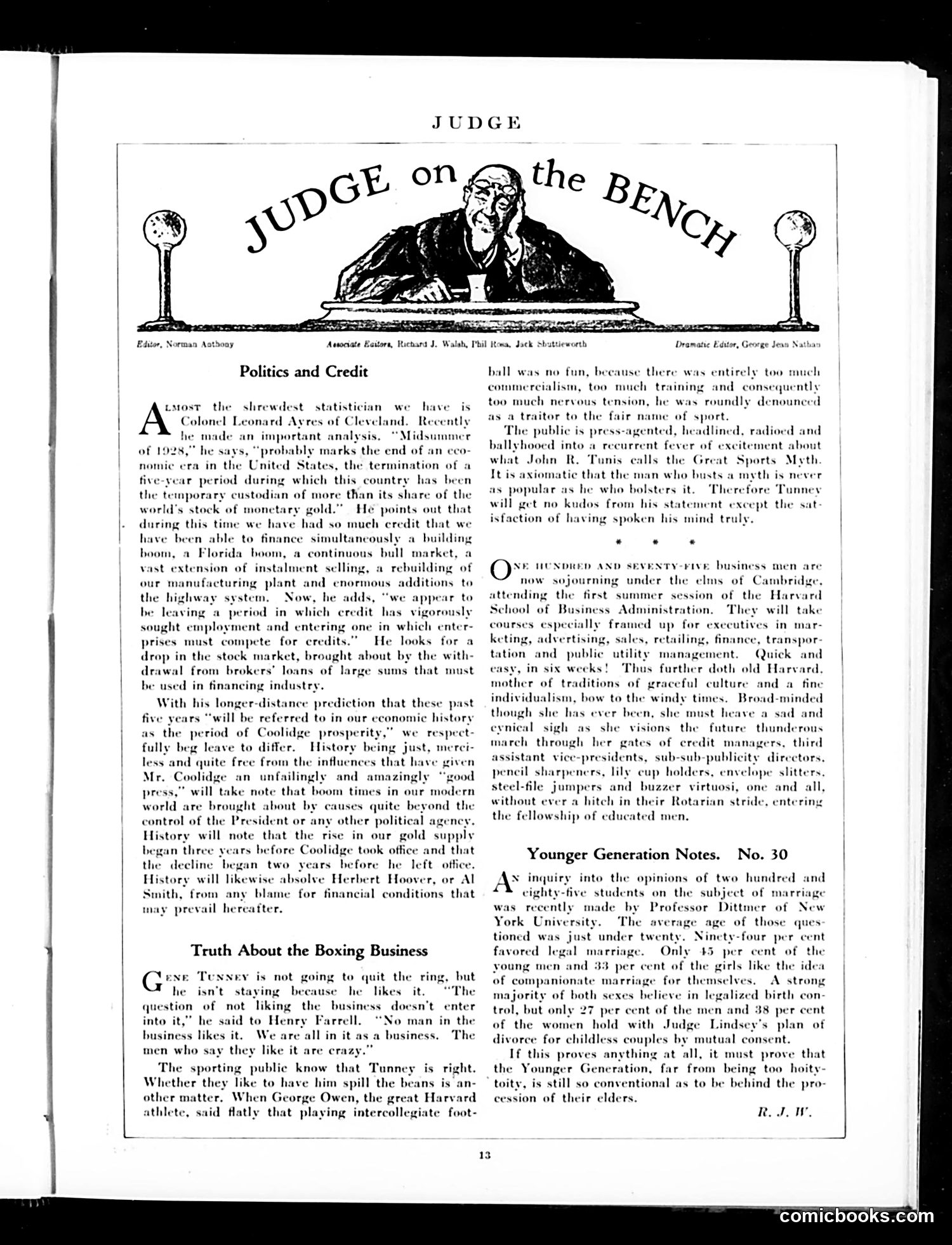
This page satirizes American prosperity and capitalism in the mid-to-late 1920s through three articles: **"Politics and Credit"** critiques crediting Coolidge's presidency for economic boom. The text argues that prosperity resulted from broader financial forces (gold supply increases, credit expansion) beginning before Coolidge took office—thus any future president shouldn't be blamed for inevitable downturns either. **"Truth About the Boxing Business"** defends boxer Gene Tunney against accusations of being mercenary, arguing that boxing is inherently commercial and that athletes claiming to love their sport "are crazy." The piece suggests the public romanticizes sports while ignoring their fundamentally profit-driven nature. **"Younger Generation Notes"** reports on Harvard business students' progressive views on marriage and divorce, contrasting their conventionality with their elders' expectations—suggesting the younger generation remains surprisingly conservative. Throughout, Judge mocks both the financial bubble (unsustainable credit-fueled boom) and the gap between public mythology and economic reality.
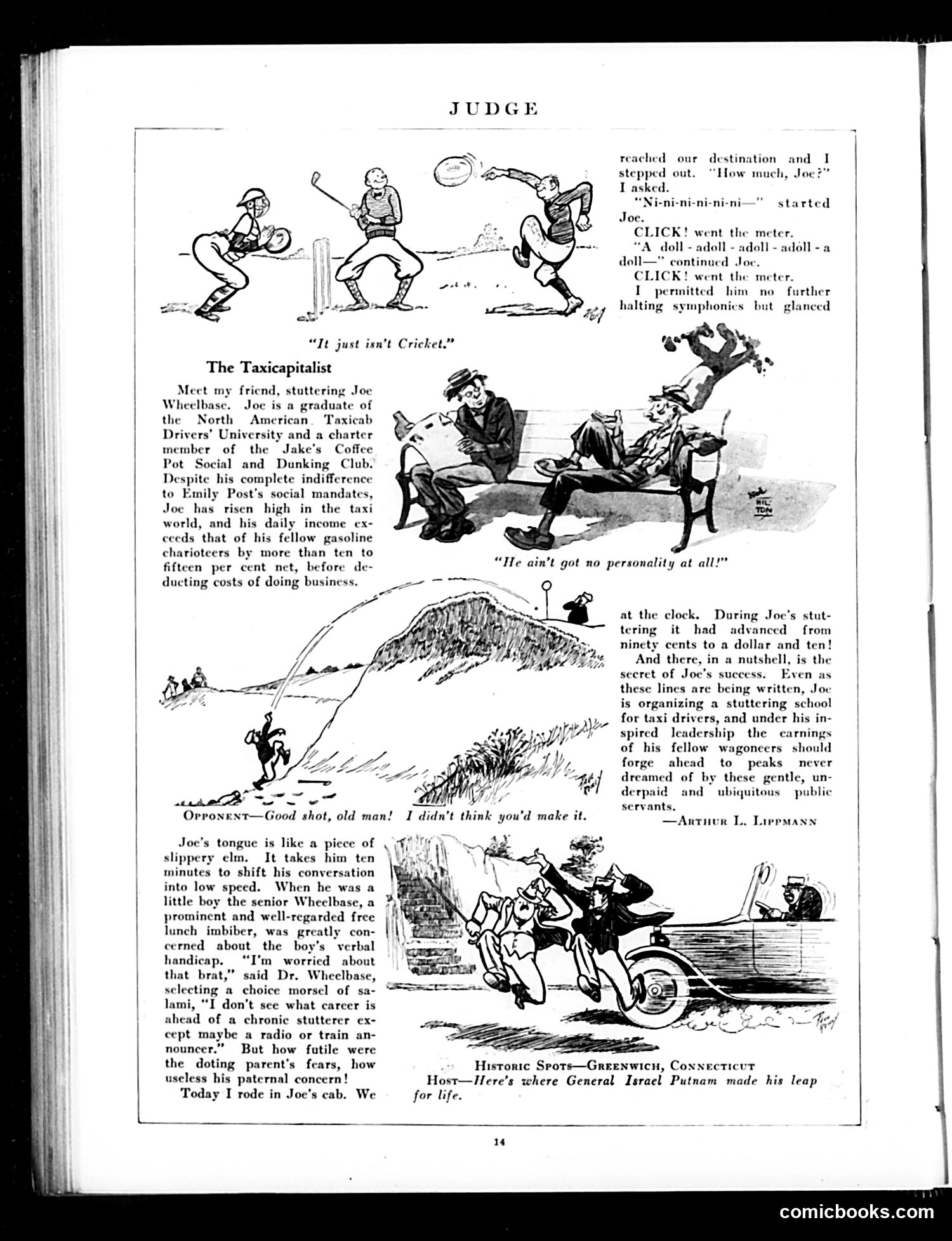
This article satirizes a taxi driver named "stuttering Joe Wheelbase" who has discovered an ingenious—if unethical—scheme to increase fares. By deliberately stuttering during rides, Joe causes the meter to run longer while passengers wait for him to finish sentences. His stutter, once seen as a career liability, becomes profitable. The satire mocks both Joe's dishonesty and the broader economic system. The piece notes Joe earns 10-15% more than fellow drivers and is now organizing a "stuttering school" to teach other taxi drivers this trick. The humor targets taxi drivers' reputation for overcharging passengers, the absurdity of monetizing a speech impediment, and the era's anxieties about labor organizing and self-improvement schemes. The title "Taxicapitalist" puns on capitalism itself, suggesting exploitation masquerading as enterprise.
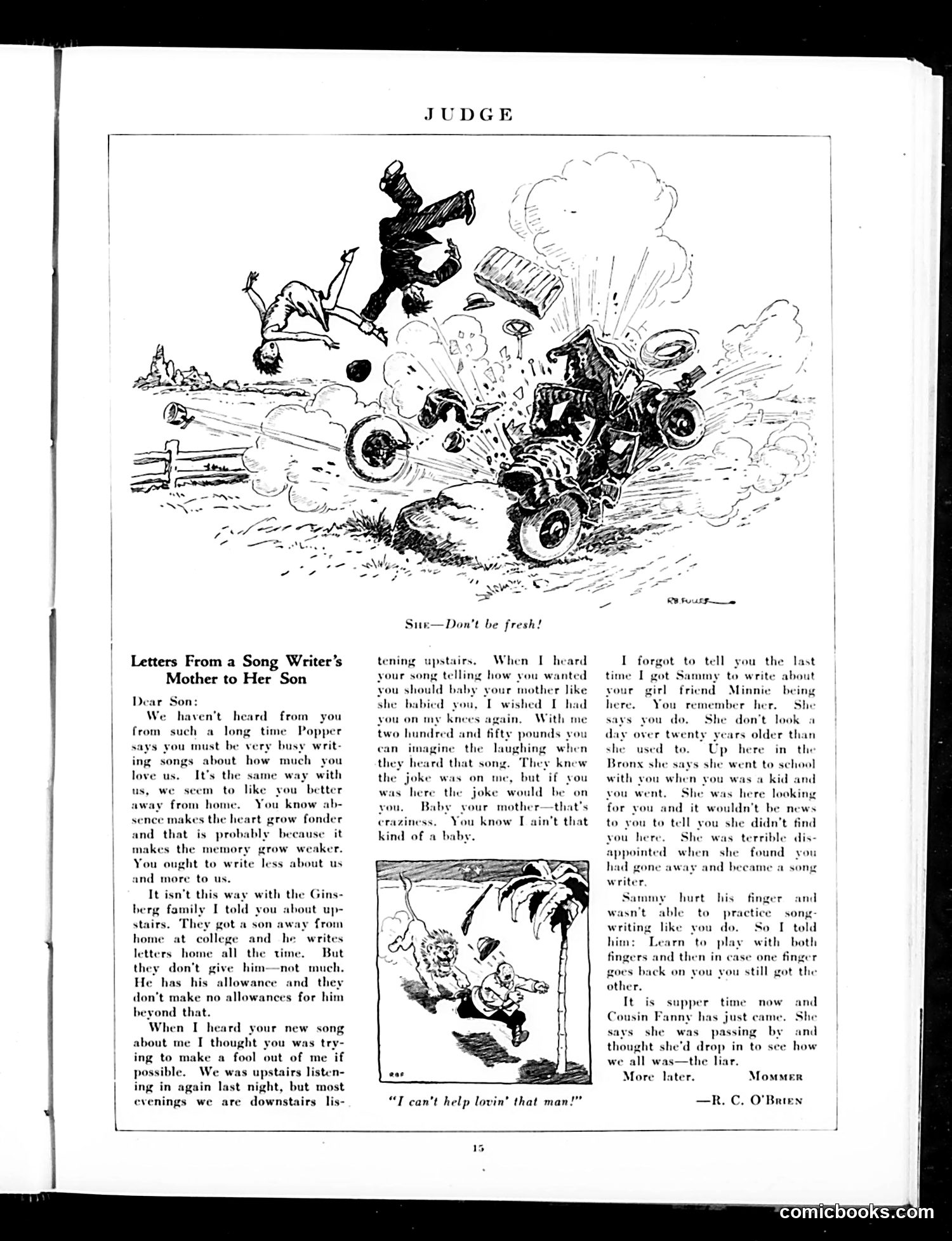
This page features a humorous letter from a mother to her son, a popular songwriter. The satire centers on the generational disconnect between old-world immigrant parents and their Americanized children pursuing modern careers. The mother complains that her son writes *songs about* her rather than *letters to* her—a jab at popular sentimental songwriting of the era. She recounts embarrassing moments, like when neighbors heard his song about her babying him (implying he's ungrateful or childish). The letter's informal, malaprop-filled language ("Popper," "was terrible dis-appointed") captures authentic immigrant speech patterns. The cartoon at bottom, titled "I can't help lovin' that man!," depicts someone caught in an explosion or chaotic situation—likely illustrating romantic misadventure mentioned in the text. The overall message mocks both sentimental popular songs exploiting family relationships and the generational divide between practical, hardworking immigrants and their entertainment-industry offspring.
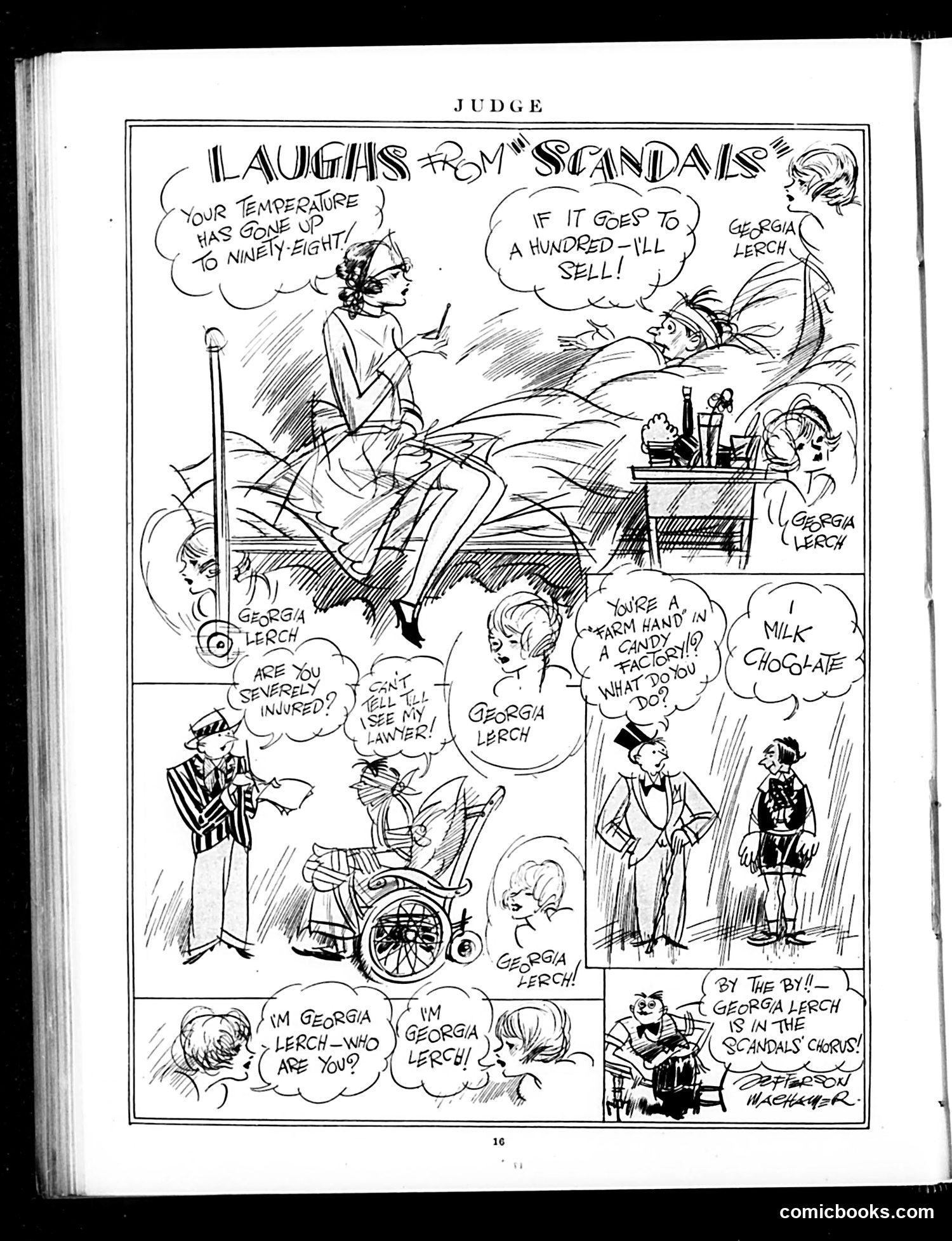
This Judge magazine comic satirizes Georgia Lerch, a public figure whose personal scandals—apparently involving temperature/fever claims, legal troubles, and questionable business dealings (farm hand, candy factory, milk chocolate ventures)—made her notorious gossip fodder. The comic mocks how her name became synonymous with scandal itself. Various characters repeatedly identify themselves as "Georgia Lerch" or reference her, suggesting her scandals were so widespread that claiming her identity became a joke. The final panel's reference to her being "in the scandals' chorus" indicates she epitomized contemporary social/moral failings being publicly discussed. The satire targets both the subject's actual misconduct and society's obsession with celebrity scandals—a timeless theme. Without knowing the specific historical context, the exact nature of Lerch's scandals remains unclear from the image alone.
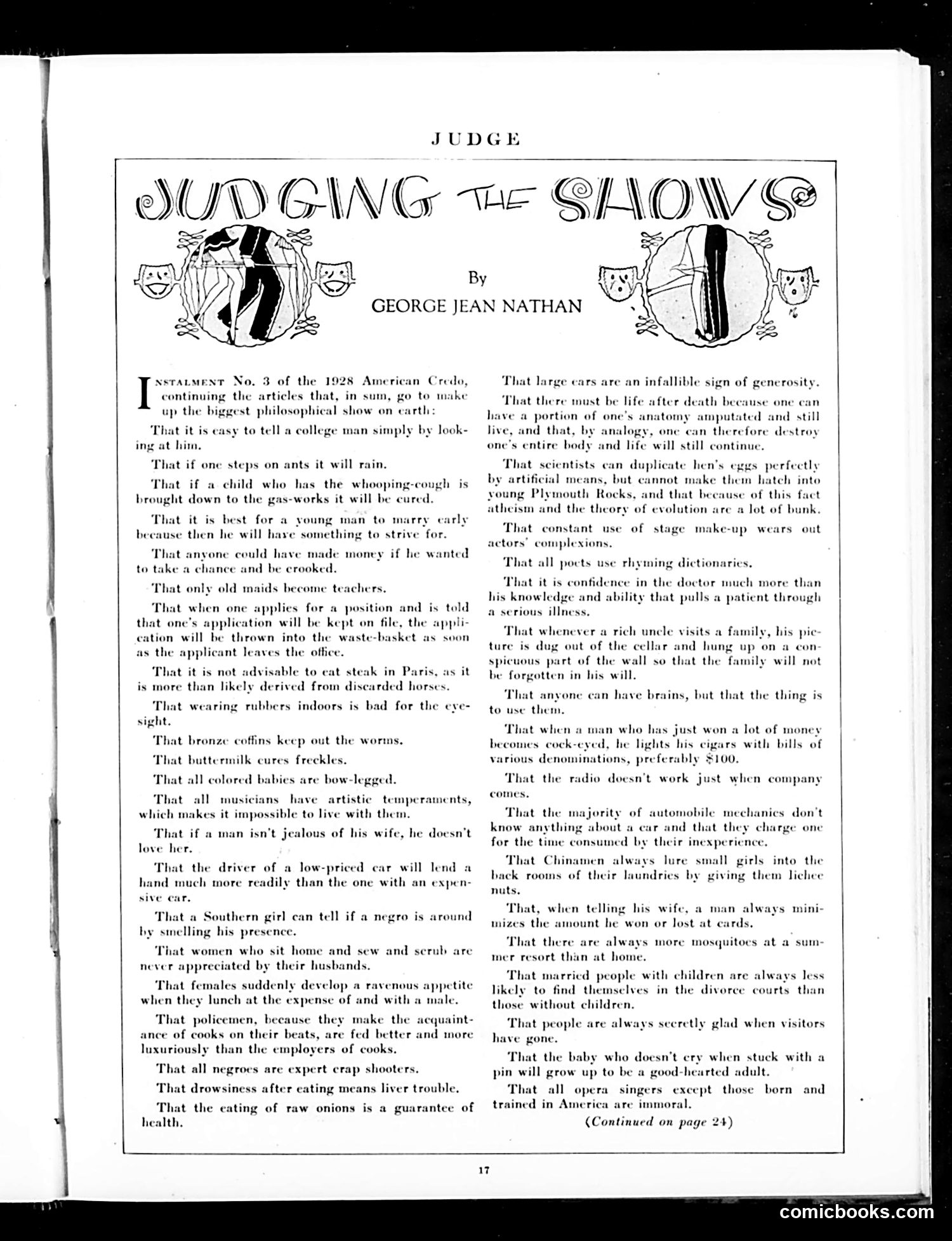
This is the third installment of satirical observations mocking popular superstitions and social prejudices of 1928 America. The piece targets widespread folk beliefs and stereotypes presented as universal "truths"—many deeply offensive by modern standards. The satire exposes era-specific superstitions (stepping on ants causes rain, buttermilk cures freckles) alongside class and racial stereotypes that reflect 1920s attitudes. References include dismissive characterizations of Black Americans, condescending observations about Southern culture, and gender stereotypes about wives and domestic workers. Nathan, a prominent theater critic, likely aims at educated readers, inviting them to recognize these "truisms" as absurd. The humor depends on readers catching the contradiction between claiming these are universal beliefs while recognizing their ridiculousness. This format—collecting illogical assertions—was popular satirical technique of the era.
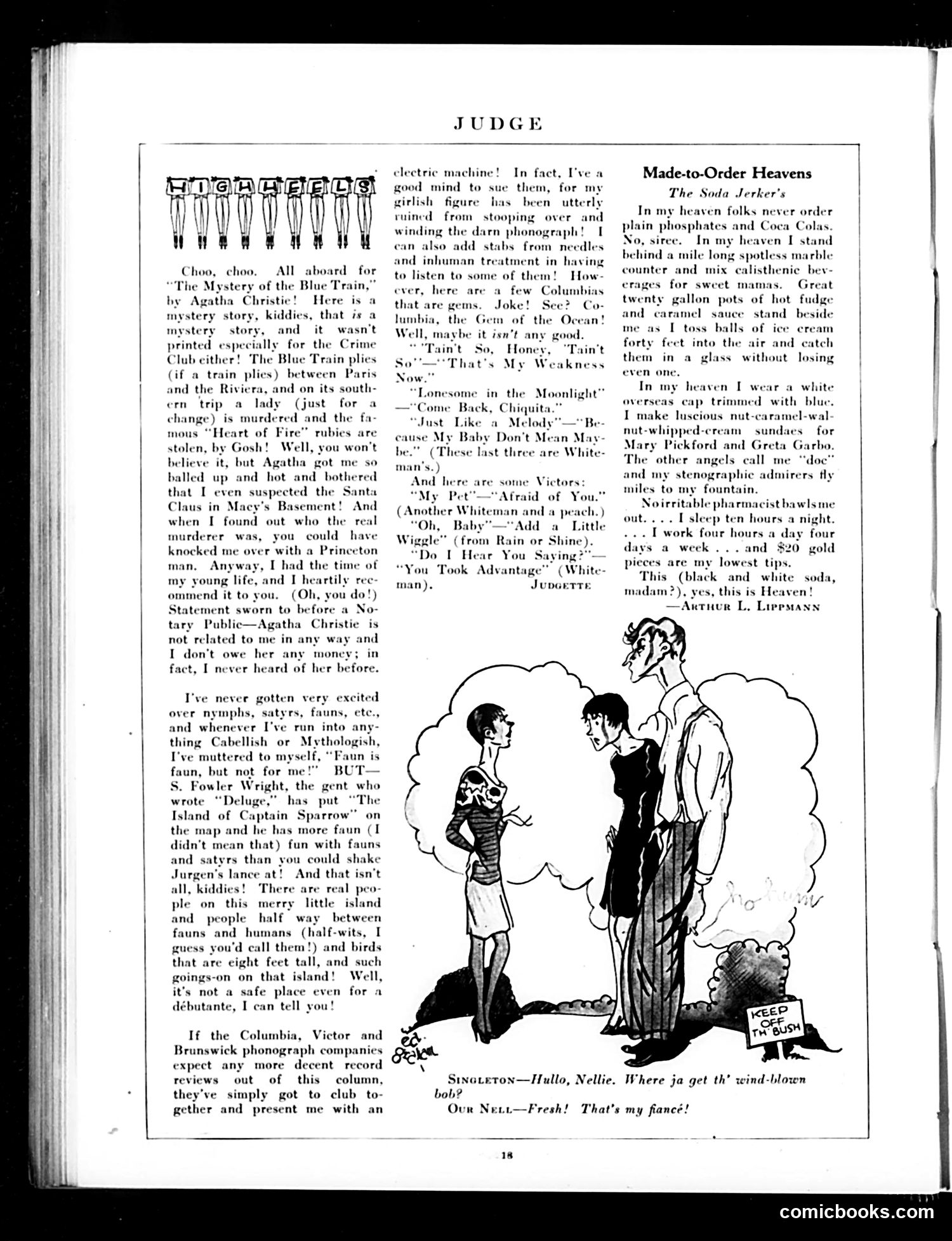
This page contains two distinct pieces of satirical content: **Left Column - Book Reviews:** The critic humorously reviews mystery and fantasy novels, including Agatha Christie's "The Mystery of the Blue Train" and S. Fowler Wright's "The Island of Captain Sparrow." The satire mocks the critic's overwrought reactions to these stories—claiming Christie's plot was so confusing he suspected even a department store Santa, and Wright's mixing of humans and eight-foot fauns on an island as utterly implausible. The affidavit-style disclaimer about Christie is comedic self-protection. **Right Column - "Made-to-Order Heavens":** A soda jerker fantasizes about his ideal heaven: working behind a marble counter, tossing ice cream balls forty feet in the air, wearing a crisp uniform, attended by admirers including Mary Pickford and Greta Garbo, sleeping ten hours nightly, and receiving only gold pieces as tips. **Bottom Cartoon:** Two figures discuss a wind-blown hairstyle, with suggestive innuendo about its origin. The humor targets 1920s popular culture, working-class aspirations, and romance.
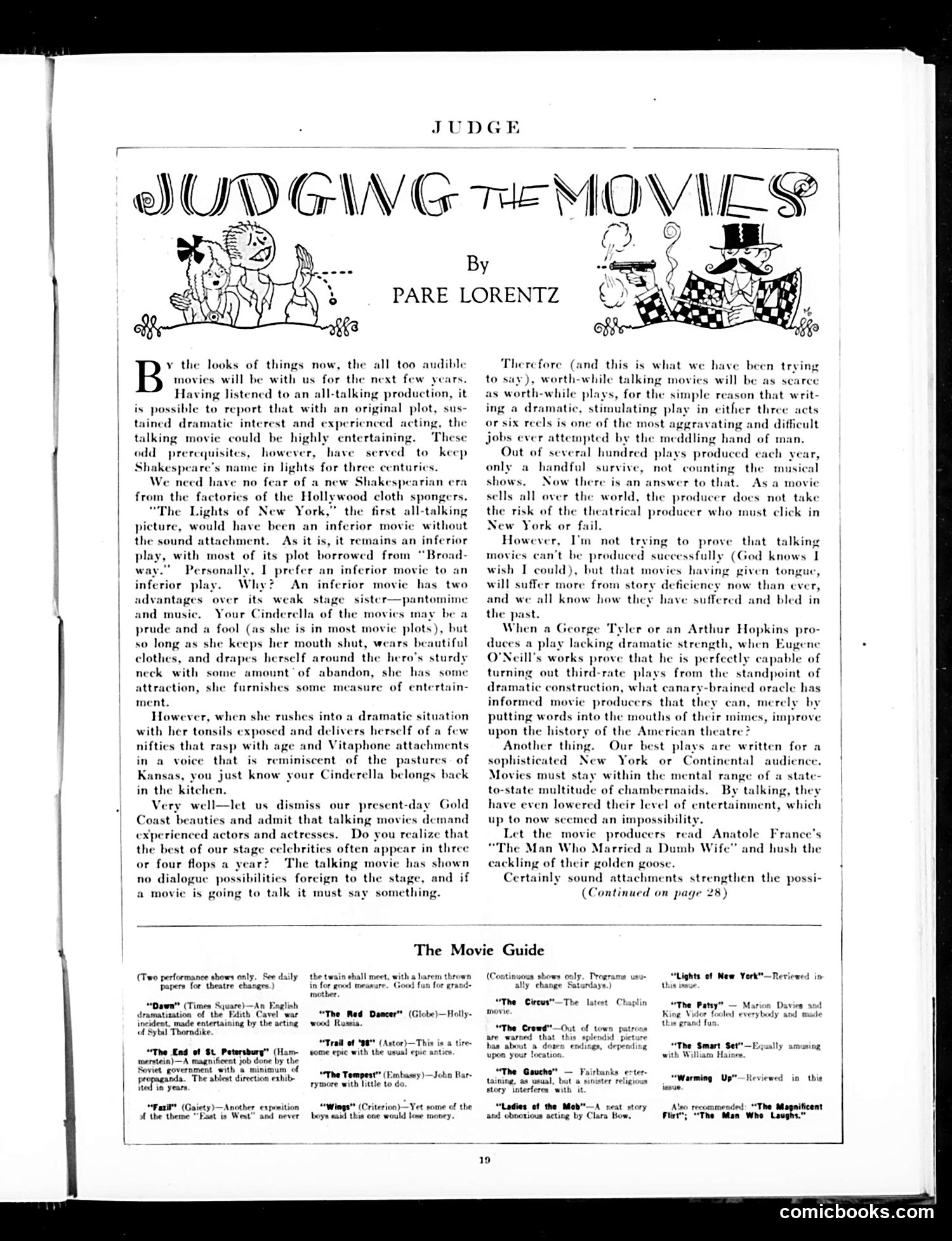
This is a critical essay, not a cartoon. Lorentz argues that **talking pictures will fail** because they require strong dramatic writing—a skill Hollywood lacks. His main points: Early talkies like "The Lights of New York" succeed *despite* dialogue, not because of it. Silent films relied on pantomime and music to disguise weak plots and poor acting. Once movies talk, they expose these deficiencies. Stage actors often fail in film; even great playwrights like O'Neill produce weak work. Moreover, movies must appeal to mass audiences across America, not sophisticated New York theatergoers—so intelligent dialogue is impossible. Lorentz sarcastically warns producers not to kill "the golden goose" by adding sound. The essay reflects **genuine 1920s anxiety** that synchronized sound (recently invented) would destroy cinema's artistic potential by forcing it to compete with legitimate theater on theater's terms—and lose.
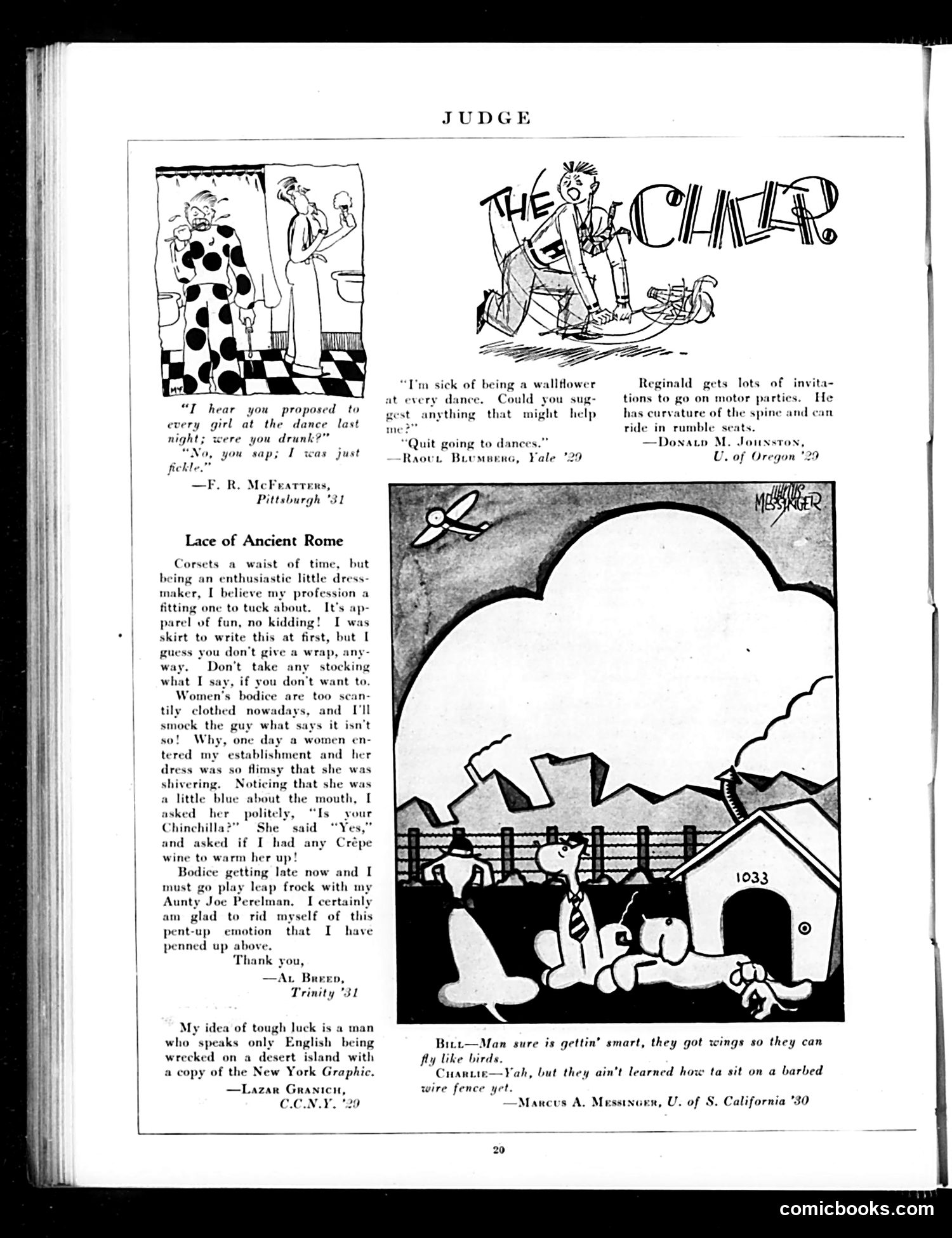
This page contains humorous reader submissions and cartoons satirizing 1920s college and social life. **Top cartoon** ("The Chill"): Mocks young men's awkward dating attempts. The dialogue jokes about a wallflower seeking help at dances and another character, Reginald, who gets motor-party invitations despite having a curved spine—implying he's physically unattractive yet socially active, likely because he owns a car (the rumble seat reference suggests he can offer rides). **Lower cartoon**: Features anthropomorphic birds or creatures discussing human intelligence. The joke contrasts birds learning to fly with their inability to perch on barbed wire fences—a nonsensical comparison meant to mock the notion of animal "progress." **Text pieces** are lighthearted essays from college readers (Yale, Oregon, Trinity, CCNY) about fashion (corsets), social anxiety, and relationships—typical college-magazine humor reflecting post-WWI youth culture concerns with dating, dancing, and modern courtship rituals. The overall tone is genteel satire aimed at educated, affluent readers.
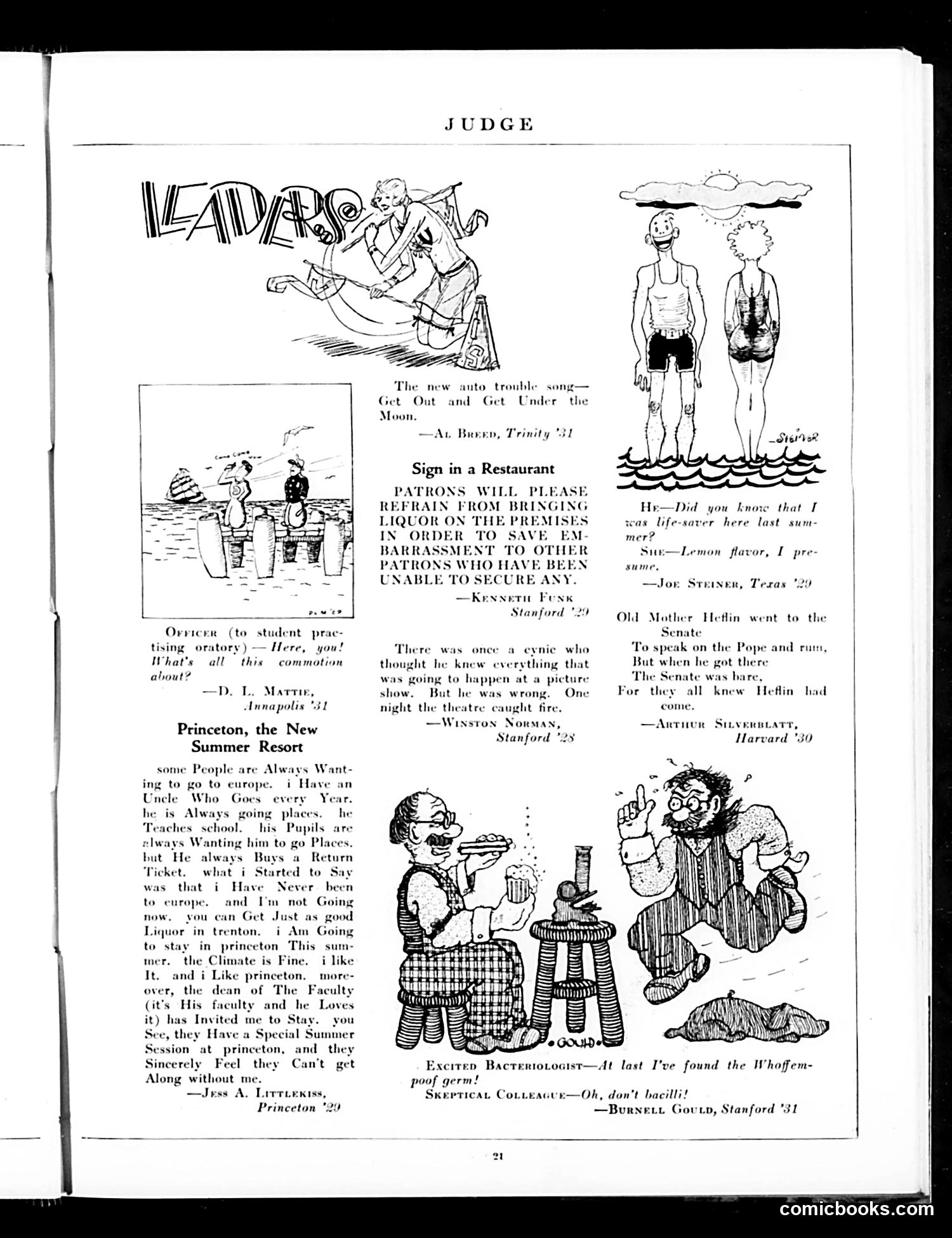
This page contains college humor from circa 1920-31, featuring satirical quips and cartoons by university students. Key content includes: **"Princeton, the New Summer Resort"**: A joke about a student staying at Princeton for summer session rather than traveling to Europe, praising the local liquor in Trenton—likely mocking Prohibition-era constraints and the appeal of easily accessible alcohol. **"Sign in a Restaurant"**: Satirizes Prohibition enforcement by depicting a notice asking patrons not to bring liquor, framed as preventing embarrassment to other guests who "have been unable to secure any"—the joke being that no one can legally obtain alcohol anyway. **The bacteriologist cartoon**: A pun-based joke where one scientist announces discovering a germ, and the colleague responds "don't bacilli!"—a wordplay on the bacterial term *bacillus*. **"Old Mother Heflin"**: References Senator Thomas Heflin (likely), suggesting his arrival at the Senate embarrasses colleagues. The page reflects 1920s college culture: anti-Prohibition sentiment, scientific humor, and political satire aimed at collegiate readers.
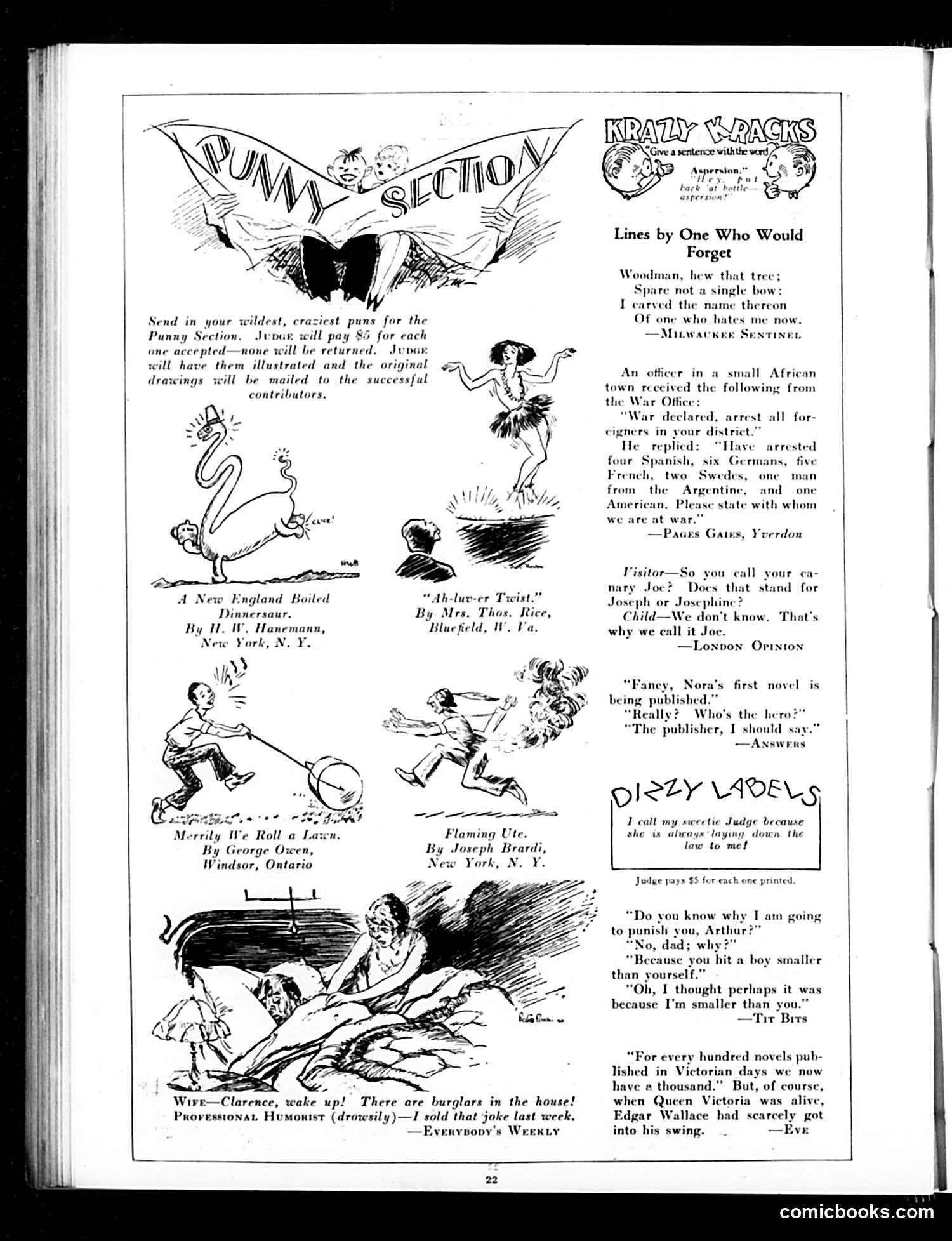
This page features Judge magazine's "Punny Section"—a humor column soliciting reader-submitted puns and visual jokes. The publication paid $5 per accepted pun, offering modest payment for amateur comedic contributions. The cartoons illustrate submitted puns through visual wordplay: - "A New England Boiled Dinnersaur" depicts a dinosaur as dinner - "Merrily We Roll a Lawn" shows people rolling a lawn like a carpet - "Flaming Ute" references a Native American tribe as a visual gag - "An Ab-lu-er Twist" plays on dance terminology The right column contains short joke items ("Krazy Kracks" and "Dizzy Labels"), including a wartime joke about an African officer arresting foreign nationals, and commentary on early 20th-century novel publishing. The humor reflects period attitudes: casual ethnic references, wordplay, and domestic comedy. This represents early American magazine humor before modern sensibilities shifted what counted as acceptable satire.
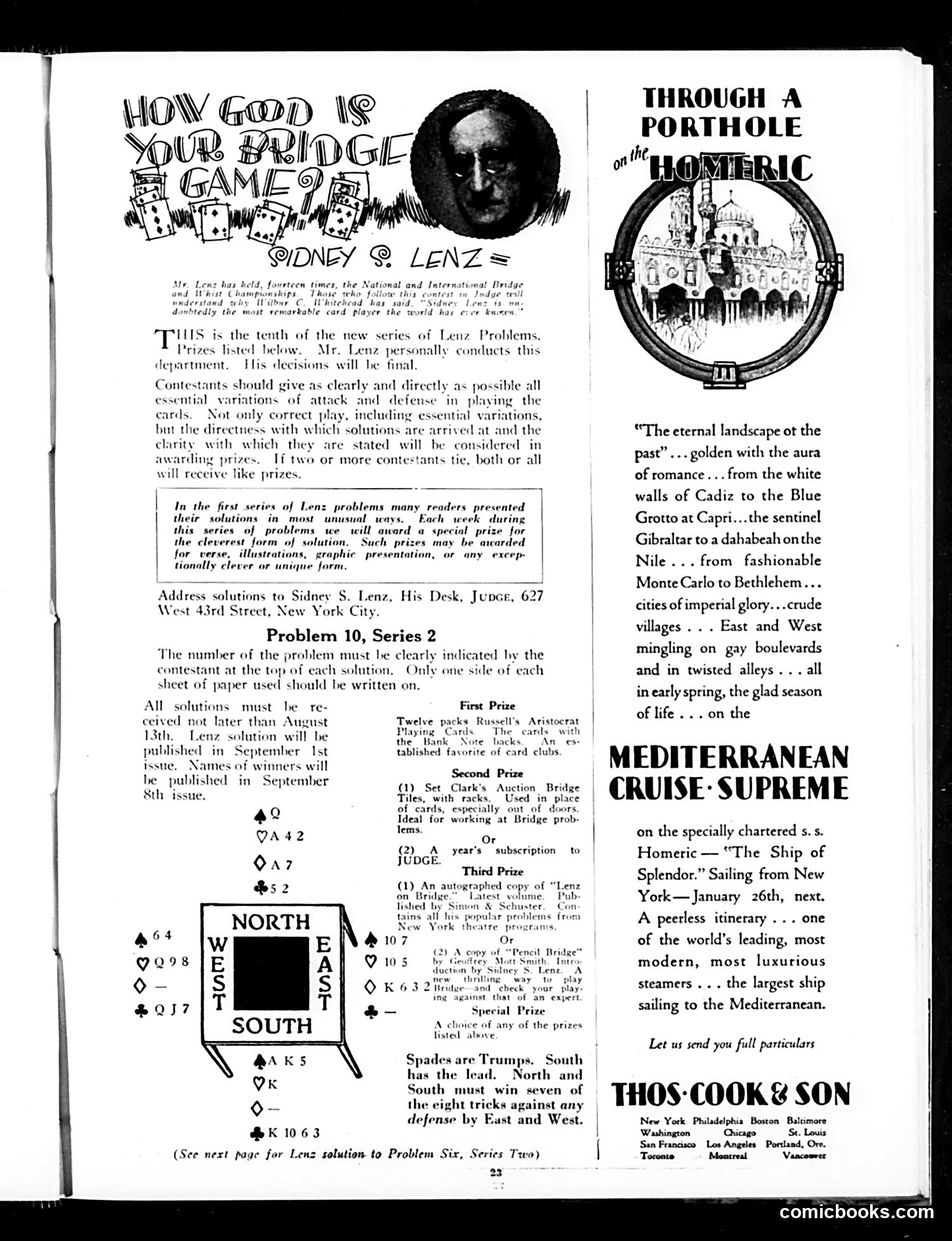
This page contains two distinct sections: **Left side - Bridge Problem Contest:** Sidney Lenz, a renowned bridge champion, presents "Problem 10, Series 2" of his instructional bridge problems for Judge magazine's readers. Contestants submit solutions analyzing card play strategy, with prizes including Russell's Aristocrat playing cards, bridge tiles, and a Judge magazine subscription. This reflects bridge's popularity as a parlor game among early 20th-century middle and upper-class Americans. **Right side - Travel Advertisement:** A full-page ad for Thomas Cook & Son promoting a Mediterranean cruise aboard the s.s. Homeric, departing January 26th. The romantic language ("eternal landscape of the past," "golden with the aura of romance") and destinations listed (Cadiz, Monte Carlo, Bethlehem, the Nile) appeal to affluent travelers seeking cultural tourism and exotic experiences—typical aspirational advertising for Judge's readership during the prosperous 1920s. No political satire appears on this page; it's primarily content and advertising.
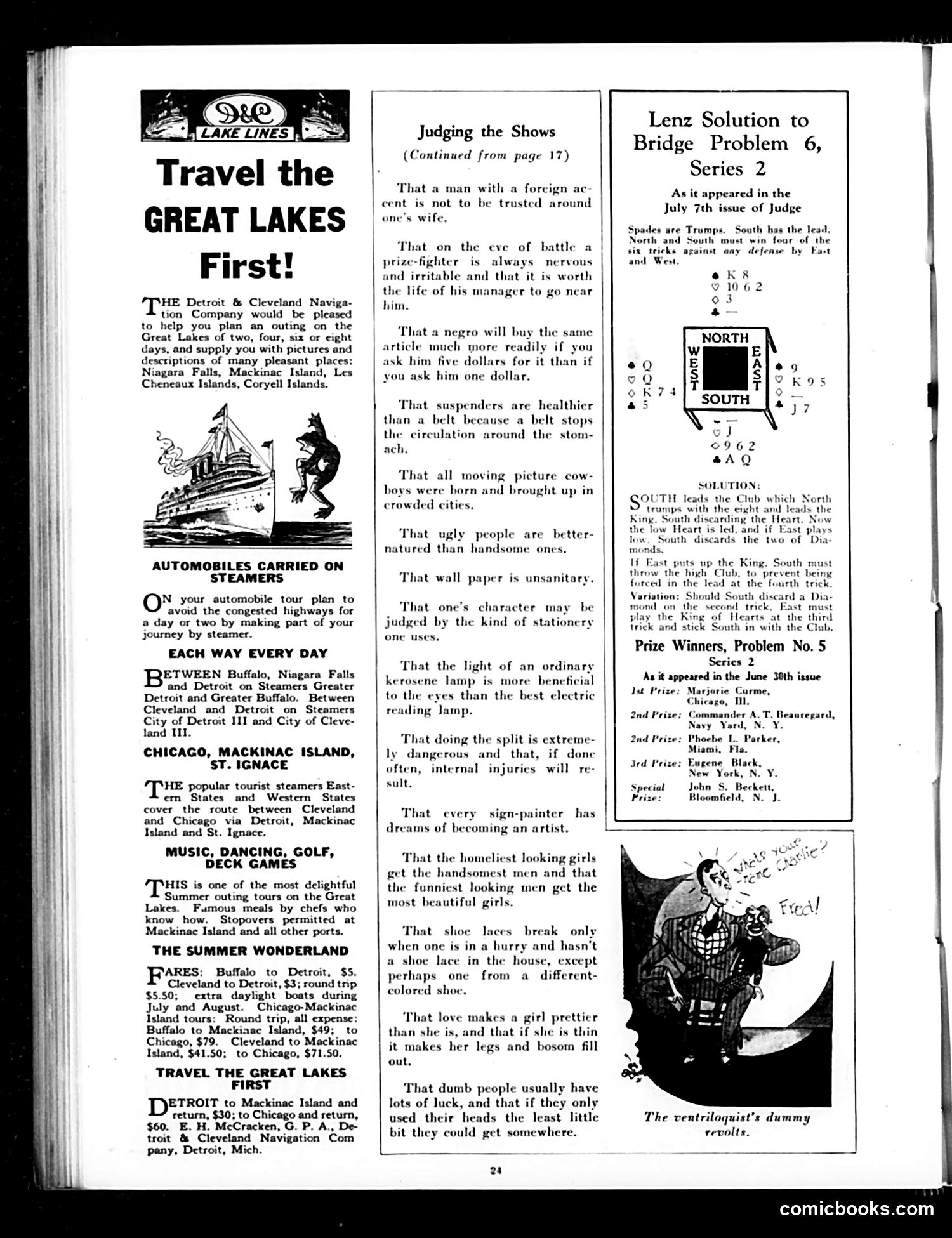
This page is primarily **advertising and humor content**, not political satire. The left side promotes Great Lakes steamship travel by the Detroit & Cleveland Navigation Company, listing destinations like Niagara Falls and Mackinac Island with pricing. The center column, "Judging the Shows," is a **humorous essay of social stereotypes and folk wisdom** — observations presented as ironic "truths." These include offensive racial stereotypes (about Black customers), gender stereotypes (about women's appearance), and absurd claims (about shoe laces and luck). The humor relies on exaggeration and contradiction rather than topical satire. The right side shows a **bridge card game solution** — a puzzle for readers to solve, common in period magazines. The cartoon illustration at bottom right depicts a ventriloquist's dummy, accompanying the text about people's appearance and luck. **Overall context**: This is a typical Judge magazine page from the early 20th century mixing advertisements, recreational puzzles, and light satirical humor based on social prejudices and observations of everyday life — not commentary on current events or politics.
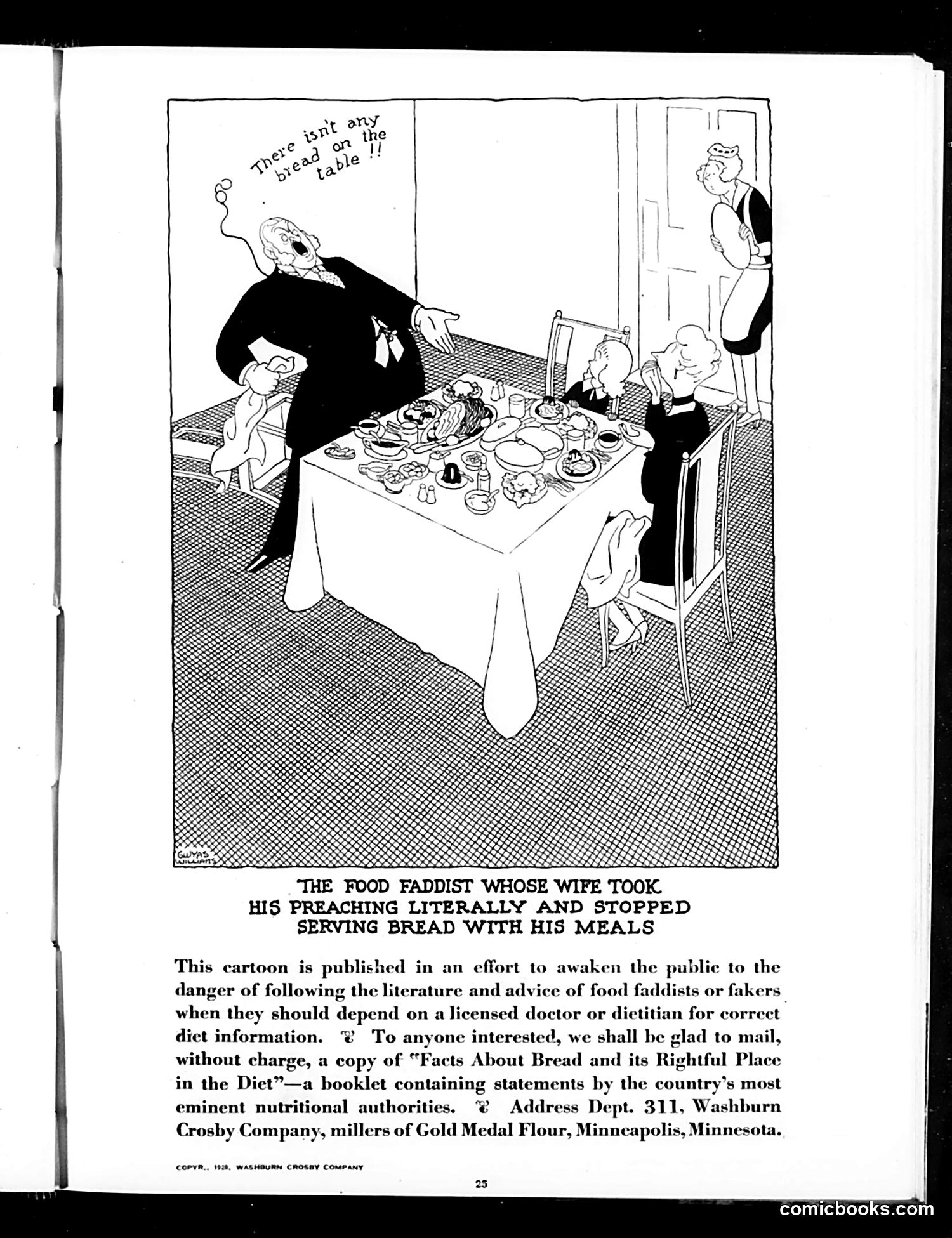
This is a **paid advertisement disguised as editorial satire**, published by Washburn Crosby Company (makers of Gold Medal Flour) circa 1928. The cartoon depicts a thin, haggard man at a dinner table with his family, complaining "There isn't any bread on the table !!" His wife and children appear well-fed while he looks emaciated—the visual joke being that he preached against eating bread as a "food faddist," and his literal-minded wife stopped serving it entirely, leaving him malnourished. The advertisement's real message: **don't follow dietary fads from unqualified sources**—a thinly veiled attack on the anti-bread diet movement of the 1920s. The company uses this satire to promote bread consumption and position themselves as aligned with "licensed doctors" and "eminent nutritional authorities." This reflects early 20th-century anxieties about health trends and represents corporate messaging strategically packaged as humorous social commentary.
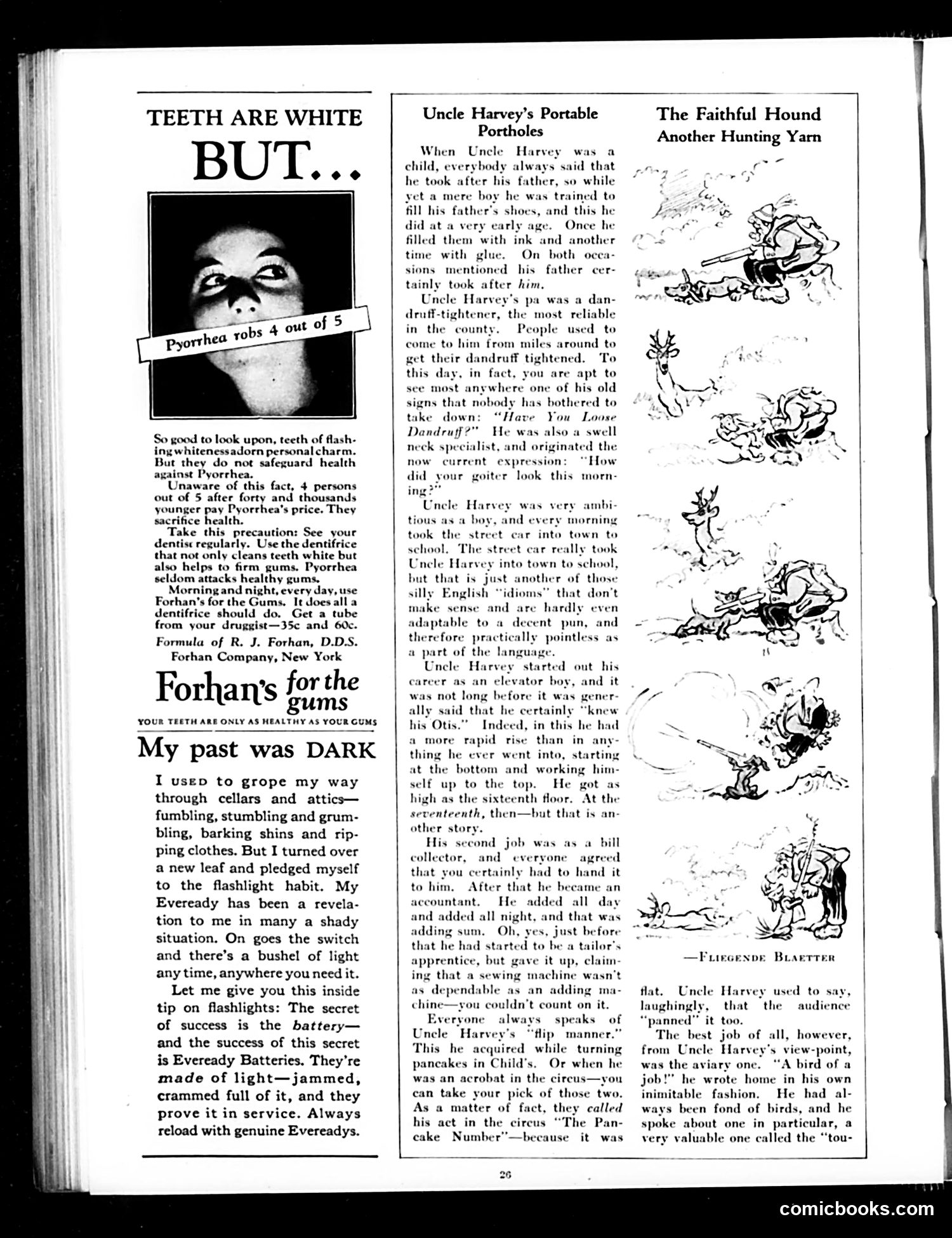
This page contains three distinct pieces of 1920s-era content: **Left side:** Two product advertisements—Forhan's toothpaste (emphasizing gum health and pyorrhea prevention, a widespread dental concern of the era) and Eveready batteries. The battery ad uses a "before/dark past" conversion narrative common in early advertising, positioning the product as life-transforming. **Right side:** A humorous short story about "Uncle Harvey," a folksy character who cycles through various jobs (elevator operator, bill collector, accountant, tailor's apprentice, circus acrobat, bird keeper). The humor derives from puns and wordplay—his "flip manner" as a pancake artist, being "panned" by audiences—and absurdist exaggeration typical of Judge's comedy style. **The cartoon:** "The Faithful Hound: Another Hunting Yarn" features simple, cartoonish illustrations of a dog hunting, likely a tall-tale setup for humorous payoff (text is cut off). The page reflects early 20th-century magazine advertising and light humor targeted at general readers.
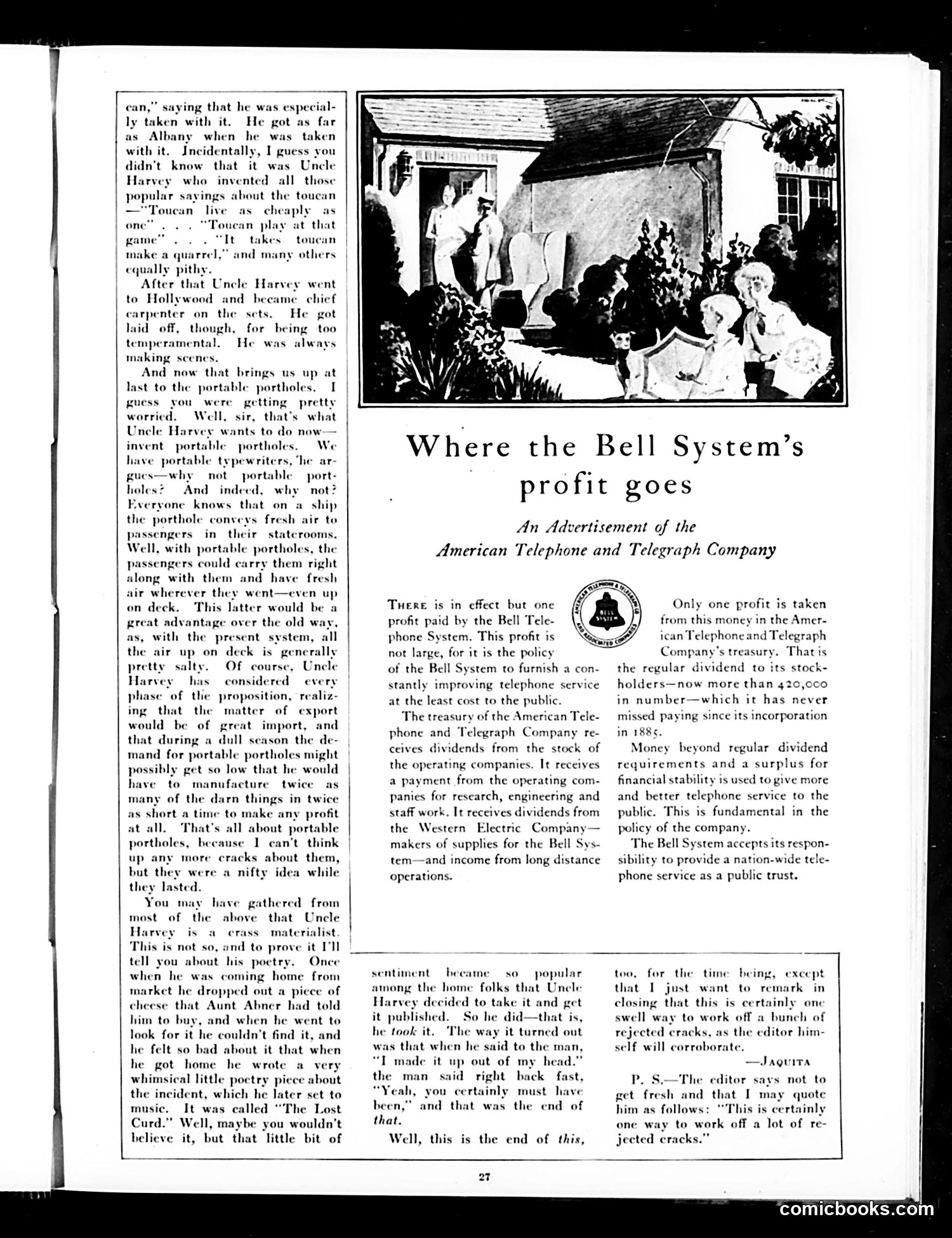
This page contains **two distinct elements**: a humorous narrative about "Uncle Harvey" (left column) and a corporate advertisement (right side). ## The Narrative The Uncle Harvey story is satirical fiction mocking an obsessively materialistic inventor character. It catalogs his failed schemes—from toucan sayings (puns like "toucan live as cheaply as one") to portable portholes for ships. The satire attacks his mercenary thinking: he worries portable portholes won't sell enough during slow seasons. A brief aside attempts to prove he's not purely greedy by citing his poetry—a whimsical piece titled "The Lost Curd"—but this only reinforces the satire of his mundane, commercial mindset. ## The Advertisement The AT&T/Bell System ad on the right uses this space to defend their profit practices, claiming they prioritize service improvements over shareholder returns. They emphasize reinvestment in infrastructure as a "public trust." **The irony**: The materialistic Uncle Harvey narrative sits directly beside corporate spin justifying profits—creating unintended commentary on business rhetoric of the era. The page number indicates this is from an early-20th-century issue (pre-1920s style).
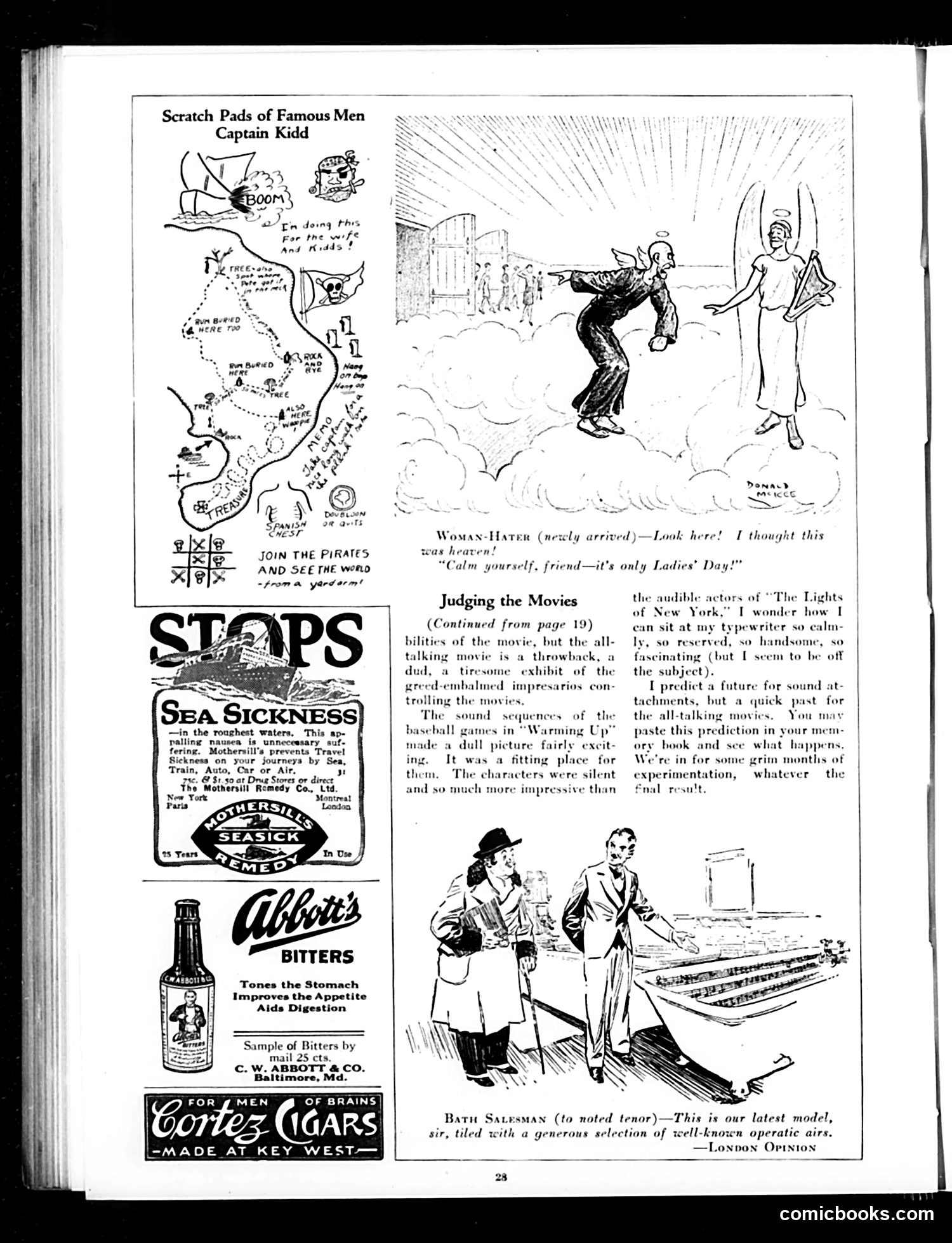
**Top Left Section:** A humorous sketch labeling various doodles as "scratch pads" from the famous pirate Captain Kidd, with annotations referencing his ships, treasure, and criminal activities. It's a playful historical joke treating Kidd's actual notes as if they were personal doodles. **Top Right Cartoon:** A "Woman-Hater" newly arrived in heaven encounters a woman with raised arms. The joke plays on the concept of Ladies' Day—suggesting even in paradise, this misogynist cannot escape women, undermining his expectations of a male-only heaven. **"Judging the Movies" Section:** A film critic discusses recent movies, particularly criticizing "The Lights New York" and "Warming Up." The reviewer dismisses talking pictures as a "throwback" and "dud," predicting sound attachments won't last—a prescient but ultimately wrong prediction from the silent-film era transitioning to talkies. **Bottom Cartoon:** A bath salesman pitches his product to an opera tenor, claiming it's filled with "operatic airs"—a pun on both musical airs and the product's actual purpose.
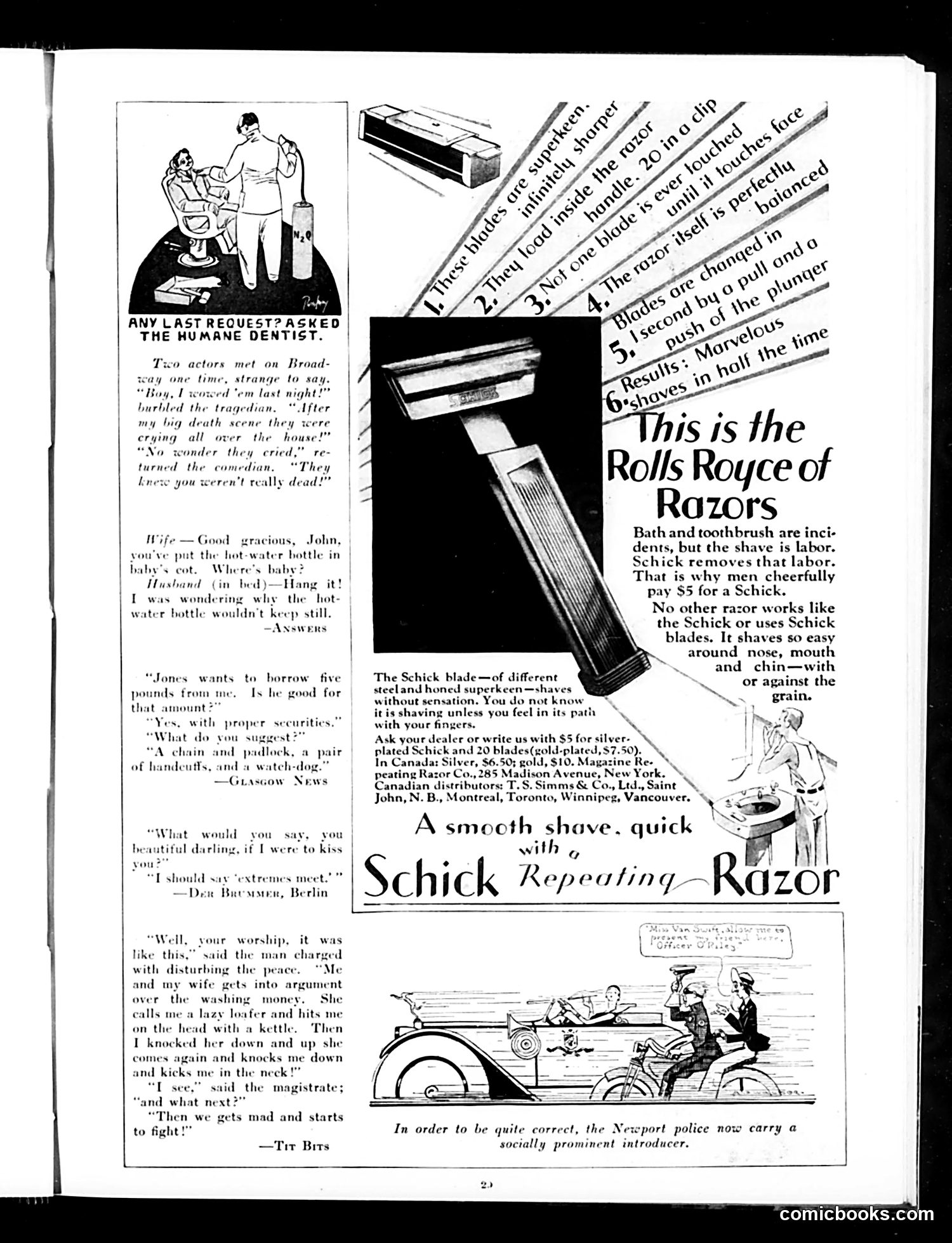
This page combines humor pieces with a Schick razor advertisement. The left side features several brief comedic anecdotes: a dentist joke, an exchange between two Broadway actors about fake emotional reactions, domestic humor about a hot-water bottle, and a magistrate hearing a case about a couple's domestic dispute over laundry money. The main advertisement (right side) promotes the Schick "Repeating Razor" as the premium shaving product—the "Rolls Royce of Razors"—charging $5 (expensive for the era). It emphasizes the innovation of its blade design and ease of use around facial contours. The bottom cartoon satirizes Newport police by suggesting they now employ "a socially prominent introducer" when making arrests—mocking the pretensions of Newport society and implying police must accommodate the class status of wealthy arrestees. The page reflects early 20th-century concerns: domestic discord, theatrical exaggeration, class consciousness, and masculine grooming as a commercial concern.
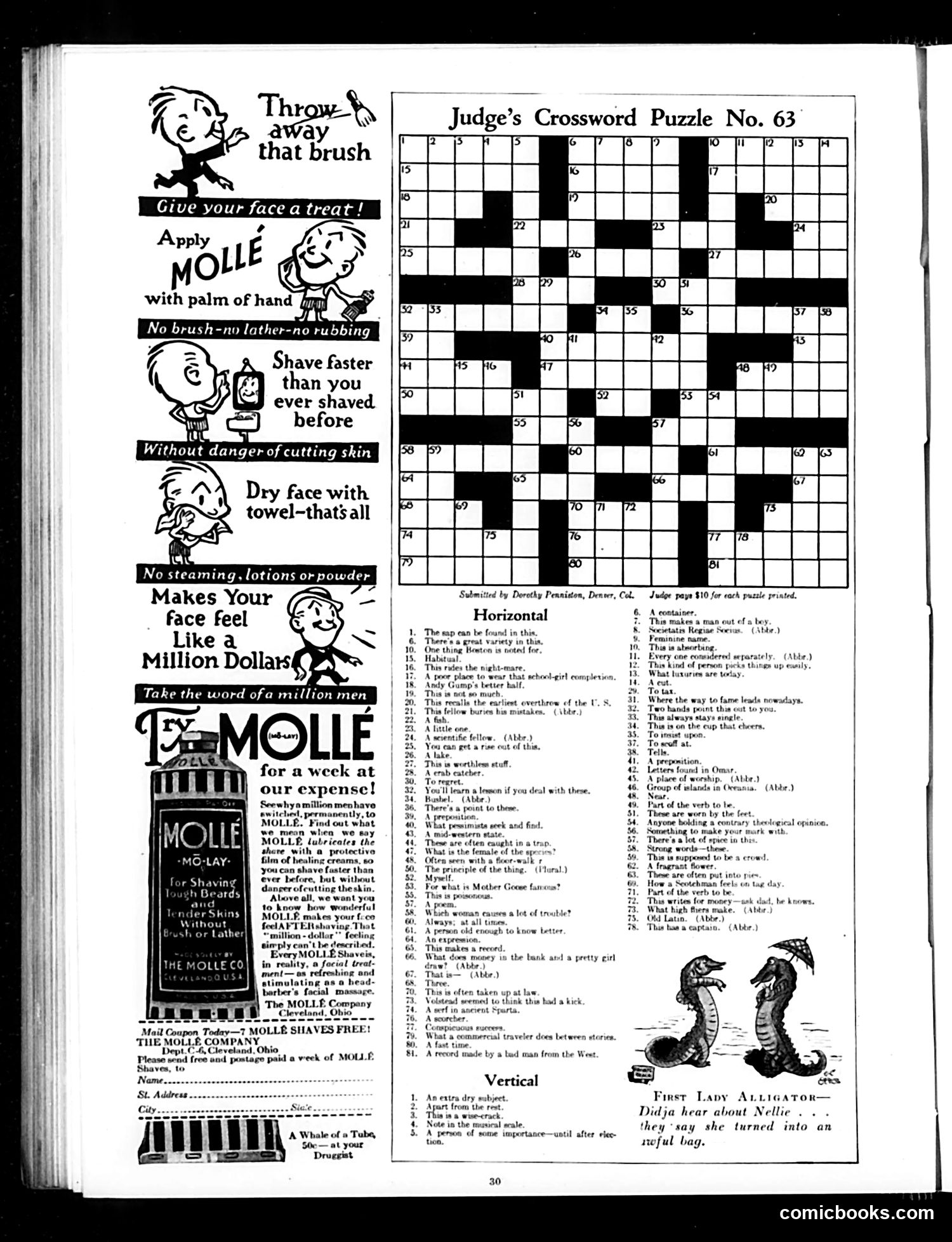
This page is primarily a **crossword puzzle advertisement** for Mollie shaving cream, not a political cartoon. The left side features vintage advertising for Mollie, a men's grooming product, with cartoon mascots demonstrating its use ("Apply Mollie with palm of hand," "Shave faster than you ever shaved before"). The ads emphasize speed, comfort, and no irritation—typical early 20th-century grooming product marketing. The right side contains **Judge's Crossword Puzzle No. 63**, a standard crossword with horizontal and vertical clues submitted by Dorothy Penniston of Denver. The clues are typical word puzzles referencing common knowledge, wordplay, and abbreviations. At the bottom right is a small cartoon labeled "First Lady Alligator," showing two alligators discussing "Nellie" who "turned into an nutfull bag"—appears to be a brief humorous anecdote unrelated to the crossword. This is primarily **advertising and entertainment content** rather than satirical commentary.
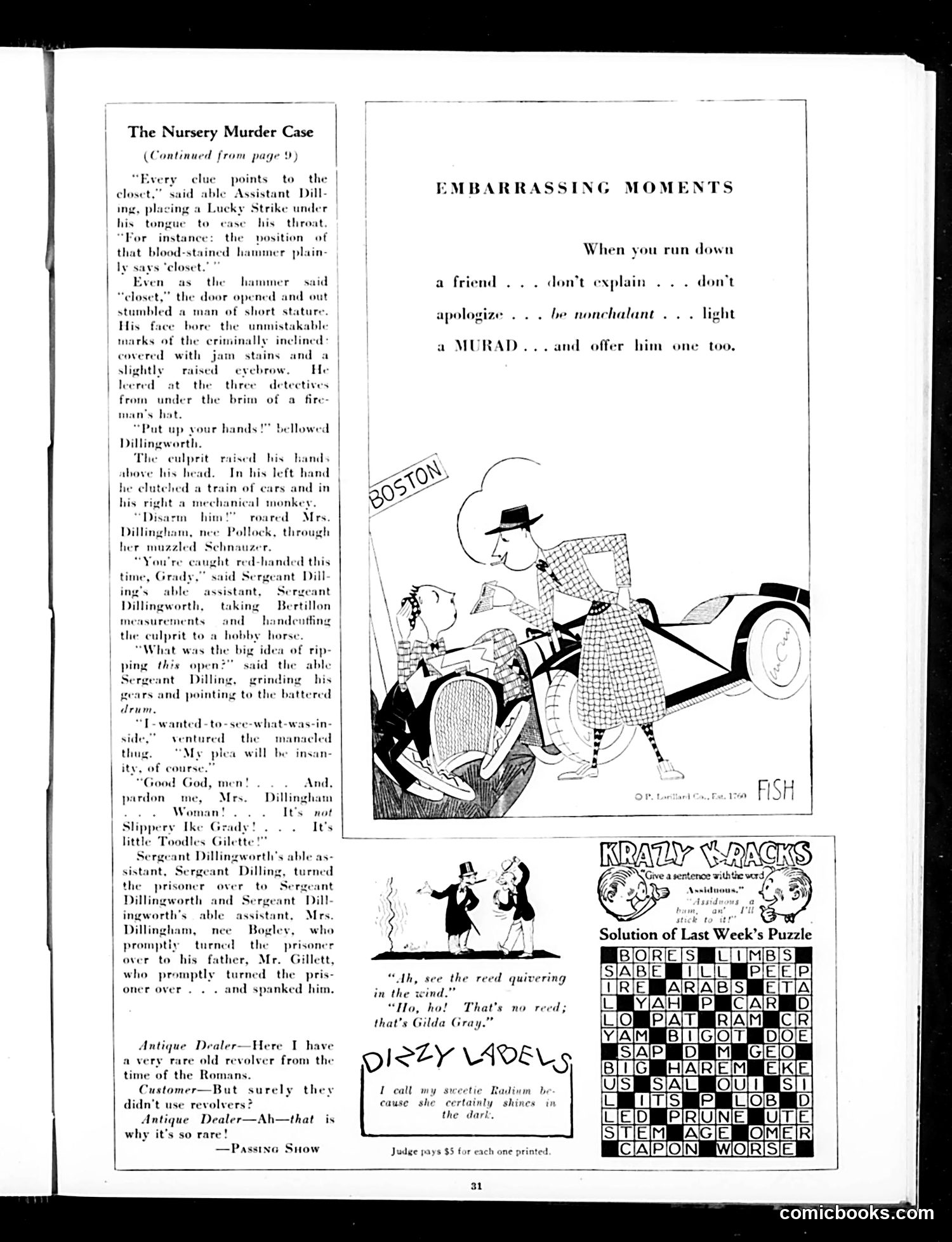
This page parodies detective fiction through an absurdist mystery story. The narrative follows detectives investigating a "murder" that turns out to involve a small child (likely "little Toodles Gilette") caught with toys—a train set and mechanical monkey. The humor comes from treating a child's mischief with overwrought detective-story drama, complete with dramatic arrests and interrogations about "blood-stained hammers" and "closets." The accompanying cartoons satirize modern manners. "Embarrassing Moments" mocks social awkwardness when encountering acquaintances—advising nonchalance and offering cigarettes. Other humor includes an "Antique Dealer" joke about Roman revolvers (anachronistic absurdity) and a "Dizzy Doll" reference to dancer Gilda Gray, implying she "shines" only in darkness. The overall tone ridicules both detective pulp fiction and contemporary social pretension through exaggeration.
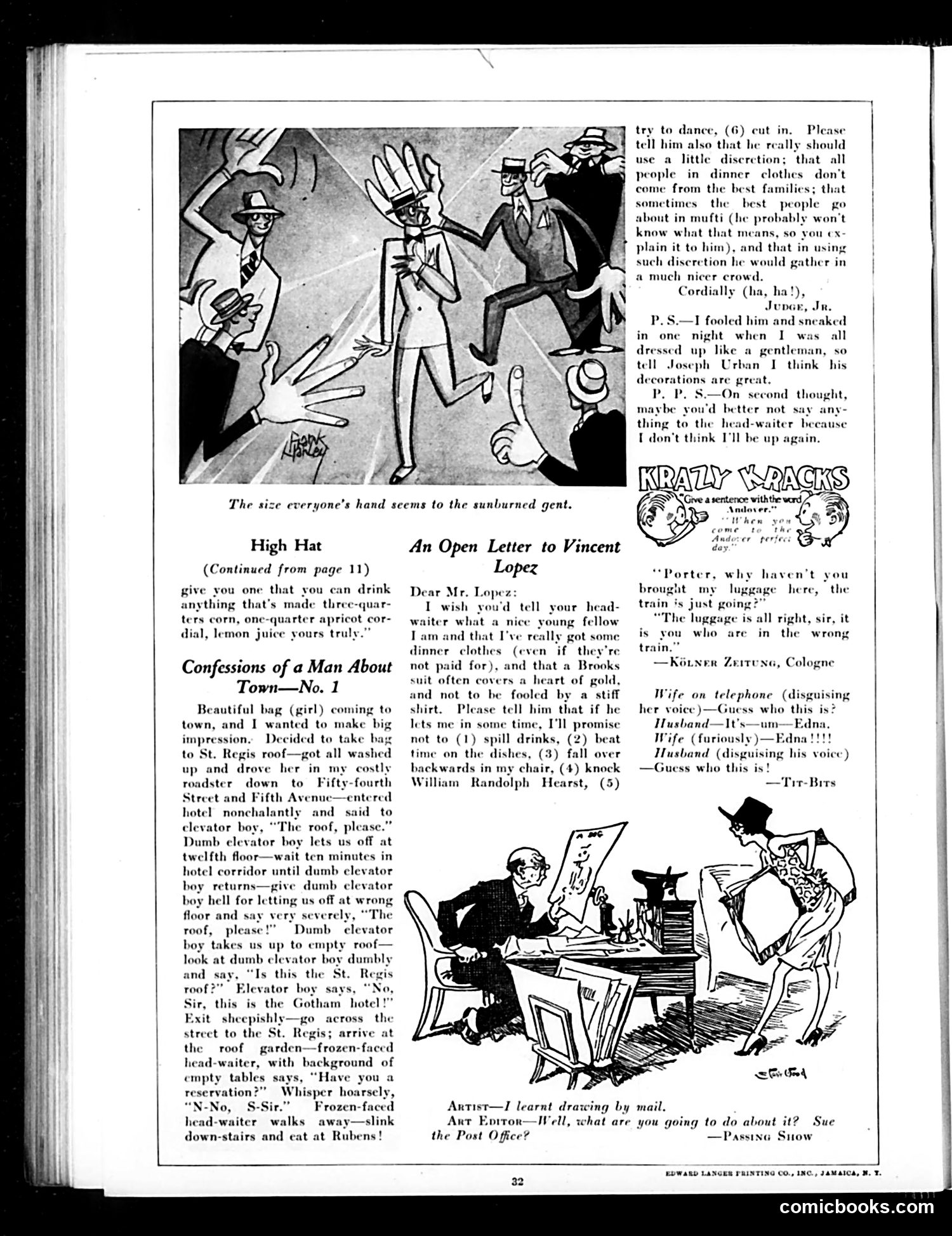
This page contains three separate satirical pieces typical of 1920s-era Judge magazine humor: **"High Hat" & "Confessions of a Man About Town"**: A social comedy about a young man trying to impress a date at the St. Regis roof garden in New York City. The joke mocks his pretentiousness—he gets humiliated when the elevator operator takes him to the wrong floor, forcing him to slink away to a cheaper restaurant (Rubens). The satire targets nouveau-riche social climbing and the pretense of sophistication among the urban middle class. **"An Open Letter to Vincent Lopez"**: References the real bandleader Vincent Lopez (popular 1920s orchestra leader). The letter humorously asks Lopez to instruct his head waiter to be less judgmental of dinner-jacketed patrons, noting they aren't all from wealthy families. It mentions "Joseph Urban" (a famous theatrical designer) and includes a joking reference to **William Randolph Hearst** (the newspaper magnate)—suggesting the writer might accidentally knock him over while dancing. **"Wife on Telephone"**: A brief domestic joke about a wife disguising her voice to test her husband's fidelity. The cartoons illustrate the social anxieties of 1920s urban life around class, etiquette, and respectability.
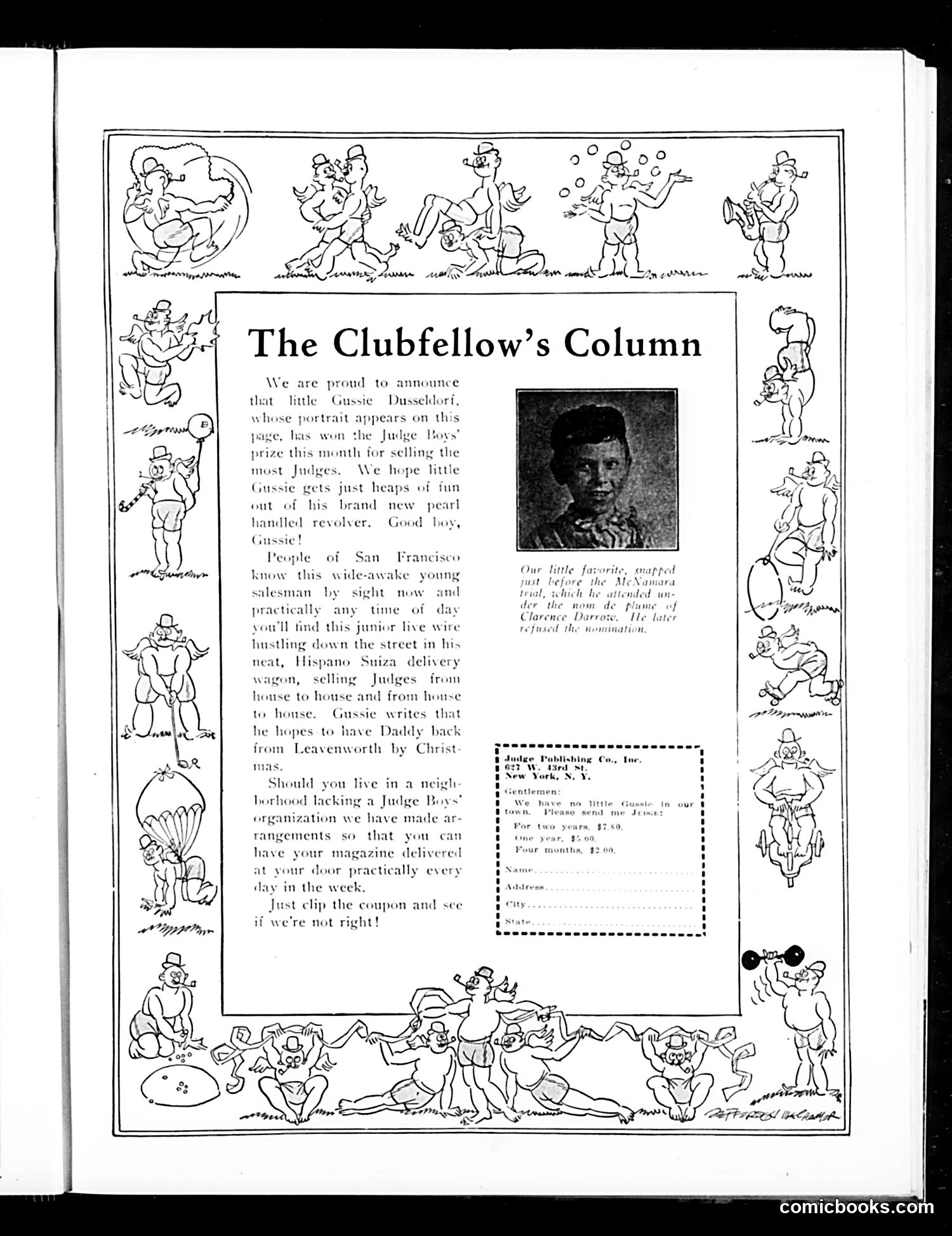
This page celebrates "Gussie Dusseldorf," a young San Francisco magazine salesman who won Judge's prize for selling the most copies. The satire works on multiple levels: **The Joke:** Gussie's prize is a pearl-handled revolver—absurdly dangerous for a child. The humor lies in this inappropriate reward. **The Dark Layer:** The text casually mentions Gussie hopes "Daddy" returns "from Leavenworth by Christmas"—Leavenworth being a federal penitentiary. This suggests Gussie comes from a criminal family, yet he's praised as a model salesman and "live wire." **The Format:** The page uses charming cartoon illustrations of children in various activities, framing the text as wholesome editorial content while the actual message is darkly comedic. This is satire of *Judge magazine's own marketing*—mocking how publications glamorize youth salesmanship and overlook uncomfortable social realities. The coupon at bottom reinforces this is partly genuine advertising wrapped in ironic humor.
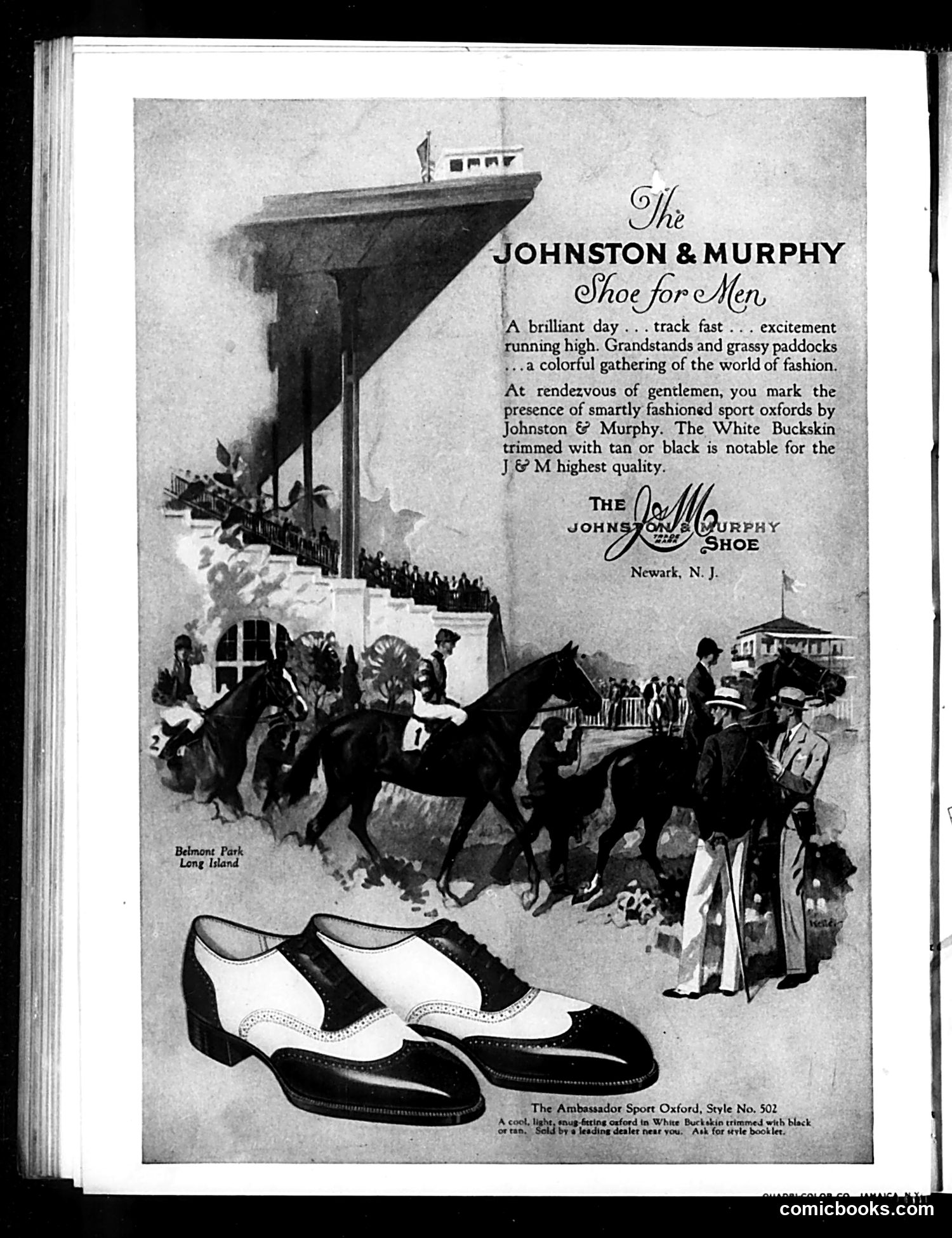
This is **not a cartoon or satire**—it's a **full-page advertisement** for Johnston & Murphy shoes, positioned in Judge magazine. The ad uses aspirational imagery: a horse-racing scene at Belmont Park (Long Island) depicting well-dressed gentlemen at a fashionable sporting event. The copy emphasizes that Johnston & Murphy oxfords are worn by sophisticated men at prestigious social gatherings. The featured shoe—"The Ambassador Sport Oxford, Style No. 502"—is shown in white buckskin with black trim. The advertisement's strategy is snobbish appeal: by associating the product with upper-class leisure activities and "the world of fashion," it targets Judge's affluent male readership who aspired to or occupied elite social circles. This appears to be from the early-to-mid 20th century based on styling and typography. There is no satire here—merely commercial messaging disguised as lifestyle editorial content.