
Judge, 1928-08-04 · page 21 of 36
Judge — August 4, 1928 — page 21: what you’re looking at
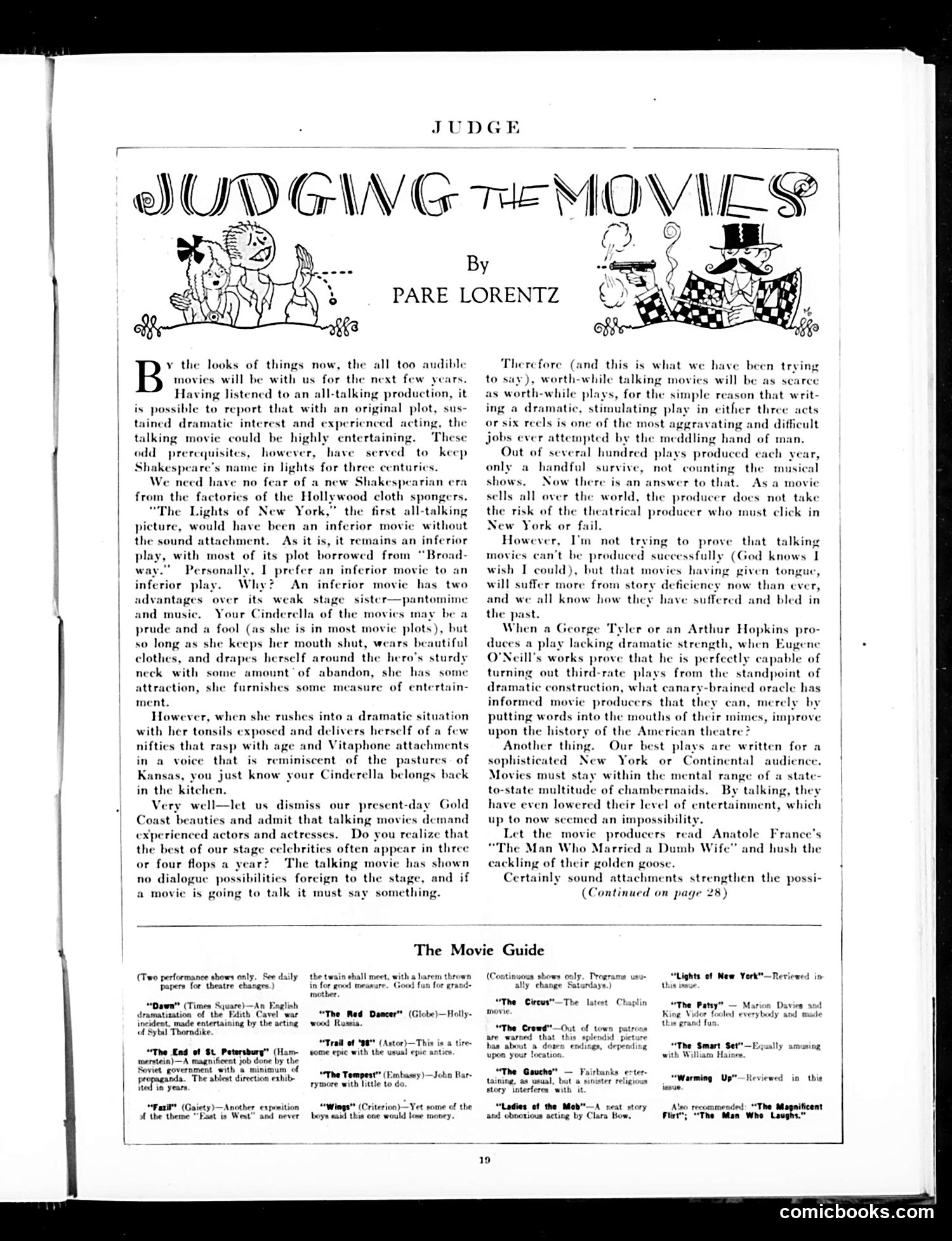
What you’re looking at
This is a critical essay, not a cartoon. Lorentz argues that **talking pictures will fail** because they require strong dramatic writing—a skill Hollywood lacks. His main points: Early talkies like "The Lights of New York" succeed *despite* dialogue, not because of it. Silent films relied on pantomime and music to disguise weak plots and poor acting. Once movies talk, they expose these deficiencies. Stage actors often fail in film; even great playwrights like O'Neill produce weak work. Moreover, movies must appeal to mass audiences across America, not sophisticated New York theatergoers—so intelligent dialogue is impossible. Lorentz sarcastically warns producers not to kill "the golden goose" by adding sound. The essay reflects **genuine 1920s anxiety** that synchronized sound (recently invented) would destroy cinema's artistic potential by forcing it to compete with legitimate theater on theater's terms—and lose.
📄 Transcribed text from this page (OCR, searchable)
Machine-transcribed from the original scan — historical spelling and the odd misread are preserved.
JUDGE cr audible years. y the looks of things now, the all too B movies will be with us for the next few Having listened to an all-talking production, it is possible to report that with an original plot, sus- sincd dramatic interest acting, the ilking movie could be highly entertaining. These odd prerequisites, however, have served to keep Shakespeare's name in lights for three centuries. We need have no fear of a new Shakespearian era m the factories of the Hollywood cloth spongers. “The Lights of New York,” the first all-talking picture, would have been an inferior movie without the sound attachment. As it is, it remains an inferior a with most of its plot borrowed from “Broad- Personally, 1 prefer an inferior movie to an inferior play. Why? An inferior has two advantages over its weak stage sister—pantomime and music. Your Cinderella of the movies may prude and a fool (as she is in most movie plots), but so long as she keeps her mouth shut, wears beautiful clothes, and dr: herself around the hero's sturdy neck with some amount’ of abandon, attraction, furnishes some m ment. However, when she rushes into a dramatic situation with her tonsils exposed and delivers herself of a few nifties that rasp with age and Vitaphone attachments in a voice that is reminiscent of the pastures of Kansas, you just know your Cinderella belongs back in the kitchen. Very well—let us dismiss our present-day Gold Coast beauties and admit that talking movies demand experienced actors and actresses. Do you realize that the best of our stage celebritics often appes or four flops a year? The talking movie 1 no dialogue possibilities foreign to the stage, and if a movie is going to talk it must say something. movie she has some she of entertain- asure By PARE LORENTZ Therefore (and this is what we to say), worth-while as worth-while ing a dramati have been trying talking movies will be as scarce plays, for the simple reason that writ- stimulating play in either thre or six reels is one of the most aggravating and difficult jobs ever attempted by the meddling hand of man. Out of several hundred plays produced eac only handful survive, not counting the mus shows. Now there is an answer to that. As a movie sells all over the world, the producer docs not ti the risk of the theatrical producer who must click in New York or fail. However, I'm not trying to prove that talking movies can't be produced successfully (God knows I wish I could), but that movies having given tongue, will suffer more from story deficiency now than ever, and we all know how they have suffered and bled in the past. When a George Tyler or an Arthur Hopkins pro- duces a play lacking dramatic strength, when E O'Neill's works prove that he is perfeetly es turning out third-rate plays from the standpoint of dramatic construction, what canary-brained or: ele has informed movie producers that they ean, merely by putting words into the mouths of their mimes, Gaprove upon the history of the American theatre? Another thing. Our best plays are written for a sopl ed New York or Continental audience. Movies must stay within the mental range of a s to-state multitude of chambermaids. By talking, they have even lowered their level of entertainment, which up to now scemed an impossibility. Let the movie producers read Anatole “The Man Who Married a Dumb Wife” cackling of their golden goose. Certainly sound attachments strengthen the possi- (Continued on page 28) gene pable of France's and hush the The Movie Guide (Two performance shows only. See daily papers for theatre changes.) “Dawn” (Times Square)—An English dramatization of the Faith Cavel war incident, made entertaining by the acting of Sybil Thorndike. “The Red Dancer” (Globe)—Holly- wood Russia. “Trail of "38" ome epic with Astor)—This is a tire- “The End of St Petersburg” (Ham- ¢ usual epic antics merstein)—A magnificent job done by the Soviet government with minimum cf propaganda. The ablest direction exhi Ke is year. “The Tempest”? (Embassy) —John Bar rymore with little to do, “Fail” (Gaiety)—Another expenition “wings” (Criterion) —Yet some of the Hf the theme “Bast is West” and never 5 boys said this one would lose m0 (Coatinvoas shows 00 ally change § “The Cireus"—The latest Trograms us- “Lights ef New Yerk""— 2.) this is Reviewed in Chaplin The Patsy” King thie — Marion Davies and J everybody and made “The Crewe"—Out of town patron fare warned. tha: has about a is splendid pict n endings, depending “The Smart Set’ with William Hais Pqually amusing “Warming Up" —Reviewed in thie ory interferes ‘with it “Ladies of the Mob’ ard obnoxious acting by C A neat story ded: “The Magnificent Whe Laughs.” comicbooks.com