
Judge, 1928-08-04 · page 15 of 36
Judge — August 4, 1928 — page 15: what you’re looking at
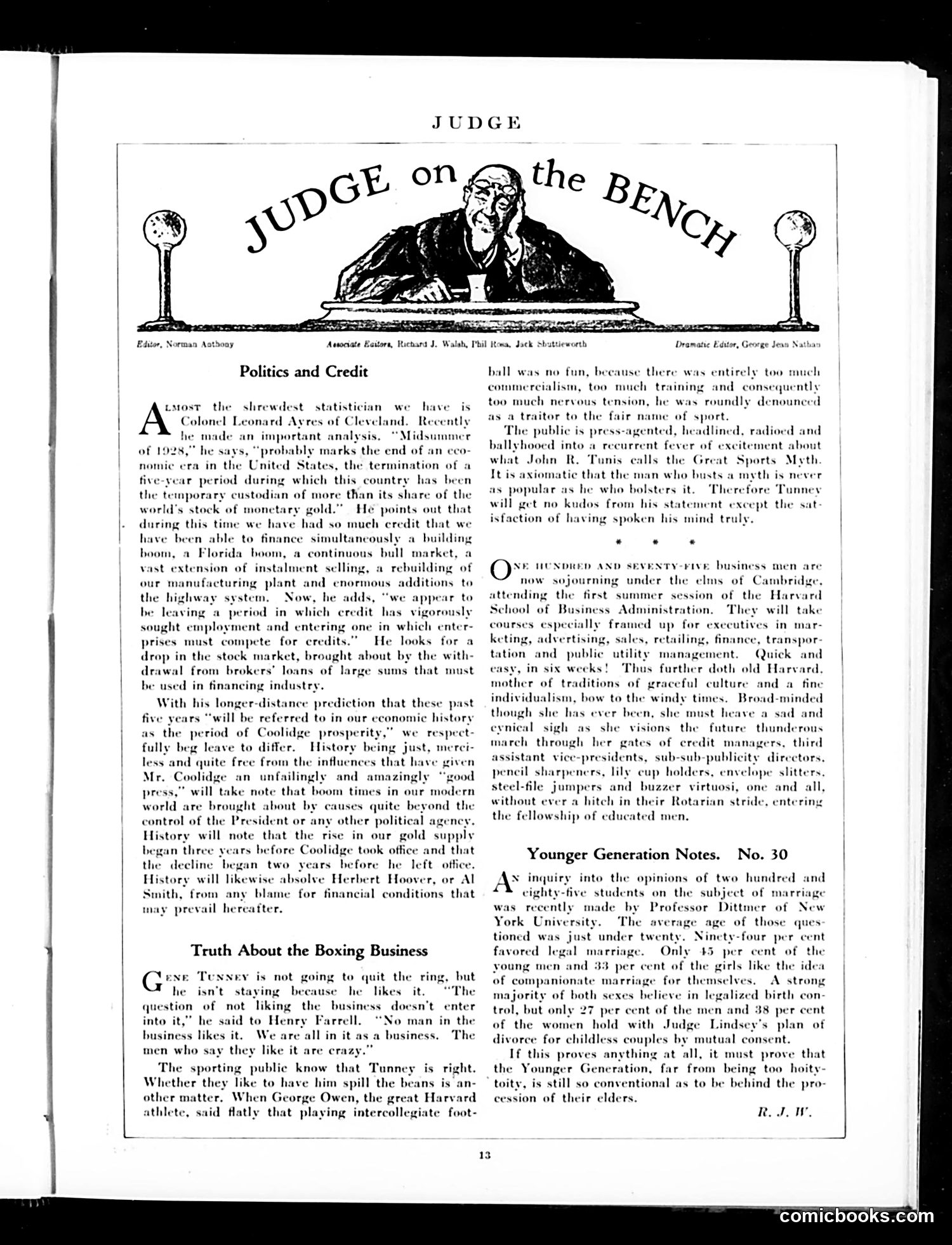
What you’re looking at
This page satirizes American prosperity and capitalism in the mid-to-late 1920s through three articles: **"Politics and Credit"** critiques crediting Coolidge's presidency for economic boom. The text argues that prosperity resulted from broader financial forces (gold supply increases, credit expansion) beginning before Coolidge took office—thus any future president shouldn't be blamed for inevitable downturns either. **"Truth About the Boxing Business"** defends boxer Gene Tunney against accusations of being mercenary, arguing that boxing is inherently commercial and that athletes claiming to love their sport "are crazy." The piece suggests the public romanticizes sports while ignoring their fundamentally profit-driven nature. **"Younger Generation Notes"** reports on Harvard business students' progressive views on marriage and divorce, contrasting their conventionality with their elders' expectations—suggesting the younger generation remains surprisingly conservative. Throughout, Judge mocks both the financial bubble (unsustainable credit-fueled boom) and the gap between public mythology and economic reality.
📄 Transcribed text from this page (OCR, searchable)
Machine-transcribed from the original scan — historical spelling and the odd misread are preserved.
JUDGE Norman Asthoay Politics and Credit téost the shrewdest) statistician we have is A“ Colonel Leonard Ayres of Cleveland. Recently . an important analysis, “Midsummer . “probably marks the end of an nomic era in the United States, the termination of a five-year period during which this country has been the temporary custod anits share of the world’s stock of mor He points out that during this time we h: had so much credit that we have been able to finance simultaneously a building boom, a Florida boom, a continuous bull market vast extension of instalment selling, our manufacturing plant and enormous the highway system. Now, he adds, “we be leaving a period in which ¢ sought employment and entering prises must compete for credit drop in the stock market, brought drawal from brokers’ loans of 1 be used in financing industry ppear to lit has vigorously in which enter- He looks for a about by the with- sums that must With his longe: Jistance prediction that these past five years “will be referred to in our economic history as the period of Coolidge prosperit we respeet- fully beg leave to differ. History being just, merei- less and quite free from the influences that have Mr. Coolidge an unfailingly and am F press,” will take note that boom times in our mode rn world are brought about by causes quite beyond the control of the President or other political agency. History will note that the rise in our gold supply began three years before Coolidge took offic the decline before he History will likewis » Herbert Hoover, or Al Smith, from any blame for financial conditions that may prevail hereafter. Truth About the Boxing Business Gus Tunney is not going to quit the ring, but he isn’t) staying because he likes it. “The question of not liking the doesn't enter into it,” he said to Henry Farrell. No man in the business likes it. We are all in it as a business. The men who say they like it are cra busine The sporting public know that Tunn Whether they like to have him spill the other matter, athle is right. ns is an- When George Owen, the great Harvard said flatly that playing intercollegiate foot- Atsociate Baitora, Ruchard J. Walah, Phil iowa, Jack Shuttieworth Dramatic Editor, George Jean Nathan ball was no fun, because there was entirely too much commercialism, too much training too much nervous tension, as a traitor to the fair n of sport. The public is press-agented, headlined, radioed and ballyhooed into a recurrent fever of excitement about what John R. Tunis ealls the Great Sports Myth It is axiomatic that the man who busts a myth is never as popular as he who bolsters it. Therefore Tunney will get no kudos from his statement except the sat isfaction of having spe and con + was roundly denoun quently en his mind truly, * . * O*« HUNDRED AND SEVENTY-FIVE business men are now sojourning under the elms of Cambridge. attending the first summer session of the Harvard School of Business Administration. They will take courses especially framed up for executives in mar- keting, advertising, sales, retailing, finance, transpor tation and public utility management. Quick and easy, in six weeks! Thus further doth old Harvard, mother of traditions of graceful cultur individualism, bow to the windy times. Br though she has « cynical sigh march throug assistant vice and a fine ad-minded a sad and cr been, she must heave visions the future thunderous 1 her gates of credit managers, third -presidents, sub-sub-publicity dire pencil sharpeners, lily cup holders, envelope slitters. steel-file jumpers and buzzer virtuosi, one and all, without ever a hitch in their Rotarian stride, the fellowship of educated men, tors, entering Younger Generation Notes. No. 30 into the opinions of two hundred and subject of marr Professor A’ inquir, cighty-five students on the was recently made by York University. The tioned was just under t favored legal marriage. Dittmer of age of those ques inety-four per cent $5 per cent of the Only young men and 33 per cent of the girls like the idea of companionate marri for thems: majority of trol, but only of the won A strong ized birth con- 7 per cent of the men and 38 per cent n hold with Judge Lindsey's plan of divorce for childless couples by mutual consent. If this proves anything at all, it must prove that the Younger Generation, far from being too hoity- toity, is still so conventional as to be behind the pro- cession of their elders. oth sexes believe in legs RILW. = — — \ comicbooks.com