
A complete issue · 36 pages · 1927
Judge — January 22, 1927
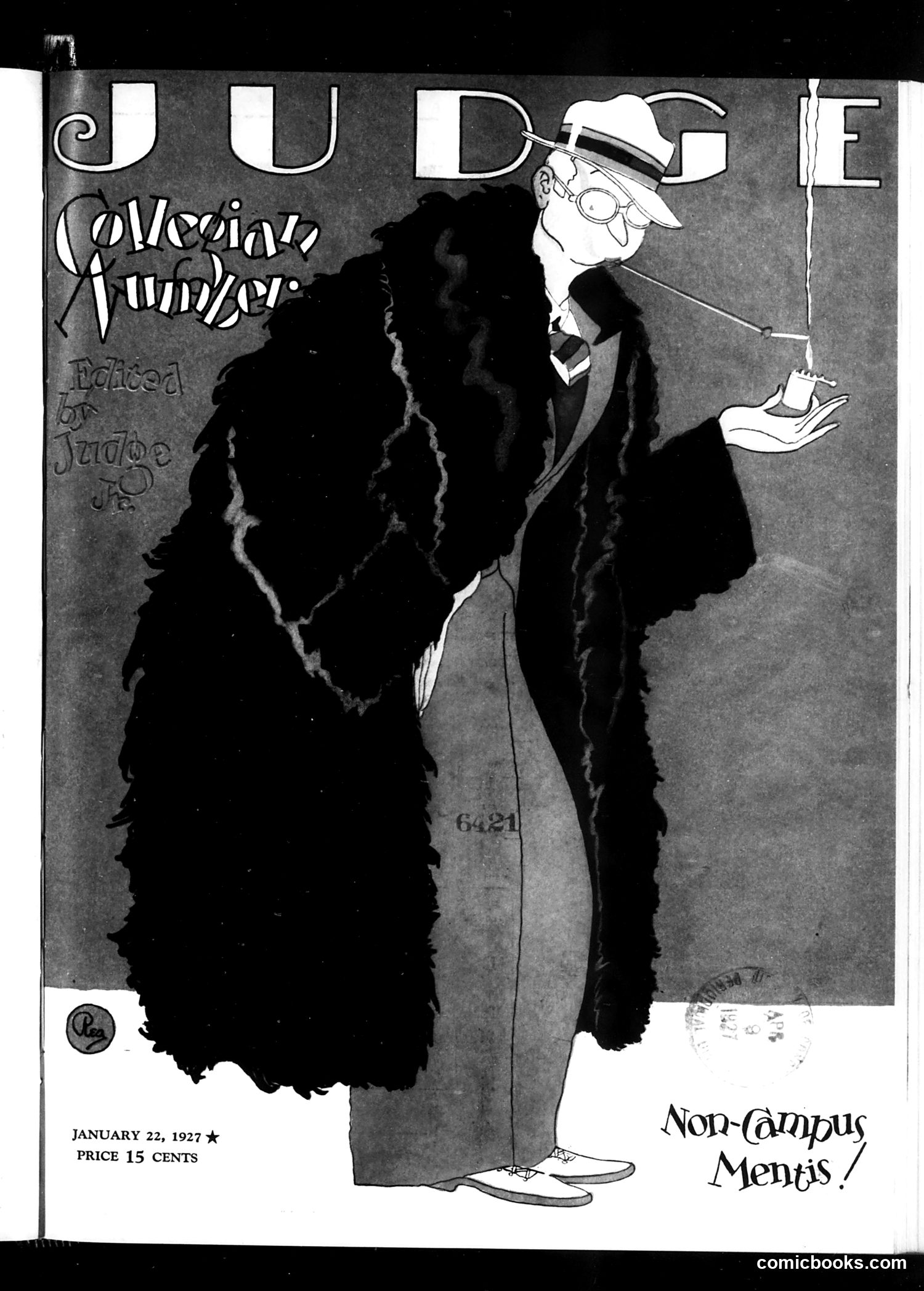
This satirical cover depicts a well-dressed gentleman in hat and glasses displaying an enormous fur coat or stole to a potential buyer. The coat is rendered almost entirely in black, creating a dramatic silhouette. The title "Collaring Junket" and subtitle "Non-Campus Mentis" (a Latin pun on "non compos mentis"—not of sound mind) suggest satire about foolish spending or conspicuous consumption. The "junket" reference likely mocks frivolous indulgence, while the salesman's proud presentation of the expensive fur implies ridicule of wealthy buyers making impractical purchases during the 1920s Jazz Age. The joke appears to target either fashion excess or gullible wealthy consumers paying inflated prices for luxury goods.
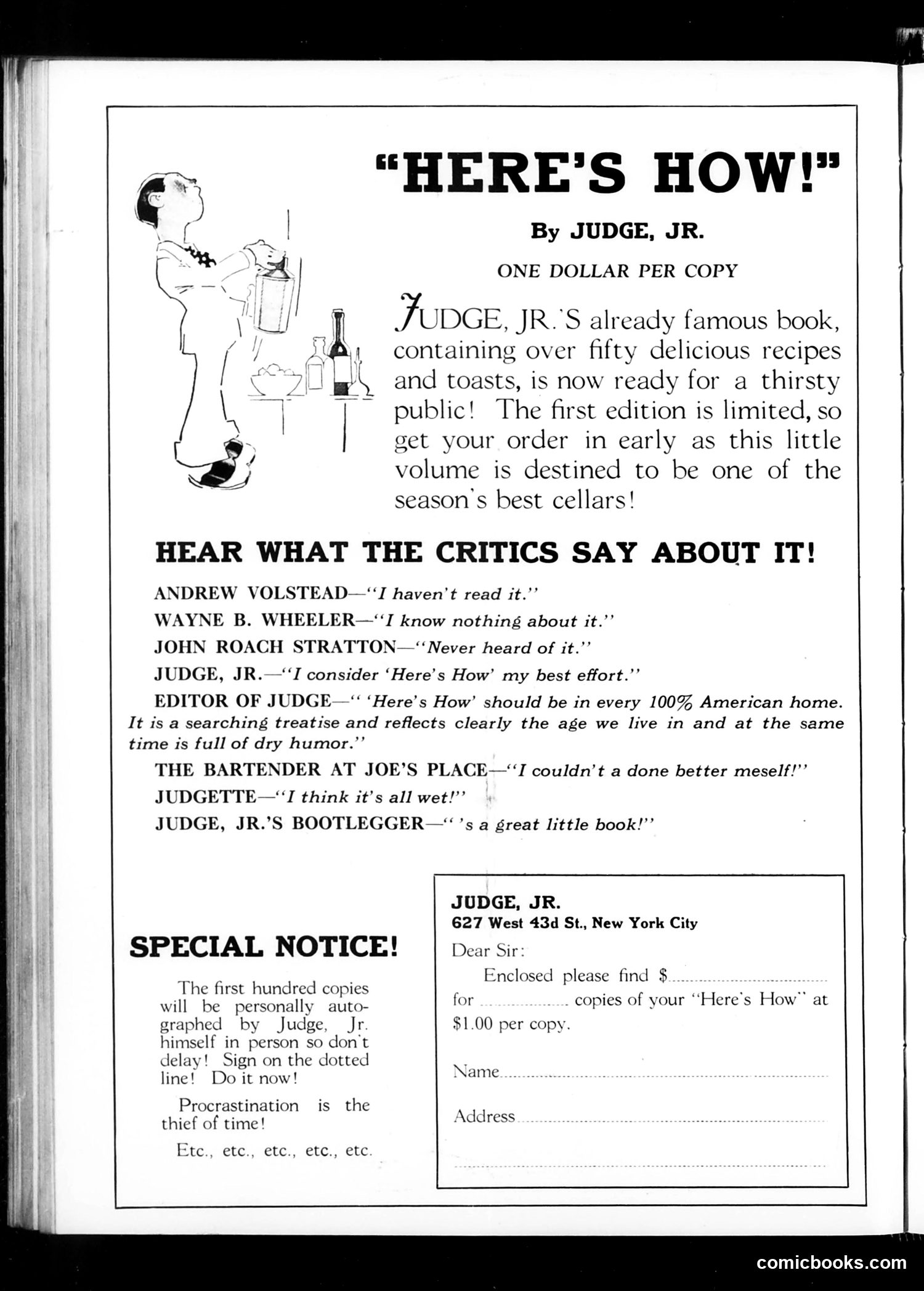
This page is primarily **advertising**, not political satire. It promotes Judge Jr.'s book "Here's How!" — a recipe and cocktail guide selling for one dollar. The humor is self-referential: the "critics' quotes" are jokes, with famous names claiming ignorance ("I haven't read it," "Never heard of it") while Judge Jr. himself calls it his "best effort." This mock-critical approach was common advertising humor of the era. The cartoon illustration shows a jovial figure surrounded by bottles and food, embodying the book's content about recipes and drinking. The "Special Notice" about autographed copies adds urgency to the sales pitch. This appears to be a **1920s-era advertisement** — the cocktail/recipe focus and tone suggest Prohibition-era humor, when such guidebooks were commercially popular.
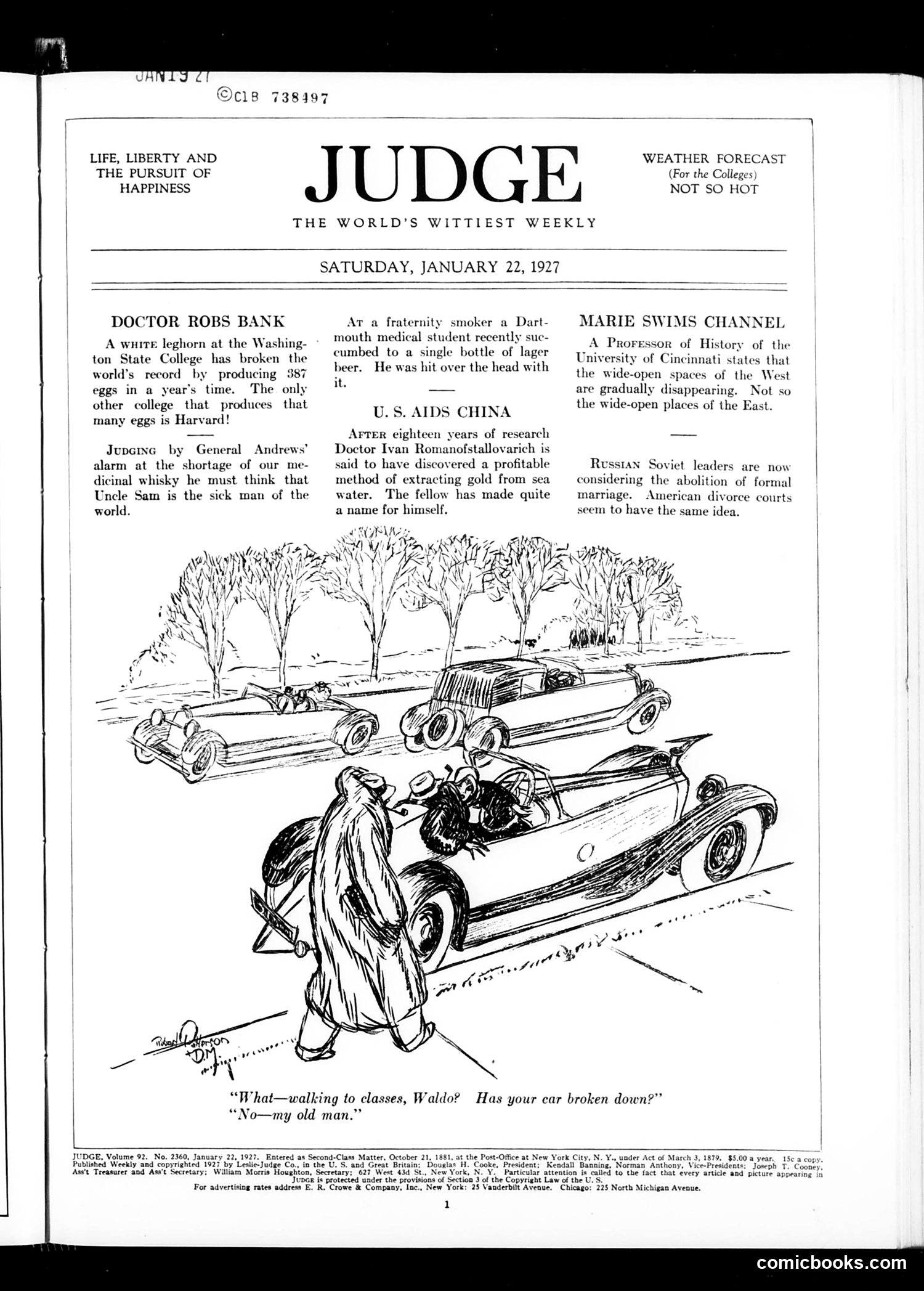
The main cartoon depicts an elderly man in traditional robes confronting several automobiles on a road lined with trees. The caption reads: "What—walking to classes, Waldo? Has your car broken down?" / "No—my old man." **The Satire**: This jokes about generational wealth and automobile ownership among college students. The humor assumes that a wealthy young man ("Waldo") would normally arrive at classes by car, so walking is shocking. When asked if his vehicle broke down, he replies his "old man" (father) is broken down—implying his father can no longer afford to buy him a car, or the father himself is decrepit. The joke reflects 1920s anxieties about economic status, college privilege, and the automobile as a marker of wealth during the prosperous Jazz Age.
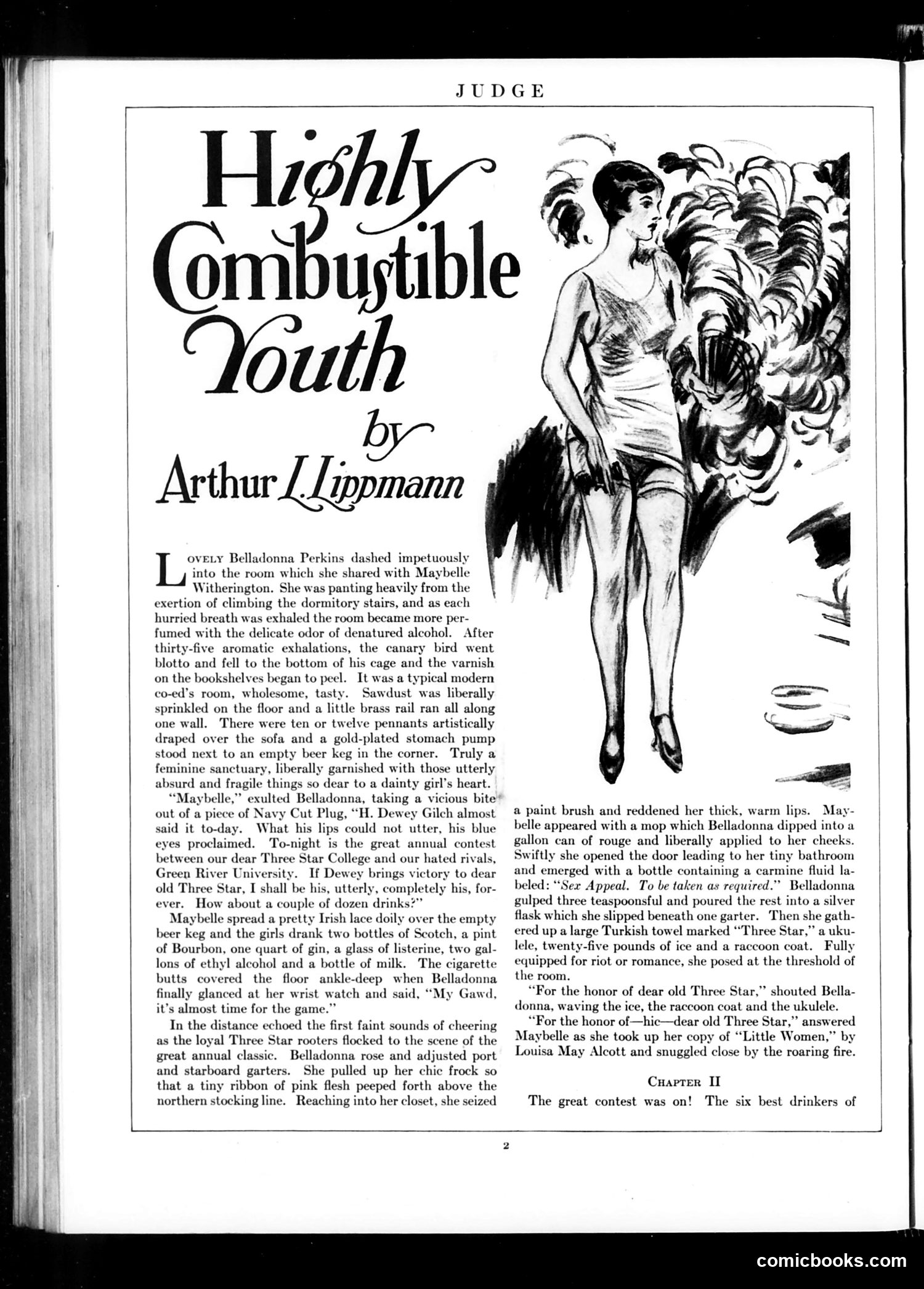
This is a satirical short story rather than a political cartoon. It mocks the excesses of 1920s youth culture, specifically young women's behavior and social freedoms. The narrative ridicules "Belladonna Perkins," a flapper character who hosts a wild party in her dormitory room with alcohol, decorations, and provocative attire. The satire targets: - **Women's newfound independence** post-suffrage, portrayed as reckless - **Prohibition-era drinking** among college students - **Modern "jazz age" social conduct** deemed scandalous by conservative standards The story's title plays on "combustible"—suggesting young women were dangerously volatile and prone to moral failure. Judge magazine used such pieces to express establishment anxiety about changing gender norms and youth rebellion in the 1920s.
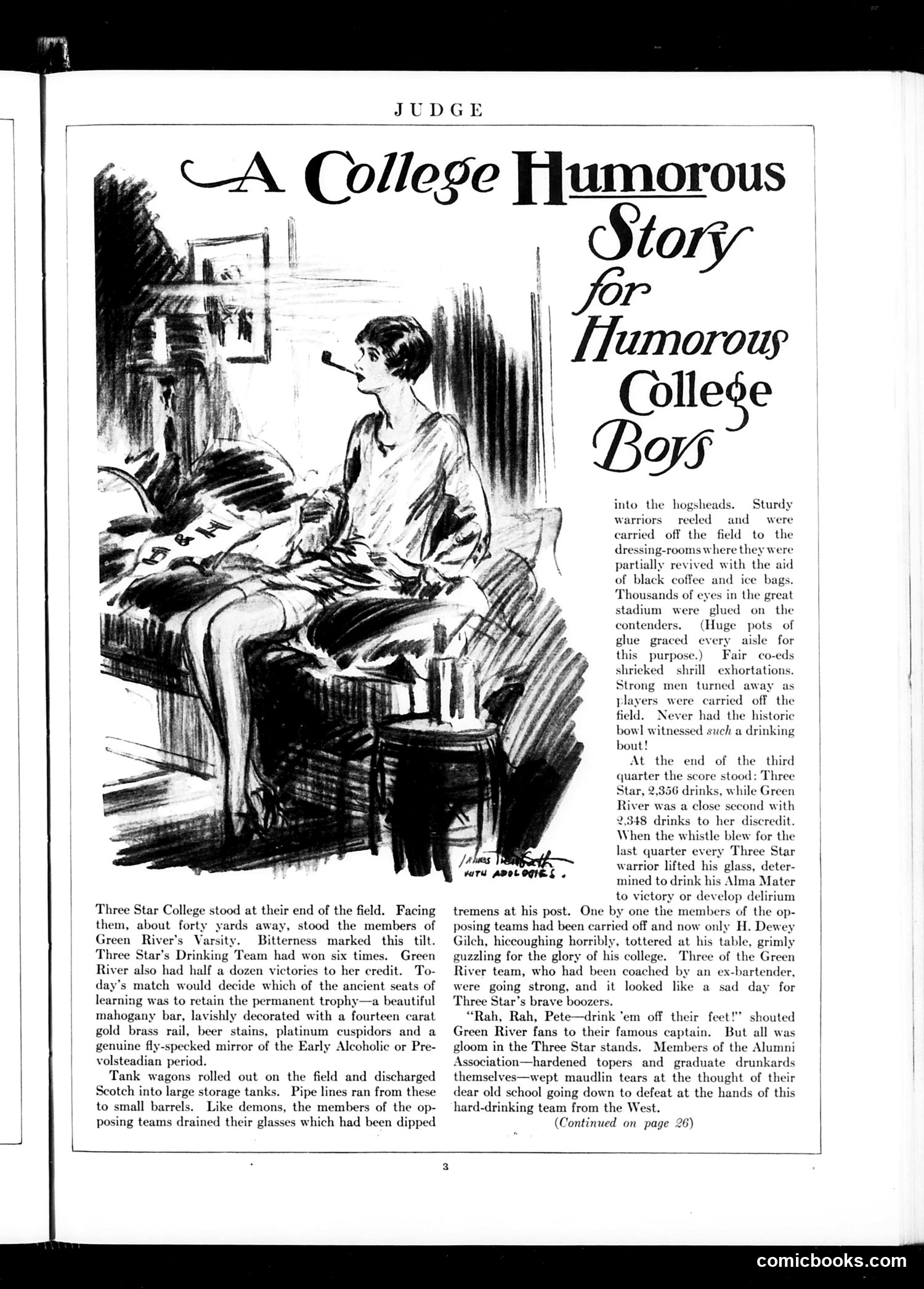
This satirical piece mocks college drinking culture, specifically a competitive drinking competition between rival college teams: "Three Star College" and "Green River." The illustration shows a woman tending to an injured male athlete, suggesting the physical toll of the match. The humor derives from the absurdity of the scenario: tank wagons dispensing alcohol, players being "revived with the aid of black coffee and ice bags," and enormous quantities consumed (2,356 versus 2,348 drinks). The satire targets both collegiate athletic excess and Prohibition-era contradictions—the piece appears to ridicule how colleges normalized heavy drinking despite legal restrictions. The "hard-drinking team from the West" reference suggests regional rivalry stereotypes. The overall tone satirizes college athletics culture as dangerously unsustainable.
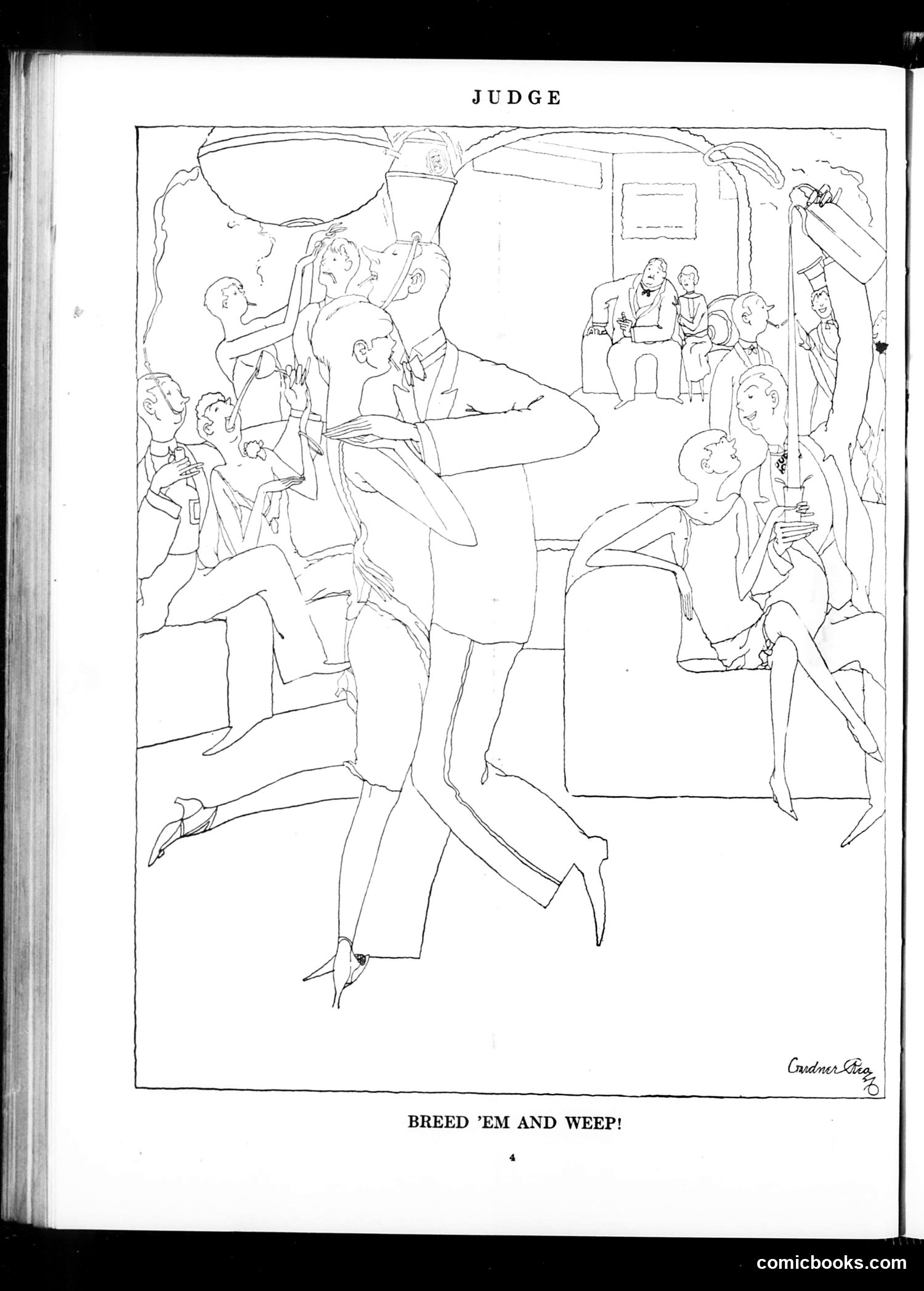
This Judge magazine cartoon depicts a courtroom scene where a judge presides over what appears to be a domestic dispute or custody matter. The title "Breed 'Em and Weep!" suggests the satire targets the consequences of procreation and family conflicts. The central figure—a man in dynamic, exaggerated poses—appears distressed or overwhelmed, surrounded by multiple children and onlookers in the courtroom gallery. The cartoon likely satirizes the burden of large families, legal complications from divorce or custody disputes, or the social costs of unplanned parenthood—common themes in early-to-mid 20th century American humor. The specific historical context or legal case being referenced is unclear without additional publication details.
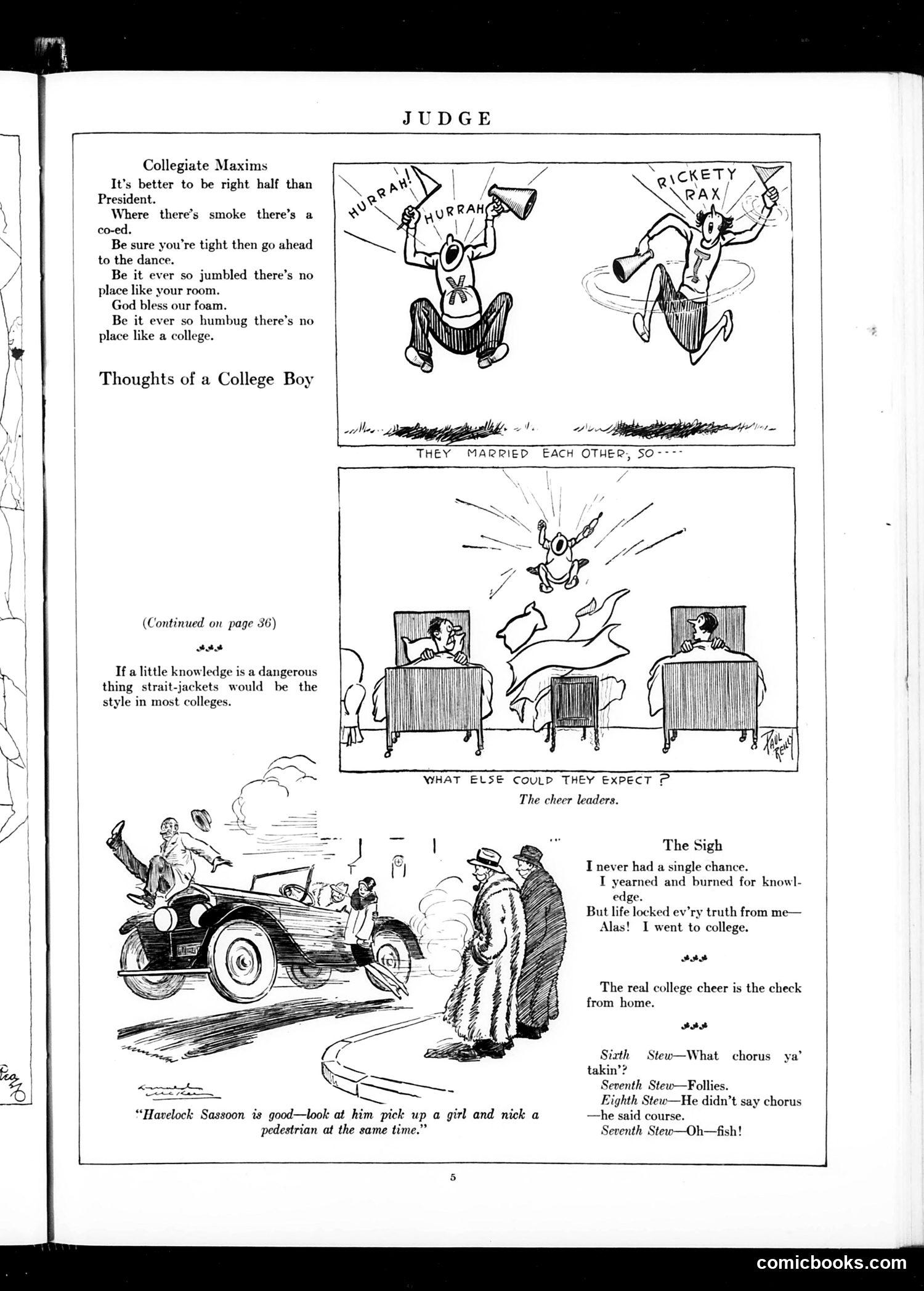
This page satirizes college life through humor and social commentary. The "Collegiate Maxims" mock pretentious student attitudes about campus superiority. The top cartoons show students celebrating loudly ("Hurrah! Hurrah!" and "Rickety Rax"), depicting typical boisterous college behavior. The middle panel—showing newlyweds in separate beds with chaos above—jokes that marriage disrupts the carefree college lifestyle. "The Sigh" poem mocks students who squandered opportunities, regretting their college years. The car accident cartoon satirizes reckless driving, showing a chauffeur picking up a girl while hitting a pedestrian simultaneously—commenting on dangerous behavior and moral carelessness among the wealthy. The dialogue about "Follies" as a chorus course is simple wordplay humor. Overall, the page criticizes college excess, poor judgment, and moral lapses among privileged youth through exaggerated scenarios and witty text.
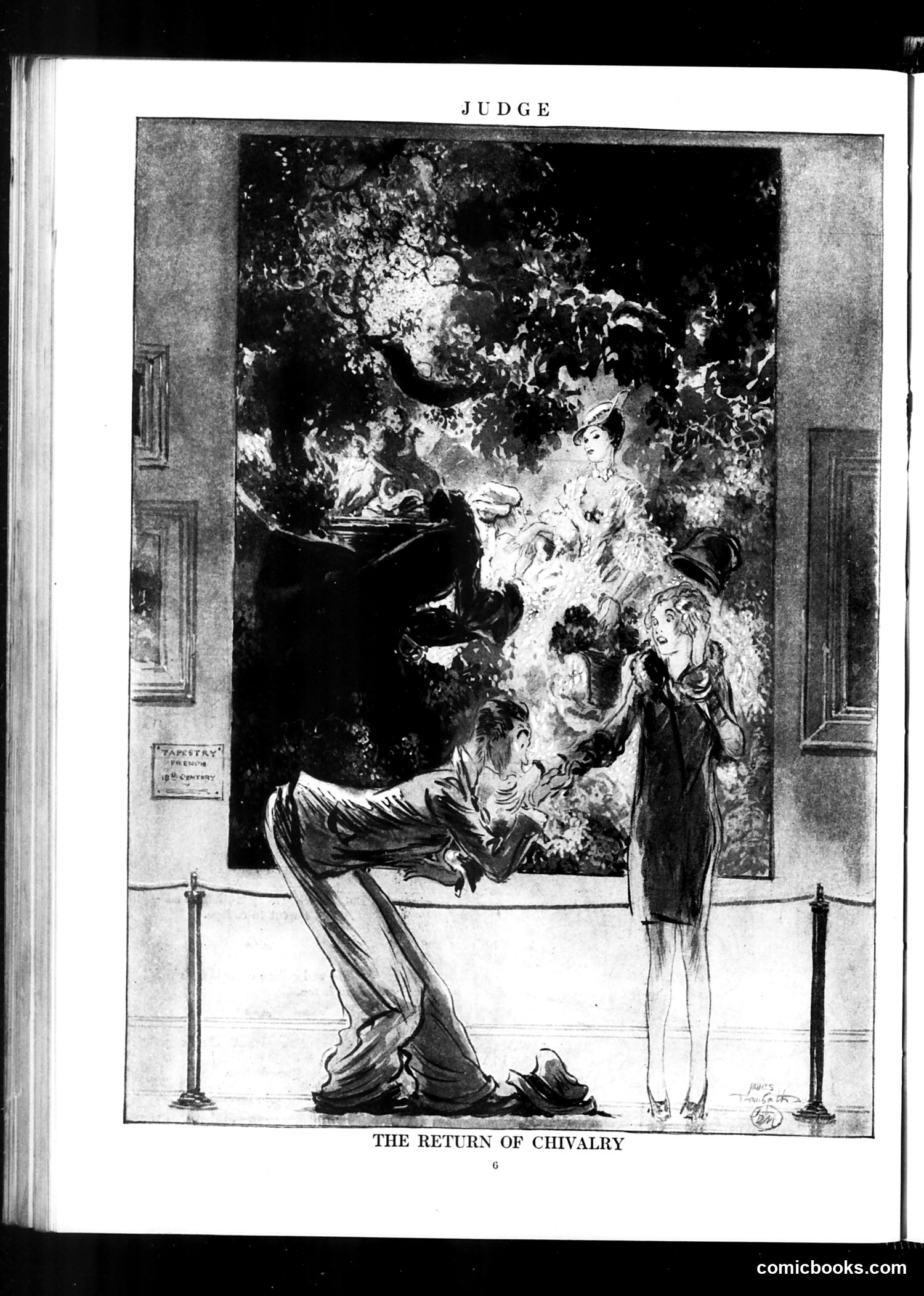
This cartoon, titled "The Return of Chivalry," depicts a scene in what appears to be an art gallery or museum. A man in formal attire is bowing deeply before a painting, while a fashionably dressed woman stands observing. The satire likely comments on old-fashioned courtly behavior or romantic gestures being revived or practiced in modern times. The cartoon's title suggests irony—that genuine chivalry is "returning" when the man's exaggerated bow appears performative or affected rather than authentically gallant. The gallery setting emphasizes the artificiality: his gesture mirrors the romanticized figures in the artwork above, implying that such courtly behavior exists more in art and fantasy than in contemporary reality. The woman's expression and stance suggest bemusement at his theatrical display.
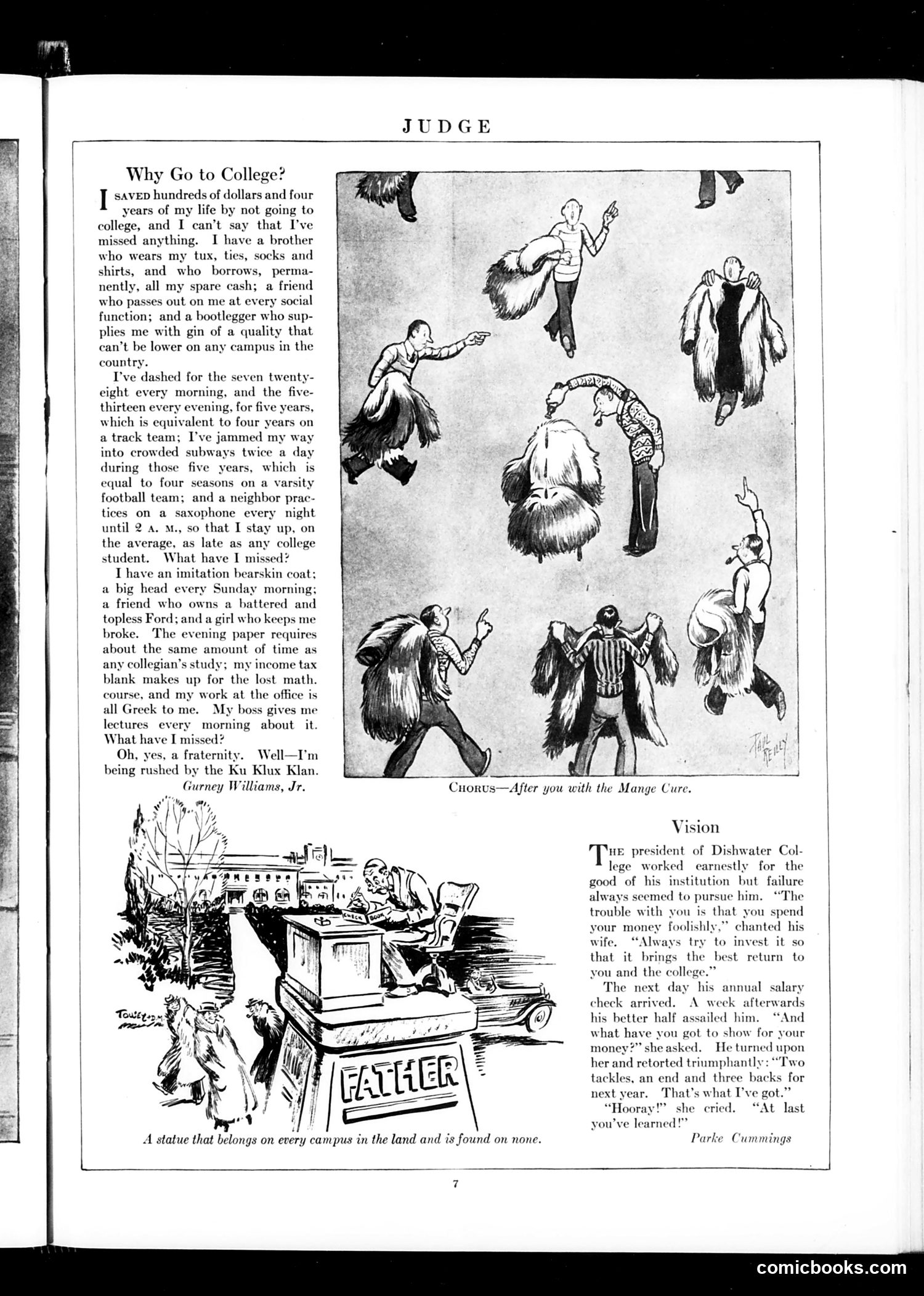
**"Why Go to College?"** mocks the value of higher education through ironic first-person testimony. The author claims he saved money by skipping college, yet lists equivalents he gained anyway: commuting replaces track team, crowded subways equal football conditioning, a neighbor's saxophone substitutes for sleep deprivation, workplace "Greek" lectures replace math courses. The punchline—being "rushed by the Ku Klux Klan" instead of fraternities—satirizes both college social hierarchies and the KKK's disturbing 1920s-era social prominence. The cartoon "Chorus" depicts figures with mange, visually reinforcing the piece's theme that college-free life involves the same hardships repackaged. **"Vision"** parodies college fundraising priorities. A college president's wife urges him to invest money wisely for returns. When he proudly reports spending on football players ("tackles, an end and three backs"), she celebrates—revealing that institutional "investment" means athletic recruitment, not academics. The statue caption reinforces the critique: prestigious institutions lack meaningful monuments while prioritizing sports programs. Both pieces satirize American colleges' emphasis on athletics and social life over genuine education.
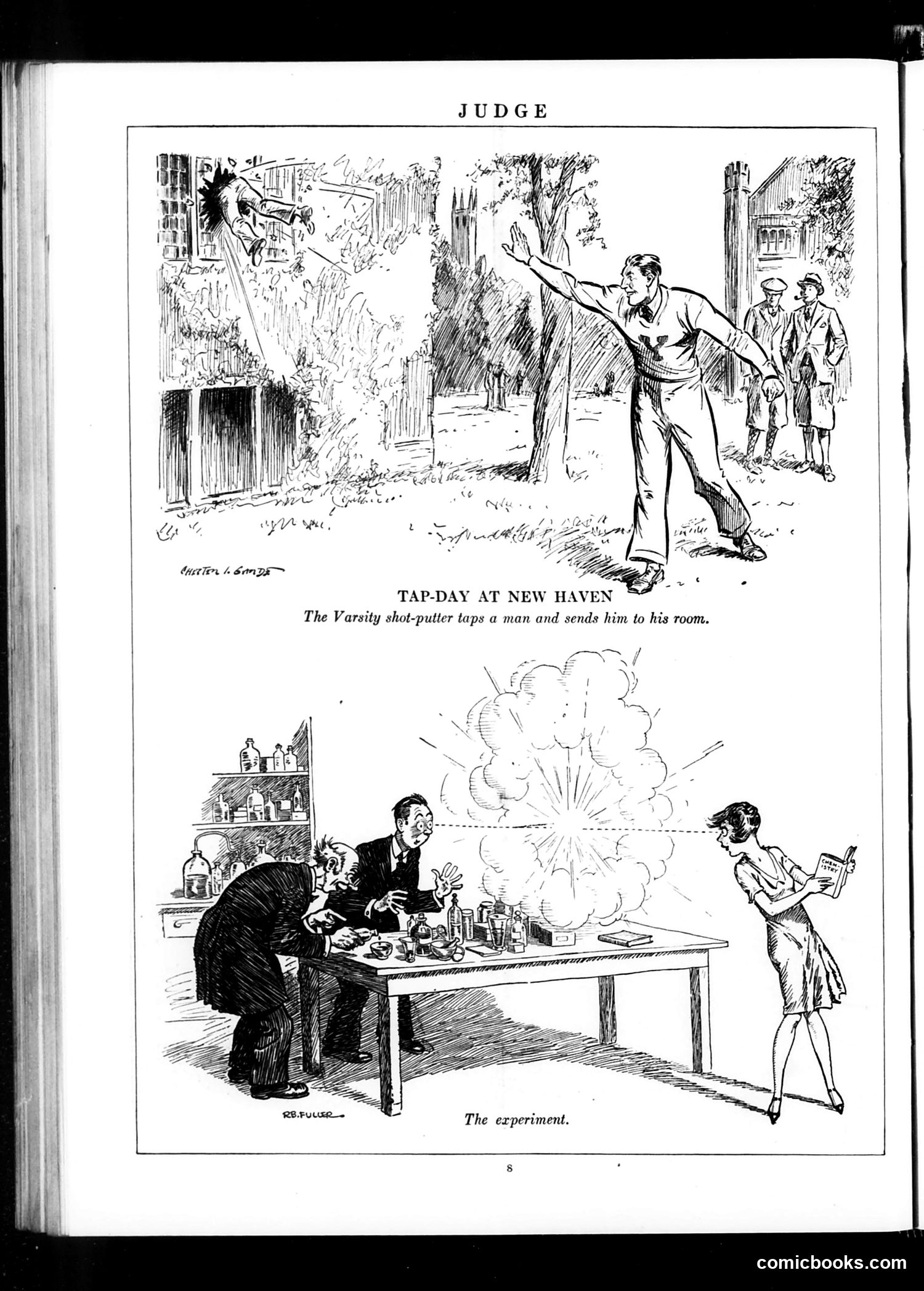
This page satirizes college hazing practices at Yale University ("New Haven"). The top cartoon depicts "Tap Day," a real Yale tradition where senior society members would tap underclassmen for membership. The joke shows this literally—a "varsity shot-putter" physically taps a man and orders him to his room. The bottom cartoon, titled "The experiment," extends the satire: a woman conducts a controlled test on a man, apparently demonstrating that the tapping/hazing ritual produces predictable, explosive reactions (shown by the burst cloud). The satire mocks both the brutality of college hazing and the pseudo-scientific justification some might offer for such practices. The cartoons ridicule Yale's elite club traditions as simultaneously violent and absurd, treating hazing as an experiment worthy of scrutiny rather than an honored custom.
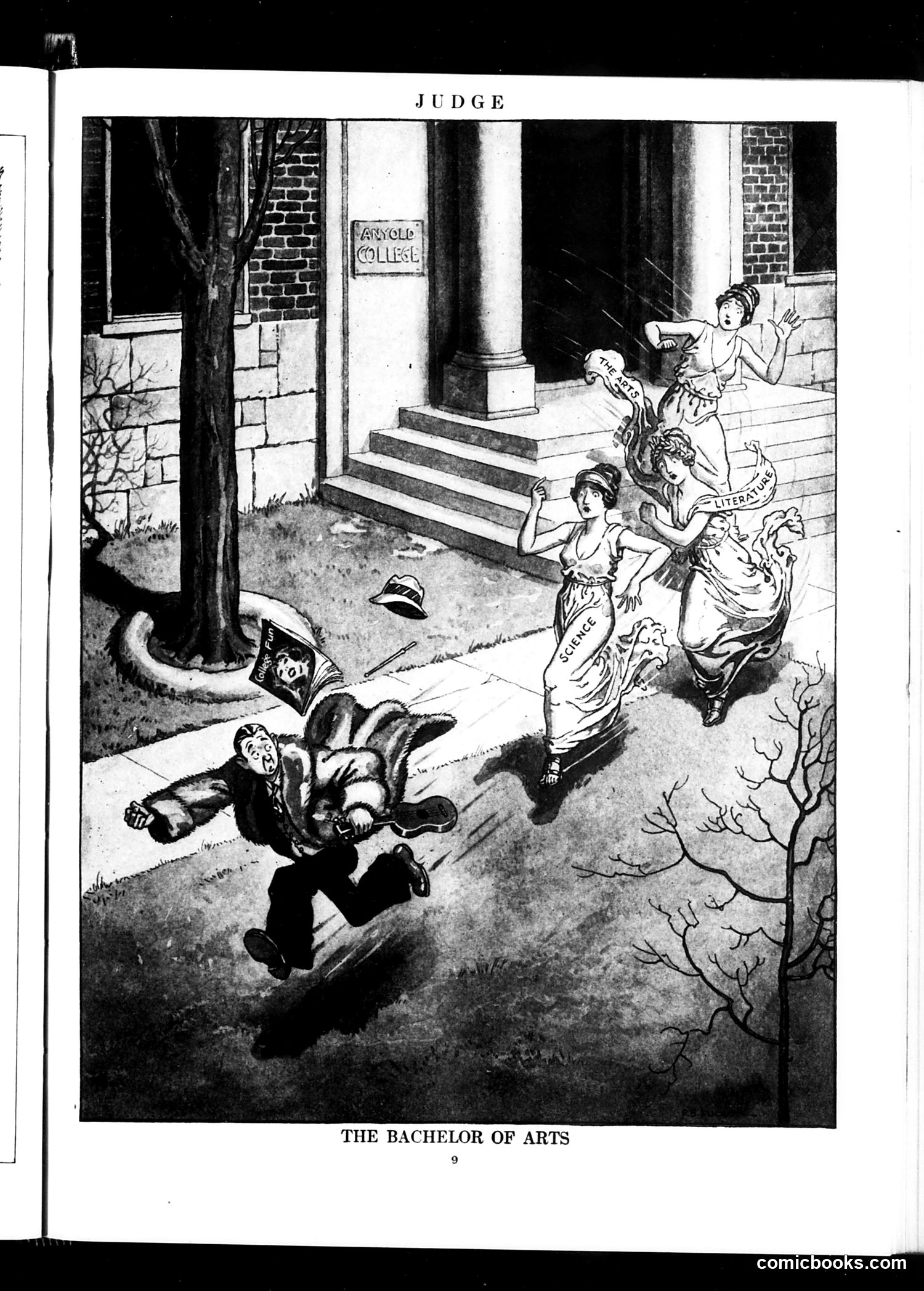
This satirical cartoon depicts a disheveled man in formal attire sprawled on the ground outside what appears to be a college building (marked "ARNOLD COLLEGE"). Several well-dressed women gesture dismissively at him from the steps. The satire targets the "Bachelor of Arts" degree—suggesting that a humanities education leaves graduates unprepared for practical life, literally knocked down by society. The women's rejection implies the degree holder lacks marketable skills or status. The scattered hat and his prone position emphasize his failure and humiliation. This reflects early 20th-century anxieties about liberal arts education's value amid rapid industrialization, when critics questioned whether classical education adequately prepared men for economic competition. The cartoon mocks both the degree and its holder as impractical and unmarketable.
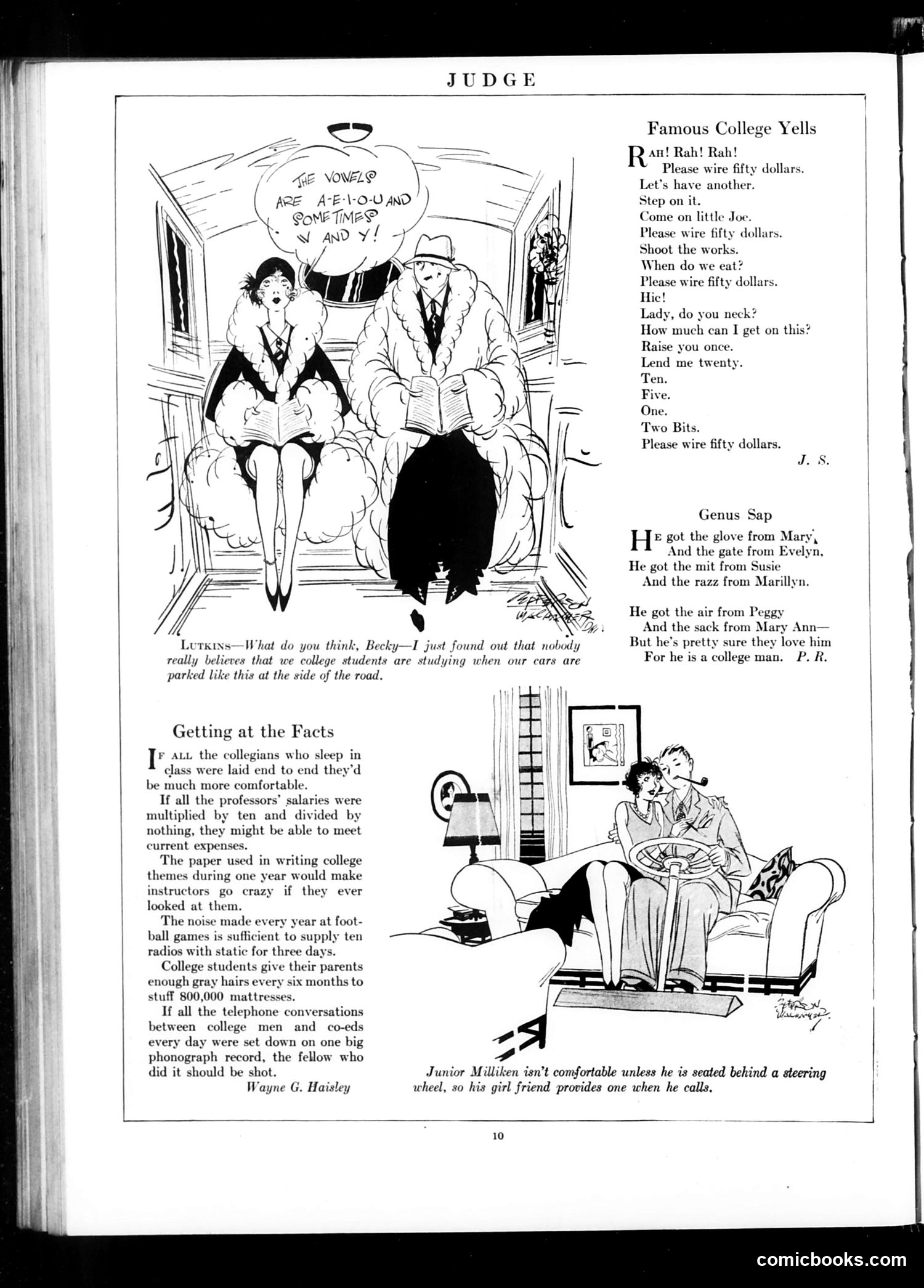
This page satirizes college life through multiple humor pieces. The "Famous College Yells" mockingly replaces traditional school spirit chants with students begging for money ("Please wire fifty dollars"), revealing financial dependence on parents and prioritizing material needs over academics. "Genius Sap" humorously catalogs a young man's romantic conquests—acquiring gloves, gates, mittens from various women—implying shallow, collecting-style dating rather than genuine relationships. "Getting at the Facts" presents absurdist observations about college life: sleeping students in uncomfortable positions, underpaid professors, excessive noise at football games, and stressed parents. The final quip about recording phone conversations and shooting the person responsible satirizes the endless, trivial chatter between college students. The illustration depicts a couple in a car, captioning that a junior requires steering-wheel seating during courting—mocking young men's obsession with automobiles as dating props. Overall, the page lampoons 1920s college culture as financially burdensome, romantically superficial, and academically questionable.
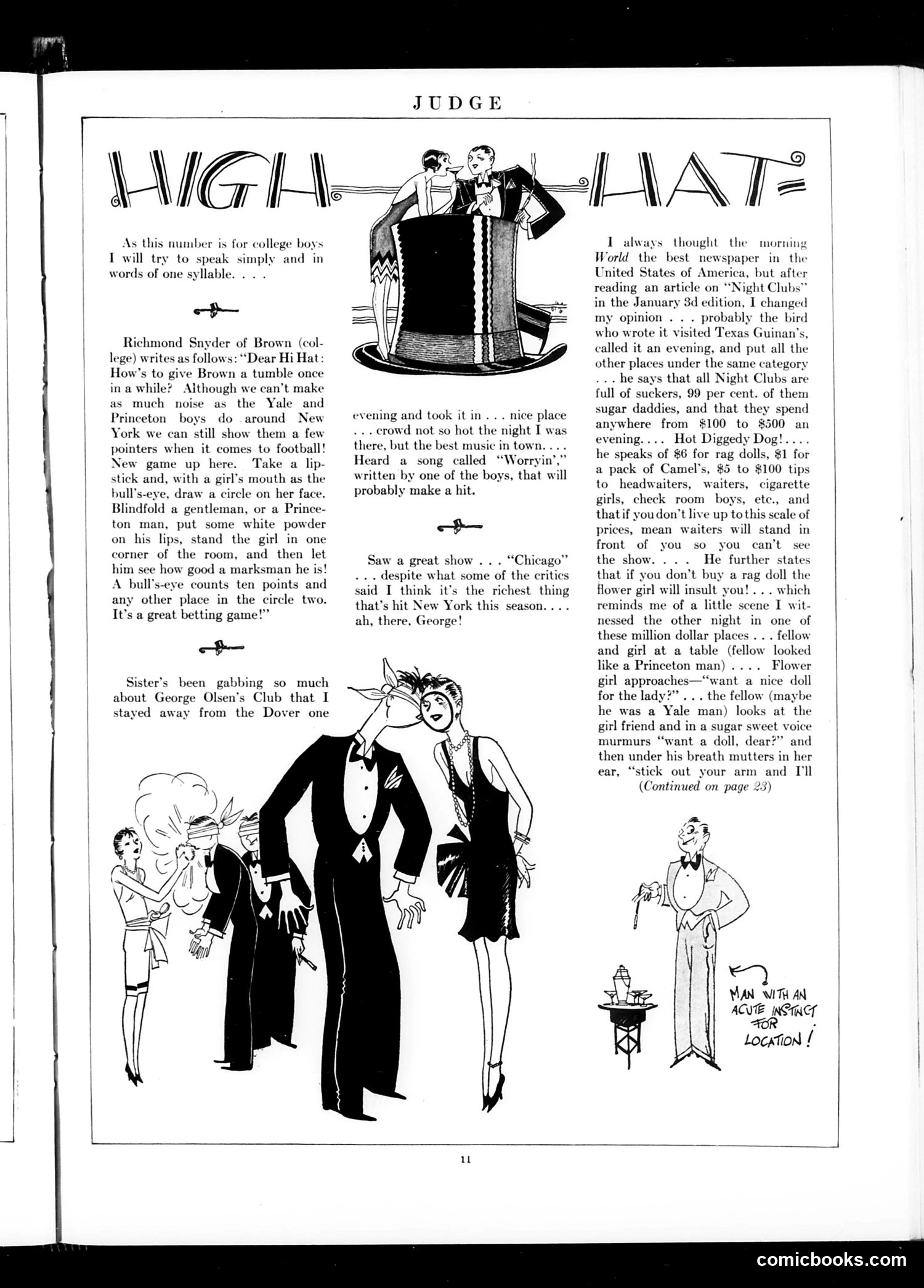
This is a humorous advice column for college readers, featuring social commentary on 1920s nightlife and college culture. **The Content:** The column addresses college pranks (like a flirting game involving lipstick at Brown University) and reviews of popular venues—George Olsen's Club and the show "Chicago." **The Key Satire:** The main target is a *World* newspaper article criticizing nightclubs as exploitative. The columnist sardonically lists inflated prices ($6 for "rag dolls"/flowers, $100+ evening tabs, $100 tips) and describes aggressive waitstaff and flower girls pressuring patrons. The final anecdote mocks this dynamic: a young man asks his date if she wants a doll, then whispers an insulting comment—revealing how nightclub culture breeds cynicism beneath surface politeness. **Context:** This reflects post-Prohibition (1920s) anxiety about commercialized nightlife, with venues like Texas Guinan's becoming symbols of excess and exploitation of wealthy "sugar daddies" and naive patrons.
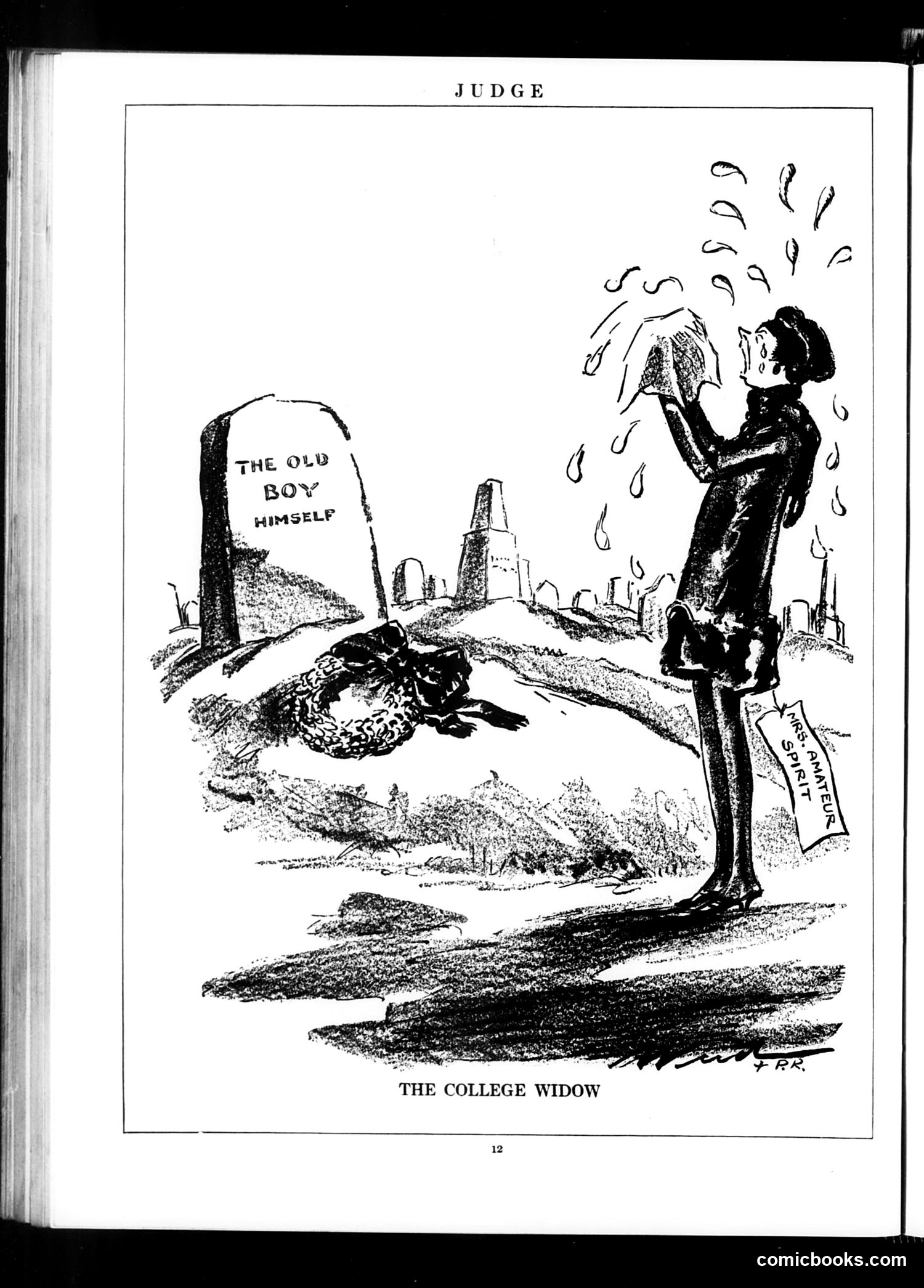
This single-panel cartoon depicts a woman at a graveside in a cemetery. A tombstone reads "THE OLD BOY HIMSELF," while she holds an umbrella in the rain, positioned near a gravestone marked "SLAUGHTER." The title "The College Widow" and the graveside setting suggest satire about a widow connected to a college or university community. "The Old Boy" likely refers to a deceased alumnus or established figure. The visual juxtaposition—a woman mourning at a grave while positioned near "Slaughter"—implies criticism of her role or conduct, though the exact satirical target remains unclear without additional historical context about Judge's publication date and contemporary college scandals.
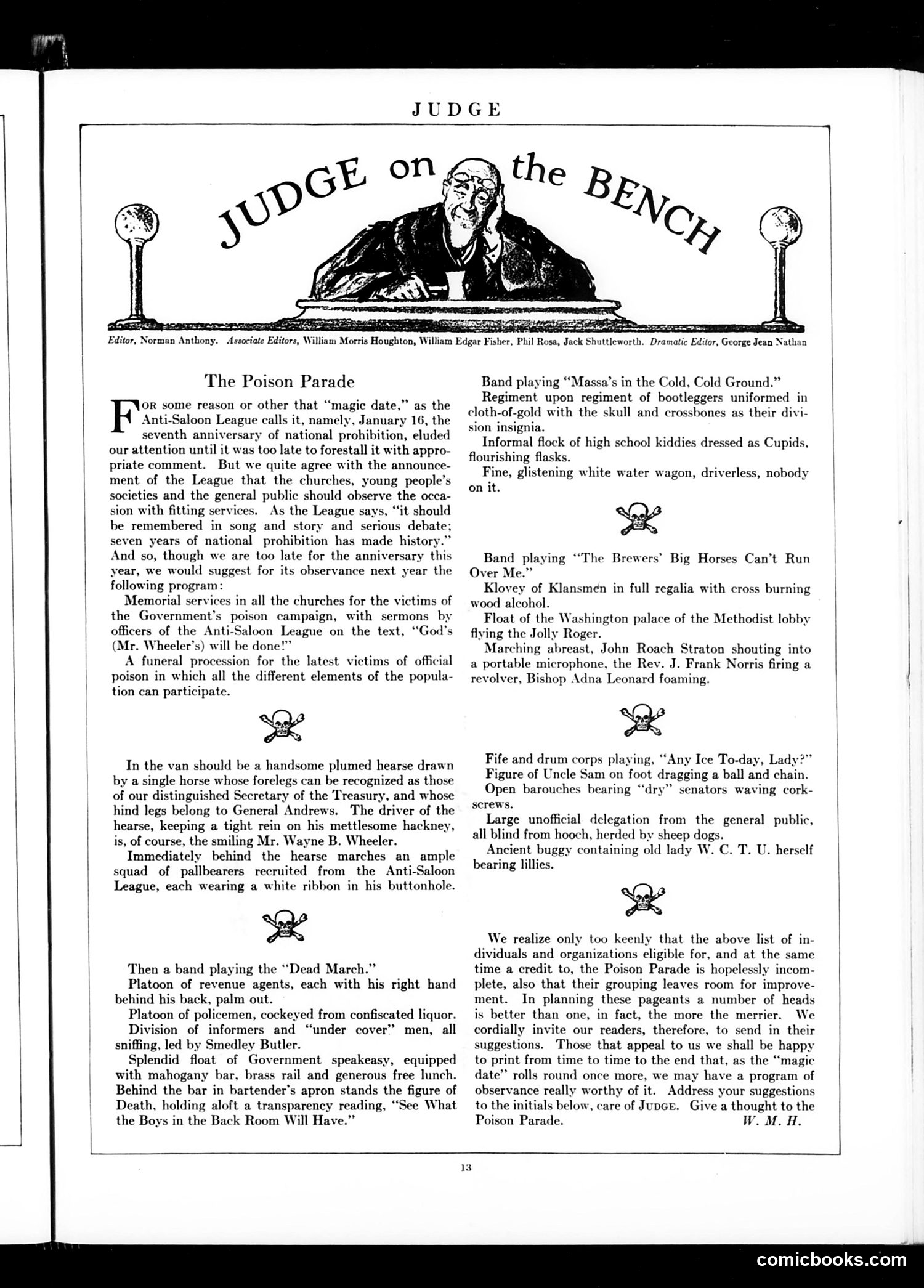
This is a satirical essay mocking Prohibition's seventh anniversary (January 16, presumably 1926). Judge ridicules the Anti-Saloon League and Prohibition enforcement by proposing a darkly comic "funeral parade" for Prohibition's victims. The satire targets: **Key figures attacked**: Wayne B. Wheeler (Anti-Saloon League leader), Secretary of Treasury Andrew Mellon, General Andrews, and preachers John Roach Straton, J. Frank Norris, and Bishop Adna Leonard—all Prohibition advocates. **The joke**: The parade ironically celebrates Prohibition by marching its supposed "casualties"—bootleggers in "cloth-of-gold," drunk policemen, dead drinkers, the KKK (which supported Prohibition), Methodist lobbyists, and a skeletal Death serving drinks. It depicts Prohibition as a deadly government poison campaign rather than a moral victory. **Social context**: By 1926, Prohibition was widely seen as corrupt and ineffective, spawning organized crime and black-market alcohol. Judge sided with anti-Prohibition forces, using grotesque humor to expose what it saw as the movement's hypocrisy and violence.
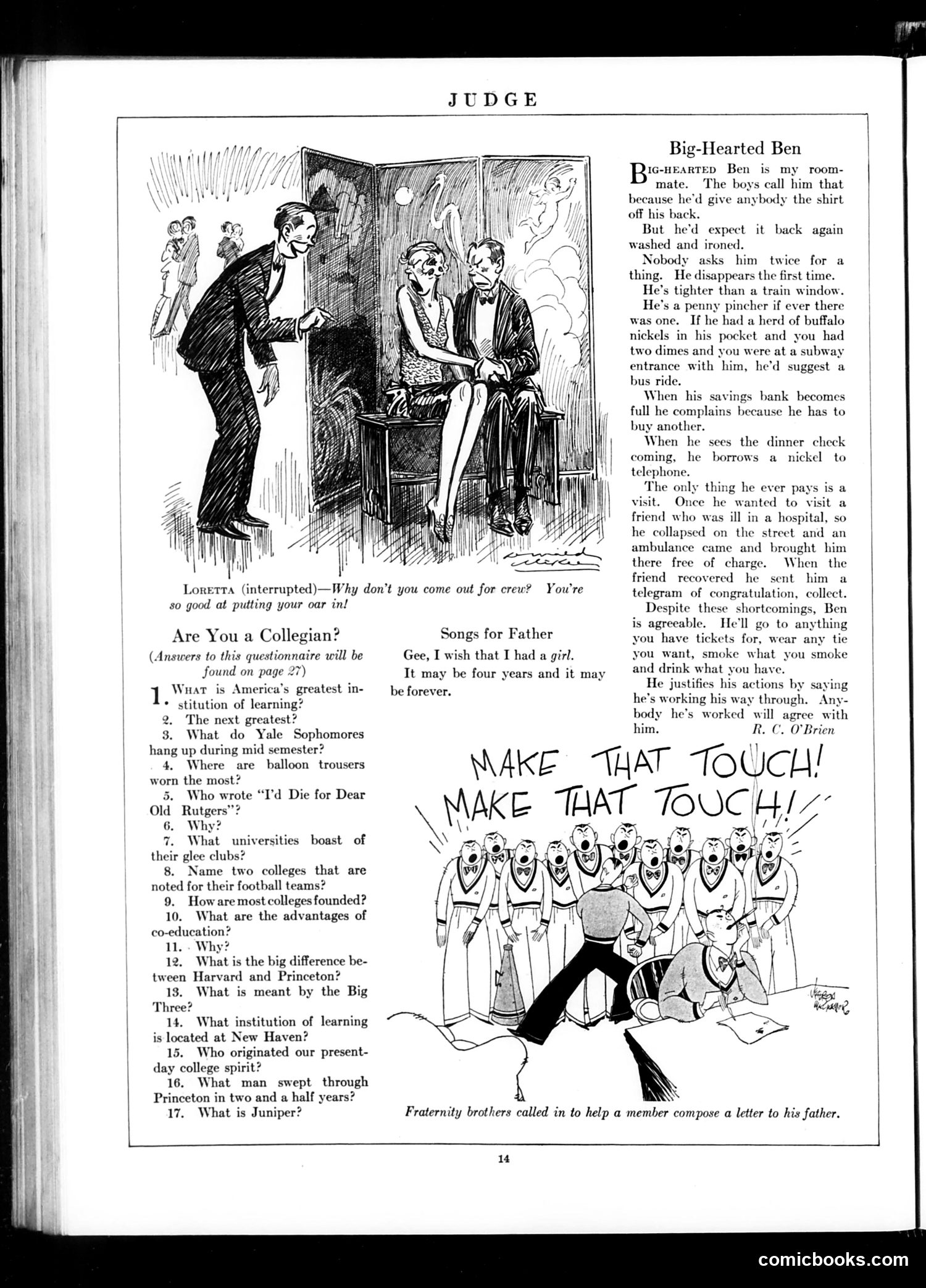
This page contains three distinct satirical pieces targeting college culture circa the 1910s-1920s: **"Big-Hearted Ben"** (right column) depicts a character type—the perpetually broke college student who generously gives his shirt but expects it laundered and returned, borrows nickels for phone calls, and manufactures free hospital visits. The satire mocks selective generosity and chronic financial irresponsibility masked as working one's way through school. **"Are You a Collegian?"** is a trivia questionnaire poking fun at collegiate clichés: prestigious universities, Yale sophomore traditions, balloon trousers fashion, football rivalries (the "Big Three"), glee clubs, and college spirit. It satirizes students' obsession with college status symbols and institutional prestige. **The fraternity cartoon** (bottom) shows fraternity brothers "helping" compose a letter to someone's father—likely assisting with financial appeals or excuses. The caption's irony suggests the "help" is collective procrastination rather than genuine assistance. Together, these pieces mock early-20th-century college pretension, financial irresponsibility, and the performative aspects of collegiate fraternity life.
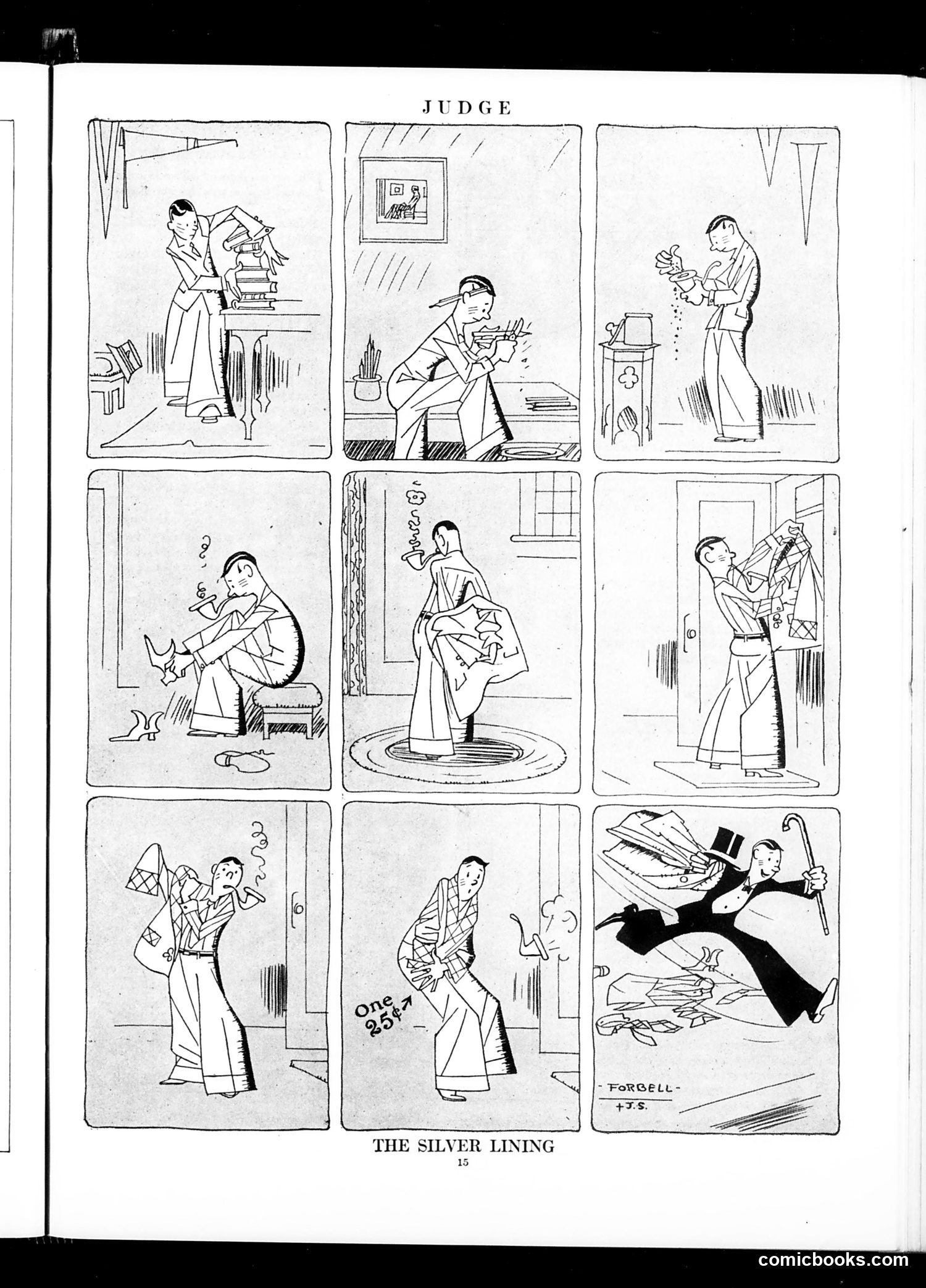
This nine-panel comic illustrates the proverb "every cloud has a silver lining" through a man's increasingly chaotic day. He begins organizing his office, then encounters escalating disasters: spilled plants, flooded floors, papers everywhere, broken furniture, and mounting clutter. By the final panel, he's buried in debris but reclines contentedly with a top hat and cane—apparently finding the "silver lining" in his complete domestic collapse. The satire likely mocks either optimistic self-delusion or the wealthy's indifference to disorder. The signature "FORSELL" is visible in the final panel. The comic plays on the tension between the saying's wisdom and the absurdity of finding positives in obvious failure.
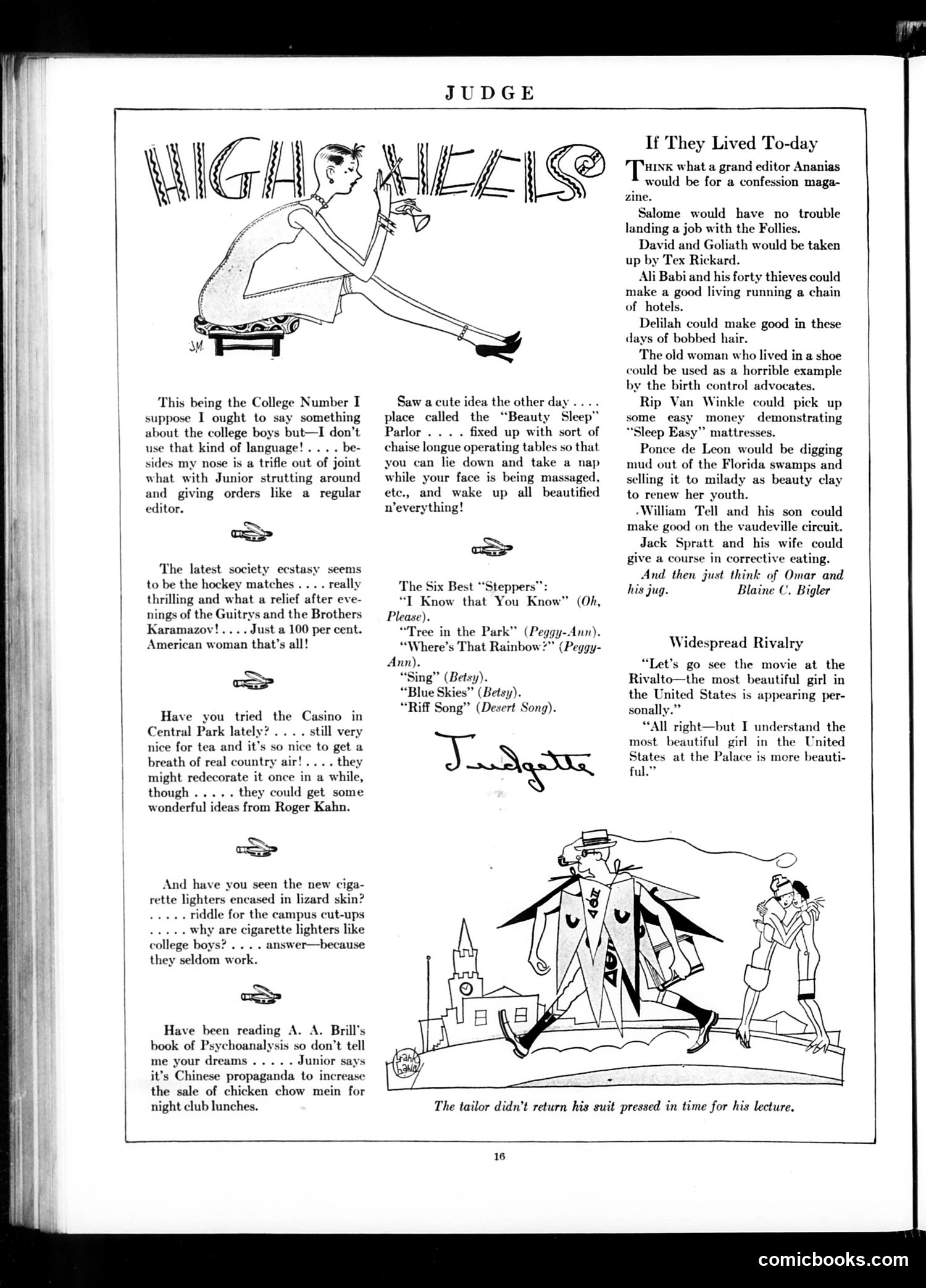
This is a satirical commentary column titled "Highhells" by what appears to be a society columnist. The page mocks contemporary 1920s trends and social figures through humorous observations. **Main Satire Points:** The column ridicules modern fads (beauty sleep parlors, lizard-skin cigarette lighters) and references current Broadway shows and popular songs. It includes a section "If They Lived To-day" that humorously reimagines biblical and fairy-tale figures as modern entrepreneurs—Salome working for the Follies, Ali Baba running hotels, Rip Van Winkle selling mattresses. This satirizes how contemporary Americans commodify everything. **Bottom Cartoon:** Shows a disheveled lecturer alongside fashionable figures, captioned "The tailor didn't return his suit pressed in time for his lecture"—mocking the gap between intellectual life and social vanity. **"Widespread Rivalry"** jokes about competing movie theaters claiming to feature "the most beautiful girl in America," satirizing entertainment industry hype and competition. The overall tone is lighthearted social satire typical of 1920s humor magazines.
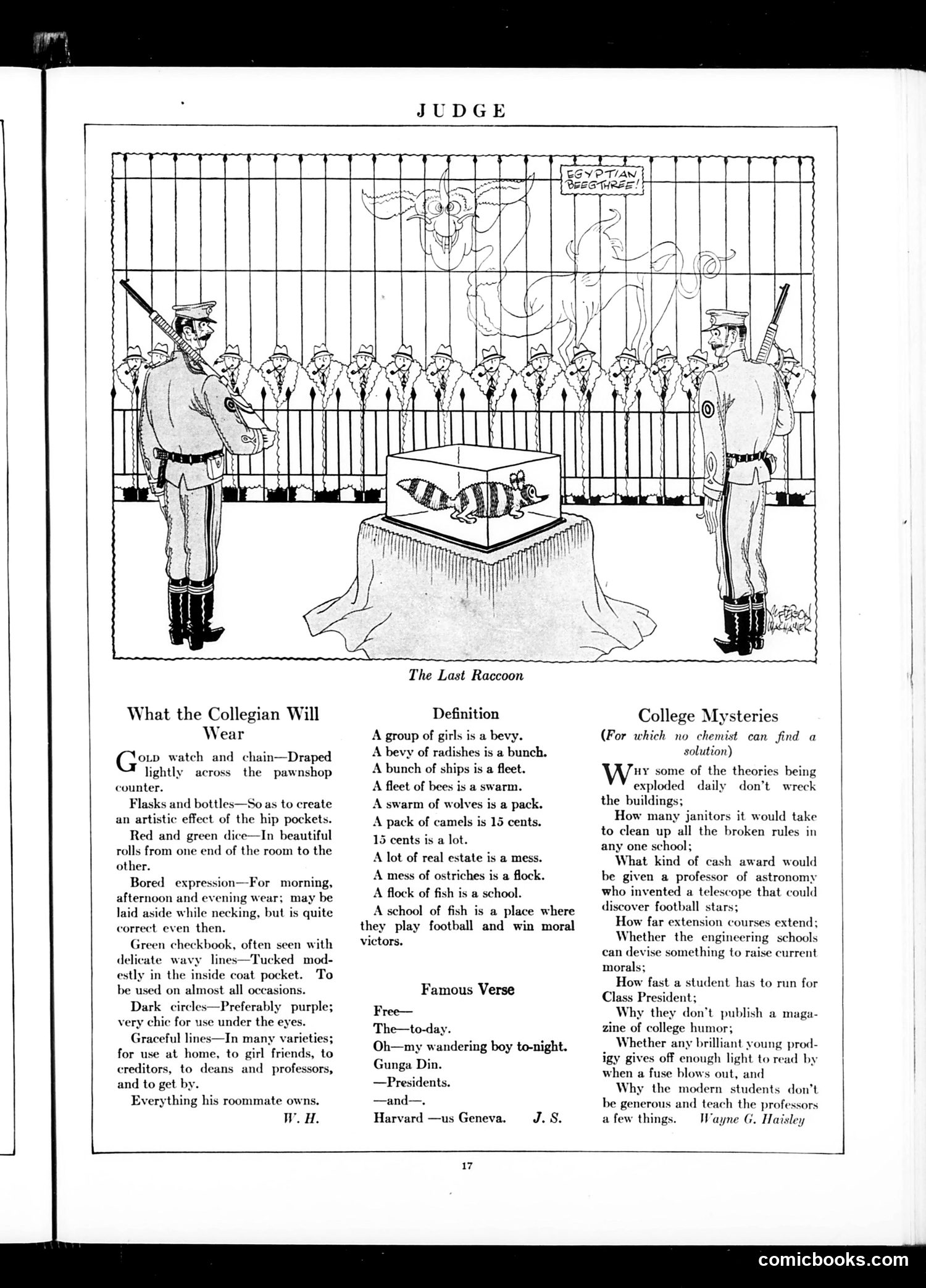
This page satirizes college life through multiple sections. The main cartoon depicts a formal execution-style scene with soldiers flanking a pedestal containing a raccoon, labeled "The Last Raccoon"—likely referencing college students' tradition of stealing or hunting raccoons, presented here as an endangered species due to student pranks. The surrounding text mocks collegian behavior: "What the Collegian Will Wear" humorously lists typical student accessories including pawned watches, hip flasks, gambling dice, overdrawn checkbooks, and stolen roommate belongings—depicting college students as financially reckless, dissolute, and dishonest. The "College Mysteries" section poses rhetorical questions about institutional absurdities (broken rules, janitor costs, engineering morals), satirizing both student behavior and institutional failures to address it. The "Definition" and "Famous Verse" sections offer wordplay and literary parody, typical of Judge's humor style. Overall, the page presents a cynical view of American college culture as characterized by theft, gambling, debt, and moral laxity.
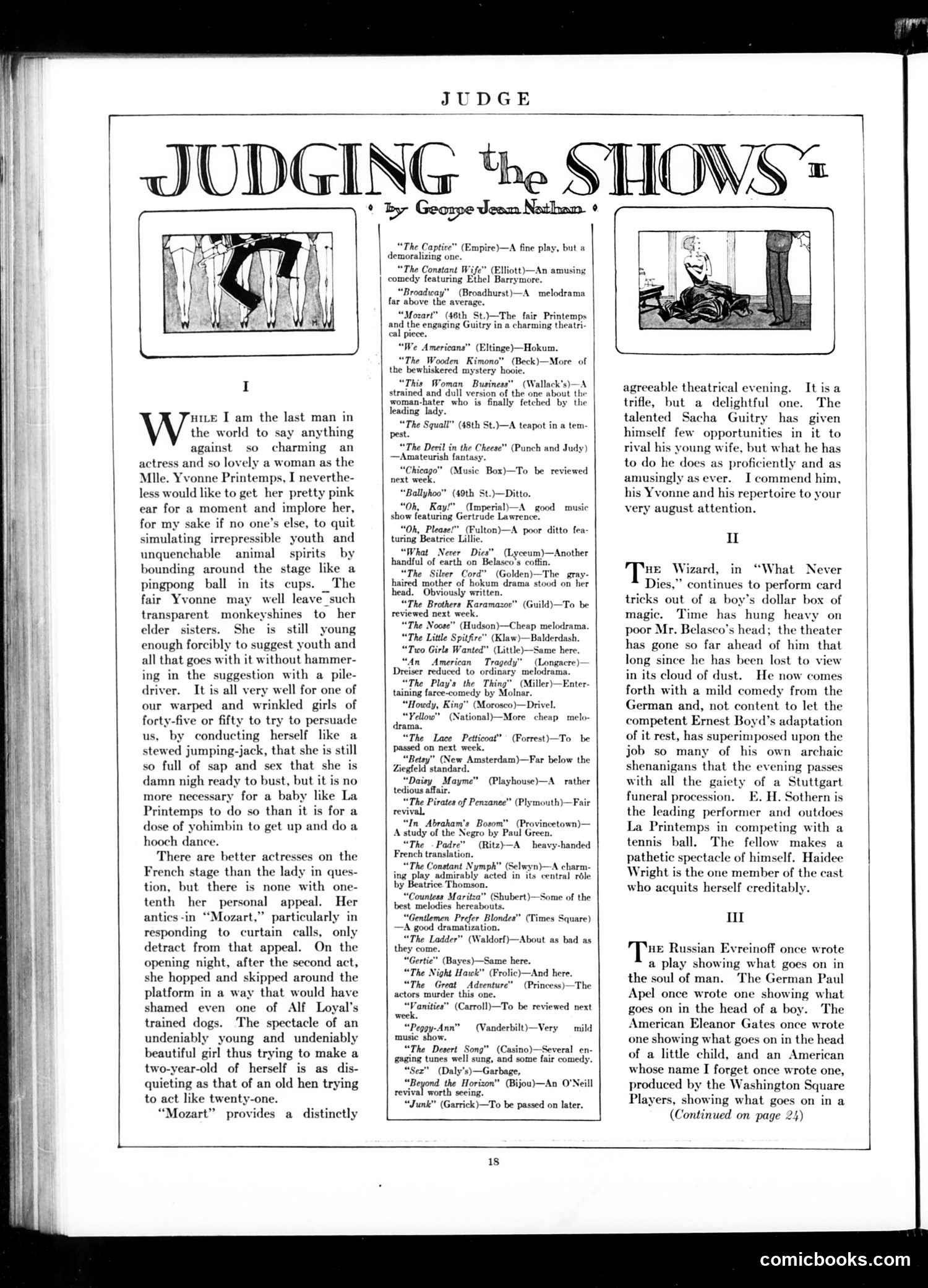
This page is a theater critic's column by George Jean Nathan reviewing Broadway productions. The main text criticizes French actress Yvonne Printemps, who stars in "Mozart" at the 46th Street Theatre. Nathan argues she's so naturally young and beautiful that her exaggerated, childish stage antics (hopping and skipping) actually *detract* from her appeal rather than enhance it. He compares her unnecessary mugging to an old woman pretending to be twenty-one—the performance undercuts her genuine assets. The right column lists brief reviews of other current Broadway shows, rating them from "fine" to "hokum" to "drivel." This was typical Judge content: theatrical criticism aimed at educated, theater-going readers who recognized these productions and performers.
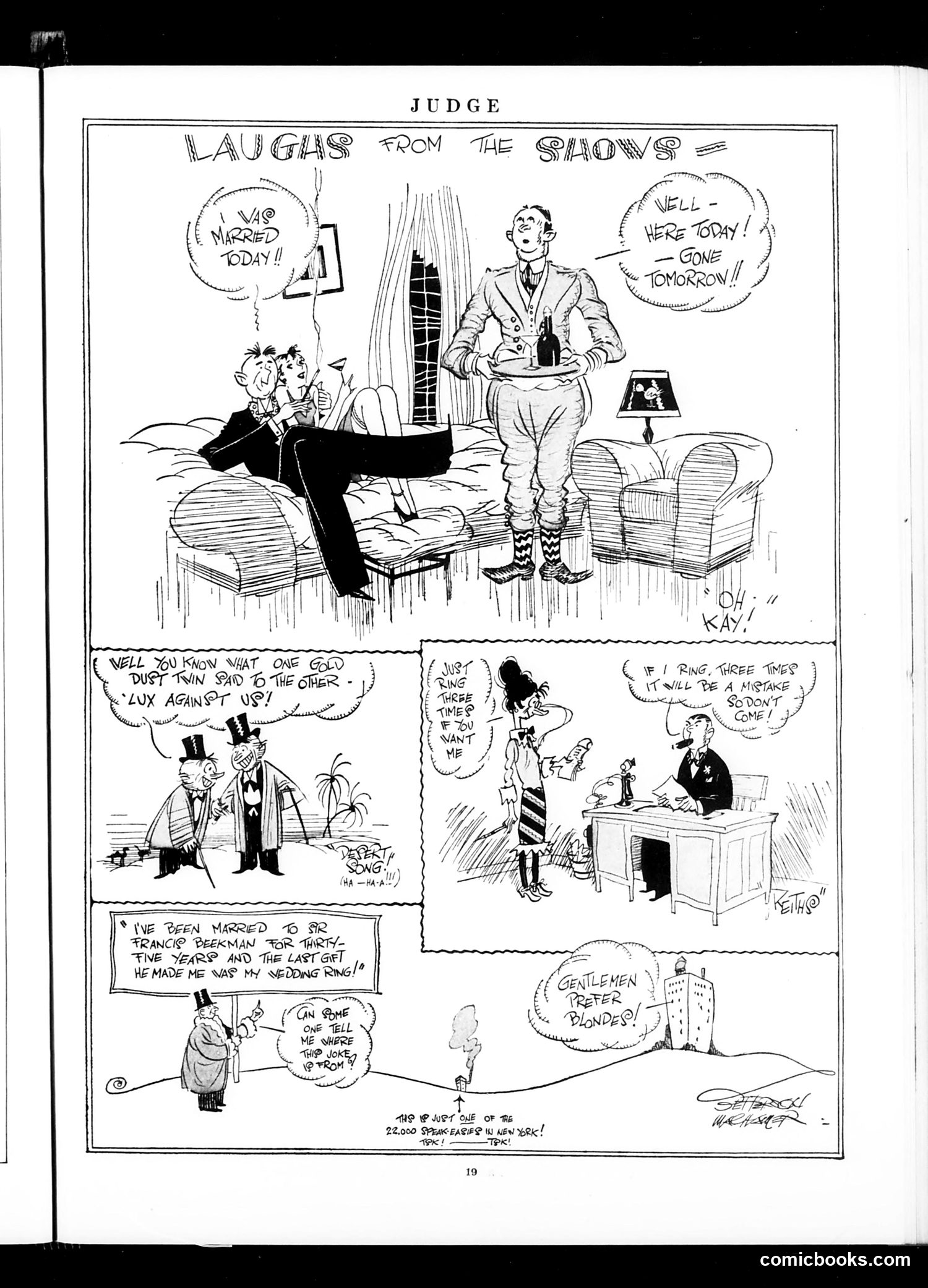
This page collects satirical comic vignettes lampooning theater and entertainment world follies. The top panel mocks newlyweds from theatrical productions announcing their marriages and immediate separations ("Well, here today! Gone tomorrow!")—suggesting the instability and artificiality of show business relationships. Lower panels joke about aging performers and romantic clichés: one depicts two elderly gentlemen reminiscing about romantic conquests using tired pickup lines ("Lux against us?"), while another shows a woman repeatedly interrupting a man's telephone proposal with false alarms. The final panel references the high cost of theatrical venues in New York. The humor targets entertainment industry stereotypes: performers' narcissism, romantic melodrama, and the disconnect between theatrical glamour and real-life relationships. The cartoons assume readers' familiarity with Broadway culture and theater gossip of the era.
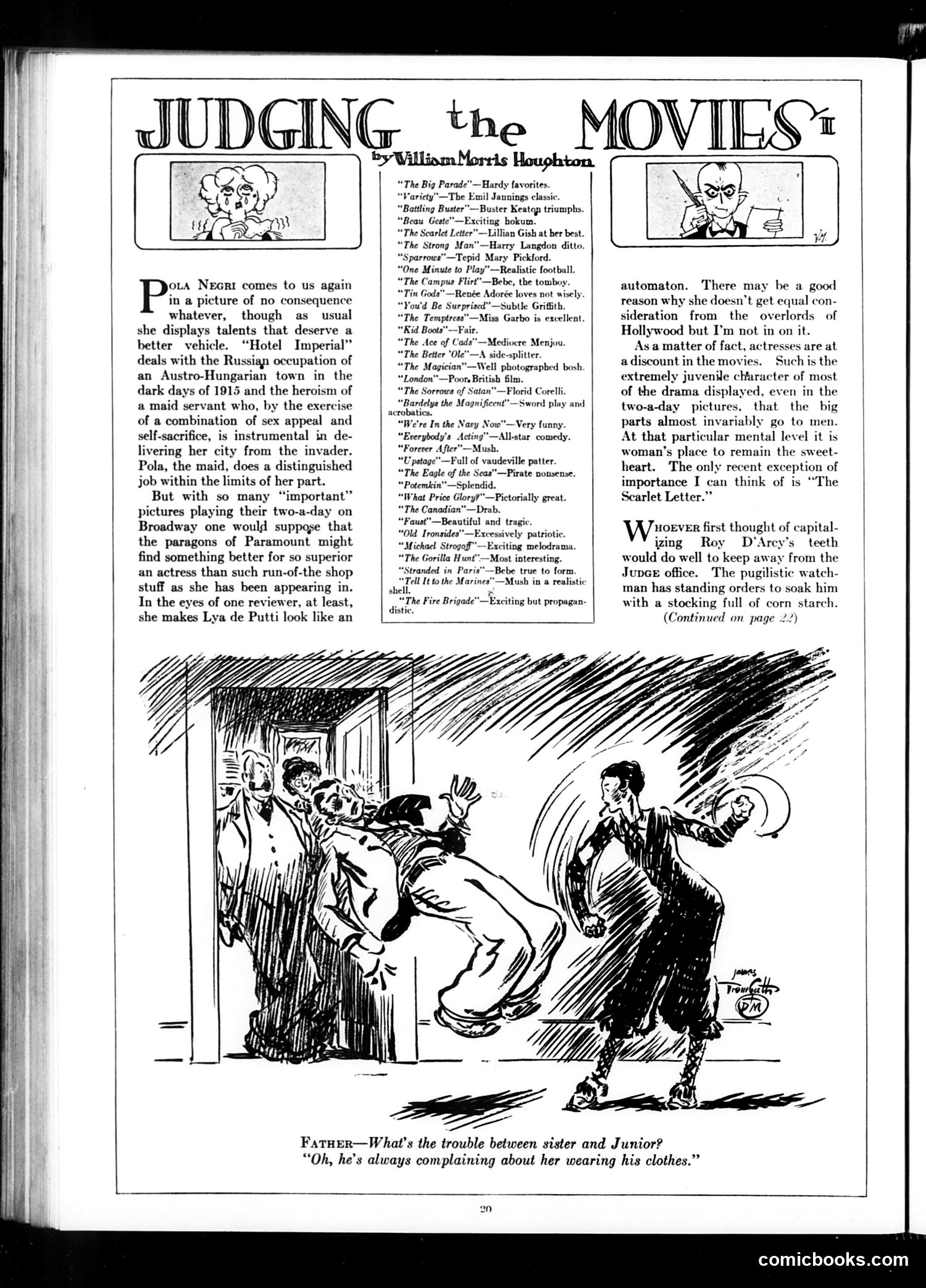
This page reviews 1920s silent films for a satirical American magazine. The main article critiques actress Pola Negri, praising her talent while lamenting that Paramount Studios wastes her abilities on mediocre films like "Hotel Imperial." The reviewer argues that Hollywood systematically undervalues actresses, relegating them to "sweetheart" roles while men get substantial parts—a complaint about gendered casting practices that persists today. The accompanying cartoon jokes about sibling rivalry: a father asks why his son complains, learning the boy resents his sister borrowing his clothes—a domestic humor piece poking fun at family dynamics rather than addressing political or social satire. The film list appears to be contemporary reviews, with varying judgments of popular movies of the period.
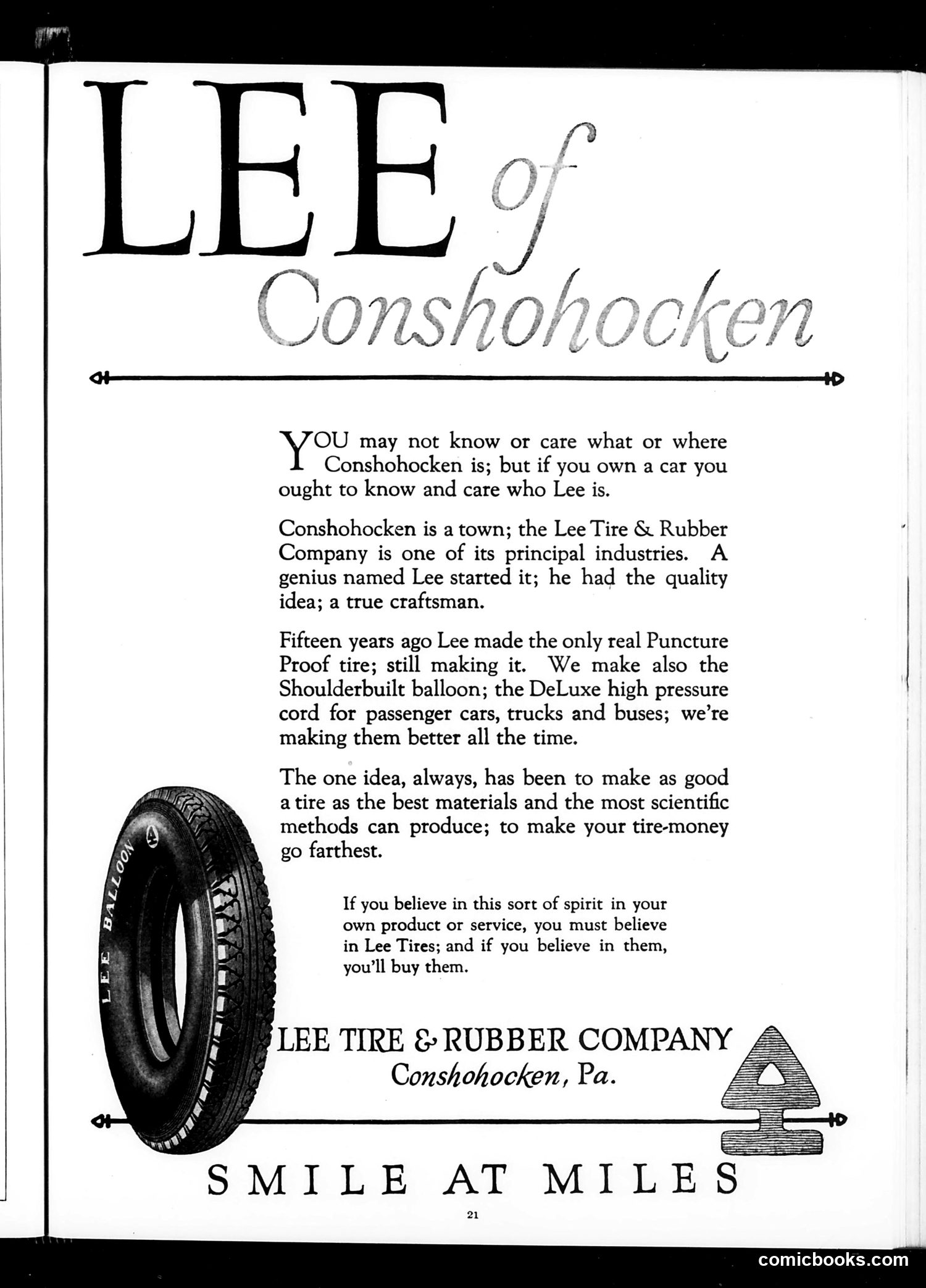
This is **not a cartoon or satire**—it's a straightforward advertisement for Lee Tire & Rubber Company of Conshohocken, Pennsylvania, appearing in *Judge* magazine. The ad promotes Lee's tire products, particularly their "Puncture Proof" tire (invented 15 years prior) and newer offerings like the "Shoulderbuilt balloon" and "DeLuxe high pressure cord." The message emphasizes craftsmanship and quality: founder Lee applied scientific methods and premium materials to maximize tire value. The closing argument appeals to readers' own business values—if you believe in quality and integrity in your own work, you should trust and buy Lee Tires. This is direct persuasion rather than satire. The page number (21) and *Judge* publication context suggest this ran in an early-20th-century issue, when tire manufacturing was emerging as a major industry and automobiles were becoming widespread consumer goods.
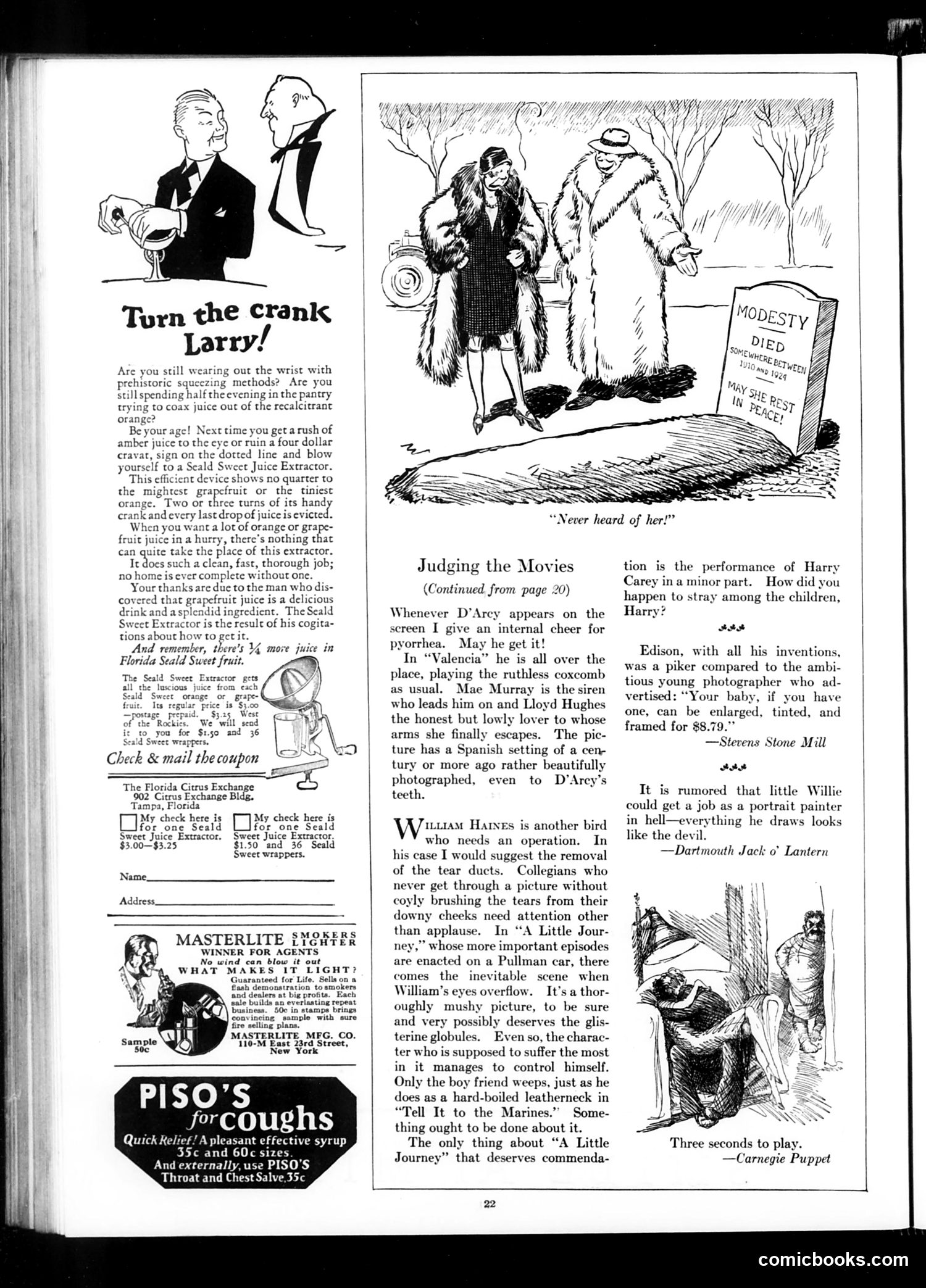
This Judge magazine page contains satirical film reviews and vintage advertisements. The main content "Judging the Movies" critiques 1920s silent film actors with biting humor. The reviewer mocks actor **D'Arcy** for his appearance, sarcastically wishing he'd get pyorrhea (gum disease). Similar insults target **William Haines** for excessive crying in films—the reviewer suggests removing his "tear ducts" since he weeps while other characters maintain composure. **Harry Carey** receives rare praise for a minor role, with the reviewer mock-surprised he'd appear in a children's picture. The scattered jokes below (credited to college humor publications) continue this style of personal ridicule—one quips that young Willie's portrait-painting would look "like the devil." This reflects 1920s satirical magazine culture: irreverent, personality-focused criticism of celebrities, often cruel by modern standards. The advertisements for juice extractors, cigarette lighters, and cough syrup are period-typical.
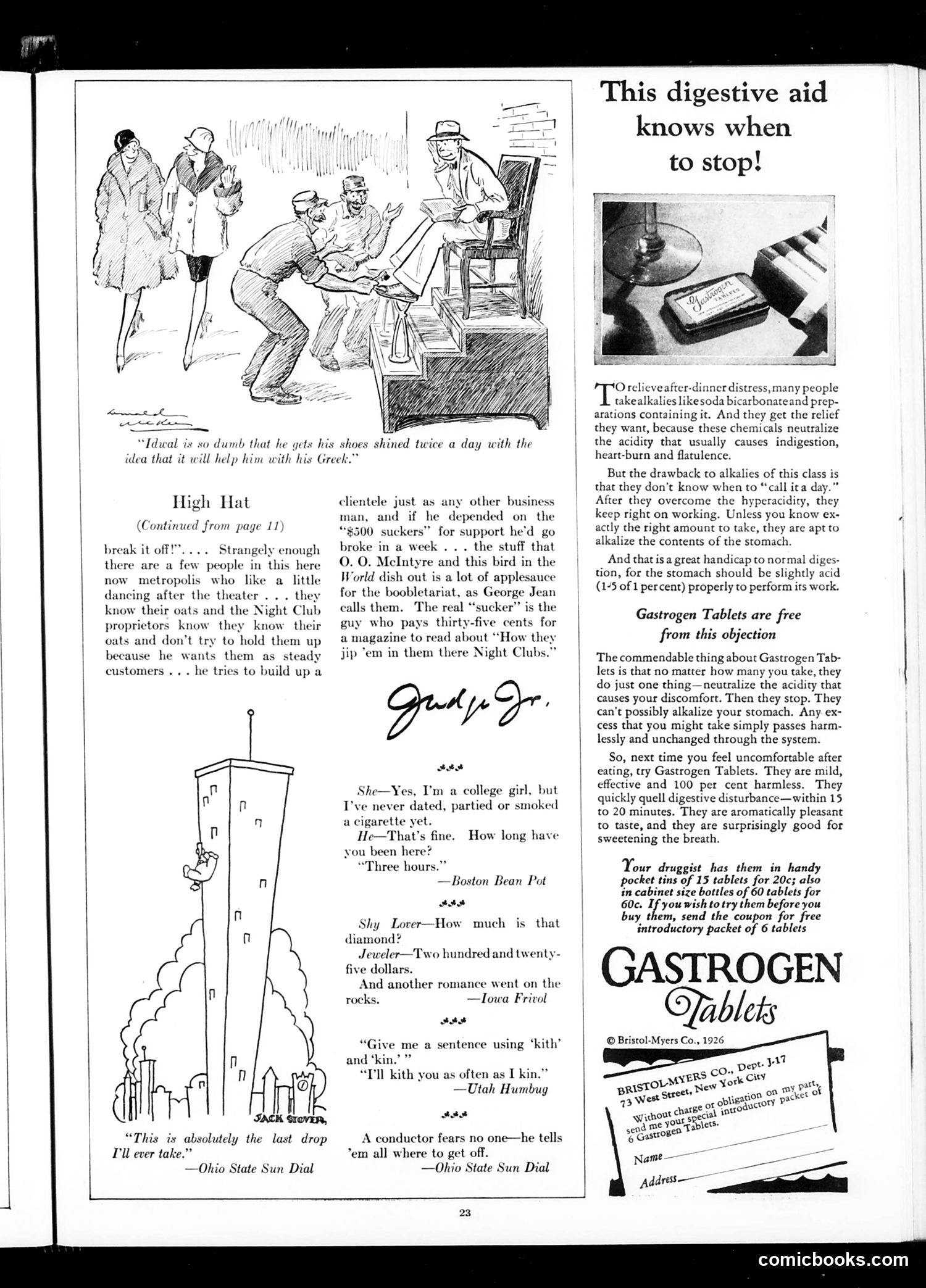
This page contains humor pieces and an advertisement from a 1926 issue of *Judge* magazine. **The Cartoons:** The main cartoon "High Hat" satirizes Night Club culture and pretentious social climbing. It mocks both the exaggerated claims made by gossip columnists (like O. O. McIntyre) about nightclub scandals and the ordinary working people who buy magazines to read such stories, imagining glamorous deception. **The Jokes:** Short humor pieces mock college students and romantic misadventures—one girl claims to be sophisticated but has only been dating for three hours; another joke notes that a shy lover can't afford the expensive diamond needed to continue courting. **The Advertisement:** Gastrogen Tablets are promoted as a digestive aid that "knows when to stop"—unlike sodium bicarbonate, which continues neutralizing stomach acid excessively. This pitch emphasizes precision dosing and harmlessness, targeting readers experiencing indigestion from rich foods or overeating. The page reflects 1920s concerns with urban nightlife, courtship rituals, and digestive complaints.
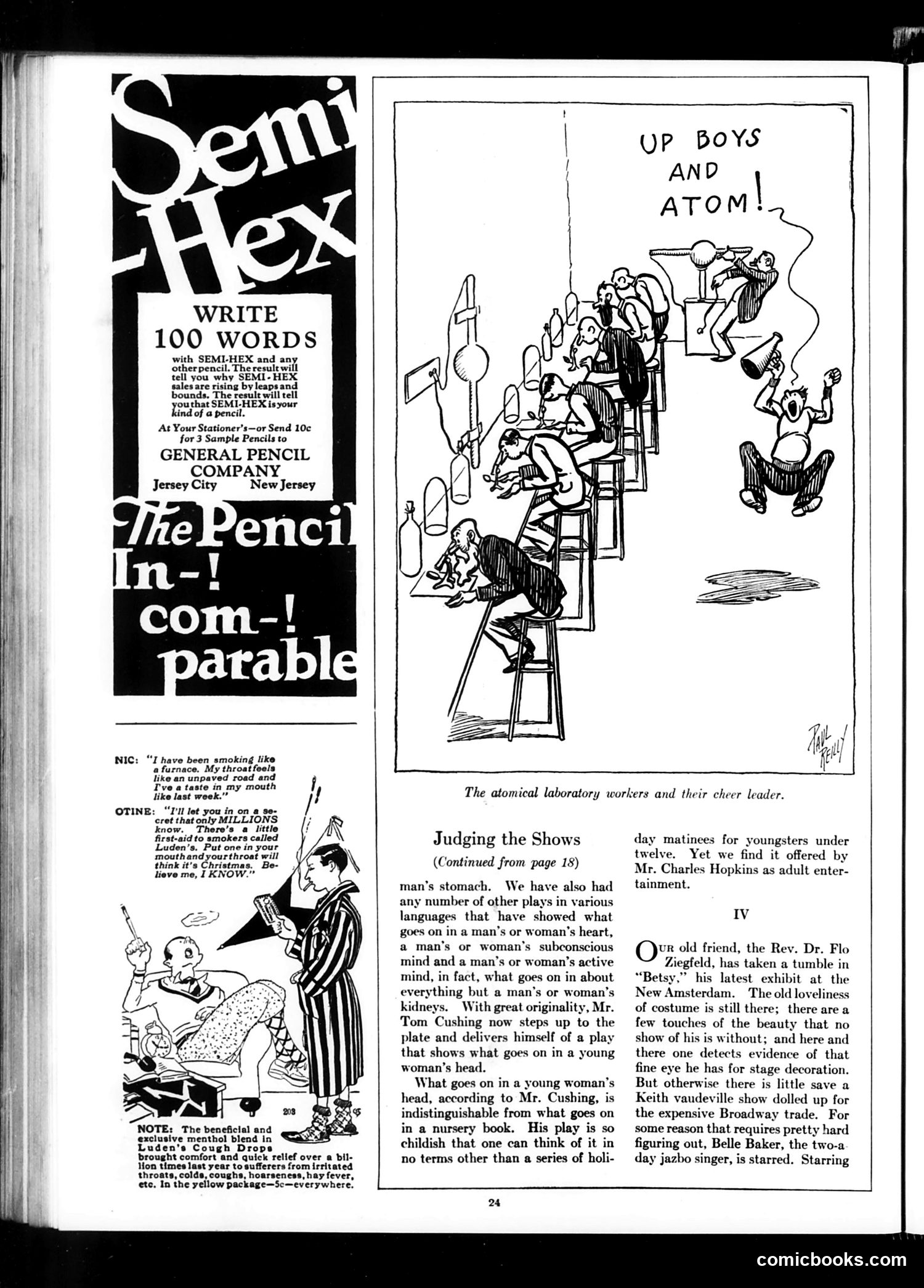
This page contains **advertisements and theater criticism**, not political satire. **Left side:** Ads for Semi-Hex pencils (urging readers to write 100-word tests) and Luden's cough drops (mentholated lozenges), featuring period testimonials and product claims typical of 1920s advertising. **Top right cartoon:** Labeled "The atomical laboratory workers and their cheer leader," it depicts scientists on tall stools at workbenches with one figure below cheering "UP BOYS AND ATOM!" The satire gently mocks atomic research enthusiasm—likely referencing early 20th-century excitement about atomic physics, portraying scientists as childishly enthusiastic about their "atom." **Bottom section:** Theater reviews by what appears to be a drama critic discussing recent Broadway shows, including criticism of a Tom Cushing play about a young woman's mind (deemed overly childish) and Florenz Ziegfeld's "Betsy" (criticized as vaudeville rather than serious theater despite its budget and Belle Baker's starring role).
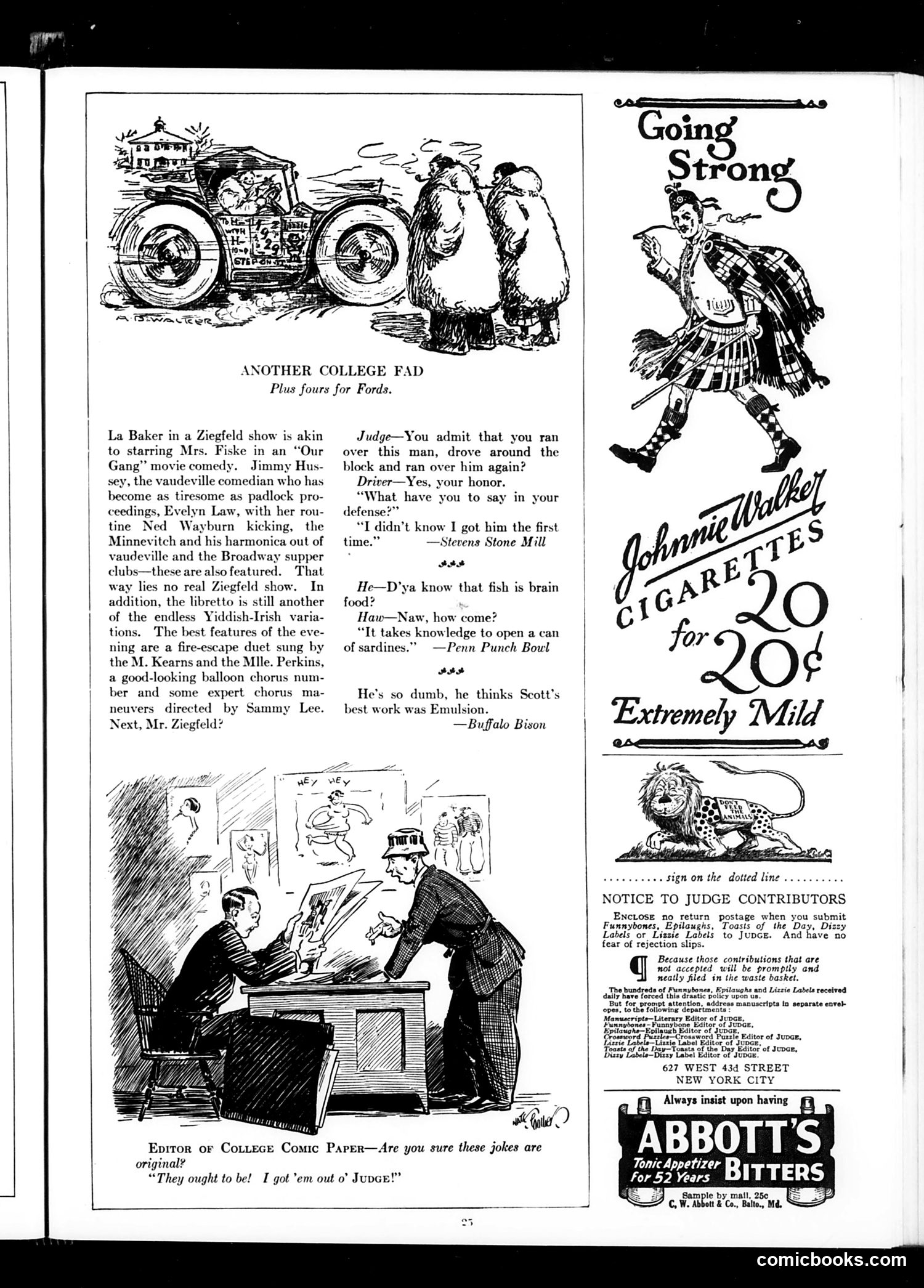
**Main Content:** The page satirizes a Ziegfeld Theatre production, criticizing its casting choices. It compares La Baker performing in a Ziegfeld show to inappropriate casting decisions (Mrs. Fiske in a cheap comedy), suggesting the production lacks the quality associated with impresario Florenz Ziegfeld Jr. The critique names several vaudeville performers deemed "tiresome," implying they've overstayed their welcome in entertainment. **Humor Section:** Three brief jokes appear: one about a hit-and-run driver claiming ignorance of his first impact; one playing on "fish is brain food"; and one mocking someone thinking Scott's best work was "Emulsion" (likely a patent medicine, not literature). **Satirical Meta-Joke:** The bottom cartoon shows an editor confronting a contributor about joke originality. The contributor admits stealing them from Judge itself—satirizing both magazine plagiarism and the circular nature of humor recycling in periodicals. **Advertisements** for Johnnie Walker cigarettes and Abbott's Bitters appear throughout.
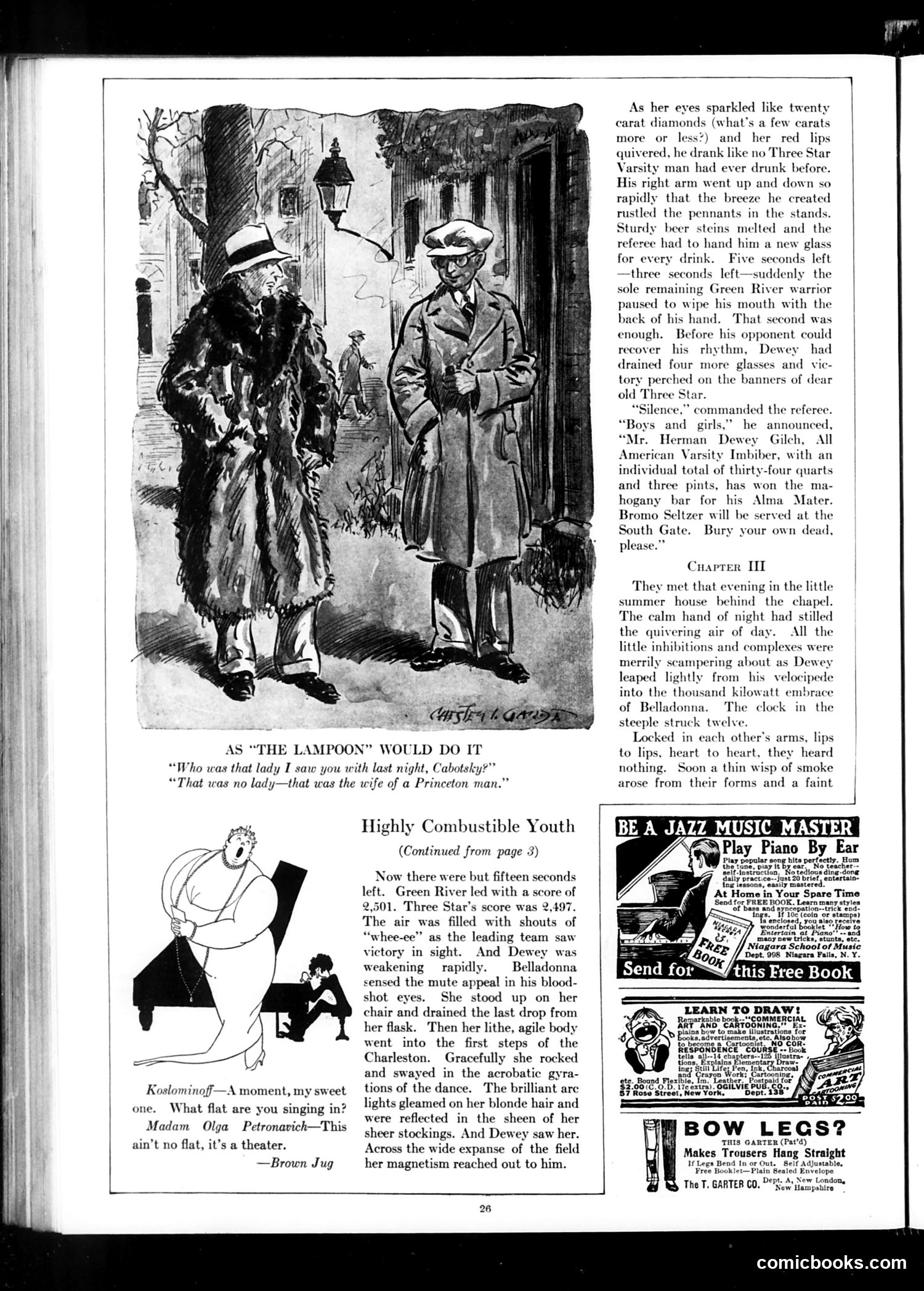
This page contains two distinct satirical pieces mocking 1920s college culture: **"The Lampoon Would Do It"** (top cartoon) jokes about Harvard's Lampoon magazine through ethnic caricature. The dialogue plays on Ivy League exclusivity—the punchline suggests a woman seen with "Cabotsky" couldn't be a lady but must be a Princeton man's wife, implying Princeton was considered lesser. The crude ethnic names mock immigrant populations while reinforcing WASP social hierarchies. **"Highly Combustible Youth"** (main story) satirizes Jazz Age excess and Prohibition-era drinking competitions among college students. The narrative—featuring characters named "Dewey," "Belladonna," and "Green River"—parodies overwrought romantic fiction while depicting collegiate drinking contests as dangerous spectacles. References to beer steins, "Bromo Seltzer" (a hangover remedy), and a climactic romantic scene ending in smoke suggest mockery of both student debauchery and florid literary conventions. Both pieces reflect Judge magazine's satirical commentary on contemporary American youth culture and social pretension.
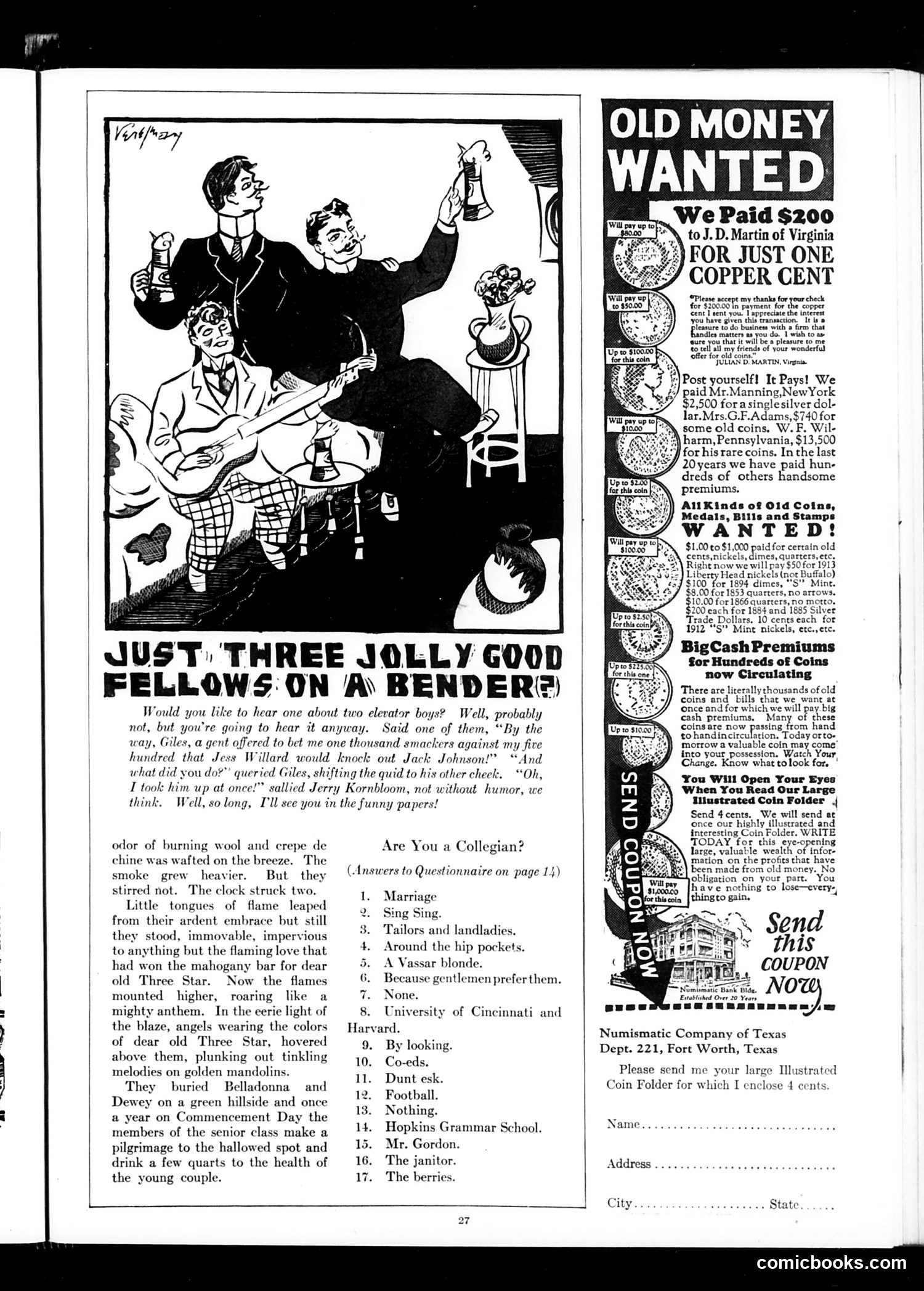
This Judge magazine page contains two distinct elements: **Left: "Just Three Jolly Good Fellows on a Bender"** A satirical cartoon and story mocking sentimental drinking culture. Three men stand immobilized by passion for "old Three Star" (whiskey), depicted through melodramatic language comparing their devotion to romantic love. The joke ridicules both excessive drinking and the overwrought literary sentimentality used to romanticize alcohol consumption—common targets of early-20th-century satire. **Right: "Old Money Wanted" Advertisement** This is a legitimate (if predatory) coin-buying advertisement offering cash premiums for rare or old U.S. currency and stamps. The testimonials from satisfied sellers establish credibility. The accompanying questionnaire ("Are You a Collegian?") appears designed to identify educated, affluent readers likely to possess valuable coins. The page juxtaposes satirical commentary on drinking excess with a straightforward commercial appeal to collectors—typical of Judge's mixed advertising and editorial content model.
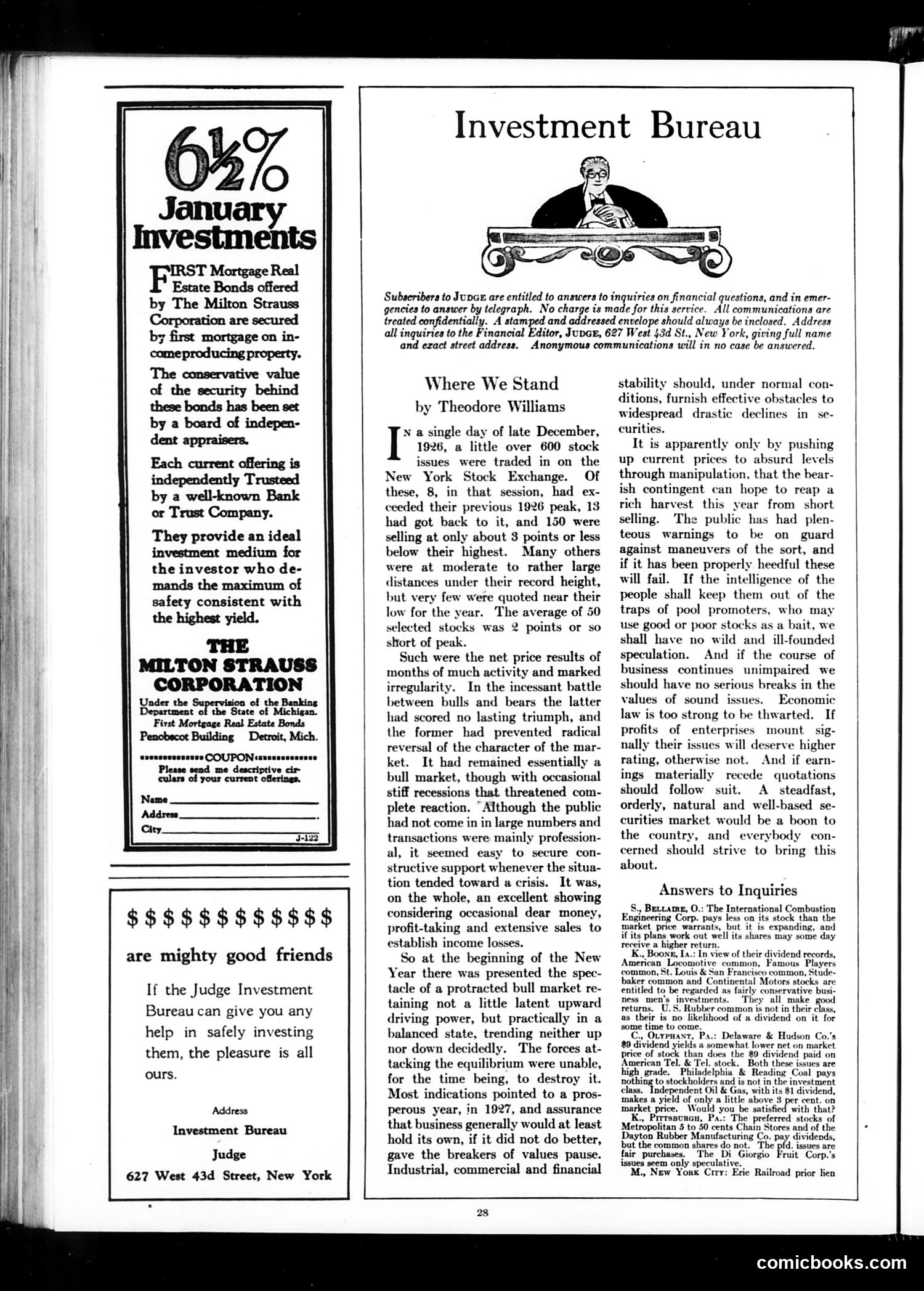
This page from Judge combines financial advertisements with market commentary from late 1926/early 1927. **The Advertisements:** The Milton Strauss Corporation and Judge's Investment Bureau both advertise financial services—mortgage bonds and investment advice respectively. These represent mainstream financial institutions of the era offering supposedly safe investments to ordinary citizens. **The Commentary:** Theodore Williams's "Where We Stand" analyzes the stock market's recent performance. He describes a bull market holding steady despite occasional volatility, with most stocks near their 1926 peaks. He expresses cautious optimism about 1927's prospects, predicting continued stability. **The Satire/Context:** The irony for modern readers: this appears in late 1926, just months before the October 1929 stock market crash that triggered the Great Depression. Williams's confident predictions about market "stability" and "prosperous year" proved catastrophically wrong. The page exemplifies the blind optimism and aggressive market manipulation that preceded the financial disaster.
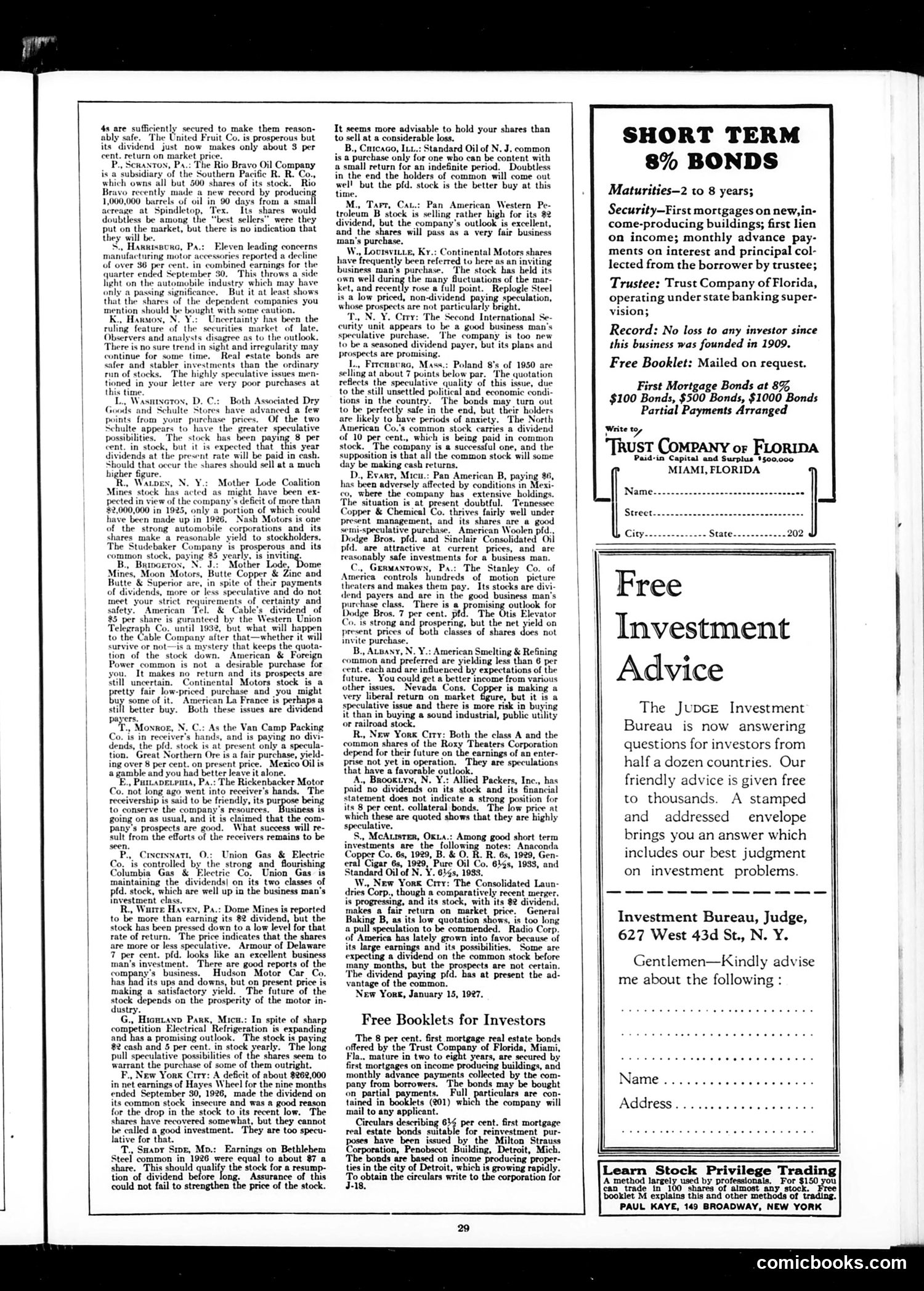
This page consists primarily of **investment advice columns** addressing reader questions about various stocks and bonds, rather than political cartoons. It's a financial guidance section typical of Judge magazine's content in the 1920s. The advice discusses industrial stocks of the era—automobile manufacturers (Nash Motors, Studebaker), utilities (Union Gas & Electric), mining companies, and railroads. The columnists evaluate dividend yields, financial stability, and speculative risk. Notable is their caution about emerging industries: automobile stocks receive mixed reviews, and they warn readers away from speculative ventures like Mexico Oil. The right sidebar advertises the Judge Investment Bureau's free advice service, emphasizing accessibility to ordinary investors. This reflects 1920s prosperity and the era's democratization of stock investing—before the 1929 crash would devastate many small investors who followed such guidance. The overall tone reflects pre-Depression optimism about industrial growth and shareholder returns.
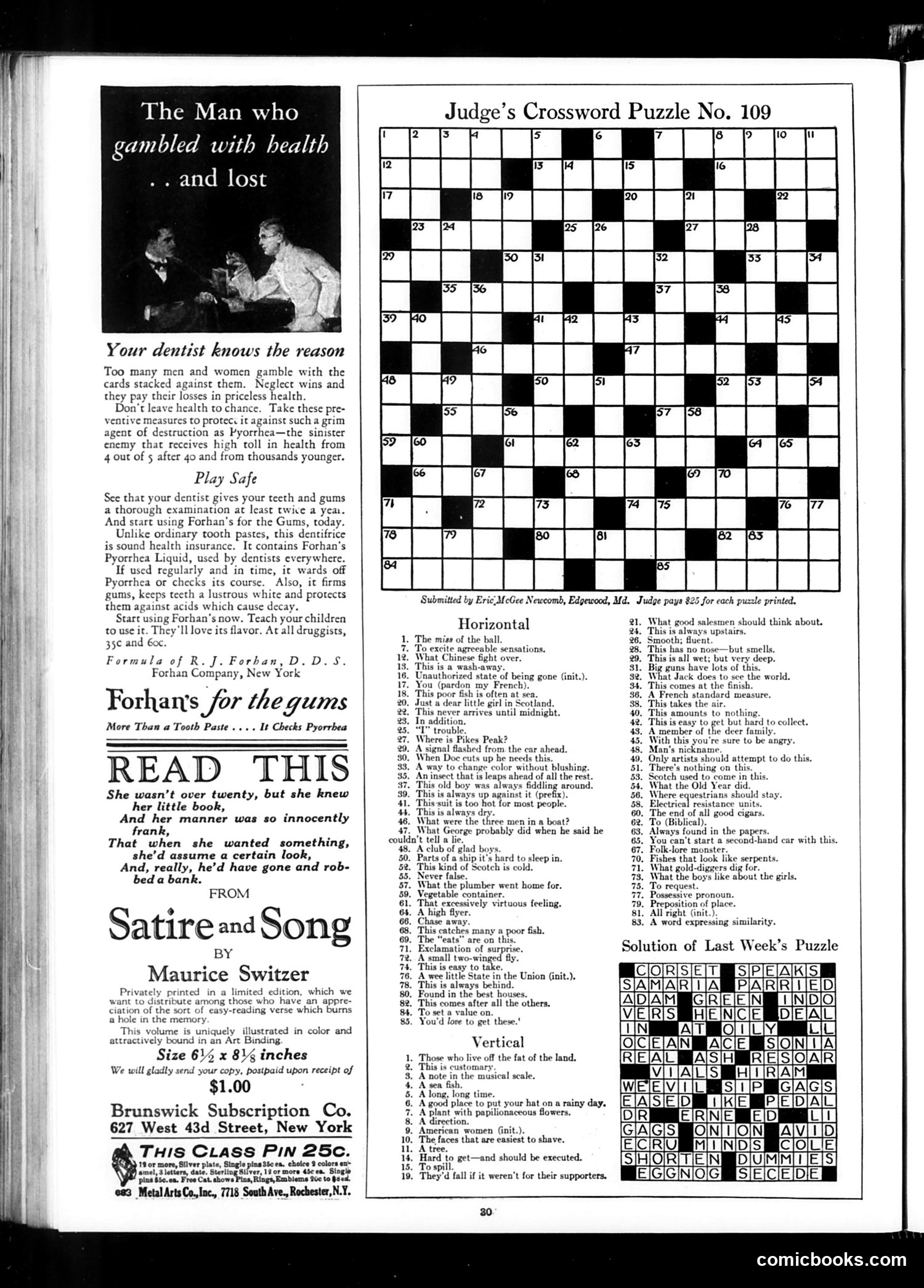
This page is primarily **advertising and entertainment content** rather than political satire. The main elements include: **The Advertisement (top-left):** A cautionary ad for Forhan's toothpaste featuring a morality tale about a man who "gambled with health...and lost" by neglecting dental care. The image shows two men in conversation, with text warning that pyorrhea (gum disease) is a serious health threat—particularly affecting men over 40. This reflects 1920s-era public health messaging that treated dental neglect as a moral failing. **The Satirical Poem (center-left):** "Satire and Song" by Maurice Switzer—a lighthearted verse mocking a young woman's manipulation of a man through innocent charm and calculated looks to get what she wants. **The Crossword Puzzle (right):** A standard Judge magazine puzzle feature, nothing particularly political. The page reflects typical Judge content: advertising, light social satire about gender relations, and puzzles—rather than the sharp political commentary the magazine was known for.
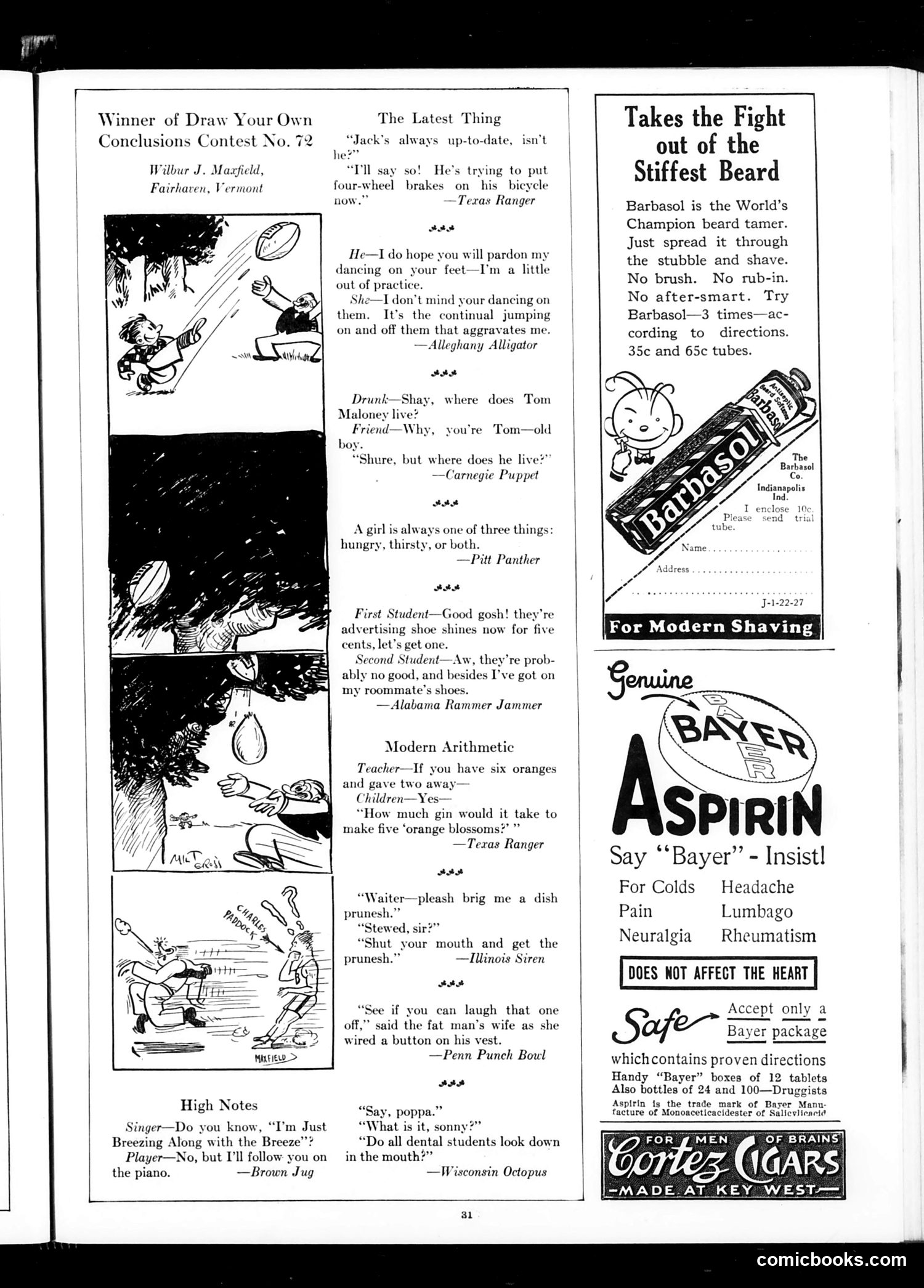
This page contains **humor shorts and advertisements** rather than political cartoons. The left side features a contest-winning cartoon by Wilbur J. Maxfield and multiple joke submissions from readers at various colleges (Texas Ranger, Carnegie Puppet, Alabama Rammer Jammer, etc.). The jokes reflect **1920s college humor**: references to Prohibition-era "orange blossoms" (gin cocktails), dating etiquette, and student life. One joke plays on a drunk man's confused identity; another mocks students advertising shoe shines. The **right side is entirely advertisements** for period products: Barbasol shaving cream, Bayer Aspirin, and Cortez cigars. These ads are notable for making health claims ("does not affect the heart") that would be illegal today. The cartoon itself appears to depict someone attempting bicycle repairs—illustrating being "up-to-date" with modern four-wheel brakes, a topical reference to 1920s automotive technology trickling down to bicycles.
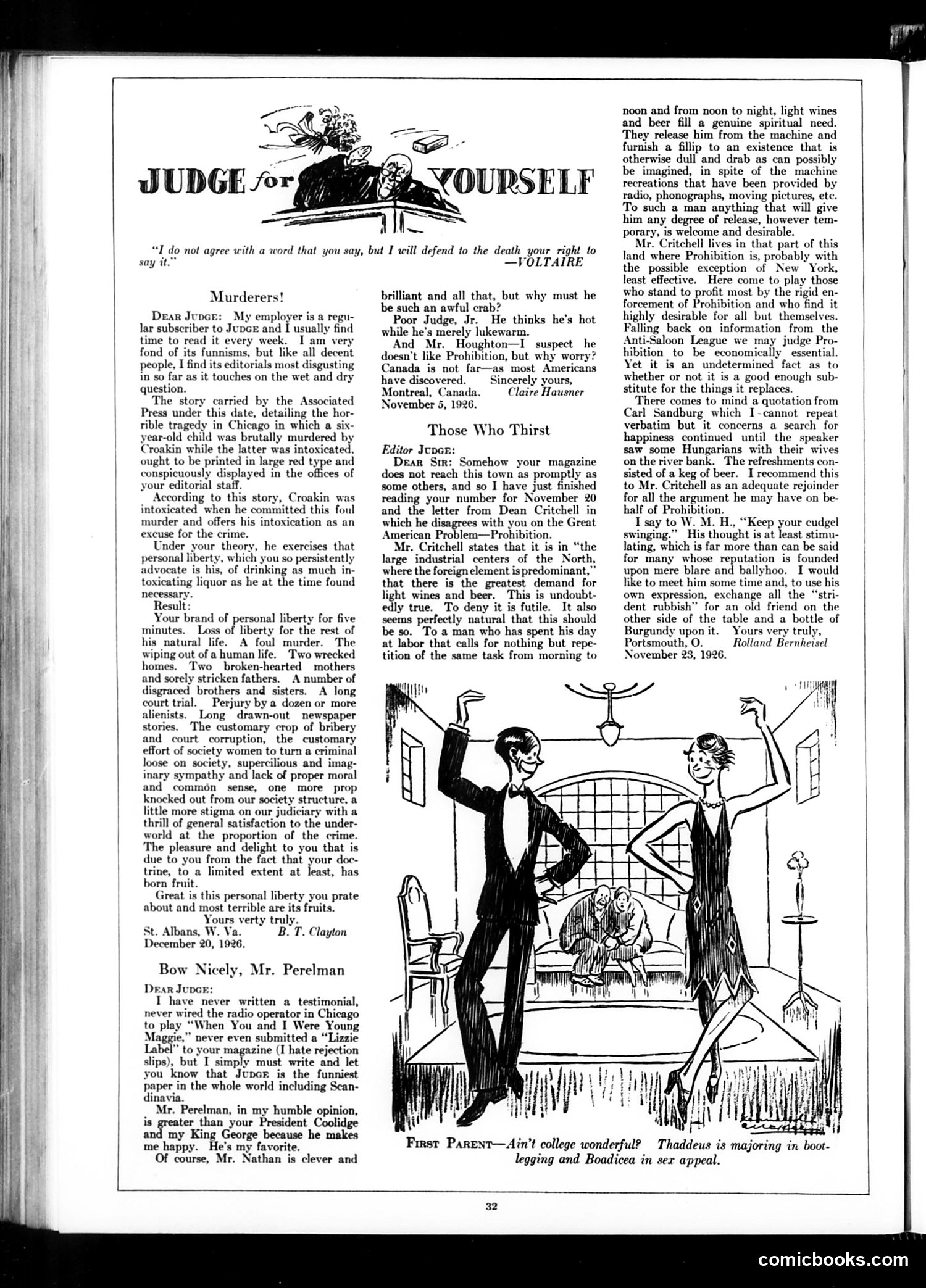
This page from Judge (1926) comprises reader letters debating Prohibition, America's then-current alcohol ban (1920-1933). **"Murderers!"** attacks Judge's pro-personal-liberty editorial stance. A correspondent blames Judge's libertarian philosophy for enabling a drunk man's murder of a child in Chicago, arguing the magazine's defense of drinking rights indirectly caused the tragedy. **"Bow Nicely, Mr. Perelman"** praises Judge's humor and specific writers (Perelman, Nathan, Houghton), while mockingly suggesting editor Houghton secretly opposes Prohibition—hinting he could easily escape to Canada, where alcohol remained legal. **"Those Who Thirst"** begins a letter supporting Prohibition's necessity in industrial cities with immigrant populations, countering an earlier argument by "Dean Critchell." The cartoon depicts parents shocked at their son's drinking escapade, captioned with ironic understatement about "bootlegging." These letters reflect the intense Prohibition debate dividing 1920s America between reformers and libertarians.
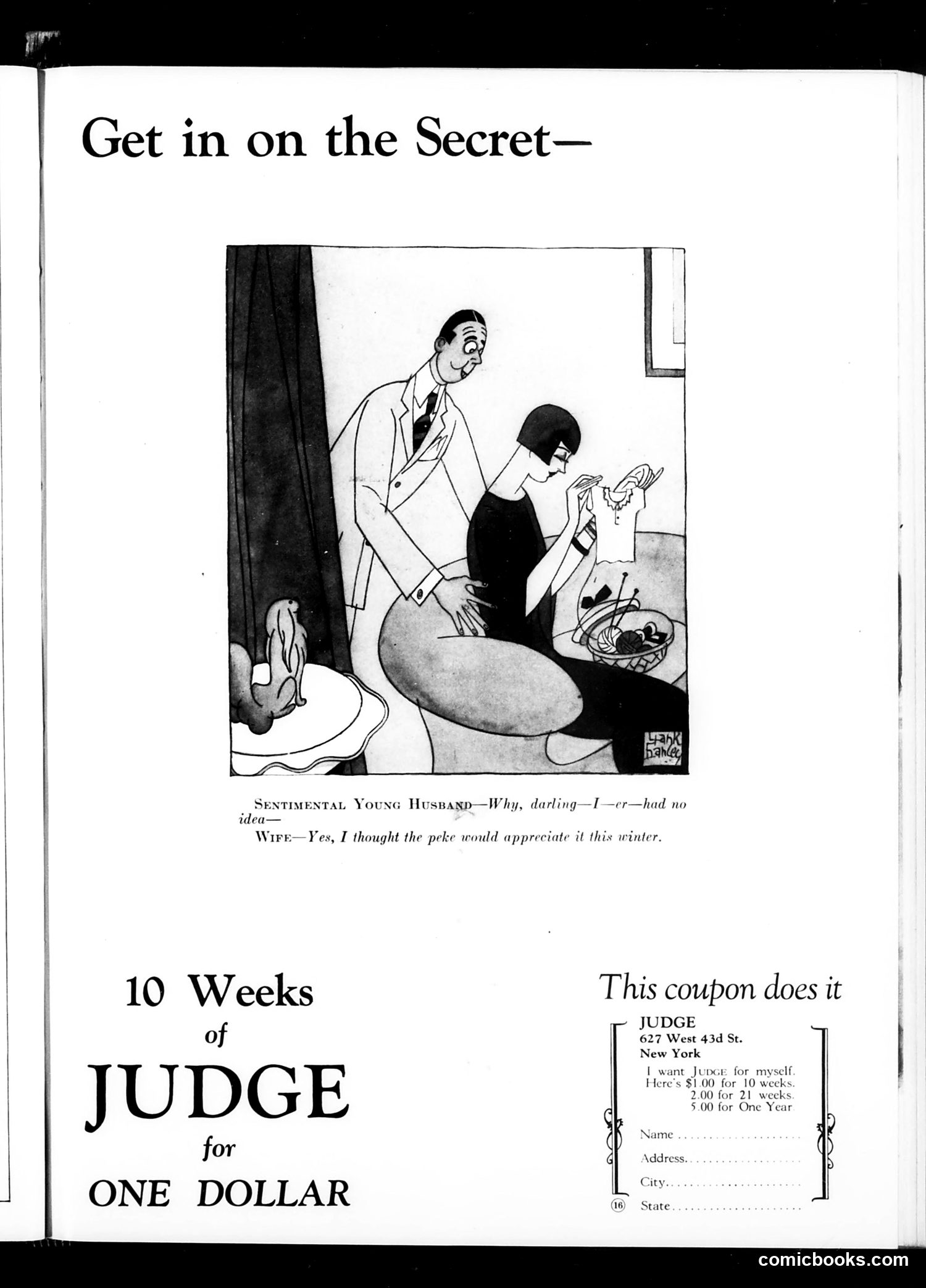
This page combines a humorous cartoon with a magazine subscription advertisement. The cartoon depicts a domestic scene where a wife has surprised her sentimental husband with a gift—a Pekingese dog ("peke")—for winter. His bewildered reaction ("I—er—had no idea") plays on the contrast between his romantic expectations and the practical reality of receiving a pet instead. The humor suggests marital miscommunication: she anticipated the dog would appreciate winter warmth, while he apparently expected something more conventionally romantic. The title "Get in on the Secret" frames this as relatable domestic comedy, likely appealing to Judge's middle-class readership. Below, a subscription coupon advertises Judge magazine itself for one dollar for ten weeks, with longer subscription options available. This is primarily a **commercial advertisement page** designed to recruit new subscribers by showcasing the magazine's humorous content.
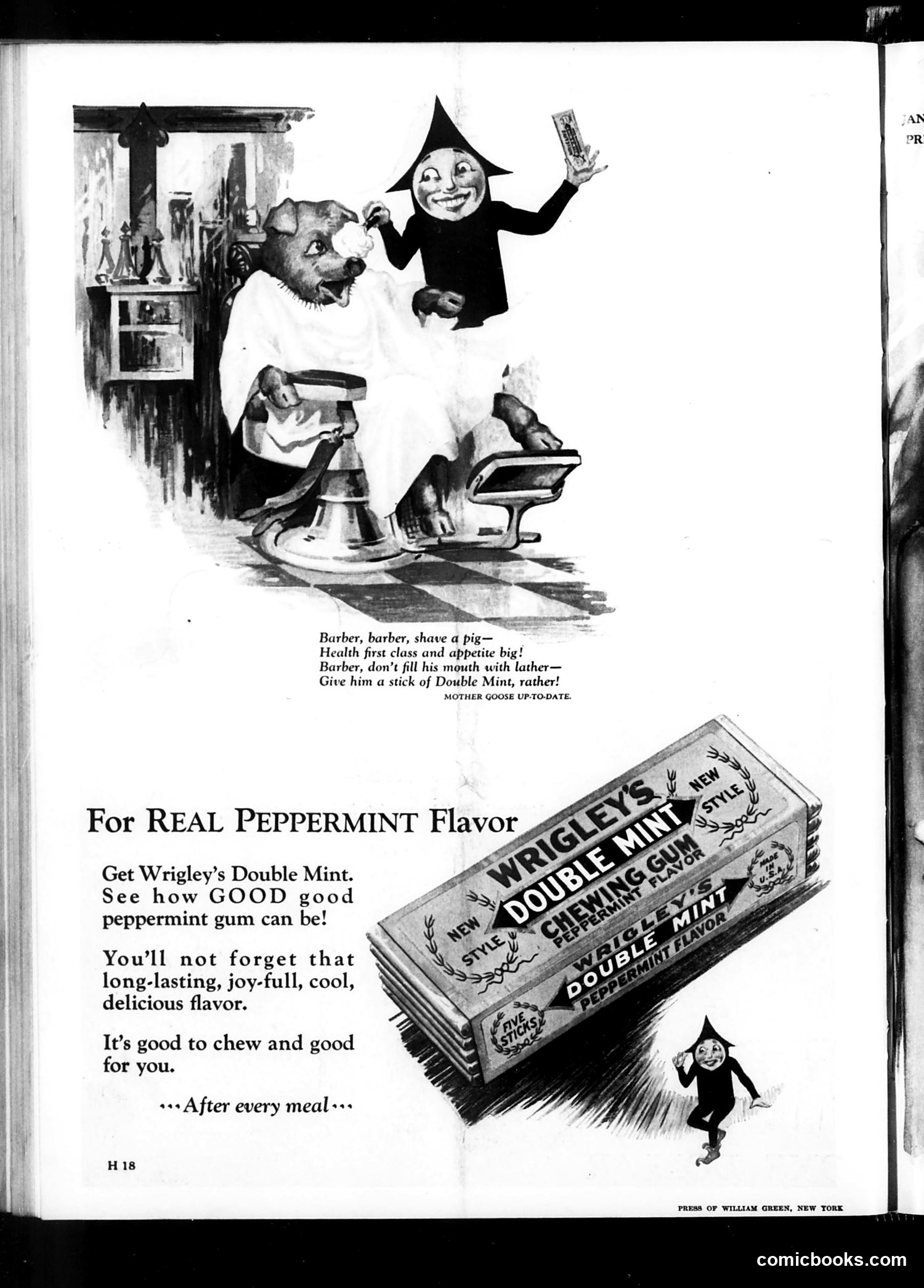
This is primarily a **Wrigley's Double Mint gum advertisement** disguised as editorial content. The page features: **The Cartoon:** A modernized "Mother Goose" nursery rhyme about a barber shaving a pig. The witch-like elf character represents the "updated" version of traditional folk wisdom. The joke is that instead of using soap lather, the barber should give the pig gum—a absurdist pitch for the product. **The Advertisement:** Below, Wrigley's promotes Double Mint as having "real peppermint flavor" and claims it's "good to chew and good for you"—a common early 20th-century marketing claim before modern health regulations. The phrase "After every meal" suggests gum as a routine digestive aid. **Context:** This reflects an era when chewing gum was actively promoted for health benefits and fresher breath, presented through whimsical humor to reach readers. The print credit indicates this appeared in *Judge* magazine published in New York.