
Judge, 1927-01-22 · page 20 of 36
Judge — January 22, 1927 — page 20: what you’re looking at
What you’re looking at
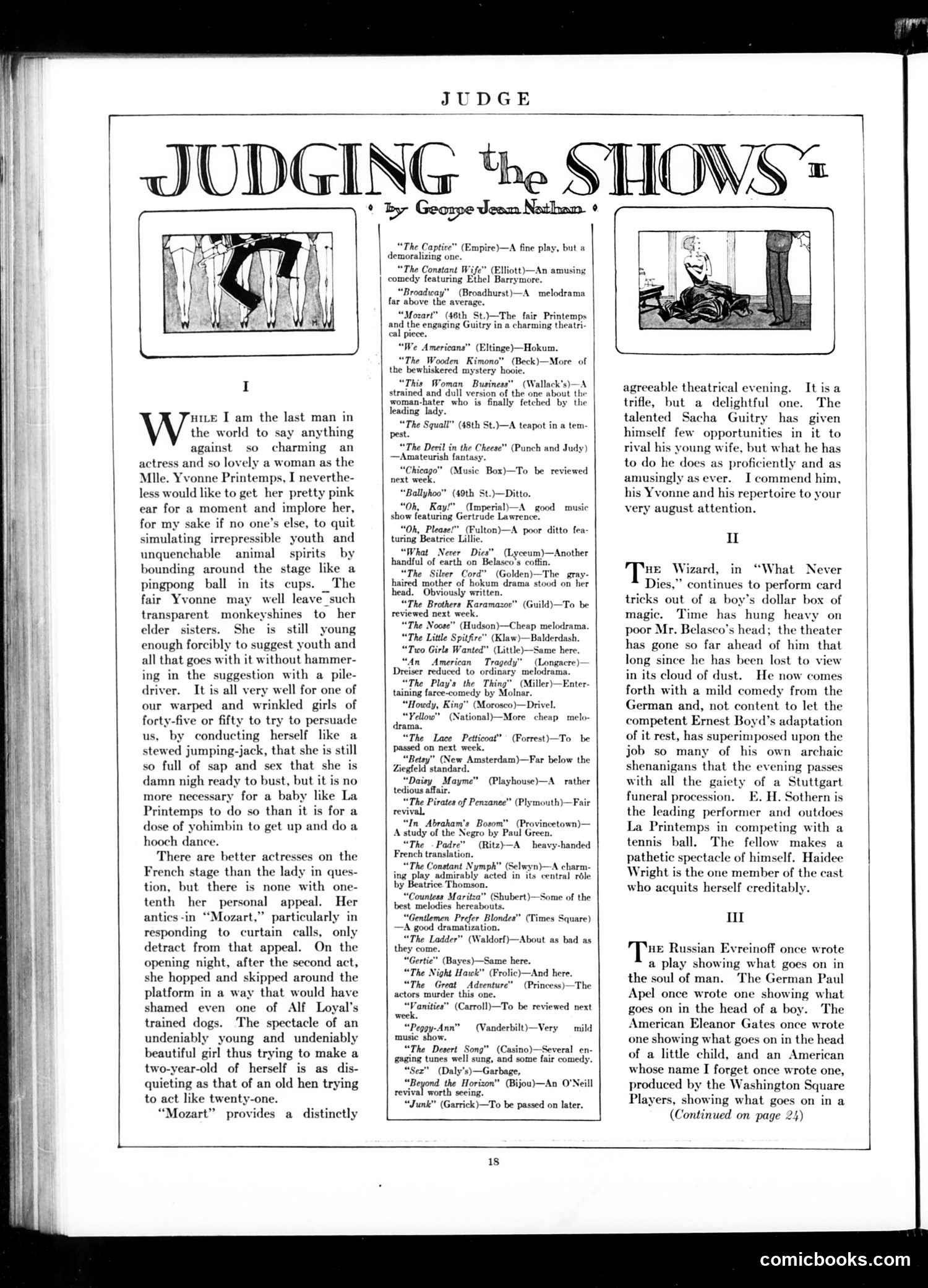
This page is a theater critic's column by George Jean Nathan reviewing Broadway productions. The main text criticizes French actress Yvonne Printemps, who stars in "Mozart" at the 46th Street Theatre. Nathan argues she's so naturally young and beautiful that her exaggerated, childish stage antics (hopping and skipping) actually *detract* from her appeal rather than enhance it. He compares her unnecessary mugging to an old woman pretending to be twenty-one—the performance undercuts her genuine assets. The right column lists brief reviews of other current Broadway shows, rating them from "fine" to "hokum" to "drivel." This was typical Judge content: theatrical criticism aimed at educated, theater-going readers who recognized these productions and performers.
📄 Transcribed text from this page (OCR, searchable)
Machine-transcribed from the original scan — historical spelling and the odd misread are preserved.
JUDGE GING ‘he SHOWS” HILE I am the last man in the world to say anything against so charming an actress and so lovely a woman as the Mlle. Yvonne Printemps, I neverthe- less would like to get her pretty pink ear for a moment and implore her, for my sake if no one’s else, to quit simulating irrepressible youth and unquenchable animal spirits by bounding around the stage like a pingpong ball in its cups. _The fair Yvonne may well leave such transparent monkeyshines to her elder sisters. She is still young enough forcibly to suggest youth and all that goes with it without hammer- ing in the suggestion with a pile- driver. It is all very well for one of our warped and wrinkled girls of forty-five or fifty to try to persuade us, by conducting herself like a stewed jumping-jack, that she is still so full of sap and sex that she is damn nigh ready to bust, but it is no more necessary for a baby like La Printemps to do so than it is for a dose of yohimbin to get up and do a hooch dance. There are better actresses on the French stage than the lady in ques- tion, but there is none with one- tenth her personal appeal. Her antics-in “Mozart,” particularly in responding to curtain calls, only detract from that appeal. On the opening night, after the second act, she hopped and skipped around the platform in a way that would have shamed even one of Alf Loyal’s trained dogs. The spectacle of an undeniably young and undeniably beautiful girl thus trying to make a two-year-old of herself is as dis- quieting as that of an old hen trying to act like twenty-one. “Mozart” provides a distinctly ¢ by Georpe Jeom Nathan. ¢ “The Captive” (Empire)—A fine play, but a demoralizing one. “The Constant Wife” (Elliott) —An amusing comedy featuring Ethel Barrymore. “Broadway” (Broadhurst)—A melodrama far above the average. “Mozart” (46th St.)—The fair Printemps and the engaging Guitry in a charming theatri- cal piece. “We Americans” (Eltinge)—Hokum. “The Wooden Kimono” (Beck)—More of the bewhiskered mystery hooie “This Woman Business” (Wallack’s)—A strained and dull version of the one about the woman-hater who is finally fetched by the lene “The Squall” (48th St.)—A teapot in a tem- pest. The Devil in the Cheese” (Punch and Judy) —Amateurish fantasy. “Chicago” (Music Box)—To next week. “Ballyhoo” (49th St.)—Ditto. “Oh, Kay!” (Imperial)—A good music show featuring Gertrude Lawrence. “Oh, Please!” (Fulton)—A poor ditto fea- turing Beatrice Lillie. “What Never Dies” (Lyceum)—Another handful of earth on Belasco's coffin. “The Silver Cord” (Golden)—The gray. haired mother of hokum drama stood on her head. Obviously written. “The Brothers Karamazoc” (Guild)—To be reviewed next week. “The Noose” (Hudson)—Cheap melodrama. “The Little Spitfire” (Klaw)—Balderdash. “Tro Girle Wanted” (Little)—Same here. “An American Tragedy” (Longacre) Dreiser reduced to ordinary melodrama. “The Play's the Thing” (Miller)—Enter- taining farce-comedy by Molnar. “Howdy, King” (Morosco)—Drivel. “Yellow” (National)—More cheap melo: drama. “The Lace Petticoat” (Forrest)—To be passed on next week. “Betsy” (New Amsterdam)—Far below the Ziegfeld standard. “Daisy Mayme” (Playhouse)—A rather tedious affair. “The Pirates of Penzanee” (Plymouth)—Fair reviv “In Abraham's Bosom” (Provincetown)— A study of the Negro by Paul Green. “The -Padre” (Ritz)—A heavy-handed French translation. “The Constant Nymph” (Selwyn)—A charm- ing play admirably acted in its central réle by Beatrice Thomson. “Countess Maritza” (Shubert)—Some of the best melodies hereabouts. ‘Gentlemen Prefer Blondes” (Times Square) —A good dramatization. The Ladder” (Waldorf}—About as bad as they come. “Gertie” (Bayes) — The Night Hawk" “The Great Adventure” actors murder this one. “Vanities” (Carroll) —To be reviewed next week. “Peggy-Ann” music show. “The Desert Song” (Casino)—Several en- gaging tunes well sung, and some fair comedy. “Sez” (Daly's) Garbage, “Beyond the Horizon” (Bijou)—An O'Neill revival worth seeing. “Junk” (Garrick)—To be passed on later. be reviewed (Vanderbilt)—Very — mild agreeable theatrical evening. It is a trifle, but a delightful one. The talented Sacha Guitry has given himself few opportunities in it to rival his young wife, but what he has to do he does as proficiently and as amusingly as ever. I commend him, his Yvonne and his repertoire to your very august attention. Il HE Wizard, in “What Never Dies,” continues to perform card tricks out of a boy’s dollar box of magic. Time has hung heavy on poor Mr. Belasco’s head; the theater has gone so far ahead of him that long since he has been lost to view in its cloud of dust. He now comes forth with a mild comedy from the German and, not content to let the competent Ernest Boyd’s adaptation of it rest, has superimposed upon the job so many of his own archaic shenanigans that the evening passes with all the gaiety of a Stuttgart funeral procession. E. H. Sothern is the leading performer and outdoes La Printemps in competing with a tennis ball. The fellow makes a pathetic spectacle of himself. Haidee Wright is the one member of the cast who acquits herself creditably. III ne Russian Evreinoff once wrote a play showing what goes on in the soul of man. The German Paul Apel once wrote one showing what goes on in the head of a boy. The American Eleanor Gates once wrote one showing what goes on in the head of a little child, and an American whose name I forget once wrote one, produced by the Washington Square Players, showing what goes on in a (Continued on page 24) comicbooks.com