
Judge, 1927-01-22 · page 22 of 36
Judge — January 22, 1927 — page 22: what you’re looking at
What you’re looking at
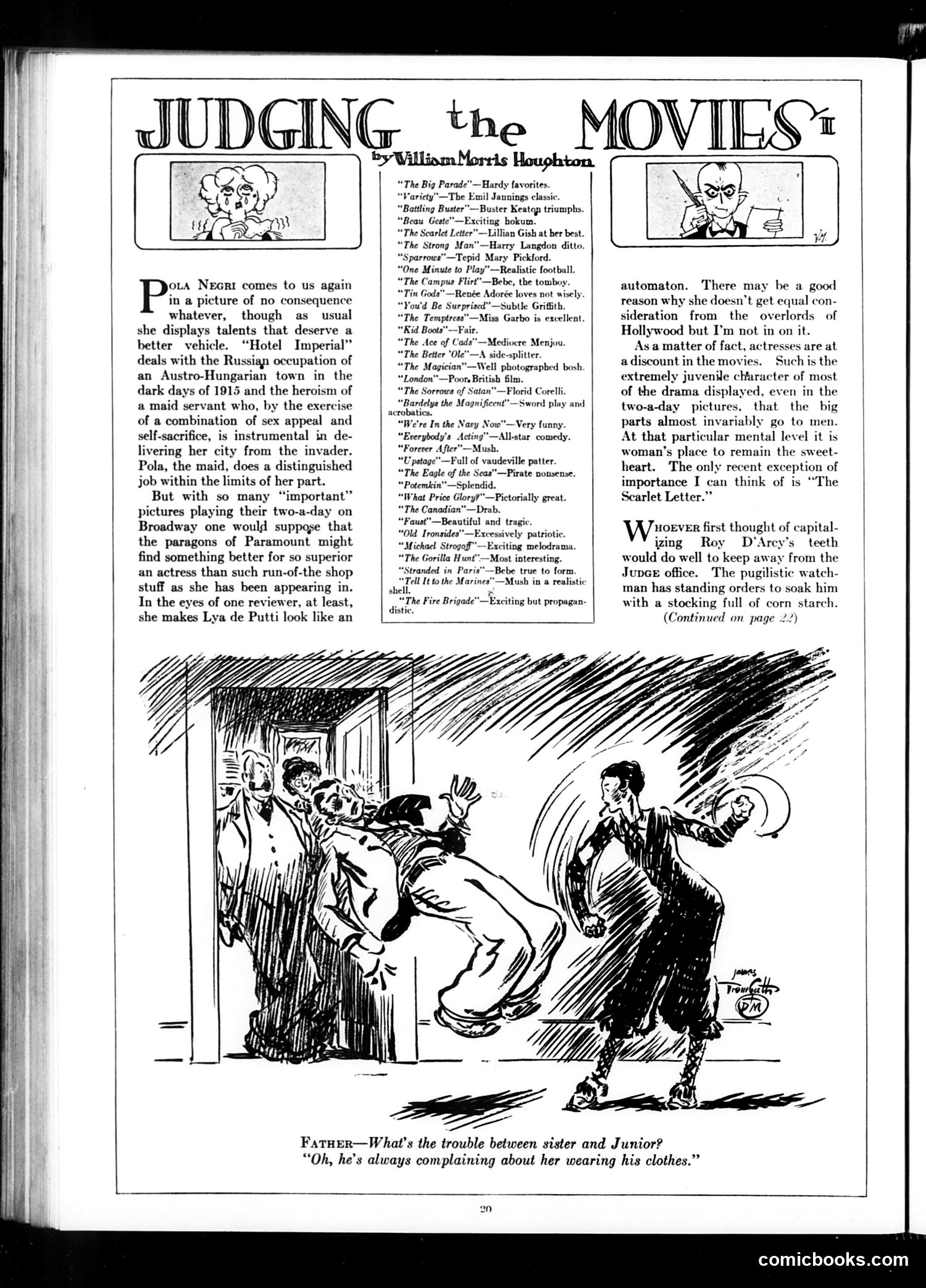
This page reviews 1920s silent films for a satirical American magazine. The main article critiques actress Pola Negri, praising her talent while lamenting that Paramount Studios wastes her abilities on mediocre films like "Hotel Imperial." The reviewer argues that Hollywood systematically undervalues actresses, relegating them to "sweetheart" roles while men get substantial parts—a complaint about gendered casting practices that persists today. The accompanying cartoon jokes about sibling rivalry: a father asks why his son complains, learning the boy resents his sister borrowing his clothes—a domestic humor piece poking fun at family dynamics rather than addressing political or social satire. The film list appears to be contemporary reviews, with varying judgments of popular movies of the period.
📄 Transcribed text from this page (OCR, searchable)
Machine-transcribed from the original scan — historical spelling and the odd misread are preserved.
DGING. the MOVIES* ota NEGRI comes to us again in a picture of no consequence whatever, though as usual she displays talents that deserve a better vehicle. “Hotel Imperial” deals with the Russian occupation of an Austro-Hungarian town in the dark days of 1915 and the heroism of a maid servant who, by the exercise of a combination of sex appeal and self-sacrifice, is instrumental in de- livering her city from the invader. Pola, the maid, does a distinguished job within the limits of her part. But with so many “important” pictures playing their two-a-day on Broadway one would suppose that the paragons of Paramount might find something better for so superior an actress than such run-of-the shop stuff as she has been appearing in. In the eyes of one reviewer, at least, she makes Lya de Putti look like an “The Big Parade”—Hardy favorites. “Variety”—The Emil Jannings classic. “Battling Buster"”"—Buster Keatop triumphs. “Beau Geste”—E: illian Gish at her best. “Sparrows"—Tepid Mary Pickford. “One Minute to Pla ‘Realistic football. “The Campus Flirt” Subtle Griffith. iss Garbo is excellent. “The Magician" —Well photographed bosh. “London —Poore Britis “U pstage”—Full of vaudeville patter. “The Eagle of the Seas”—Pirate nonsense. “Potemkin” —Splendid. “What Price Glory” ctorially great. patriotic. ichael Strogoff melodrama. “The Gorilla Hunt'—Most interesting. randed in Paris"—Bebe true to form. “Tell It to the Marines” —Mush in a realistic *he Fire Brigade” —Exciting but propagan- ii£, FE automaton. There may be a good reason why she doesn’t get equal con- sideration from the overlords of Hollywood but I’m not in on it. As a matter of fact, actresses are at adiscount in the movies. Such is the extremely juvenile character of most of the drama displayed, even in the two-a-day pictures, that the big parts almost invariably go to men. At that particular mental level it is woman’s place to remain the sweet- heart. The only recent exception of importance I can think of is “The Scarlet Letter.” Whoever first thought of capital- izing Roy D?’Arcy’s teeth would do well to keep away from the JupcE office. The pugilistic watch- man has standing orders to soak him with a stocking full of corn starch. (Continued on page 22) FatHER—What’s the trouble between sister and Junior? “Oh, he’s always complaining about her wearing his clothes.” comicbooks.com