
Judge, 1927-01-22 · page 34 of 36
Judge — January 22, 1927 — page 34: what you’re looking at
What you’re looking at
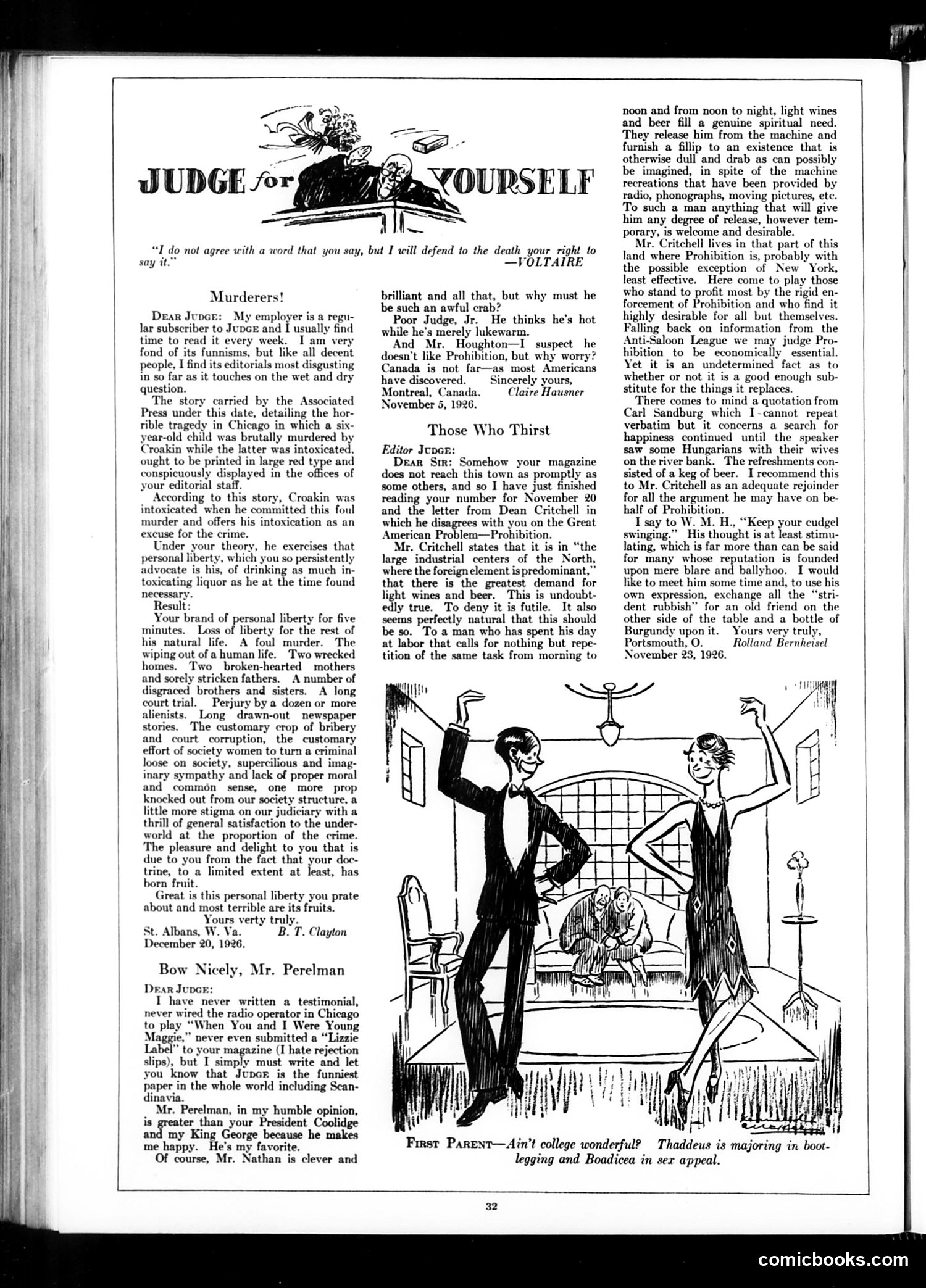
This page from Judge (1926) comprises reader letters debating Prohibition, America's then-current alcohol ban (1920-1933). **"Murderers!"** attacks Judge's pro-personal-liberty editorial stance. A correspondent blames Judge's libertarian philosophy for enabling a drunk man's murder of a child in Chicago, arguing the magazine's defense of drinking rights indirectly caused the tragedy. **"Bow Nicely, Mr. Perelman"** praises Judge's humor and specific writers (Perelman, Nathan, Houghton), while mockingly suggesting editor Houghton secretly opposes Prohibition—hinting he could easily escape to Canada, where alcohol remained legal. **"Those Who Thirst"** begins a letter supporting Prohibition's necessity in industrial cities with immigrant populations, countering an earlier argument by "Dean Critchell." The cartoon depicts parents shocked at their son's drinking escapade, captioned with ironic understatement about "bootlegging." These letters reflect the intense Prohibition debate dividing 1920s America between reformers and libertarians.
📄 Transcribed text from this page (OCR, searchable)
Machine-transcribed from the original scan — historical spelling and the odd misread are preserved.
“I do not agree with a word that you say, but I will defend to the death “your right to say it.” Murderers! Dear Jupce: My employer is a regu- lar subscriber to Jupce and I usually find time to read it every week. I am very fond of its funnisms, but like all decent people, I find its editorials most disgusting in so far as it touches on the wet and dry question. The story carried by the Associated Press under this date, detailing the hor- rible tragedy in Chicago in which a six- year-old child was brutally murdered by Croakin while the latter was intoxicated, ought to be printed in large red type and conspicuously displayed in the offices of your editorial staff. According to this story, Croakin was intoxicated when he committed this foul murder and offers his intoxication as an excuse for the crime. Under your theory, he exercises that personal liberty, whic! uu so persistently advocate is his, of drinking as much in- toxicating liquor as he at the time found Your brand of personal liberty for five minutes. Loss of liberty for the rest of his natural life. A foul murder. The wiping out of ahuman life. Two wrecked homes. Two broken-hearted mothers and sorely stricken fathers. A number of disgraced brothers and sisters. A long court trial. Perjury by a dozen or more alienists. Long drawn-out newspaper stories. The customary crop of bribery and court corruption, the customary effort of society women to turn a criminal loose on society, supercilious and imag- inary sympathy and lack of proper moral and commén sense, one more prop knocked out from our society structure, a little more stigma on our judiciary with a thrill of general satisfaction to the under- world at the proportion of the crime. The pleasure and delight to you that is due to you from the fact that your doc- trine, to a limited extent at least, has born fruit. Great is this personal libert: about and most terrible are Yours verty truly. St. Albans, W. Va. B. T. Clayton December 20, 1926. Bow Nicely, Mr. Perelman Dear Jupcr: I have never written a testimonial, never wired the radio operator in Chicago to play “When You and I Were Young Maggie,” never even submitted a “Lizzie Label” to your magazine (I hate rejection slips), but I simply must write and let you know that Jupcr is the funniest paper in the whole world including Scan- dinavia. ue Perelman, in my humble opinion, ter than your President Coolidge my King George because he makes Tahaoytica me leone Of course, Mr. Nathan is clever and LTAIRE brilliant and all that, but why must he be such an awful crab? Poor Judge, Jr. He thinks he’s hot while he’s merely lukewarm. And Mr. Houghton—I suspect he doesn’t like Prohibition, but why worry? Canada is not far—as most Americans have discovered. Sincerely yours, Montreal, Canada. Claire Hausner November 5, 1926. Those Who Thirst Editor IcvaE: Dear Str: Somehow your magazine does not reach this town as promptly as some others, and so I have just finished reading your number for November 20 and the letter from Dean Critchell in which he disagrees with you on the Great American Problem—Prohibition. Mr. Critchell states that it is in “the large industrial centers of the North, where the foreign element is predominant,” that there is the greatest demand for light wines and beer. This is undoubt- edly true. To deny it is futile. It also seems perfectly natural that this should be so. To a man who has spent his day at labor that calls for nothing but. repe- tition of the same task from morning to UT Hy First Parent—Ain’t college wonderful? yy noon and from noon to night, light wines and beer fill a genuine spiritual need. They release him from the machine and furnish a fillip to an existence that is otherwise dull and drab as can possibly be imagined, in spite of the machine recreations that have been provided by radio, phonographs, moving pictures, ete. To such a man anything that will give him any degree of release, however tem- rary, is welcome and desirable. Mr. Critchell lives in that part of this land where Prohibition is, probably with the possible exception of New York, least effective. Here come to play those who stand to profit most by the rigid en- forcement of Prohibition and who find it highly desirable for all but themselves. Falling back on information from the Anti-Saloon League we may judge Pro- hibition to be economically’ essential. Yet it is an undetermined fact as to whether or not it is a good enough sub- stitute for the things it replaces. There comes to mind a quotation from Carl Sandburg which I-cannot repeat verbatim but it concerns a search for happiness continued until the speaker saw some Hungarians with their wives on the river bank. The refreshments con- sisted of a keg of beer. I recommend this to Mr. Critchell as an adequate rejoinder for all the argument he may have on be- half of Prohibition. I say to W. M. H., “Keep your cudgel swinging.” His thought is cele ast stimu- lating, which is far more than can be said for many whose reputation is founded upon mere blare and ballyhoo. I would like to meet him some time and, to use his own expression, exchange all the “stri- dent rubbish” for an old friend on the other side of the table and a bottle of Burgundy upon it. Yours very truly, Portsmouth, O. Rolland Bernheisel November 23, 1926. Thaddeus is majoring in boot- legging and Boadicea in sex appeal. 32 comicbooks.com