
A complete issue · 36 pages · 1927
Judge — January 1, 1927
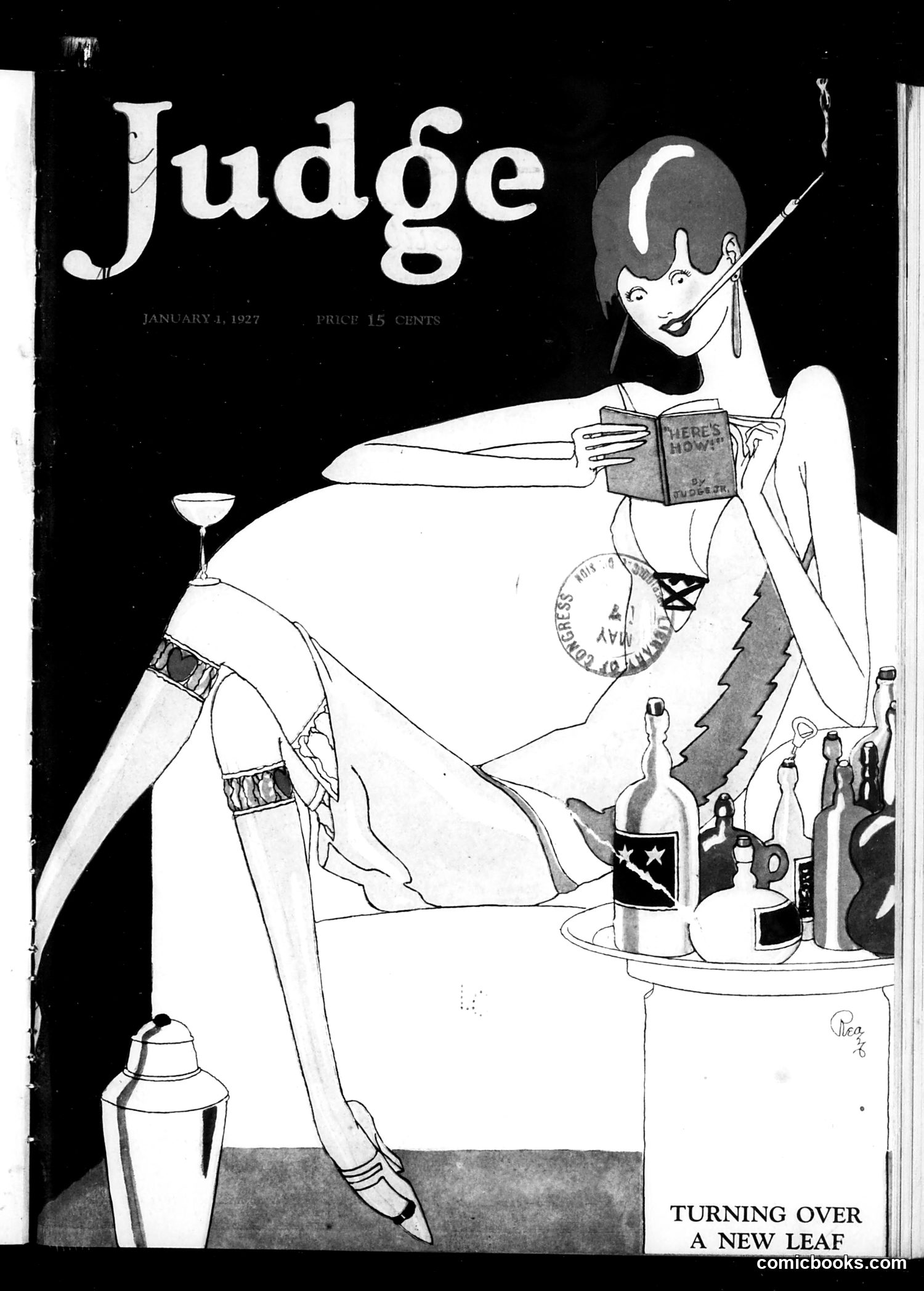
This is a magazine cover titled "Turning Over a New Leaf," depicting a stylishly dressed woman in 1920s attire reading a book labeled "Here's How!" She's surrounded by alcohol bottles and drinking vessels, including a cocktail glass and what appears to be a shaker with a star. The satire references Prohibition (1920-1933), during which alcohol was legally banned in America. The "new leaf" phrase ironically suggests New Year's resolutions for reform, while the woman's relaxed pose amid abundant alcohol mocks the ineffectiveness of Prohibition laws. The fashionable "flapper" styling emphasizes how young women openly flouted the ban. The joke critiques both Prohibition's failure and the era's widespread illegal drinking culture despite federal law.
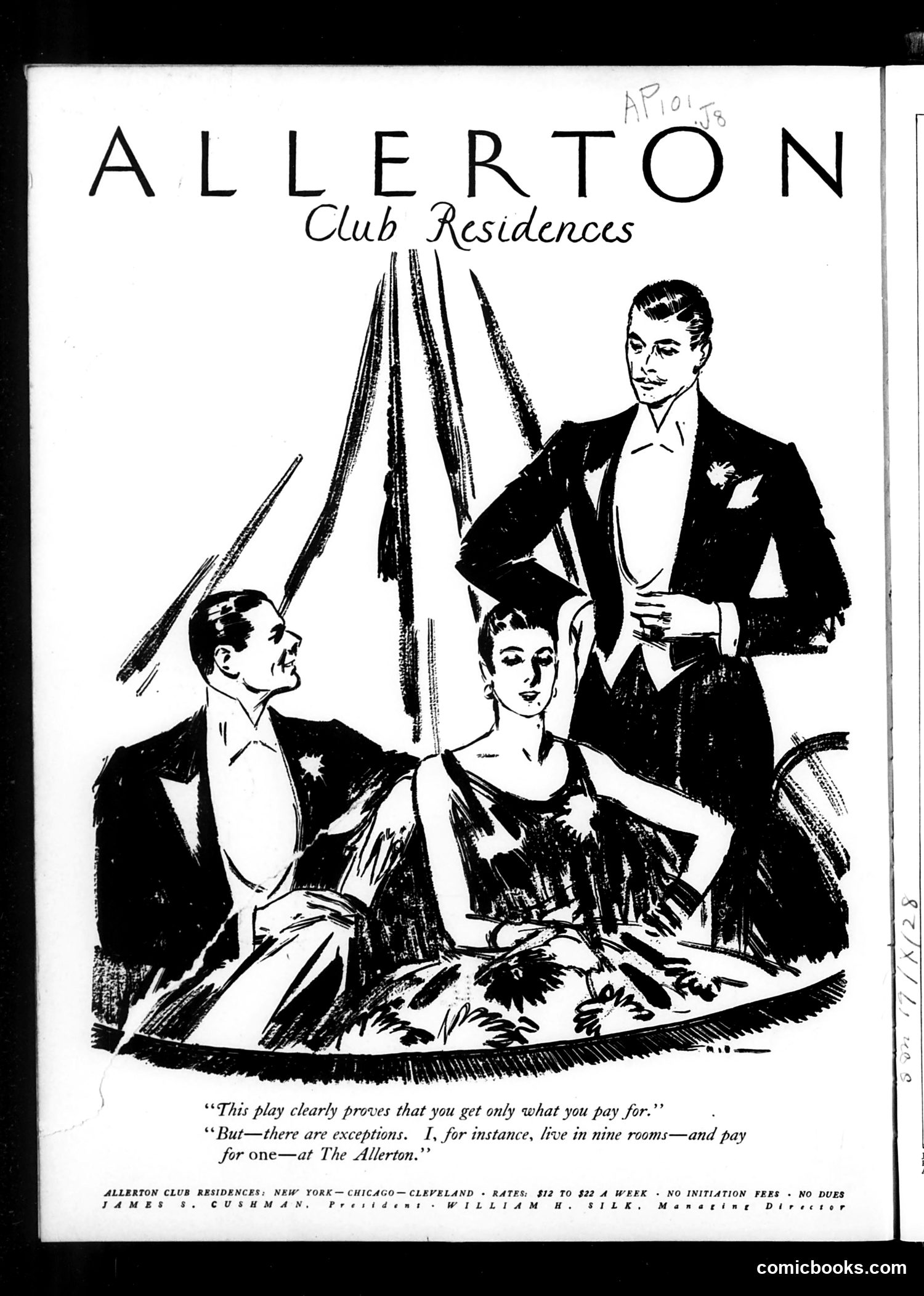
This page is primarily an **advertisement** for the Allerton Club Residences, a residential hotel chain operating in New York, Chicago, and Cleveland in the early 20th century. The illustration shows three well-dressed men and one woman in elegant attire gathered under a tent, accompanying a sales pitch. The quoted text uses humor to market the service: "This play clearly proves that you get only what you pay for. But—there are exceptions. I, for instance, live in nine rooms—and pay for one—at The Allerton." The joke satirizes the unusual value proposition of club residences: residents could occupy multiple rooms while only paying for one, presenting this as an exceptional financial advantage compared to typical market exchanges. The ad emphasizes rates of $12-$22 weekly with no initiation fees or dues.
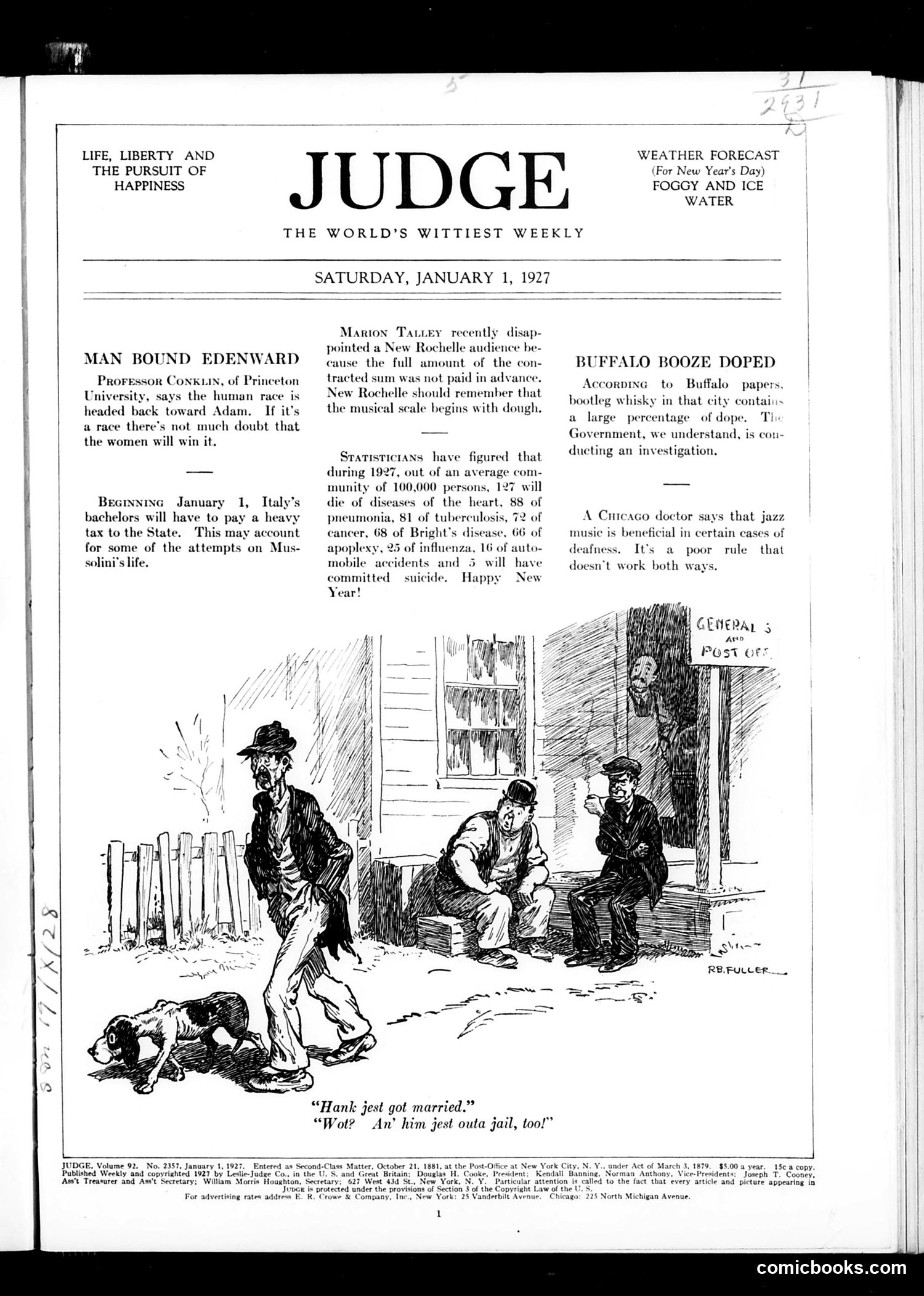
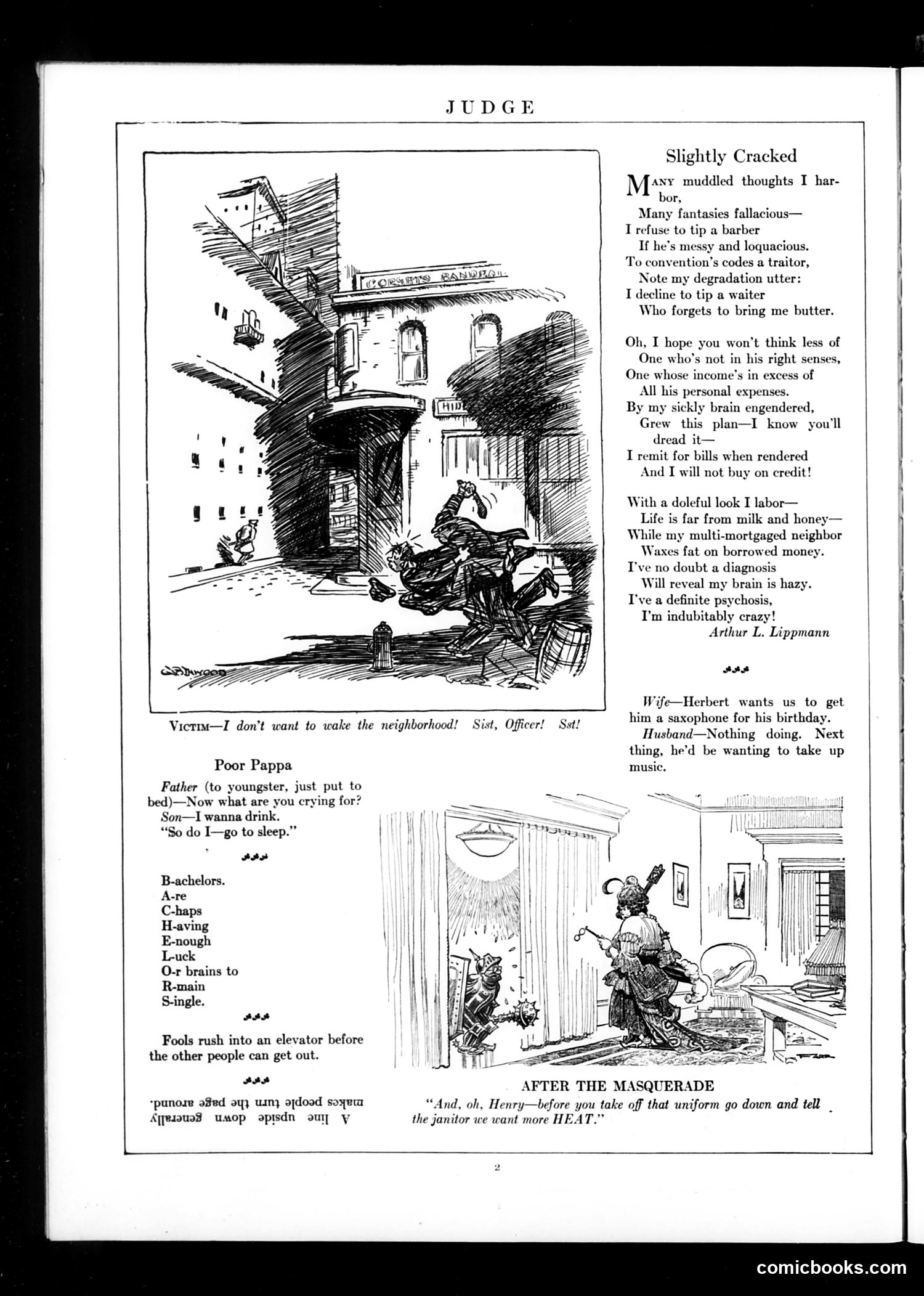
This page contains three satirical pieces typical of early-20th-century Judge humor: **"Slightly Cracked"**: A poem by Arthur L. Lippmann mocking middle-class anxieties about social propriety and financial strain—refusing to tip barbers or waiters, rationalizing debt avoidance, and displaying neurotic concerns about status and appearances. **"Poor Pappa"**: A brief joke about a father's exhaustion with his son's demands, using wordplay on bachelor-related terms as a punchline. **"After the Masquerade"**: A cartoon depicting a domestic scene where a woman scolds a man (Henry) still in formal masquerade attire, demanding he remove his uniform and tell the janitor they need more heat—a commentary on post-party domestic discord and household help relations. The humor targets middle-class pretensions, marital tensions, and class dynamics of the era.
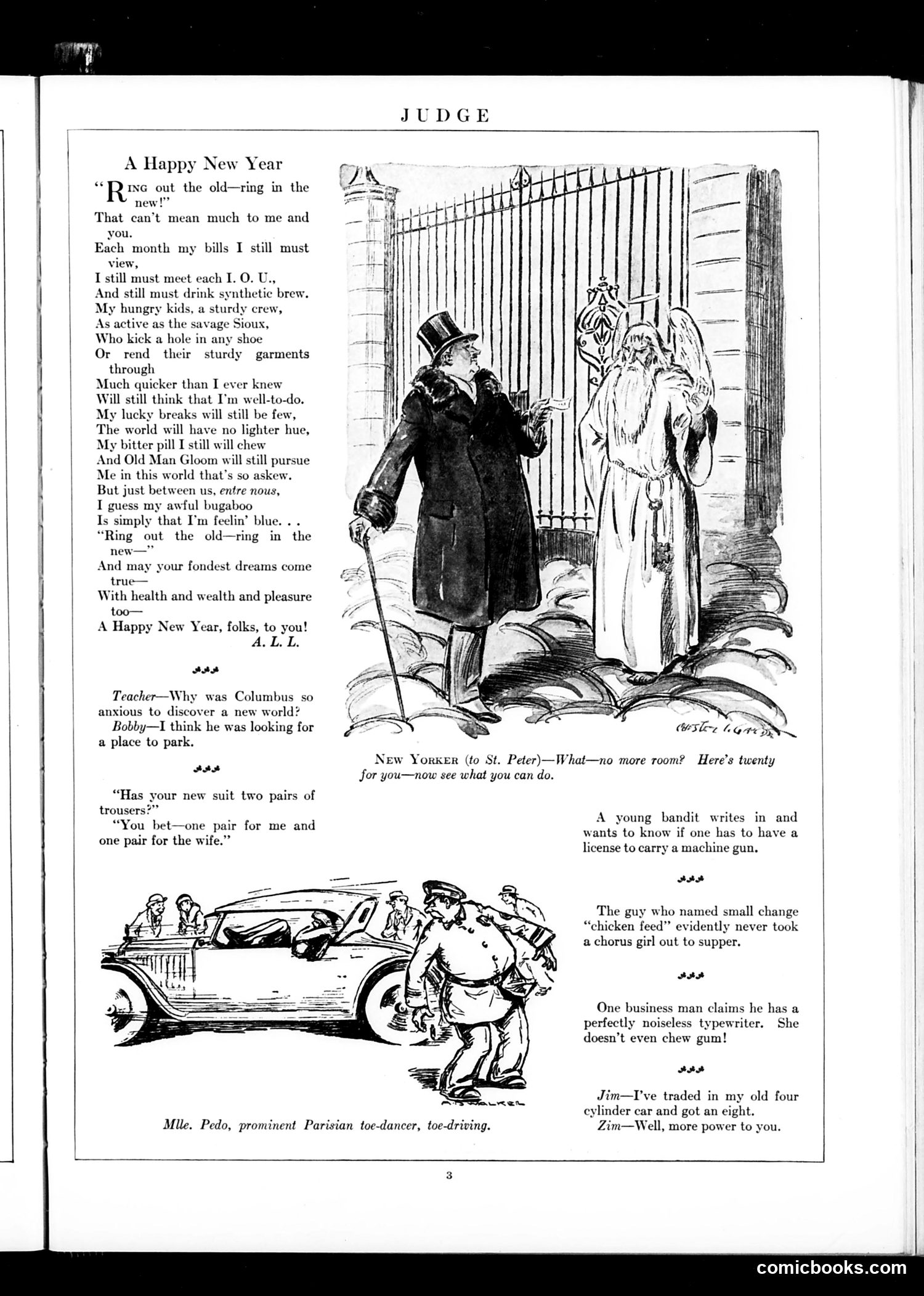
This page contains New Year's humor from an early 20th-century American magazine. The main poem "A Happy New Year" satirizes persistent life frustrations—bills, family obligations, work demands—that supposedly disappear with the new year but inevitably return. The joke is that nothing actually changes. The illustration shows a man in a top hat meeting Father Time/Old Man Gloom at a gate, representing the transition between years. The caption suggests even fresh starts bring old problems back. Below are brief jokes about everyday absurdities: Columbus seeking a "place to park," trousers for wives, a "noiseless typewriter," and a woman who trades her old car for an eight-cylinder vehicle. These reference contemporary consumer culture and changing gender roles, presenting modern life's contradictions for laughs.
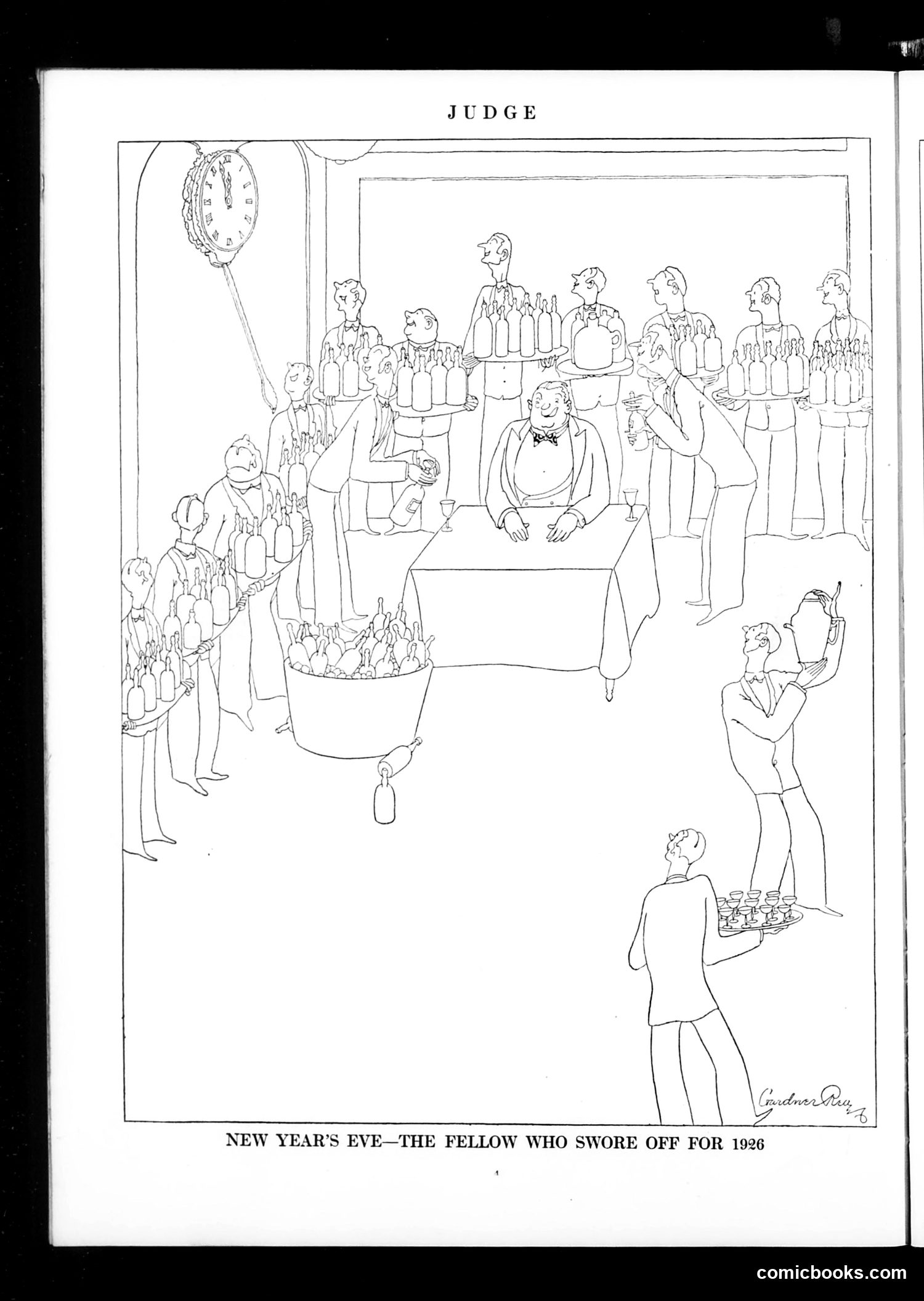
This cartoon satirizes the common New Year's resolution to quit drinking during Prohibition (1920-1933). The central figure, a portly man at a desk wearing formal attire, represents someone who has publicly pledged sobriety for 1926. He's surrounded by: - Bottles of alcohol being consumed by numerous attendees at what appears to be a lavish party - A clock showing midnight - A large cauldron of burning bottles - Observers holding drinks and chess pieces (suggesting strategic drinking games) The satire mocks the hypocrisy of Prohibition-era pledges—the resolution-maker is supposedly "swearing off" alcohol while surrounded by illegal drinking. The cartoon cynically suggests that such New Year's vows are futile given widespread alcohol consumption and social pressure during an era when drinking remained culturally pervasive despite legal prohibition.
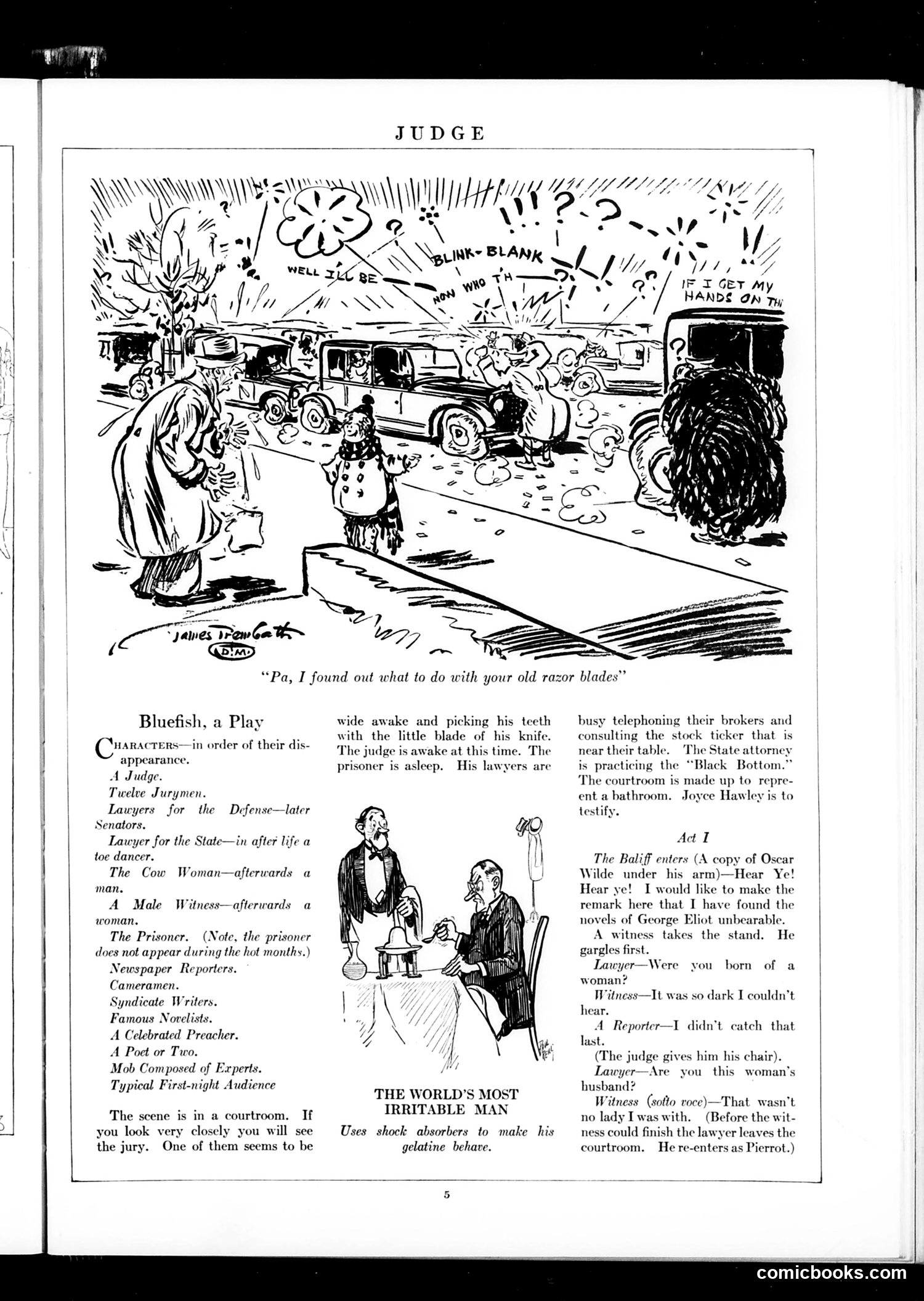
This page presents "Bluefish, a Play"—a satirical courtroom sketch. The cartoon depicts a chaotic courtroom scene where a judge presides over what appears to be an absurd legal proceeding. The caption reads: "Pa, I found out what to do with your old razor blades." The satire targets the legal system's inefficiency and pretentiousness. The courtroom is filled with various characters—lawyers, witnesses, and officials—engaged in typical legal theater. The "World's Most Irritable Man Uses shock absorbers to make his gelatine behave" suggests mockery of both excessive legal procedure and contemporary advertising claims. The play format allows Judge to lampoon courtroom dramatics, legal jargon, and the byzantine nature of American justice. The humor derives from exposing how legalistic formality masks inherent absurdity in the system.
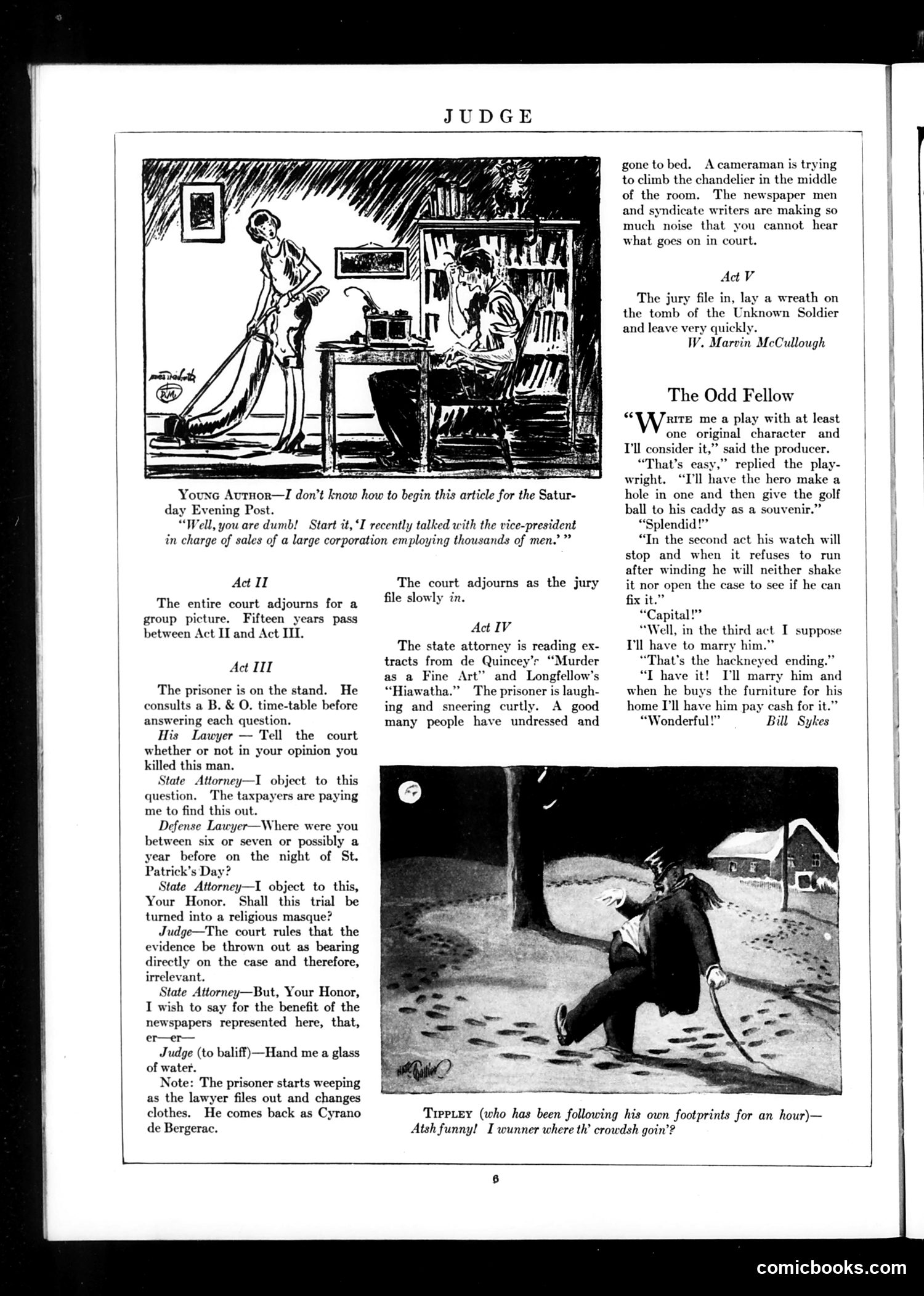
This page contains two distinct satirical pieces: **"Judge" (by W. Marvin McCullough):** A five-act courtroom farce mocking American legal incompetence. The satire depicts a trial so dysfunctional that evidence is ruled "irrelevant," lawyers obstruct rather than clarify, cameramen climb chandeliers, and the jury—after the verdict—inexplicably lay a wreath at the Unknown Soldier's tomb before leaving. The implicit critique: trials have become media spectacles and bureaucratic theater rather than justice-seeking proceedings. **"The Odd Fellow":** A producer-playwright exchange lampooning theatrical conventions. The playwright pitches supposedly "original" ideas (a golf hole-in-one gift, a stopped watch, marriage) that are actually tired clichés. The joke: what passes for originality in commercial theater is utterly hackneyed, revealing both theatrical mediocrity and producer gullibility. Both pieces target institutional absurdity—the legal and entertainment industries—through exaggeration and ironic understatement.
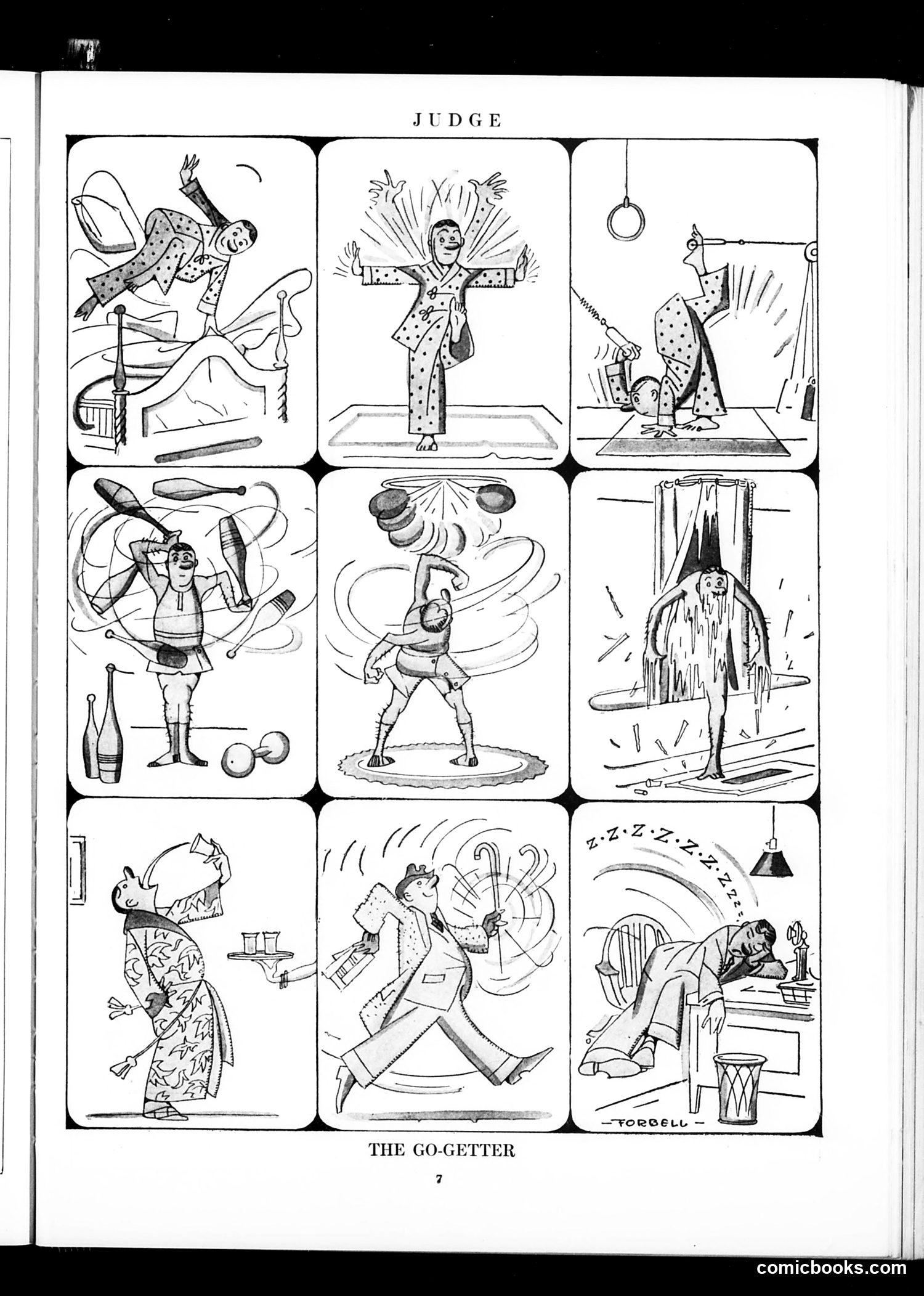
This nine-panel strip satirizes the "go-getter"—a type of ambitious, energetic person celebrated in early 20th-century American business culture. Each panel depicts increasingly absurd scenarios showing this character's relentless pursuit of success and activity: juggling work duties, multitasking frantically, balancing precarious situations, spinning plates, catching objects mid-air, and ultimately exhausted or collapsed. The satire mocks the era's obsession with constant productivity and hustle. The character's frenetic energy becomes self-destructive—the final panels suggest burnout and failure despite ceaseless effort. The cartoonist appears critical of the "go-getter" ideal, suggesting that relentless ambition without wisdom leads to chaos and ruin rather than genuine achievement. It's a commentary on unsustainable work culture attitudes of the period.
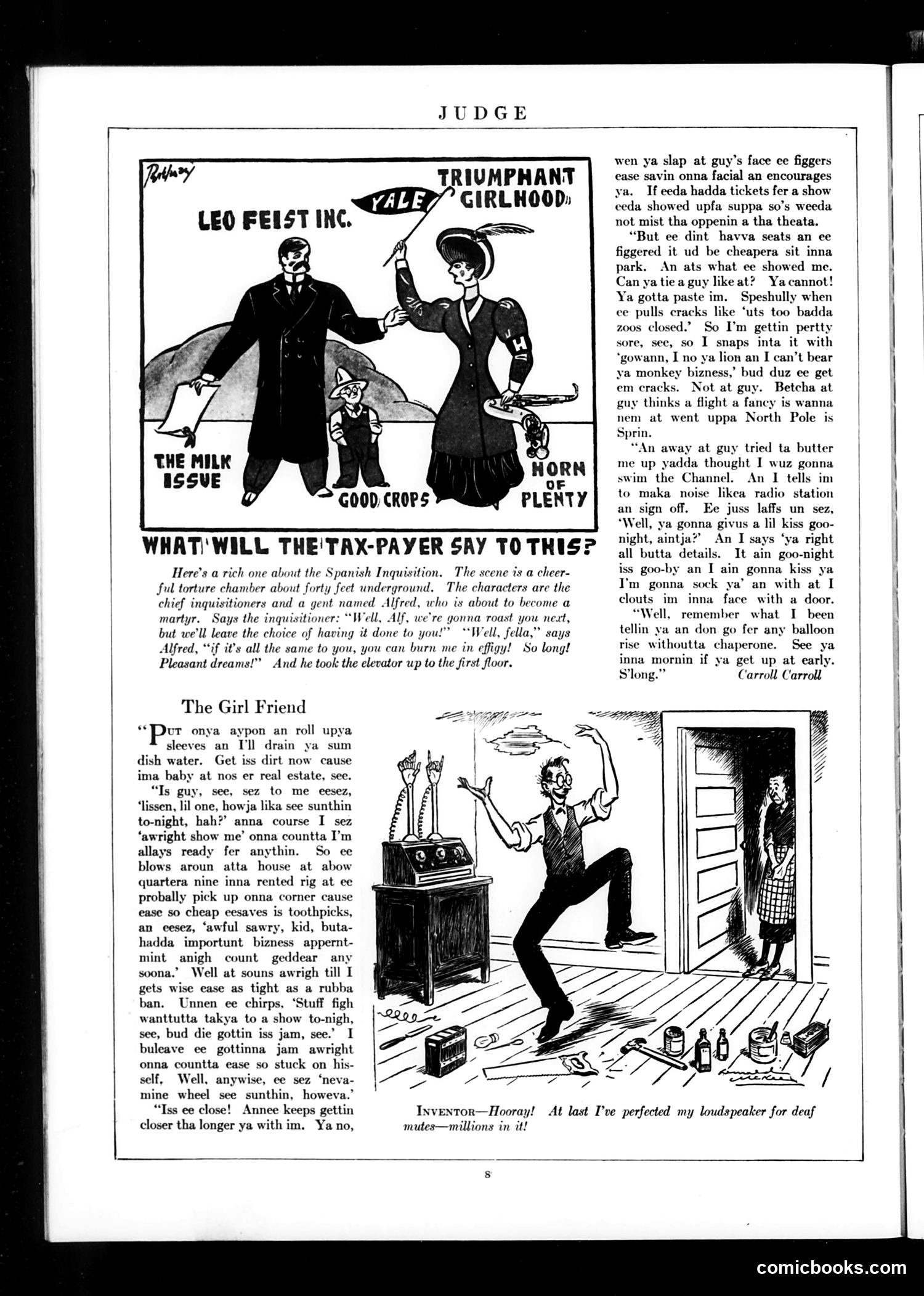
**Top Cartoon: "Triumphant Girlhood"** This Leo Feist Inc. advertisement celebrates women's expanded roles, depicting a woman as an equal alongside a man, holding symbols of prosperity (crops, milk). The caption "What will the tax-payer say to this?" sarcastically questions whether taxpayers will accept women's economic independence and equality—reflecting 1920s anxiety about changing gender roles and women's newfound voting and economic power. **Middle Section: Spanish Inquisition Joke** A brief comedic piece mocking religious torture, where a condemned man escapes by suggesting he be burned "in effigy" instead, then takes an elevator upstairs. It's absurdist humor playing on the contrast between medieval torture and modern convenience. **"The Girl Friend" Column** A monologue in exaggerated urban dialect describing a woman's frustrating date with a cheap, unreliable man who cancels plans and makes excuses. It satirizes both working-class courtship and male behavior, with the woman asserting her agency by literally hitting him. The tone is humorous but reflects real frustrations about male irresponsibility.
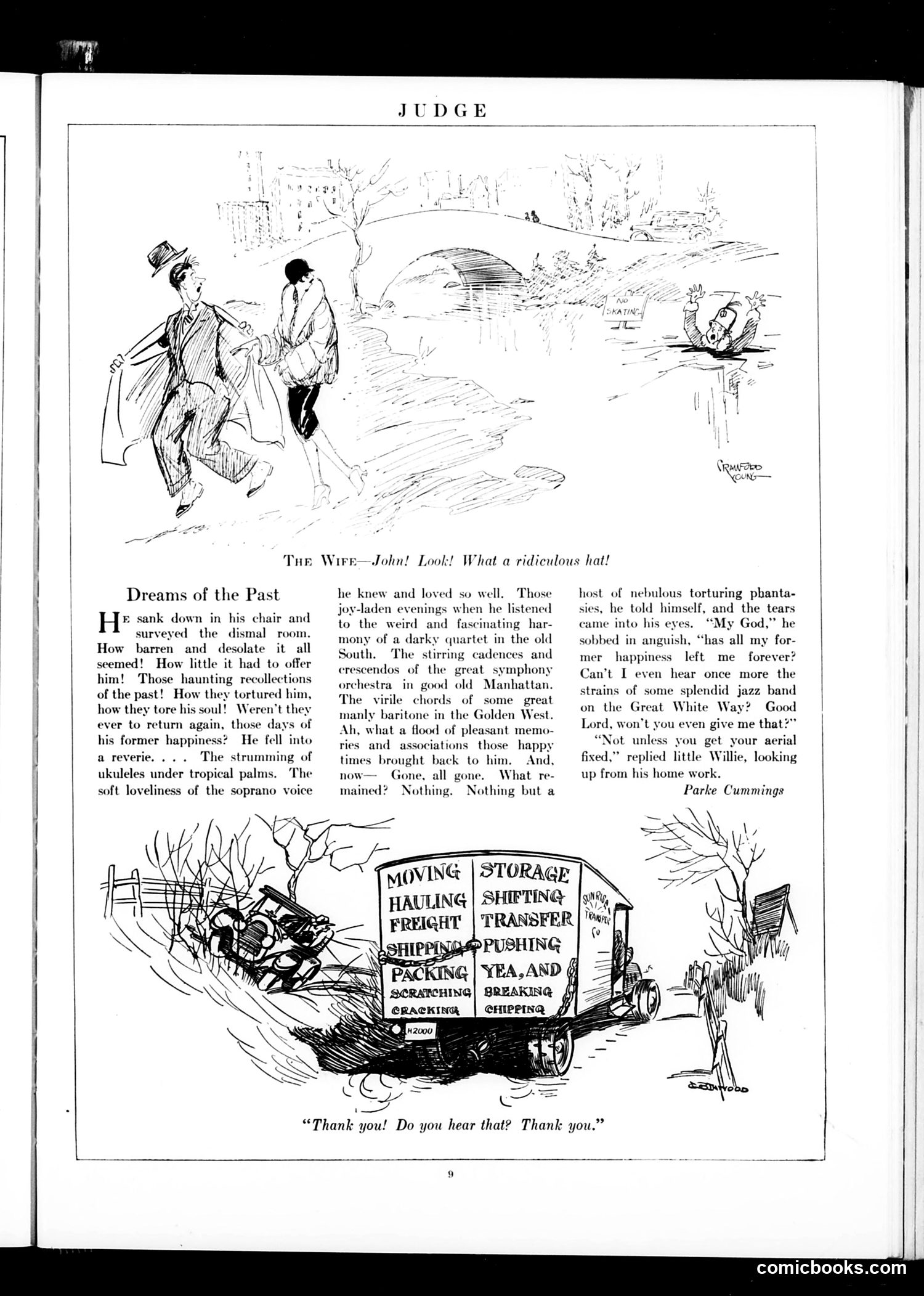
This two-panel page satirizes nostalgia and domestic life in the early 20th century. **Top panel:** A man daydreams wistfully about past pleasures—tropical ukulele music, symphony orchestras, jazz bands on Broadway—mourning their loss. His reverie is interrupted by his wife commenting on his ridiculous hat, grounding him in mundane reality. **Bottom panel:** The man laments he can't even hear jazz anymore. His son Willie, working on a radio set, delivers the punchline: get your aerial (antenna) fixed—the problem is technical, not existential. The satire targets male sentimentality and escapism. The joke relies on radio technology being relatively new; many readers would recognize the struggle with early radio reception. The cartoons mock men who romanticize the past while ignoring simple, practical solutions in their present lives. Willie's matter-of-fact response deflates his father's melodramatic nostalgia.
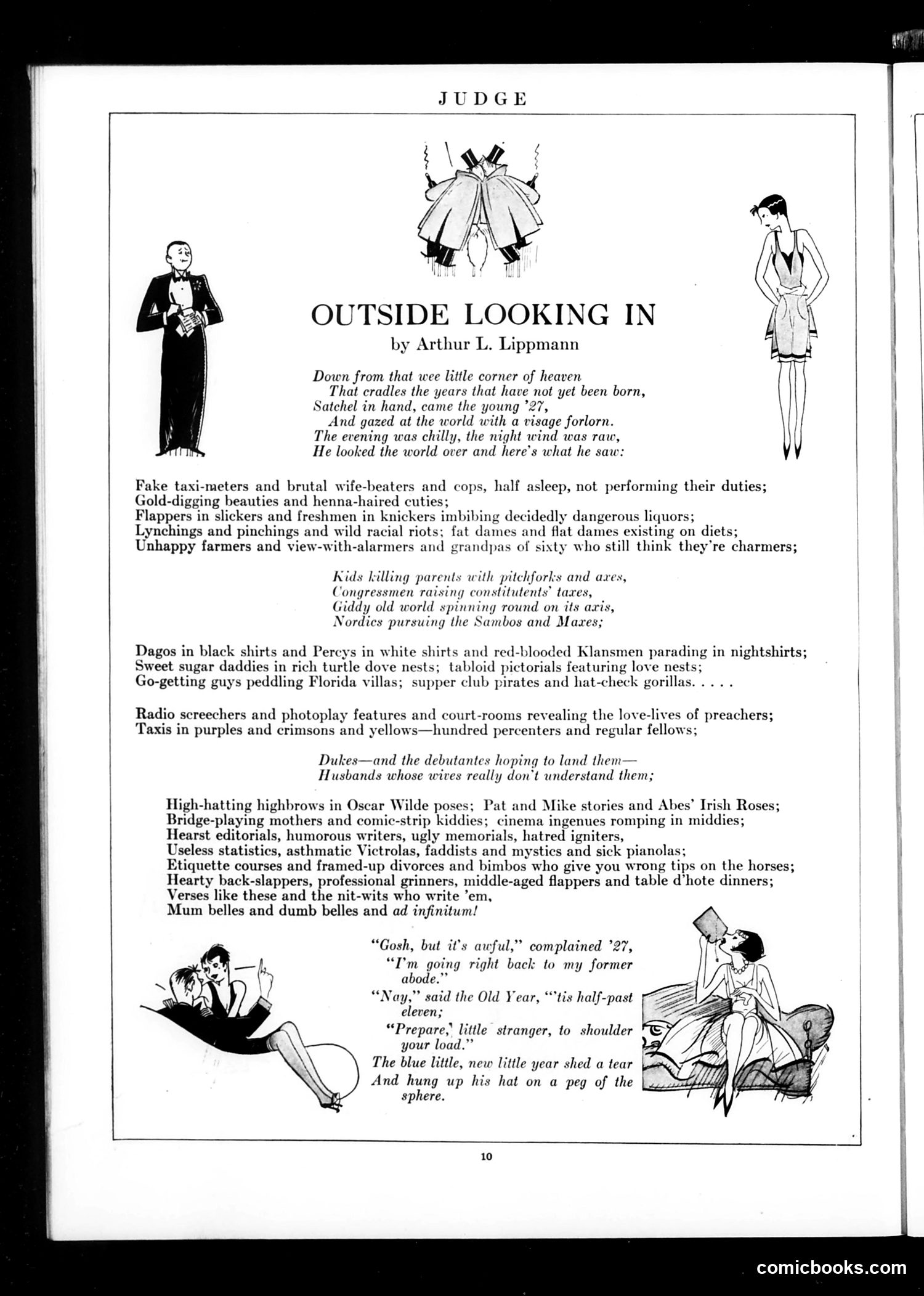
This 1927 satirical poem personifies the incoming year as a young figure ("'27") surveying American society with dismay. The satire catalogs social ills and frivolities of the era: corrupt officials, Prohibition-era drinking, sexual scandals, racial violence (lynchings, KKK activity), tabloid culture, and jazz-age excess. References include "Dagos" and ethnic slurs reflecting 1920s prejudices, "Klansmen," and prohibition violations. The poem mocks both serious problems (racial riots, corruption) and trivial concerns (bridge-playing mothers, comic strips) with equal cynicism. The young year complains the world is "awful" and wants to return "to my former abode" (pre-existence), but the Old Year insists he must "shoulder your load"—accept the burden of 1927. The drawing shows the personified year as a tearful child witnessing humanity's flaws. The satire suggests 1920s optimism masked widespread social dysfunction and moral decline.
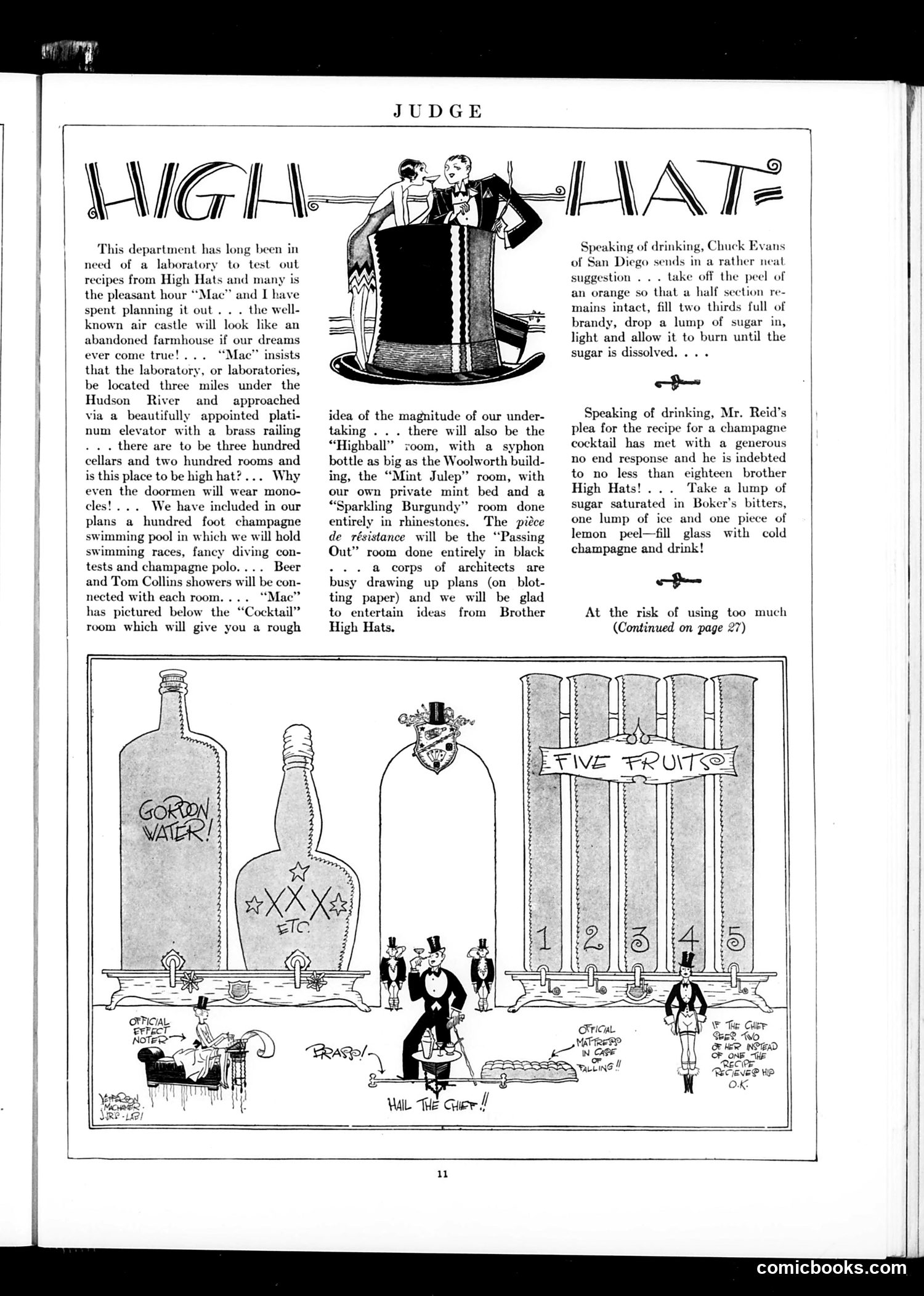
This is a humorous department from Judge magazine celebrating cocktails and luxurious drinking culture during Prohibition or the early 20th century. The satirical "High Hat" laboratory concept mocks the elite's obsessive pursuit of elaborate cocktails by proposing an absurdly extravagant underground facility beneath the Hudson River—complete with 300 cellars, champagne swimming pools, and rooms themed after specific drinks ("Mint Julep," "Sparkling Burgundy," a "Passing Out" room). The cartoon below illustrates this fantasy with bottles labeled "Gordon Water" and XXX liquor, plus the "Five Fruits" establishment with numbered sections. The satire targets wealthy sophisticates' pretentiousness about drinking. Interspersed are genuine cocktail recipes from readers (Chuck Evans, Mr. Reid) for drinks like flaming brandy oranges and champagne cocktails—treating them as treasured contributions worthy of sharing among this snobbish "High Hats" social circle. The overall tone gently ridicules upper-class drink obsession while entertaining readers with the recipes themselves.
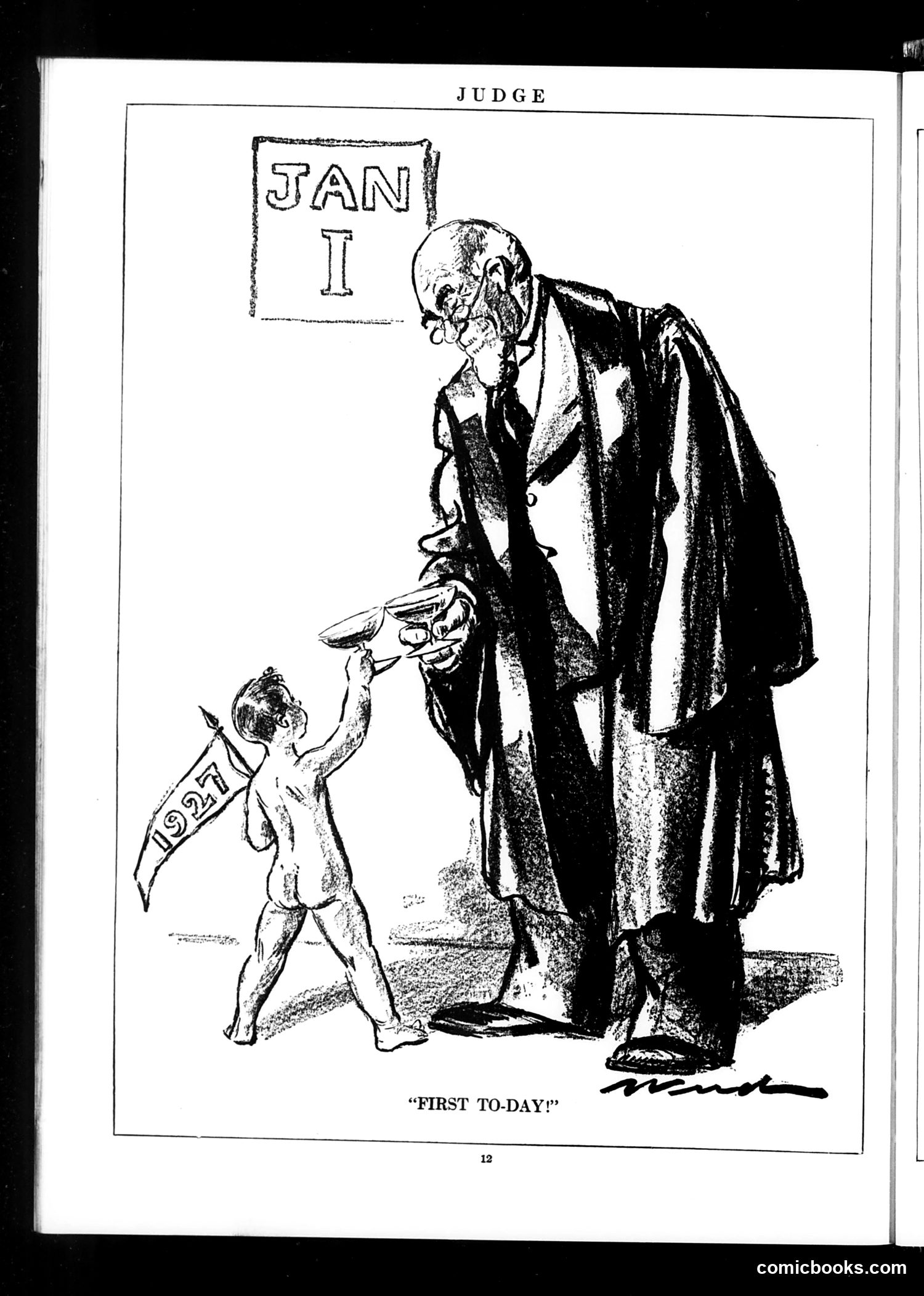
This cartoon depicts an elderly, gaunt judge in formal robes handing something to a cherubic baby labeled "1927." The baby carries a flag marked "1927." The caption "First To-Day!" suggests this represents New Year's Day or the first day of 1927. The satire appears to comment on the transfer of responsibility or expectations from the old year to the new one. The judge's skeletal appearance and stern demeanor contrast with the innocent baby, suggesting the outgoing year was harsh or burdensome. By showing an official judge presiding over this transition, the cartoonist likely critiques legal or governmental conditions of 1926, sardonically "handing off" problems to the fresh year ahead with little optimism for improvement.
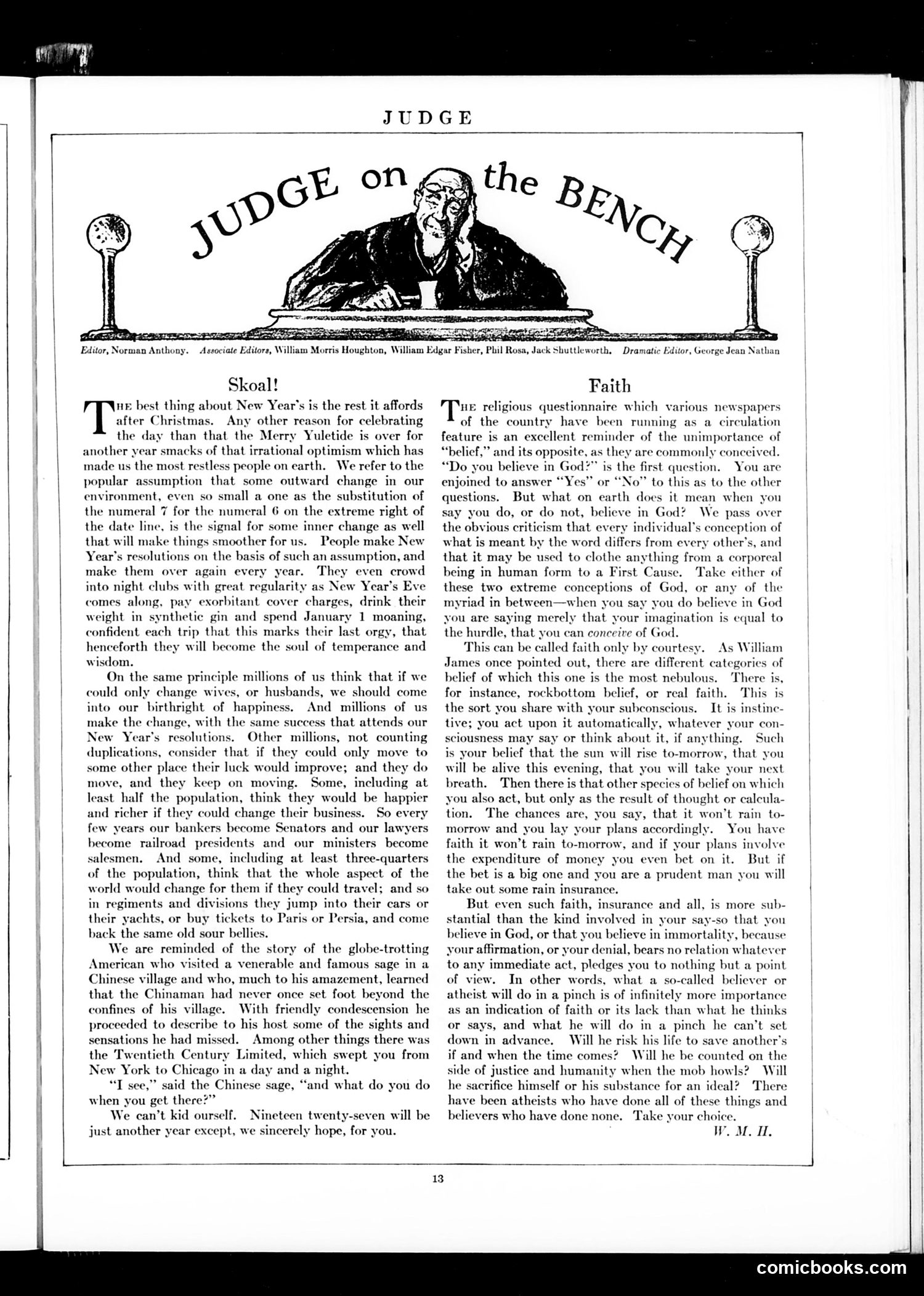
This page from *Judge* magazine features two satirical essays under the column "Judge on the Bench." **"Skoal!"** mocks Americans' New Year's optimism. The author argues that changing the calendar date won't improve lives—a jab at people who make resolutions they repeatedly break, change spouses hoping for happiness, relocate seeking better luck, or change careers expecting improvement. He illustrates this with an anecdote of a globe-trotting American bragging to a Chinese sage about traveling from New York to Chicago in a day, only to be asked: "and what do you do when you get there?" The point: external changes mean nothing without internal change. **"Faith"** critiques newspaper "religious questionnaires" (circulation-boosting surveys asking "Do you believe in God?"). The author argues yes/no answers are meaningless—people's conceptions of God vary wildly from literal deity to abstract First Cause. True faith, he suggests, involves action and ethical behavior, not simple yes-or-no affirmations. Both essays deflate American pretension and superficiality with dry wit.
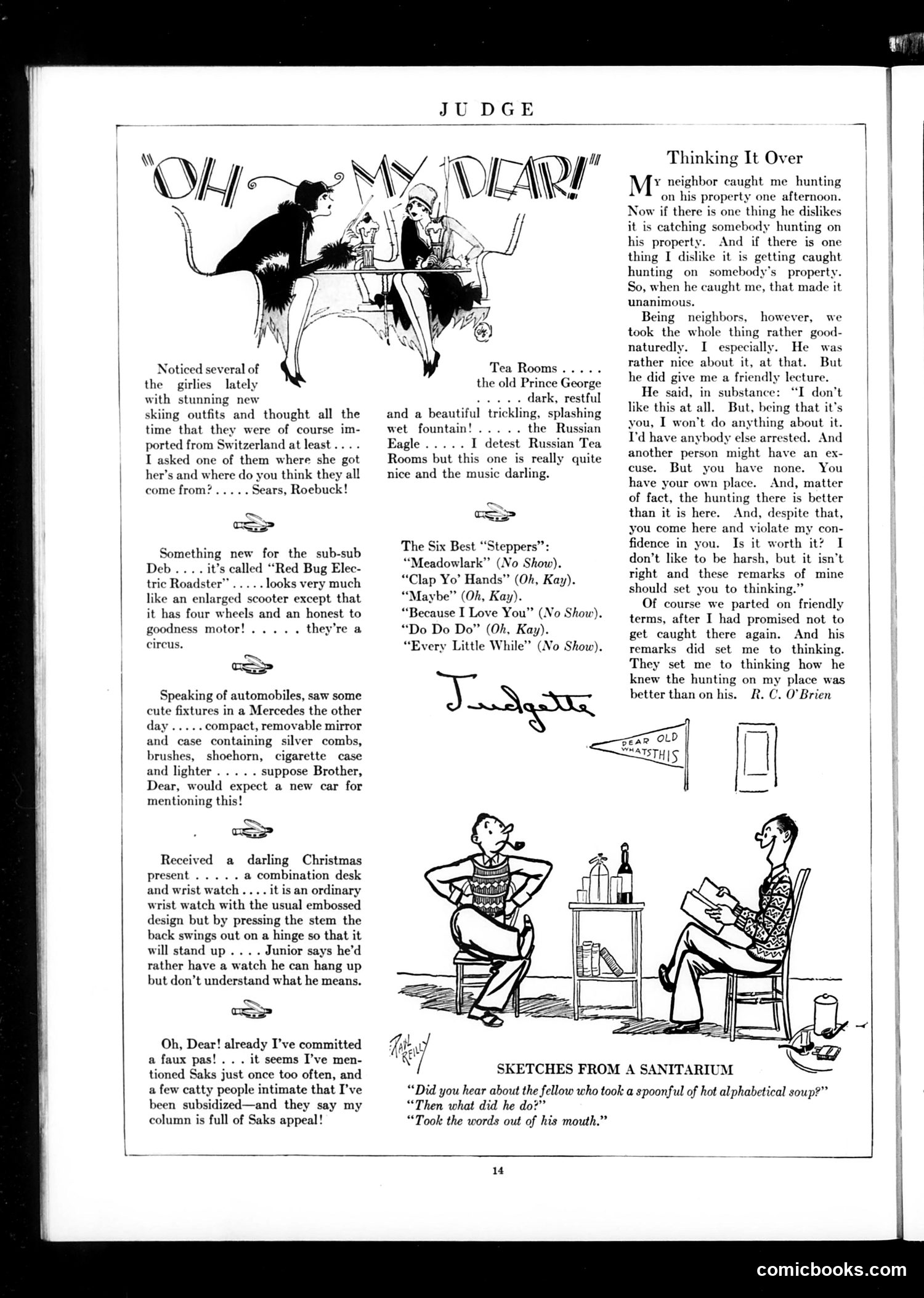
This is a **social gossip column** rather than political satire. The main content is "Thinking It Over" by R.C. O'Brien—a humorous anecdote about being caught trespassing while hunting on a neighbor's property. The neighbor's gentle rebuke—noting that O'Brien has better hunting on his own land yet violated the neighbor's trust—becomes a meditation on conscience and social obligation. The surrounding items are lighter **society page filler**: observations about wealthy women's skiing outfits (imported Swiss goods), new luxury automobiles and accessories (Mercedes fixtures, "Red Bug Electric Roadster"), Christmas gifts (combination desk-watches), and fashionable tea rooms. A "Saks" department store reference prompts jocular complaints about advertising bias. The bottom section, "Sketches from a Sanitarium," offers a brief **pun-based joke** about alphabet soup. The overall tone is gossipy, affluent, and gently self-mocking about consumer culture and social conventions among the upper class.
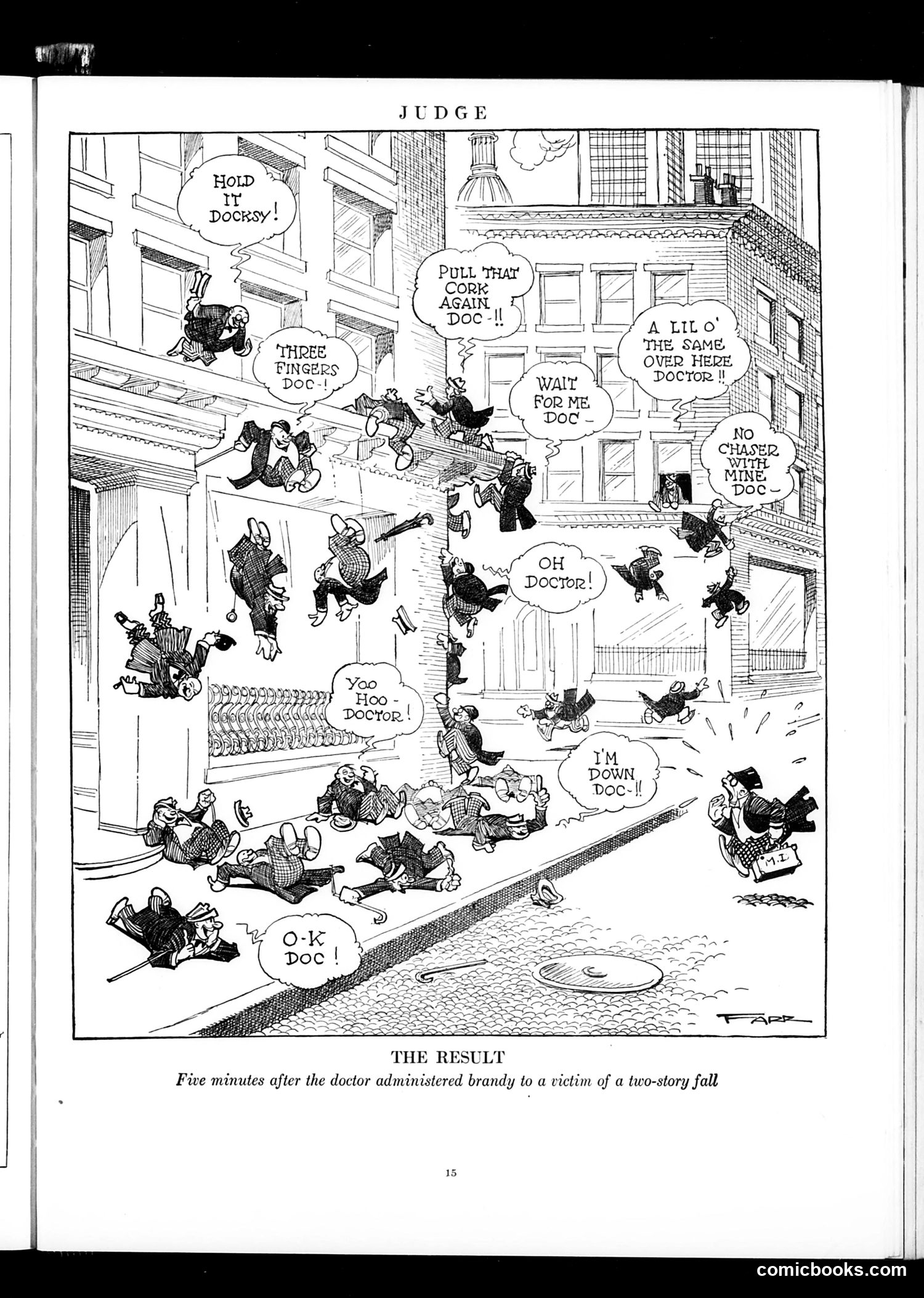
This cartoon satirizes the chaos that erupts when a doctor gives brandy (alcohol) to an accident victim. The scene shows a crowded urban street where numerous people are intoxicated and disorderly—falling, staggering, fighting, and shouting various slurred statements ("Hold it Docsy!", "Pull that cork again Doc!", "Wait for me Doc", etc.). The satire targets two things: the medical practice of administering alcohol as treatment for shock or injury, and the broader social problem of alcohol's chaotic effects on crowds. The humor derives from the exaggerated consequence—one dose of brandy seemingly intoxicates the entire neighborhood, creating mayhem. This reflects early 20th-century debates about alcohol's proper uses and the temperance movement's concerns about drinking culture.
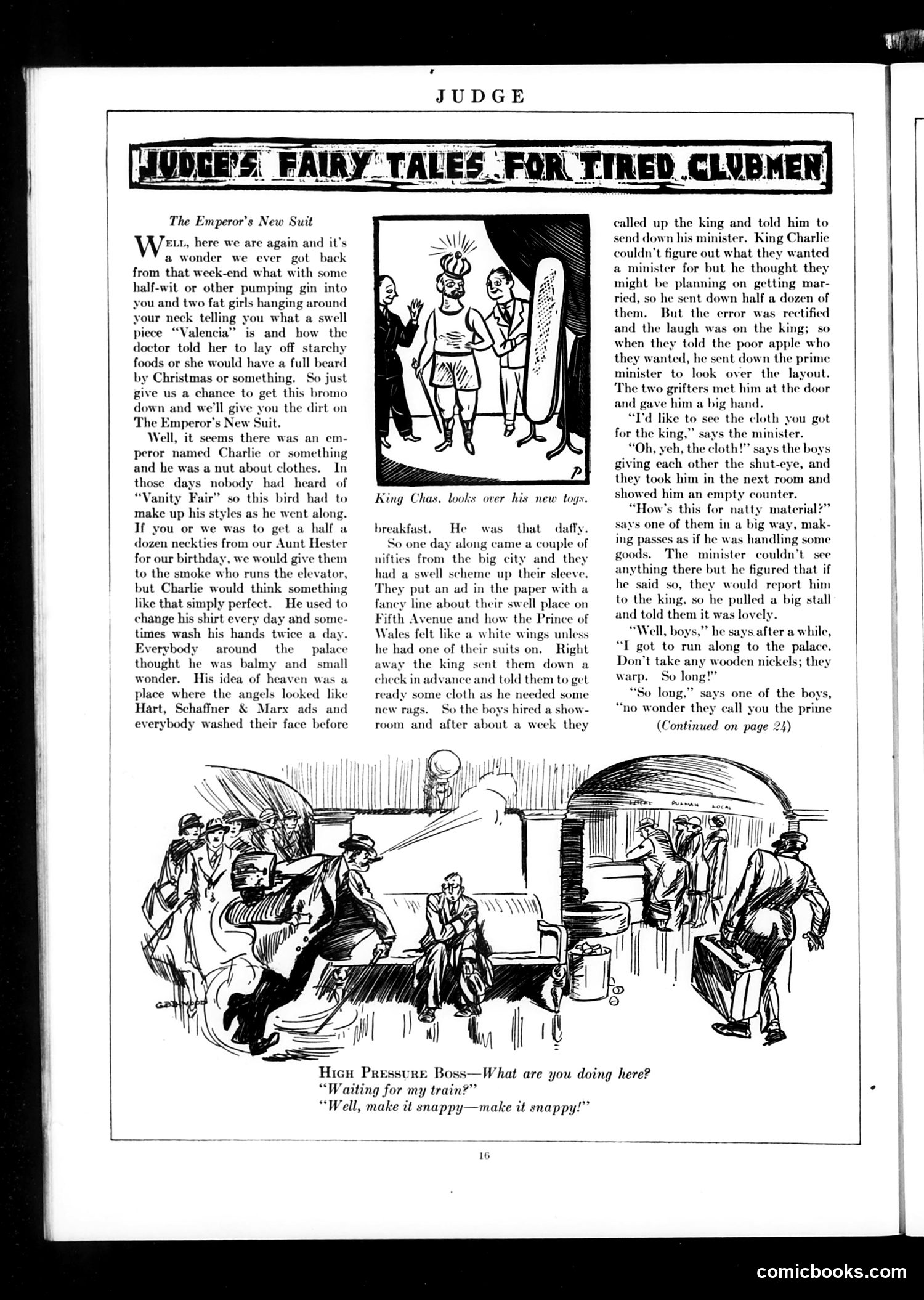
This page presents a comedic retelling of Hans Christian Andersen's "The Emperor's New Clothes" fairy tale, updated for a 1920s American audience. The story satirizes gullibility and vanity: Emperor Charlie, obsessed with fashion, is duped by con artists who pretend to sell him invisible cloth, claiming it's only visible to the worthy. His prime minister, fearing ridicule, pretends to see the nonexistent fabric rather than admit the truth. The satire targets pretension and social climbing—the con artists invoke Fifth Avenue prestige and the Prince of Wales to manipulate the emperor. The phrase "wooden nickels" (worthless counterfeits) underscores the scam's obviousness. The bottom cartoon, "High Pressure Boss," shows an impatient businessman harassing a worker at a train station—unrelated satire about workplace rudeness and efficiency obsession. The overall message: don't be fooled by hype or fear admitting what you cannot see.
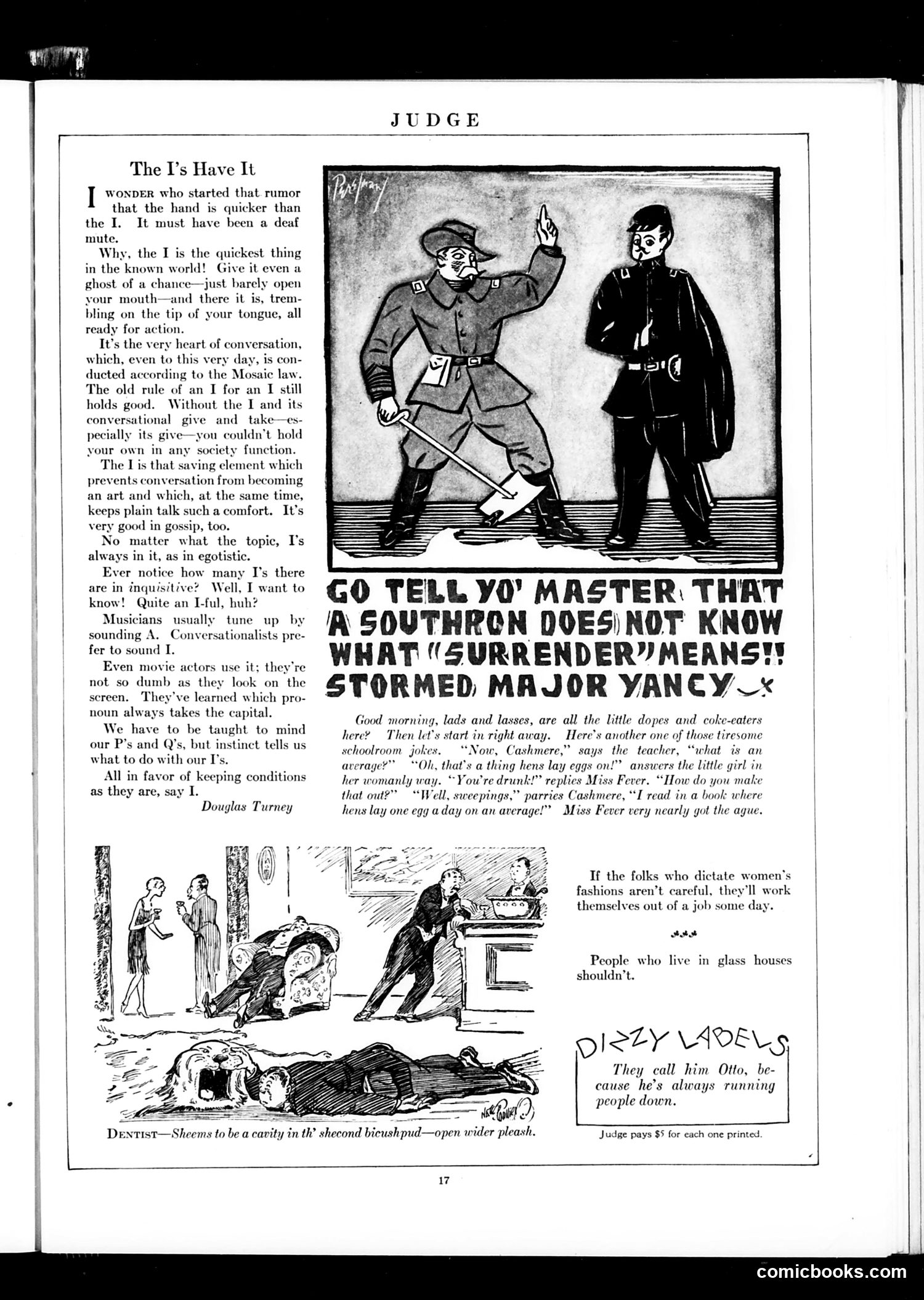
This page from *Judge* magazine contains satirical commentary on American speech and regional identity circa early 20th century. **"The I's Have It"** (top left): Douglas Turney's essay playfully critiques American conversational egotism—how people constantly insert the pronoun "I" into speech. It's a linguistic humor piece about self-centeredness in social discourse. **Main cartoon (top right)**: Shows a soldier confronting a civilian, with text "GO TELL YO' MASTER THAT A SOUTHRON DOES NOT KNOW WHAT 'SURRENDER' MEANS!!" This references the American South's post-Civil War regional pride and defiance, using exaggerated dialect ("Southron," "yo'") to satirize Southern resistance to federal authority or cultural change. **Lower cartoons**: School joke material and brief humorous observations ("People who live in glass houses shouldn't," "Dizzy Labels" about someone named Otto). The page reflects early-20th-century American humor relying on regional stereotypes and dialect comedy—elements that would alienate modern audiences.
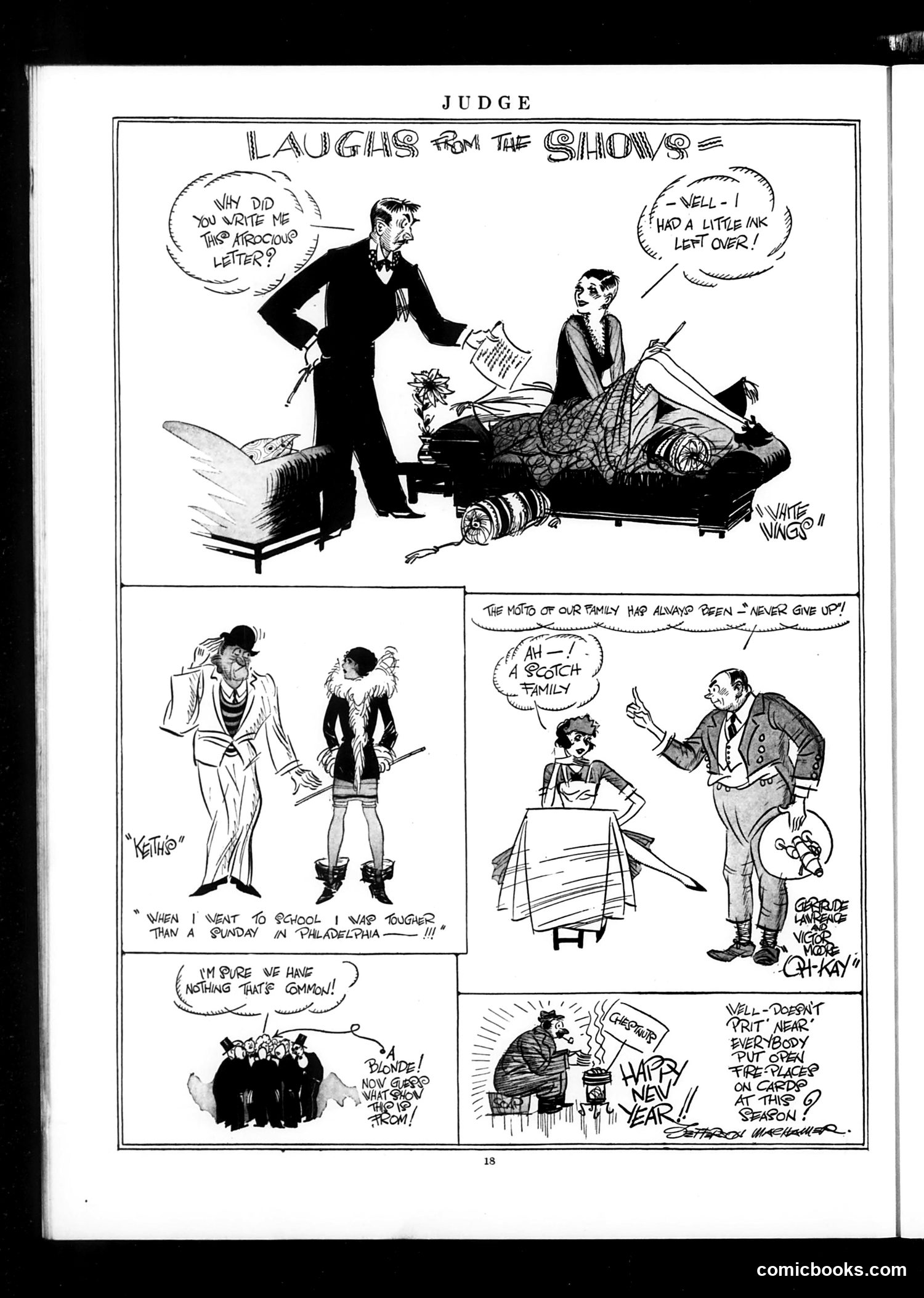
This page collects theatrical humor jokes, likely from early-to-mid 20th century vaudeville and stage performances. The top panel shows a judge questioning why someone wrote an "atrocious letter," with the response being spilled ink—a visual pun. The subsequent panels reference stage performers and their act catchphrases. One mentions someone attending "school" in Philadelphia (likely referencing a specific performer's bit), another quotes "the motto of our family has always been—never give up!" as a character trait, and the final panels contain variations on show business humor and New Year's resolutions. The cartoons satirize theatrical stock characters and clichéd dramatic moments common to stage comedy of the era. The humor relies on audiences recognizing these performers or their famous routines. Without identifying the specific actors or shows referenced, the exact targets remain unclear to modern readers unfamiliar with that performance era.
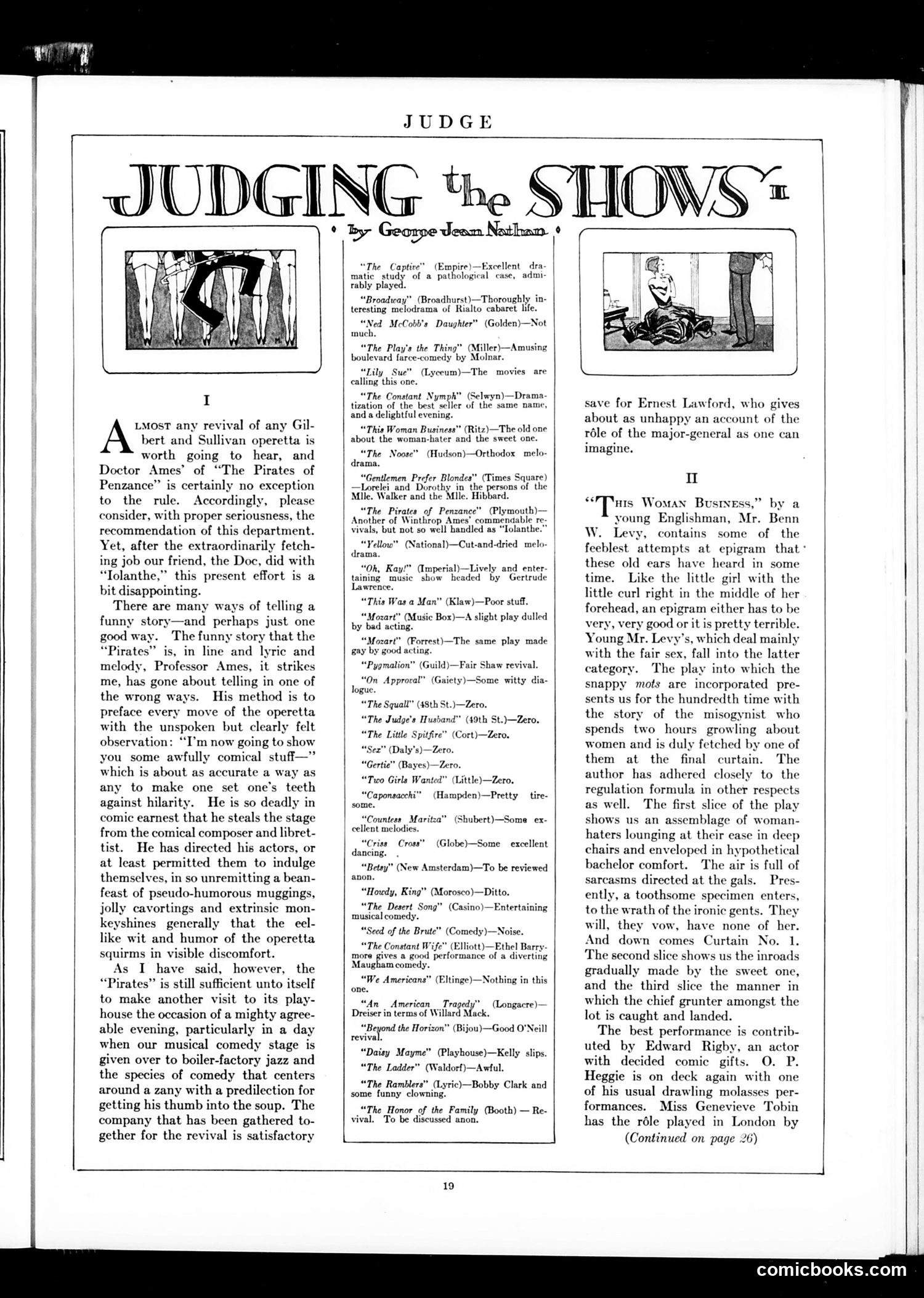
This is a theater review column by George Jean Nathan, a prominent drama critic of the 1920s. Rather than a political cartoon, it's editorial content evaluating Broadway productions. Nathan critiques a revival of *The Pirates of Penzance* directed by Winthrop Ames, praising the operetta itself but faulting Ames's overly earnest, mugging direction that undermines the Gilbert & Sullivan wit. He contrasts this with Ames's superior handling of *Iolanthe*. The second section reviews *This Woman Business*, a conventional romantic comedy about a "woman-hater and the sweet one"—a tired trope even then. The middle column lists brief assessments of current Broadway shows, using "Zero" ratings for inferior works. Nathan's verdict: while musical comedy stages were increasingly dominated by lowbrow "boiler-factory jazz" comedies, the *Pirates* revival remains worthwhile entertainment. This represents early 20th-century theater criticism addressing artistic standards in popular entertainment.
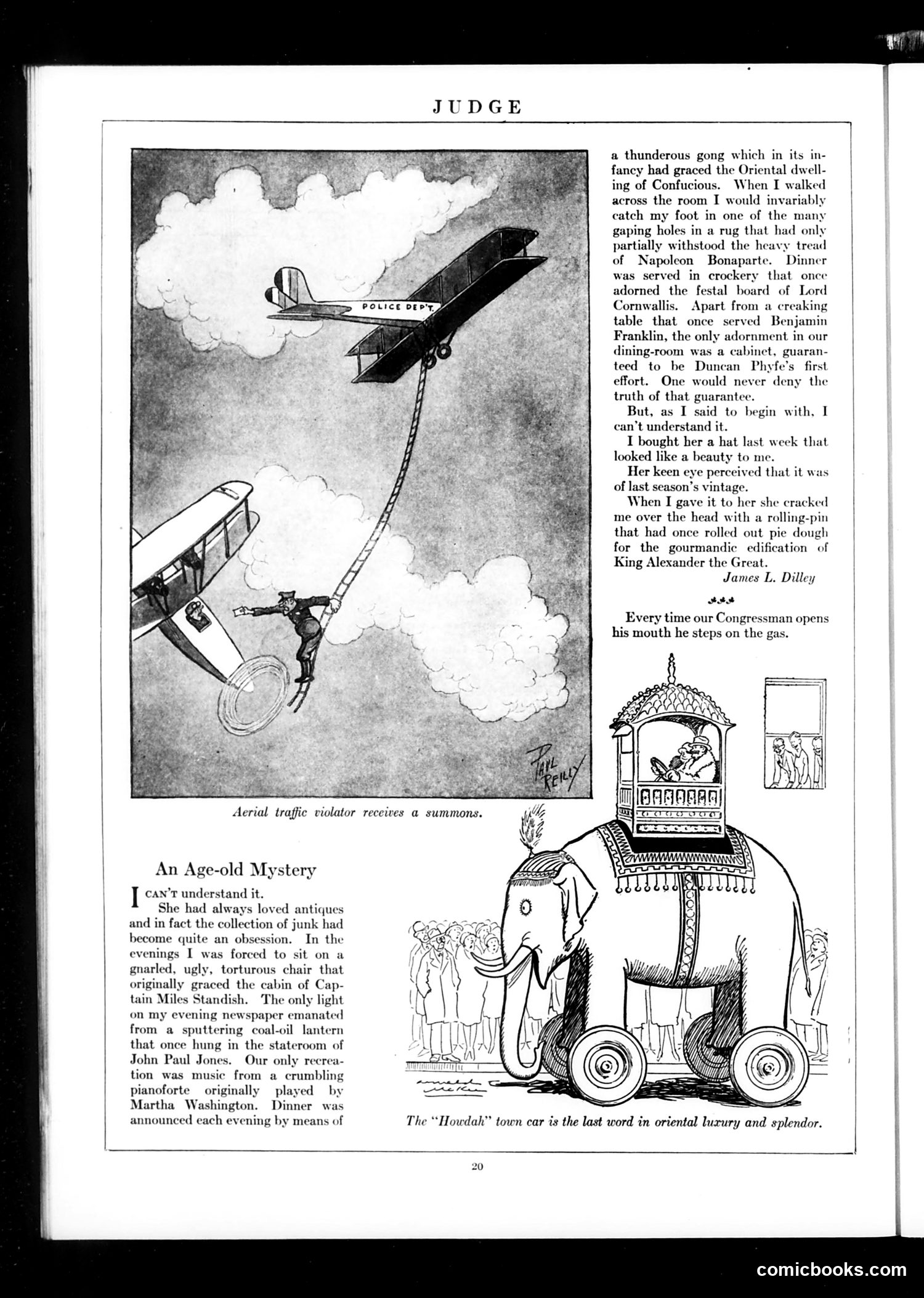
This page contains two distinct satirical pieces: **"An Age-old Mystery"** (main text): A humorous complaint by James L. Dilley about his wife's obsession with antiques. The joke is that she collects only *claimed* historical relics—furniture allegedly owned by famous figures (Napoleon, Martha Washington, John Paul Jones, etc.)—creating an uncomfortable home. The punchline: despite his gift of a new hat, she rejects it as "last season's vintage" and beats him with a rolling-pin supposedly used by King Alexander the Great. The satire targets both antique-collecting mania and the absurdity of unverifiable historical "authenticity." **Top cartoon**: Shows an airplane receiving a traffic summons, satirizing new aerial traffic laws as authorities attempted to regulate early aviation. **Bottom cartoon**: Depicts an ornate "Howdah" (howdak) town car—a vehicle styled as an elephant carriage—mocking orientalist luxury trends and automobiles designed to mimic exotic aesthetics. Both address early 20th-century American consumer culture and fads.
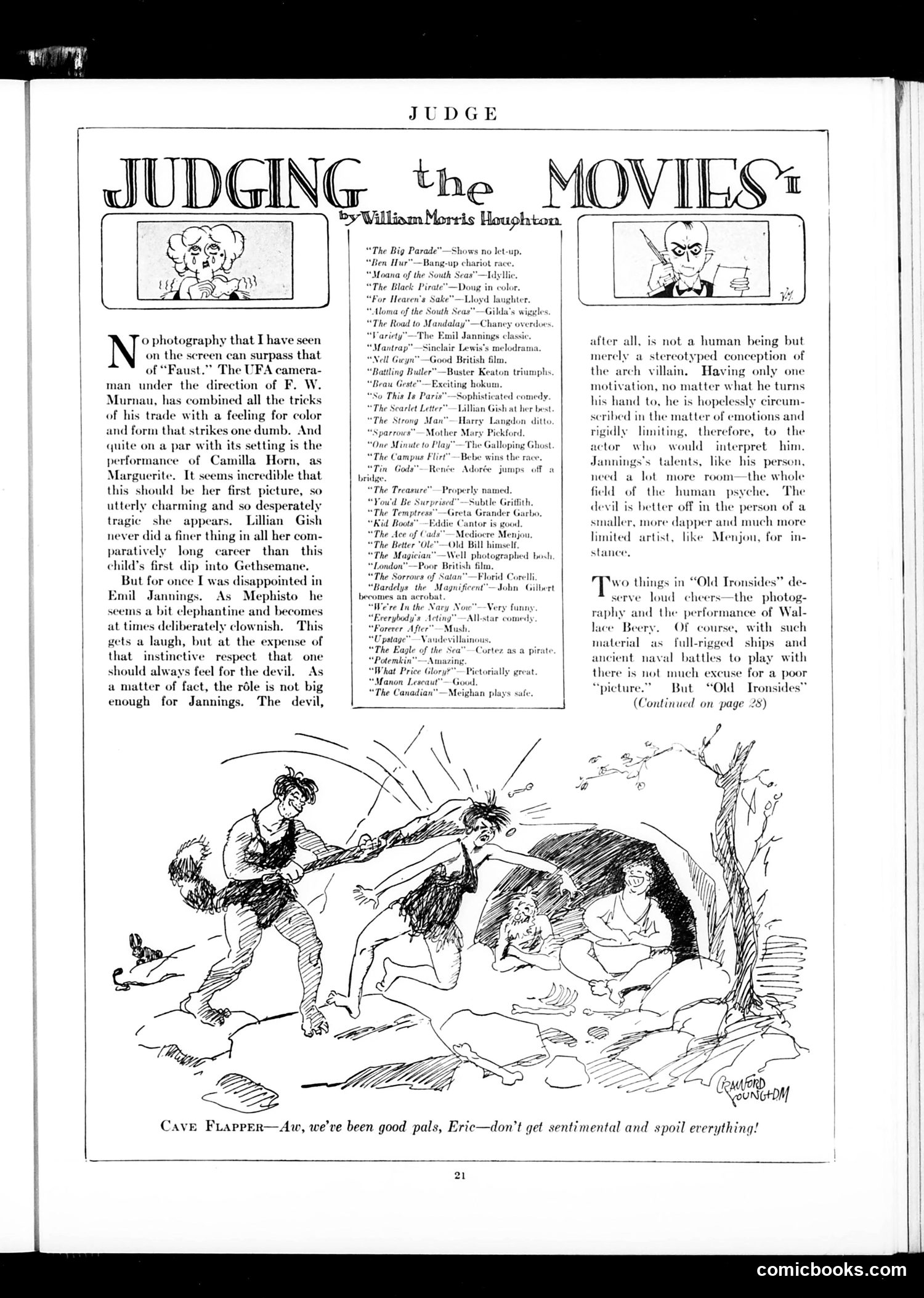
This page reviews 1920s silent films, particularly praising director F.W. Murnau's "Faust" and actress Camilla Horn's debut performance. The critic contrasts Horn's nuanced portrayal of Marguerite favorably against Emil Jannings's interpretation of Mephisto (the devil), arguing Jannings is "elephantine" and "deliberately clownish"—too broad and physical for the role's complexity. The satire critiques Jannings's acting style: as a devil character with "only one motivation," he's limited to stereotyped villainy rather than exploring human psychology. The critic suggests smaller, more refined actors like Adolphe Menjou better capture the devil's subtlety. The bottom cartoon shows primitive "cave people" in a slapstick scene, likely parodying the popular adventure films listed above (like "Beau Geste" and "The Treasure"). The detailed film listings reflect Judge's role as entertainment commentary for educated readers following contemporary cinema.
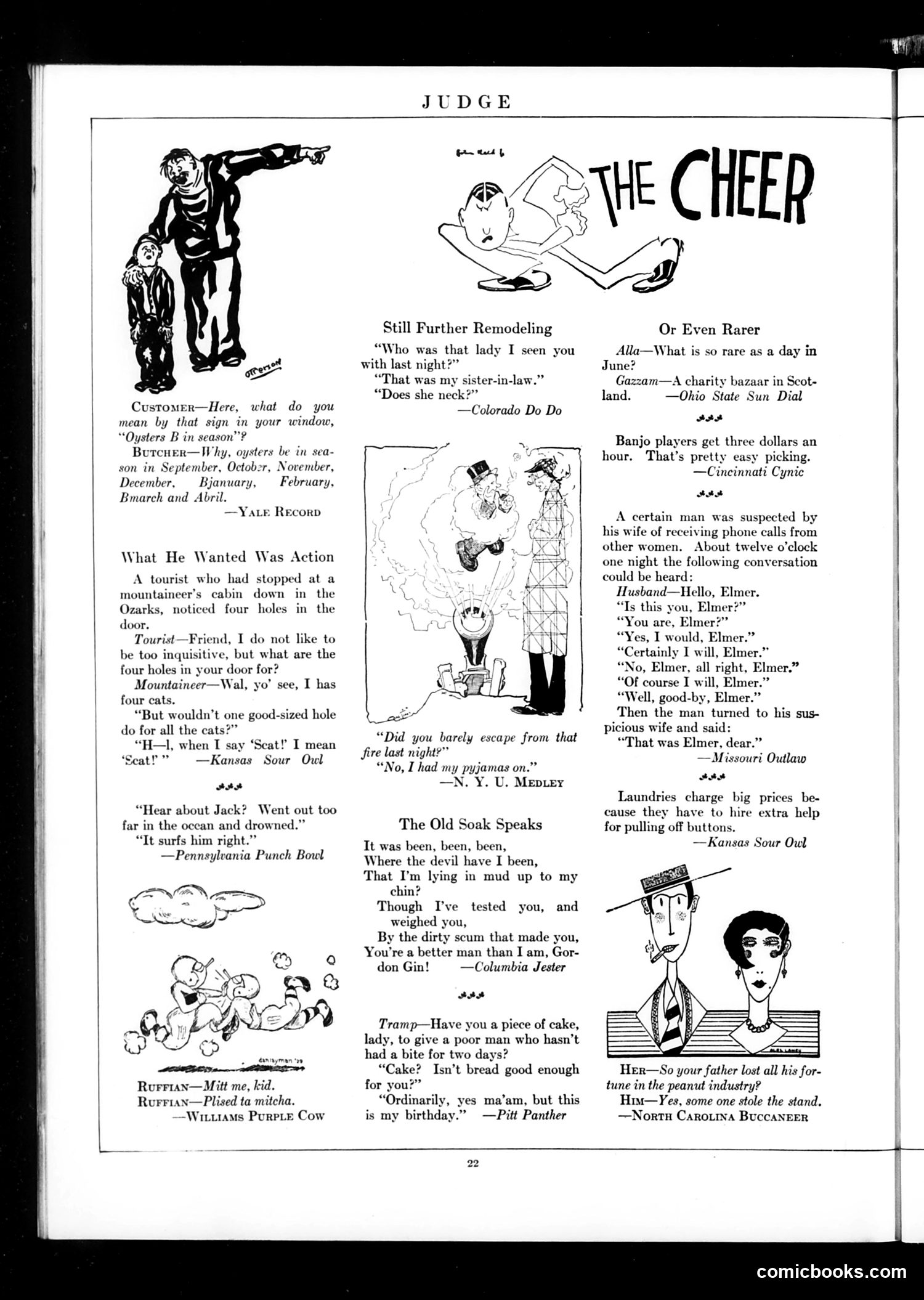
This page from *Judge* contains humor pieces typical of early 20th-century American satirical magazines. The content includes: **"Oysters B in season"**: A butcher's joke playing on the old saying that oysters are safe to eat only in months containing the letter "R"—he's humorously listing months starting with "B" to mock the customer's pedantry. **Ozark mountaineer joke**: Rural stereotyping humor about a backwoods cabin owner with four cats, making a pun on "Scat!" (meaning "go away") versus "Seat!" (a chair)—relying on exaggerated dialect comedy. **Other brief gags**: Standard period humor about phone calls (marriage infidelity concerns), tramps begging, laundry costs, and peanut vendors. The "Old Soak" poem satirizes a drunk man's incoherence. The cartoons are simple line drawings accompanying these quips. Overall, the page showcases *Judge's* formula: ethnic/regional stereotypes, wordplay, and observational humor about domestic life and social manners—entertainment reflecting era-specific attitudes now considered dated.
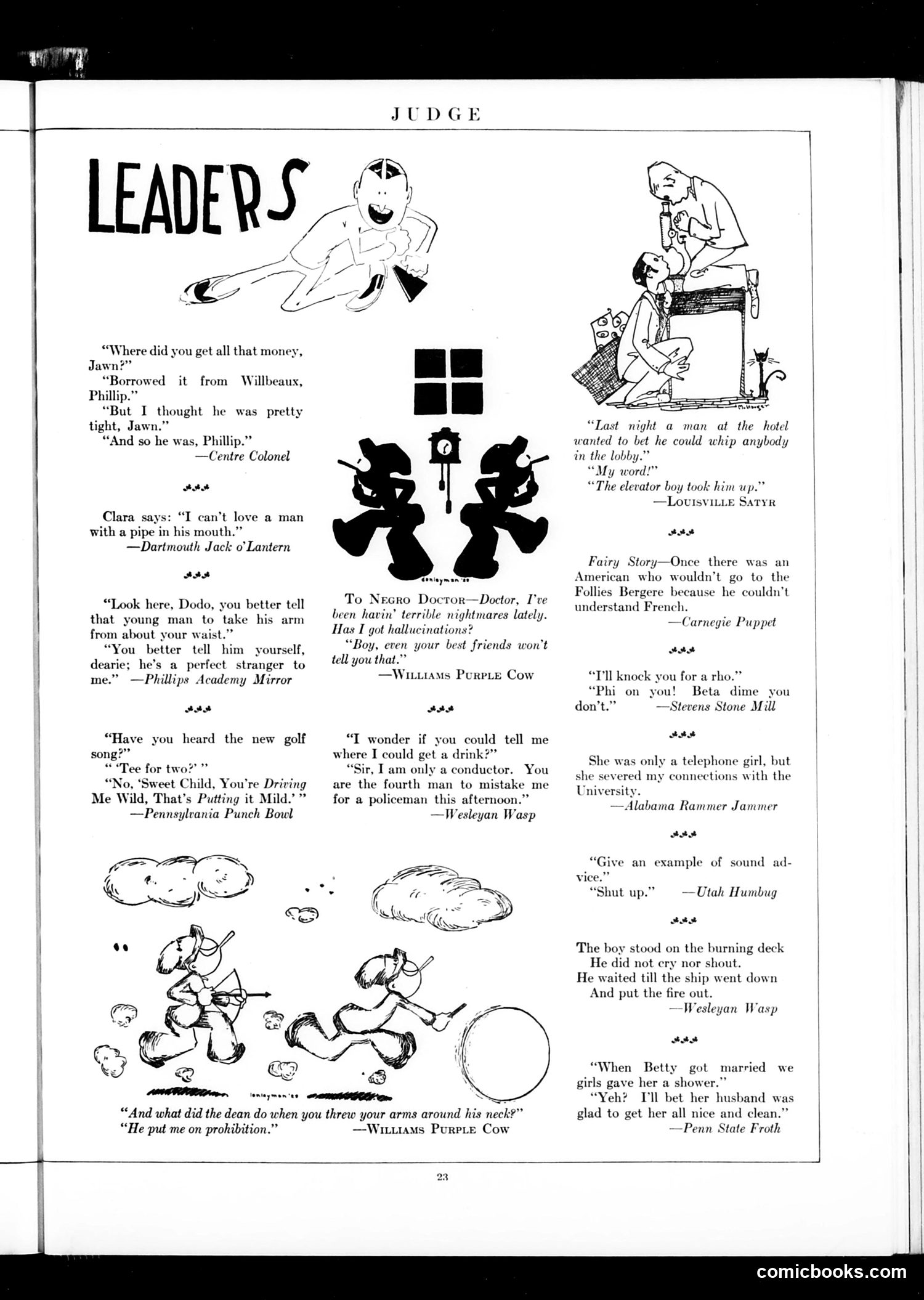
This page collects brief jokes and quips from various college humor magazines (Pennsylvania Punch Bowl, Wesleyan Wasp, etc.), typical of Judge's format showcasing collegiate wit. **Key themes:** - **Prohibition era humor**: References to drinking and "prohibition" reflect the 1920s alcohol ban - **College social dynamics**: Dating etiquette ("arm around waist"), gender relations, dean authority - **Class/economic humor**: Borrowing money, mistaking conductors for policemen - **Wordplay**: Golf puns ("Tee for two"), fraternity Greek letters ("Phi," "Beta") - **Period absurdism**: The poem about a boy calmly extinguishing a fire on a sinking ship exemplifies surreal humor popular in student publications **Caricatures**: "Williams Purple Cow" and "Negro Doctor" appear as recurring satirical characters—personas used to deliver jokes rather than identified individuals. The satire targets student life, social pretension, and Prohibition-era contradictions. Most humor relies on double meanings and gentle mockery of courtship, authority, and class rather than sharp political commentary.
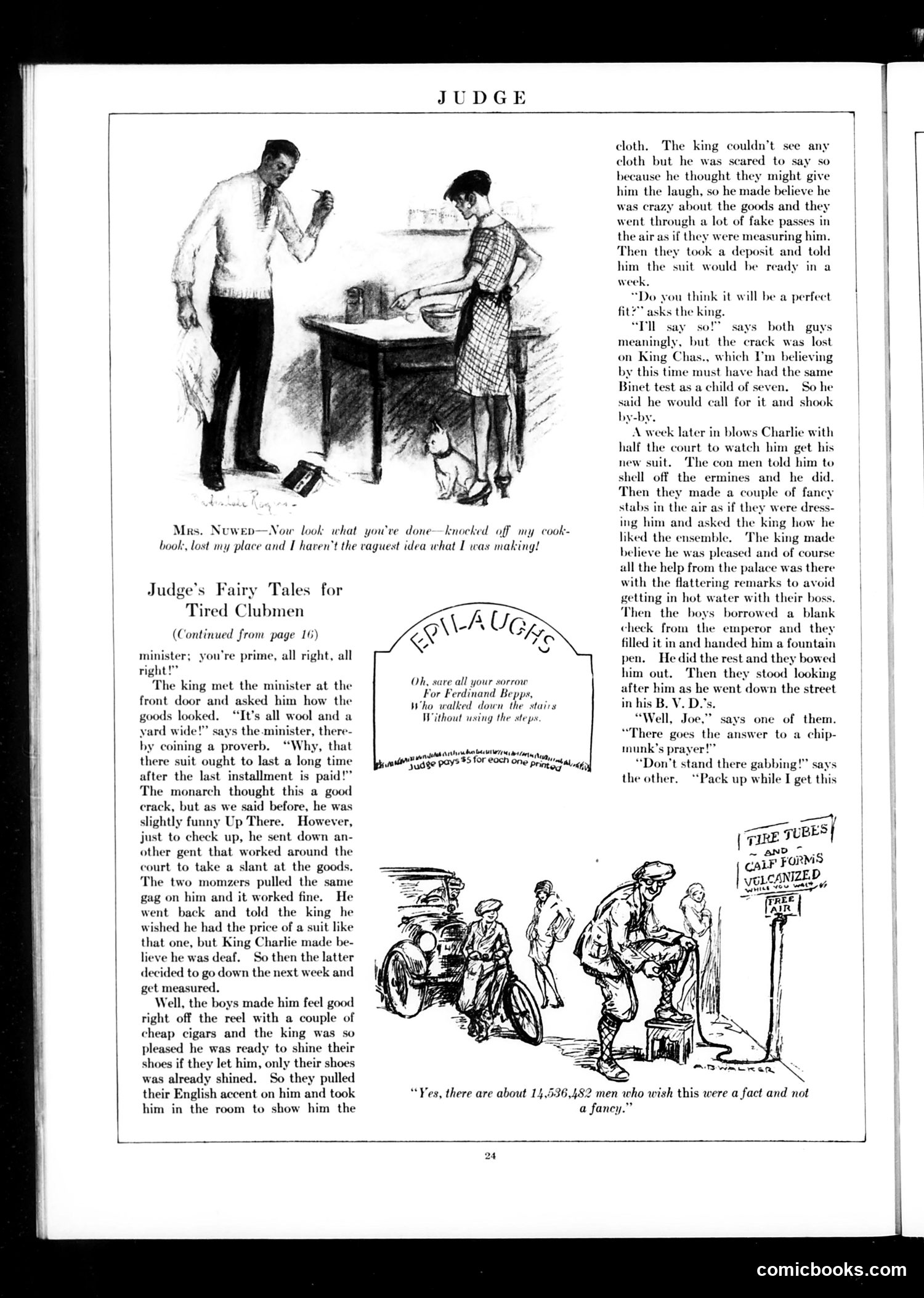
This is a satirical retelling of "The Emperor's New Clothes" folktale, adapted for early 20th-century American readers. Two con artists pose as tailors and convince a wealthy king (King Charles) that they're creating an invisible suit visible only to the wise—a classic con. The satire targets gullibility and vanity: the king cannot see the non-existent cloth but pretends enthusiasm to avoid ridicule. Court members flatter him obsequiously, fearing his displeasure. The con men extract payment and disappear. The final caption—"14,536,482 men who wish this were a fact"—suggests the author is mocking readers who wish such easy wealth schemes actually worked, or perhaps critiquing widespread con artistry of the era. The top vignette shows a domestic scene where a woman has been interrupted while cooking, likely illustrating another comic story about domestic mishaps or marital humor typical of Judge's content.
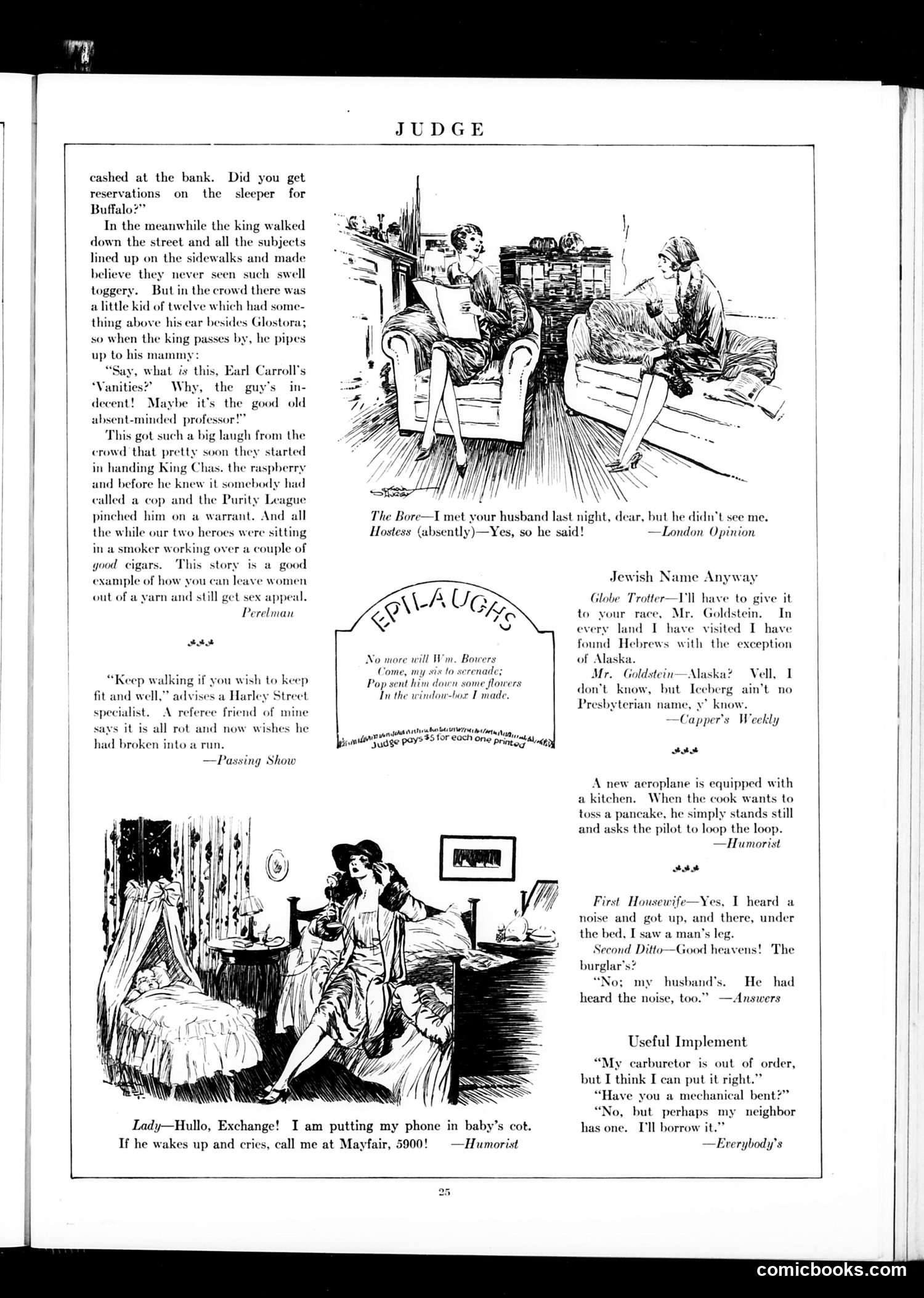
This page contains multiple short humor pieces typical of Judge magazine's satirical format. **Top narrative**: A story about a king walking through town in fancy clothes. A twelve-year-old boy makes a crude joke comparing the king's appearance to Earl Carroll's "Vanities" (a Broadway revue known for scantily-clad performers). The crowd laughs and heckles the king until someone calls a cop and the "Purity League" arrests him—satirizing both the prudish morality police and the absurdity of arresting a monarch for indecent appearance. **Other jokes**: Various one-liner gags about modern life—phones in baby cribs, airplanes with kitchens, borrowed tools. The "Jewish Name Anyway" section mocks a globe-trotter's stereotypical observation about finding Hebrews everywhere except Alaska. The page reflects 1920s-era American humor: slapstick situations, class commentary, mild ethnic stereotyping, and commentary on new technologies and social conventions like the "Purity League" censorship movements of that era.
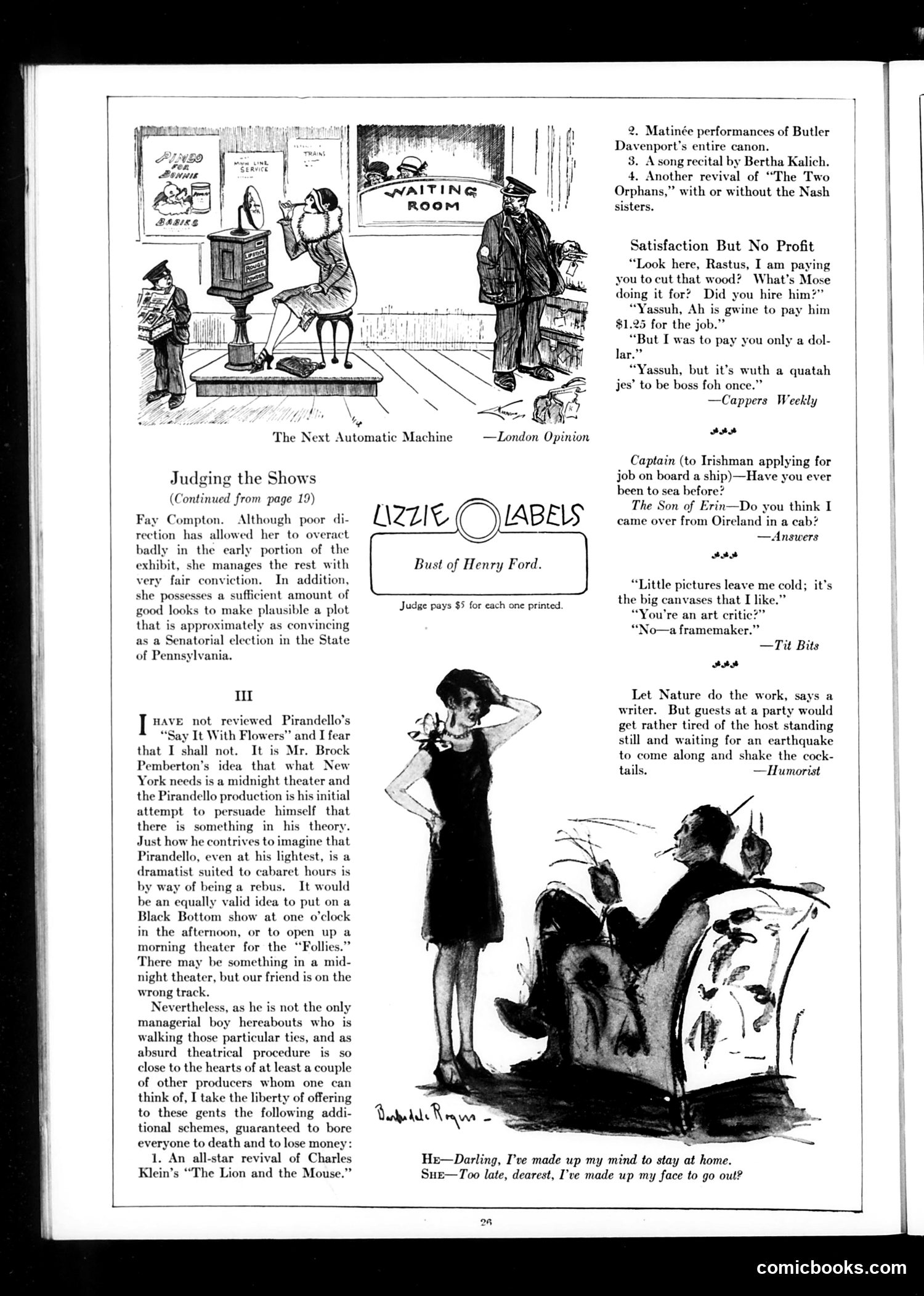
This page contains several satirical cartoons and jokes typical of early 20th-century American humor: **"The Next Automatic Machine"** depicts a woman at a vending machine—likely satirizing the era's fascination with automated conveniences and their potential to replace human labor. **"Satisfaction But No Profit"** uses racist dialect humor (common then, offensive now) to joke about wage disputes between Black workers, with "Rastus" complaining that paying a coworker more undermines his own compensation. **Theater criticism section** discusses various Broadway productions and unconventional scheduling ideas, mocking impractical theatrical trends. **"Lizzie Labels"** advertises Henry Ford busts priced at $5—capitalizing on Ford's celebrity status during the automotive boom. The remaining jokes are light observational humor: art criticism, party etiquette, and marital banter. The page reflects 1920s entertainment culture, racial attitudes of the era, and early consumer product marketing, all presented through Judge's satirical lens.
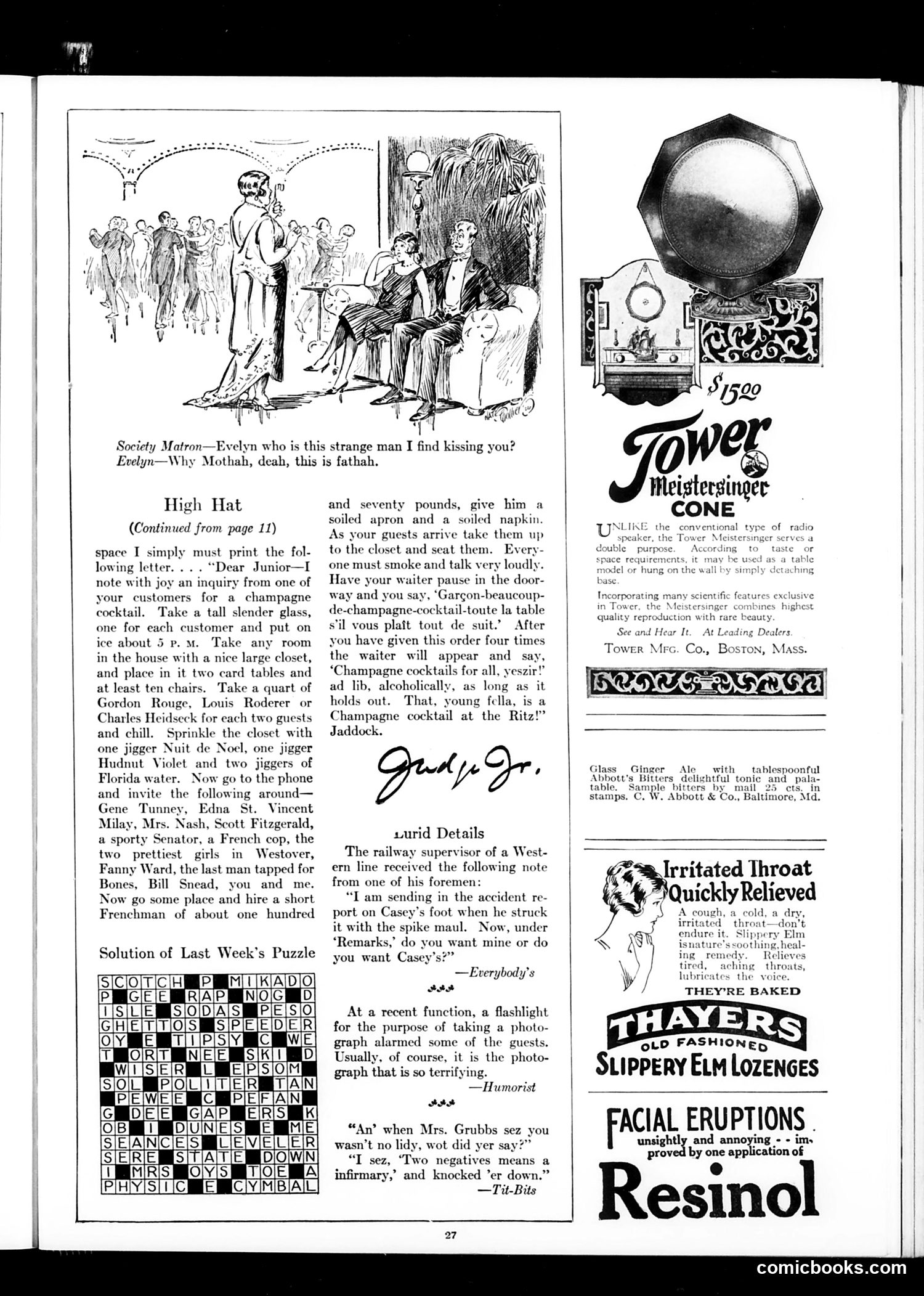
This page contains three distinct humor pieces satirizing 1920s social pretension: **"High Hat" (main cartoon):** A society advice column mocking the affectations of the wealthy elite hosting cocktail parties. The joke satirizes both the elaborate, French-inflected instructions for serving champagne cocktails and the guest list of celebrities and society figures (Gene Tunney, F. Scott Fitzgerald, etc.). The humor targets the performative sophistication of the upper class—hiring a diminutive Frenchman as waiter and using excessive French phrases to impress guests. The paired dialogue joke reinforces this: a society matron is shocked to find her husband kissing a man, who responds it's actually her father, playing on miscommunication and class pretension. **"Lurid Details":** Two short anecdotes. One satirizes bureaucratic obfuscation (a foreman asking whether to report his own or Casey's perspective on an accident). The second mocks misunderstanding—a woman supposedly compliments another's education by confusing grammar ("two negatives means infirmary"). The page is primarily satirical content with period advertisements for radio speakers, throat lozenges, and skin treatments.
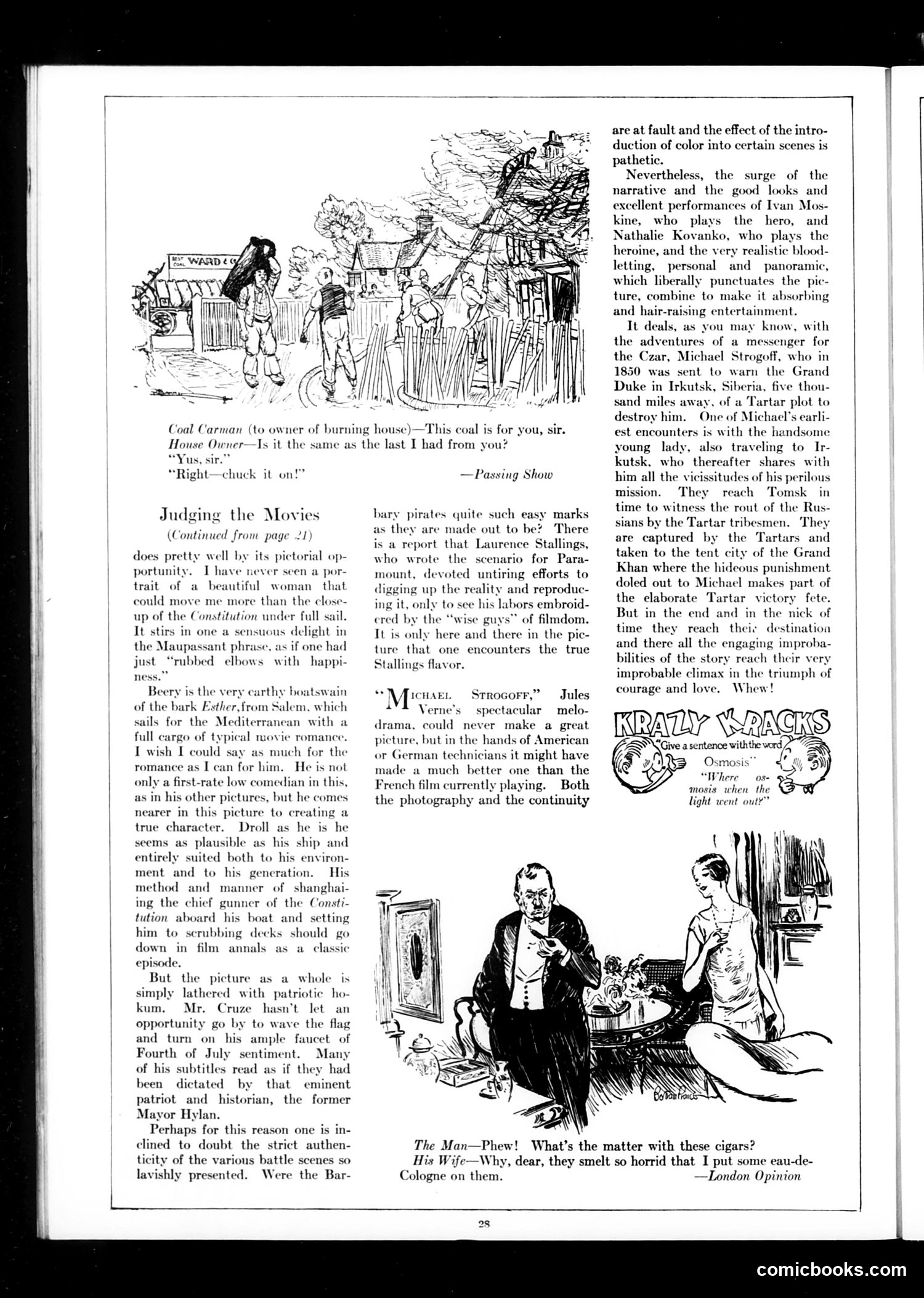
This page contains film criticism and two unrelated satirical cartoons. The main content reviews recent movies, discussing films like "The Constitution" (featuring actor Wallace Beery) and "Michael Strogoff" (based on Jules Verne's novel). The critic praises Beery's acting but criticizes the film's excessive patriotic sentiment, suggesting director James Cruze prioritized Fourth of July spectacle over historical accuracy regarding Barbary pirates. The two cartoons at bottom are simple domestic humor unrelated to politics: 1. **Coal delivery joke**: A coal merchant delivers coal to a burning house, and the owner absurdly asks him to throw it on the fire anyway. 2. **Perfume gag**: A husband notices his cigars smell horrible; his wife explains she sprayed them with eau-de-Cologne to mask the odor—defeating the purpose entirely. Both cartoons mock everyday absurdity rather than political issues.
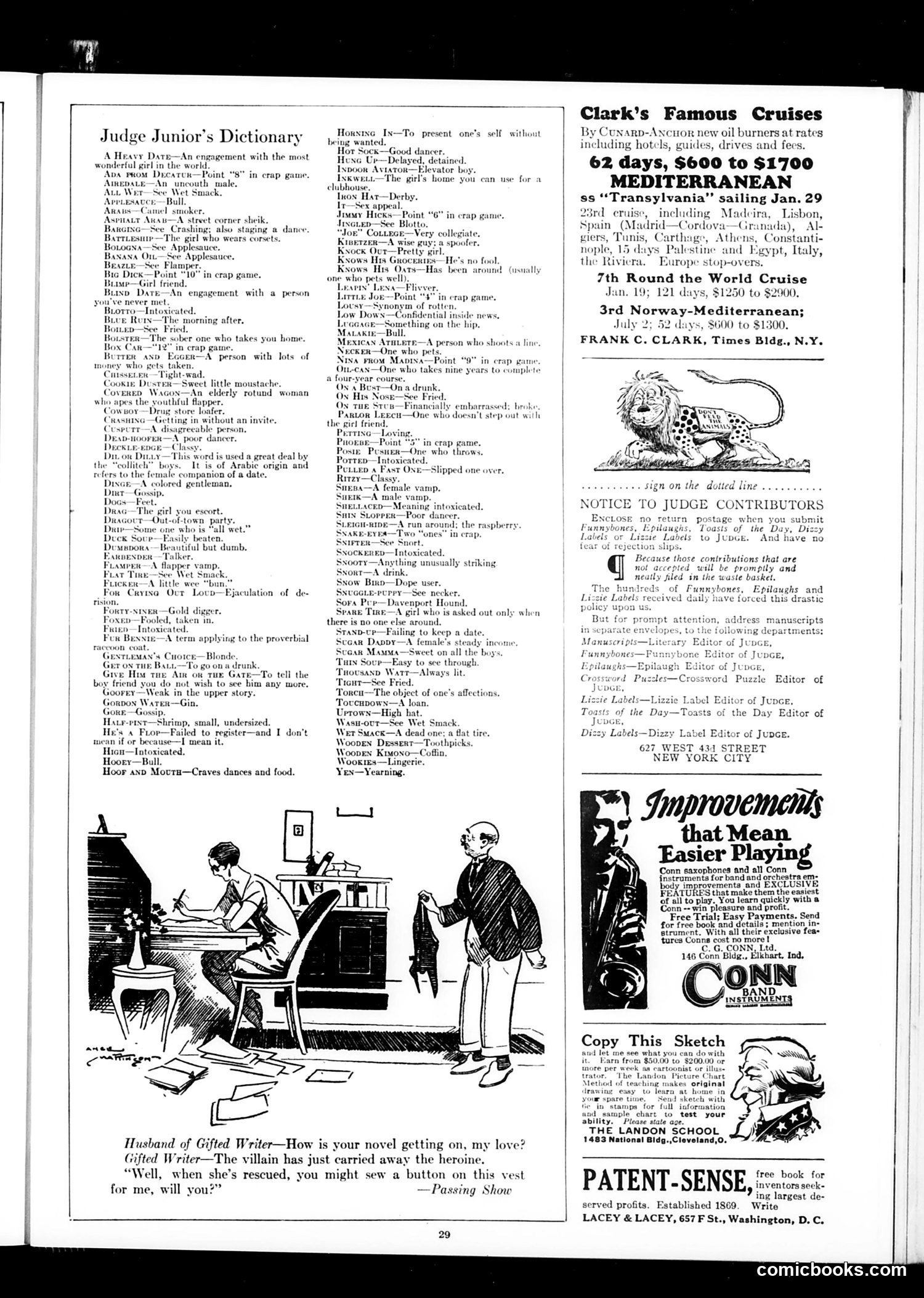
This page from Judge magazine contains three main elements: **"Judge Junior's Dictionary"** is a satirical glossary of 1920s slang terms, mocking the era's youth culture and jazz-age terminology. Terms like "Applesauce" (nonsense), "Berries" (excellent), "Flapper," and "Crap game" reflect contemporary concerns about young people's morality and behavior. The dictionary ridicules modern speech patterns and social customs. **The cartoon** depicts a domestic scene where a husband interrupts his wife's writing. She's written a melodramatic novel where "the villain has just carried away the heroine," but the husband's response is bathetic—he asks her to sew a button on his vest. The satire mocks both the pretensions of amateur writers and husbands' obliviousness to their wives' creative ambitions. **Surrounding advertisements** promote cruise vacations, music instruction, and other goods typical of the era. The page reflects Judge's focus on satirizing modern American social trends, generational conflict, and domestic life in the prosperous 1920s.
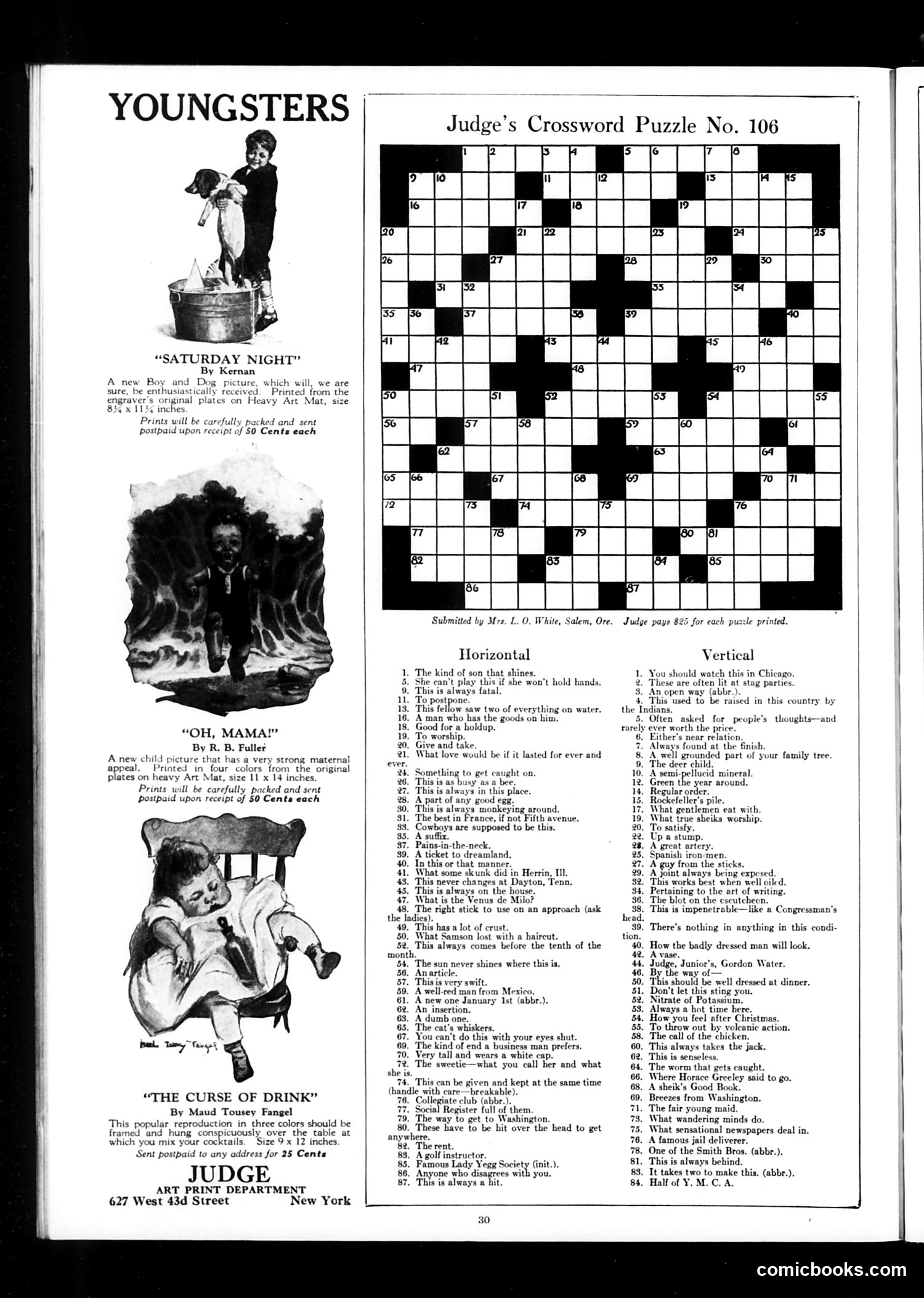
This page from *Judge* magazine (a satirical publication) contains three elements: **Left side:** Advertisements for art prints by various illustrators—"Saturday Night" by Kernan, "Oh, Mama!" by R.B. Fuller, and "The Curse of Drink" by Maud Tousey Fangel. These were sold by Judge's Art Print Department as decorative reproductions, priced 25-50 cents. **Right side:** A crossword puzzle submitted by a reader from Salem, Oregon. The clues are typical early 20th-century wordplay mixing current slang ("the cat's whiskers"), contemporary references (Dayton, Tennessee; Herrin, Illinois), and social observations about drinking, romance, and manners. **Historical context:** The "Curse of Drink" print title reflects Prohibition-era concerns (1920-1933), while references to "stag parties" and cocktails suggest the Jazz Age. The puzzle's gentle humor targets middle-class readers—there's no overt political satire here, just light social commentary typical of Judge's family-friendly content from this period.
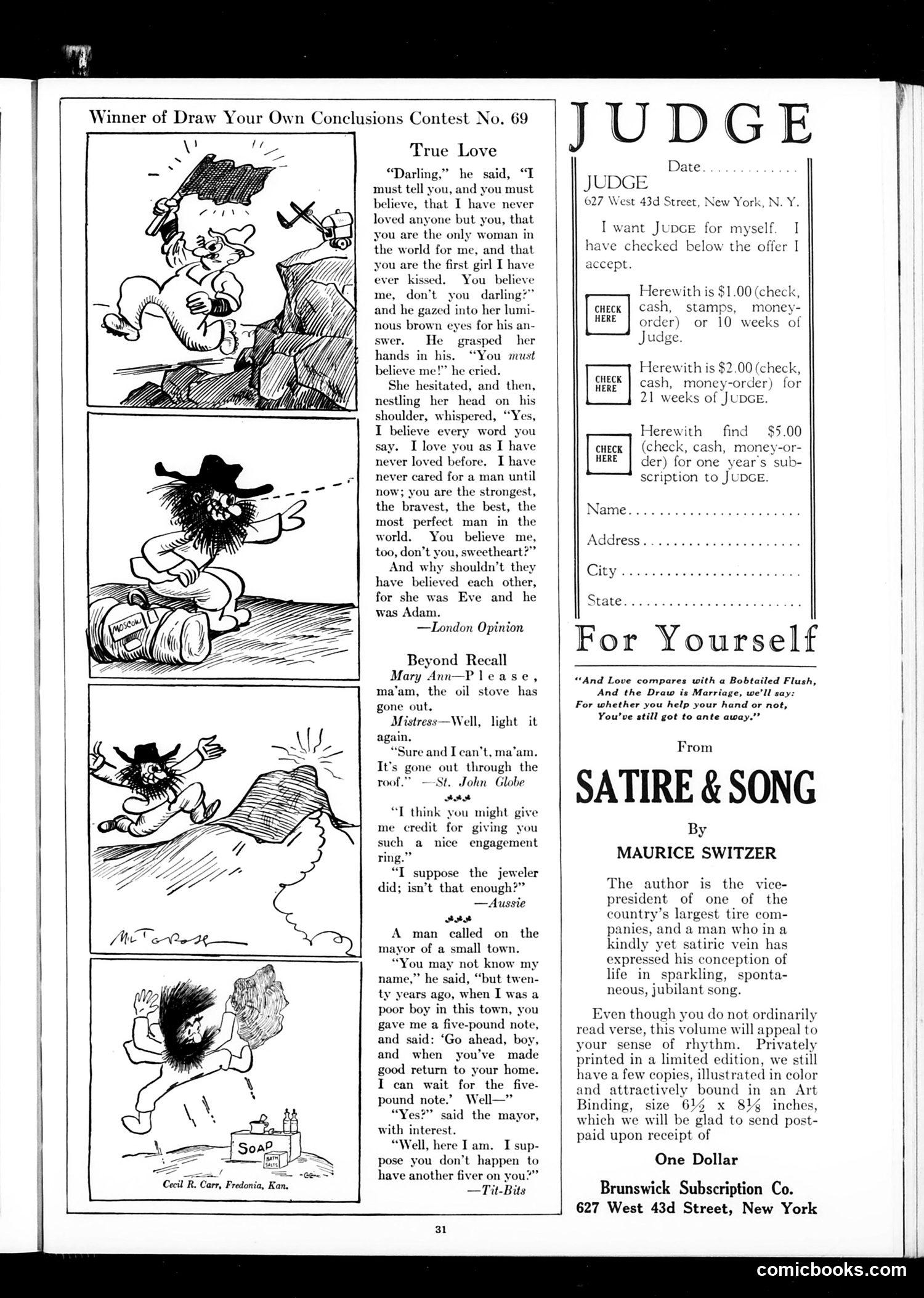
This page contains four brief humorous anecdotes and advertising, rather than political cartoons. **"True Love"**: A satirical take on romantic declarations. The joke is that Adam and Eve—humanity's first couple—had no basis for comparison, so they could believe each other's claims of exclusive love without evidence. It's gentle satire on the dishonesty of romantic pledges. **"Beyond Recall"**: A domestic servant comedy. A maid reports the oil stove went out and she "can't" relight it. The unstated implication is she's being deliberately unhelpful or inept—typical working-class humor of the era mocking servants. **The unnamed mayor anecdote**: A con-artist joke. A man thanks the mayor for a five-pound loan given decades ago, claiming he's now successful—but the punchline reveals he's really asking for another loan. It satirizes false gratitude and people who exploit others' generosity. The page is primarily **advertising for Judge magazine itself** and Maurice Switzer's book *Satire & Song*, using these brief humor pieces as content samples.
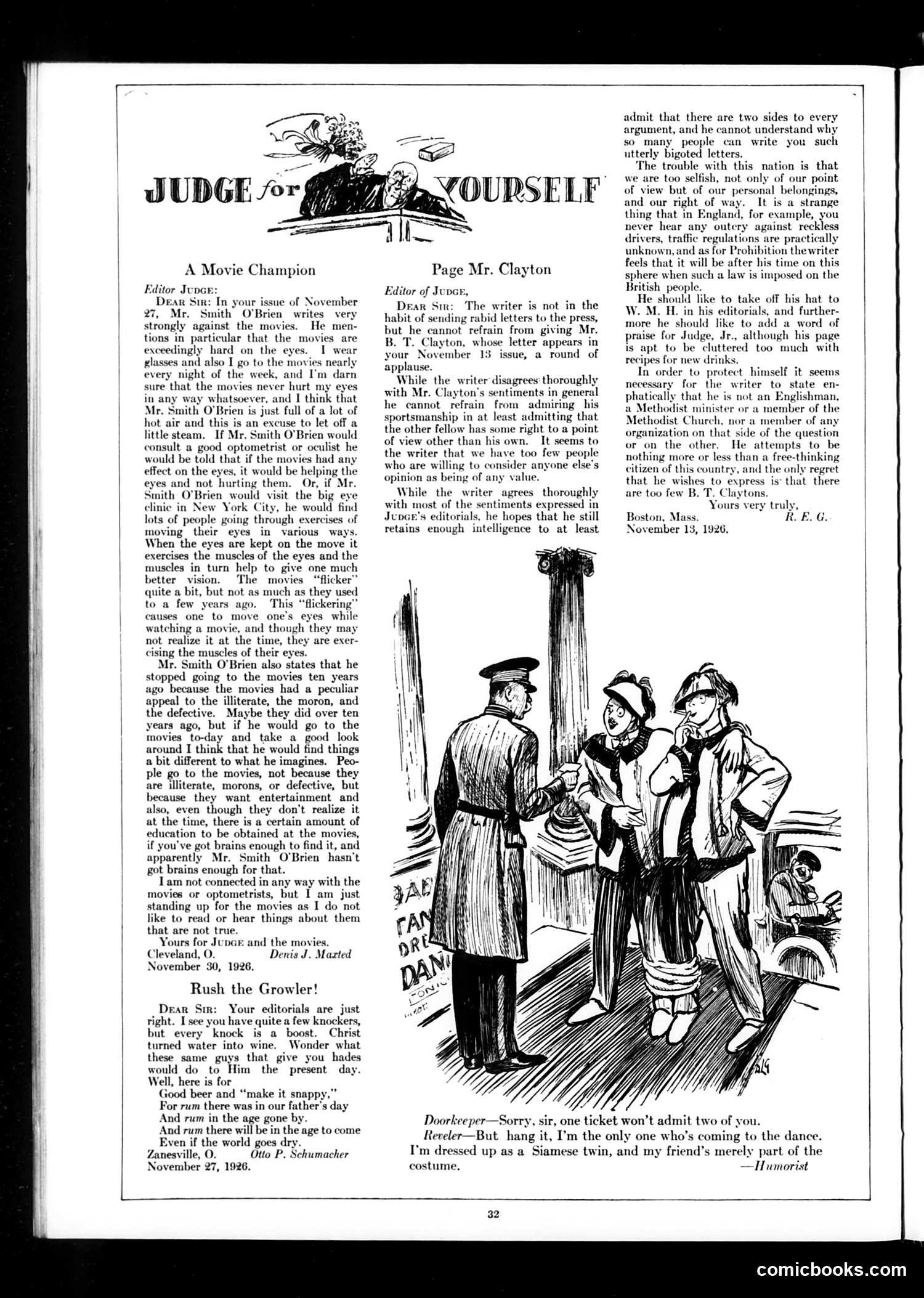
This page contains three reader letters debating social issues, plus one cartoon. **The cartoon** depicts a nightclub doorkeeper refusing entry to a reveler dressed as a "Siamese twin," explaining the costume violates the one-ticket-per-person policy. The joke relies on the absurd literalism of treating a costume as actual twins. **The letters debate**: 1. **Movies and eyesight**: A pro-movie reader defends cinema against claims it damages vision, arguing the flickering actually *exercises* eye muscles beneficially. 2. **Alcohol**: "Rush the Growler" advocates for beer and rum, comparing prohibition-era restrictions unfavorably to "father's day." (This references Prohibition, enacted 1920.) 3. **Civil discourse**: A reader praises someone named Mr. Clayton for acknowledging opposing viewpoints exist, lamenting that few people consider alternative opinions valid. The page exemplifies Judge's format: mixing reader responses on topical debates (movies, Prohibition, intellectual civility) with light satirical cartoons.
This is an advertisement, not a political cartoon. Judge magazine is running a promotional contest offering ten weeks of free subscription in exchange for a one-dollar bill meeting specific criteria: it must feature George Washington (first president), have "Washington" spelled with exactly ten letters, and possess a green back. The humor is gentle and self-promotional rather than satirical. The phrase "Incidentally do it now" adds playful urgency. The contest exploits the appeal of finding "lucky" currency—a common folk superstition—while actually just soliciting dollar bills and contact information from readers in exchange for a magazine subscription. This appears to be a creative circulation-building scheme disguised as a whimsical game, typical of early-to-mid 20th century magazine marketing tactics.
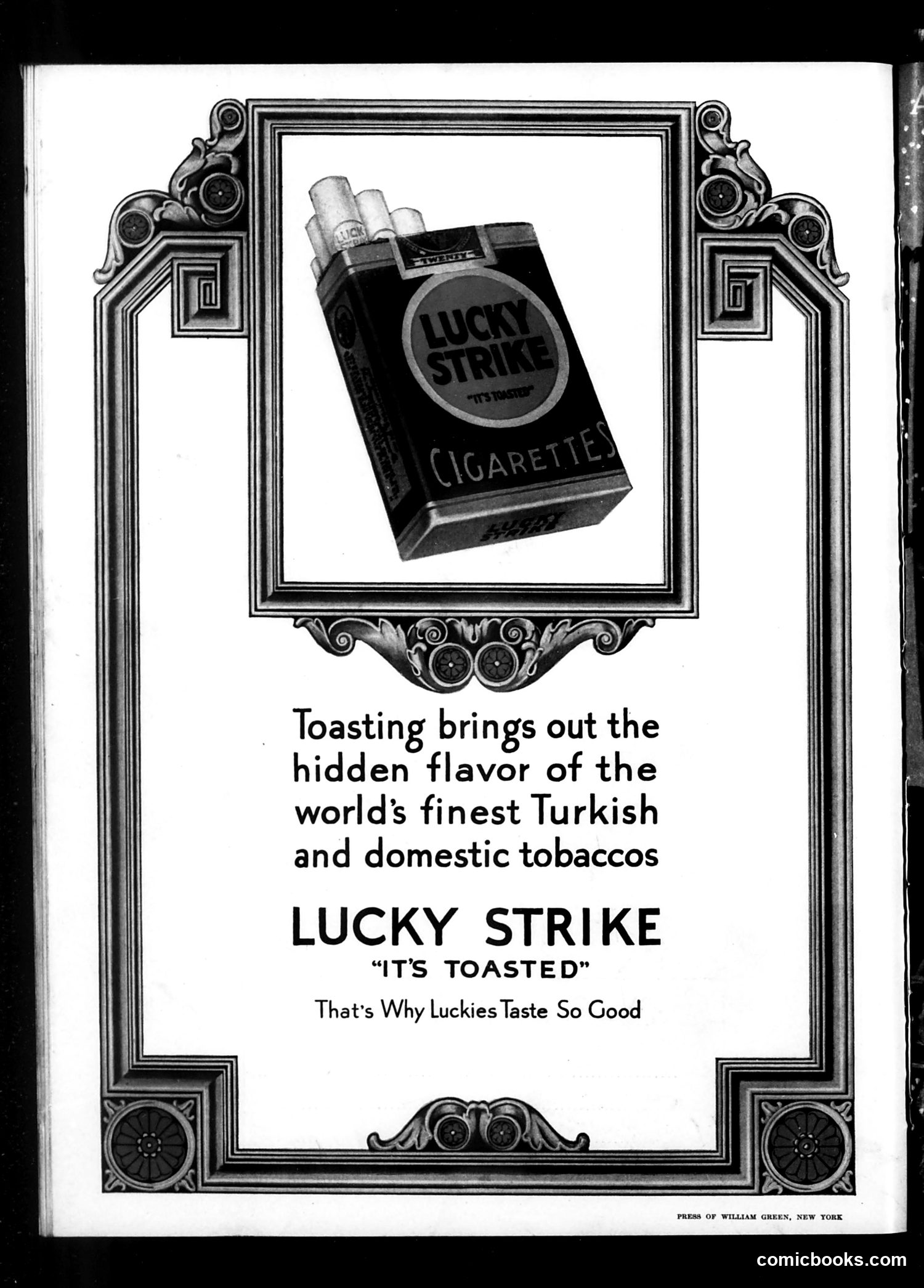
This is a **cigarette advertisement**, not political satire. It promotes Lucky Strike cigarettes, emphasizing their "toasted" tobacco process as a distinctive feature that enhances flavor. The ad uses an ornate, decorative Art Deco frame to present the product package with cigarettes visible at the top. The "toasting" claim was Lucky Strike's actual marketing strategy in the early-to-mid 20th century—the company advertised this manufacturing process as unique and superior. The phrase "That's Why Luckies Taste So Good" was their slogan. This represents typical **mid-century tobacco marketing** before health warnings were required. For modern readers, the striking aspect is how openly cigarettes were advertised in mainstream publications like *Judge* magazine, targeting general audiences without any health disclaimers.