
Judge, 1927-01-01 · page 8 of 36
Judge — January 1, 1927 — page 8: what you’re looking at
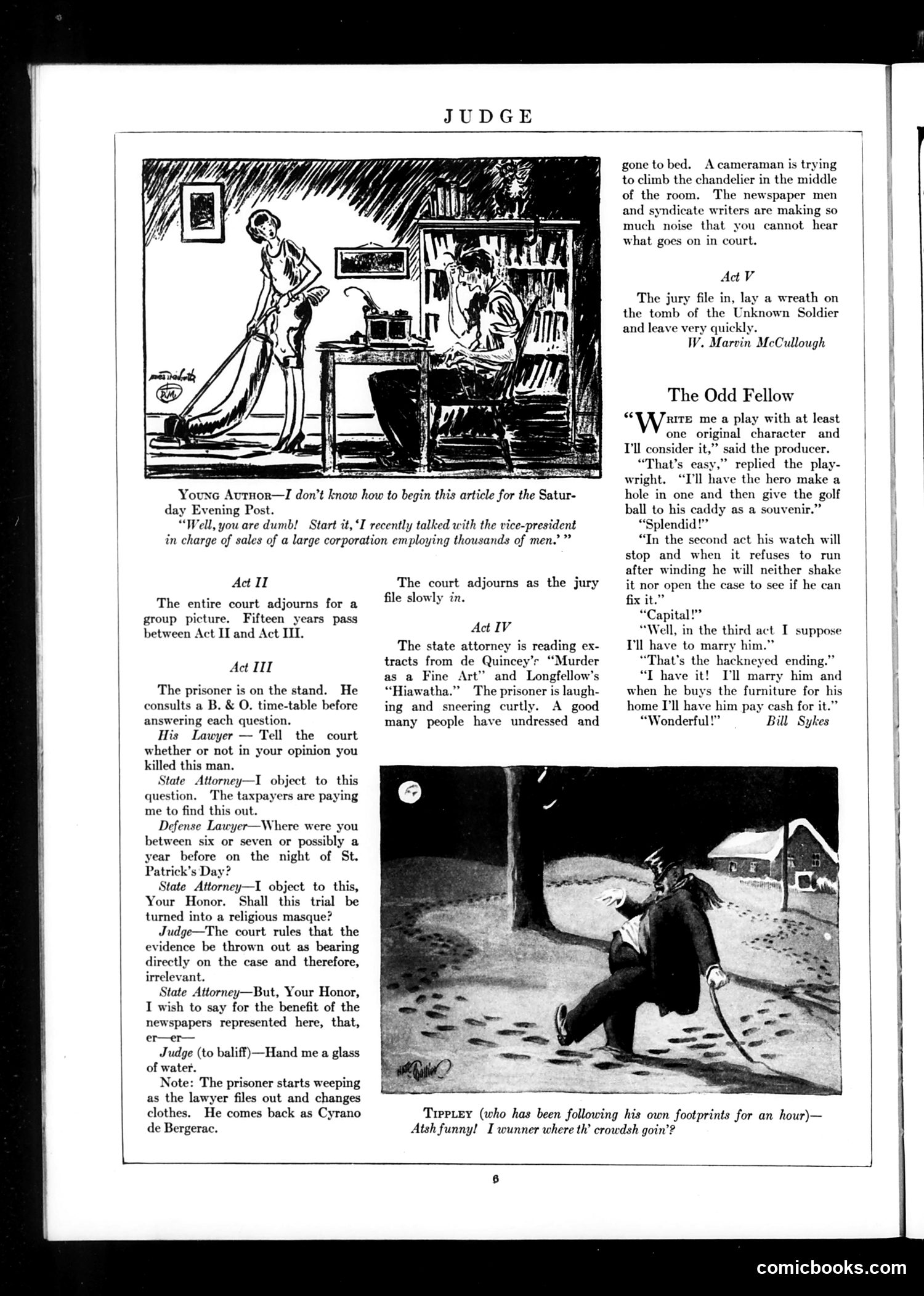
What you’re looking at
This page contains two distinct satirical pieces: **"Judge" (by W. Marvin McCullough):** A five-act courtroom farce mocking American legal incompetence. The satire depicts a trial so dysfunctional that evidence is ruled "irrelevant," lawyers obstruct rather than clarify, cameramen climb chandeliers, and the jury—after the verdict—inexplicably lay a wreath at the Unknown Soldier's tomb before leaving. The implicit critique: trials have become media spectacles and bureaucratic theater rather than justice-seeking proceedings. **"The Odd Fellow":** A producer-playwright exchange lampooning theatrical conventions. The playwright pitches supposedly "original" ideas (a golf hole-in-one gift, a stopped watch, marriage) that are actually tired clichés. The joke: what passes for originality in commercial theater is utterly hackneyed, revealing both theatrical mediocrity and producer gullibility. Both pieces target institutional absurdity—the legal and entertainment industries—through exaggeration and ironic understatement.
📄 Transcribed text from this page (OCR, searchable)
Machine-transcribed from the original scan — historical spelling and the odd misread are preserved.
JUDGE day Evening Post. Act II The entire court adjourns for a group picture. Fifteen years pass between Act II and Act IIT. Act IIT The prisoner is on the stand. He consults a B. & O. time-table before answering each question. His Lawyer — Tell the court whether or not in your opinion you killed this man. State Attorney—I object to this question. The taxpayers are paying me to find this out. Defense Lawyer—Where were you between six or seven or possibly a year before on the night of St. Patrick’s Day? State Attorney—I object to this, Your Honor. Shall this trial be turned into a religious masque? Judge—The court rules that the evidence be thrown out as bearing directly on the case and therefore, irrelevant. State Attorney—But, Your Honor, I wish to say for the benefit of the newspapers represented here, that, er—er— Judge (to baliff)—Hand me a glass of water. Note: The prisoner starts weeping as the lawyer files out and changes clothes. He comes back as Cyrano Youne Avtnor—I don’t know how to begin this article for the Satur- “Well, you are dumb! Start it, ‘I recently talked with the vice-president in charge of sales of a large corporation employing thousands of men. The court adjourns as the jury file slowly in. Act IV The state attorney is reading ex- tracts from de Quincey’s “Murder as a Fine Art” and Longfellow’s “Hiawatha.” The prisoner is laugh- ing and sneering curtly. A good many people have undressed and gone to bed. A cameraman is trying to climb the chandelier in the middle of the room. The newspaper men and syndicate writers are making so much noise that you cannot hear what goes on in court. Act V The jury file in, lay a wreath on the tomb of the Unknown Soldier and leave very quickly. W. Marvin McCullough The Odd Fellow se \ Kyure me a play with at least one original character and T'll consider it,” said the producer. “That’s easy,” replied the play- wright. “I'll have the hero make a hole in one and then give the golf ball to his caddy as a souvenir.” “Splendid!” “In the second act his watch will stop and when it refuses to run after winding he will neither shake it nor open the case to see if he can fix it.” “Capital!” “Well, in the third T'll have to marry him.” “That's the hackneyed ending.” “T have it! I'll marry him and when he buys the furniture for his home I'll have him pay cash for it.” “Wonderful!” Bill Sykes I suppose Tieptey (who has been following his own footprints for an hour)— Atsh funny! I wunner where th’ crowdsh goin’? de Bergerac. comicbooks.com