
Judge, 1927-01-01 · page 34 of 36
Judge — January 1, 1927 — page 34: what you’re looking at
What you’re looking at
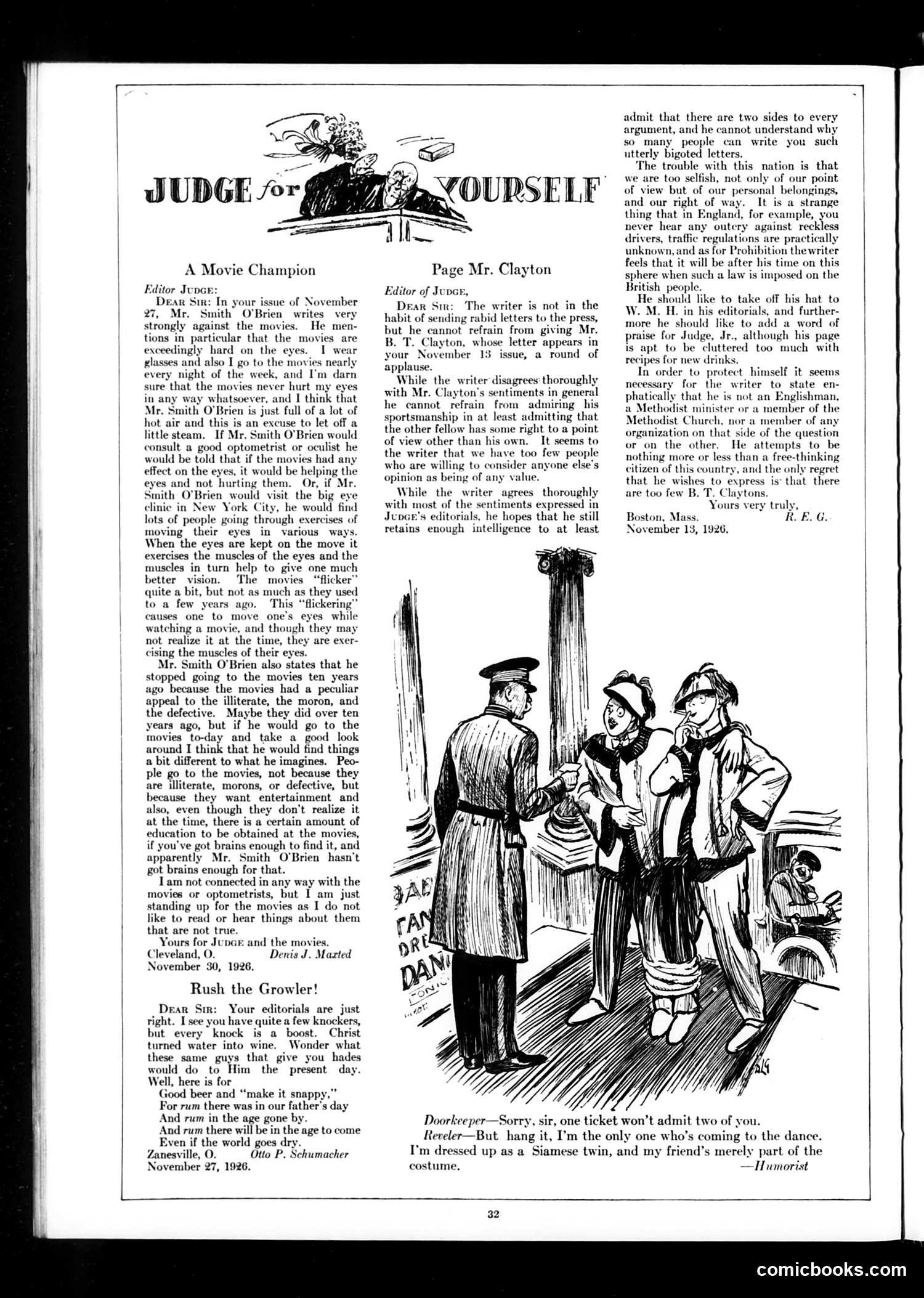
This page contains three reader letters debating social issues, plus one cartoon. **The cartoon** depicts a nightclub doorkeeper refusing entry to a reveler dressed as a "Siamese twin," explaining the costume violates the one-ticket-per-person policy. The joke relies on the absurd literalism of treating a costume as actual twins. **The letters debate**: 1. **Movies and eyesight**: A pro-movie reader defends cinema against claims it damages vision, arguing the flickering actually *exercises* eye muscles beneficially. 2. **Alcohol**: "Rush the Growler" advocates for beer and rum, comparing prohibition-era restrictions unfavorably to "father's day." (This references Prohibition, enacted 1920.) 3. **Civil discourse**: A reader praises someone named Mr. Clayton for acknowledging opposing viewpoints exist, lamenting that few people consider alternative opinions valid. The page exemplifies Judge's format: mixing reader responses on topical debates (movies, Prohibition, intellectual civility) with light satirical cartoons.
📄 Transcribed text from this page (OCR, searchable)
Machine-transcribed from the original scan — historical spelling and the odd misread are preserved.
A Movie Champion Editor Juv Dear Sir: In your issue of November 27, Mr. Smith O'Brien writes very strongly against the movies. He men- tions in particular that the movies are exceedingly hard on the eyes. I wear gla: and also I go to the movies nearly every night of the week, and I'm darn sure that the movies never hurt my eyes in any way whatsoever, and I think that Mr. Smith O'Brien is just full of a lot of hot air and this is an excuse to let off a little steam. If Mr. Smith O’Brien would consult a good optometrist or oculist he would be told that if the movies had any effect on the eyes, it would be helping the eyes and not hurting them. Or, if Mr. Smith O’Brien would visit the big eye ic in New York City, he would find lots of people going through exe: moving their eyes in various ways. When the eyes are kept on the move it exercises the muscles of the eyes and the muscles in turn help to give one much better vision. The movies “flicker quite a bit, but not as much as they used to a few years ago. This “flickering” causes one to move one’s eyes while watching a movie, and though they may t realize it at the time, they are exer- cising the muscles of their eyes. Mr. Smith O'Brien also states that he stopped going to the movies ten years ago because the movies had a peculiar appeal to the illiterate, the moron, and the defective. Maybe they did over ten years ago, but if he would go to the movies to-day and take a good look around I think that he would find things a bit different to what he imagines. Peo- ple go to the movies, not because they are illiterate, morons, or defective, but because they want entertainment’ and also, even though they don't realize it at the time, there is a certain amount of education to be obtained at the movies, if you've got brains enough to find it, and apparently Mr. Smith O'Brien hasn't got brains enough for that. 1am not connected in any way with the movies or optometrists, but I am just standing up for the movies as I do not like to read or hear things about them that are not true. Yours for Jupce and the movies. Cleveland, O. Denis J. Mazxted November 30, 1926. Rush the Growler! Dear Sir: Your editorials are just right. I see you have quite a few knockers, but every knock is a boost. Christ turned water into wine. Wonder what these same guys that give you hades would do to Him the present day. Well, here is for Good beer and ‘make it snappy,” For rum there was in our father’s day And rum in the age gone by. And rum there will be in the age to come Even if the world goes di Zanesville, O. Otto P. Schumacher November 27, 1926. Page Mr. Clayton Editor of Juvce, Dear Sir: The writer is not in the habit of sending rabid letters to the press, but he cannot refrain from giving Mr. B. T. Clayton, whose letter appears in your November 13 issue, a round of applause. While the writer disagrees thoroughly with Mr. Clayton’s sentiments in gen he cannot refrain from admiring his sportsmanship in at least admitting that the other fellow has some right to a point of view other than his own. It seems to the writer that we have too few people who are willing to consider anyone else's opinion as being of any value. While the writer agrees thoroughly with most of the sentiments expressed in Jvpce’s editorials, he hopes that he still retains enough intelligence to at least Doorkeeper—Sorry: Reveler—But hang ii costume, admit that there are two sides to evel argument, and he cannot understand wh so many’ people can write you such utterly bigoted letters. The trouble with this nation is that we are too selfish, not only of our point of view but of our personal belongings, and our right of way. It is a strange thing that in England, for example, you never hear any oute against reckle: drivers, traffic regulations are practic unknown, and as for Prohibition the writ feels that it will be after his time on this sphere when such a law is imposed on the British people. He should like to take off his hat to W. M. H. in his editorials, and further- more he should like to add a word of praise for Judge, Jr., although his page is apt to be cluttered too much with recipes for new drinks. In order to protect himself it seems necessary for the writer to state en- phatically that he is not an Englishman, a Methodist minister or a member of the Methodist Church, nor a member of any organization on that side of the question or on the other. He attempts to be nothing more or less than a free-thinking citizen of this country, and the only regret that he wishes to express is: that there are too few B. T. Claytons. Yours very truly, Boston, Mass. R. E.G. November 13, 1926, ir, one ticket won’t admit two of you. I'm the only one who’s coming to the dance. I'm dressed up as a Siamese twin, and my friend’s merely part of the —Humorist comicbooks.com