
Judge, 1927-01-01 · page 15 of 36
Judge — January 1, 1927 — page 15: what you’re looking at
What you’re looking at
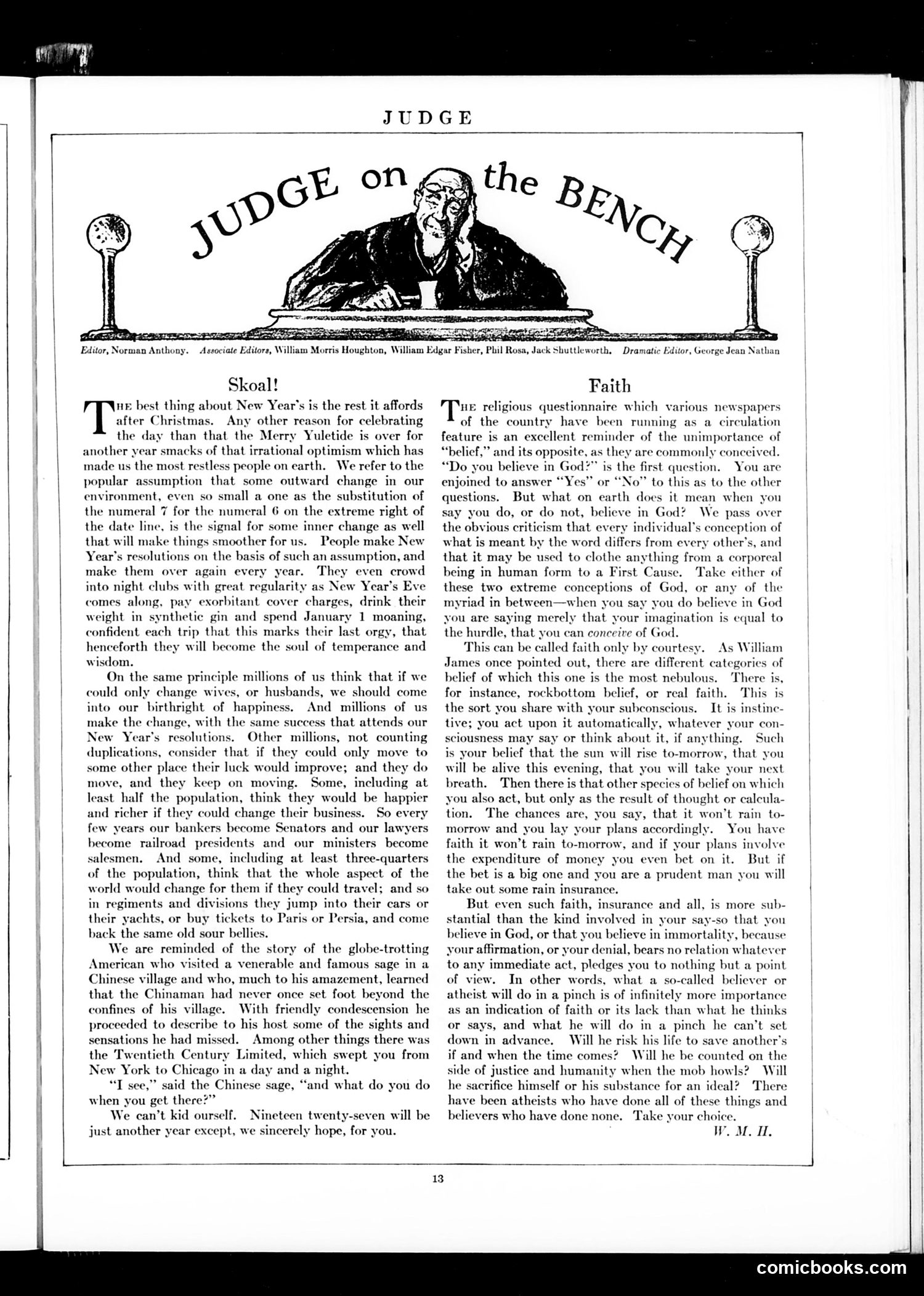
This page from *Judge* magazine features two satirical essays under the column "Judge on the Bench." **"Skoal!"** mocks Americans' New Year's optimism. The author argues that changing the calendar date won't improve lives—a jab at people who make resolutions they repeatedly break, change spouses hoping for happiness, relocate seeking better luck, or change careers expecting improvement. He illustrates this with an anecdote of a globe-trotting American bragging to a Chinese sage about traveling from New York to Chicago in a day, only to be asked: "and what do you do when you get there?" The point: external changes mean nothing without internal change. **"Faith"** critiques newspaper "religious questionnaires" (circulation-boosting surveys asking "Do you believe in God?"). The author argues yes/no answers are meaningless—people's conceptions of God vary wildly from literal deity to abstract First Cause. True faith, he suggests, involves action and ethical behavior, not simple yes-or-no affirmations. Both essays deflate American pretension and superficiality with dry wit.
📄 Transcribed text from this page (OCR, searchable)
Machine-transcribed from the original scan — historical spelling and the odd misread are preserved.
JUDGE Editor, Norman Anthony. Associate Editors, William Morris Houghton, William E Skoal! HE best thing about New Year's is the rest it affords I after Christmas. Any other reason for celebrating the day than that the Merry Yuletide is over for another year smacks of that irrational optimism which has made us the most restless people on earth. We refer to the popular assumption that some outward change in our environment, even so small a one as the substitution of the numeral 7 for the numeral 6 on the extreme right of the date line, is the signal for some inner change as well that will make things smoother for us. People make New Year’s resolutions on the basis of such an assumption, and make them over again every year. They even crowd into night clubs with great regularity as New Year's Eve comes along, pay exorbitant cover charges, drink their weight in synthetic gin and spend January 1 moaning, confident each trip that this marks their last orgy, that henceforth they will become the soul of temperance and wisdom. On the same principle millions of us think that if we could only change wives, or husbands, we should come into our birthright of happiness. And millions of us make the change, with the same success that attends our New Year's resolutions. Other millions, not counting duplications, consider that if they could only move to some other place their luck would improve; and they do move, and they keep on moving. Some, including at least half the population, think they would be happier and richer if they could change their business. So every few years our bankers become Senators and our lawyers become railroad presidents and our ministers become salesmen. And some, including at least three-quarters of the population, think that the whole aspect of the world would change for them if they could travel; and so in regiments and divisions they jump into their cars or their yachts, or buy tickets to Paris or Persia, and come back the same old sour bellie: We are reminded of the story of the globe-trotting American who visited a venerable and famous sage in a Chinese village and who, much to his amazement, learned that the Chinaman had never once set foot beyond the confines of his village. With friendly condescension he proceeded to describe to his host some of the sights and sensations he had missed. Among other things there was the Twentieth Century Limited, which swept you from New York to Chicago in a day and a night. “I see,” said the Chinese sage, ‘ when you get there?” We can’t kid ourself. Nineteen twenty-seven will be just another year except, we sincerely hope, for you. do you do igar Fisher, Phil Rosa, Jack Shuttleworth, Dramatic Editor, George Jean Nathan Faith HE religious questionnaire which various newspapers of the country have been running as a circulation feature is an excellent reminder of the unimportance of “belief,” and its opposite, as they are commonly conceived. “Do you believe in God?" is the first question. You are enjoined to answer “Yes” or “No” to this as to the other questions. But what on earth does it mean when you Si you do, or do not, believe in God? We pass over the obvious criticism that every individual's conception of what is meant by the word differs from every other's, and that it may be used to clothe anything from a corporeal being in human form to a First Cause. Take either of these two extreme conceptions of God, or any of the myriad in between—when you say you do believe in God you are saying merely that your imagination is equal to the hurdle, that you can conceive of God. This can be called faith only by courtesy. As William James once pointed out, there are different categories of belief of which this one is the most nebulous. There is, for instance, rockbottom belief, or real faith. This is the sort you share with your subconscious. It is instine- tive; you act upon it automatically, wl sciousness may si tever your con- or think about it, if anything. Such is your belief that the sun will rise to-morrow, that you will be alive this evening, that you will take your next breath. Then there is that other spec you also act, but only as the result of thought or calcula- tion. The chances are, you say, that it won't rain to- morrow and you lay your plans accordingly. You have faith it won’t rain to-morrow, es of belief on which nd if your plans involve the expenditure of money you even bet on it. But if the bet is a big one and you are a prudent man you will take out some rain insurance. But even such faith, insurance and all, is more sub- stantial than the kind involved in your say-so that you believe in God, or that you believe in immortality, because your affirmation, or your denial, bears no relation whatever to any immediate act, pledges you to nothing but a point of view. In other words, what a so-called believer or atheist will do in a pinch is of infinitely more importance as an indication of faith or its lack than what he thinks or says, and what he will do in a pinch he can’t set down in advance. Will he risk his life to save another's if and when the time comes? Will he be counted on the side of justice and humanity when the mob how Will he sacrifice himself or his substance for an id There have been atheists who have done all of these things and believers who have done none, Take your choice. W.M. HW. 13 comicbooks.com