
Judge, 1927-01-01 · page 30 of 36
Judge — January 1, 1927 — page 30: what you’re looking at
What you’re looking at
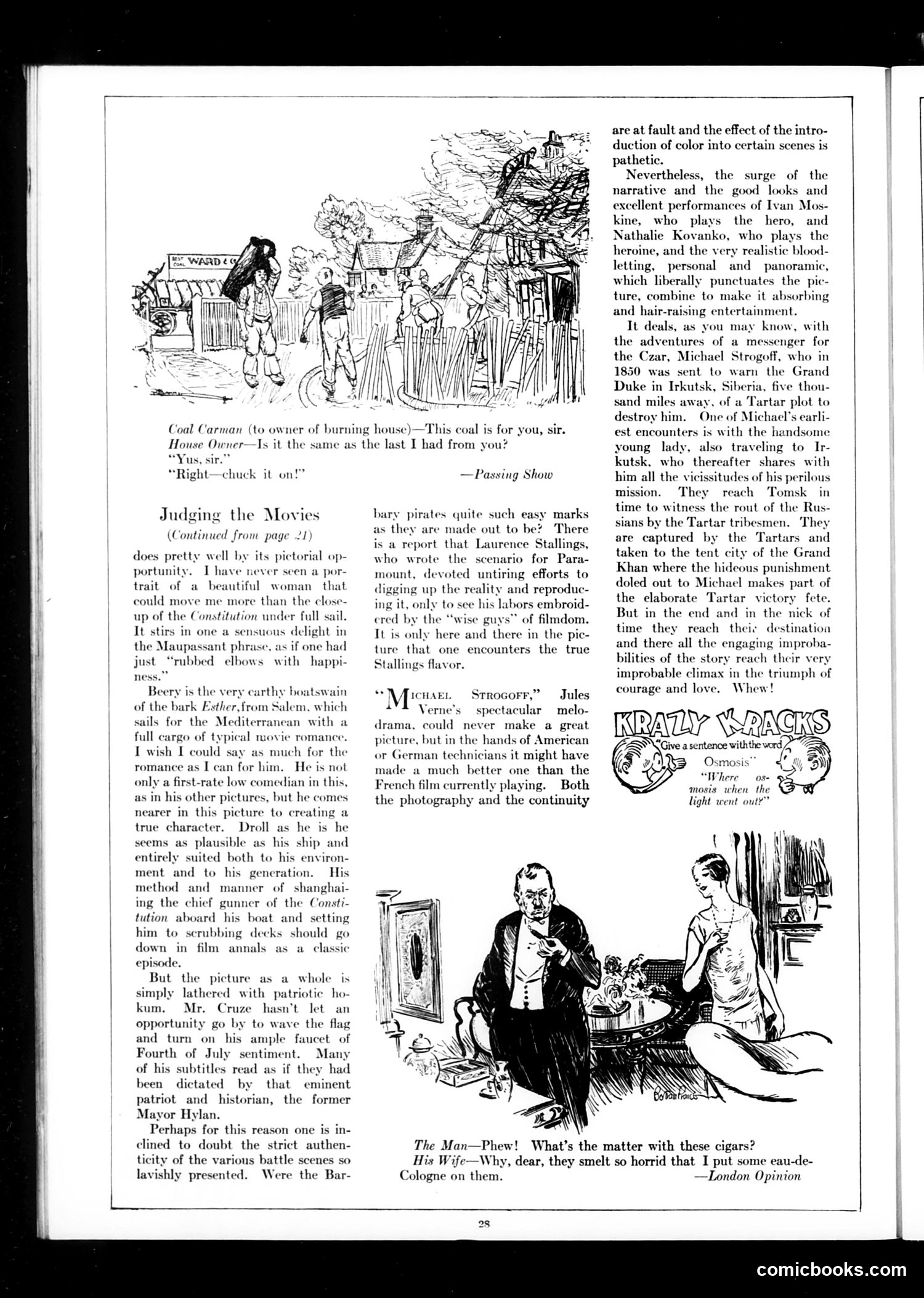
This page contains film criticism and two unrelated satirical cartoons. The main content reviews recent movies, discussing films like "The Constitution" (featuring actor Wallace Beery) and "Michael Strogoff" (based on Jules Verne's novel). The critic praises Beery's acting but criticizes the film's excessive patriotic sentiment, suggesting director James Cruze prioritized Fourth of July spectacle over historical accuracy regarding Barbary pirates. The two cartoons at bottom are simple domestic humor unrelated to politics: 1. **Coal delivery joke**: A coal merchant delivers coal to a burning house, and the owner absurdly asks him to throw it on the fire anyway. 2. **Perfume gag**: A husband notices his cigars smell horrible; his wife explains she sprayed them with eau-de-Cologne to mask the odor—defeating the purpose entirely. Both cartoons mock everyday absurdity rather than political issues.
📄 Transcribed text from this page (OCR, searchable)
Machine-transcribed from the original scan — historical spelling and the odd misread are preserved.
Coal Carman (to owner of burning house)—This coal is for you, sir. House Owner- “Yus, sir.” “Right—chuck it on!” Judging the Movies (Continued from page 21) does pretty well by its pictorial op- portunity. I have never seen a por- trait of a beautiful woman that could move me more than the close- up of the Constitution under full sail. It stirs in one a sensuous delight in the Maupassant phrase, just “rubbed ness.” Beery is th of the bark sails for the as if one had elbows with happi- very earthy boatswain her,from Salem, which Mediterranean with a full cargo of typical movie romance. I wish I could say as much for the romance as I can for him. He is not only a first-rate low comedian in this, as in his other pictures, but he comes nearer in this picture to creating a true character. Droll as he is he plausible as his ship and entirely suited both to his environ- ment and to his generation. His method and manner of shanghai- ing the chief gunner of the Consti- tution ¢ seems ard his boat and_ setting him to scrubbing decks should go down in film annals as a classic episode. But the picture as a whole is simply lathered with patriotic ho- kum. Mr. Cruze hasn’t let an opportunity go by to wave the flag and turn on his ample faucet of Fourth of July sentiment. Many of his subtitles read as if they had been dictated by that eminent patriot and historian, the former Mayor Hy! Perhaps for this reason one is in- clined to doubt the strict authen- ticity of the various battle scenes so lavishly presented. Were the Bar- Is it the same as the last I had from you? —Passing Show bary pirates quite such easy marks as they are made out to be? There is a report that Laurence Stallings, who wrote the scenario for Para- mount, devoted untiring efforts to digging up the reality and reproduc- ing it, only to see his labors embroid- ered by the “ of filmdom. It is only here and there in the pic- ture that one encounters the true Stallings flavor. “Maes, Verne’s wise guys” Srrocorr,” Jules spectacular melo- drama, could never make a great picture, but in the hands of American or German technicians it might have made a much better one than the French film currently playing. Both the photography and the continuity The Man—Phew! His Wife—Why, dear, they smelt so horrid that I put some eau-de- Cologne on them. are at fault and the effect of the intro- duction of color into certain scenes is pathetic. Nevertheless, the surge of the narrative and the good looks and excellent performances of Ivan Mos- kine, who plays the hero, and Nathalie Kovanko, who plays the heroine, and the very realistic blood- letting, personal and panorami which liberally punctuates the pic- ture, combine to make it absorbing and hair-raising entertainment. It deals, as you may know, with the adventures of a messenger for the Czar, Michael Strogoff, who in 1850 was sent to warn the Grand Duke in Irkutsk, Siberia, sand miles awé destroy him. five thou- . of a Tartar plot to One of Michael's earli- est encounters is with the handsome also traveling to Ir- . Who thereafter shares with him all the vicissitudes of his perilous mission. They reach Tomsk in time to witness the rout of the Rus- sians by the Tartar tribesmen. They are captured by the Tartars and taken to the tent city of the Grand Khan where the hideous punishment doled out to Michael makes part of the elaborate Tartar victory fete. But in the end and in the nick of time they reach theic and there all the engaging improba- bilities of the story reach their very improbable climax in the triumph of courage and love. Whew! destinatioa Osmosis” “Where ose mosis when the light went out?” What’s the matter with these cigars? —London Opinion comicbooks.com