
Judge, 1927-01-01 · page 21 of 36
Judge — January 1, 1927 — page 21: what you’re looking at
What you’re looking at
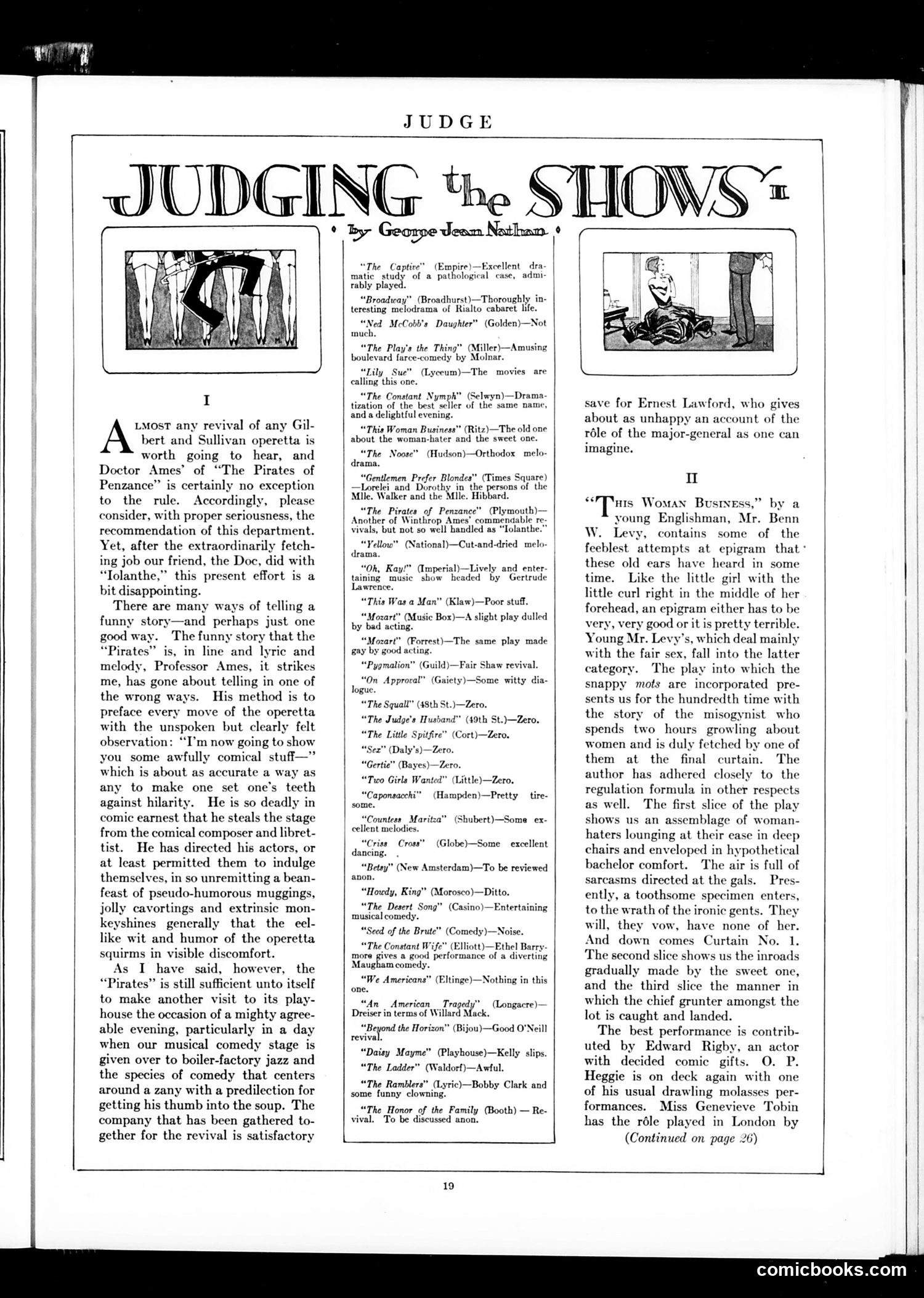
This is a theater review column by George Jean Nathan, a prominent drama critic of the 1920s. Rather than a political cartoon, it's editorial content evaluating Broadway productions. Nathan critiques a revival of *The Pirates of Penzance* directed by Winthrop Ames, praising the operetta itself but faulting Ames's overly earnest, mugging direction that undermines the Gilbert & Sullivan wit. He contrasts this with Ames's superior handling of *Iolanthe*. The second section reviews *This Woman Business*, a conventional romantic comedy about a "woman-hater and the sweet one"—a tired trope even then. The middle column lists brief assessments of current Broadway shows, using "Zero" ratings for inferior works. Nathan's verdict: while musical comedy stages were increasingly dominated by lowbrow "boiler-factory jazz" comedies, the *Pirates* revival remains worthwhile entertainment. This represents early 20th-century theater criticism addressing artistic standards in popular entertainment.
📄 Transcribed text from this page (OCR, searchable)
Machine-transcribed from the original scan — historical spelling and the odd misread are preserved.
JUDGE JUDGING be SHOWS*= Lost any revival of any Gi A bert and Sullivan operetta worth going to hear, and Doctor Ames’ of “The Pirates of Penzance” is certainly no exception to the rule. Accordingly, please consider, with proper seriousness, the recommendation of this department. Yet, after the extraordinarily fetch- ing job our friend, the Doc, did with “Tolanthe,” this present effort is a bit disappointing. There are many ways of telling a funny story—and perhaps just one good way. The funny story that the “Pirates” is, in line and lyric and melody, Professor Ames, it strikes me, has gone about telling in one of the wrong ways. His method is to preface every move of the operetta with the unspoken but clearly felt observation: “I’m now going to show you some awfully comical stuff— which is about as accurate a wa any to make one set one’s teeth against hilarity. He is so deadly in comic earnest that he steals the stage from the comical composer and libret- tist. He has directed his actors, or at least permitted them to indulge themselves, in so unremitting a bean- feast of pseudo-humorous muggings, jolly cavortings and extrinsic mon- keyshines generally that the eel- like wit and humor of the operetta squirms in visible discomfort. As I have said, however, the “Pirates” is still sufficient unto itself to make another visit to its play- house the occasion of a mighty agree- able evening, particularly in a day when our musical comedy stage is given over to boiler-factory jazz and the species of comedy that centers around a zany with a predilection for getting his thumb into the soup. The company that has been gathered to- gether for the revival is satisfactory ¢ by Geonpe Jeam Nathan. ¢ “The Captive” (Empire)—Excellent dra matic study of a pathological case, admi- rably played. “Broadway” (Broadhurst)—Thoroughly in- teresting melodrama of Rialto cabaret life. “Ned McCobb’s Daughter” (Golden)—Not much, “The Play's the Thing” (Miller)—Amusing boulevard farce-comedy by Molnar. “Lily Sue” (Lyceum)—The movies are calling this one. “The Constant Nymph” (Selwyn)—Drama- tization of the best seller of the same name, and a delightful evening. “This Woman Business” (Ritz)—The old one about the woman-hater and the sweet one. “The Noose (Hudson)—Orthodox melo- drama. “Gentlemen Prefer Blondea” (Times Square) d Dorothy in the persons of the lie’ Wanker and the Mite, Hibberd. “The Pirates of Penzance” (Plymouth)— Another of Winthrop Ames’ commendable re- vivals, but not so well handled as “Iolanthe. “Yellow” (National)—Cut-and-dried-melo- drama. “Oh, Kay!" (Imperial taining music show headed Lawrence. “This Was a Man” (Klaw)—Poor stuff. “Mozart” (Music Box)—A slight play dulled by bad acting. “Mozart” (Forrest)—The same play made gay by good acting. ively and enter- by Gertrude “Pygmalion” (Guild)—Fair Shaw revival. “On Approval” (Gaie logue. “The Squall” (48th St.)—Zero. “The Judge's Husband” (49th St.)—Zero. “The Little Spitfire” (Cort)—Zero. “Sex” (Daly's) —Zero. “Gertie” (Bayes): “Two Girls Wanted” (Little)—Zero. “Caponsacchi” some. —Some witty dia- Leto. (Hampden)—Pretty _ tire- “Countess Maritza” (Shubert)—Some ex- cellent melodies. “Criss Cross” (Globe)—Some excellent dancing. “Betsy” (New Amsterdam)—To be reviewed anon. “Howdy, King” (Morosco)—Ditto. “The Desert Song” (Casino)—Entertai musical comedy. “Seed of the Brute” (Comedy “The Constant Wife” (Elliott)—Ethel Barry- more gives a good performance of a diverting Maugham comedy. “We Americans” (Eltinge)—Nothing in this one. “An American Tragedy” Dreiser in terms of Willard Mack. Bl pa the Horizon” (Bijou)—Good O'Neill revival. (Longacre)— “Daisy Mayme” (Playhouse)—Kelly slips. “The Ladder” (Waldorf)—Awful. “The Ramblers” (Lyric)—Bobby Clark and some funny clowning. “The Honor of the Family (Booth) — Re- vival. To be discussed anon. Meee save for Ernest Lawford, who gives about as unhappy an account of the role of the major-general as one can imagine. I HIs Woman Bustness,” by a young Englishman, Mr. Benn W. Levy, contains some of the feeblest attempts at epigram that* these old ears have heard in some time. Like the little girl with the little curl right in the middle of her forehead, an epigram either has to be very, very good or it is pretty terrible. Young Mr. Levy’s, which deal mainly with the fair sex, fall into the latter category. The play into which the snappy mots are incorporated pre- sents us for the hundredth time with the story of the misogynist who spends two hours growling about women and is duly fetched by one of them at the final curtain. The author has adhered closely to the regulation formula in other respects as well. The first slice of the play shows us an assemblage of woman- haters lounging at their ease in deep chairs and enveloped in hypothetical bachelor comfort. The air is full of sarcasms directed at the gals. Pres- ently, a toothsome specimen enters, to the wrath of the ironic gents. They will, they vow, have none of her. And down comes Curtain No. 1. The second slice shows us the inroads gradually made by the sweet one, and the third slice the manner in which the chief grunter amongst the lot is caught and landed. The best performance is contrib- uted by Edward Rigby, an actor with decided comic gifts. O. P. Heggie is on deck again with one of his usual drawling molasses per- formances. Miss Genevieve Tobin has the réle played in London by (Continued on page 26) 19 comicbooks.com