
Judge, 1927-01-01 · page 28 of 36
Judge — January 1, 1927 — page 28: what you’re looking at
What you’re looking at
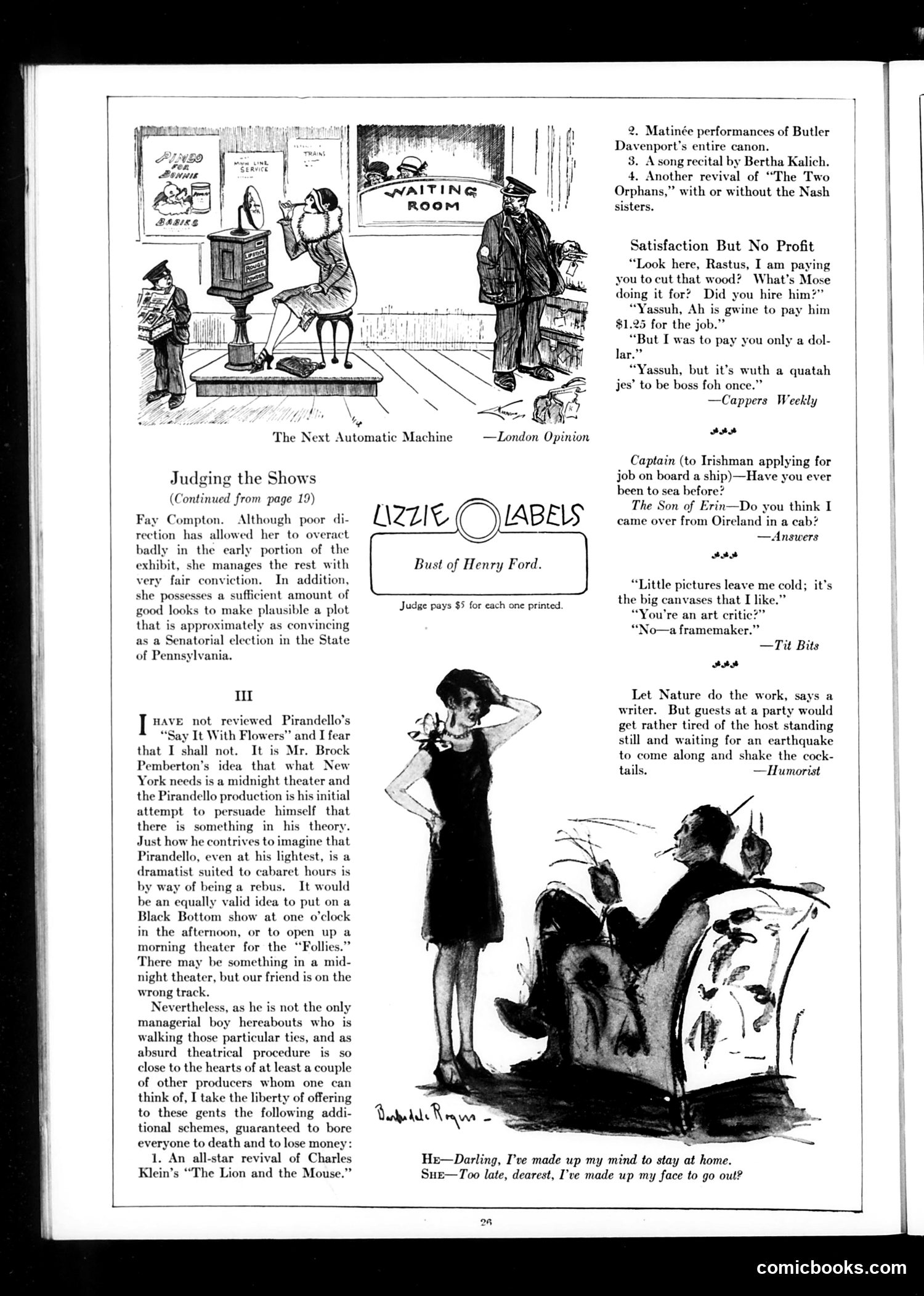
This page contains several satirical cartoons and jokes typical of early 20th-century American humor: **"The Next Automatic Machine"** depicts a woman at a vending machine—likely satirizing the era's fascination with automated conveniences and their potential to replace human labor. **"Satisfaction But No Profit"** uses racist dialect humor (common then, offensive now) to joke about wage disputes between Black workers, with "Rastus" complaining that paying a coworker more undermines his own compensation. **Theater criticism section** discusses various Broadway productions and unconventional scheduling ideas, mocking impractical theatrical trends. **"Lizzie Labels"** advertises Henry Ford busts priced at $5—capitalizing on Ford's celebrity status during the automotive boom. The remaining jokes are light observational humor: art criticism, party etiquette, and marital banter. The page reflects 1920s entertainment culture, racial attitudes of the era, and early consumer product marketing, all presented through Judge's satirical lens.
📄 Transcribed text from this page (OCR, searchable)
Machine-transcribed from the original scan — historical spelling and the odd misread are preserved.
2, Matinée performances of Butler Davenport's entire canon. 3. A song recital by Bertha Kalich. 4, Another revival of “The Two Orphans,” with or without the Nash sisters. } RoomM Satisfaction But No Profit “Look here, Rastus, I am paying you tocut that wood? What’s Mose doing it for? Did you hire him?” “Yassuh, Ah is gwine to pay him 5 for the jot $ “But I was to pay you only a dol- The Next Automatic Machine Judging the Shows (Continued from page 19) ‘ay Compton. Although poor di- rection has allowed her to overact badly in the early portion of the ibit, she manages the rest with y fair conviction. In addition, she possesses a sufficient amount of good looks to make plausible a plot that is approximately as convincing as a Senatorial election in the State of Pennsylvania. It not reviewed Pirandello’s It With Flowers” and I fear that I shall not. It is Mr. Brock Pemberton’s idea that what New York needs is a midnight theater and the Pirandello production is his initial attempt to persuade himself that there is something in his theory. Just how he contrives to imagine that Pirandello, even at his lightest, is a dramatist suited to cabaret hours is by way of being a rebus. It would be an equally valid idea to put on a Black Bottom show at one o'clock in the afternoon, or to open up a morning theater for the “Follies.” There may be something in a mid- night theater, but our friend is on the wrong track. Nevertheless, as he is not the only managerial boy hereabouts who is walking those particular ties, and as absurd theatrical procedure is so close to the hearts of at least a couple of other producers whom one can think of, I take the liberty of offering to these gents the following addi- tional schemes, guaranteed to bore everyone to death and to lose money: 1. An all-star revival of Charles Klein’s “The Lion and the Mouse.” lar.” “Yassuh, but it’s wuth a quatah jes’ to be boss foh once.” —Cappers Weekly —London Opinion ea Captain (to Irishman applying for job on board a ship)—Have you ever been to sea before? The Son of Erin—Do you think I came over from Oireland in a cab? —Answers LZ2Ie 1@) IABELS Bust of Henry Ford. sat “Little pictures leave me cold; it’s the big canvases that I like.” “You're an art crit “No—a framemaker. Judge pays $5 for each one printed —Tit Bits Pas Let Nature do the work, says a writer. But guests at a party would — | Yy get rather tired of the host standing still and waiting for an earthquake to come along and shake the cock- tails. —Humorist He—Darling, I’ve made up my mind to stay at home. Sue—Too late, dearest, I've made up my face to go out? comicbooks.com