
A complete issue · 37 pages · 1924
Judge — August 2, 1924
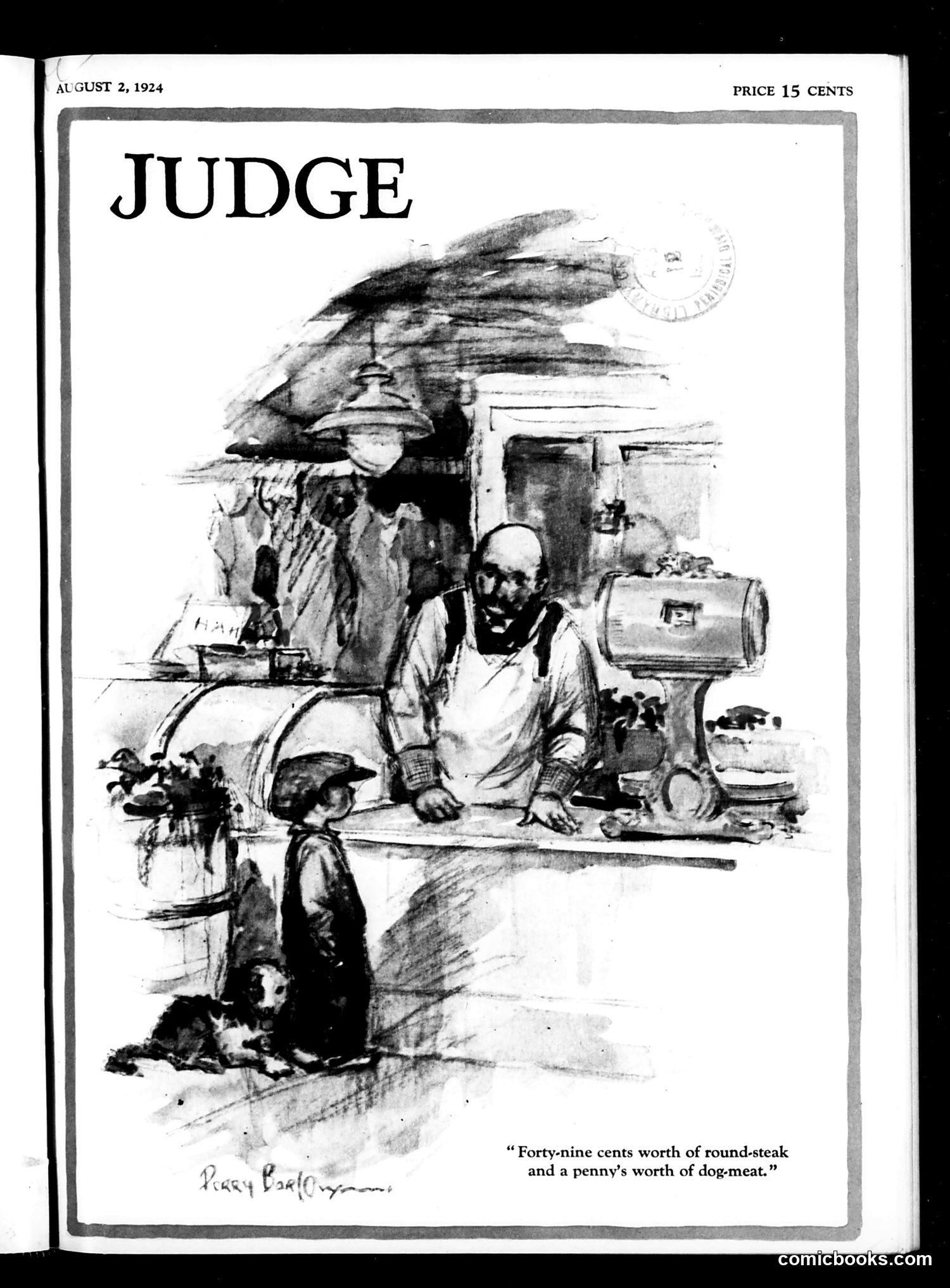
This cover illustration satirizes food prices and economic hardship in 1920s America. The scene depicts a butcher shop where a man in an apron serves customers from a sparse counter. The caption reads: "Forty-nine cents worth of round-steak and a penny's worth of dog-meat." The satire targets the high cost of living during this period—customers could afford only minimal quantities of meat, and the joke darkly suggests they're purchasing dog meat mixed with legitimate cuts due to poverty or unscrupulous merchant practices. The butcher's meager display of goods emphasizes scarcity and inflation concerns. This reflects post-WWI economic anxieties that plagued Americans in the early 1920s before the decade's prosperity took hold.
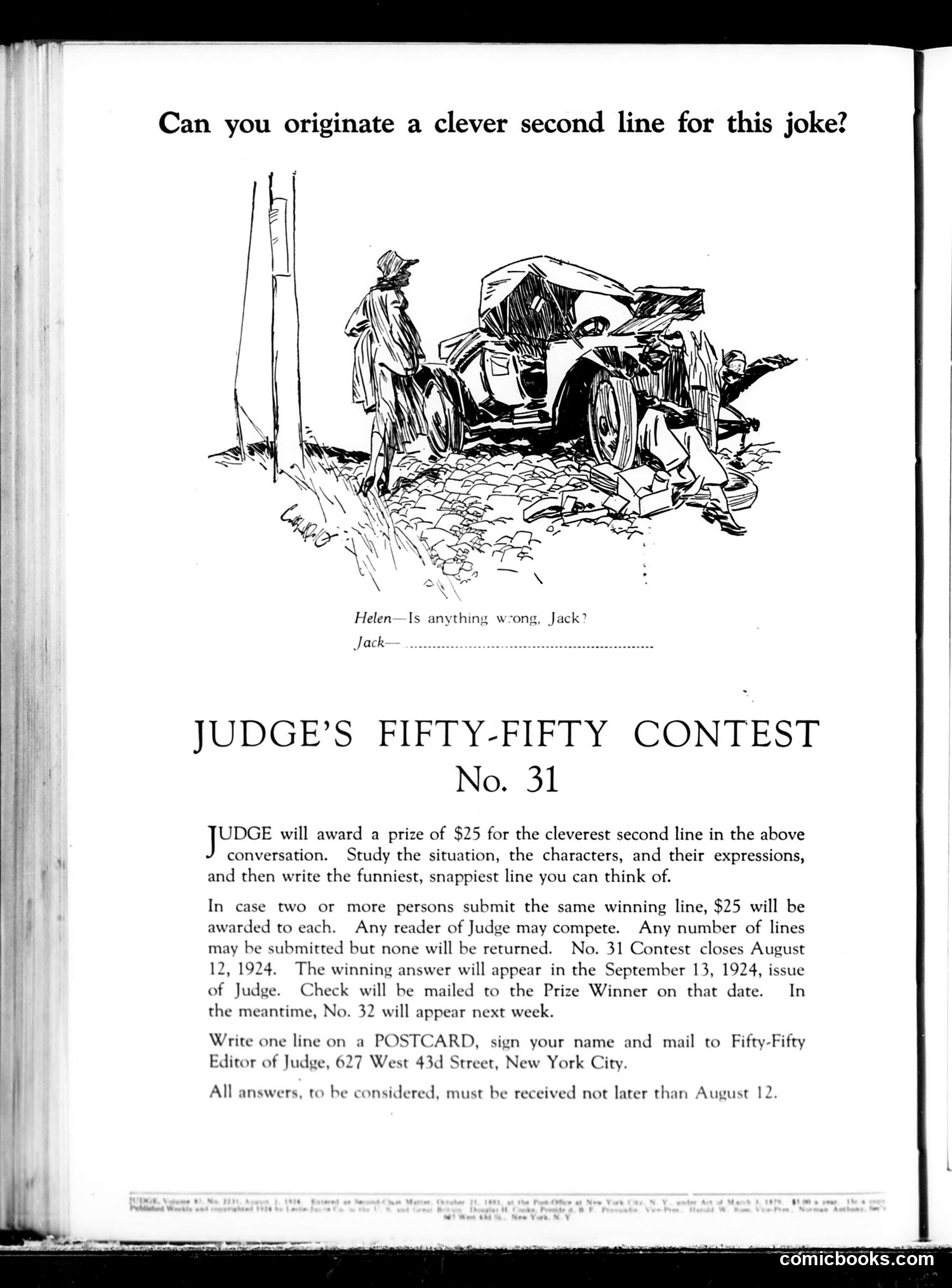
This page features a humor contest rather than political satire. The cartoon shows a car accident scene with two figures: Helen (a woman) asking Jack (a man) "Is anything wrong, Jack?" as their vehicle has crashed into a tree. Jack's response line is blank—readers are invited to submit the funniest possible reply. The joke setup plays on the absurdity of Helen's understated question given the obvious disaster. The contest offered a $25 prize for the cleverest second line, with submissions due by August 12, 1924. This reflects early 20th-century humor conventions: automobile accidents were popular comedic subjects as cars were still relatively novel, and the gender dynamics (a woman's oblivious question contrasted with male exasperation) were considered humorous by contemporary standards.
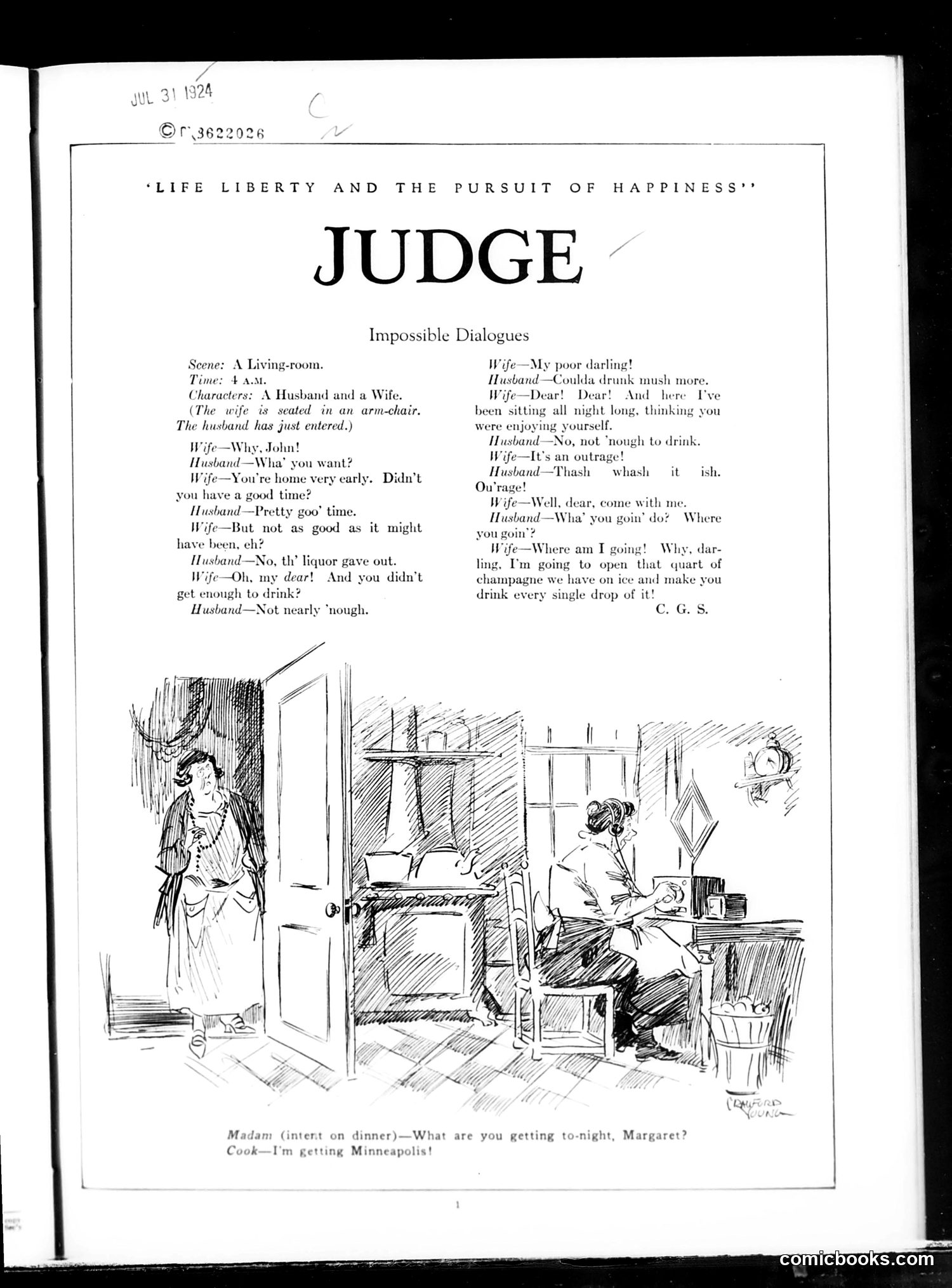
This page contains two separate satirical pieces about marital discord and alcohol consumption during Prohibition. **"Judge" (top)**: A husband-and-wife dialogue mocking the enforcement of Prohibition (1920-1933). The wife complains about her husband's drinking and late nights; he defensively claims the liquor "gave out." The satire targets widespread hypocrisy—despite the legal ban on alcohol, affluent households maintained private supplies. The couple's argument reflects genuine social tensions as Prohibition proved unenforceable among the wealthy. **Bottom cartoon**: A cook tells a madam she's preparing "Minneapolis" for dinner—likely a regional dish joke playing on the city's name as a culinary reference. Both pieces exemplify Judge's humor targeting upper-class life and Prohibition's failures.
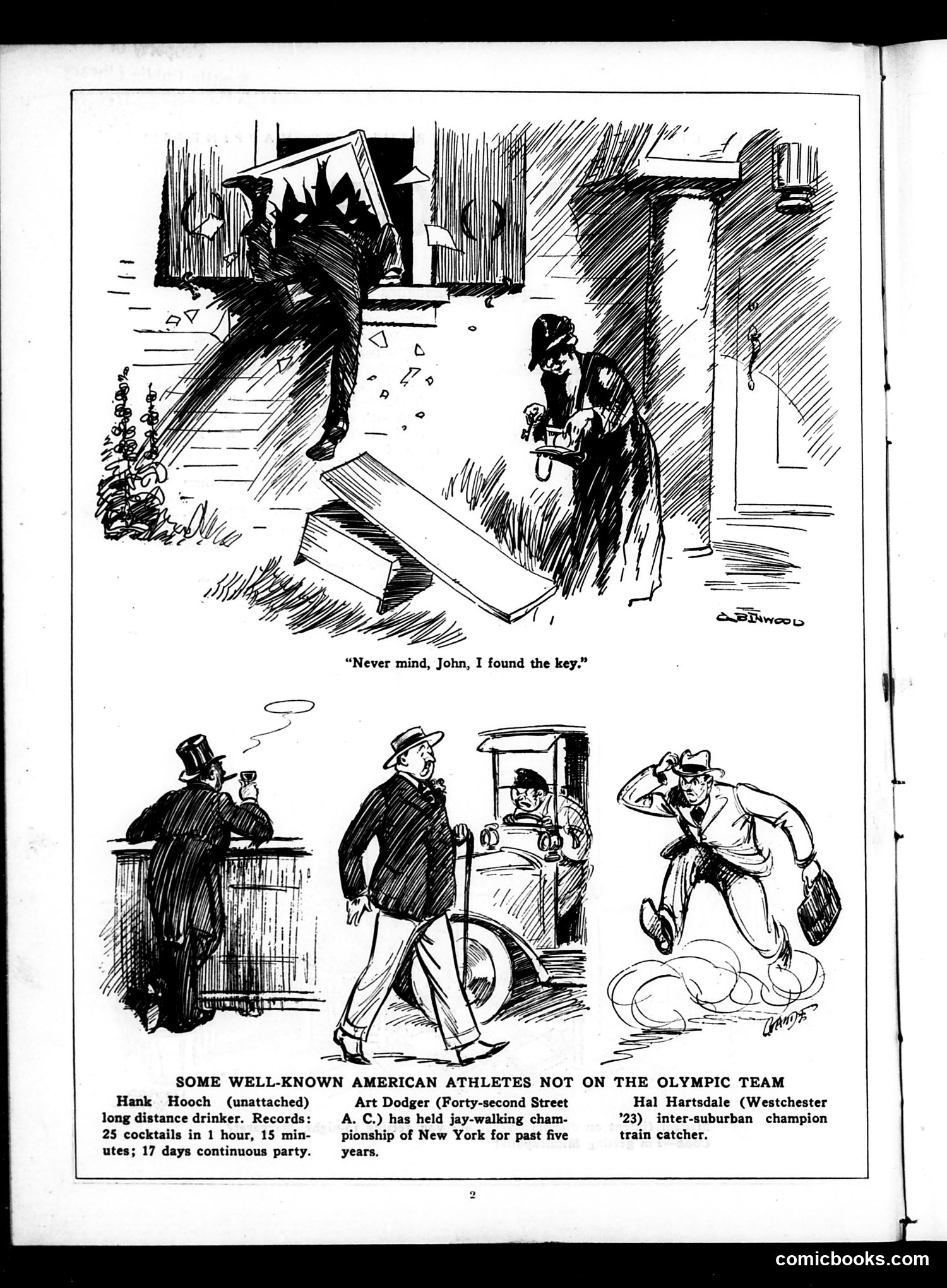
This page from *Judge* contains two distinct sections: a humorous domestic scene and sports satire. **Top cartoon:** A woman discovers a key while her husband is being thrown out, saying "Never mind, John, I found the key." The joke plays on marital discord—likely about being locked out or financial troubles ("the key" to solving problems). **Bottom section:** Labeled "Some Well-Known American Athletes Not on the Olympic Team," it mocks three fictional "athletes": Hank Hooch (a continuous drinker), Art Dodger (a jaywalker), and Hal Hartsdale (a train catcher). Each caricature exaggerates humorous "skills" unrelated to legitimate sports. This satirizes either Olympic selection standards or American celebrity culture by pretending these absurd figures are serious athletes worthy of mention.
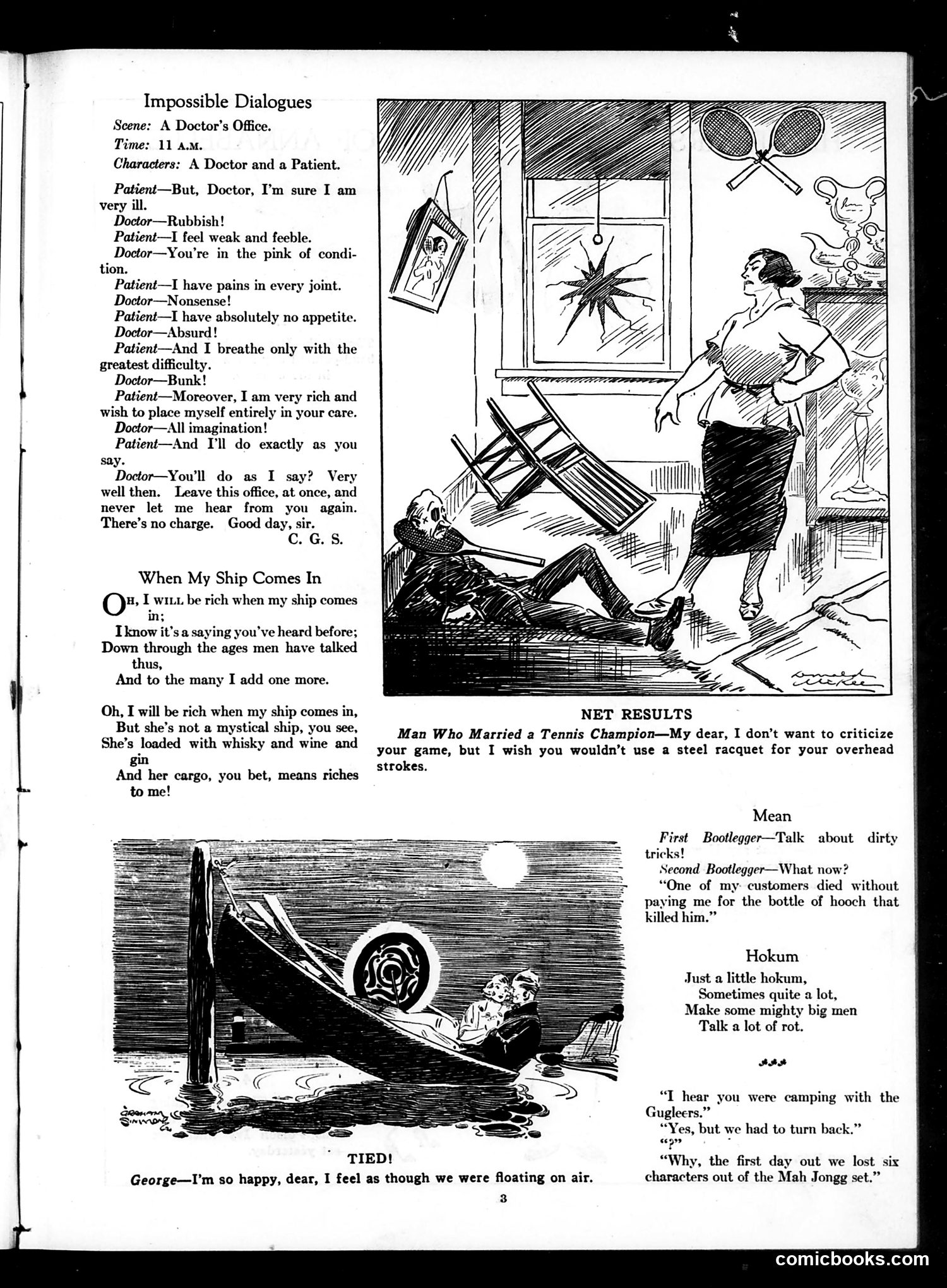
This page contains three satirical pieces: **"Impossible Dialogues"** (top): A doctor dismisses a hypochondriac patient's multiple complaints as "imagination," then paradoxically tells him to leave and never return—exposing the absurdity of physicians who simultaneously deny patients' symptoms while refusing treatment. **"When My Ship Comes In"** (middle): A whimsical poem about anticipated wealth from a ship's cargo, humorously contrasting the speaker's hopeful fantasies with practical reality—a common period expression about deferred prosperity. **"Net Results"** (right): Brief comic vignettes including a joke about a man married to a tennis champion and dialogue about camping mishaps. These are lightweight humor pieces typical of Judge's satirical magazine format. The cartoons use exaggeration and irony to mock pretension and human nature.
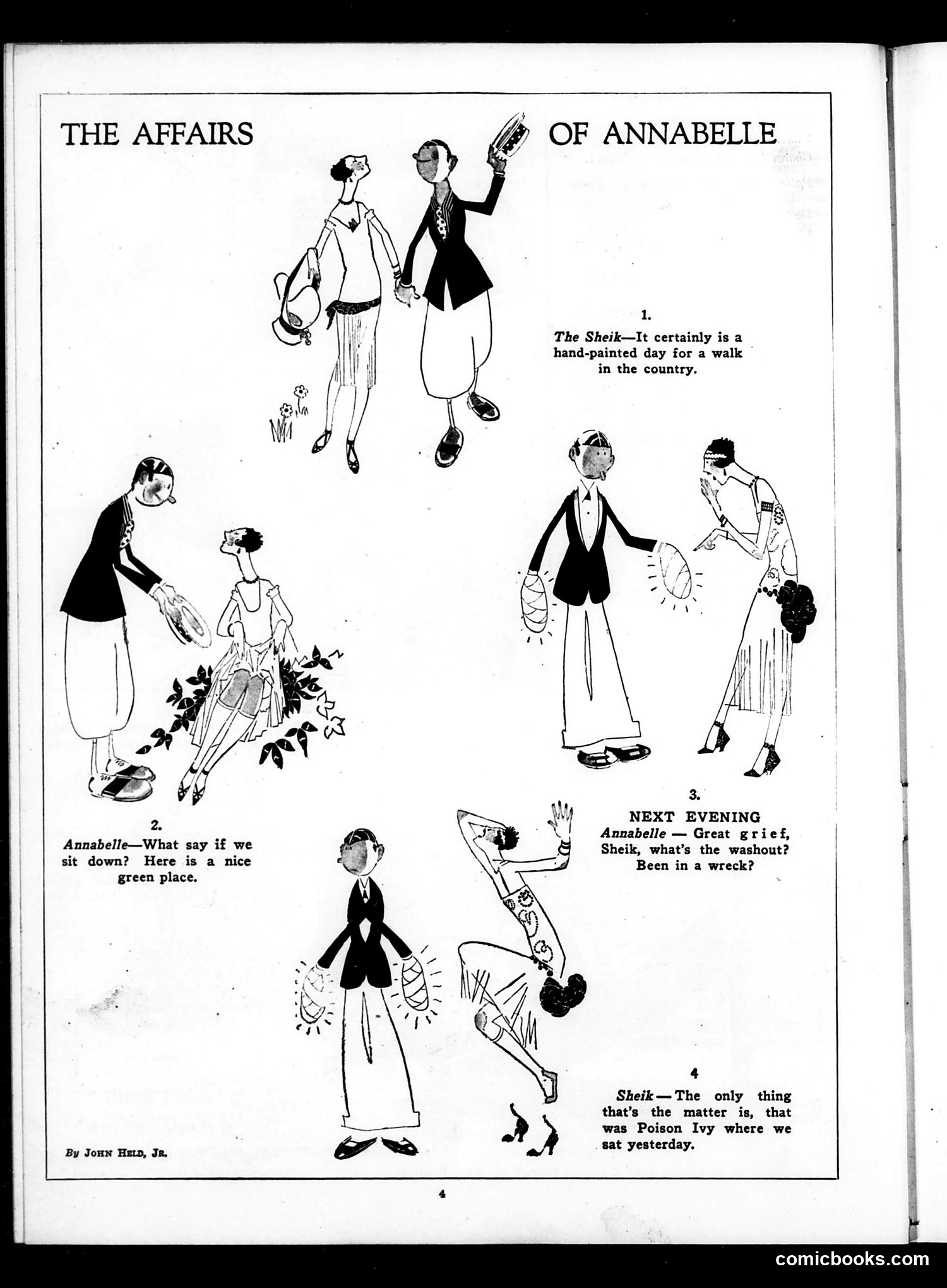
This is a humorous comic strip about a young woman named Annabelle and her romantic interest, "the Sheik." The narrative follows their dating activities: a country walk, a proposal to sit in a "nice green place," an evening encounter where the Sheik appears disheveled (asking about "the washout"), and a final explanation blaming food poisoning from eating poison ivy. The "Sheik" reference likely alludes to the popular 1921 film and the romanticized "Latin lover" archetype popular in 1920s culture. Held's cartoons typically satirized flapper-era dating customs and romantic melodrama. The humor derives from the gap between romantic expectation and comedic reality—the dramatic evening ending with a mundane explanation.
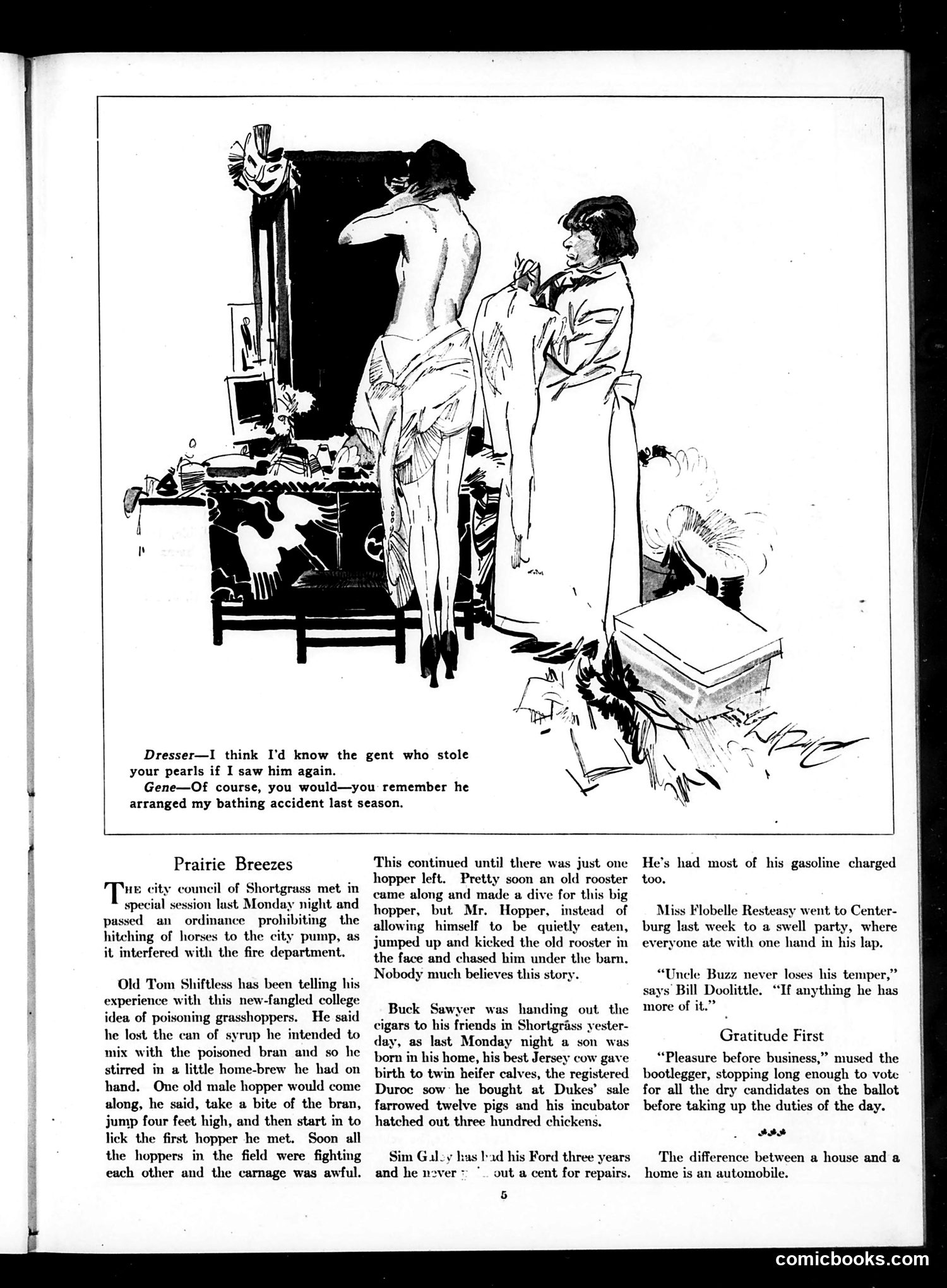
The top cartoon depicts a dressing room scene where a woman accuses another of knowing a man who "stole your pearls" and "arranged my bathing accident last season." This is satirical social commentary on wealthy women's gossip circles and the tendency to blame others for misfortunes while moving in circles where such "accidents" seem oddly common—likely poking fun at upper-class women's drama and moral flexibility. The "Prairie Breezes" section contains rural humor sketches mocking small-town life: a city council prohibiting horses at pumps, an old man's tall tale about drunk grasshoppers fighting each other, and a farmer's implausible claim that his Ford needs no repairs despite being charged gasoline on credit. The final jokes mock Prohibition-era hypocrisy (a bootlegger voting dry) and the newfound automobile obsession replacing traditional home life. The humor targets rural simplicity, tall tales, and urban-rural cultural differences typical of early 20th-century American magazines.
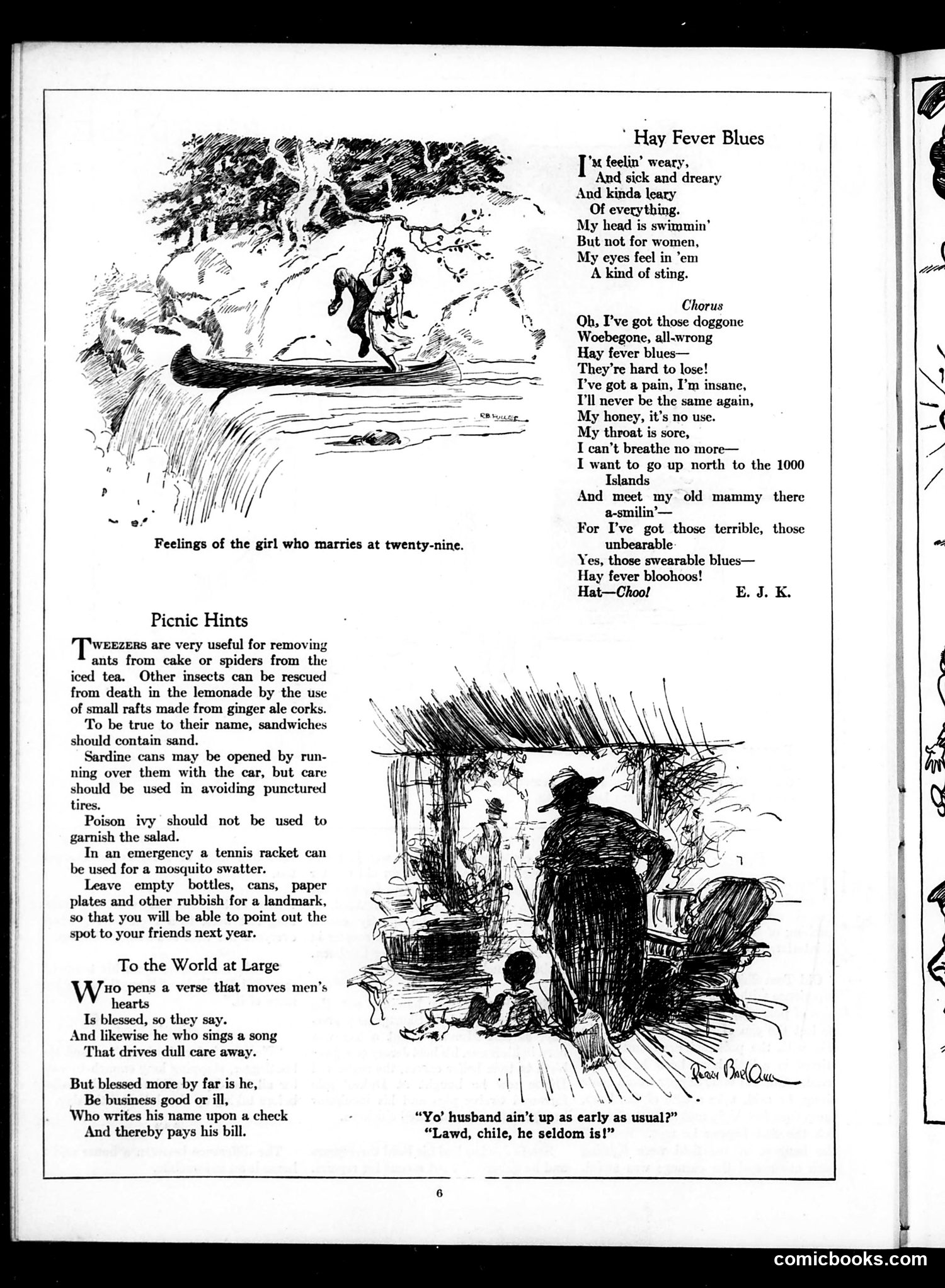
This page contains three distinct pieces: 1. **"Hay Fever Blues"** (top right): A humorous poem about hay fever symptoms, signed E.J.K. The verse uses blues-song conventions to catalog misery—itchy eyes, sore throat, breathing difficulty—culminating in a self-pitying plea to escape to "the 1000 Islands." This satirizes how people exaggerate seasonal allergies. 2. **"Picnic Hints"** (left): Practical satirical advice offering absurd "solutions" to picnic problems—using tweezers for insects, sardine cans for mosquitoes, tennis rackets as swatters. The humor lies in treating trivial annoyances with overengineered absurdity. 3. **"To the World at Large"** (bottom): A verse praising the person who "writes his name upon a check / And thereby pays his bill" above poets and songwriters. This sarcastically celebrates mundane financial responsibility over artistic achievement.
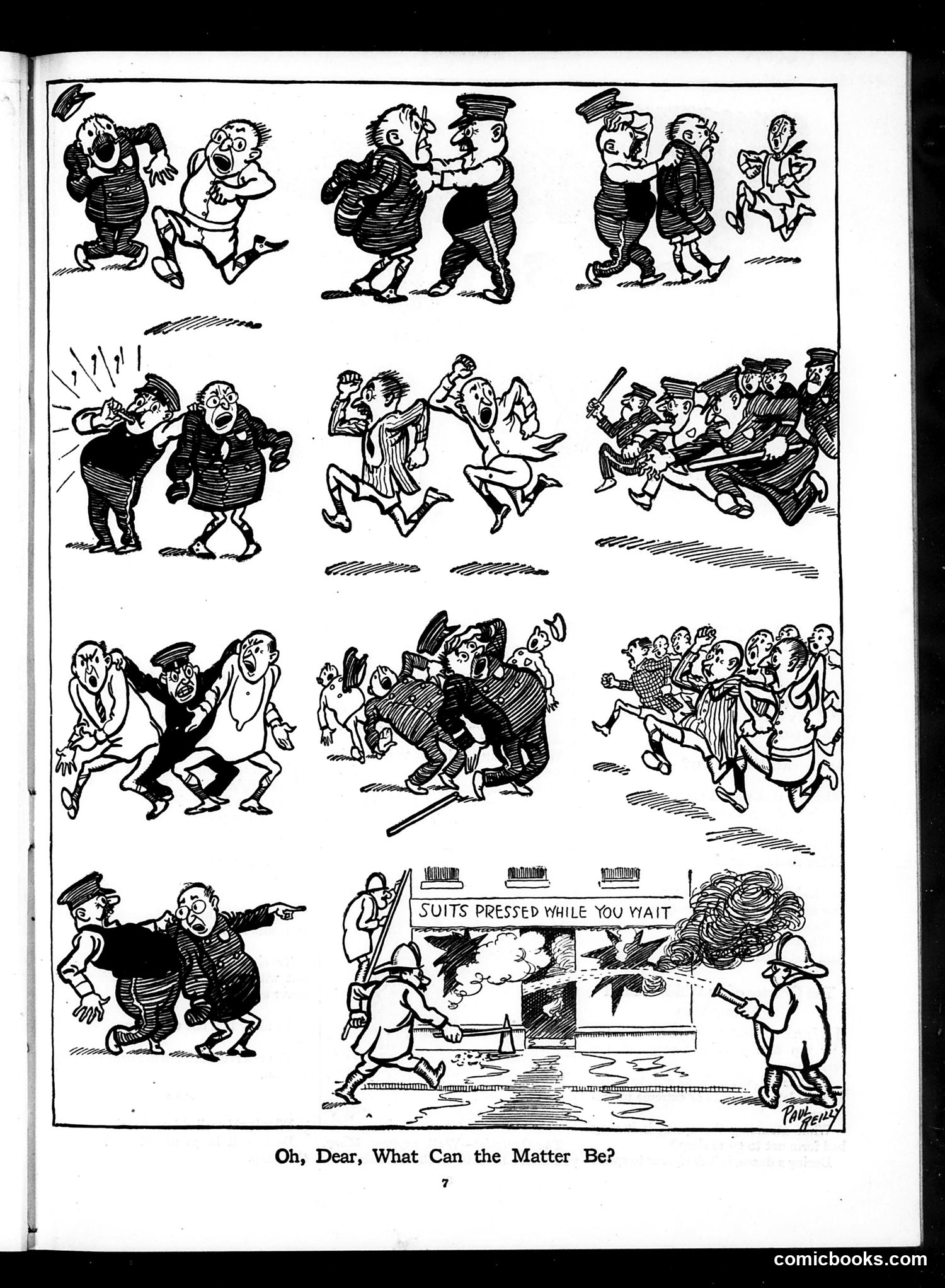
This multi-panel satirical cartoon appears to depict chaos involving police or military figures and civilians. The panels show various scenes of confrontation, pursuit, and disorder—figures running, fighting, and gesturing dramatically. The final panel contains a sign reading "SUITS PRESSED WHILE YOU WAIT," suggesting the cartoonist is satirizing how quickly situations escalate into violence or damage. The title—a reference to the popular 1860s song "Oh Dear, What Can the Matter Be?"—uses irony: something minor (suit pressing) juxtaposed against the mayhem depicted above. Without specific historical dating visible, the exact political context remains unclear. The cartoon likely comments on law enforcement conduct or public disorder during an unidentified period, but I cannot definitively identify which specific incident or political moment this references.
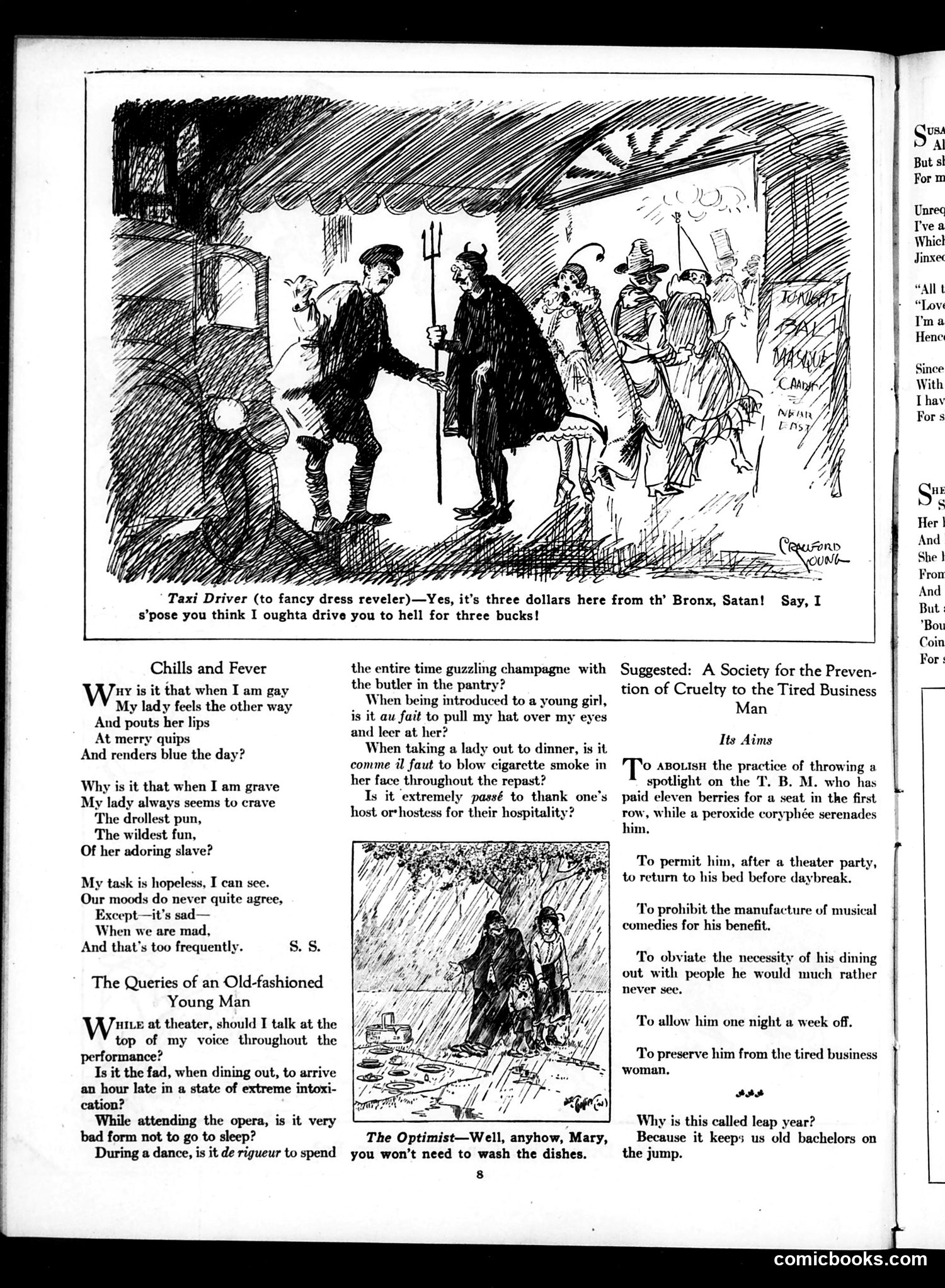
This page contains social satire targeting early 20th-century etiquette and gender relations. **Top Cartoon**: A taxi driver confronts a fancy-dressed man (likely returning from a costume ball) demanding three dollars. The driver sarcastically suggests he should charge extra for "driving you to hell"—mocking the passenger's rudeness and cheap tip relative to his obvious wealth. **"Chills and Fever" Poem**: Satirizes the paradox of romance—the speaker's moods never align with his lady's, creating constant friction. **"Queries of an Old-fashioned Young Man"**: Mocks modern social behavior by asking rhetorical questions suggesting crude conduct (talking loudly at theater, arriving drunk to dinner, sleeping at the opera) in mock-serious, French phrases, exposing how these behaviors violate basic courtesy. **"Society for the Prevention of Cruelty to the Tired Business Man"**: The central satire. It humorously proposes protecting overworked businessmen from social obligations—theater spotlights, late nights, forced socializing—and specifically "the tired business woman," implying exhausting modern dating expectations. The overall theme: complaints about changing social norms, particularly regarding courtesy, modernity, and gender dynamics in urban society.
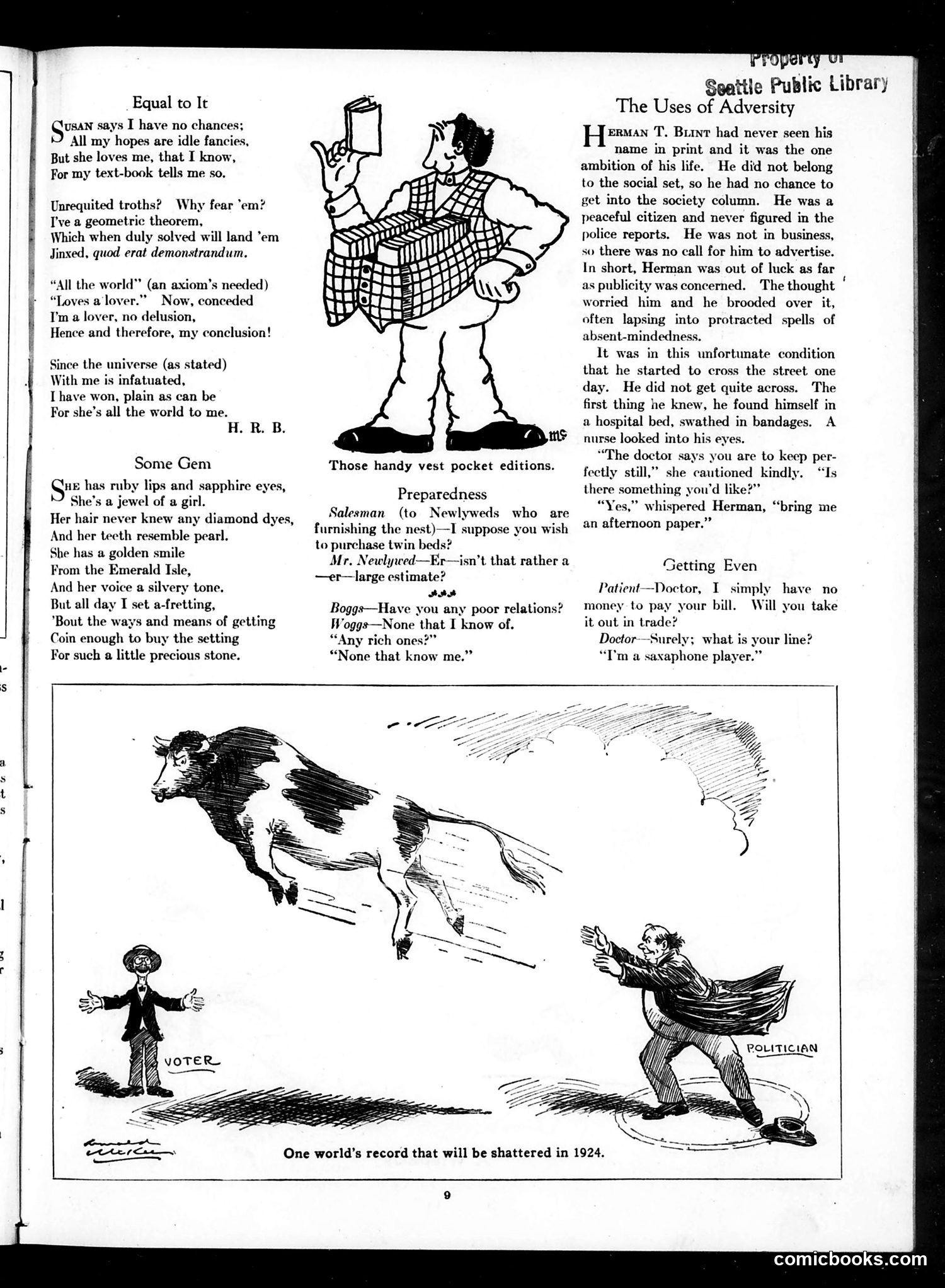
The bottom cartoon satirizes American politics and public trust. It depicts a **voter** (ordinary citizen) being literally kicked into the air by a **politician**, with the caption "One world's record that will be shattered in 1924." The joke reflects early 1920s cynicism about electoral politics: voters feel betrayed and "kicked" by politicians' broken promises. The "record that will be shattered in 1924" likely references the upcoming 1924 presidential election, suggesting that voter disillusionment—or perhaps voter turnout records—would dramatically change that year. The other content includes light humor pieces: a young man using geometry to "prove" his crush loves him, poems about an attractive girl, jokes about newlyweds and poor relations, and a brief story about Herman Blunt, an ordinary man who finally gets his name in the newspaper—by being hit by a car.
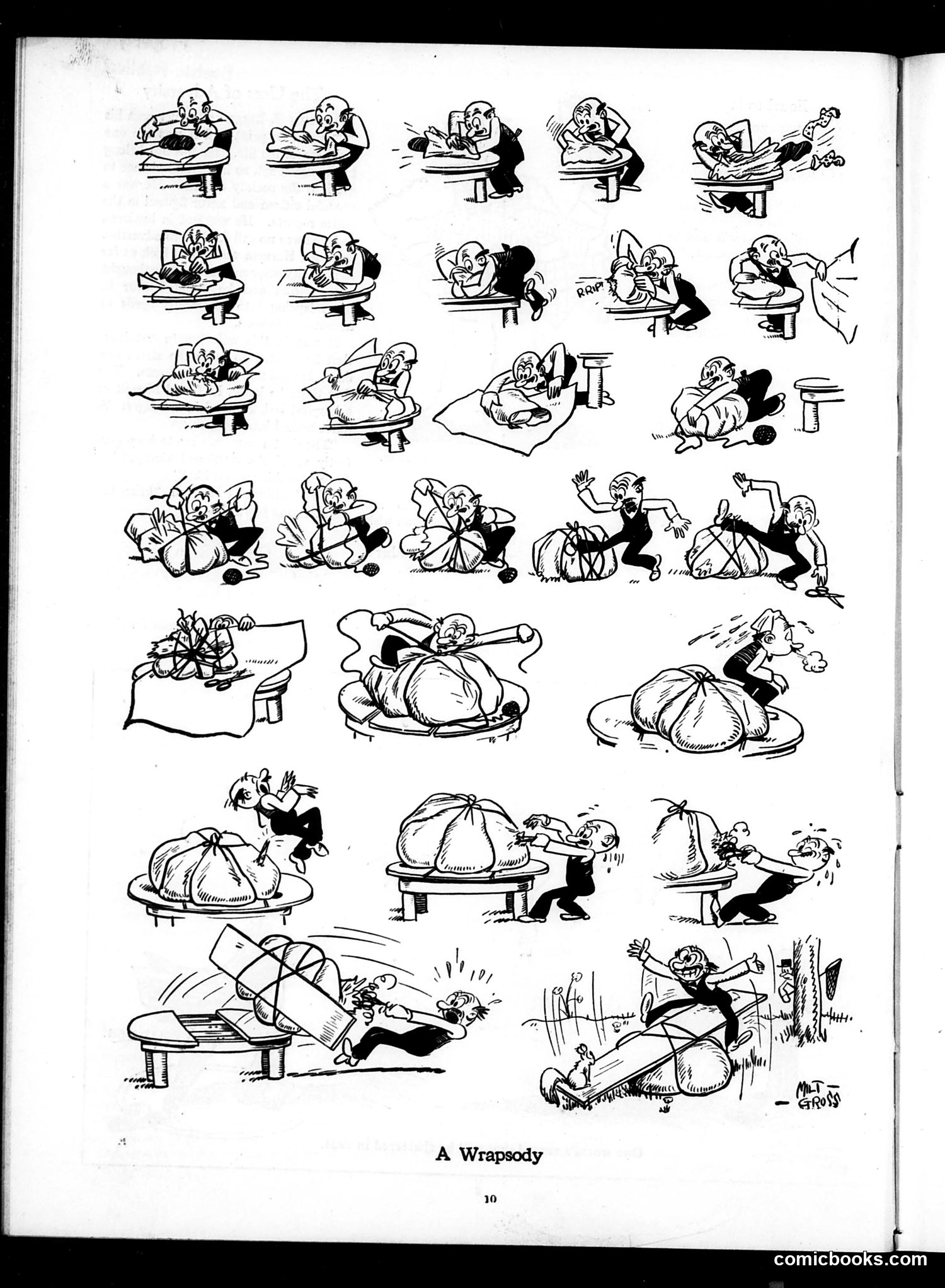
This page presents a visual gag sequence showing a character repeatedly struggling with wrapping packages—hence the pun "Wrapsody" (play on "Rhapsody"). The cartoons depict various comedic mishaps: the figure battles with wrapping paper, string, and large bundled objects at tables, gets tangled in materials, attempts different wrapping techniques, and generally creates chaos while trying to package items. The humor derives from the universal frustration of gift-wrapping—a relatable domestic task. The sequential comic format emphasizes mounting exasperation through escalating physical comedy. This appears designed as light-hearted entertainment rather than political satire, reflecting Judge magazine's occasional use of domestic humor alongside its typical social commentary. The artist's signature appears at bottom right.
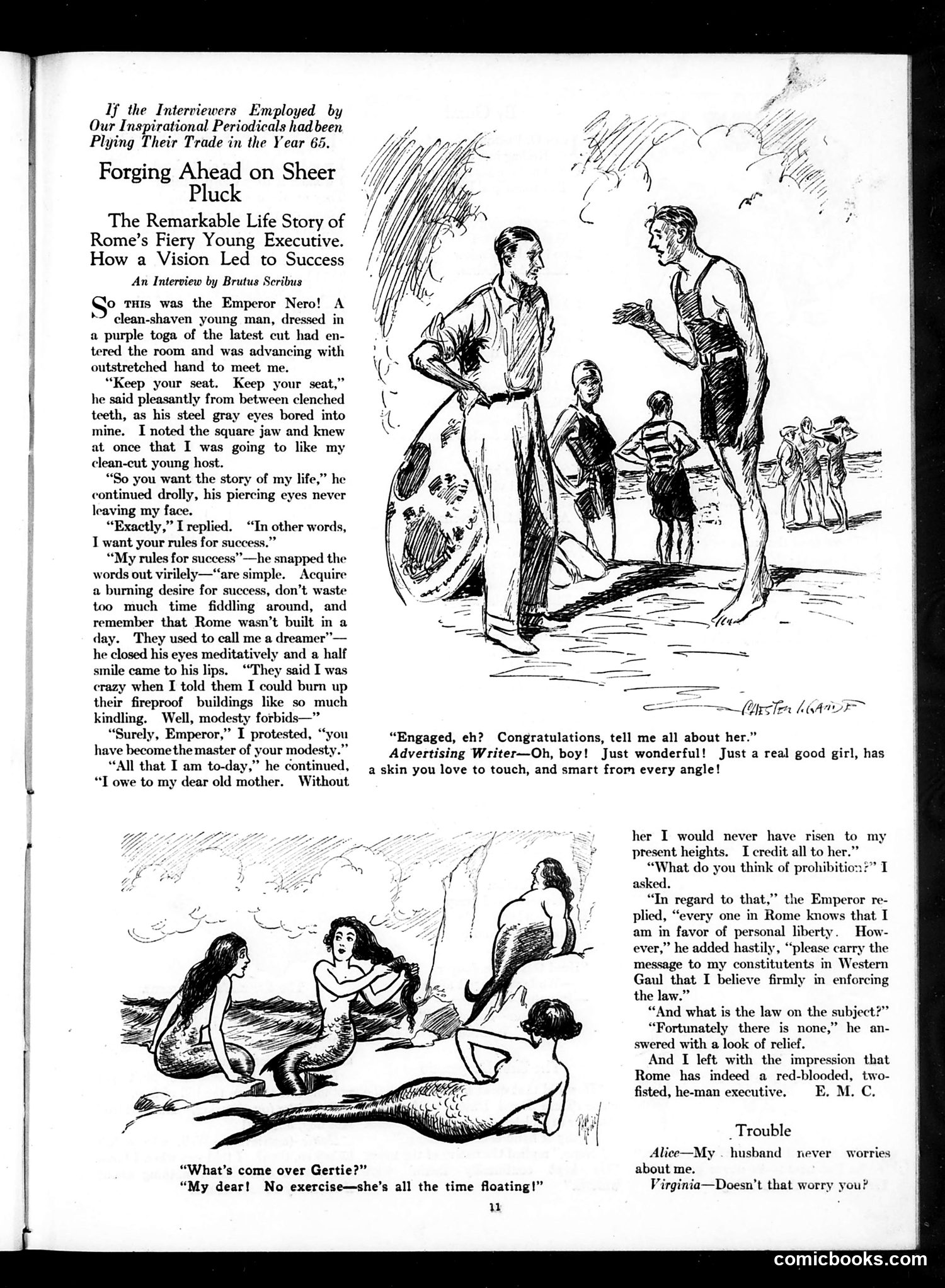
This satirical piece parodies the "inspirational success story" interviews popular in early 20th-century American magazines. The interviewer (Brutus Scribus) profiles the Roman Emperor Nero as if he were a contemporary American business executive, applying modern success-story rhetoric to history's most infamous tyrant. **The satire targets:** - Corporate self-help clichés ("Rome wasn't built in a day," crediting one's mother) - Hypocrisy on prohibition: Nero claims to favor "personal liberty" while promising constituents he'll "enforce the law"—then admits there IS no law, revealing the cynicism beneath corporate doublespeak - The absurdity of treating a man famous for burning Rome and murdering citizens as an admirable "red-blooded, two-fisted, he-man executive" **The bottom cartoons** are unrelated humor: one about a woman who never exercises, another mocking advertising copy that uses flattery ("skin you love to touch") to sell engagement congratulations. The piece mocks how American business culture romanticizes ruthlessness while wrapping it in motivational language.
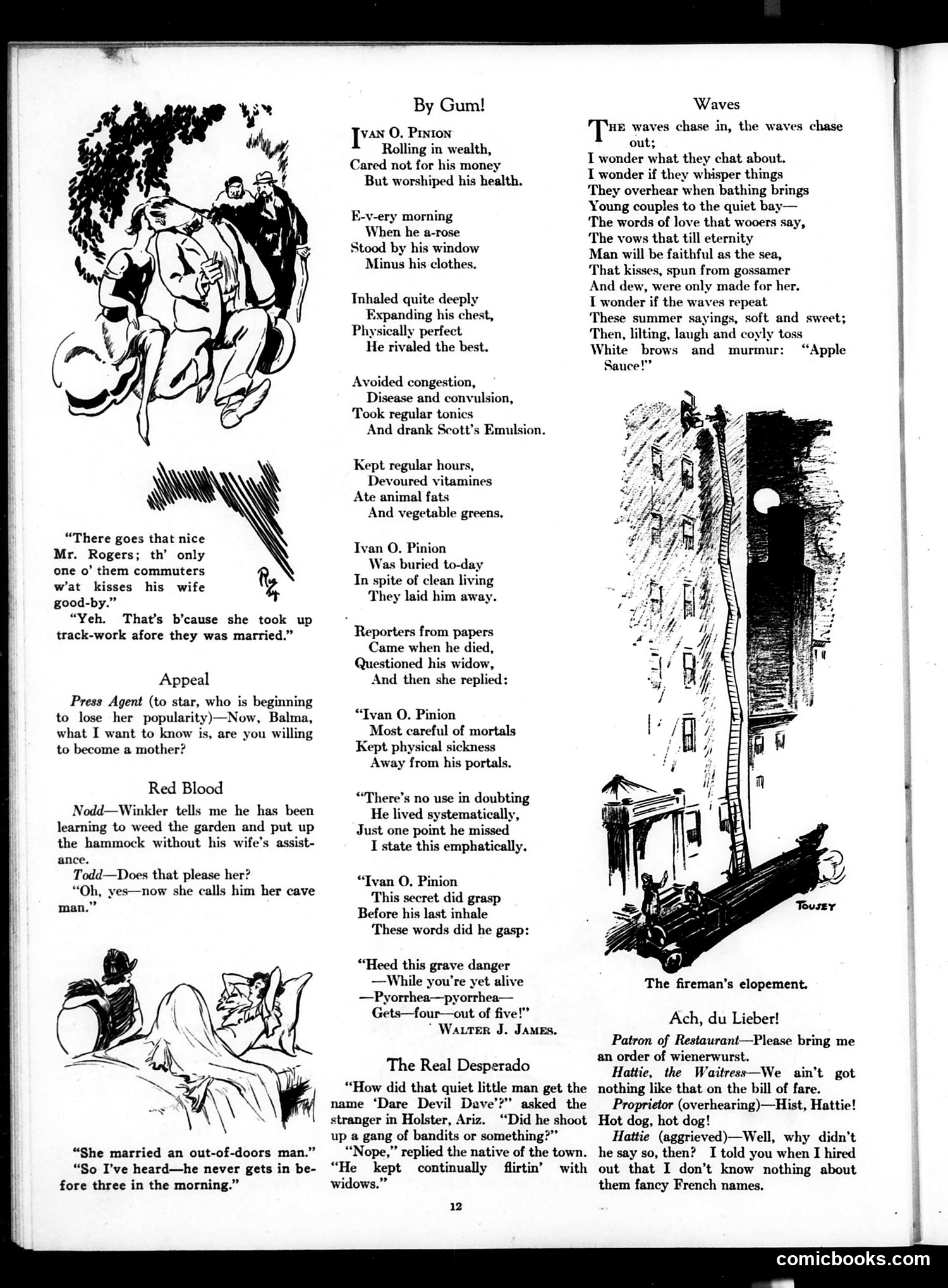
This page contains multiple satirical pieces lampooning early 20th-century American attitudes and fads: **"By Gum!"** mocks the health-obsession craze of the era through Ivan O. Pinion, a man who meticulously follows every wellness trend (fresh air, tonics, Scott's Emulsion, vitamins)—yet dies anyway. The widow's revelation that he suffered from pyorrhea (gum disease) suggests the satire: obsessive health-consciousness is futile and somewhat ridiculous. **The vignettes** about Mr. Rogers and Winkler satirize changing gender roles—wives taking "track-work" and husbands learning domestic tasks, which confuses traditional expectations. **"The Real Desperado"** jokes that flirting with widows is more daring than actual frontier violence—commentary on small-town morality. **"Waves"** is romantic poetry, seemingly unrelated satirical filler. **The restaurant exchange** plays on immigrant/ethnic humor: a waitress unfamiliar with "wienerwurst" (German sausage), misunderstanding it as French cuisine—mocking both pretension and working-class ignorance.
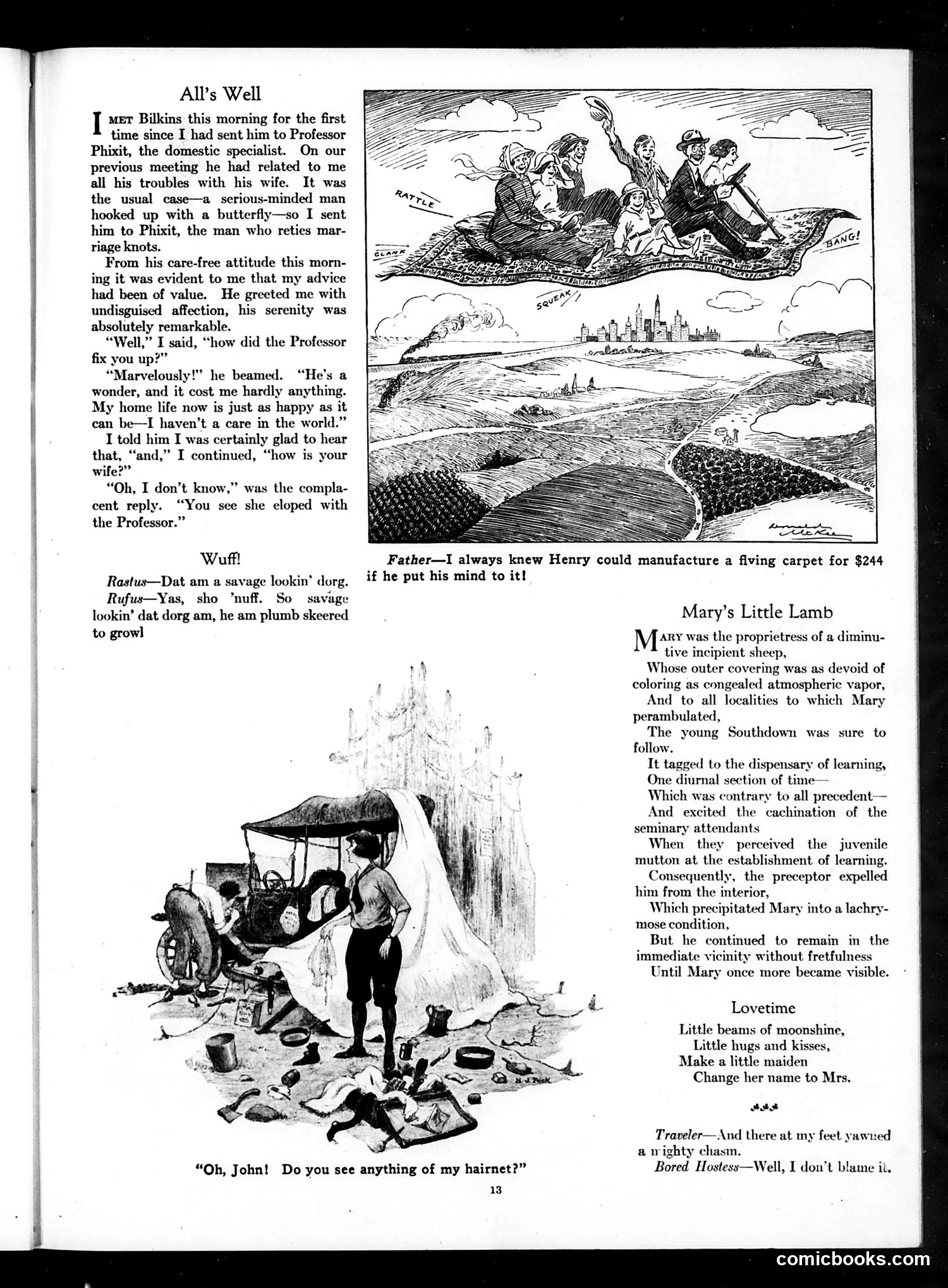
This page contains several humorous pieces typical of early 20th-century satirical magazines: **"All's Well"** is a joke about marriage counseling. A man consults "Professor Phixit," a domestic specialist, to fix his unhappy marriage. He reports being cured—now carefree and unburdened—because his "butterfly" wife has eloped with the Professor himself. The satire mocks both marriage difficulties and the dubious efficacy of professional advice. **"Wuff!"** is a brief dialect joke featuring two Black characters (Rastus and Rufus) discussing a savage-looking dog that's "plumb skeered to growl"—playing on exaggerated stereotypes common to the era. **"Mary's Little Lamb"** is a mock-serious poem that restates the nursery rhyme in deliberately overwrought, pompous language ("cachination" for laughter, "lachrymoze condition" for tears), satirizing pretentious vocabulary. The remaining brief items are light humor pieces. The illustrations support each piece's joke.
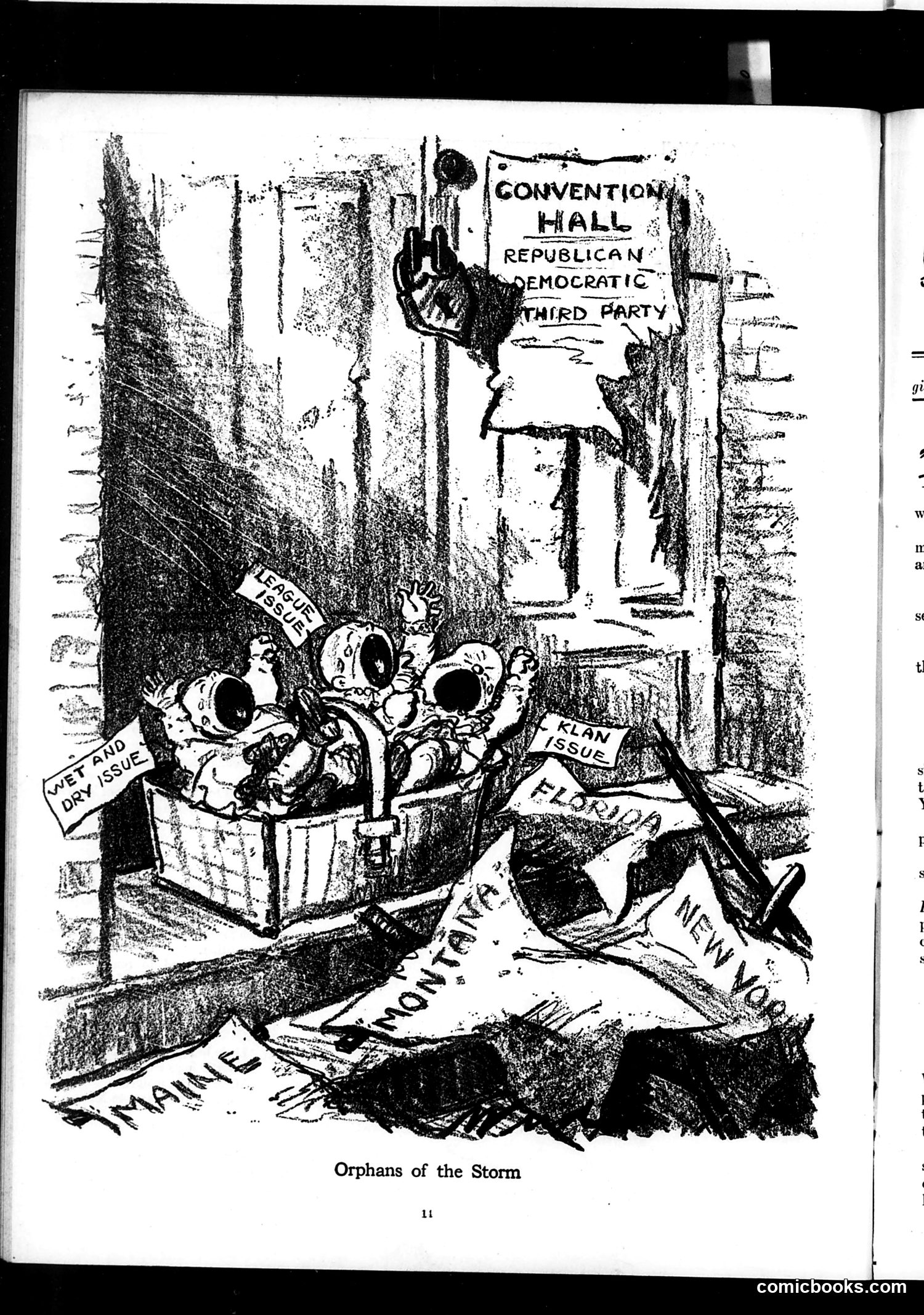
This political cartoon satirizes the fractured state of American politics following a major storm (likely a hurricane or natural disaster). The cartoon depicts three distressed figures labeled with regional issues—"Wet and Dry Issue," "Florida," and "Maine"—huddled together outside a "Convention Hall" marked for Republican, Democratic, and Third Party conventions. The title "Orphans of the Storm" suggests these regional political concerns have been abandoned or neglected by the major parties. The cartoon critiques how political conventions prioritize party machinery over addressing real constituent needs and regional crises. The bewildered figures represent voters left vulnerable by political parties focused on internal disputes rather than disaster relief or practical governance.
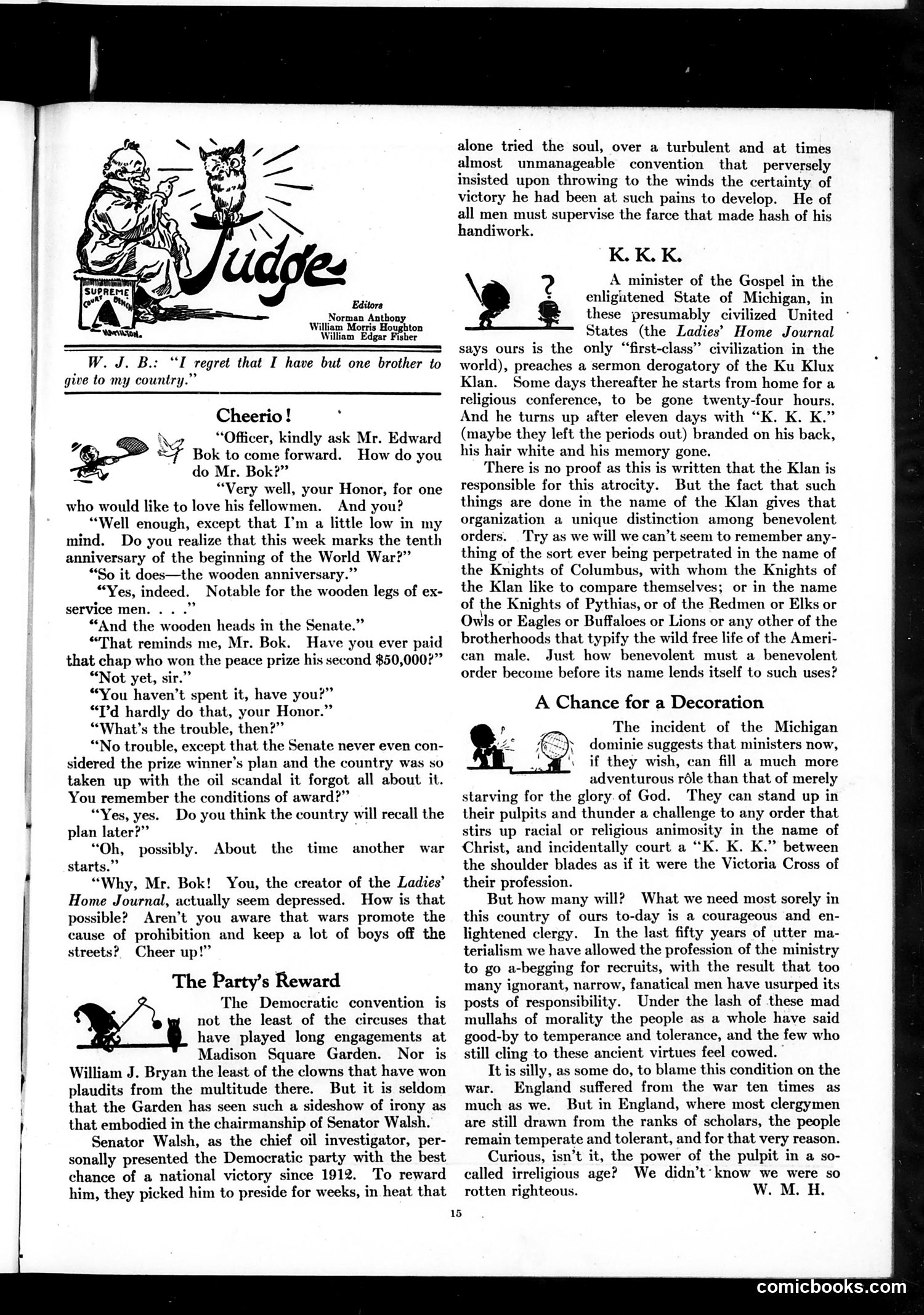
This 1924 page contains three satirical pieces critiquing American politics and social issues: **"Cheerio"** mocks Edward Bok (editor of *Ladies' Home Journal*) and the Senate's inaction. A judge notes the tenth WWI anniversary coincides with "wooden legs of ex-service men" and "wooden heads in the Senate"—sarcastically suggesting politicians are as useless as wooden prosthetics. The piece ridicules the Senate's failure to act on a peace prize winner's plan, overshadowed by the oil scandal (Teapot Dome). **"The Party's Reward"** criticizes the Democratic convention for punishing Senator Walsh, whose oil scandal investigation gave them electoral advantage, by forcing him to chair their chaotic convention in summer heat—an ironic "reward" that undermines his own work. **"K.K.K."** reports a Michigan minister's assault by assailants (implied to be KKK members) and condemns the organization for conducting violence under its name, contrasting it with other fraternal orders like Knights of Columbus or Pythias, which don't perpetrate such acts.
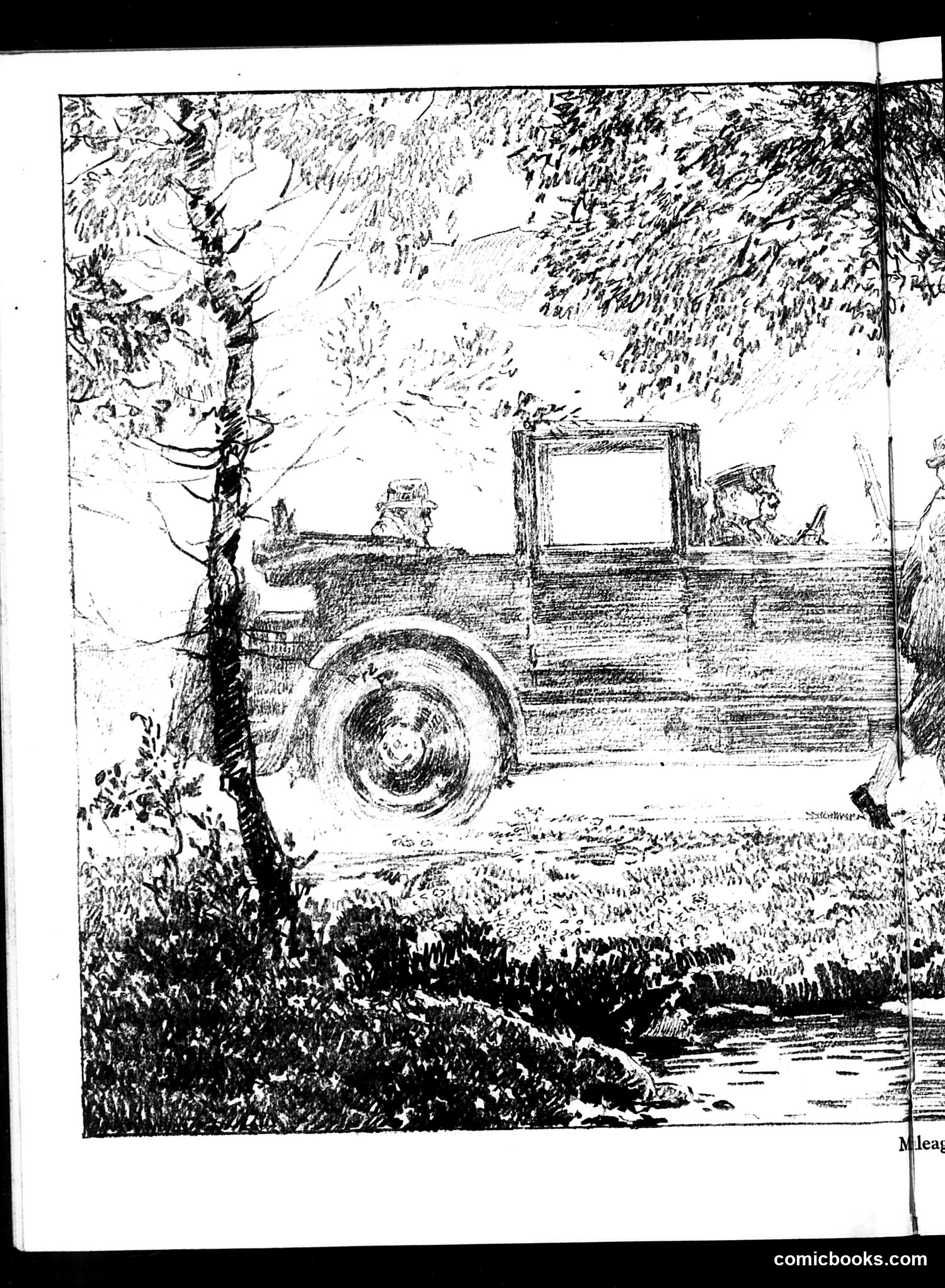
This appears to be a single illustration rather than a political cartoon. It depicts a wooden truck or delivery vehicle parked near a bare tree and overgrown vegetation, with what looks like a stream or water feature in the foreground. The scene has a rural or neglected appearance. Without visible text, captions, or clear satirical elements identifying specific political figures or current events, I cannot confidently explain what social or political commentary this image intends to convey. The signature appears to read "M. Leag" or similar, but this doesn't help establish the cartoon's meaning or historical context. To accurately interpret this as satire, I would need accompanying text or captions that clarified its subject matter.
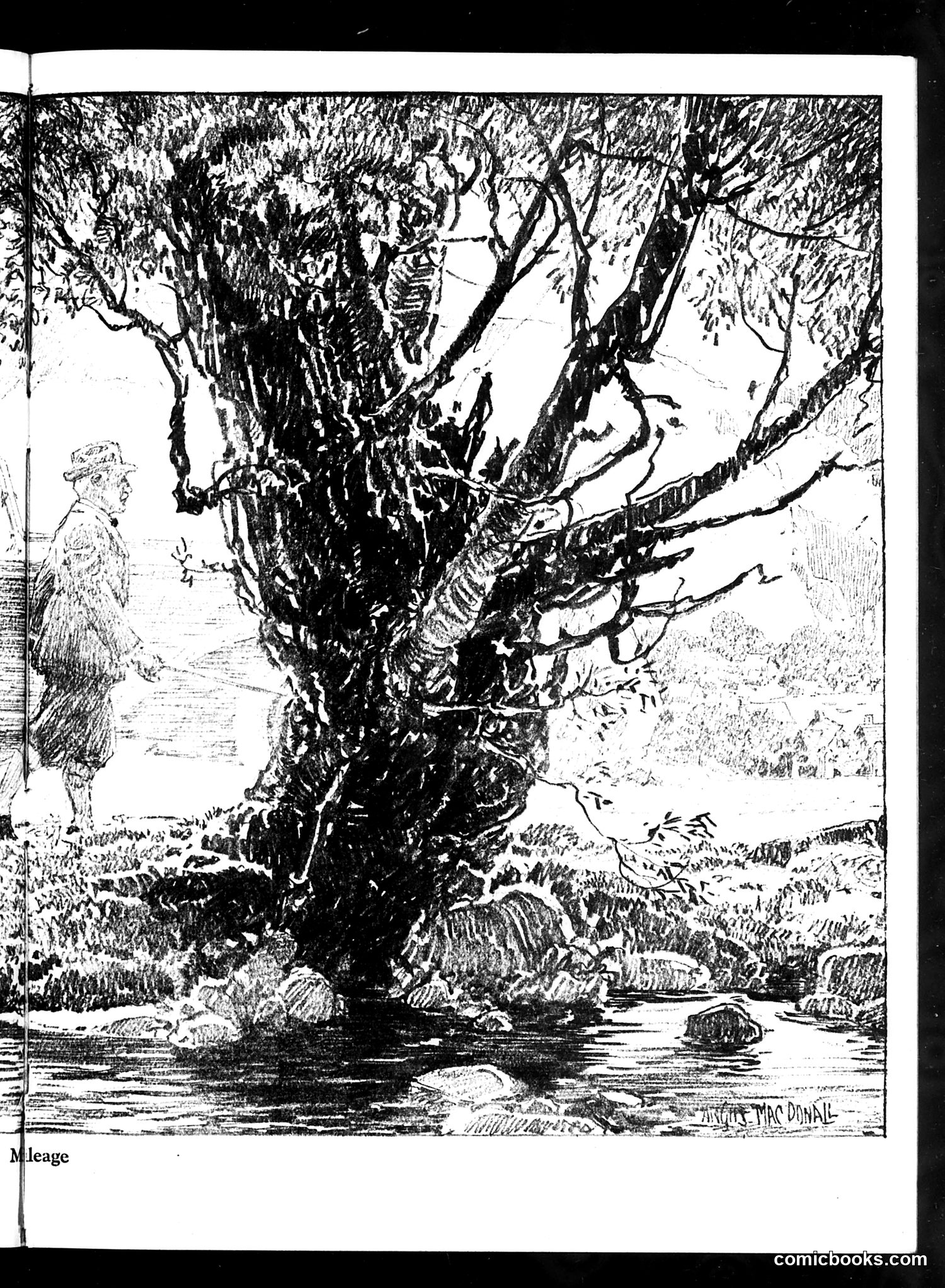
This appears to be a pen-and-ink illustration signed by "Inting Mac Donnall" (artist signature visible). The image depicts a solitary figure standing beside a gnarled, ancient tree growing near a stream or water's edge, surrounded by rocks and vegetation. Without additional context from the magazine page—such as a title, caption, or accompanying text—the specific political or social satire intended is unclear. The image could represent themes common to Judge magazine's satirical content (late 19th/early 20th century), such as nature, aging, wisdom, or persistence, but I cannot definitively identify the cartoon's intended meaning or any specific political figures or events referenced without more information. The word "leage" appears at bottom left, though its relevance is uncertain.
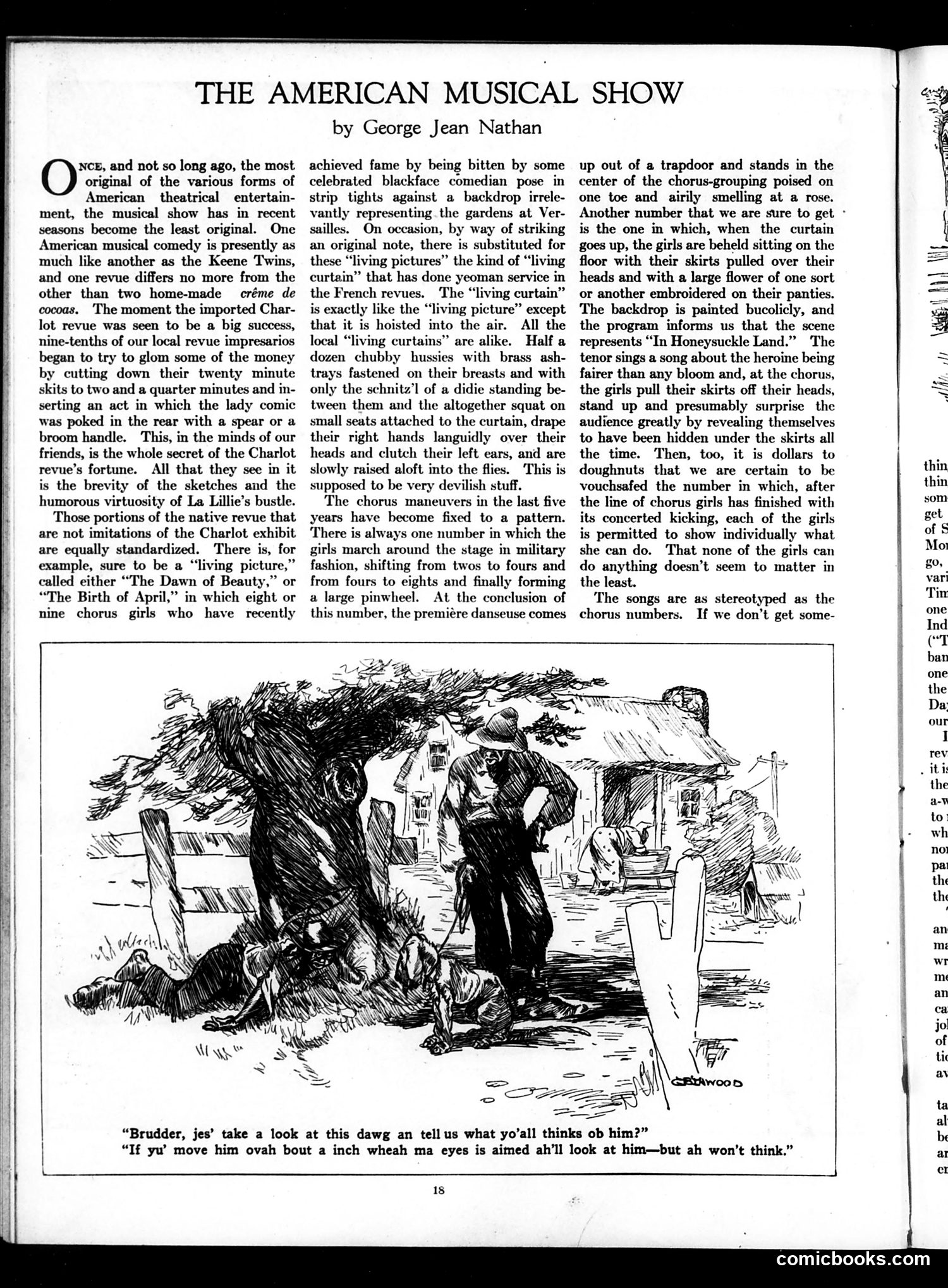
This article by George Jean Nathan critiques the American musical theater industry for lack of originality. Nathan argues that producers, after witnessing the success of the imported French "Charlot revue," began slavishly copying its formula rather than creating genuinely new work. The cartoon below illustrates this through a rural scene with a dialogue about a dog—likely a visual metaphor for undiscerning judgment. Nathan identifies specific repetitive theatrical conventions he ridicules: standardized "living pictures" of scantily-clad chorus girls posed against irrelevant backdrops (like Versailles gardens), predictable military-formation choreography culminating in pinwheel formations, and the tiresome "girls-hiding-under-skirts" number. His satire targets both producers' lack of creativity and audiences' acceptance of derivative entertainment. The piece suggests American theater had become formulaic and shallow, merely imitating European imports without understanding what made them successful.
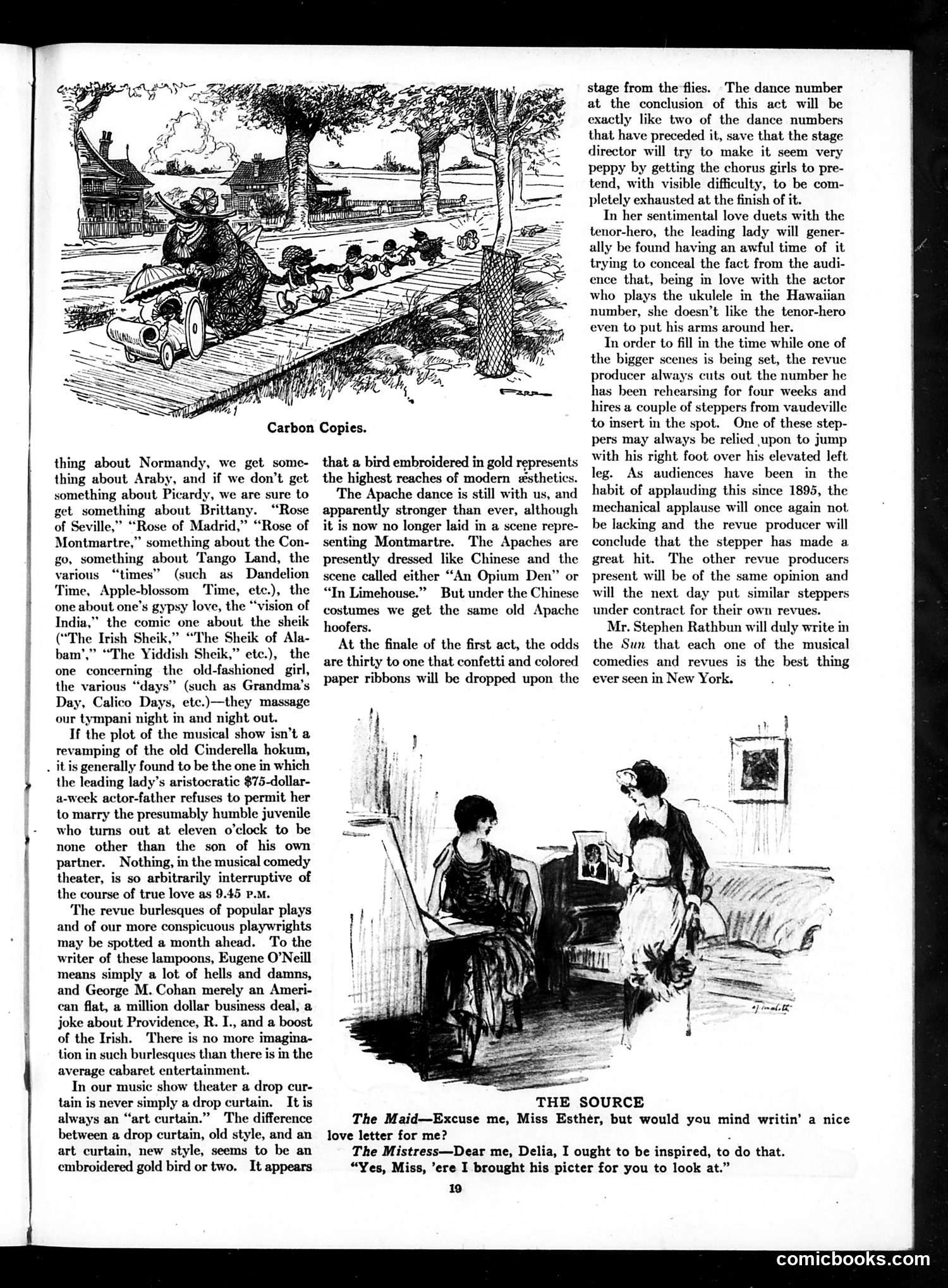
This page satirizes the formulaic predictability of early 20th-century musical theater and revue productions. The lengthy "Carbon Copies" essay mocks how Broadway shows recycled identical plots, settings, and performance tropes endlessly. The satire targets: - **Overused plots**: Cinderella stories, aristocratic father-refuses-poor-suitor narratives interrupted by 9:45 P.M. curtain times - **Tired exotic settings**: Apache dances (Parisian street fighter scenes), now incongruously relocated to "Opium Dens" or "Limehouse" with Chinese costumes - **Repetitive visual elements**: "Art curtains" with embroidered gold birds; confetti dropped from flies; exhausted chorus girls pretending exertion - **Lazy choreography**: Vaudeville steppers hired last-minute, performing the same elevated-leg jump audiences applauded since 1895 The smaller illustration "The Source" depicts a domestic scene where a maid asks a mistress to write a love letter—a joke about theatrical artificiality bleeding into "real life." The commentary names Eugene O'Neill and George M. Cohan as subjects of shallow theatrical parodies, suggesting audience weariness with formulaic entertainment.
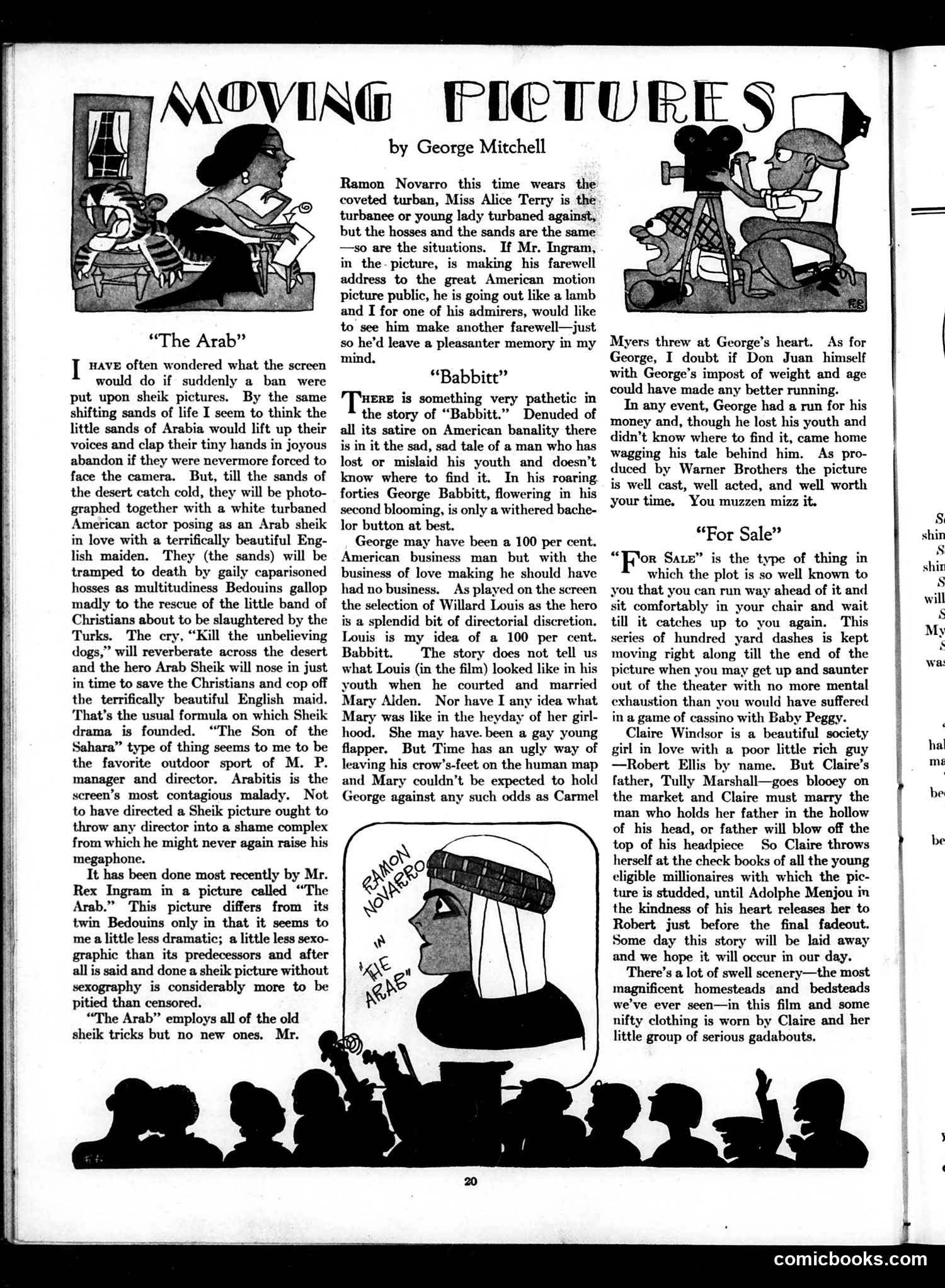
This page reviews three recent films, critiquing Hollywood's reliance on formulaic "Sheik" movies. Mitchell mocks the genre's predictable plot: a white American actor (here Ramon Novarro in "The Arab") poses as an Arab sheik rescuing a beautiful English woman from Bedouins and Turks. Mitchell notes director Rex Ingram repeats all the old conventions without innovation—the "sexography" is notably absent, making it "more to be pitied than censored." The reviews of "Babbitt" and "For Sale" follow similar patterns, examining character casting and narrative construction. The satire targets Hollywood's obsession with proven formulas over originality, and the racial/orientalist stereotyping embedded in "Sheik" pictures that dominated 1920s cinema. Mitchell essentially argues these films are exhausted entertainment relying on tired tropes rather than artistic merit.
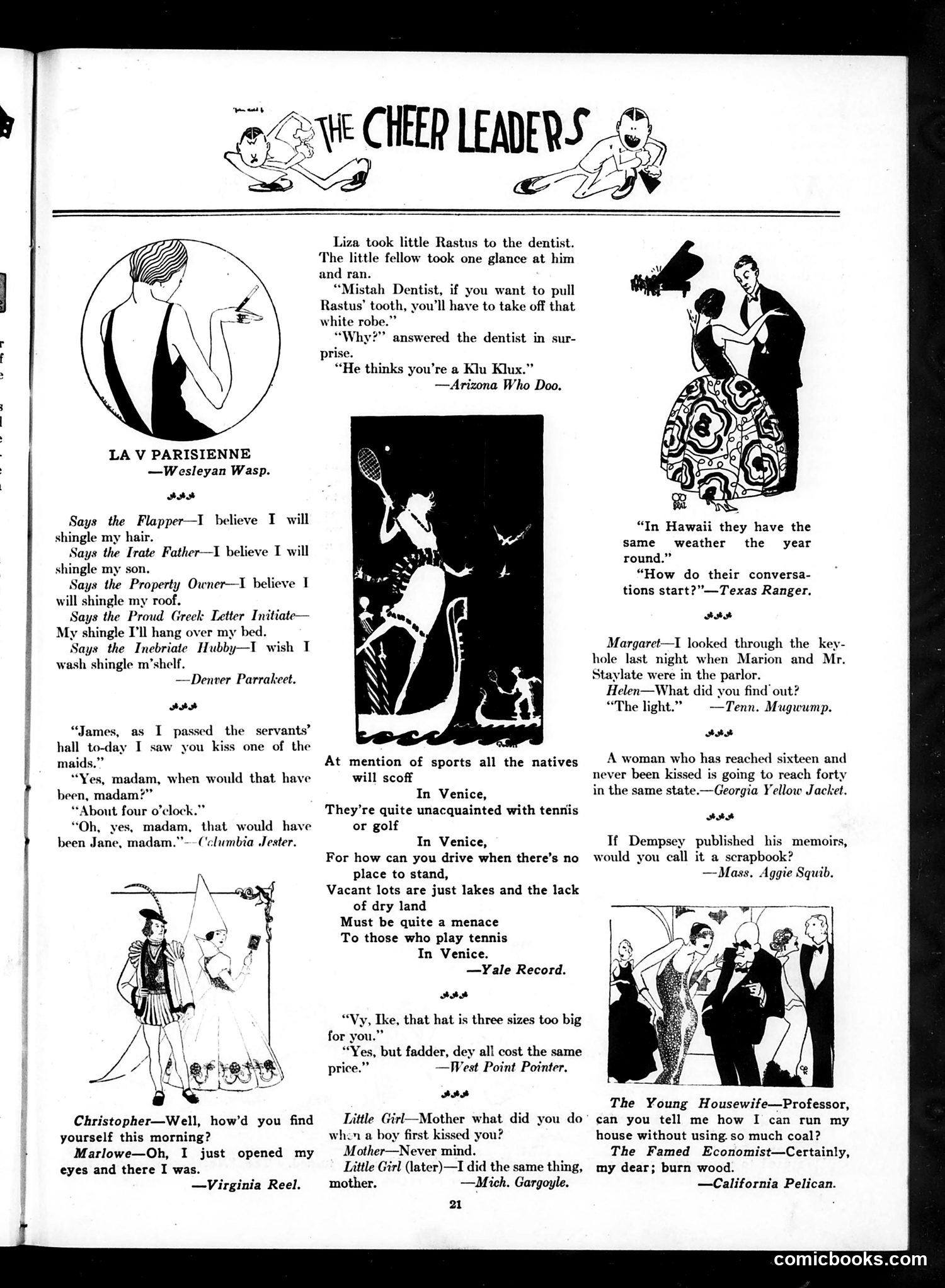
This Judge magazine page collects humor from college publications, primarily joke exchanges rather than political cartoons. The content reflects 1920s social anxieties and college humor conventions. **Key satirical targets:** - **"Shingling" jokes**: Mock the "flapper" trend of bobbed hair (women cutting hair short), with authorities responding by "shingling" sons, roofs, and even themselves—trivializing both the fashion rebellion and parental outrage. - **Racial stereotype humor**: The "Rastus" dentist joke relies on minstrelsy caricatures and KKK references, presenting fear of the Klan as comedic subject matter. - **Venice/sports jokes**: Satirize American tourists' ignorance about foreign lands (Venice's canals make golf/tennis impossible). - **Gender/romance humor**: Multiple jokes about kissing and courtship reflect anxieties about changing dating customs post-WWI. - **Class/servant humor**: The "James and Jane" joke mocks servant-employer relations through mistaken identity. The overall tone emphasizes college-age irreverence toward authority, fashion, and social conventions of the era.
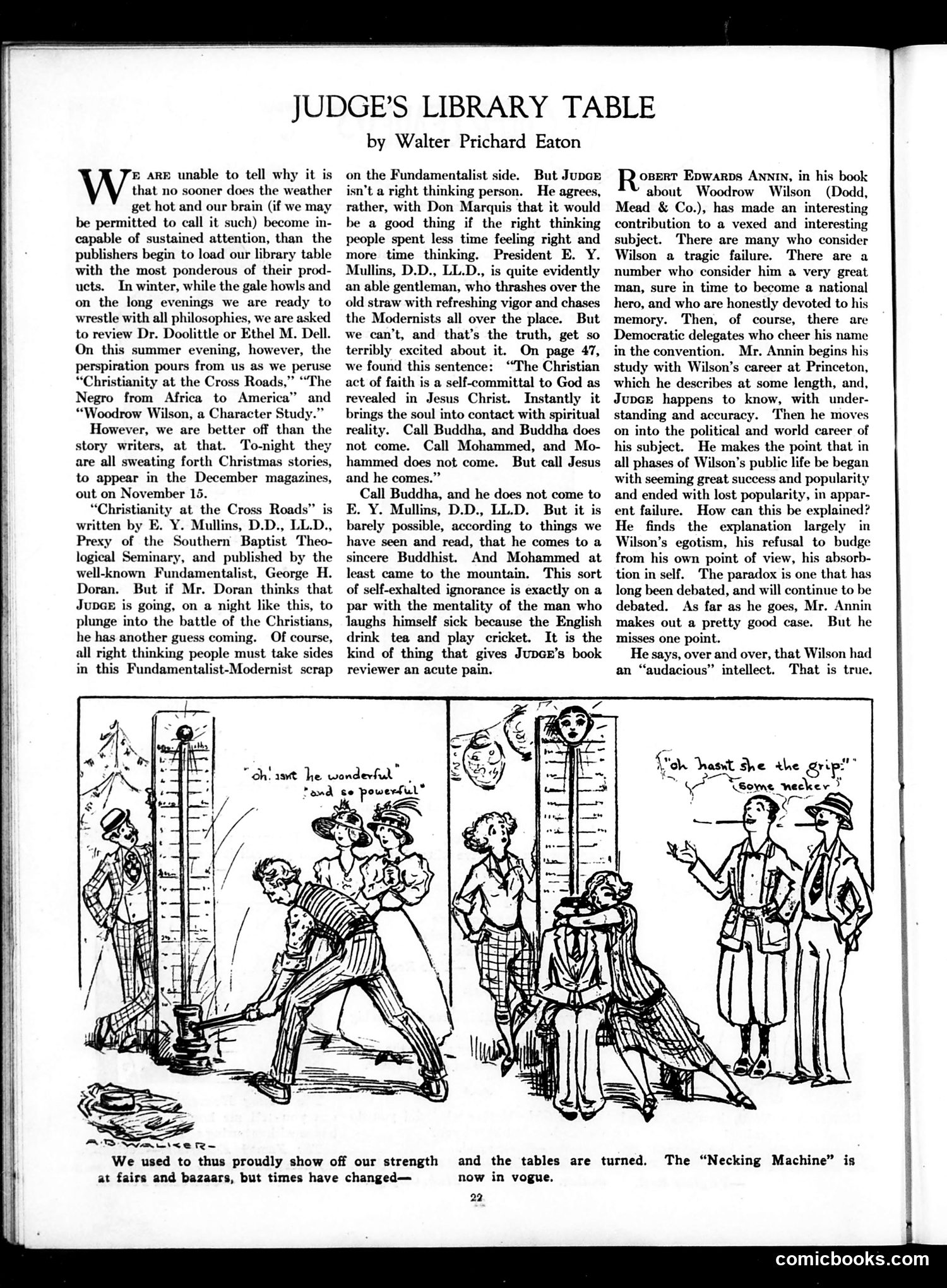
This column by Walter Prichard Eaton reviews three summer books while mocking intellectual pretension. The author complains that publishers dump heavy philosophical works when readers are too hot and lazy to engage seriously. The main target is **E.Y. Mullins' "Christianity at the Cross Roads,"** a Fundamentalist tract arguing that calling on Jesus works while Buddha and Mohammed don't. Eaton ridicules this as "self-exhalted ignorance"—equivalent to mocking English people for drinking tea. He refuses to take sides in the contemporary **Fundamentalist-Modernist debate** (a real 1920s-30s religious controversy), claiming the Judge magazine stays above such partisan thinking. The cartoons depict a "necking machine" at a fair—showing how courtship customs have changed. The satire's edge: while Mullins pontificates about faith, Eaton highlights society's actual concerns are far more worldly.
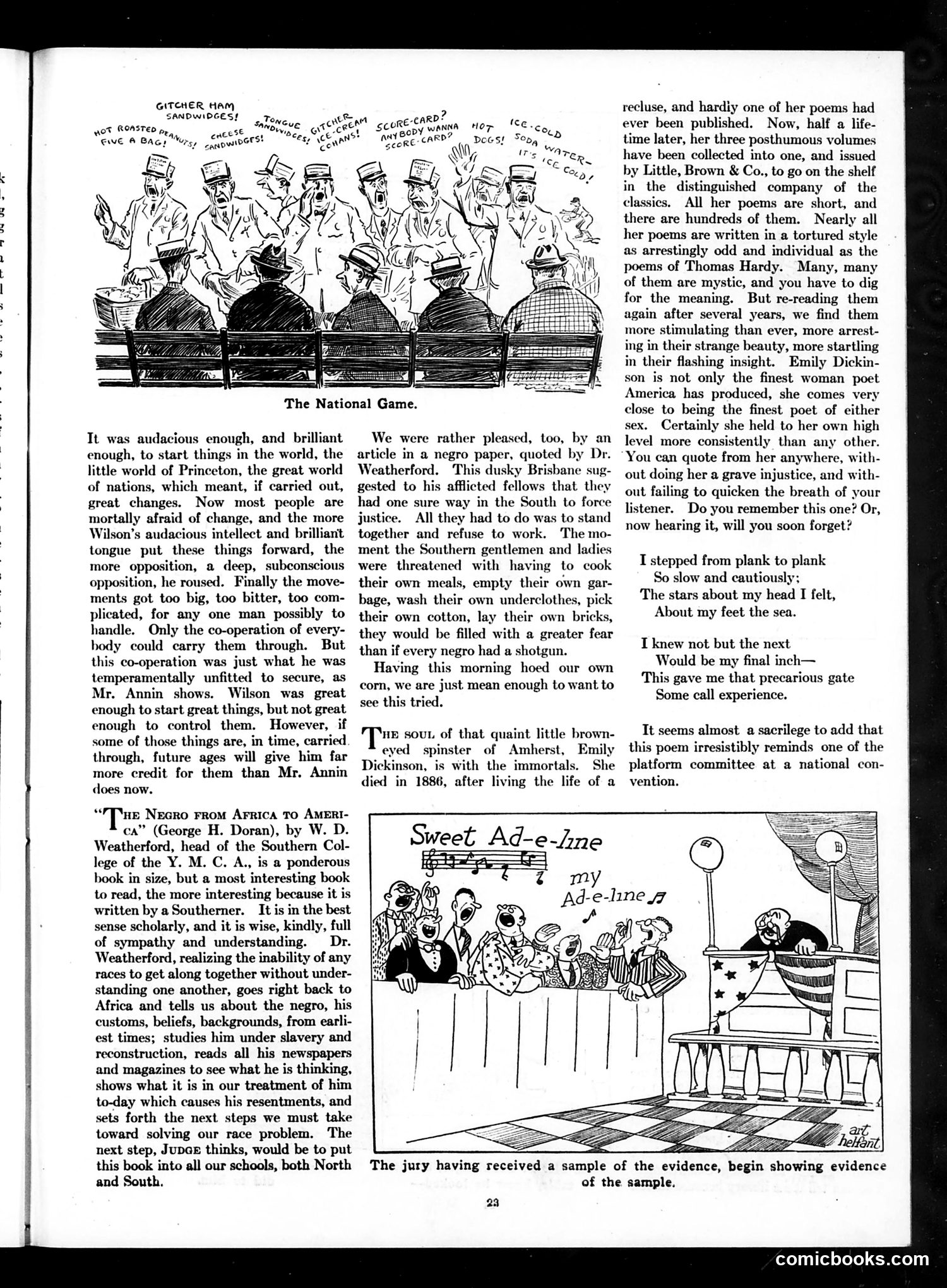
**The Main Cartoon:** Shows men in top hats at a fence labeled "Gitcher Ham Sandwidges!" hawking various political offerings ("Hot Roasted," "Tongue," "Scure-Card," etc.). This satirizes **Woodrow Wilson's** political initiatives—the cartoon criticizes Wilson as someone intellectually brilliant enough to initiate major reforms but temperamentally unable to manage their implementation or build necessary coalitions. The "sandwiches" represent his various policy proposals being sold to the public. **Key Points:** The text explicitly names Wilson, discussing how his "audacious" progressive agenda generated opposition he couldn't control. The satire suggests his idealism outpaced his practical leadership abilities—he could "start great things" but lacked the cooperative temperament to see them through. **Secondary Content:** The page also includes commentary on a book about African American history and a tribute to Emily Dickinson's poetry, unrelated to the cartoon's satirical message.
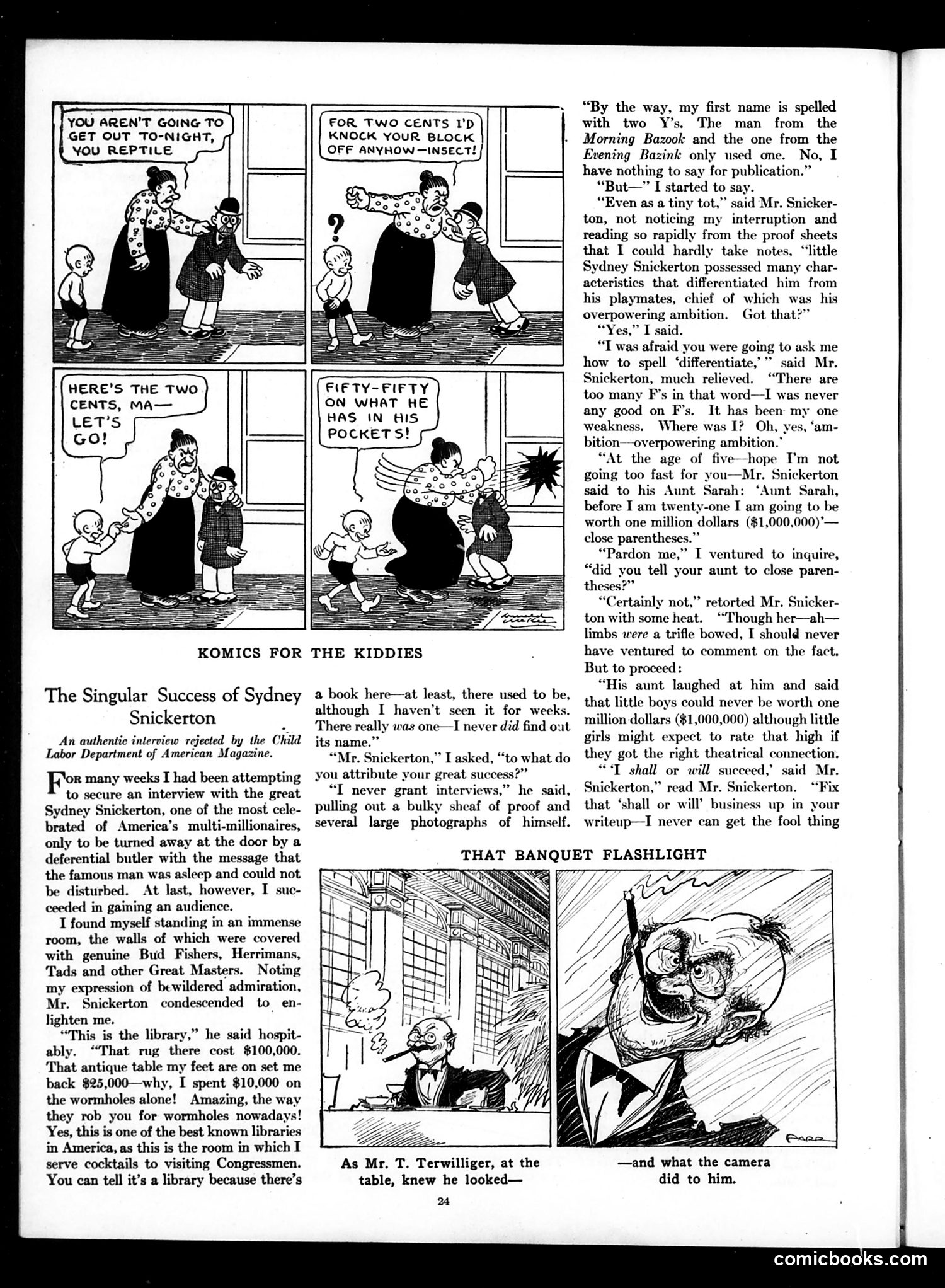
This piece satirizes wealthy industrialists and their self-aggrandizing vanity. Sydney Snickerton, a fictional multi-millionaire, represents the arrogant robber barons of the era who obsess over trivial displays of wealth while being fundamentally vapid. The satire works through absurdity: Snickerton spends $10,000 on wormholes in antique furniture, uses his expensive "library" merely to serve cocktails to congressmen, and wastes the interviewer's time reading pre-written publicity material rather than answering genuine questions. His pedantic corrections (spelling his name with "two Y's") reveal petty vanity masking hollow accomplishment. The opening comic strips show children mimicking adult greed and violence, suggesting such materialism corrupts society from the ground up. "That Banquet Flashlight" section appears to mock how photography distorts wealthy men's appearances—another jab at vanity. The piece ridicules both the wealthy elite and the press apparatus that enables their self-promotion through fawning interviews.
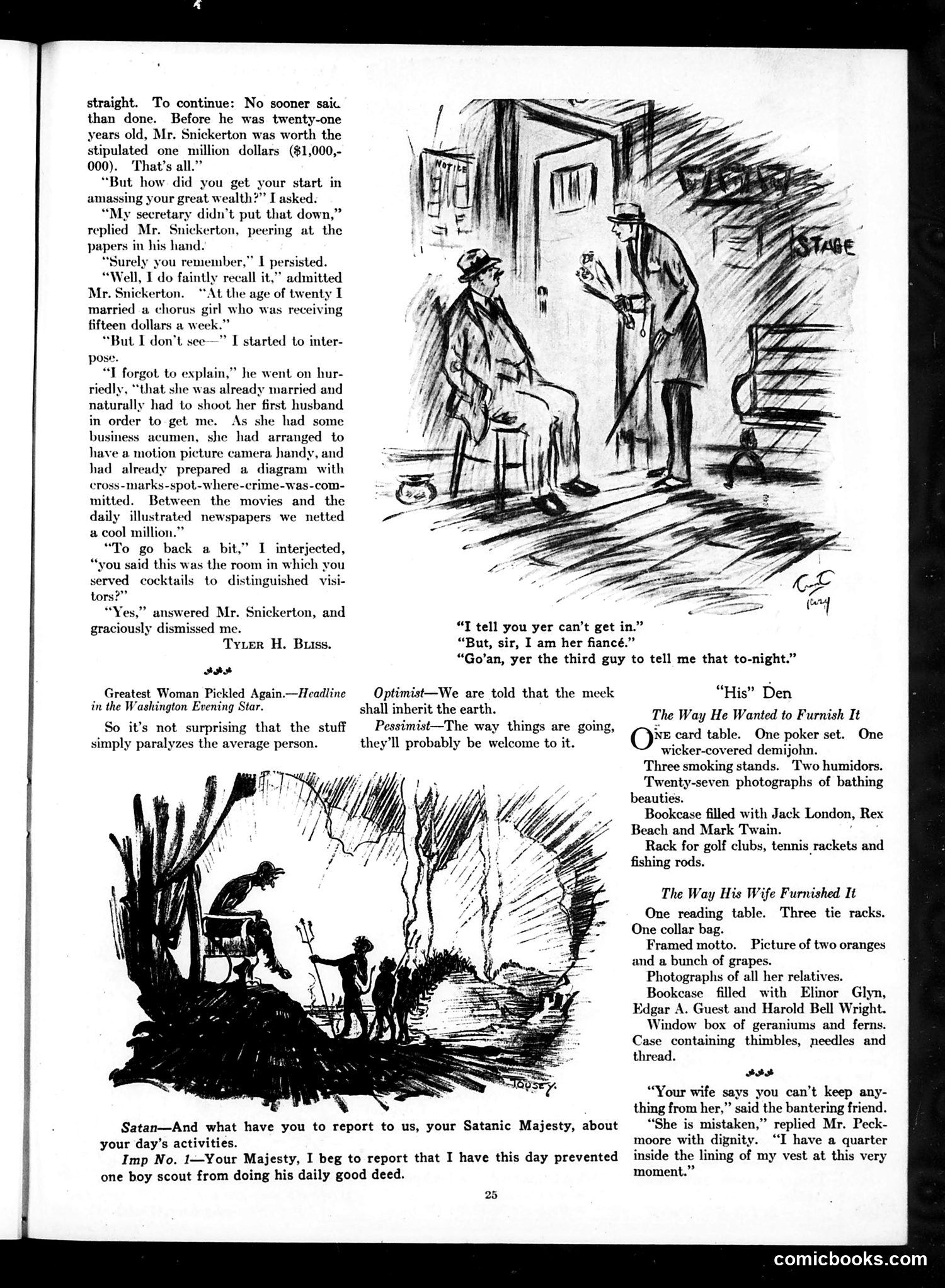
This page contains multiple satirical pieces typical of early-20th-century American humor: **"Snickerton" Interview**: A wealthy man's origin story reveals dark satire—he admits his fortune came from his wife shooting her previous husband, then profiting from selling the crime footage to newspapers and motion pictures. The joke mocks both get-rich-quick schemes and the era's sensationalist media that monetized violence. **Top cartoon**: A doorman turns away men claiming to be a woman's fiancé, suggesting she has multiple engagements—satire on gold-digging women or infidelity. **"His Den" vs. "His Wife's Den"**: Contrasts bachelor furnishings (gambling, bathing beauty photos, adventure novels) with a wife's domestic practicality (sewing supplies, sentiment, respectable authors like Elinor Glyn). This gender-role satire plays on domestic tension. **Bottom cartoons**: Brief jokes about pessimism, the meek inheriting earth, and an imp preventing a Boy Scout's good deed—general moral/social commentary typical of the era's light satire.
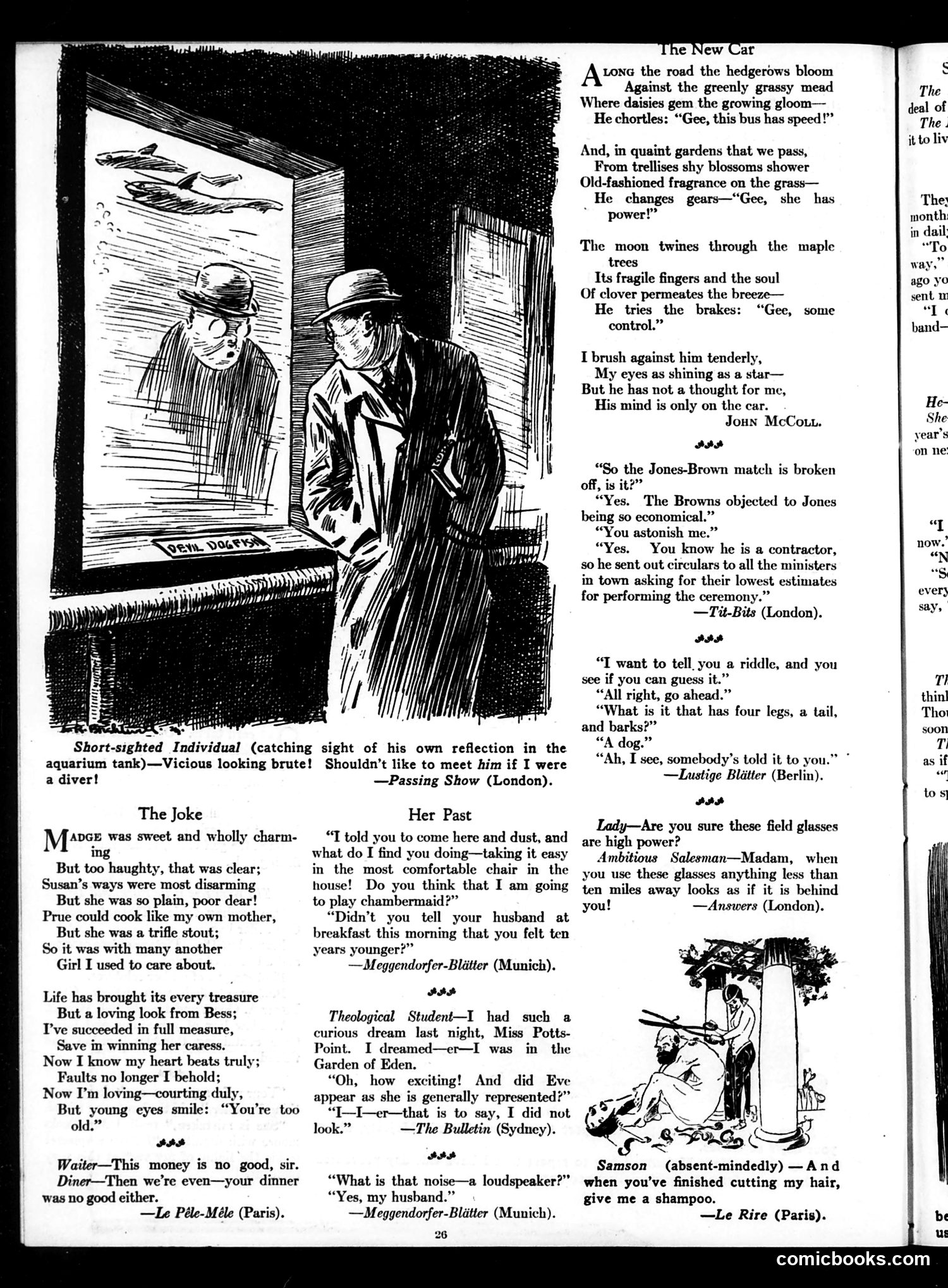
This page from *Judge* magazine contains primarily **humorous short jokes and verses** rather than political cartoons. The main illustrated piece, "The New Car," is a **romantic satire**. It contrasts a woman's tender, poetic observations of nature during a car ride with her male companion's complete indifference to her—his attention fixed entirely on the vehicle's mechanical performance ("Gee, this bus has speed!"). The joke mocks how automotive enthusiasm can eclipse romantic connection. The smaller cartoons and jokes scattered throughout target universal domestic and social situations: a short-sighted man frightened by his own reflection; a woman caught shirking housework; an awkward theological student; a wife sarcastically praising her husband as a "loudspeaker" (nagging); and a contractor so stingy he solicits competitive bids from ministers for wedding ceremonies. **The satire is social rather than political**—targeting vanity, materialism, marital dynamics, and modern consumer culture (the automobile craze). The humor relies on recognizable character types and everyday absurdities rather than specific political figures or events.
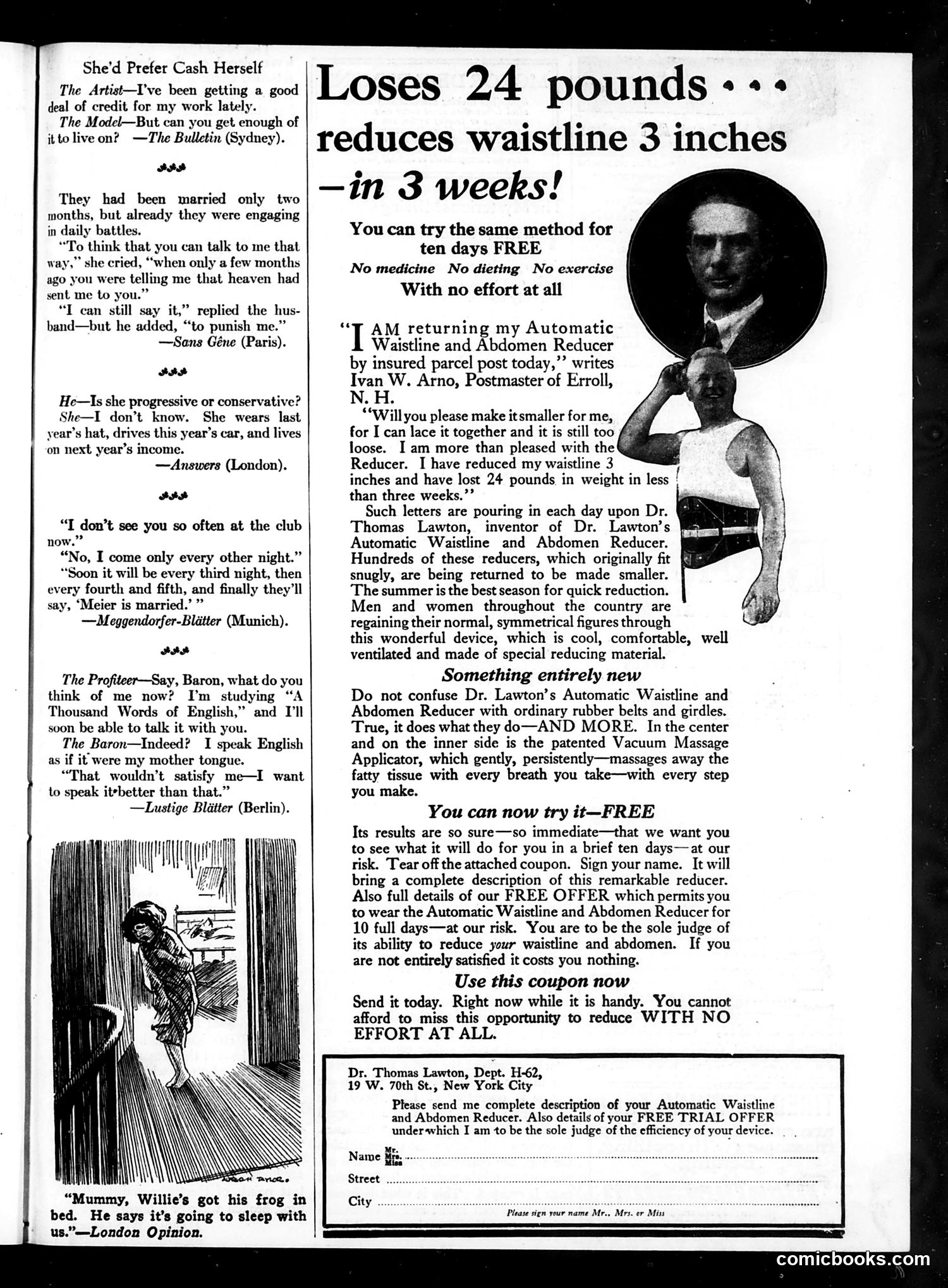
This page combines satirical humor with period advertising. The left side features **short, international jokes** reprinted from various newspapers—typical Judge content mocking marriage ("credit" vs. income), social climbing (mixing old hats with new cars), infidelity, and class pretension (a nouveau-riche "profiteer" studying English to outdo a baron). The right side is a **full-page advertisement** for Dr. Lawton's "Automatic Waistline and Abdomen Reducer"—a mechanical weight-loss device (appears to be a belt with a vacuum massage applicator). It uses a testimonial from a postmaster claiming 24-pound weight loss in 3 weeks with "no effort at all," plus a free 10-day trial offer. **The satire lies in juxtaposition**: Judge's jokes mock vanity and social pretension, while the facing ad exploits exactly those desires—promising effortless transformation. The contrasting messages suggest how advertising preys on the same human weaknesses the jokes ridicule. This reflects early-20th-century skepticism about "miracle" weight-loss claims.
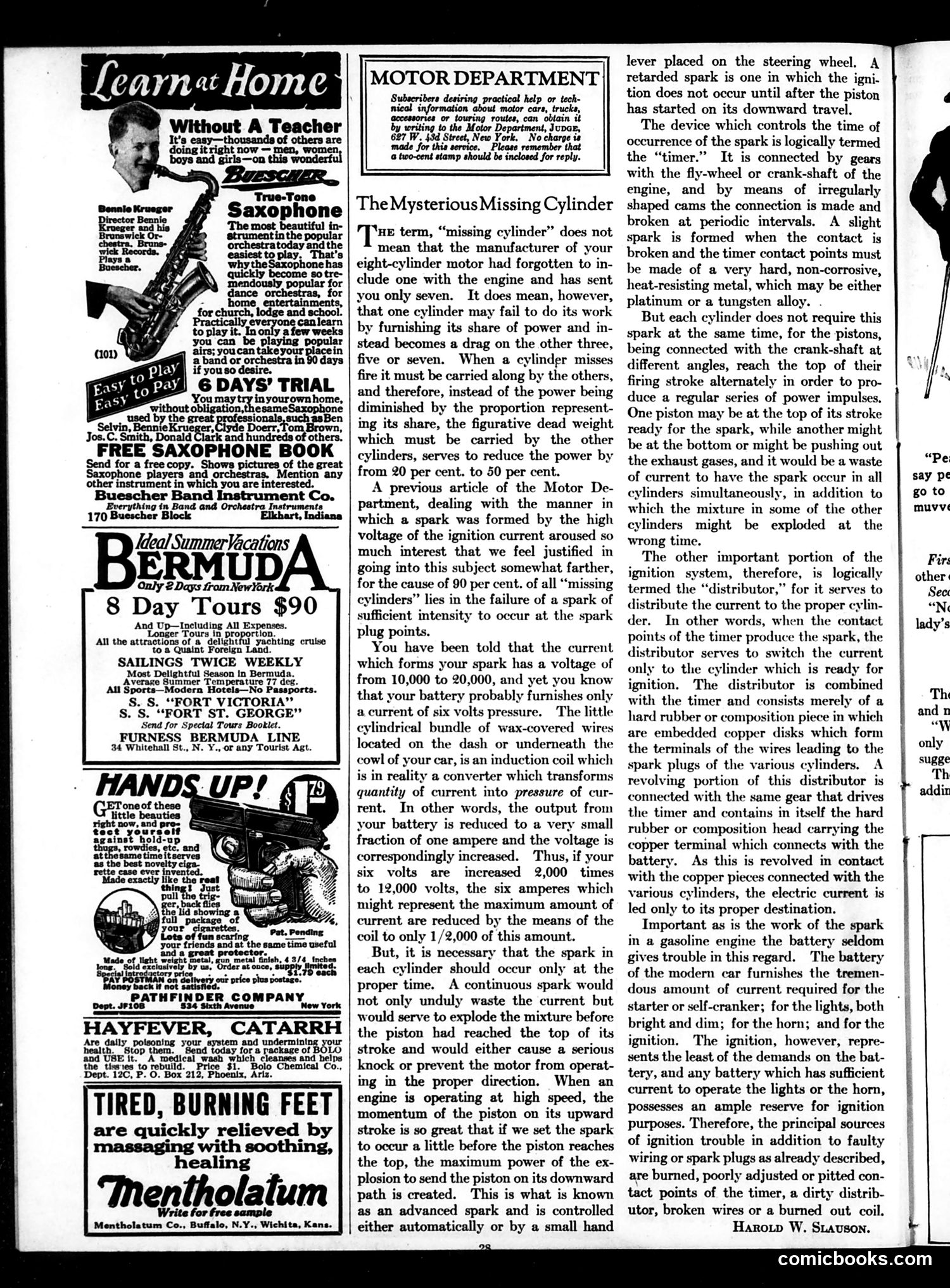
This page is primarily **advertising and instructional content**, not political satire. The dominant feature is a "Motor Department" article titled "The Mysterious Missing Cylinder," a technical explanation of automobile engine problems for general readers. The article addresses a common mechanical issue: when one cylinder in an eight-cylinder engine fails to fire properly, it becomes "dead weight" dragged by the others, reducing overall power output by 20-50%. The author explains that 90% of such failures stem from insufficient spark intensity at the spark plugs, then describes how the ignition system works—converting low-voltage battery current (6 volts) into high-voltage spark (10,000-20,000 volts) through an induction coil. The surrounding content includes **period advertisements** for saxophones, Bermuda vacation cruises, and patent medicines (Mentholatum for feet, Bolo for hay fever). The "Learn at Home" sidebar promotes self-teaching via saxophone instruction. This reflects early 20th-century concerns: automobiles were still relatively new technology requiring explanation for average readers, while the ads target middle-class leisure and health anxieties.
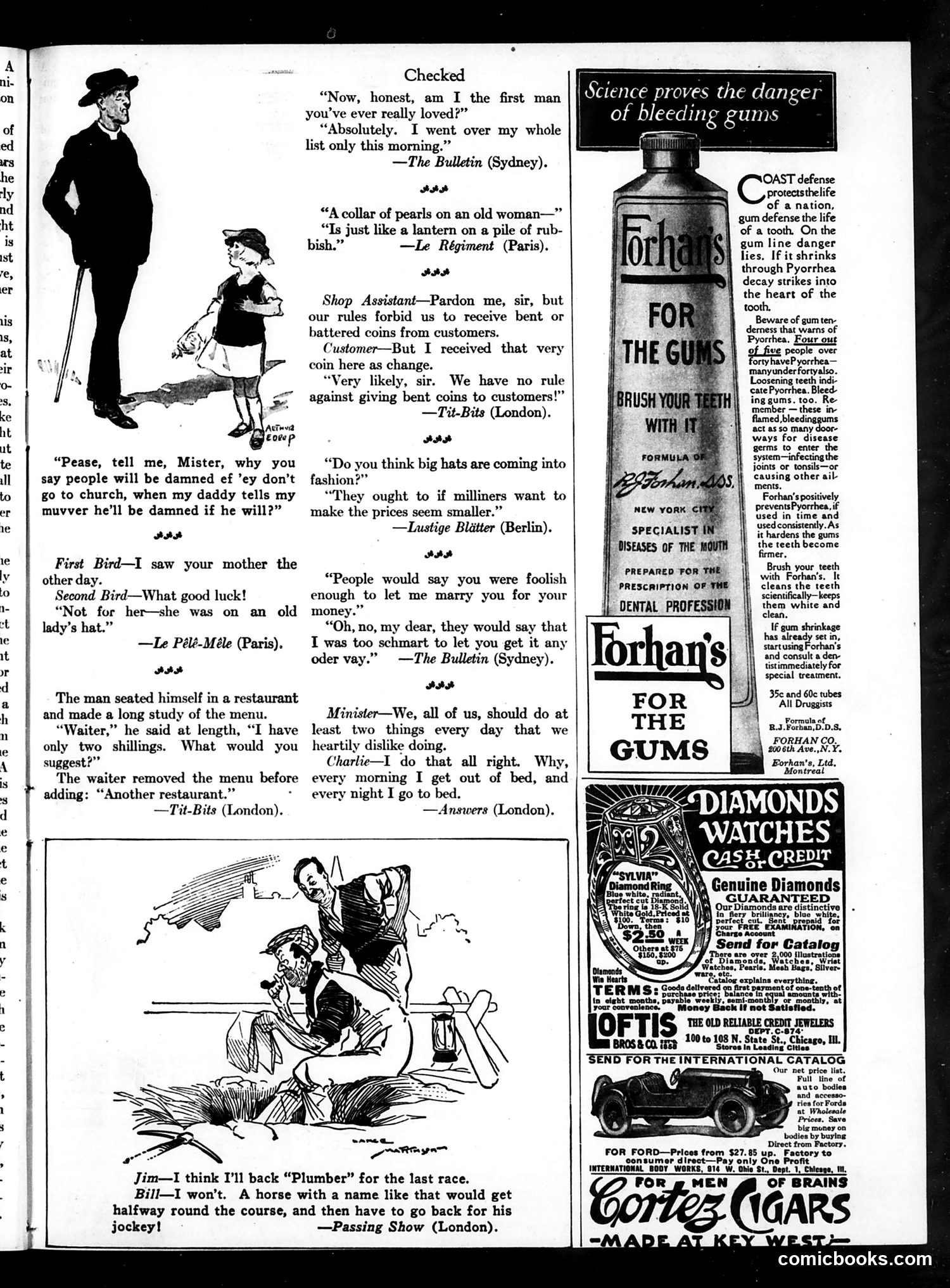
This page from the satirical magazine *Judge* collects brief humorous anecdotes and jokes from international sources, labeled "Checked." The humor relies on wordplay and social observation rather than political commentary. The jokes mock everyday situations: a woman's romantic history, a shop's circular logic about damaged coins, fashion absurdity (oversized hats hiding price increases), and a restaurant's dismissive service. One joke plays on a horse named "Plumber" needing to "go back for his jockey"—a pun on plumbers returning to finish jobs. The cartoons illustrate these anecdotes with simple line drawings. The page also includes period advertisements, notably for Forhan's gum treatment (warning of pyorrhea/gum disease) and jewelry. The sources cited—*The Bulletin* (Sydney), *Tit-Bits* (London), *Le Régiment* (Paris)—suggest *Judge* reprinted international humor, reflecting early 20th-century magazine culture. The content emphasizes gentle satire of consumer culture and domestic life rather than serious political critique.
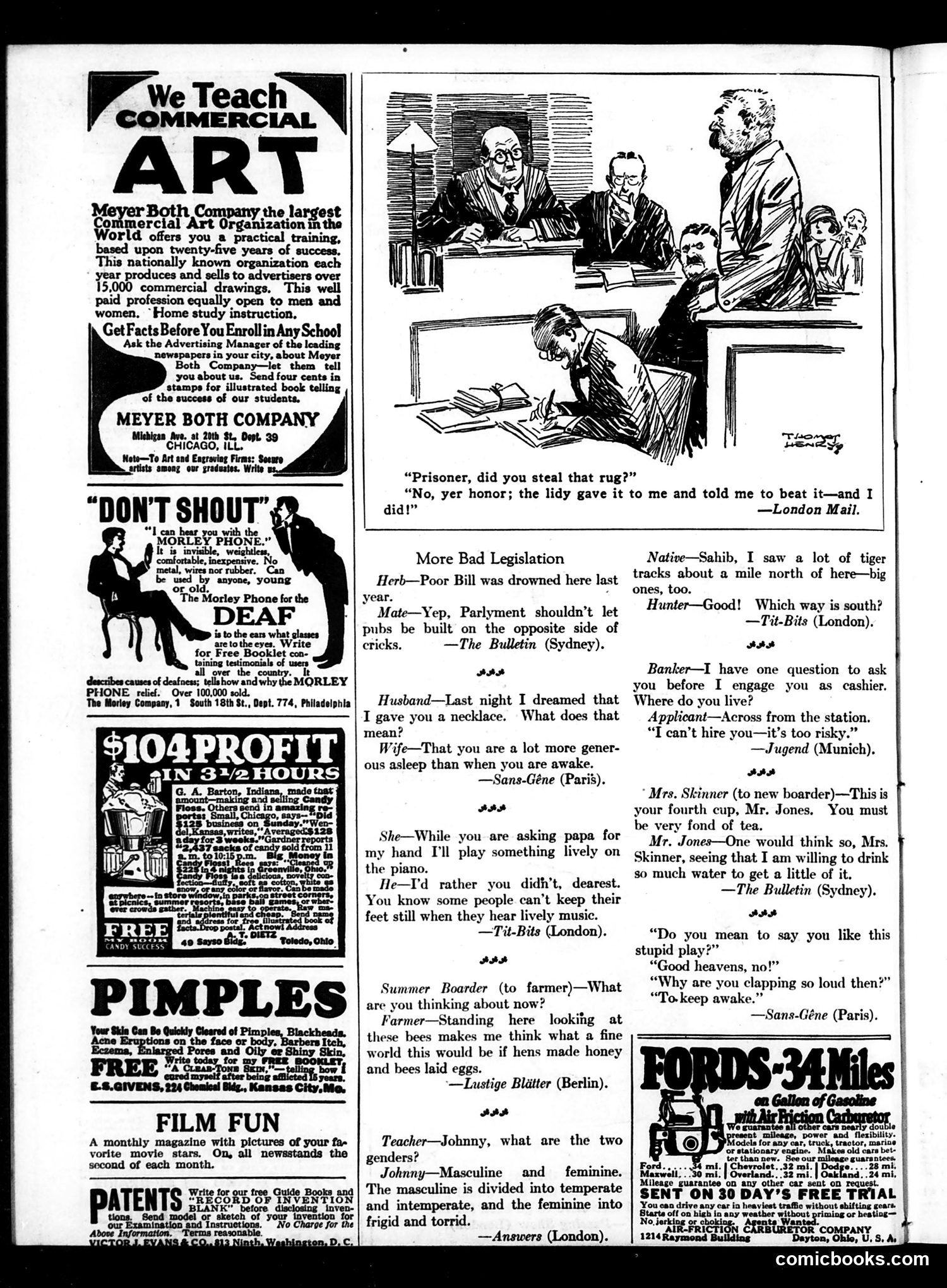
The main cartoon depicts a courtroom scene where a prisoner is accused of stealing a rug. The joke's humor relies on Irish immigrant dialect and working-class stereotypes common in early 20th-century satire. The prisoner claims the woman gave him the rug and told him to "beat it"—he literally beat the rug (a common household chore) rather than fleeing, misunderstanding her instruction. The page is primarily **advertising and humor fillers** rather than political satire. It includes ads for commercial art training, a hearing device ("Morley Phone"), and Ford automobiles. The scattered jokes—sourced from international publications like *Tit-Bits*, *Sans-Géne*, and *Lustige Blatter*—are lighthearted domestic humor about marriages, summer boarders, and theater patrons, reflecting genteel magazine comedy of the era. There is no significant political content on this page.
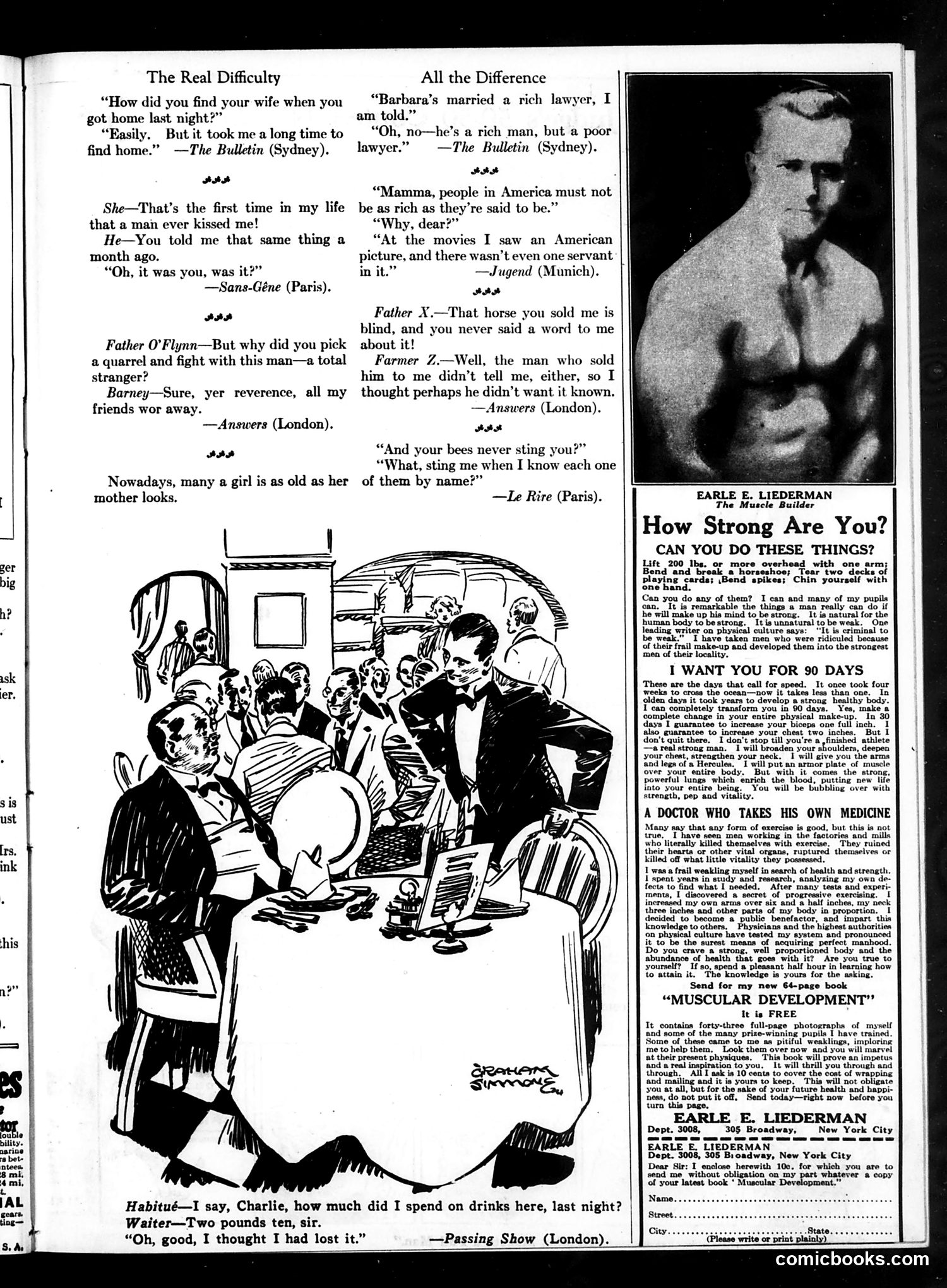
This page from *Judge* magazine contains two sections: **Left side:** A collection of brief satirical jokes sourced from international publications (*The Bulletin*, *Sans-Géne*, *Answers*, *Jugend*, *Le Rire*, *Passing Show*). The humor relies on wordplay and ironic twists—a man can't find his home but finds his wife; a woman repeats the same lie to different men; a farmer unknowingly sells a blind horse; a drunk patron forgets he's been drinking. These reflect common early-20th-century comedy tropes about marriage troubles, dishonesty, and drunkenness. **Right side:** A full-page advertisement for Earle E. Liederman's muscle-building correspondence course. Promising dramatic physical transformation in 90 days—including increased arm and chest size, stronger physique, and athletic prowess—this exemplifies early mail-order fitness schemes. The ad appeals to readers' insecurities about weakness, claiming Liederman himself transformed from "frail weakling" to strong man through his method. Such advertisements were common in magazines targeting male readers.
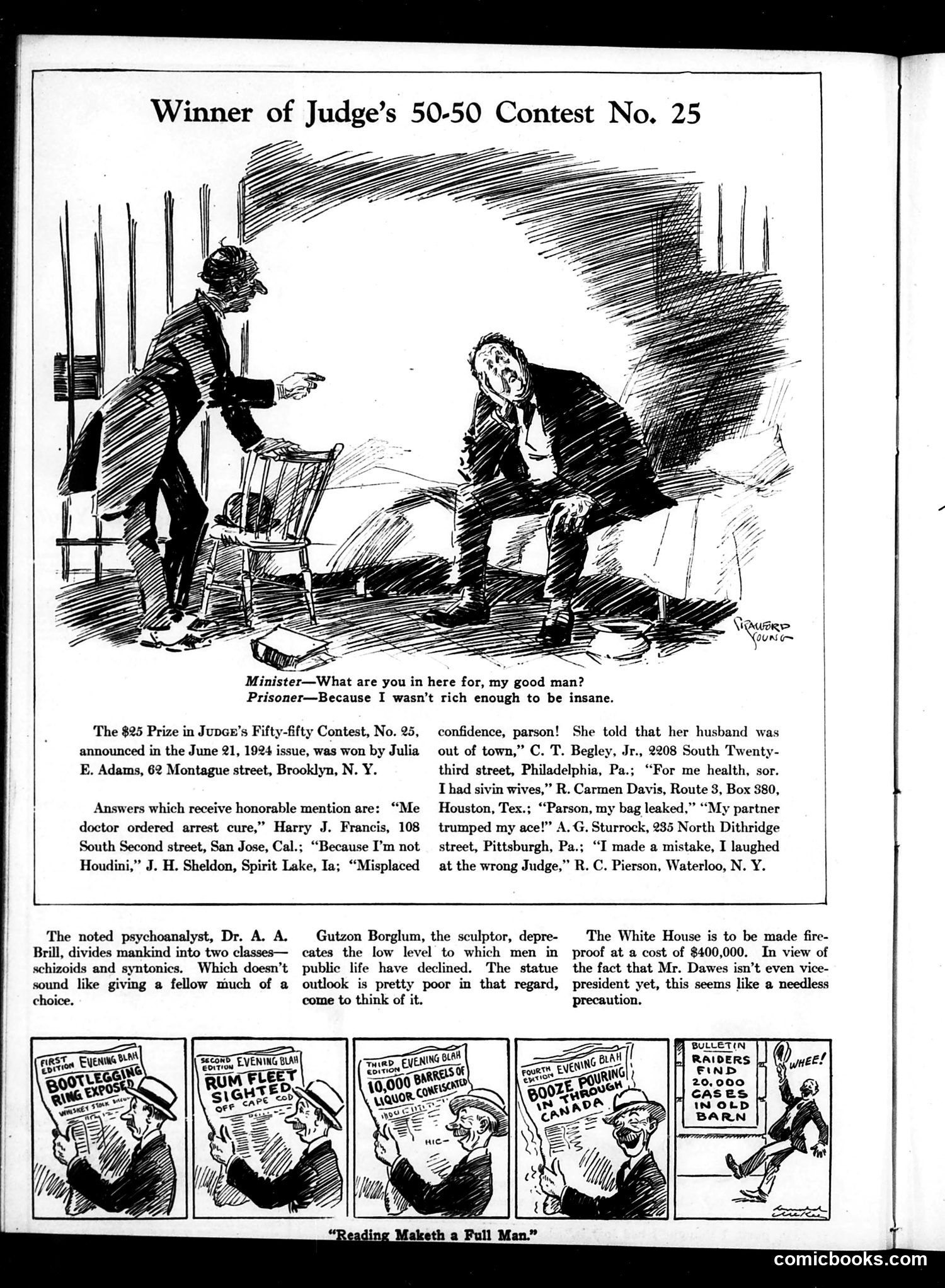
The main cartoon satirizes wealth-based inequality in the criminal justice system. A minister visits a prisoner who explains he's incarcerated simply for lacking money—implying that wealthy individuals, even when mentally unstable, escape prosecution or face milder treatment. The joke inverts the expected logic: normally insanity might excuse crime, but here poverty is the actual "crime." The page also features Judge's "Fifty-fifty Contest" (a humor competition), with winning and honorable-mention submissions offering humorous reasons for various misfortunes—mostly working-class complaints. Lower sections reference contemporary figures: psychoanalyst Dr. A.A. Brill and sculptor Gutzon Borglum, commenting on public decline. A final note mocks spending $400,000 to fireproof the White House when Vice President Charles Dawes "isn't even vice-president yet"—likely satirizing unnecessary government expenditure or premature security measures. The comic strip "Reading Maketh a Full Man" at bottom appears unrelated.
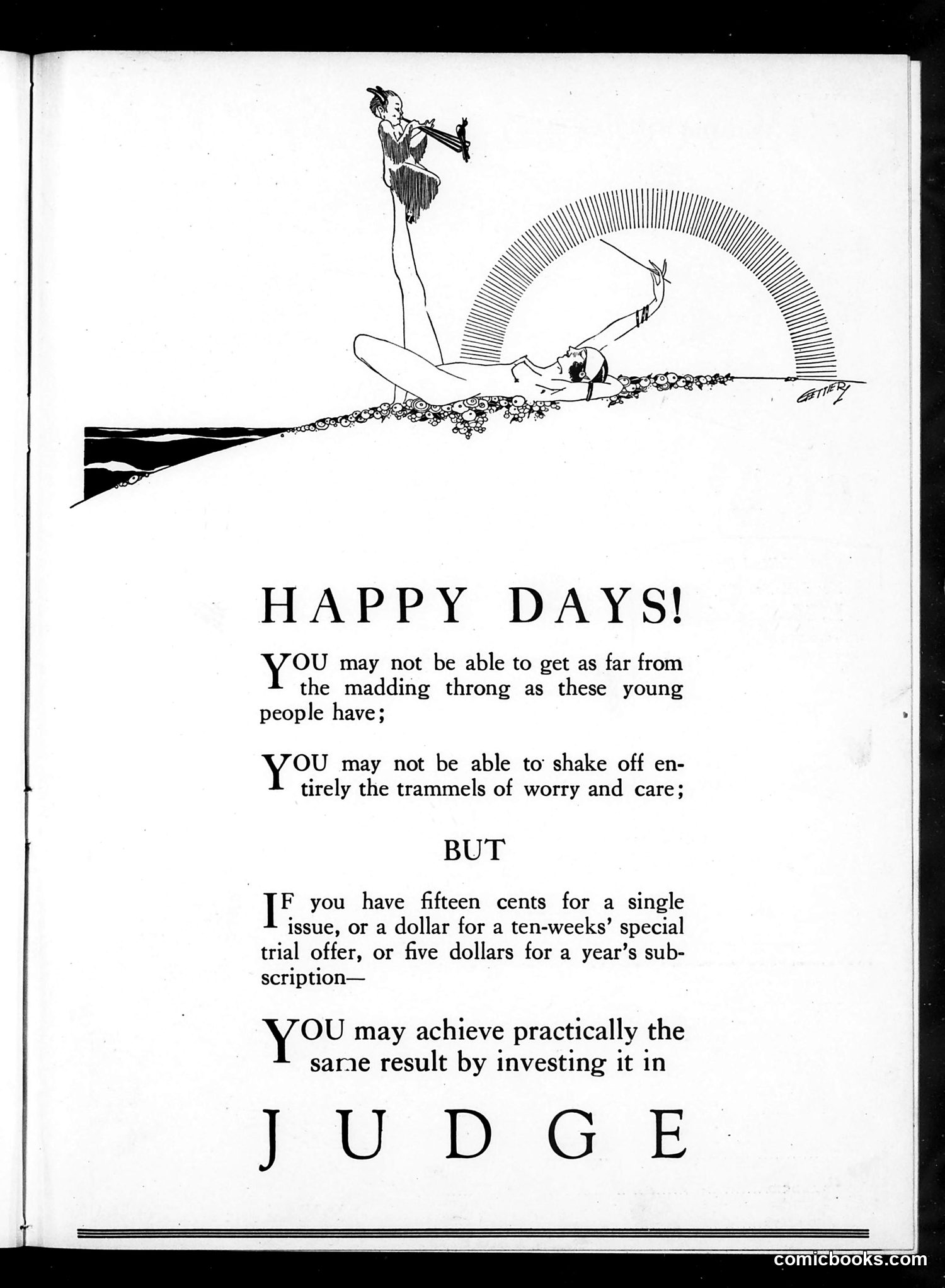
This is a **subscription advertisement**, not a political cartoon. The illustration shows two stylized young figures in 1920s attire relaxing on a beach or seaside setting, appearing carefree and distant from urban crowds. The text uses a "happy days" pitch common to leisure magazines of the era. It acknowledges that most readers cannot escape daily worries and "the madding throng" (referencing Thomas Gray's poetry), but proposes that **subscribing to Judge magazine offers an affordable mental escape**—for 15 cents per issue, $1 for a trial, or $5 yearly. The satire is gentle: the ad humorously suggests that while you can't actually achieve the relaxation shown in the illustration, Judge's humor and entertainment provide "practically the same result" as a real vacation. This reflects Judge's positioning as aspirational entertainment for middle-class readers seeking relief from modern anxieties.
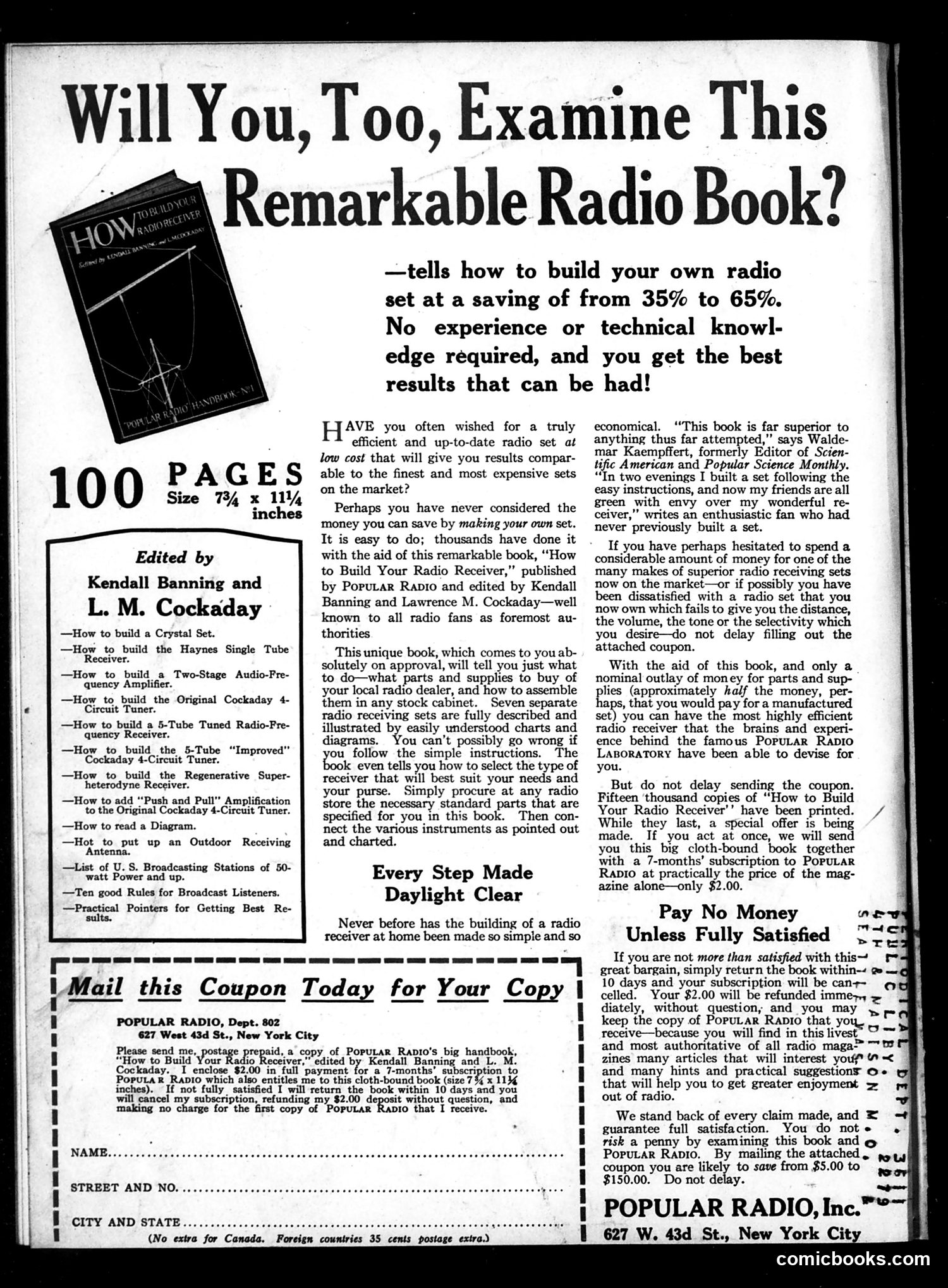
This is primarily a **full-page advertisement**, not a cartoon or satirical content. It promotes a radio-building handbook published by *Popular Radio* magazine, edited by Kendall Banning and L.M. Cockaday. **Context:** This appears from the early 1920s radio boom era, when radio was cutting-edge consumer technology. The advertisement targets hobbyists and cost-conscious consumers by promising 35-65% savings through DIY assembly. **The Appeal:** The pitch emphasizes simplicity ("no experience or technical knowledge required") and includes testimonials from authority figures like Waldemar Kaempffert (a real science editor). The "on approval" guarantee and urgency ("fifteen thousand copies printed") are classic sales tactics. **What's Notable:** This reflects genuine 1920s enthusiasm for radio as an accessible technology project—not satirical commentary. The detailed table of contents shows genuine technical instruction for building various receiver types, from crystal sets to complex superheterodyne receivers.

I can see this is a page from *Judge* magazine, but the image quality is too poor for me to make out specific cartoon details, figures, or text with confidence. The right side shows what appears to be decorative patterning or possibly a repeated illustration, while the left side is largely blank or black. There's a measurement scale visible on the left edge, suggesting this is a scan of archival material. Without being able to clearly discern the specific content—whether this is a cartoon, advertisement, or editorial material—I cannot accurately identify the figures, political references, or satire involved. To provide reliable historical context, I would need a clearer image.