
Judge, 1924-08-02 · page 30 of 37
Judge — August 2, 1924 — page 30: what you’re looking at
What you’re looking at
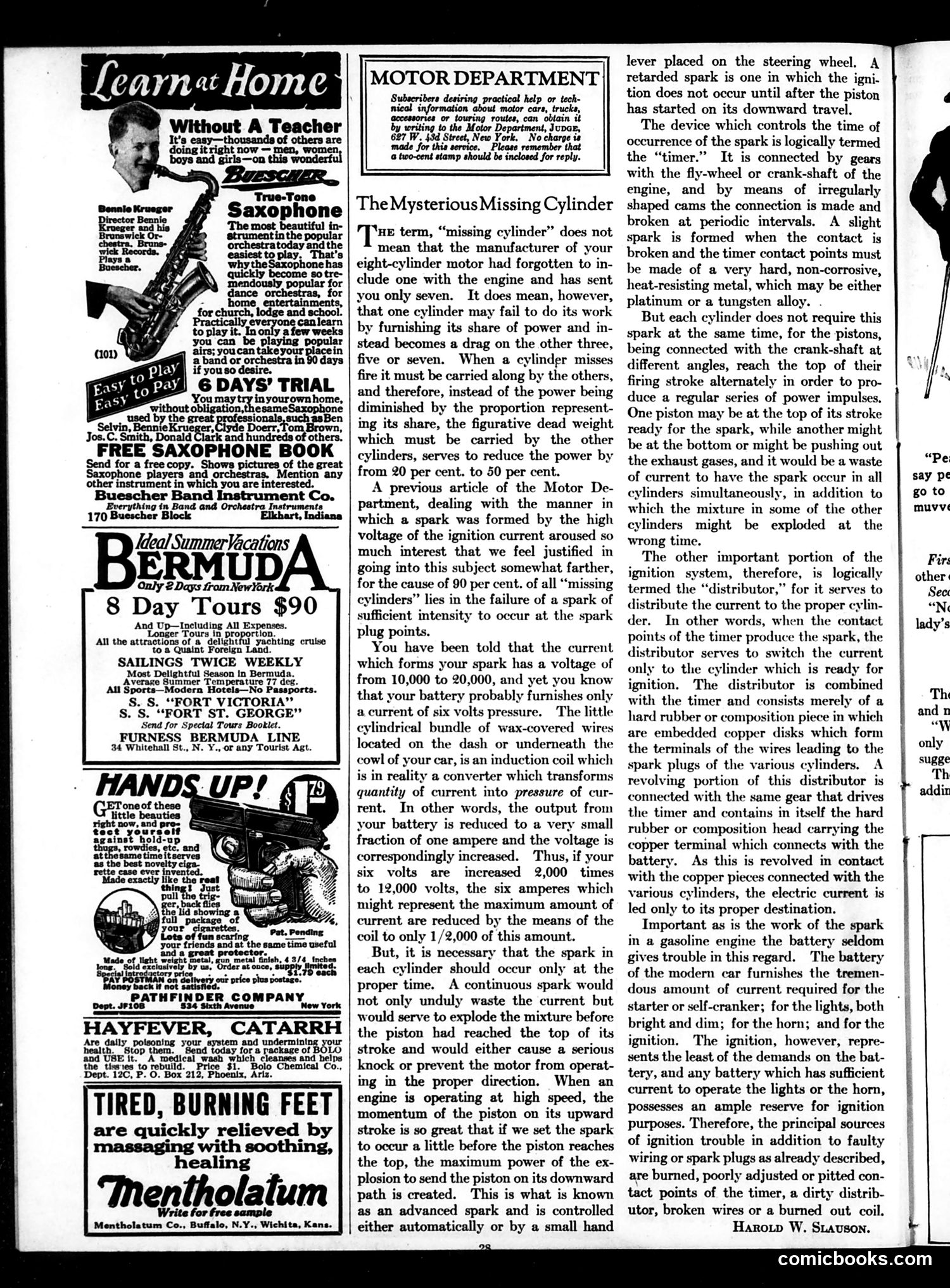
This page is primarily **advertising and instructional content**, not political satire. The dominant feature is a "Motor Department" article titled "The Mysterious Missing Cylinder," a technical explanation of automobile engine problems for general readers. The article addresses a common mechanical issue: when one cylinder in an eight-cylinder engine fails to fire properly, it becomes "dead weight" dragged by the others, reducing overall power output by 20-50%. The author explains that 90% of such failures stem from insufficient spark intensity at the spark plugs, then describes how the ignition system works—converting low-voltage battery current (6 volts) into high-voltage spark (10,000-20,000 volts) through an induction coil. The surrounding content includes **period advertisements** for saxophones, Bermuda vacation cruises, and patent medicines (Mentholatum for feet, Bolo for hay fever). The "Learn at Home" sidebar promotes self-teaching via saxophone instruction. This reflects early 20th-century concerns: automobiles were still relatively new technology requiring explanation for average readers, while the ads target middle-class leisure and health anxieties.
📄 Transcribed text from this page (OCR, searchable)
Machine-transcribed from the original scan — historical spelling and the odd misread are preserved.
Learn« Home Without A Teacher others are : Wee ear manda ot boys and girls—on this wonderful True-Tone Saxophone soda mine a You may t .soureSagopuané sameSexophone rr fomprown, t Everything in Band and Orchestra Instrument 170 Buescher Biock "Ellbart, Indi deal Summer Vacations Only 2 Days fromNewYork. 8 Day Tours $90 And Up-—Including All Expenses. ‘Tours in Ete yachting cruise All the axeractions of a delig ‘@ Quaint Fore! SAILINGS TWICE. WEEKLY . S. “FORT VICTORIA” S. S. “FORT ST. GEORGE” ‘Send for Spectal Tours Booklet. FURNESS BERMUDA LINE 34 Whitehall St., N. Y.,or any Tourist Agt. of fan searing ideo your friends and at the sametime useful n, metal finish. 4 3/4, inches rea ‘each weient petal, New York HAYFEVER, CATARRH olecaing your eystem and undermining your nd today for a package of BOLO it. gal ras hich cleanees aad belpe the, she 10 rebuild... Price Fi Bato ‘Chen . Box 212, Phoenix, Ariz. TIRED, BURNING FEET are cruielcty. relieved by massaging with soothing, healing “‘Ientholatum Mentholatum Co., Buffalo, N.Y., Wichita, MOTOR DEPARTMENT nel prt aon Seat practical help or tech- about motor cara, trucks, The Mysterious Missing Cylinder T= term, “missing cylinder” does not mean that the manufacturer of your eight-cylinder motor had forgotten to in- clude one with the engine and has sent you only seven. It does mean, however, that one cylinder may fail to do its work by furnishing its share of power and in- stead becomes a drag on the other three, five or seven. When a cylinder misses fire it must be carried along by the others, and therefore, instead of the power being diminished by the proportion represent- ing its share, the figurative dead weight which must be carried by the other cylinders, serves to reduce the power by from 20 per cent. to 50 per cent. A previous article of the Motor De- partment, dealing with the manner in which a spark was formed by the high voltage of the ignition current aroused so much interest that we feel justified in going into this subject somewhat farther, for the cause of 90 per cent. of all “missing cylinders” lies in the failure of a spark of sufficient intensity to occur at the spark plug points. You have been told that the current which forms your spark has a voltage of from 10,000 to 20,000, and yet you know that your battery probably furnishes only a current of six volts pressure. The little cylindrical bundle of wax-covered wires located on the dash or underneath the cowl of your car, is an induction coil which is in reality a converter which transforms quantity of current into pressure of cur- rent. In other words, the output from your battery is reduced to a very small fraction of one ampere and the voltage is correspondingly increased. Thus, if your six volts are increased 2,000 times to 12,000 volts, the six amperes which might represent the maximum amount of current are reduced by the means of the coil to only 1/2,000 of this amount. But, it is necessary that the spark in each cylinder should occur only at the proper time. A continuous spark would not only unduly waste the current but would serve to explode the mixture before the piston had reached the top of its stroke and would either cause a serious knock or prevent the motor from operat- ing in the proper direction. When an engine is operating at high speed, the momentum of the piston on its upward stroke is so great that if we set the spark to occur a little before the piston reaches the top, the maximum power of the ex- plosion to send the piston on its downward path is created. This is what is known as an advanced spark and is controlled either automatically or by a small hand lever placed on the steering wheel. A retarded spark is one in which the igni- tion does not occur until after the piston has started on its downward travel. The device which controls the time of occurrence of the spark is logically termed the “timer.” It is connected by gears with the fly-wheel or crank-shaft of the engine, and by means of irregularly shaped cams the connection is made and broken at periodic intervals. A slight spark is formed when the contact is broken and the timer contact points must be made of a very hard, non-corrosive, heat-resisting metal, which may be either platinum or a tungsten alloy. But each cylinder does not require this spark at the same time, for the pistons, being connected with the crank-shaft at different angles, reach the top of their firing stroke alternately in order to pro- duce a regular series of power impulses. One piston may be at the top of its stroke ready for the spark, while another might be at the bottom or might be pushing out the exhaust gases, and it would be a waste of current to have the spark occur in all cylinders simultaneously, in addition to which the mixture in some of the other cylinders might be exploded at the wrong time. The other important portion of the ignition system, therefore, is logically termed the “distributor,” for it serves to distribute the current to the proper cylin- der. In other words, when the contact points of the timer produce the spark, the distributor serves to switch the current only to the cylinder which is ready for ignition. The distributor is combined with the timer and consists merely of a hard rubber or composition piece in which are embedded copper disks which form the terminals of the wires leading to the spark plugs of the various cylinders. A revolving portion of this distributor is connected with the same gear that drives the timer and contains in itself the hard rubber or composition head carrying the copper terminal which connects with the battery. As this is revolved in contact with the copper pieces connected with the various cylinders, the electric current is led only to its proper destination. Important as is the work of the spark in a gasoline engine the battery seldom gives trouble in this regard. The battery of the modern car furnishes the tremen- dous amount of current required for the starter or self-cranker; for the lights, both bright and dim; for the horn; and for the ignition. The ignition, however, repre- sents the least of the demands on the bat- tery, and any battery which has sufficient current to operate the lights or the horn, possesses an ample reserve for ignition purposes. Therefore, the principal sources of ignition trouble in addition to faulty wiring or spark plugs as already described, are burned, poorly adjusted or pitted con- tact points of the timer, a dirty distrib- utor, broken wires or a burned out coil. Hanowp W. Stavson. “Pe say pe go to muvv Firs other. Sec “Ne lady’s Th and n “W only sugge addin comicbooks.com