
Judge, 1924-08-02 · page 25 of 37
Judge — August 2, 1924 — page 25: what you’re looking at
What you’re looking at
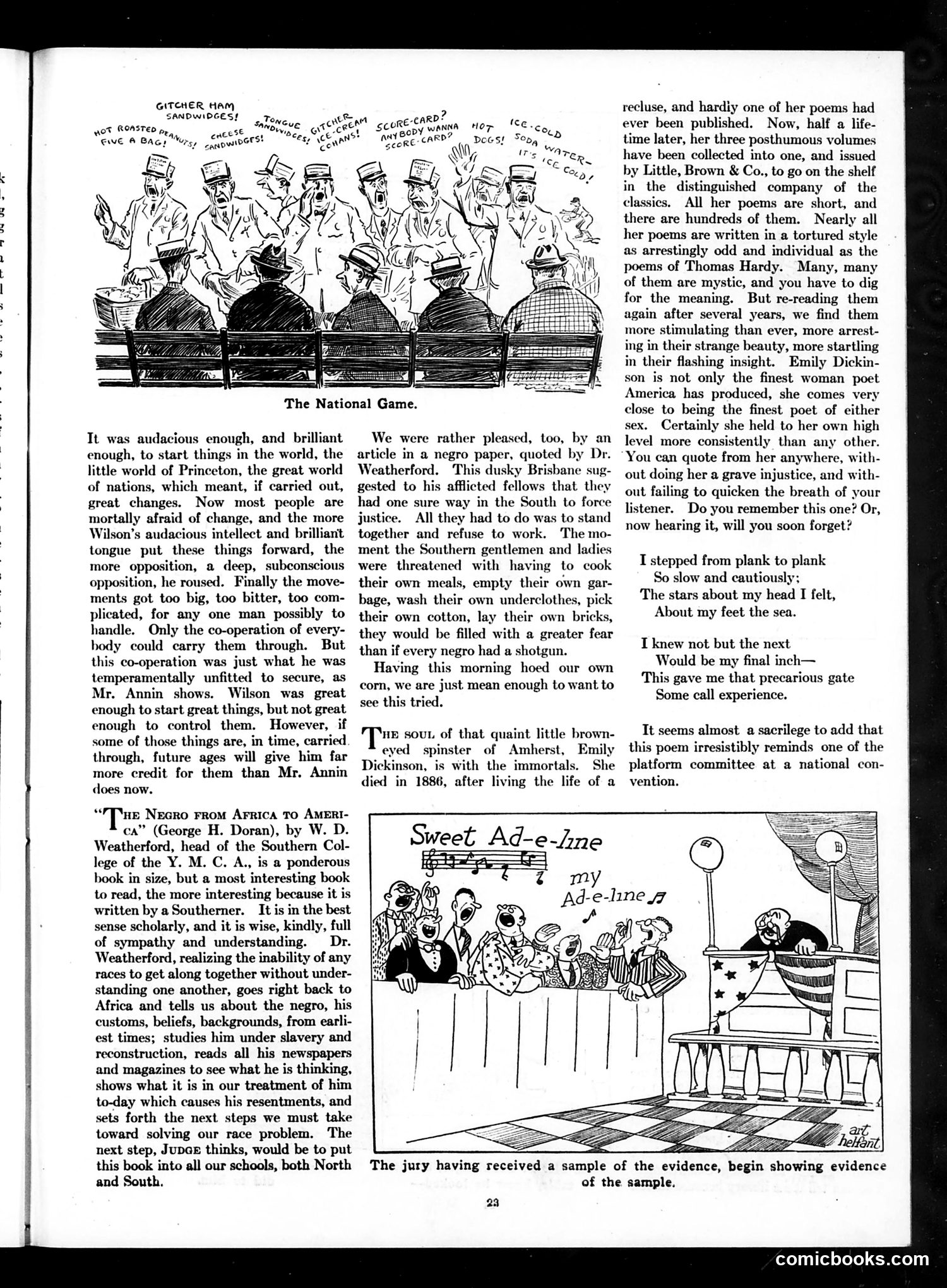
**The Main Cartoon:** Shows men in top hats at a fence labeled "Gitcher Ham Sandwidges!" hawking various political offerings ("Hot Roasted," "Tongue," "Scure-Card," etc.). This satirizes **Woodrow Wilson's** political initiatives—the cartoon criticizes Wilson as someone intellectually brilliant enough to initiate major reforms but temperamentally unable to manage their implementation or build necessary coalitions. The "sandwiches" represent his various policy proposals being sold to the public. **Key Points:** The text explicitly names Wilson, discussing how his "audacious" progressive agenda generated opposition he couldn't control. The satire suggests his idealism outpaced his practical leadership abilities—he could "start great things" but lacked the cooperative temperament to see them through. **Secondary Content:** The page also includes commentary on a book about African American history and a tribute to Emily Dickinson's poetry, unrelated to the cartoon's satirical message.
📄 Transcribed text from this page (OCR, searchable)
Machine-transcribed from the original scan — historical spelling and the odd misread are preserved.
GITCHER Ham SANDWIDGES! ot ROMSTED py 4, EVE B BAG, Mrs, Cd! The National Game. It was audacious enough, and brilliant enough, to start things in the world, the little world of Princeton, the great world of nations, which meant, if carried out, great changes. Now most people are mortally afraid of change, and the more Wilson’s audacious intellect and brilliant tongue put these things forward, the more opposition, a deep, subconscious opposition, he roused. Finally the move- ments got too big, too bitter, too com- plicated, for any one man possibly to handle. Only the co-operation of every- body could carry them through. But this co-operation was just what he was temperamentally unfitted to secure, as Mr. Annin shows. Wilson was great enough to start great things, but not great enough to control them. However, if some of those things are, in time, carried through, future ages will give him far more credit for them than Mr, Annin does now. “Tne Necro FroM AFRICA TO AMERI- ca” (George H. Doran), by W. D. Weatherford, head of the Southern Col- lege of the Y. M. C. A., is a ponderous book in size, but a most interesting book to read, the more interesting because it is written by a Southerner. It is in the best sense scholarly, and it is wise, kindly, full of sympathy and understanding. Dr. Weatherford, realizing the inability of any races to get along together without under- standing one another, goes right back to Africa and tells us about the negro, his customs, beliefs, backgrounds, from earli- est times; studies him under slavery and reconstruction, reads all his newspapers and magazines to see what he is thinking, shows what it is in our treatment of him to-day which causes his resentments, and sets forth the next steps we must take toward solving our race problem. The next step, Jupce thinks, would be to put this book into all our schools, both North and South. We were rather pleased, too, by an article in a negro paper, quoted by Dr. Weatherford. This dusky Brisbane sug- gested to his afflicted fellows that they had one sure way in the South to force justice. All they had to do was to stand together and refuse to work. The mo- ment the Southern gentlemen and ladies were threatened with having to cook their own meals, empty their own gar- bage, wash their own underclothes, pick their own cotton, lay their own bricks, they would be filled with a greater fear than if every negro had a shotgun. Having this morning hoed our own corn, we are just. mean enough to want to see this tried. NE souL of that quaint little brown- eyed spinster of Amherst, Emily Dickinson, is with the immortals. She died in 1886, after living the life of a Sweet Ad-e-hne my Ad-e-hne yy recluse, and hardiy one of her poems had ever been published. Now, half a life- time later, her three posthumous volumes have been collected into one, and issued by Little, Brown & Co., to go on the shelf in the distinguished company of the classics. All her poems are short, and there are hundreds of them. Nearly all her poems are written in a tortured style as arrestingly odd and individual as the poems of Thomas Hardy. Many, many of them are mystic, and you have to dig for the meaning. But re-reading them again after several years, we find them more stimulating than ever, more arrest- ing in their strange beauty, more startling in their flashing insight. Emily Dickin- son is not only the finest woman poet America has produced, she comes very close to being the finest poet of either sex. Certainly she held to her own high level more consistently than any other. You can quote from her anywhere, with- out doing her a grave injustice, and with- out failing to quicken the breath of your listener. Do you remember this one? Or, now hearing it, will you soon forget? I stepped from plank to plank So slow and cautiously; The stars about my head I felt, About my feet the sea. I knew not but the next Would be my final inch— This gave me that precarious gate Some call experience. It seems almost a sacrilege to add that this poem irresistibly reminds one of the platform committee at a national con- vention. oN of the sample. 23 comicbooks.com