
Judge, 1924-08-02 · page 22 of 37
Judge — August 2, 1924 — page 22: what you’re looking at
What you’re looking at
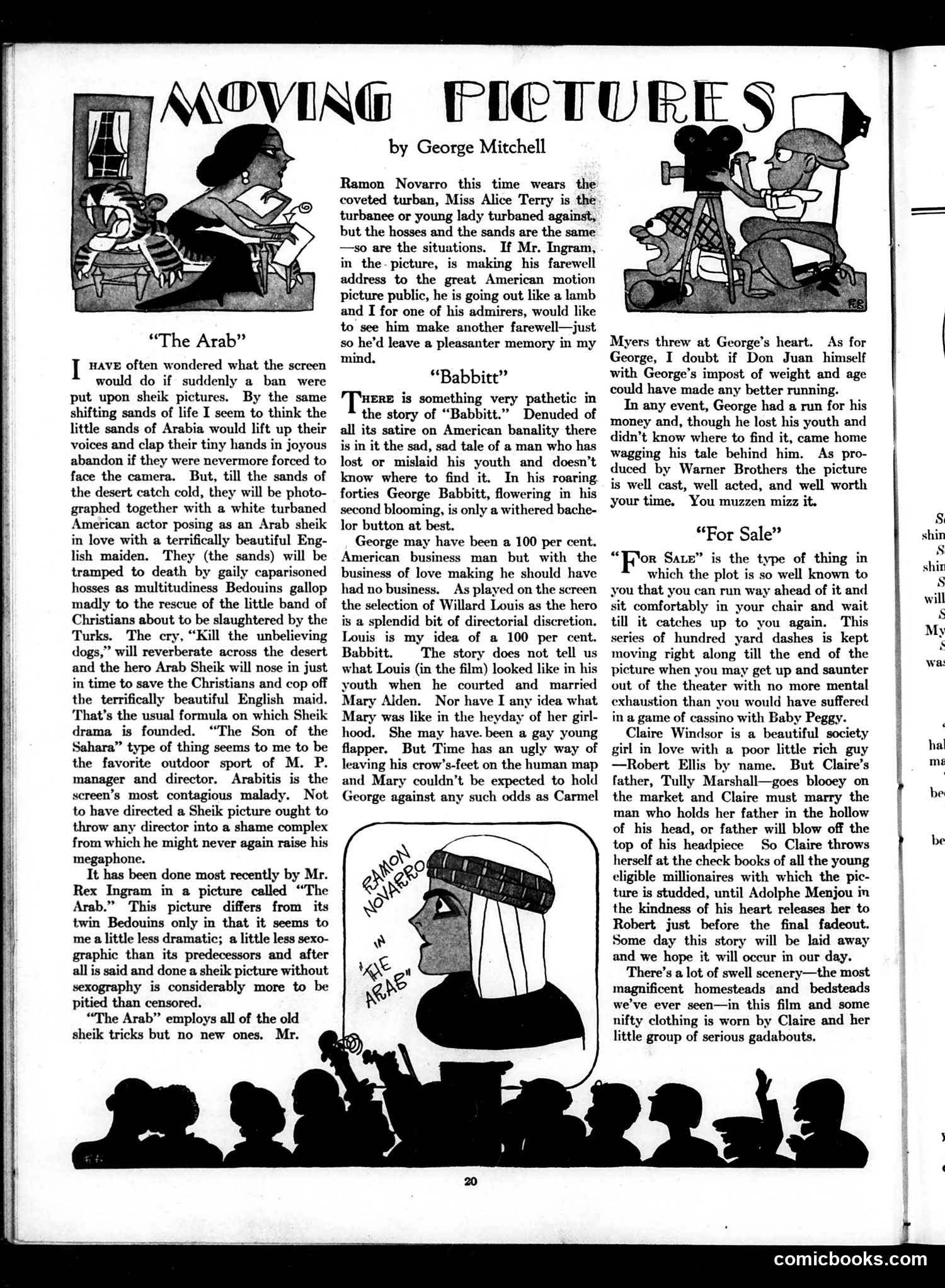
This page reviews three recent films, critiquing Hollywood's reliance on formulaic "Sheik" movies. Mitchell mocks the genre's predictable plot: a white American actor (here Ramon Novarro in "The Arab") poses as an Arab sheik rescuing a beautiful English woman from Bedouins and Turks. Mitchell notes director Rex Ingram repeats all the old conventions without innovation—the "sexography" is notably absent, making it "more to be pitied than censored." The reviews of "Babbitt" and "For Sale" follow similar patterns, examining character casting and narrative construction. The satire targets Hollywood's obsession with proven formulas over originality, and the racial/orientalist stereotyping embedded in "Sheik" pictures that dominated 1920s cinema. Mitchell essentially argues these films are exhausted entertainment relying on tired tropes rather than artistic merit.
📄 Transcribed text from this page (OCR, searchable)
Machine-transcribed from the original scan — historical spelling and the odd misread are preserved.
“The Arab” HAVE often wondered what the screen would do if suddenly a ban were put upon sheik pictures. By the same shifting sands of life I seem to think the little sands of Arabia would lift up their voices and clap their tiny hands in joyous abandon if they were nevermore forced to face the camera. But, till the sands of the desert catch cold, they will be photo- graphed together with a white turbaned American actor posing as an Arab sheik in love with a terrifically beautiful Eng- lish maiden. They (the sands) will be tramped to death by gaily caparisoned hosses as multitudiness Bedouins gallop madly to the rescue of the little band of Christians about to be slaughtered by the Turks. The cry, “Kill the unbelieving dogs,” will reverberate across the desert and the hero Arab Sheik will nose in just in time to save the Christians and cop off the terrifically beautiful English maid. That’s the usual formula on which Sheik drama is founded. “The Son of the Sahara” type of thing seems to me to be the favorite outdoor sport of M. P. manager and director. Arabitis is the screen’s most contagious malady. Not to have directed a Sheik picture ought to throw any director into a shame complex from which he might never again raise his megaphone. It has been done most recently by Mr. Rex Ingram in a picture called “The Arab.” This picture differs from its twin Bedouins only in that it seems to me a little less dramatic; a little less sexo- graphic than its predecessors and after all is said and done a sheik picture without sexography is considerably more to be pitied than censored. “The Arab” employs all of the old sheik tricks but no new ones. Mr. by George Mitchell Ramon Novarro this time wears the coveted turban, Miss Alice Terry is the turbanee or young lady turbaned against, but the hosses and the sands are the same —so are the situations. If Mr. Ingram, in the- picture, is making his farewell address to the great American motion picture public, he is going out like a lamb and I for one of his admirers, would like to see him make another farewell—just so he’d leave a pleasanter memory in my mind. “Babbitt” 4 i is something very pathetic in the story of “Babbitt.” Denuded of all its satire on American banality there is in it the sad, sad tale of a man who has lost or mislaid his youth and doesn’t know where to find it. In his roaring. forties George Babbitt, flowering in his second blooming, is only a withered bache- lor button at best. George may have been a 100 per cent. American business man but with the business of love making he should have had no business. As played on the screen the selection of Willard Louis as the hero is a splendid bit of directorial discretion. Louis is my idea of a 100 per cent. Babbitt. The story does not tell us what Louis (in the film) looked like in his youth when he courted and married Mary Alden. Nor have I any idea what Mary was like in the heyday of her girl- hood. She may have. been a gay young flapper. But Time has an ugly way of leaving his crow’s-feet on the human map and Mary couldn’t be expected to hold George against any such odds as Carmel Myers threw at George’s heart. As for George, I doubt if Don Juan himself with George’s impost of weight and age could have made any better running. In any event, George had a run for his money and, though he lost his youth and didn’t know where to find it, came home wagging his tale behind him. As pro- duced by Warner Brothers the picture is well cast, well acted, and well worth your time. You muzzen mizz it. “For Sale” lor SALE” is the type of thing in which the plot is so well known to you that you can run way ahead of it and sit comfortably in your chair and wait till it catches up to you again. This series of hundred yard dashes is kept moving right along till the end of the picture when you may get up and saunter out of the theater with no more mental exhaustion than you would have suffered in a game of cassino with Baby Peggy. Claire Windsor is a beautiful society girl in love with a poor little rich guy —Robert Ellis by name. But Claire’s father, Tully Marshall—goes blooey on the market and Claire must marry the man who holds her father in the hollow of his head, or father will blow off the top of his headpiece So Claire throws herself at the check books of all the young eligible millionaires with which the pic- ture is studded, until Adolphe Menjou in the kindness of his heart releases her to Robert just before the final fadeout. Some day this story will be laid away and we hope it will occur in our day. There’s a lot of swell scenery—the most magnificent homesteads and bedsteads we've ever seen—in this film and some nifty clothing is worn by Claire and her little group of serious gadabouts. \| comicbooks.com