
Judge, 1924-08-02 · page 24 of 37
Judge — August 2, 1924 — page 24: what you’re looking at
What you’re looking at
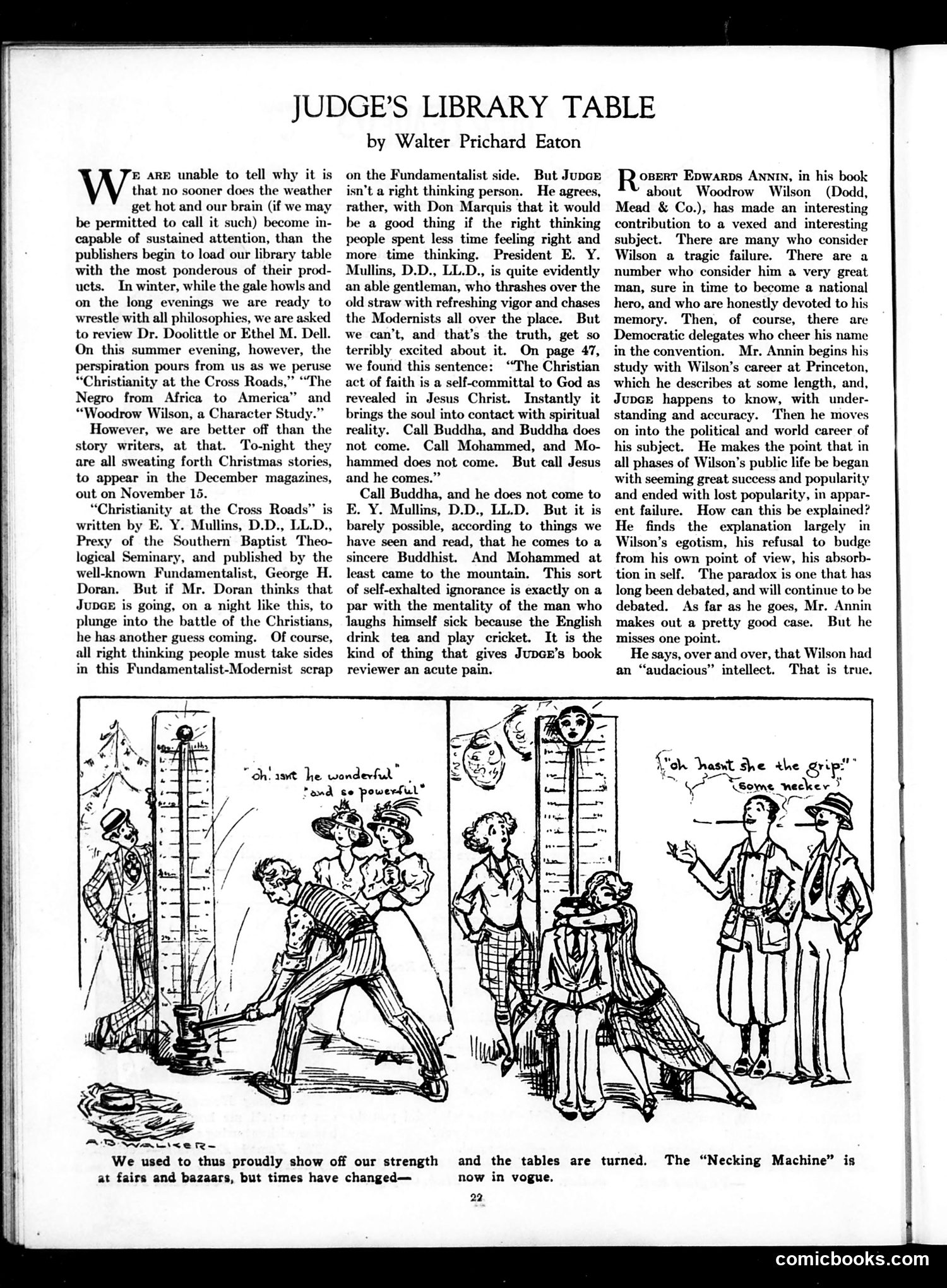
This column by Walter Prichard Eaton reviews three summer books while mocking intellectual pretension. The author complains that publishers dump heavy philosophical works when readers are too hot and lazy to engage seriously. The main target is **E.Y. Mullins' "Christianity at the Cross Roads,"** a Fundamentalist tract arguing that calling on Jesus works while Buddha and Mohammed don't. Eaton ridicules this as "self-exhalted ignorance"—equivalent to mocking English people for drinking tea. He refuses to take sides in the contemporary **Fundamentalist-Modernist debate** (a real 1920s-30s religious controversy), claiming the Judge magazine stays above such partisan thinking. The cartoons depict a "necking machine" at a fair—showing how courtship customs have changed. The satire's edge: while Mullins pontificates about faith, Eaton highlights society's actual concerns are far more worldly.
📄 Transcribed text from this page (OCR, searchable)
Machine-transcribed from the original scan — historical spelling and the odd misread are preserved.
! i JUDGE’S LIBRARY TABLE 'E ARE unable to tell why it is Wi no sooner does the weather get hot and our brain (if we may be permitted to call it such) become in- capable of sustained attention, than the publishers begin to load our library table with the most ponderous of their prod- ucts. In winter, while the gale howls and on the long evenings we are ready to wrestle with all philosophies, we are asked to review Dr. Doolittle or Ethel M. Dell. On this summer evening, however, the perspiration pours from us as we peruse “Christianity at the Cross Roads,” “The Negro from Africa to America” and “Woodrow Wilson, a Character Study.” However, we are better off than the story writers, at that. To-night they are all sweating forth Christmas stories, to appear in the December magazines, out on November 15. “Christianity at the Cross Roads’ written by E. Y. Mullins, D.D., LL.D., Prexy of the Southern Baptist Theo- logical Seminary, and published by the well-known Fundamentalist, George H. Doran. But if Mr. Doran thinks that JuDGE is going, on a night like this, to plunge into the battle of the Christians, he has another guess coming. Of course, all right thinking people must take sides in this Fundamentalist-Modernist scrap AR Waecu<er- We used to thus proudly show off our strength at fairs and bazaars, but times have changed— by Walter Prichard Eaton on the Fundamentalist side. But JupaE isn’t a right thinking person. He agrees, rather, with Don Marquis that it would be a good thing if the right thinking people spent less time feeling right and more time thinking. President E. Y. Mullins, D.D., LL.D., is quite evidently an able gentleman, who thrashes over the old straw with refreshing vigor and chases the Modernists all over the place. But we can’t, and that’s the truth, get so terribly excited about it. On page 47, we found this sentence: “The Christian act of faith is a self-committal to God as revealed in Jesus Christ. Instantly it brings the soul into contact with spiritual reality. Call Buddha, and Buddha does not come. Call Mohammed, and Mo- hammed does not come. But call Jesus and he comes.” Call Buddha, and he does not come to E. Y. Mullins, D.D., LL.D. But it is barely possible, according to things we have seen and read, that he comes to a sincere Buddhist. And Mohammed at least came to the mountain. This sort of self-exhalted ignorance is exactly on a par with the mentality of the man who laughs himself sick because the English drink tea and play cricket. It is the kind of thing that gives Juper’s book reviewer an acute pain. and the tables now in vogue. 22 are turned. oBerRT Epwarps ANNI, in his book about Woodrow Wilson (Dodd, Mead & Co.), has made an interesting contribution to a vexed and interesting subject. There are many who consider Wilson a tragic failure. There are a number who consider him a very great man, sure in time to become a national hero, and who are honestly devoted to his memory. Then, of course, there are Democratic delegates who cheer his name in the convention. Mr. Annin begins his study with Wilson’s career at Princeton, which he describes at some length, and, Jupce happens to know, with under- standing and accuracy. Then he moves on into the political and world career of his subject. He makes the point that in all phases of Wilson’s public life be began with seeming great success and popularity and ended with lost popularity, in appar- ent failure. How can this be explained? He finds the explanation largely in Wilson’s egotism, his refusal to budge from his own point of view, his absorb- tion in self. The paradox is one that has long been debated, and will continue to be debated. As far as he goes, Mr. Annin makes out a pretty good case. But he misses one point. He says, over and over, that Wilson had an “audacious” intellect. That is true. The “Necking Machine” is comicbooks.com