
Judge, 1924-08-02 · page 20 of 37
Judge — August 2, 1924 — page 20: what you’re looking at
What you’re looking at
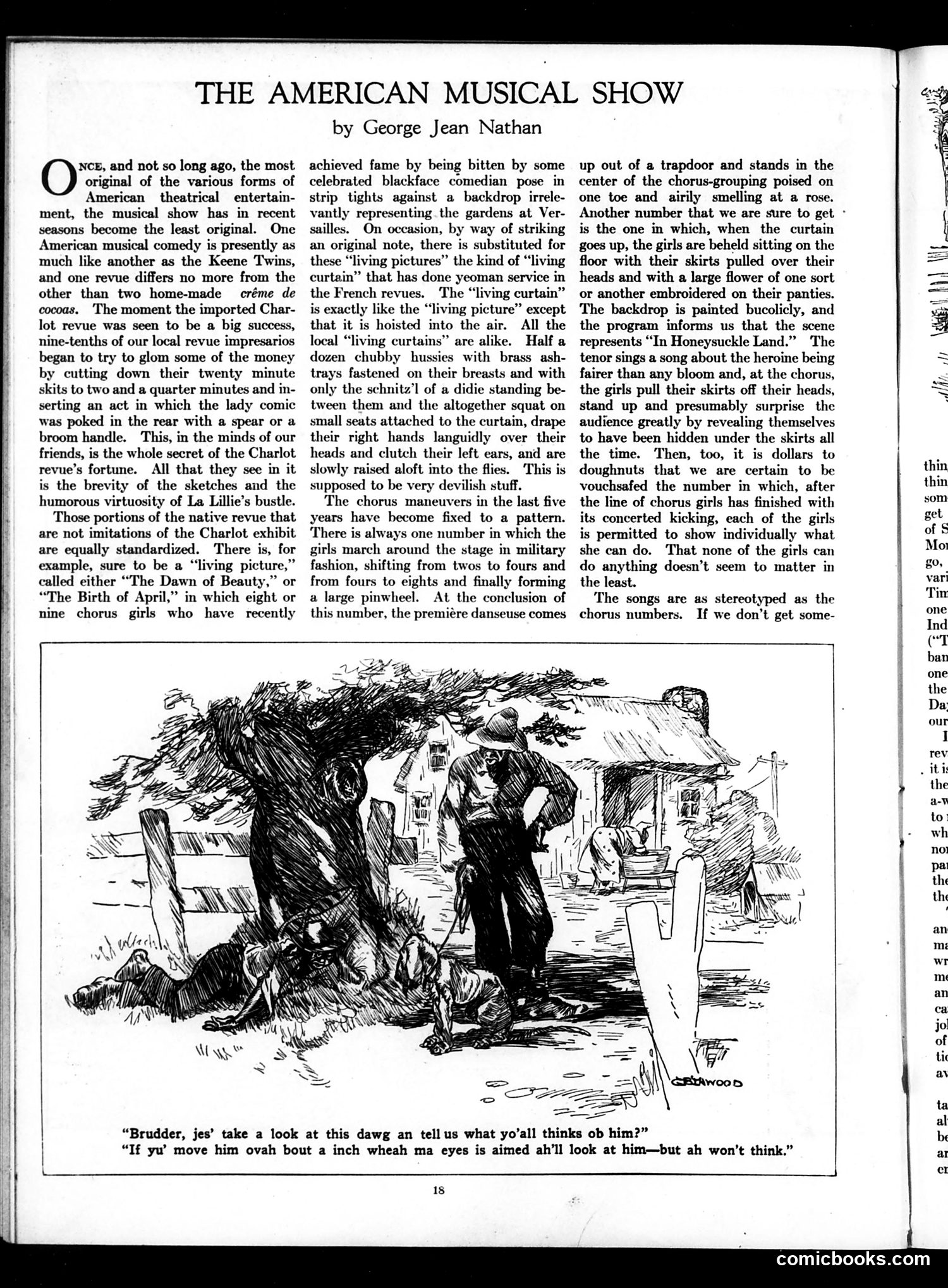
This article by George Jean Nathan critiques the American musical theater industry for lack of originality. Nathan argues that producers, after witnessing the success of the imported French "Charlot revue," began slavishly copying its formula rather than creating genuinely new work. The cartoon below illustrates this through a rural scene with a dialogue about a dog—likely a visual metaphor for undiscerning judgment. Nathan identifies specific repetitive theatrical conventions he ridicules: standardized "living pictures" of scantily-clad chorus girls posed against irrelevant backdrops (like Versailles gardens), predictable military-formation choreography culminating in pinwheel formations, and the tiresome "girls-hiding-under-skirts" number. His satire targets both producers' lack of creativity and audiences' acceptance of derivative entertainment. The piece suggests American theater had become formulaic and shallow, merely imitating European imports without understanding what made them successful.
📄 Transcribed text from this page (OCR, searchable)
Machine-transcribed from the original scan — historical spelling and the odd misread are preserved.
original of the various forms of American theatrical entertain- ment, the musical show has in recent seasons become the least original. One American musical comedy is presently as much like another as the Keene Twins, and one revue differs no more from the other than two home-made créme de cocoas. The moment the imported Char- lot revue was seen to be a big success, nine-tenths of our local revue impresarios began to try to glom some of the money by cutting down their twenty minute skits to two and a quarter minutes and in- serting an act in which the lady comic was poked in the rear with a spear or a broom handle. This, in the minds of our friends, is the whole secret of the Charlot revue’s fortune. All that they see in it is the brevity of the sketches and the humorous virtuosity of La Lillie’s bustle. Those portions of the native revue that are not imitations of the Charlot exhibit are equally standardized. There is, for example, sure to be a “living picture,” called either “The Dawn of Beauty,” or “The Birth of April,” in which eight or nine chorus girls who have recently Oz and not so long ago, the most THE AMERICAN MUSICAL SHOW by George Jean Nathan achieved fame by being bitten by some celebrated blackface comedian pose in strip tights against a backdrop irrele- vantly representing the gardens at Ver- sailles. On occasion, by way of striking an original note, there is substituted for these “living pictures” the kind of “living curtain” that has done yeoman service in the French revues. The “living curtain” is exactly like the “living picture” except that it is hoisted into the air. All the local “living curtains” are alike. Half a dozen chubby hussies with brass ash- trays fastened on their breasts and with only the schnitz’l of a didie standing be- tween them and the altogether squat on small seats attached to the curtain, drape their right hands languidly over their heads and clutch their left ears, and are slowly raised aloft into the flies. This is supposed to be very devilish stuff. The chorus maneuvers in the last five years have become fixed to a pattern. There is always one number in which the girls march around the stage in military fashion, shifting from twos to fours and from fours to eights and finally forming a large pinwheel. At the conclusion of this number, the premiére danseuse comes up out of a trapdoor and stands in the center of the chorus-grouping poised on one toe and airily smelling at a rose. Another number that we are sure to get ~ is the one in which, when the curtain goes up, the girls are beheld sitting on the floor with their skirts pulled over their heads and with a large flower of one sort or another embroidered on their panties. The backdrop is painted bucolicly, and the program informs us that the scene represents “In Honeysuckle Land.” The tenor sings a song about the heroine being fairer than any bloom and, at the chorus, the girls pull their skirts off their heads, stand up and presumably surprise the audience greatly by revealing themselves to have been hidden under the skirts all the time. Then, too, it is dollars to doughnuts that we are certain to be vouchsafed the number in which, after the line of chorus girls has finished with its concerted kicking, each of the girls is permitted to show individually what she can do. That none of the girls can do anything doesn’t seem to matter in the least. The songs are as stereotyped as the chorus numbers. If we don’t get some- “Brudder, jes’ take a look at this dawg an tellus what yo’all thinks ob him?” “If yu’ move him ovah bout a inch wheah ma eyes is aimed ah’ll look at him—but ah won’t think.” 18 comicbooks.com