
Judge, 1924-08-02 · page 21 of 37
Judge — August 2, 1924 — page 21: what you’re looking at
What you’re looking at
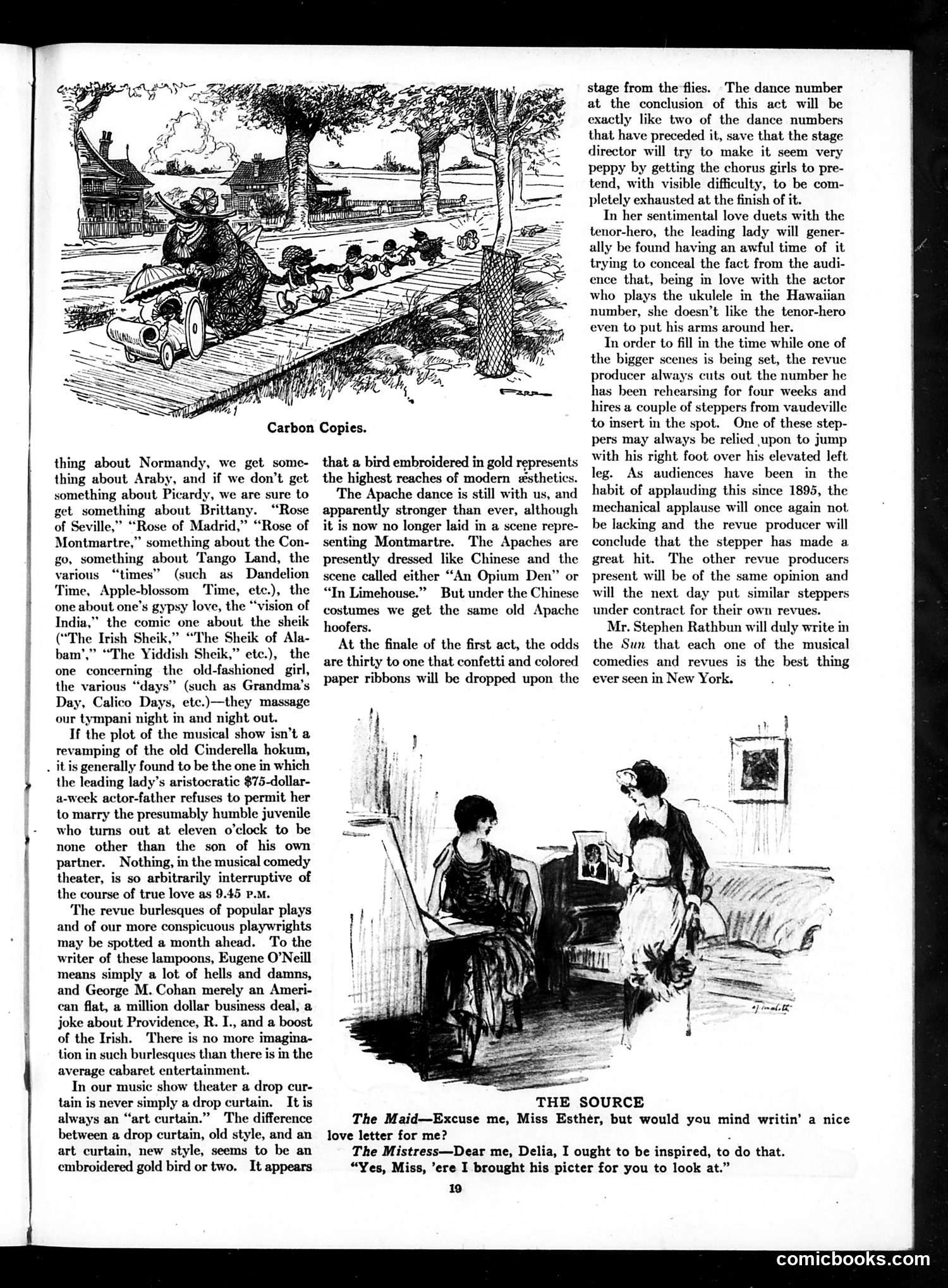
This page satirizes the formulaic predictability of early 20th-century musical theater and revue productions. The lengthy "Carbon Copies" essay mocks how Broadway shows recycled identical plots, settings, and performance tropes endlessly. The satire targets: - **Overused plots**: Cinderella stories, aristocratic father-refuses-poor-suitor narratives interrupted by 9:45 P.M. curtain times - **Tired exotic settings**: Apache dances (Parisian street fighter scenes), now incongruously relocated to "Opium Dens" or "Limehouse" with Chinese costumes - **Repetitive visual elements**: "Art curtains" with embroidered gold birds; confetti dropped from flies; exhausted chorus girls pretending exertion - **Lazy choreography**: Vaudeville steppers hired last-minute, performing the same elevated-leg jump audiences applauded since 1895 The smaller illustration "The Source" depicts a domestic scene where a maid asks a mistress to write a love letter—a joke about theatrical artificiality bleeding into "real life." The commentary names Eugene O'Neill and George M. Cohan as subjects of shallow theatrical parodies, suggesting audience weariness with formulaic entertainment.
📄 Transcribed text from this page (OCR, searchable)
Machine-transcribed from the original scan — historical spelling and the odd misread are preserved.
| j j 1 } ] j Carbon Copies. thing about Normandy, we get some- thing about Araby, and if we don’t get something about Picardy, we are sure to get something about Brittany. “Rose of Seville,” ““Rose of Madrid,” “Rose of Montmartre,” something about the Con- go, something about Tango Land, the various “times” (such as Dandelion Time, Apple-blossom Time, etec.), the one about one’s gypsy love, the “vision of India,” the comic one about the sheik (“The Irish Sheik,” “The Sheik of Ala- bam’,” “The Yiddish Sheik,” ete.), the one concerning the old-fashioned girl, the various “days” (such as Grandma’s Day, Calico Days, etc.)—they massage our tympani night in and night out. If the plot of the musical show isn’t a revamping of the old Cinderella hokum, . it is generally found to be the one in which the leading lady’s aristocratic $75-dollar- a-week actor-father refuses to permit her to marry the presumably humble juvenile who turns out at eleven o'clock to be none other than the son of his own partner. Nothing, in the musical comedy theater, is so arbitrarily interruptive of the course of true love as 9.45 P.M. The revue burlesques of popular plays and of our more conspicuous playwrights may be spotted a month ahead. To the writer of these lampoons, Eugene O’Neill means simply a lot of hells and damns, and George M. Cohan merely an Ameri- can flat, a million dollar business deal, a joke about Providence, R. I., and a boost of the Irish. There is no more imagina- tion in such burlesques than there is in the average cabaret entertainment. In our music show theater a drop cur- tain is never simply a drop curtain. It is always an “art curtain.” The difference between a drop curtain, old style, and an art curtain, new style, seems to be an embroidered gold bird or two. It appears that a bird embroidered in gold represents the highest reaches of modern esthetics. The Apache dance is still with us, and apparently stronger than ever, although it is now no longer laid in a scene repre- senting Montmartre. The Apaches are presently dressed like Chinese and the scene called either “An Opium Den” or “In Limehouse.” But under the Chinese costumes we get the same old Apache hoofers. At the finale of the first act, the odds are thirty to one that confetti and colored paper ribbons will be dropped upon the stage from the flies. The dance number at the conclusion of this act will be exactly like two of the dance numbers that have preceded it, save that the stage director will try to make it seem very peppy by getting the chorus girls to pre- tend, with visible difficulty, to be com- pletely exhausted at the finish of it. In her sentimental love duets with the tenor-hero, the leading lady will gener- ally be found having an awful time of it trying to conceal the fact from the audi- ence that, being in love with the actor who plays the ukulele in the Hawaiian number, she doesn’t like the tenor-hero even to put his arms around her. In order to fill in the time while one of the bigger scenes is being set, the revue producer always cuts out the number he has been rehearsing for four weeks and hires a couple of steppers from vaudeville to insert in the spot. One of these step- pers may always be relied upon to jump with his right foot over his elevated left leg. As audiences have been in the habit of applauding this since 1895, the mechanical applause will once again not be lacking and the revue producer will conclude that the stepper has made a great hit. The other revue producers present will be of the same opinion and will the next day put similar steppers under contract for their own revues. Mr. Stephen Rathbun will duly write in the Sun that each one of the musical comedies and revues is the best thing ever seen in New York. THE SOURCE The Maid—Excuse me, Miss Esthér, but would you mind writin’ a nice love letter for me? z The Mistress—Dear me, Delia, I ought to be inspired, to do that. “Yes, Miss, ’ere I brought his picter for you to look at.” 19 comicbooks.com