
A complete issue · 36 pages · 1924
Judge — July 5, 1924
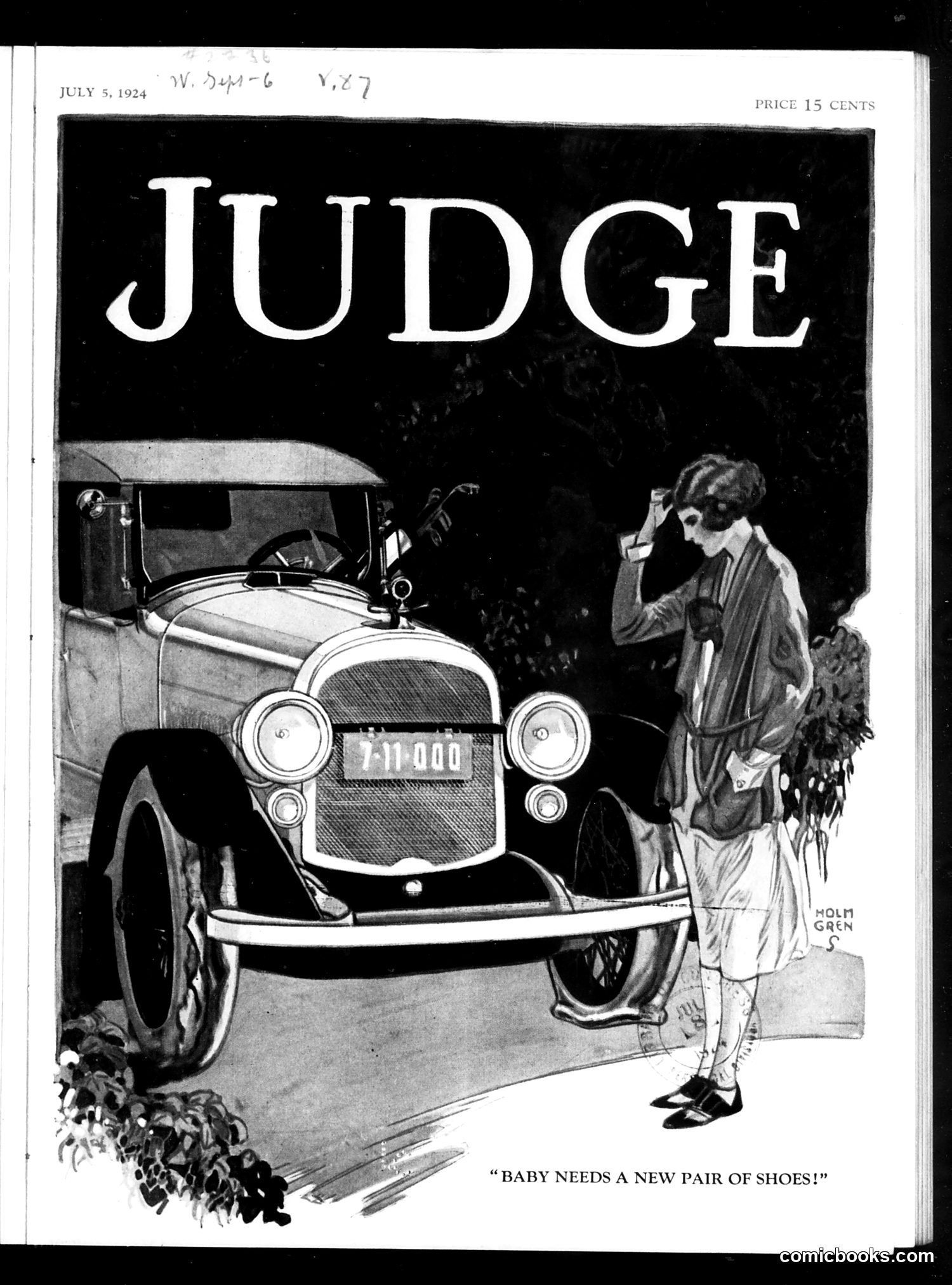
This cover depicts a domestic humor scenario rather than political satire. A well-dressed woman stands beside an automobile (displaying "711900" on its plate), gesturing toward the car. The caption reads "Baby Needs a New Pair of Shoes!" The joke plays on the common domestic complaint of wives pressuring husbands for new clothing or luxury purchases. By showing the woman pointing to an expensive automobile while claiming the "baby" needs shoes, the satire suggests wives use their children as pretexts to justify expensive wants—in this case, suggesting the family vehicle itself is what's really desired. The 1920s setting reflects the era's rapid automobile adoption and changing consumer culture, making car ownership a status symbol and source of domestic negotiation.
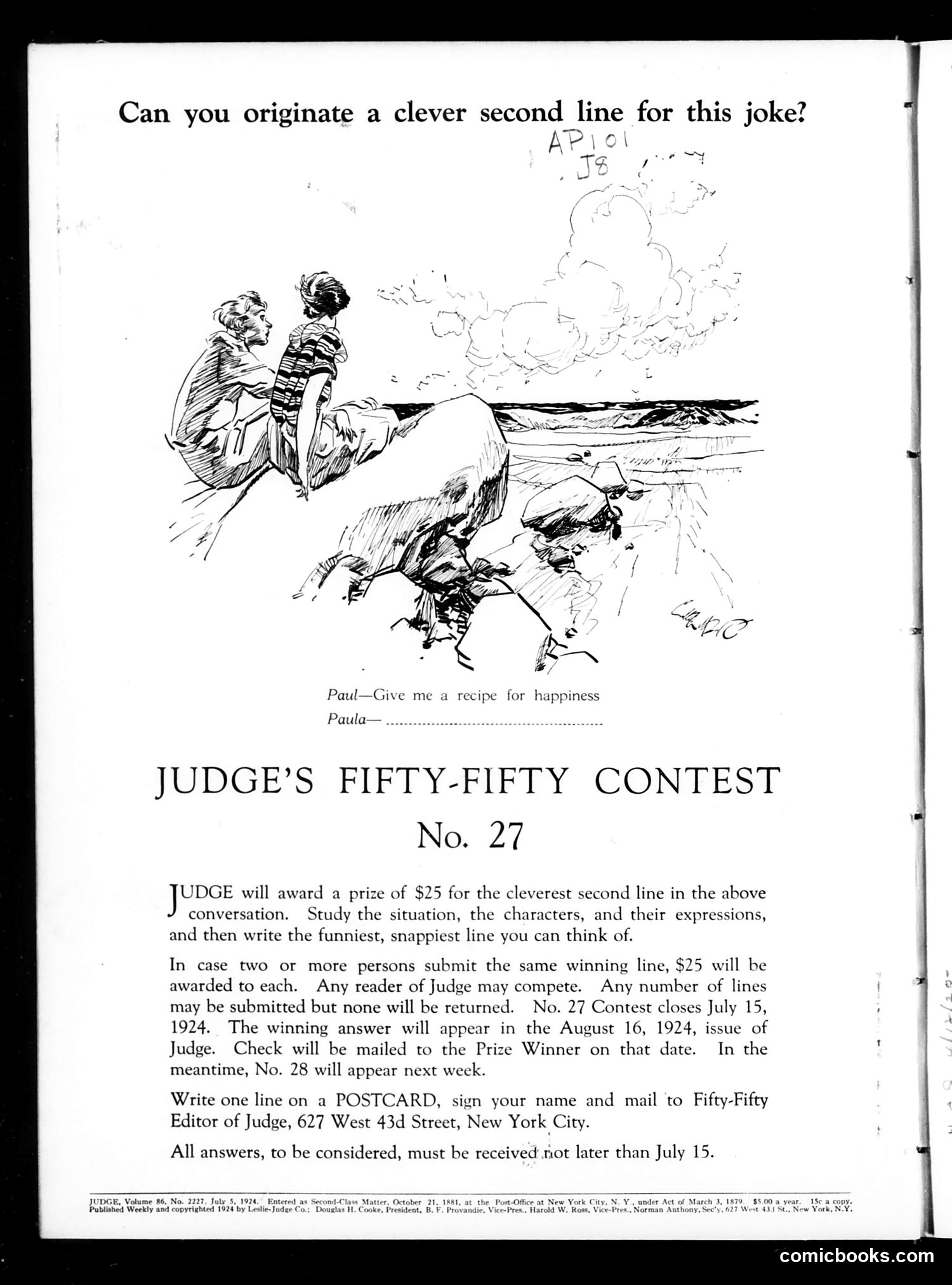
This page features "Judge's Fifty-Fifty Contest No. 27," a humor competition inviting readers to complete a joke. The cartoon shows two children observing insects (appearing to be ants or beetles) working on the ground. The first line of dialogue reads: "Paul—Give me a recipe for happiness." Readers were challenged to supply Paula's clever response, with a $25 prize for the wittiest answer. The joke plays on the contrast between childhood innocence and adult concerns—the children are watching industrious insects while discussing abstract concepts. The humor likely relies on unexpected wordplay or a punny response connecting the insects' labor to happiness. This was a common feature in Judge, combining visual comedy with reader participation to boost engagement and circulation during the 1920s.
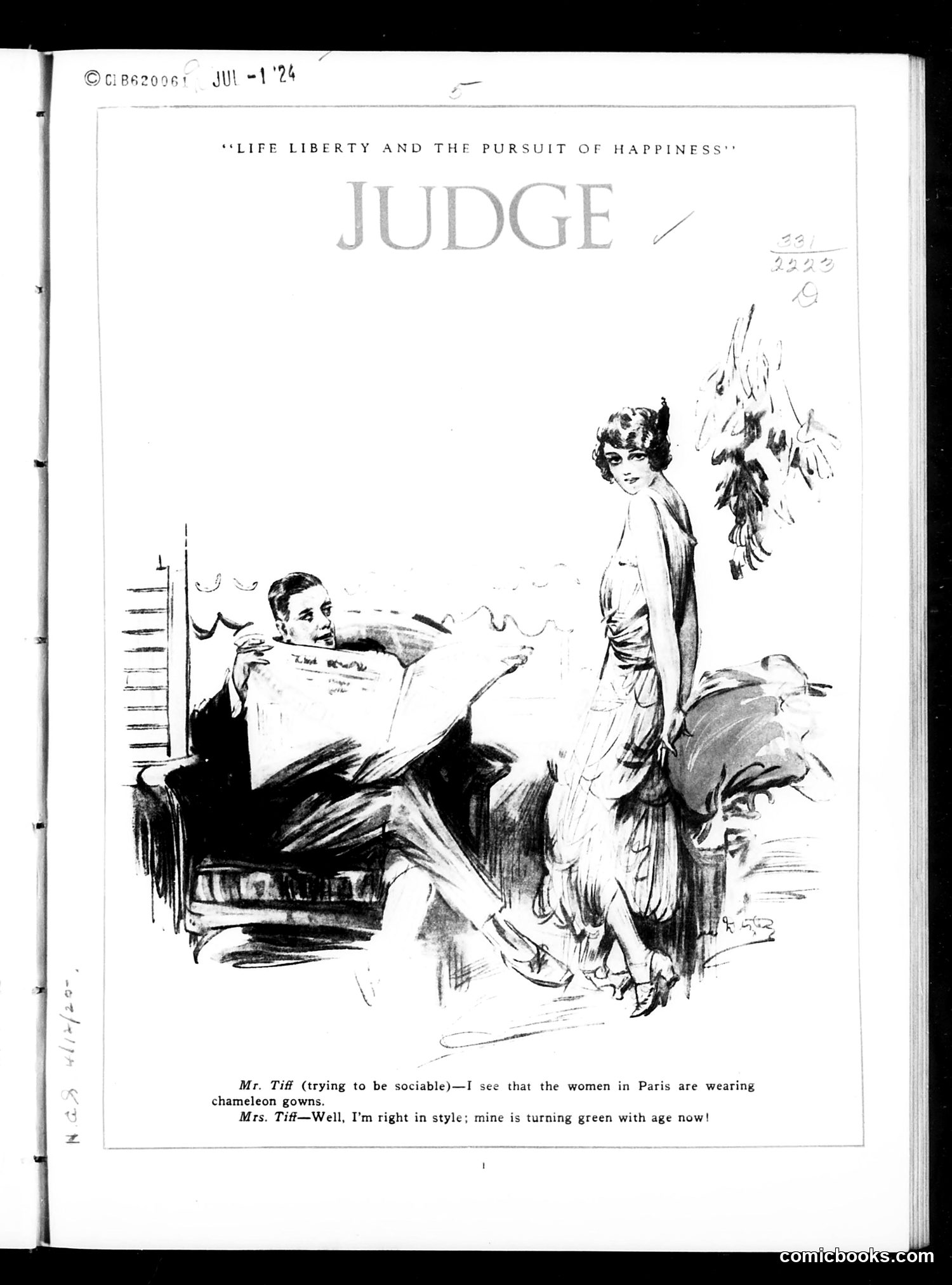
This is a comedic cartoon from *Judge* magazine satirizing fashion and gender dynamics. Mr. Tiff, attempting to appear cultured and sociable, comments on Parisian women wearing "chameleon gowns" (dresses that change color). Mrs. Tiff responds with a jab: her own gown is "turning green with age," implying it's outdated and worn out. The joke plays on multiple levels: it mocks Mr. Tiff's pretentious attempts at sophistication, critiques the fashion industry's emphasis on novelty, and uses the wife's sharp retort to suggest she's more honest than her husband's social posturing. The drawing style is typical of early 20th-century magazine illustration, capturing the era's gender dynamics through domestic banter.
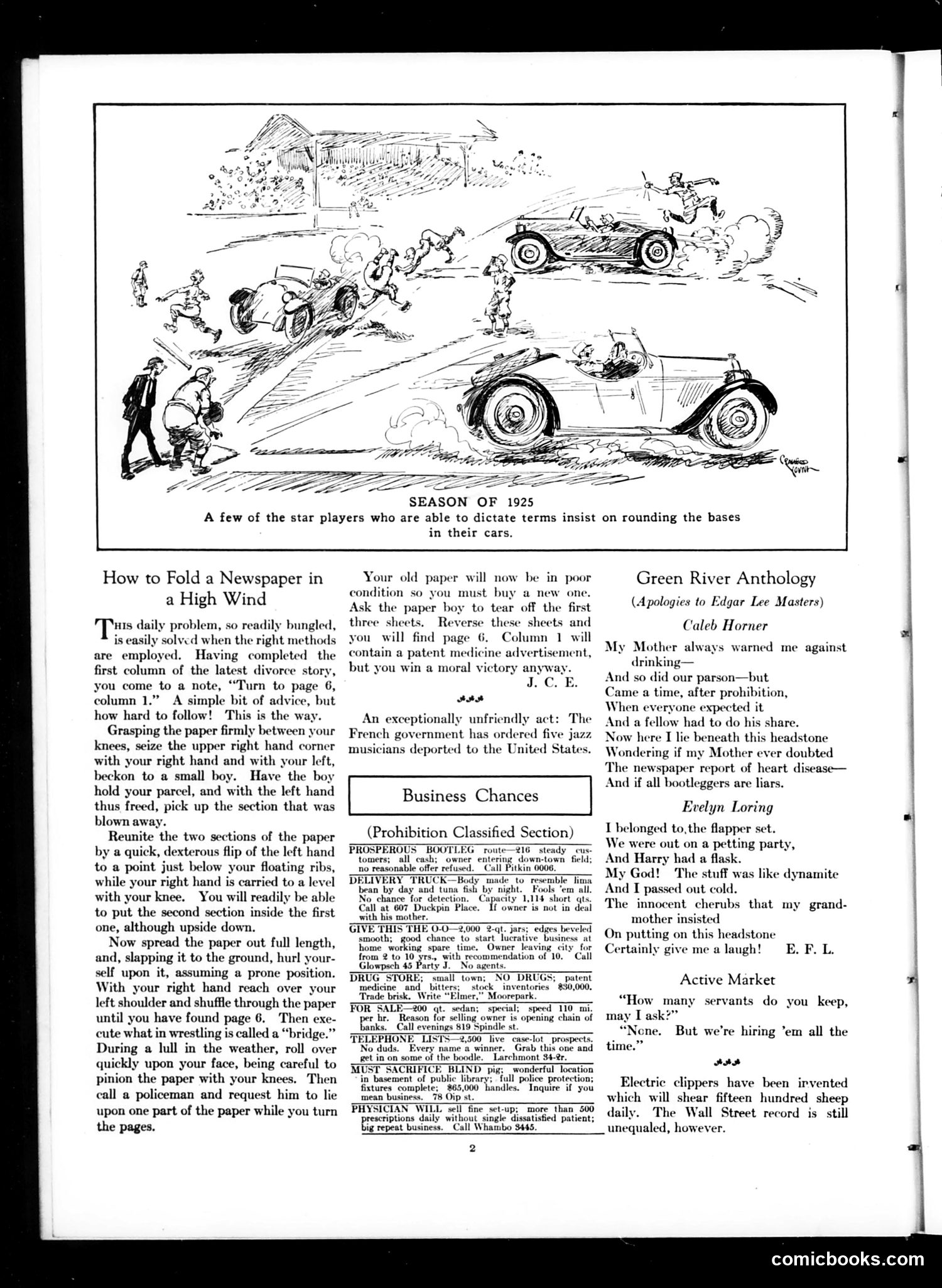
The top cartoon depicts several racing cars with drivers and spectators in chaotic motion, captioned "A few of the star players who are able to dictate terms insist on rounding the bases in their cars." This is a satirical commentary on 1925 baseball's top players—likely referencing prominent athletes demanding high salaries and special treatment. The phrase "rounding the bases in their cars" is a play on baseball terminology, suggesting these star players are so demanding and reckless that they're careening around like out-of-control drivers rather than playing the game properly. The joke critiques both the inflated egos of celebrity athletes and the chaos their demands supposedly create. It reflects broader 1920s anxieties about professional sports commercialization and player salaries during baseball's "Golden Age."
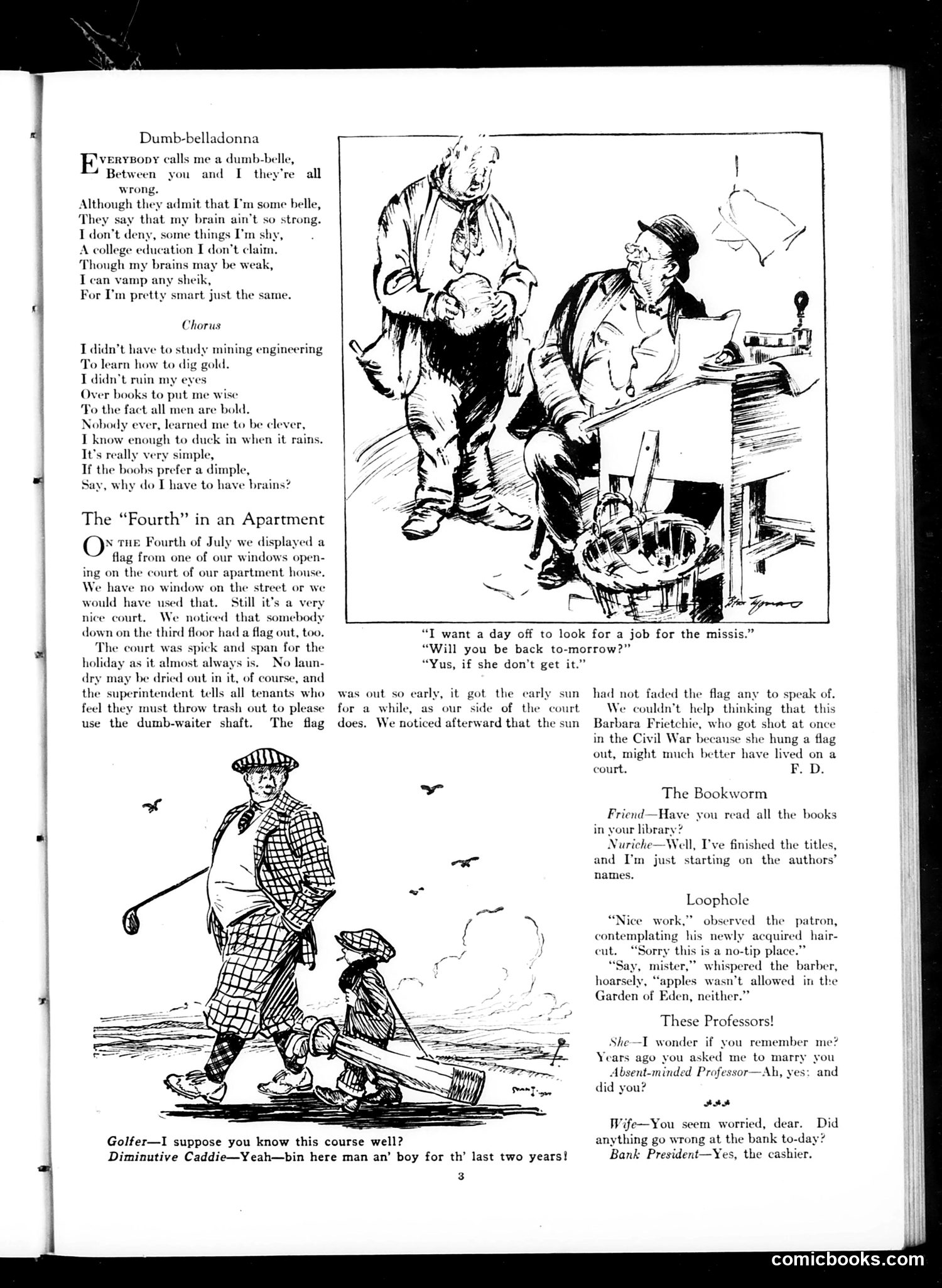
This page contains several humor pieces rather than political cartoons: **"Dumb-belladonna"** satirizes a woman claiming intelligence despite admitting she lacks education, mining knowledge, or serious study—mocking pretentiousness about being "smart." **"The 'Fourth' in an Apartment"** describes neighbors displaying a Fourth of July flag in their apartment courtyard, creating practical problems (sun damage, trash accumulation). The humor derives from impractical patriotism in confined urban spaces. **Other brief comedic dialogues** include "The Bookworm" (someone reading only book titles), "Loophole" (barbershop banter about haircuts and the Garden of Eden), and exchanges between professors, golfers, and spouses—standard domestic humor of the era. The page represents Judge's typical format: light satirical commentary on everyday middle-class life, social pretension, and domestic situations rather than serious political critique.
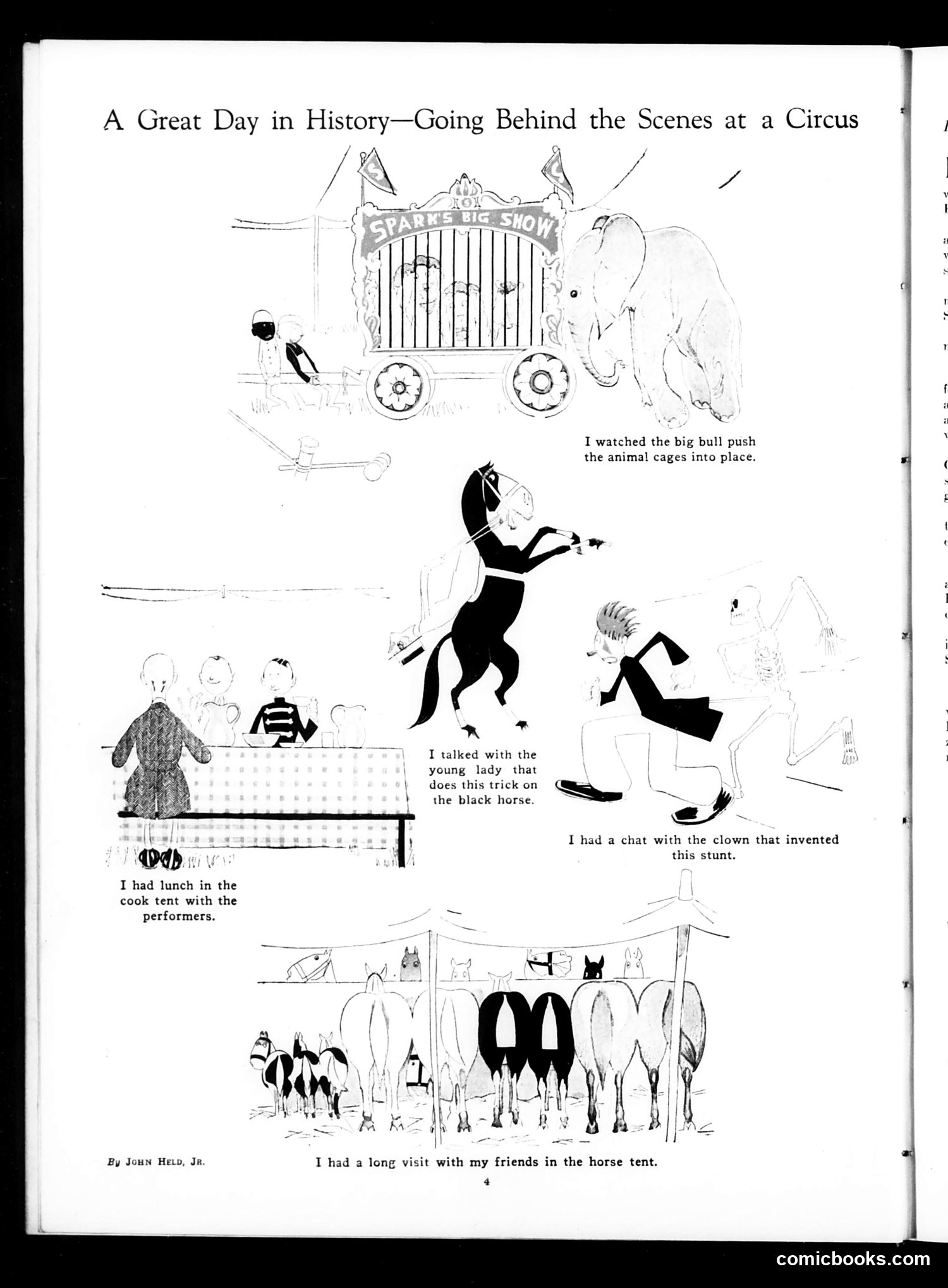
This is a straightforward illustrated article—not political satire—titled "A Great Day in History—Going Behind the Scenes at a Circus," by John Held Jr. The piece depicts a day visiting a circus, with illustrations showing various behind-the-scenes activities: the animal cages being transported, acrobats performing tricks, lunch in the cook tent with performers, conversations with a young lady about horse tricks and a clown about stunts, and a visit to the horse tent. This appears to be lifestyle entertainment journalism rather than satire—common in *Judge* magazine, which mixed humor, cartoons, and illustrated articles. The drawings are characteristic of Held's style from the 1920s-30s, focusing on whimsical observations of everyday entertainment rather than political commentary or social criticism.
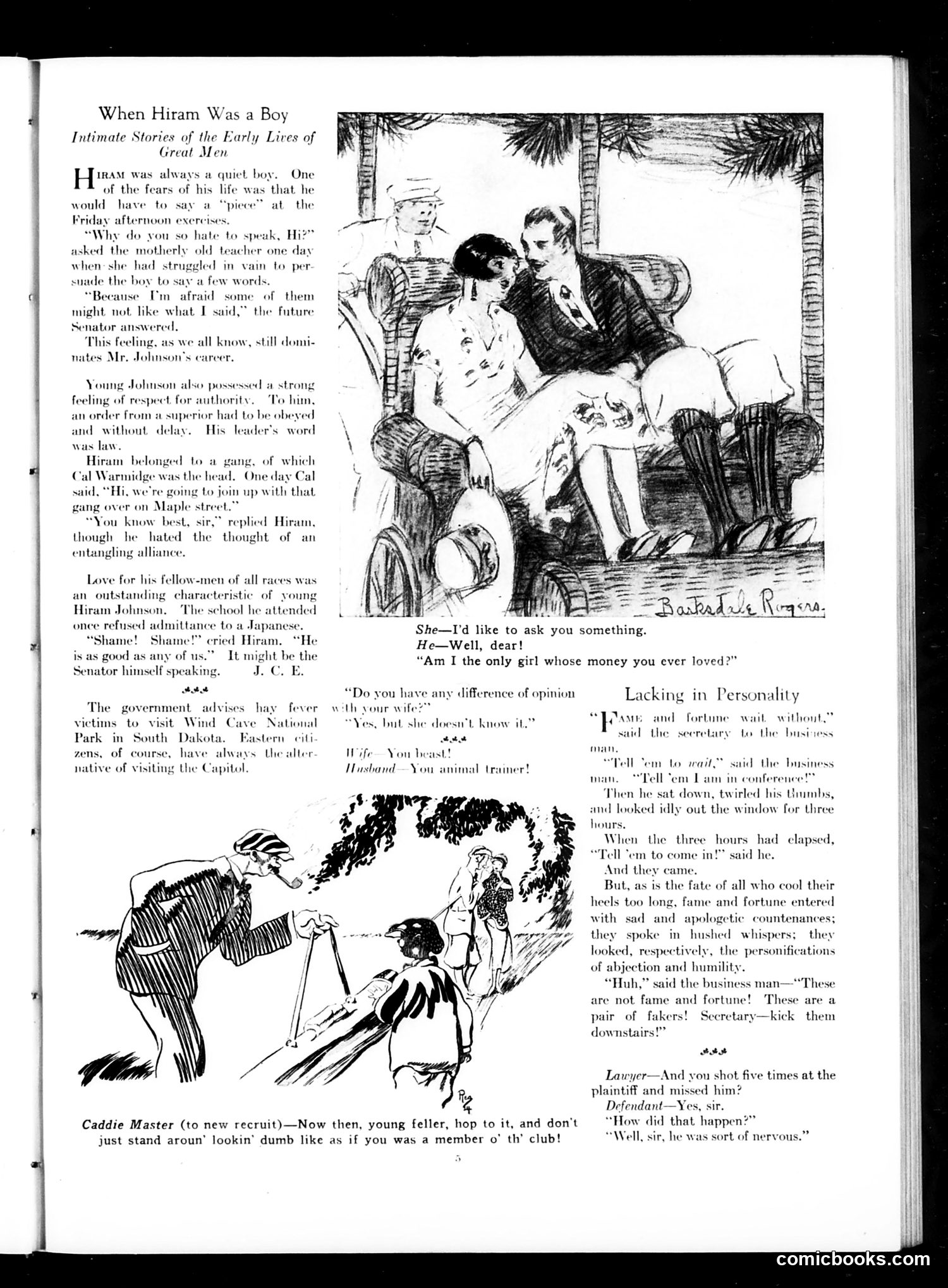
This page satirizes **Hiram Johnson**, a prominent early 20th-century U.S. Senator known for his cautious political approach. The biographical sketch mocks his lifelong reluctance to speak freely, attributing it to childhood shyness and excessive deference to authority figures—traits the satire suggests still dominate his Senate career. The cartoons below illustrate related social commentary: one depicts a golf instructor barking orders at a nervous recruit (satirizing rigid authority); another shows a businessman rudely dismissing "Fame and Fortune" after keeping them waiting, suggesting that arrogance and dismissiveness backfire. The romantic dialogue jokes about women's mercenary interests in marriage. Overall, **Judge** uses Johnson's cautious political style as the butt of jokes about timidity, conformity, and the social costs of excessive deference—critiquing both his leadership and broader American attitudes toward authority and ambition.
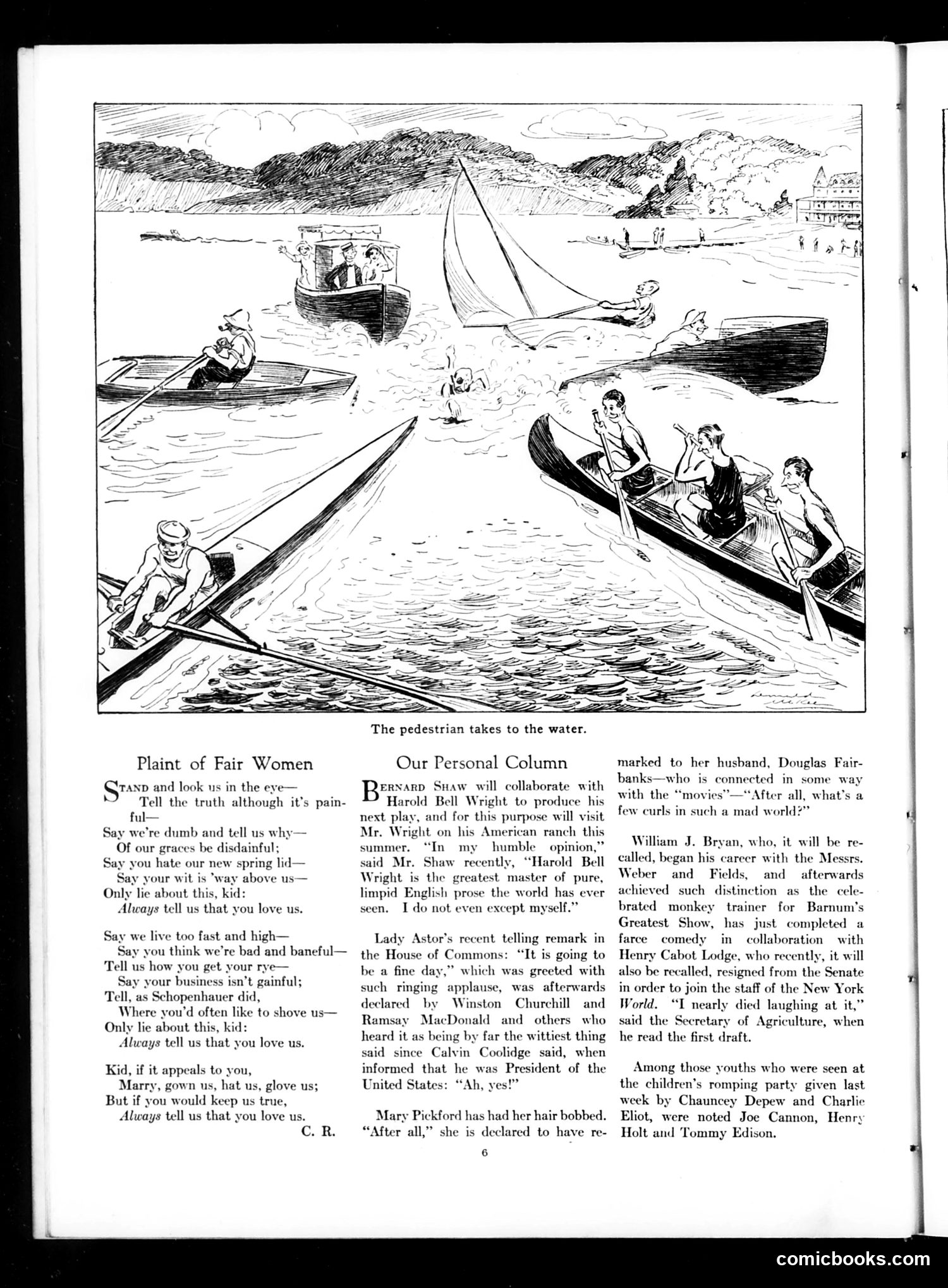
The main cartoon depicts a beach scene with multiple boats and figures, captioned "The pedestrian takes to the water"—a visual pun about someone forced into water, likely satirizing some contemporary situation. The page's text consists primarily of a poem by C.R. titled "Plaint of Fair Women," which humorously articulates women's contradictory demands: men should be honest about everything *except* love—always profess devotion regardless of truth. It's satire on romantic relationships and female psychology as perceived in the 1920s era. The "Personal Column" section mocks prominent figures through exaggerated praise: Bernard Shaw flattering Harold Bell Wright absurdly; Lady Astor's banal comment being hailed as witty; Mary Pickford's bobbed hair being treated as momentous; and William J. Bryan being jokingly called a "celebrated monkey trainer." These brief items satirize celebrity worship and how the press inflates trivial actions into significance—typical Judge magazine satirical commentary on American public life and media sensationalism.
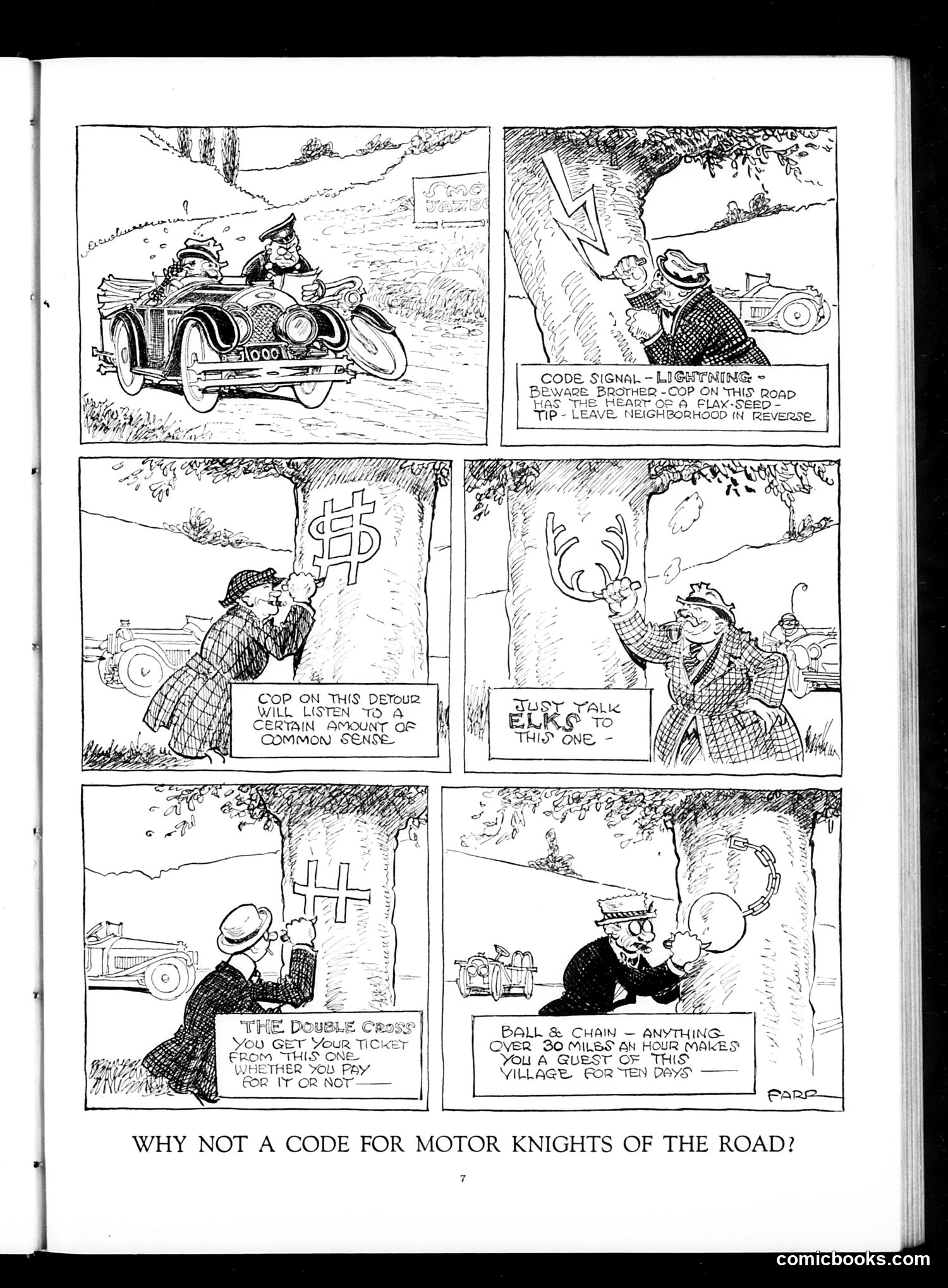
This satirical comic by an artist signed "BARR" mocks early automobile culture and reckless motorists, titled "Why Not a Code for Motor Knights of the Road?" The cartoon depicts wealthy car owners as lawless "knights" who've created an underground code to evade traffic enforcement. Each panel shows different traffic violations and corrupt practices: speeding past police ("lightning signal"), bribing officers with "common sense," hitting pedestrians ("ball & chain"), and extorting locals through hit-and-run incidents. The satire targets the privileged motorist class who treated roads as personal domains, ignored speed limits, and faced minimal consequences due to wealth and connections. The "code" signals represent how early drivers communicated to warn each other about enforcement. This reflects widespread public anger (circa early 1900s) over dangerous automobiles driven recklessly by the wealthy, with inadequate regulation and enforcement of traffic laws.
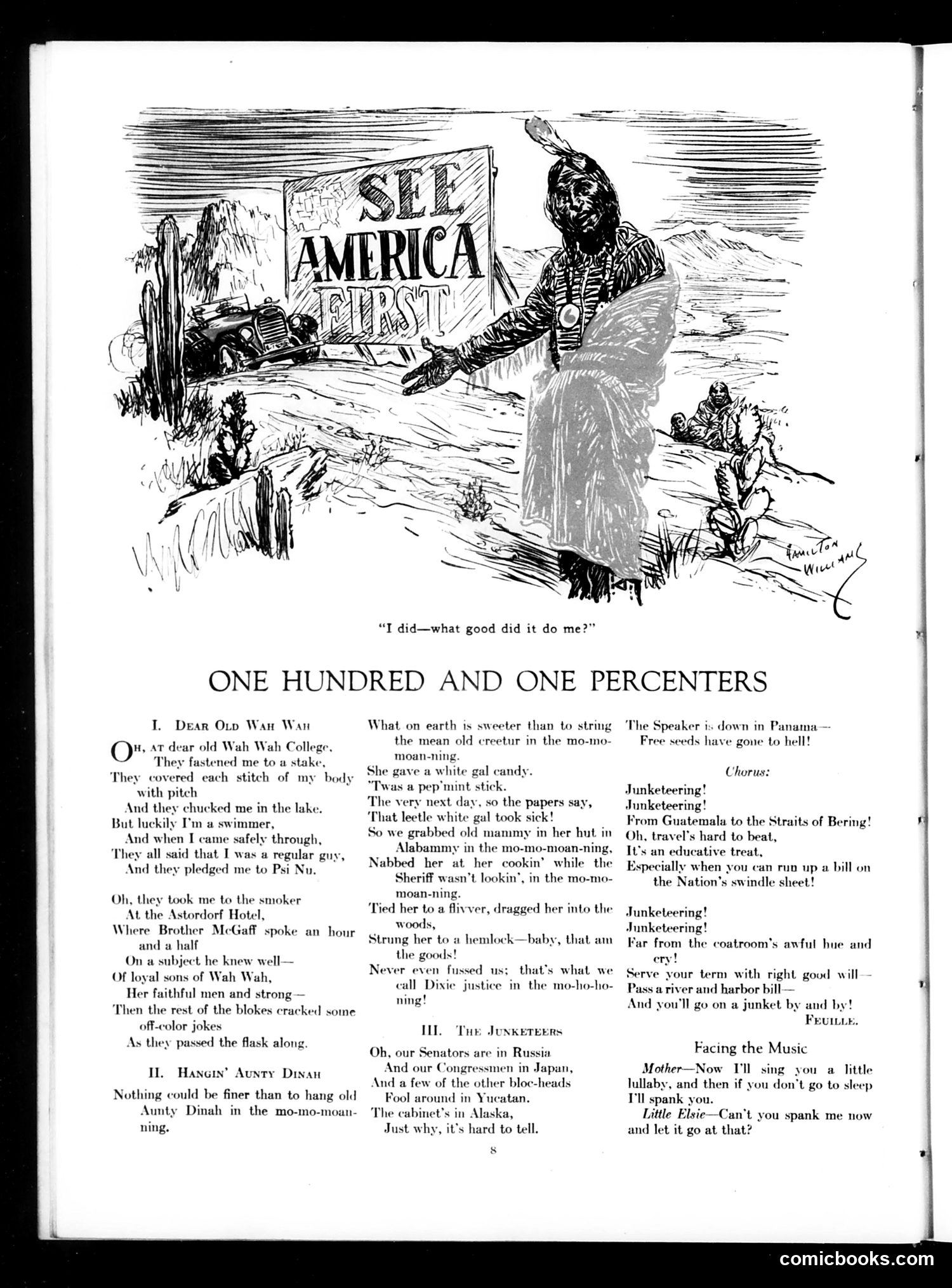
This page satirizes American hypocrisy and excess through three songs mocking different groups: **First section** ridicules college fraternity hazing and conformist "loyalty" - a pledge survives abuse, then is celebrated as a "regular guy." **Second section** contains deeply racist content depicting a lynching, presented as darkly comic. It reflects Judge's problematic era while ostensibly criticizing Southern violence as "Dixie justice." **Third section** attacks government officials as wasteful through "The Junketeers" - mocking Congressional junkets (pleasure trips disguised as official business). Politicians travel globally while neglecting domestic duties like infrastructure bills, spending public funds ("the Nation's swindle sheet"). **Final item** is a brief joke about child discipline. The cartoonist's drawing above shows a Native American figure pointing to a "See America First" sign - likely mocking the irony of promoting national tourism while mistreating Native Americans and engaging in corrupt government spending.
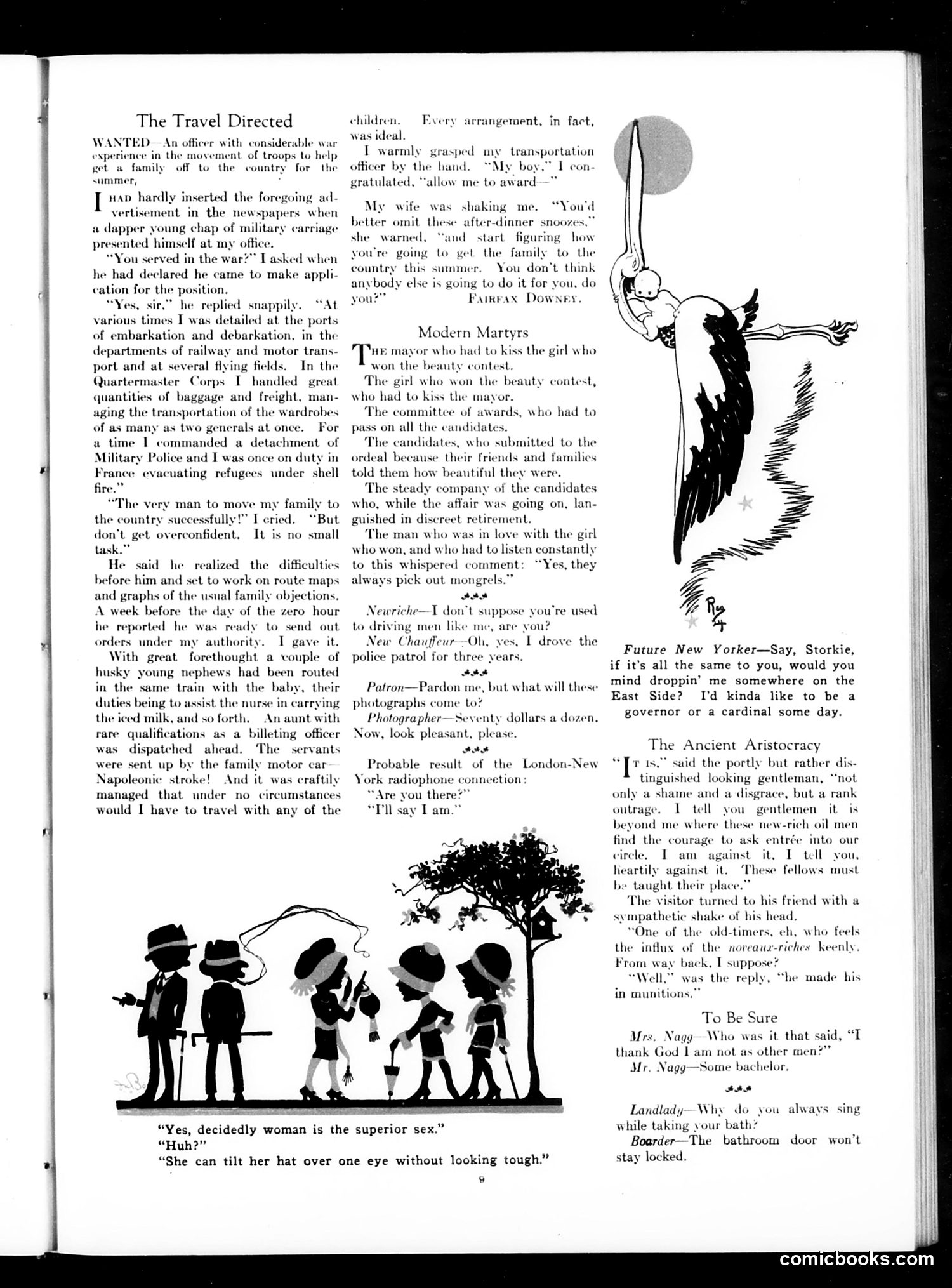
This page contains several short satirical pieces typical of early 20th-century American humor: **"The Travel Directed"** mocks family summer vacations. A man hires a military officer to orchestrate moving his family to the country—treating domestic logistics like wartime troop movements. The joke's punchline reveals it's a dream; his wife wakes him, demanding he actually organize the chaotic real task himself. **"Modern Martyrs"** lists the various people suffering through a beauty contest: the mayor forced to kiss the winner, the contestants enduring judgment, and notably the boyfriends of contestants who must listen to complaints that "they always pick out mongrels"—satirizing the superficiality of such competitions and male jealousy. **Lower sections** contain brief joke exchanges about a chauffeur who previously drove police patrols, expensive photographs, and a radiophone call. **"The Ancient Aristocracy"** (partially visible) appears to critique old-money elites dismissing nouveau riche social climbers as lacking breeding. The humor reflects pre-WWII American anxieties about class, courtship rituals, and emerging technologies like radiotelephones.
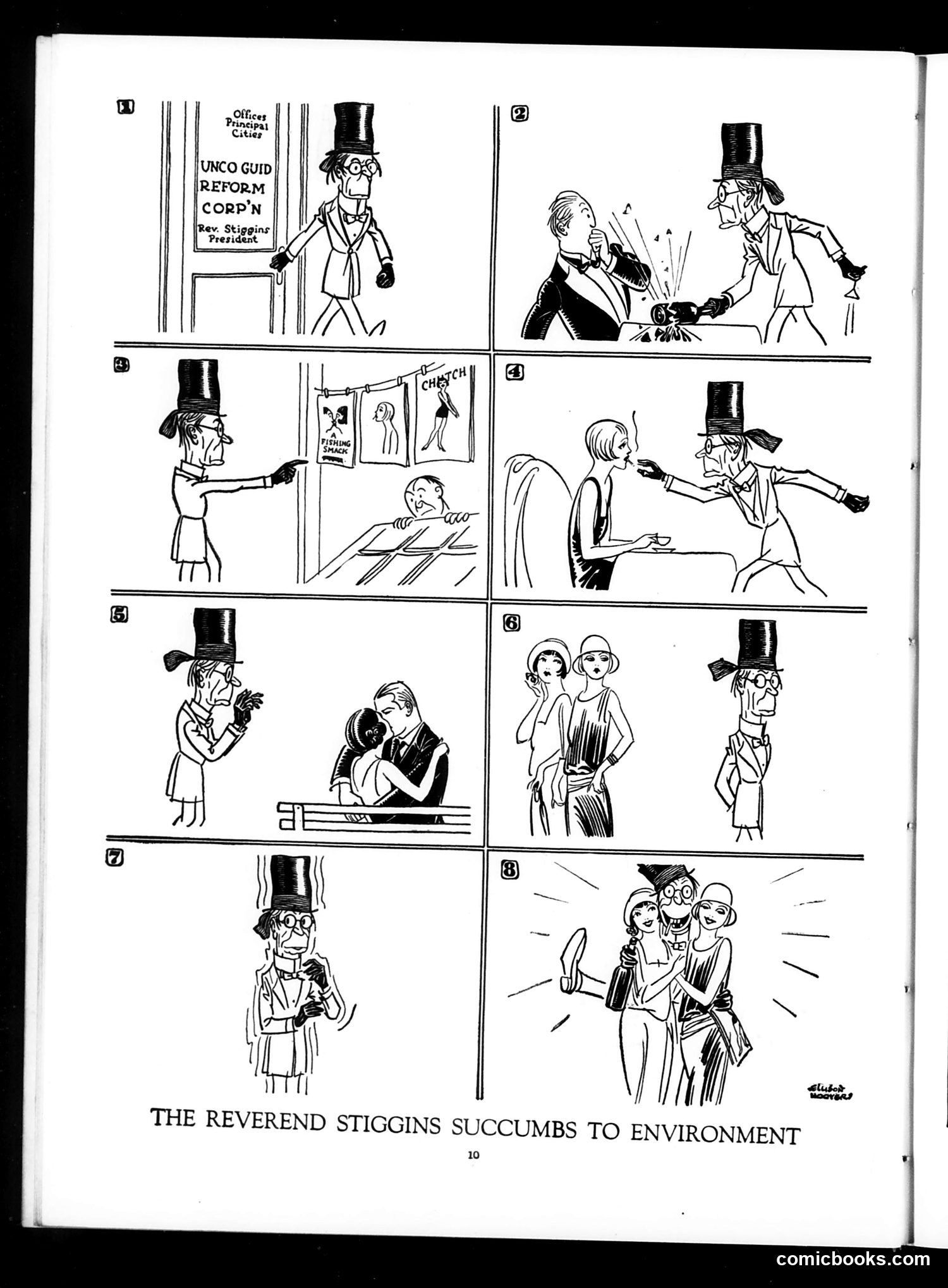
This comic strip satirizes Reverend Stiggins, an apparent reformer associated with the "UNCO GUID REFORM CORP'N" (visible on the office door in panel 1). The title suggests he's succumbing to environmental pressures—specifically, the temptations of urban leisure and vice. The sequence shows Stiggins progressively abandoning his moral stance: he encounters women, frequents what appears to be a nightclub or gambling establishment (panels 3-4), and eventually embraces secular pleasures with companions. The final panel depicts him triumphantly celebrating with two fashionable women, having completely abandoned his reformist pretensions. The satire mocks self-righteous moralists who preach virtue while secretly desiring the very vices they condemn—a common Judge magazine theme attacking hypocrisy among religious reformers.
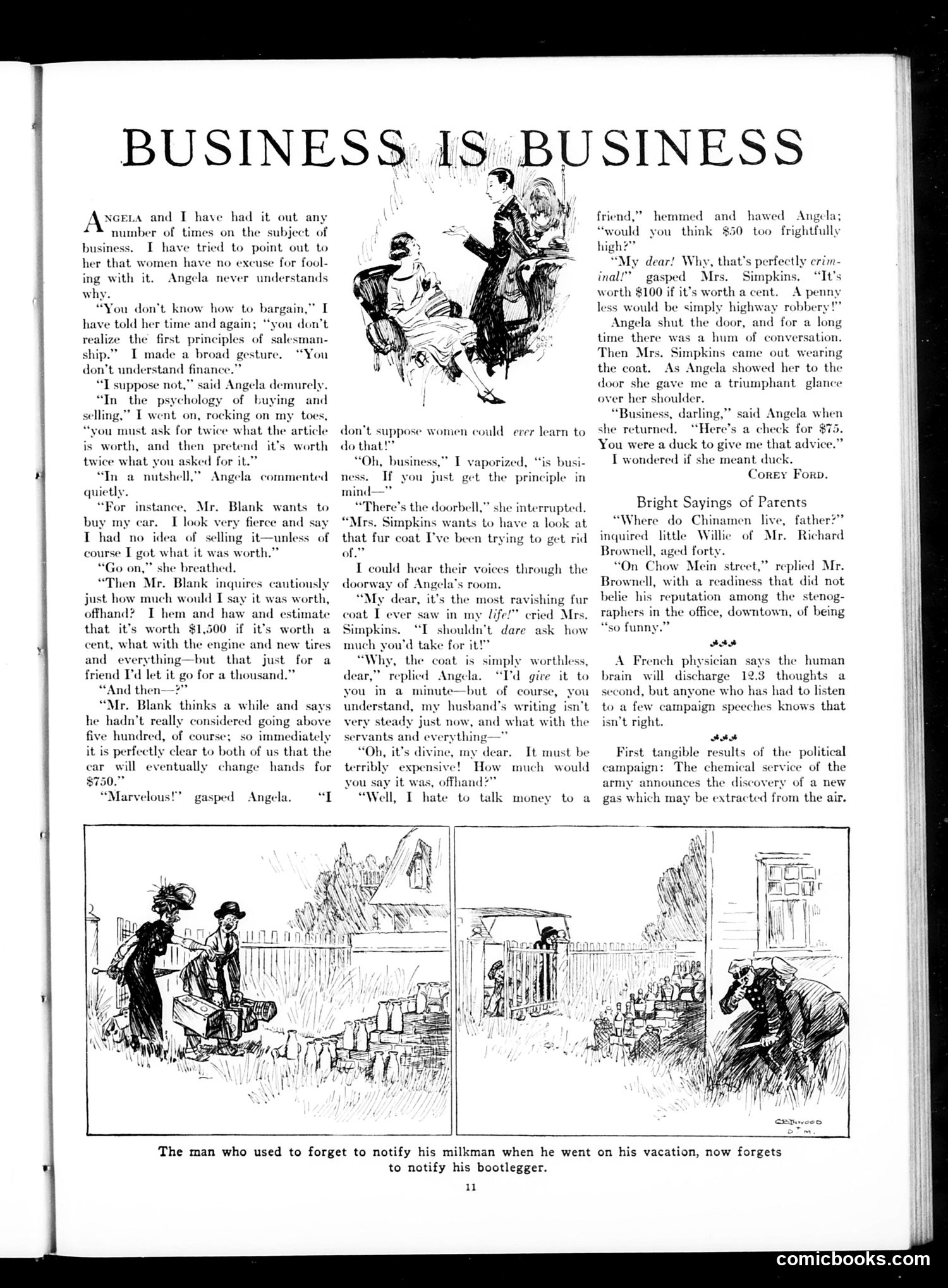
This page satirizes early 20th-century gender dynamics and business practices. The main article, by Corey Ford, features a husband explaining "business negotiation" to his wife Angela—the principle being to ask twice an item's worth, then pretend that inflated price is reasonable. The joke: Angela learns the lesson perfectly and outmaneuvers him. When Mrs. Simpkins comes to buy a fur coat Angela wants to sell, Angela uses the exact reverse psychology the husband described—claiming the coat is "worthless" while implying financial hardship. Mrs. Simpkins, thinking she's helping a struggling woman, pays $75 for a coat supposedly worth $100. Angela emerges victorious. The satire mocks male assumptions that women lack business acumen, while demonstrating women are equally capable of (and perhaps better at) manipulation and negotiation. The bottom cartoon about "bootleggers" references Prohibition-era illegal alcohol smuggling.
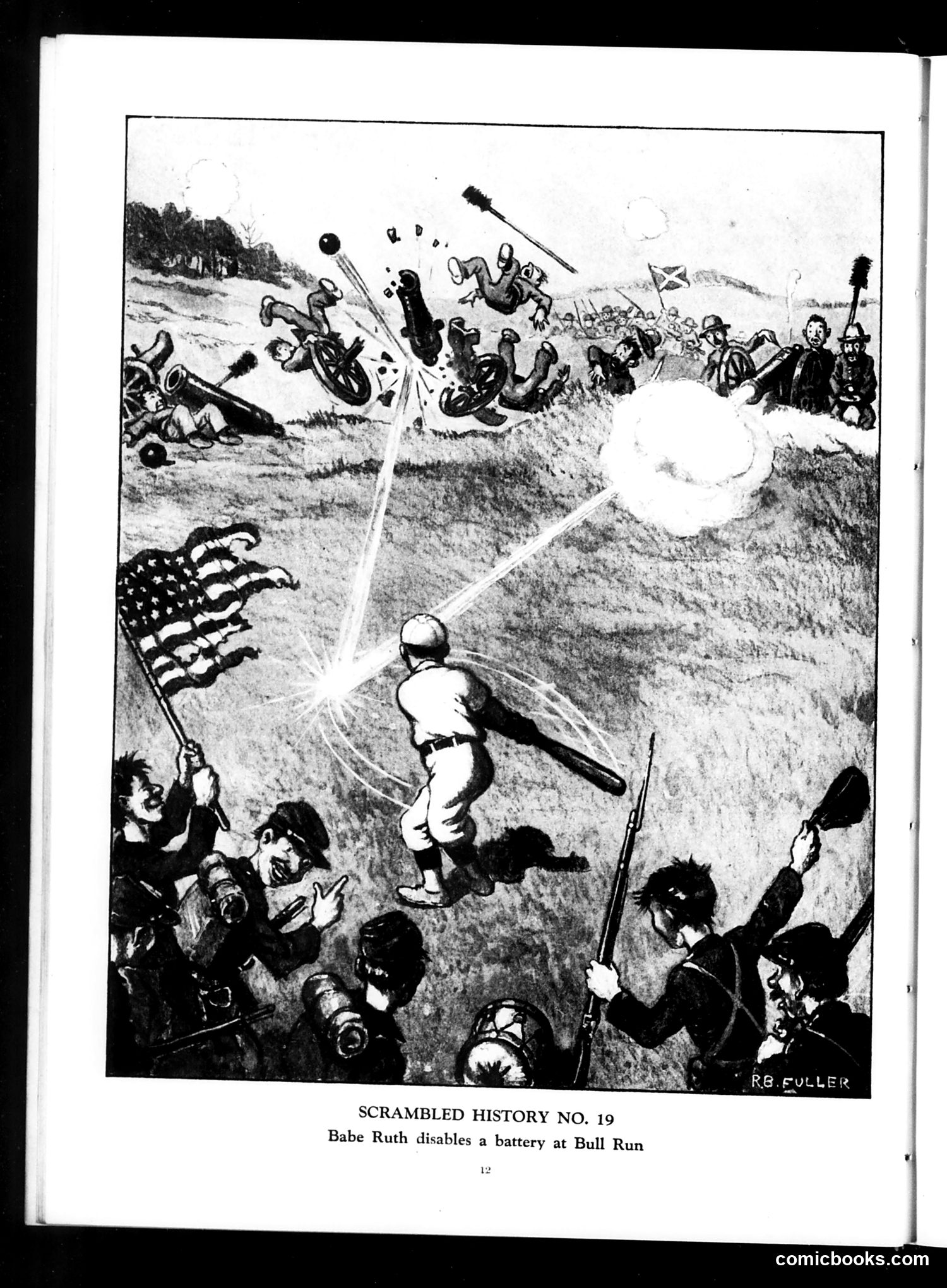
This is a satirical cartoon from Judge magazine titled "Scrambled History No. 19." It humorously reimagines the Battle of Bull Run (a major Civil War battle in 1861) with Babe Ruth, the famous baseball player, as the central figure instead of military combatants. The joke conflates baseball terminology with Civil War imagery: Ruth "disables a battery" (a baseball term for neutralizing the pitcher-catcher combination) rather than a military battery (artillery unit). The cartoon shows soldiers and an American flag in a battlefield setting, but the action centers on Ruth in baseball attire, apparently hitting or striking with a bat, causing chaos among the troops. This plays on Ruth's celebrity status and popularity in the 1920s-30s by absurdly inserting him into historical events.
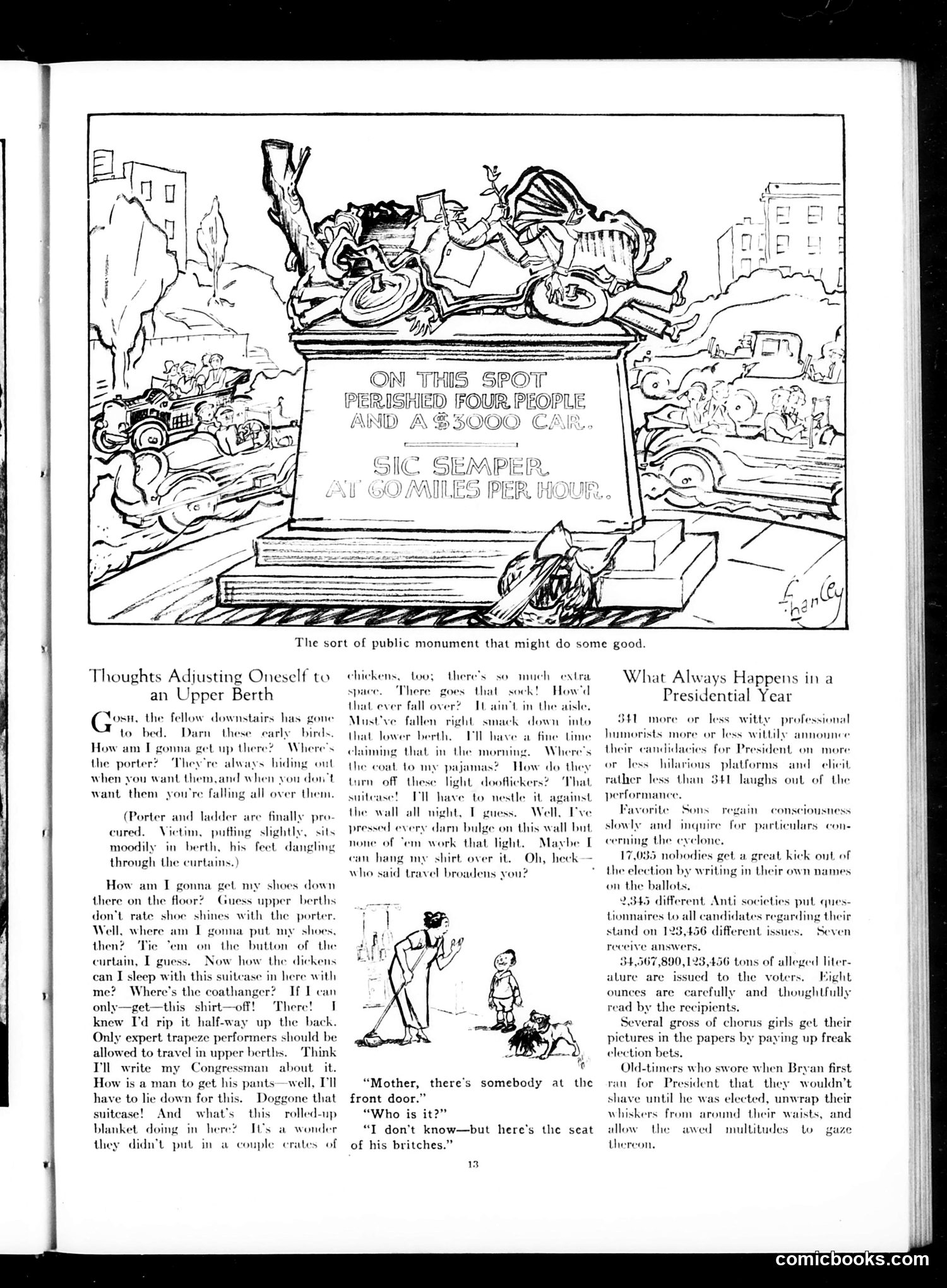
**Top Cartoon - Traffic Safety Monument:** This depicts a proposed public monument commemorating a fatal car crash ("ON THIS SPOT PERISHED FOUR PEOPLE AND A $3000 CAR"). The satire critiques reckless driving and speeding ("SIC SEMPER, AT 60 MILES PER HOUR"). The caption suggests such monuments might actually deter dangerous driving—a dark joke about using tragedy as public warning rather than traditional commemoration. **Middle Section - "Upper Berth" Humor:** Humorous complaints about train travel discomforts (sleeping in upper berths), typical of early 20th-century railroad complaints. The porter joke at bottom ("here's the seat of his britches") is slapstick physical comedy about an upper berth passenger's embarrassing descent. **Right Column - Presidential Election:** Satirizes recurring election-year absurdities: politicians announcing candidacies, frivolous publicity stunts by chorus girls, excessive campaign literature nobody reads, and obscure "Favorite Son" candidates. References Bryan (likely William Jennings Bryan), suggesting this is from an early 1900s election cycle.
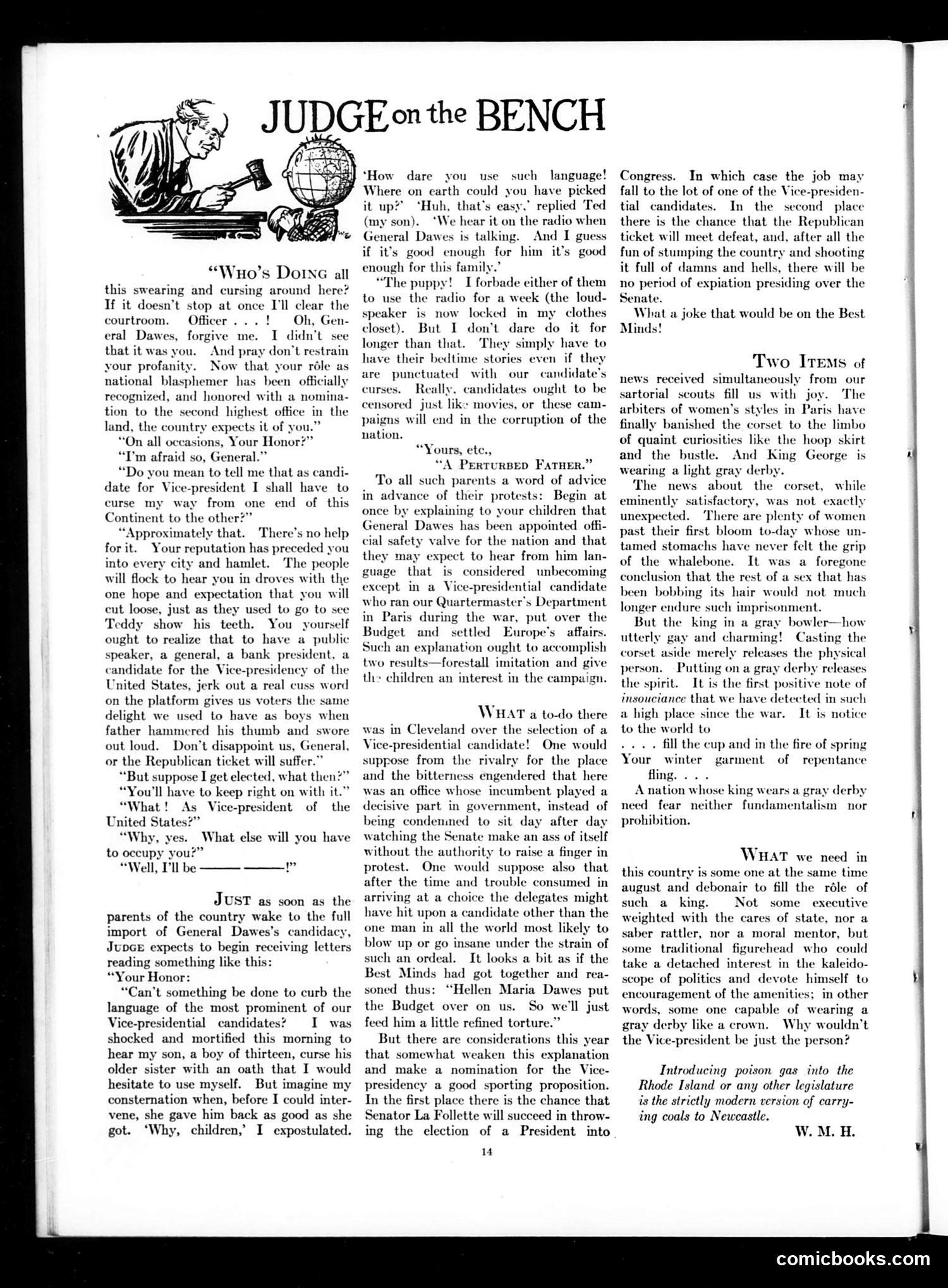
This 1924 cartoon mocks General Charles G. Dawes, the Republican Vice-Presidential nominee known for his notorious profanity. The humor centers on Dawes's reputation for colorful language becoming an unexpected political asset. The judge tells Dawes he must continue cursing throughout his campaign because voters expect it—comparing his appeal to Theodore Roosevelt showing his teeth. The satire suggests this vulgar reputation, ironically, makes him an entertaining public figure. The accompanying letter from "A Perturbed Father" extends the joke: children are imitating Dawes's profanity after hearing him on radio, yet parents can't restrict their access because kids need their bedtime stories. The satire ultimately critiques both Dawes's unsuitability for high office and the absurdity of his nomination—the Vice-Presidency being portrayed as a do-nothing position requiring nothing but colorful language to occupy one's time.
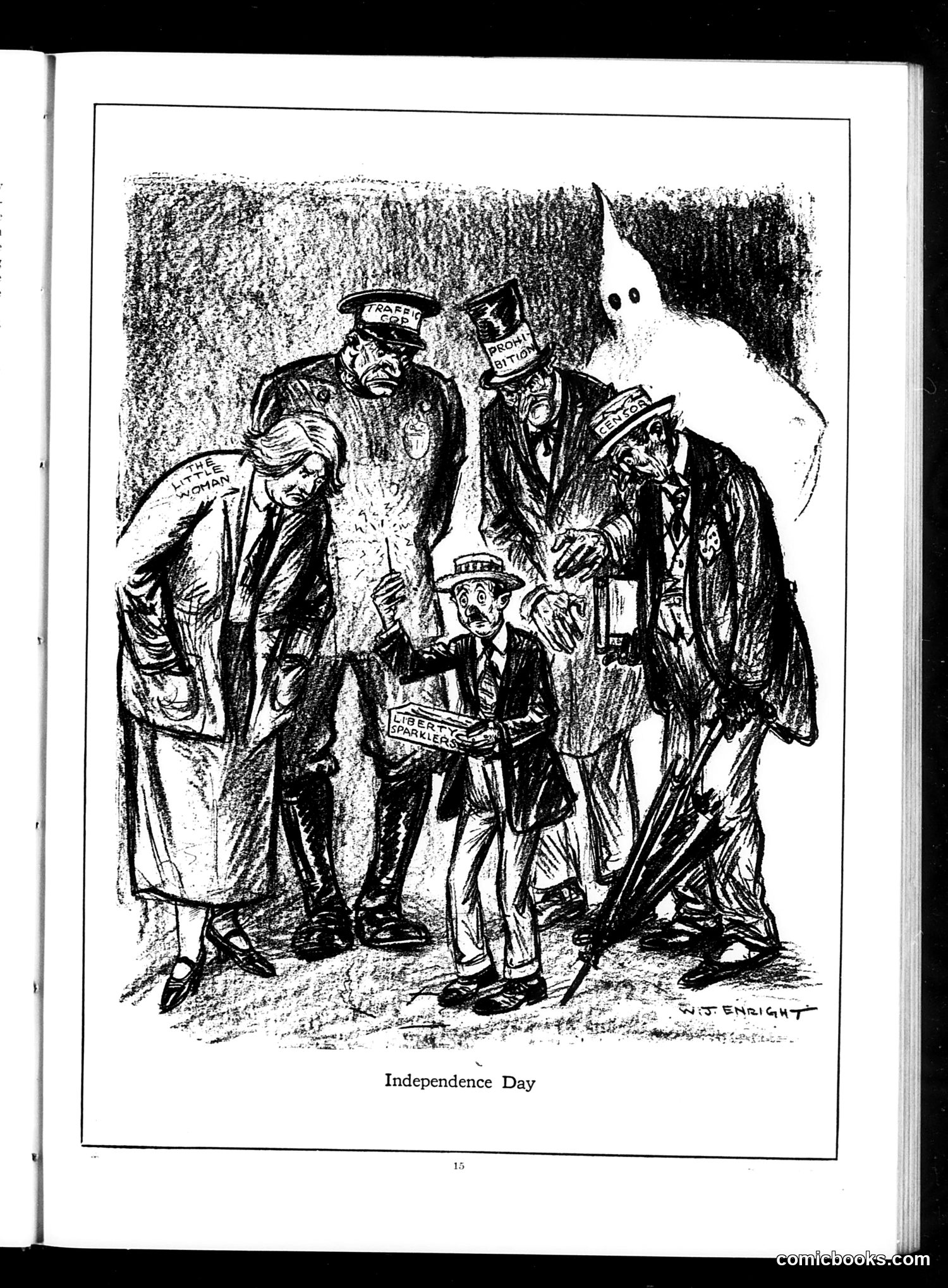
This political cartoon depicts a sinister hooded figure (representing the Ku Klux Klan) looming over a group of men in formal attire and a small child labeled "Sparkler." The child appears to represent American independence or democratic ideals, while the suited men—bearing labels including "Prohibition" and "Woman"—represent various social and political movements or constituencies. The satire suggests the KKK's threatening presence over American institutions and values during a period of significant social change (woman suffrage, Prohibition). The "Independence Day" title ironically contrasts the holiday's meaning with the cartoon's dark implication that fundamental American freedoms face danger from this extremist organization. This reflects Judge magazine's apparent anti-KKK stance during the 1920s resurgence of the organization.
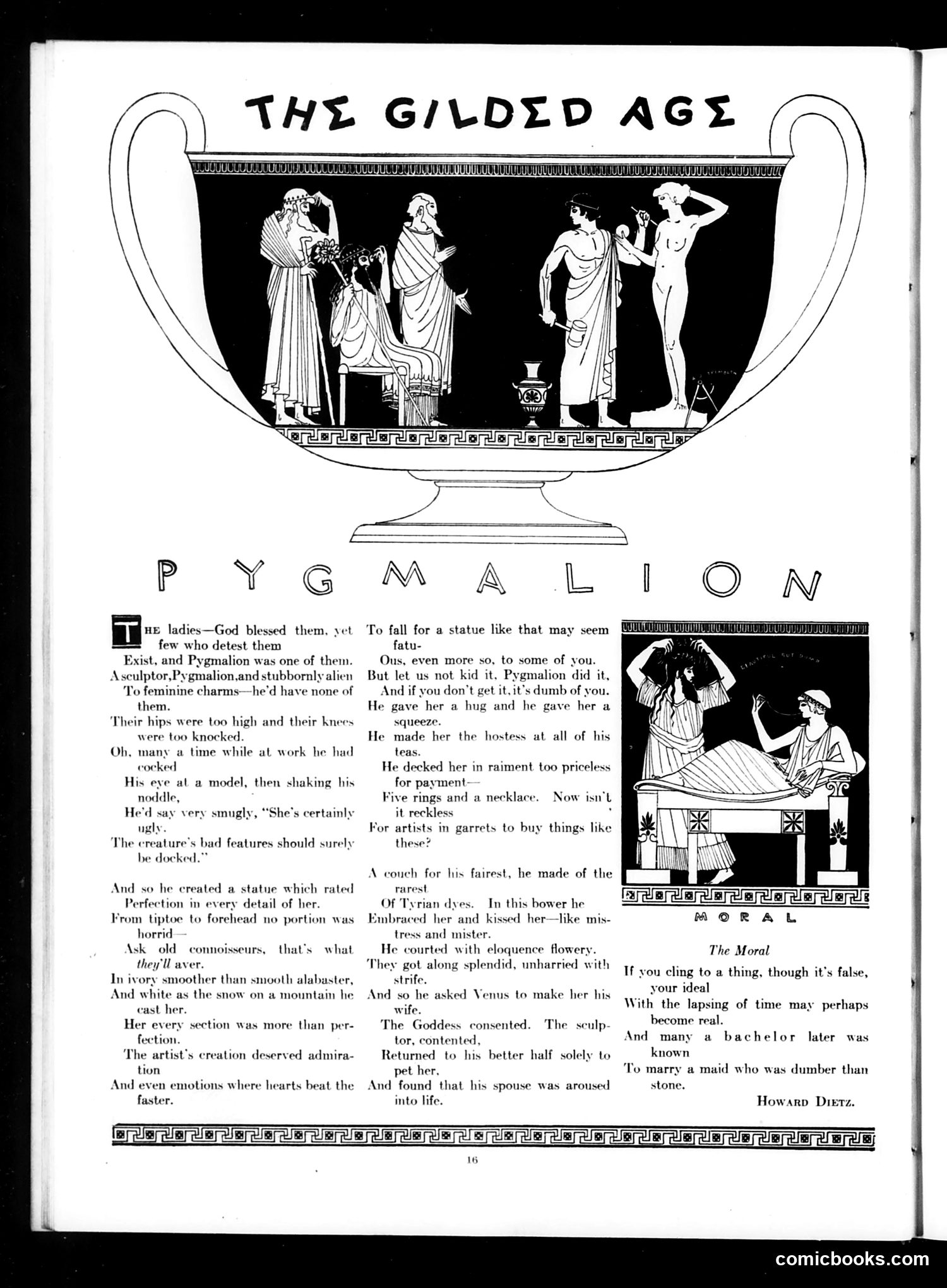
This page presents Howard Dietz's retelling of the classical myth for a modern audience. The satire targets the Gilded Age obsession with wealth and artificial perfection. **The Story**: A sculptor creates an idealized statue of a woman—perfect in every detail—whom he treats as a living companion, lavishing her with expensive clothes, jewelry, and luxuries. Venus grants his wish by bringing her to life as his wife. **The Satire**: The joke mocks wealthy men who pursue impossibly perfect, artificial ideals of femininity rather than accepting real women with natural flaws. The "moral" delivers the actual critique: men cling to false ideals hoping they'll magically become real—then marry women who are "dumber than stone," discovering too late that their fantasy doesn't match reality. **Context**: This reflects Gilded Age anxieties about materialism, the commercialization of beauty, and men's unrealistic expectations shaped by art and consumption rather than genuine human connection. The classical framing satirizes how wealthy aesthetes pursued artificial perfection through money.
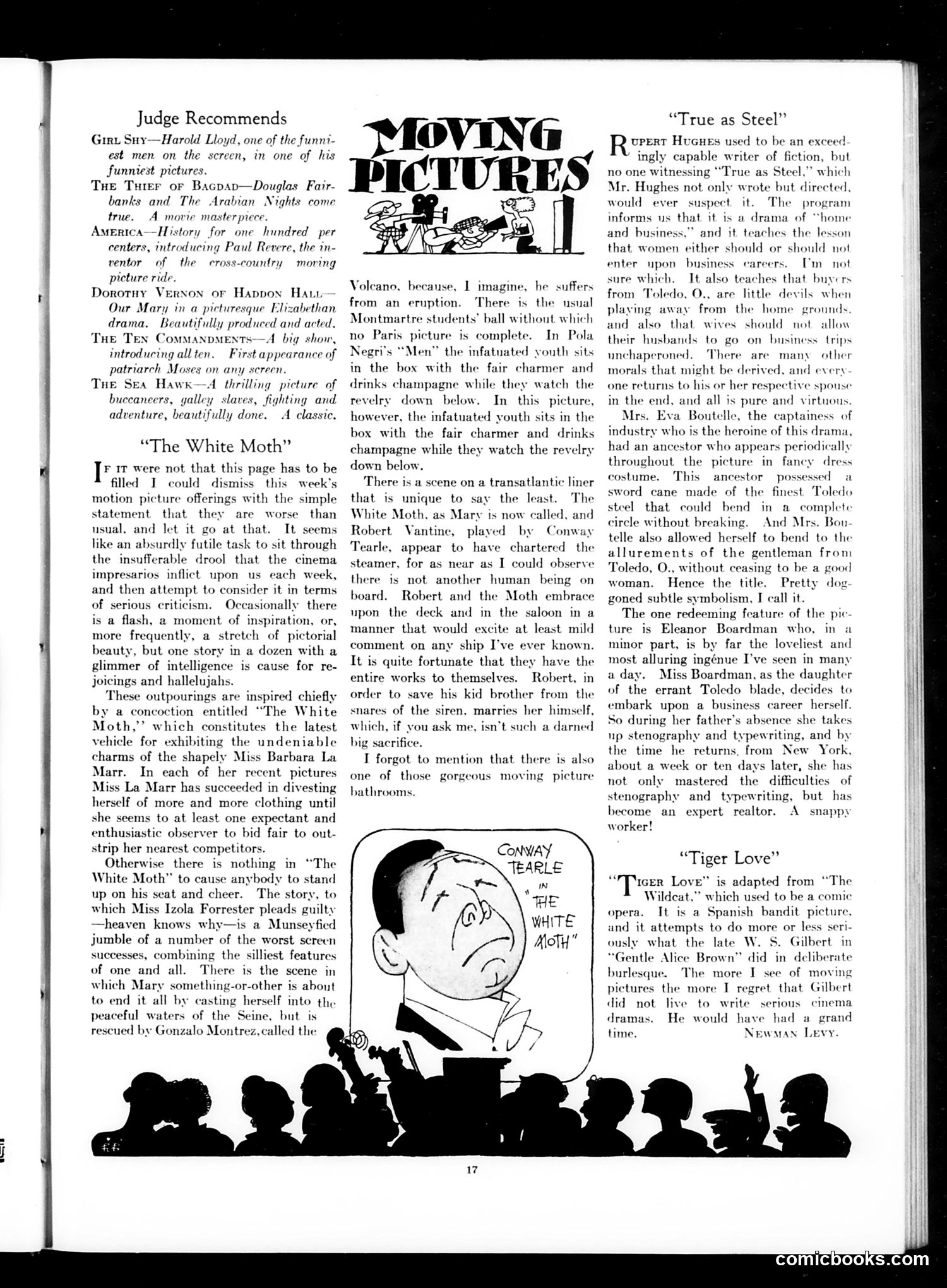
This page reviews several silent films from the 1920s. The main review criticizes "The White Moth," starring Barbara La Marr, as typical Hollywood drivel featuring a tired plot: a woman contemplating suicide in Paris, rescued by a man named "Volcano" (Conway Tearle), leading to marriage. The critic notes La Marr's progressive undressing across her recent films and mocks the film's clichés—Montmartre balls, transatlantic scenes—suggesting the couple has chartered an entire ship alone. The cartoon shows Conway Tearle as the exasperated "Volcano" character, overwhelmed by an audience—satirizing both the melodramatic acting style and the absurdity of the film's premise. The page also recommends Harold Lloyd and Douglas Fairbanks comedies positively, and reviews "True as Steel," directed by Rupert Hughes, dismissing it as proof that capable writers don't necessarily make competent filmmakers. The overall tone reflects 1920s film criticism's condescension toward plot-driven dramatic pictures while favoring comedy and spectacle.
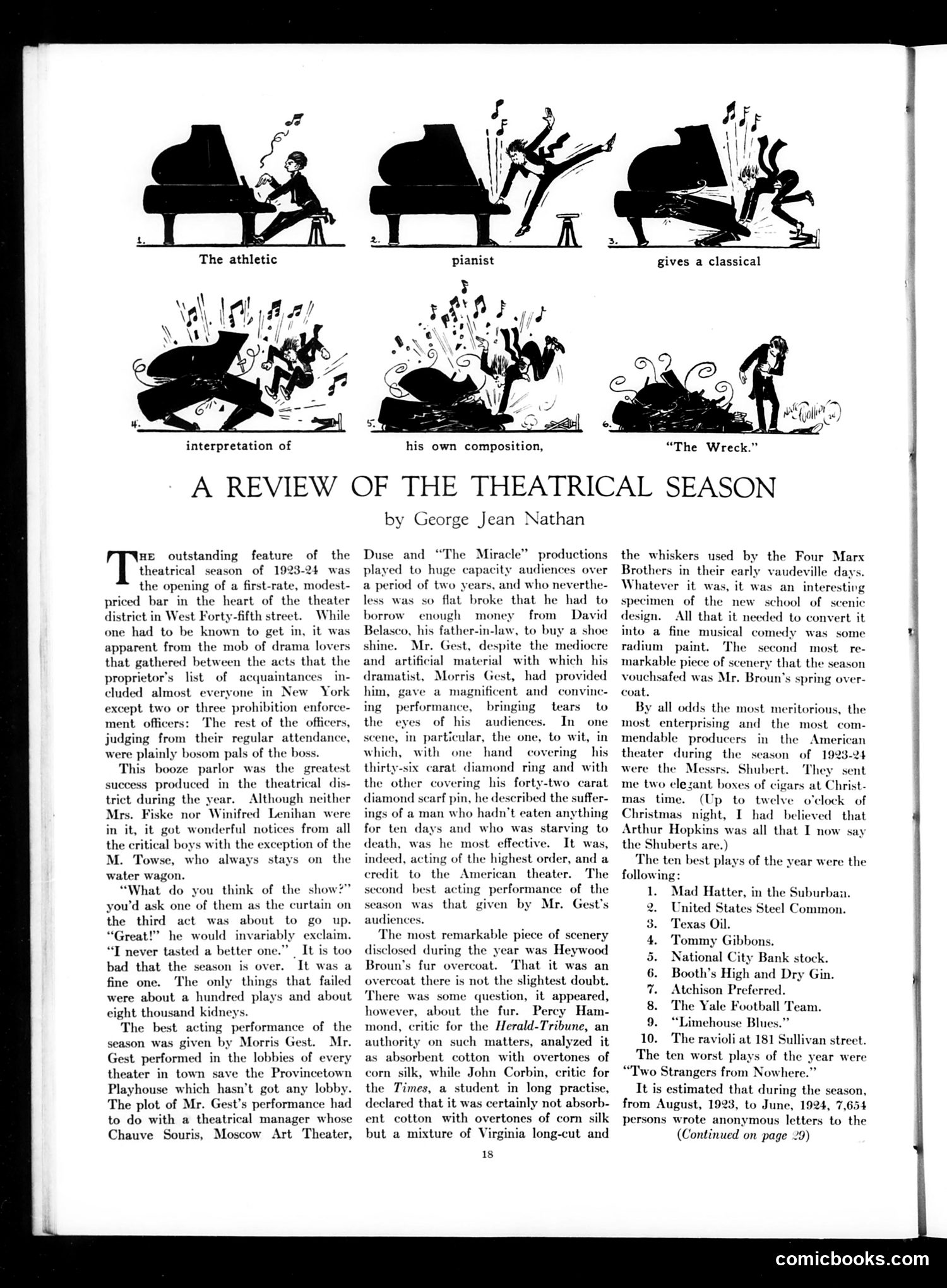
The top cartoons satirize different pianists' performance styles: "The athletic pianist" plays with exaggerated physical gyrations; "gives a classical interpretation" shows restrained, proper technique; and "his own composition" depicts chaotic, explosive performance. These mock various concert pianists' showmanship tendencies. The main text by George Jean Nathan is a satirical review of Broadway's 1923-24 season. Its central joke: **the real theatrical highlight wasn't any play, but a speakeasy** (illegal bar) operating on West 45th Street during Prohibition. Nathan quips that even prohibition enforcement officers frequented it regularly—a dig at widespread corruption and the failure of Prohibition enforcement. Secondary targets include producer Morris Gest (mocked for his grandiose performances and evident wealth despite claimed poverty) and theater critic Heywood Broun's shabby fur overcoat, which Nathan and fellow critics debate sarcastically: is it cotton with corn silk, or Virginia tobacco and Marx Brothers' whiskers? The joke emphasizes critics' pretentious over-analysis of trivial matters.
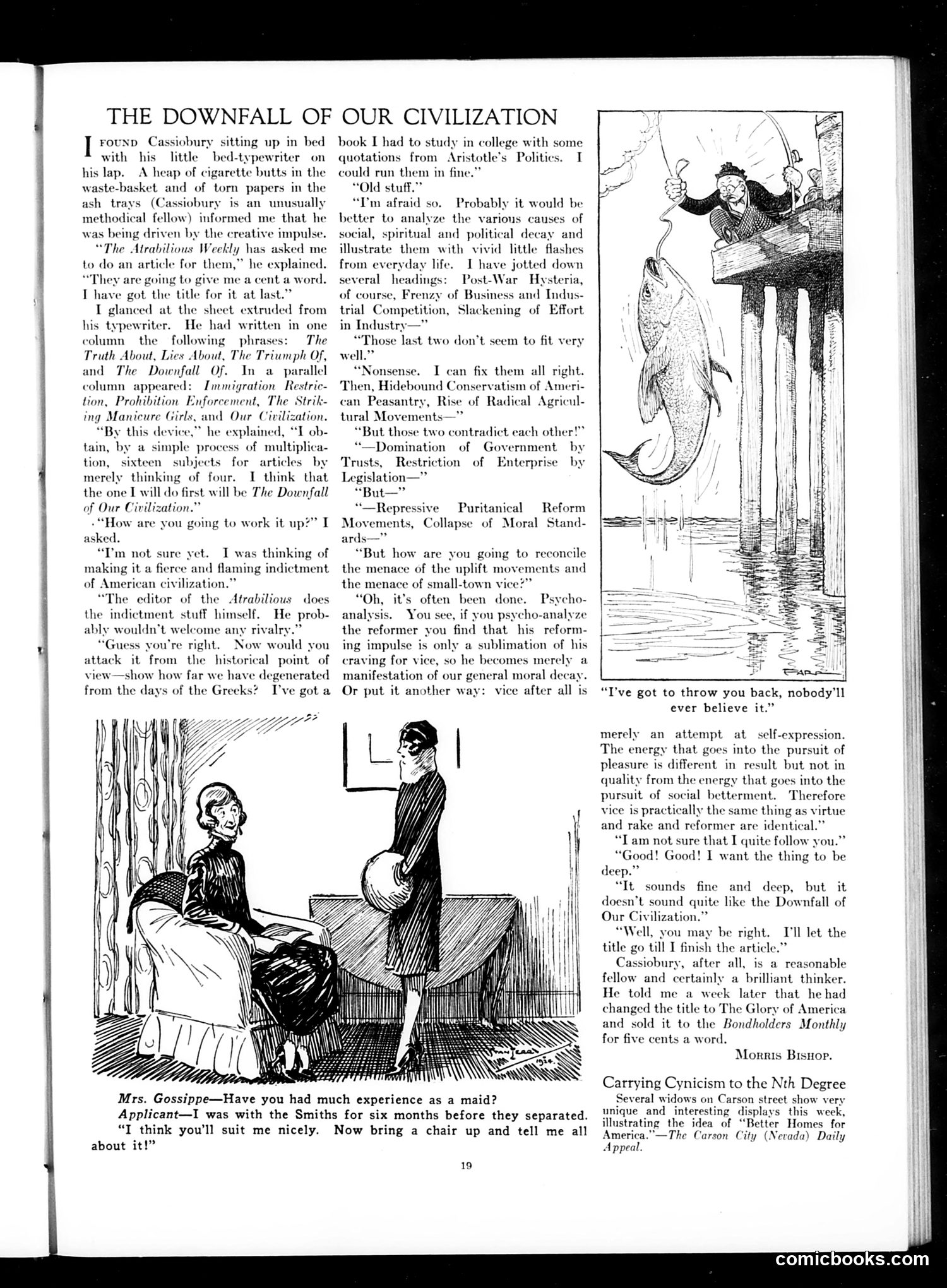
This satirical piece mocks superficial magazine journalism and intellectual laziness. **Cassiobury**, a writer for *The Atrabilious Weekly*, demonstrates how articles are assembled mechanistically—he literally uses a "process of multiplication" combining stock phrases ("The Truth About," "The Downfall Of") with trendy topics (Prohibition, strikes, civilization decline) to generate saleable content without genuine thought. The satire escalates when Cassiobury justifies contradictory arguments (condemning both reform movements *and* moral decay) through pseudo-intellectual psychoanalysis, claiming vice and virtue are "practically the same thing." His friend's skepticism—"it doesn't sound quite like the Downfall of Our Civilization"—underscores the absurdity. The punchline reveals Cassiobury later simply retitles the same article *"The Glory of America"* and sells it elsewhere, proving the entire exercise was hollow commercial cynicism masquerading as serious social commentary.
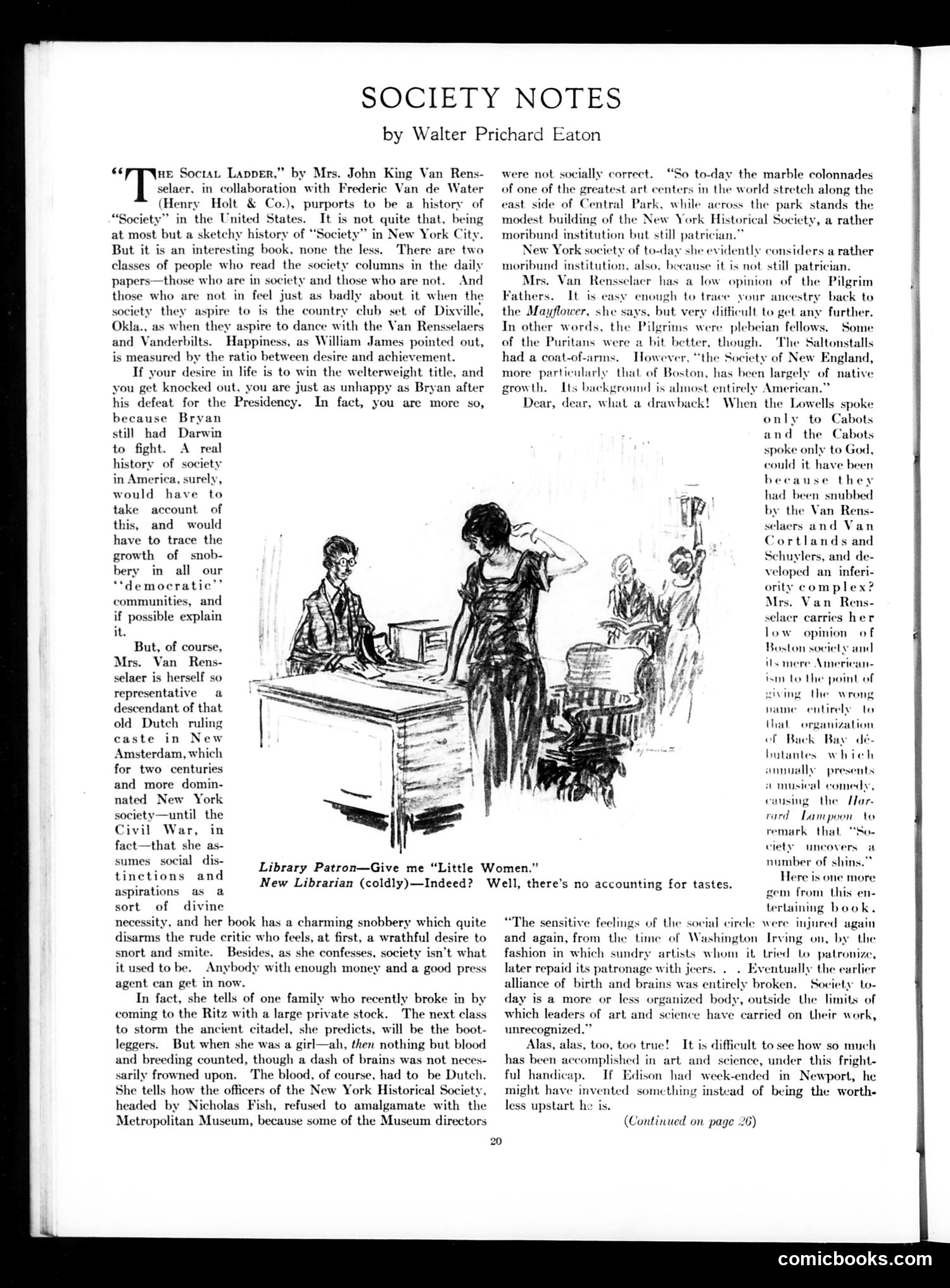
This page contains a book review by Walter Prichard Eaton of "The Social Ladder" by Mrs. John King Van Rensselaer, a history of New York City society. **The cartoon** shows a library patron asking for "Little Women" while a librarian responds coldly that "there's no accounting for tastes"—a mild joke suggesting the patron has poor literary judgment. **The satire's main target** is Mrs. Van Rensselaer herself, a descendant of old Dutch aristocracy who wrote about American social hierarchies. Eaton mocks her assumption that social distinctions are divinely ordained while acknowledging that modern society (including bootleggers) can now "buy in" with money. **Key irony**: He references the famous Brahmin saying "The Lowells speak only to Cabots, and the Cabots speak only to God," suggesting Boston's superiority complex may stem from being snubbed by New York's Dutch families—inverting her authority. The piece critiques inherited privilege and suggests America's "democratic" communities are fundamentally snobbish, contradicting their democratic ideals.
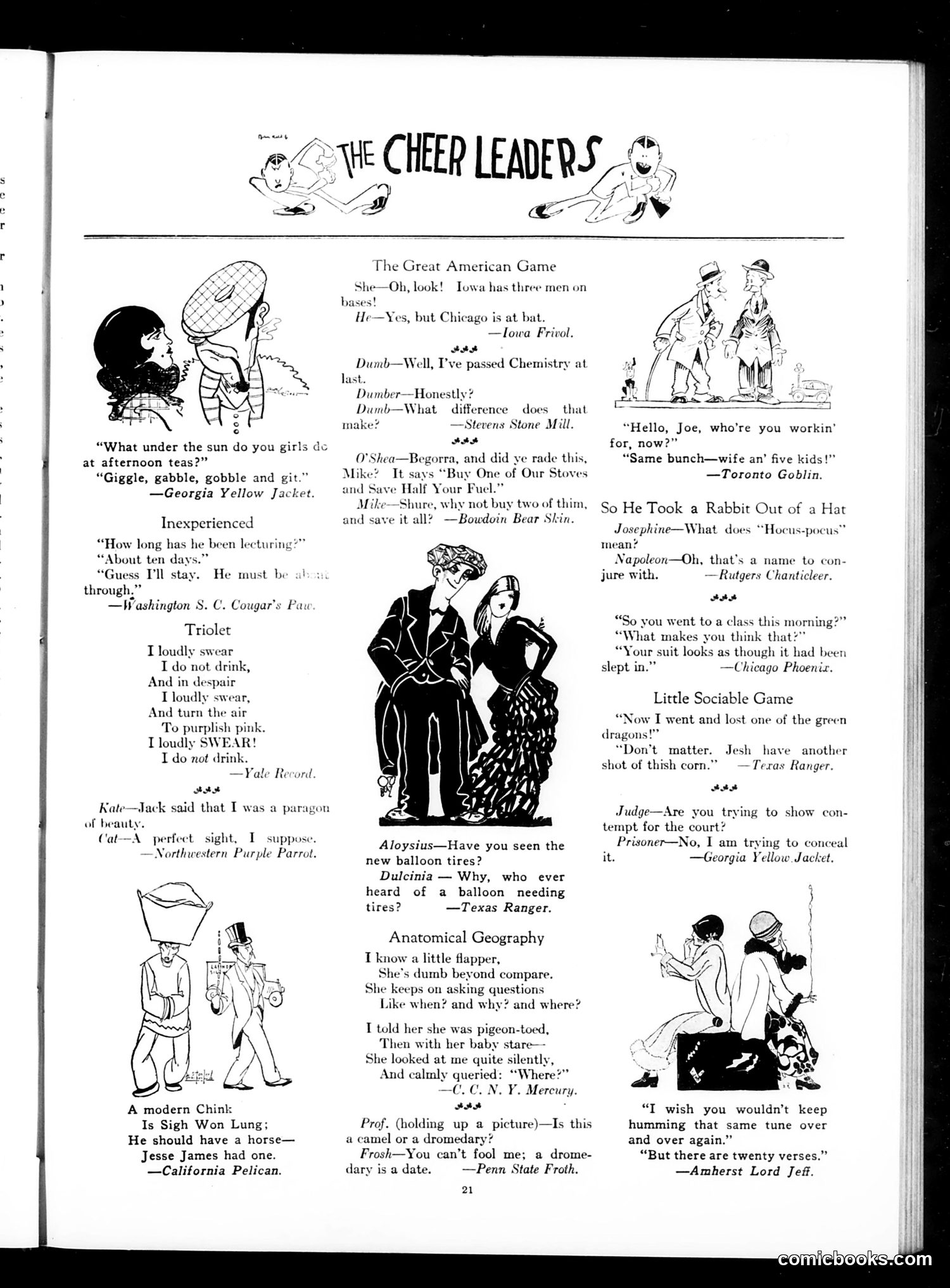
This page from *Judge* magazine collects humorous short jokes and verses from various college publications, arranged around decorative illustrations. The content reflects early 20th-century college humor—likely 1920s based on references to "flappers" and "balloon tires." The jokes target familiar targets: absent-minded professors, naive freshmen, drinking culture ("I loudly swear / I do not drink"), marital complaints, and romantic misunderstandings. One cartoon depicts a man and woman in an embrace, illustrating romantic humor typical of the era. Notable is casual ethnic stereotyping: a "modern Chink" named "Sigh Won Lung" appears in a brief joke, reflecting the casual racism common in period college humor. The recurring theme is collegiate life—classes, romance, courtship—with humor aimed at educated young readers. The "Little Sociable Game" reference to "green dragons" and drinking corn whiskey reflects Prohibition-era coded references to alcohol consumption. The satire is gentle and domestic rather than political, targeting social conventions and academic pretension rather than substantive critique.
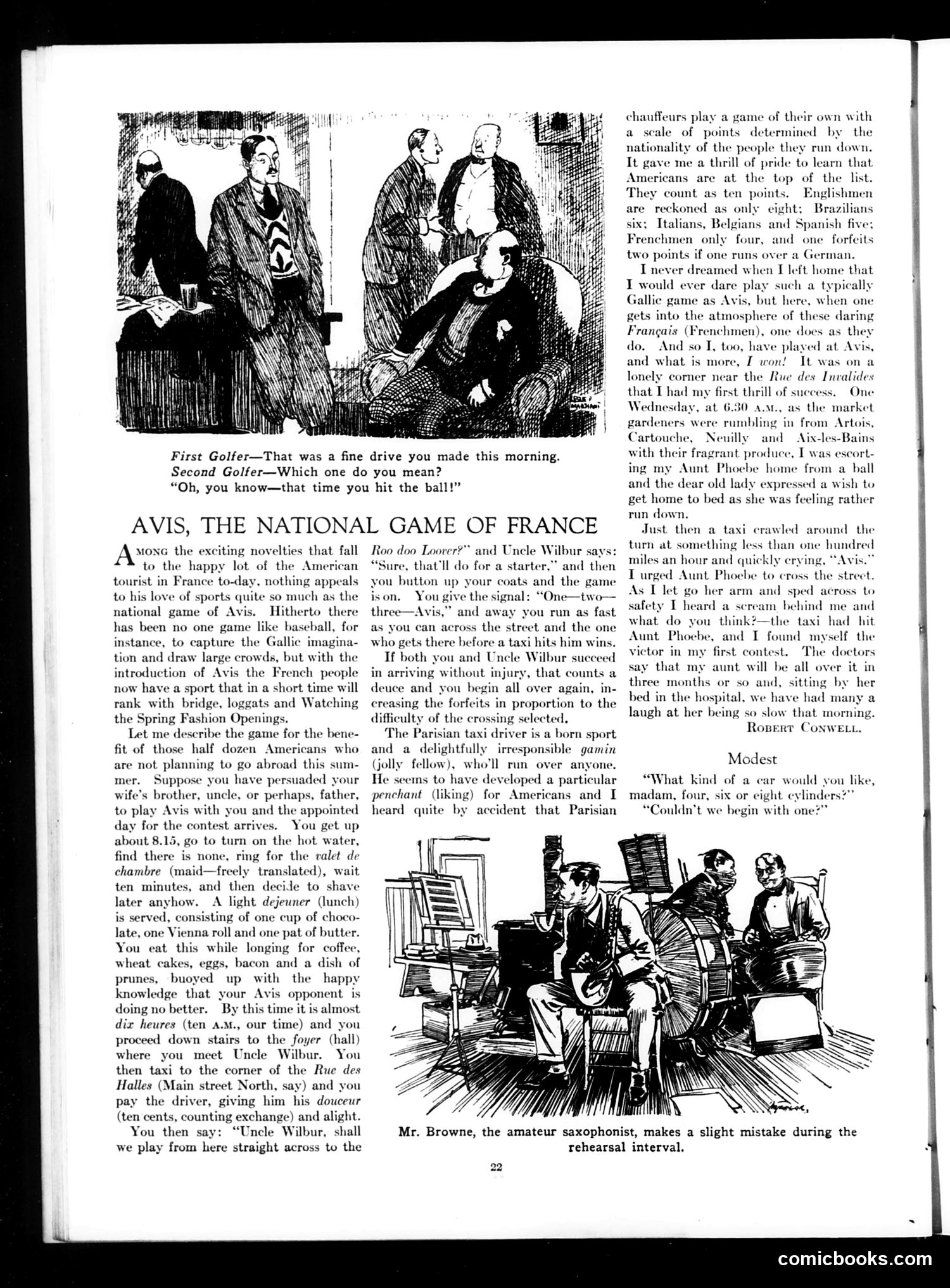
This satirical article mocks both American tourists in France and French taxi drivers' recklessness. "Avis" is a fictional "national game" where players race across Paris streets, dodging taxis to reach the opposite side first—the winner determined by who avoids being hit. The satire works on multiple levels: it portrays Americans as gullible tourists easily seduced by exotic European experiences, while depicting Parisian taxi drivers as dangerously irresponsible. The humor intensifies when the article claims French drivers have invented their own "scoring system" based on pedestrian nationality, with Americans worth ten points—a darkly comedic jab at both American pride and French disregard for safety. The opening joke about golf establishes the theme: absurdist humor about missing obvious points. The accompanying illustrations show upper-class men in formal dress, reinforcing Judge's typical audience of educated urbanites amused by travel mishaps and international stereotypes. The piece satirizes 1910s-era American tourist culture and Franco-American relations.
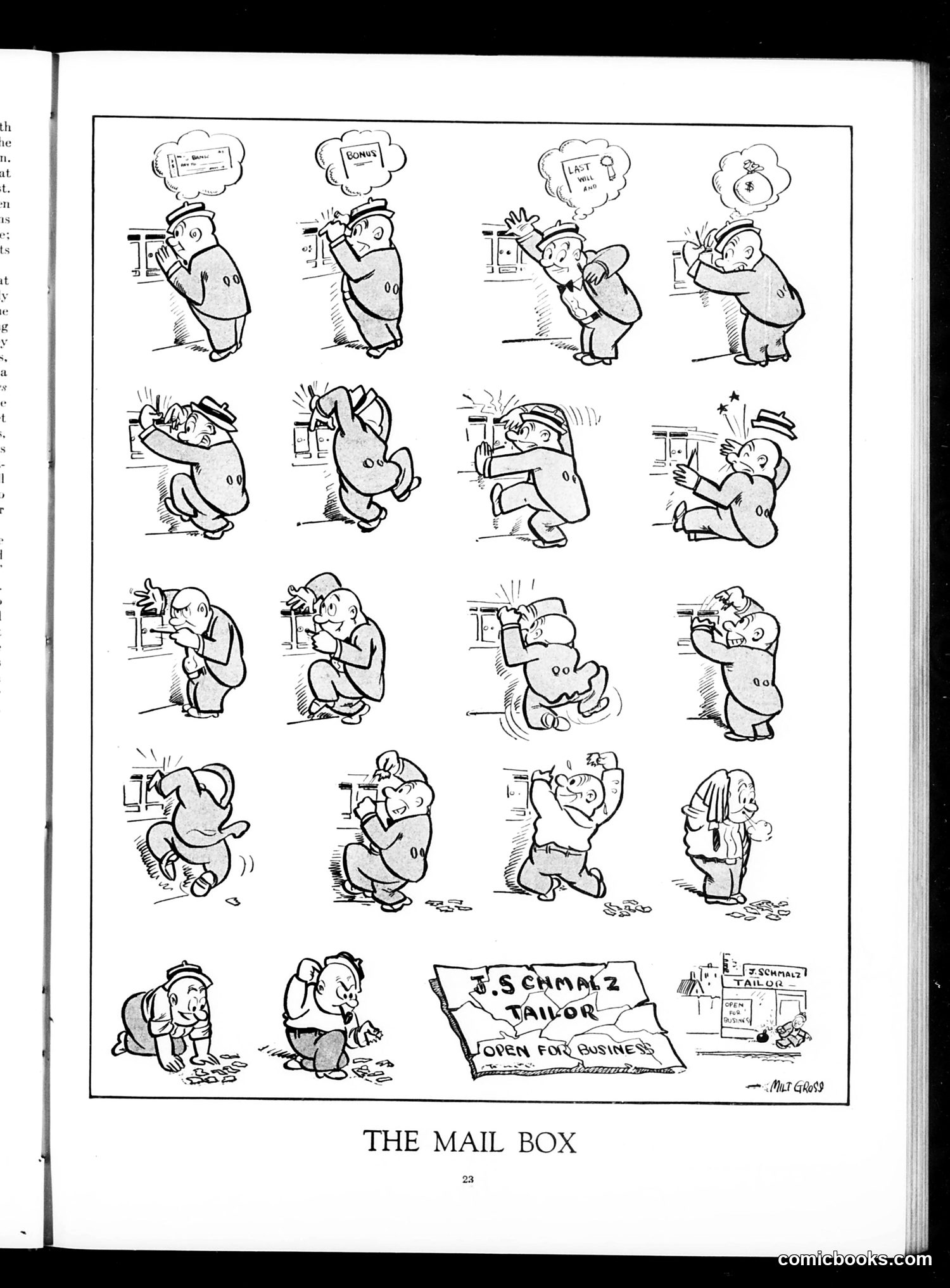
This is a sequential comic strip by Mil Gross (signed "Mat Gross") showing a character's increasingly frantic interactions with a mailbox labeled "F. Schmalz Tailor - Open for Business." The humor follows a slapstick progression: the figure begins calmly checking the mailbox, then becomes progressively more agitated and physically contorted as he retrieves mail. By the final panels, he's crawling on the ground, appearing exhausted or defeated. The joke likely satirizes the frustration of receiving unwanted mail or bills—a relatable concern for early 20th-century readers. The character's name "Schmalz" (Yiddish slang for excessive sentimentality or "schlock") suggests this may carry ethnic humor typical of Judge magazine's era. The comic's appeal rests on visual exaggeration and physical comedy rather than political commentary.
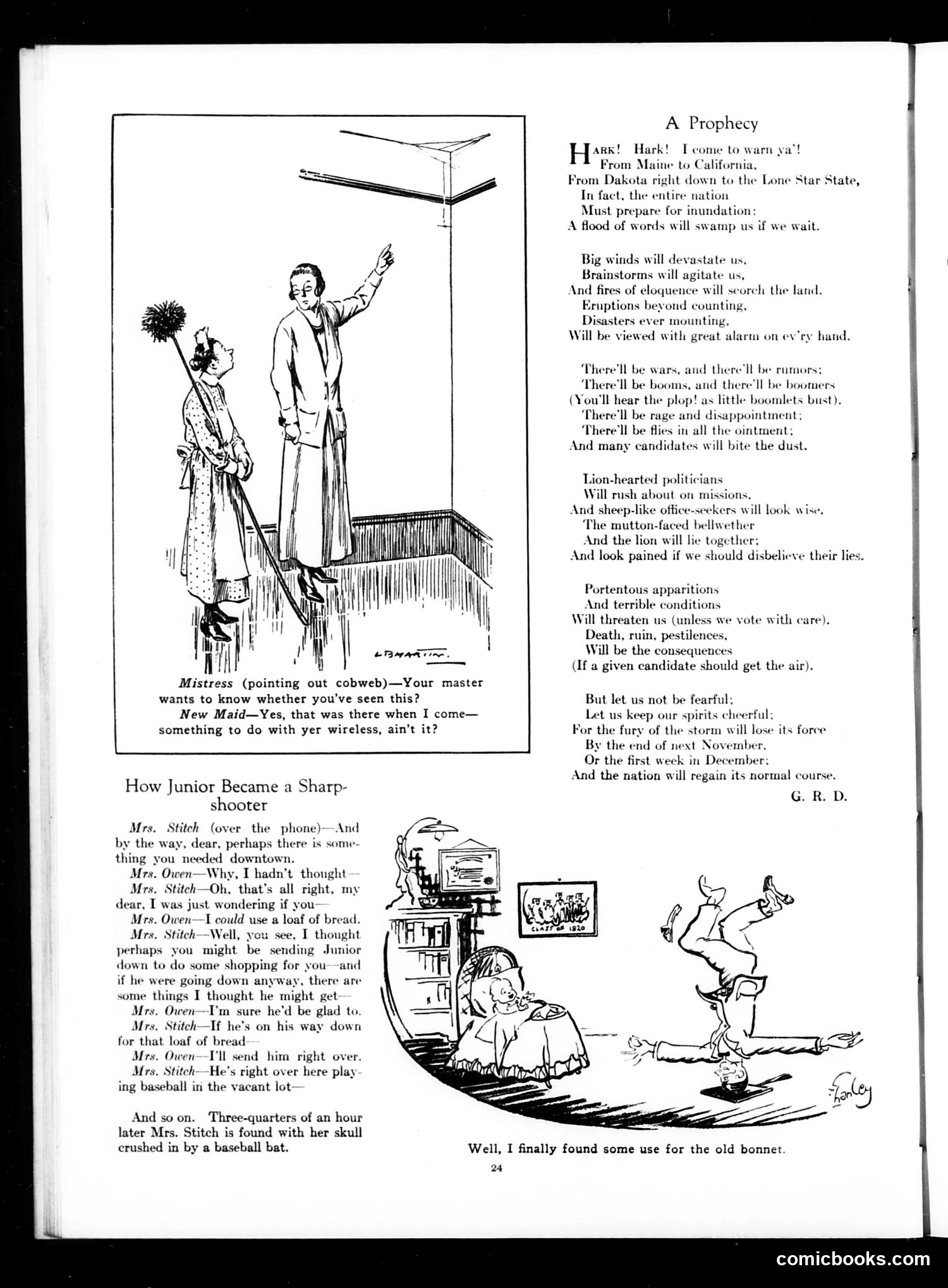
**"A Prophecy"** is a political satire about an upcoming election cycle (likely 1920 or similar era). The poem mocks the anticipated chaos of American politics: politicians making grandiose speeches ("fires of eloquence"), competing candidates ("boomers"), rumors and false promises spreading like natural disasters, and office-seekers pretending wisdom. The satire suggests political rhetoric will "swamp" the nation with empty words. It caricatures politicians as either "lion-hearted" (aggressive) or "sheep-like" (foolish followers). The conclusion reassures readers that after November elections, normalcy will return—implying the election season itself is a temporary deluge of nonsense to endure. **"How Junior Became a Sharpshooter"** is dark humor: Mrs. Stitch manipulates her neighbor into sending her son on errands, eventually resulting in the boy hitting her with a baseball. The punchline—she finally found use for her old bonnet (presumably to shield from the baseball)—suggests she orchestrated her own injury.
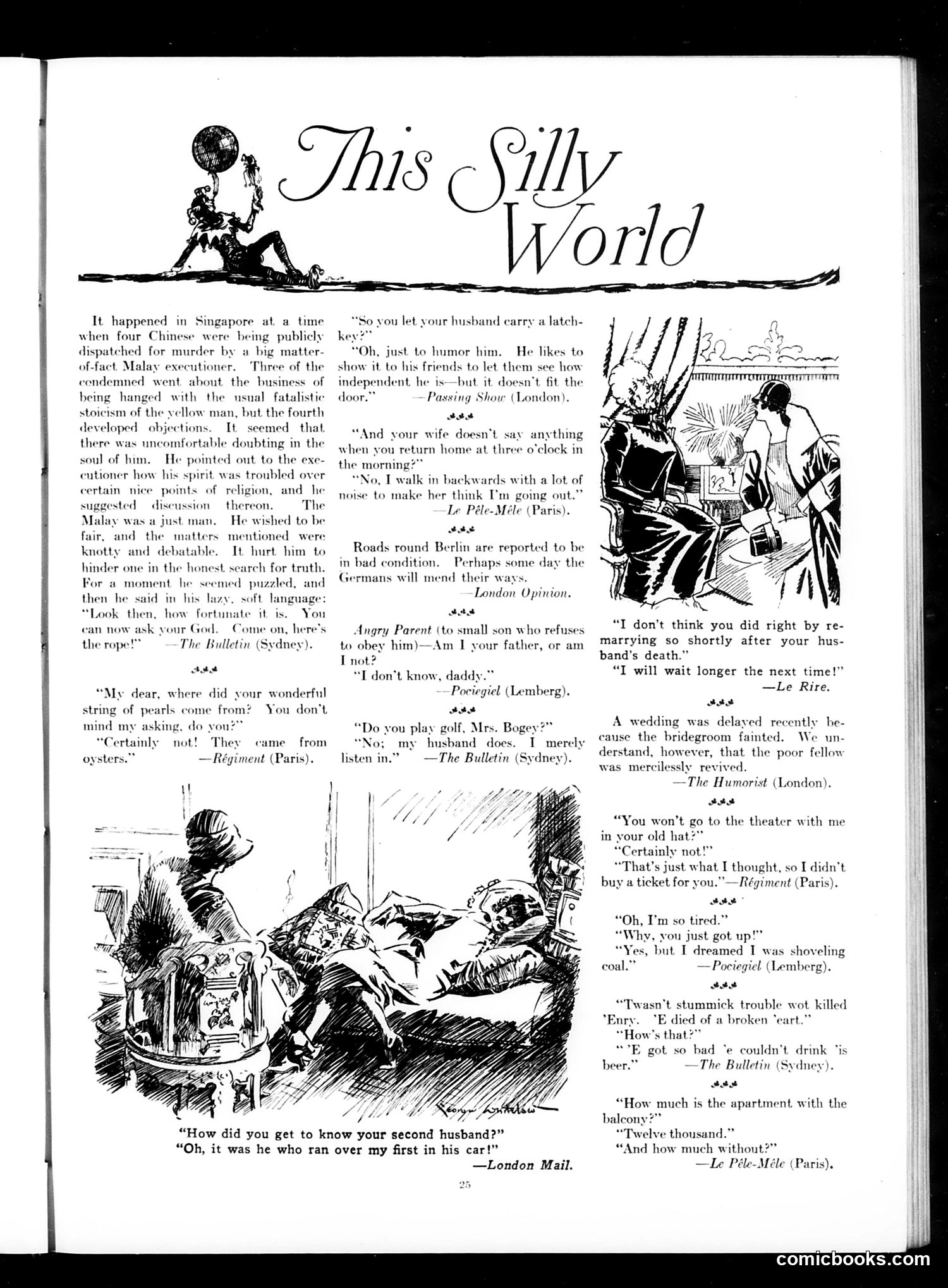
This page collects humorous anecdotes from international satirical magazines, arranged around two cartoons. The content satirizes early 20th-century social conventions and marital dynamics. **Main themes:** The jokes mock middle-class marriage—particularly husbands' infidelity, independence, and dishonesty. A husband carries a latchkey to seem "independent" but it doesn't fit; another walks in backwards at 3 AM to deceive his wife about going out. One wife remarries quickly after her husband's death, joking she'll "wait longer next time." **The cartoons** depict domestic scenes with exaggerated situations: one shows a chaotic household moment; another illustrates the anecdote about a second husband who was introduced via car accident. The Singapore execution anecdote opens the piece with dark humor about religious doubts—contrasting the condemned man's philosophical objections with the executioner's pragmatic fatalism. **Cultural references** are international (Paris, London, Sydney publications), reflecting Judge's cosmopolitan humor market. The satire assumes readers recognize and find amusement in marital deception as a universal condition.
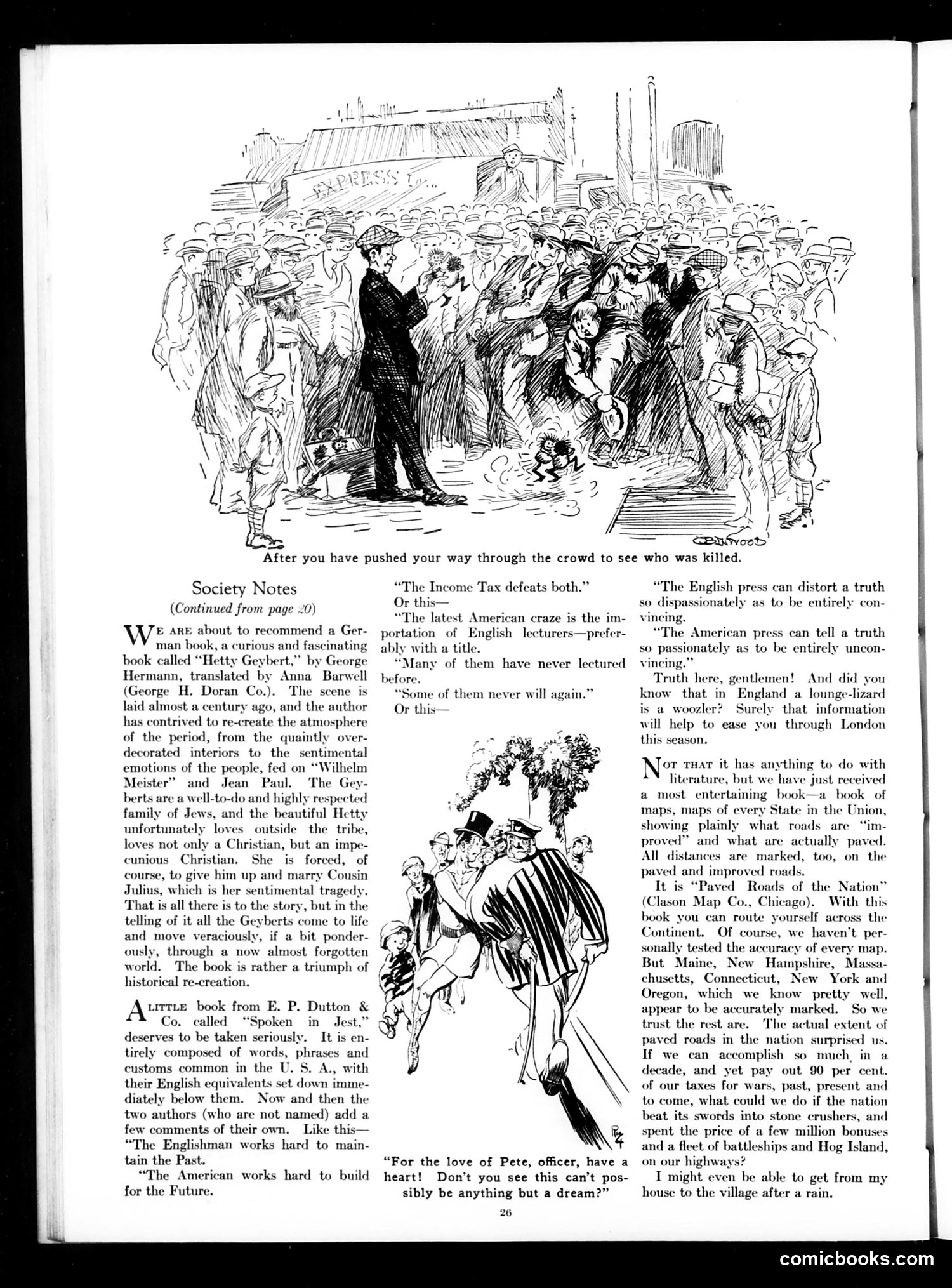
The page contains a **society/book review column** rather than a traditional political cartoon. The sketch at top shows a crowd scene after an accident or disaster—the caption suggests morbid curiosity drawing onlookers. The reviews discuss three books, with satirical commentary interspersed. A key section compares American and English national character through paired observations: "The Englishman works hard to maintain the Past. The American works hard to build for the Future." This reflects early-20th-century anxieties about American vs. European values. The most pointed satire appears in contrasts about press truthfulness—the English distort dispassionately (convincingly), Americans tell truth passionately (unconvincingly)—poking fun at both nations' media. The final review of "Paved Roads of the Nation" becomes genuinely political: it mocks government priorities, arguing that if America can build extensive road networks on limited budgets, imagine what could be accomplished if military spending ("swords into stone crushers") were redirected to infrastructure. This reflects Progressive-era critiques of military expenditure.
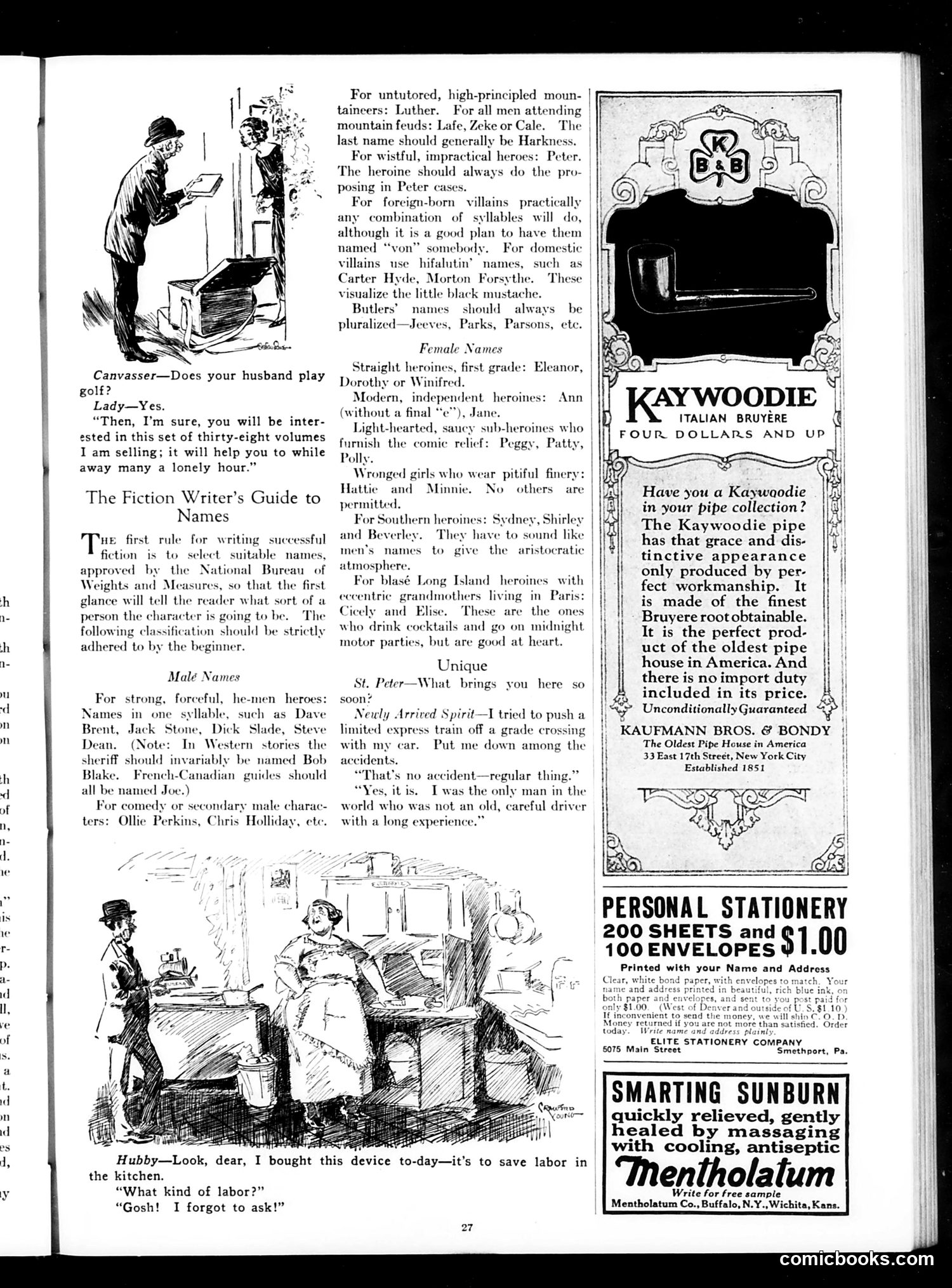
This satirical article mocks the predictability and formula-driven nature of popular fiction writing. The piece humorously prescribes rigid naming conventions supposedly approved by a "National Bureau of Weights and Measures"—a deliberately absurd authority. The satire targets cheap pulp fiction tropes: strong heroes must have one-syllable names (Brent, Stone); villains should be "foreign-born" with "von" surnames; Southern heroines sound aristocratic; wronged girls are named only Hattie or Minnie. The humor lies in exposing how formulaic commercial fiction had become—characters were interchangeable stock types identified entirely by their names. The sidebar jokes reinforce this: a door-to-door salesman sells 38 volumes on golf to distract lonely golf wives; a "newly arrived spirit" claims a car-train accident is actually routine because he was the only careful driver alive. The overall message: popular fiction writers followed such rigid, predictable conventions that readers could identify any character's role instantly from their name alone.
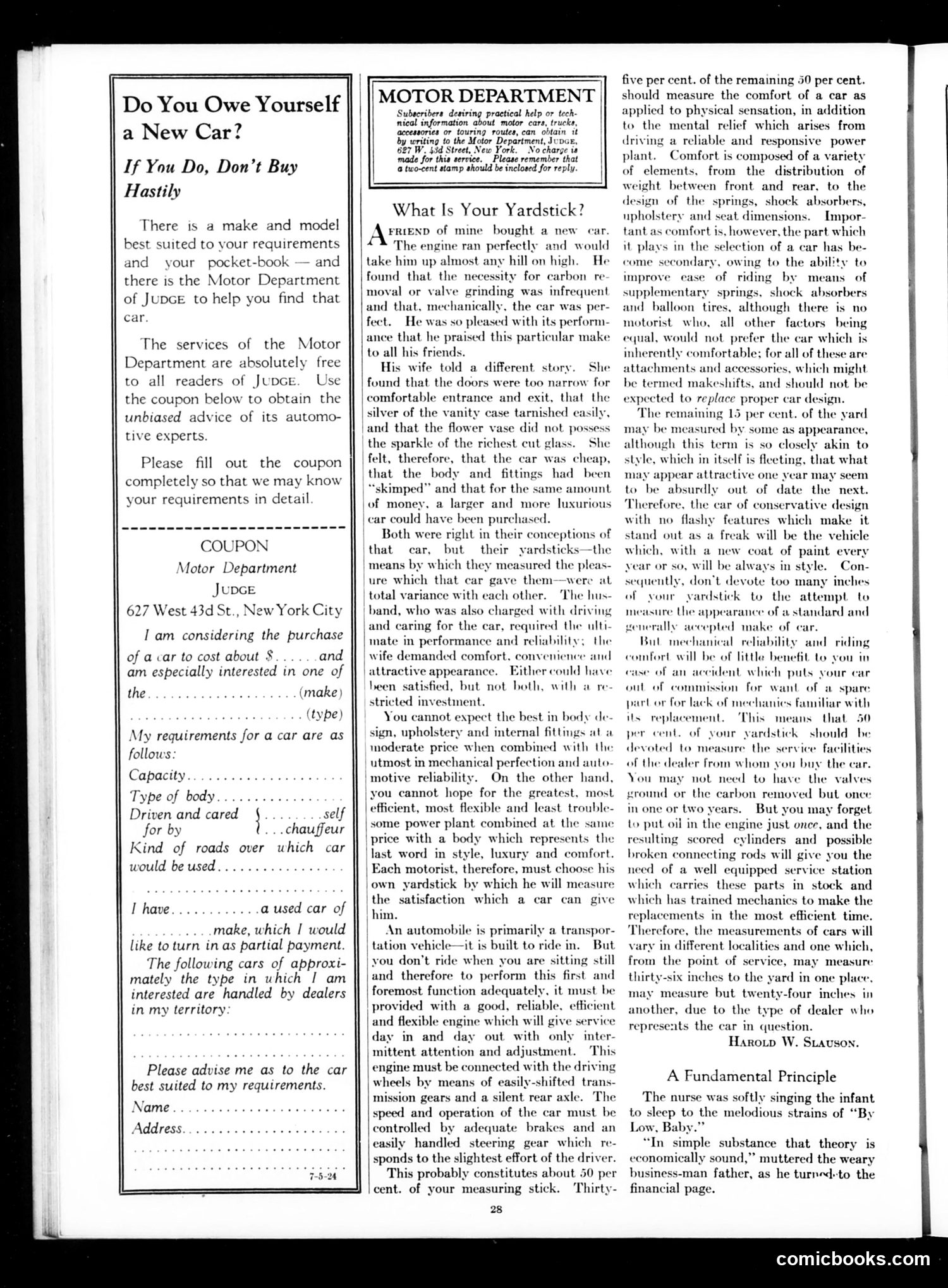
This page combines advertising with consumer advice. The left side is a **coupon for Judge's Motor Department**—a free advisory service helping readers choose cars by mail, targeting the magazine's upscale readership considering automobile purchases. The main article, "What Is Your Yardstick?" humorously illustrates a marital disagreement: a husband praises his new car's mechanical perfection (engine, reliability), while his wife dislikes its cheap interior details (narrow doors, tarnished vanity case, dull flower vase). The satire critiques how different people measure value—he prioritizes engineering; she wants luxury and comfort. The piece's practical advice argues buyers must choose what matters most: mechanical perfection *or* stylish comfort, not both at moderate cost. The "yardstick" metaphor suggests each motorist must establish personal priorities rather than expecting everything. This reflects 1920s-era automobile culture when cars were becoming consumer goods, and gender roles shaped purchasing preferences.
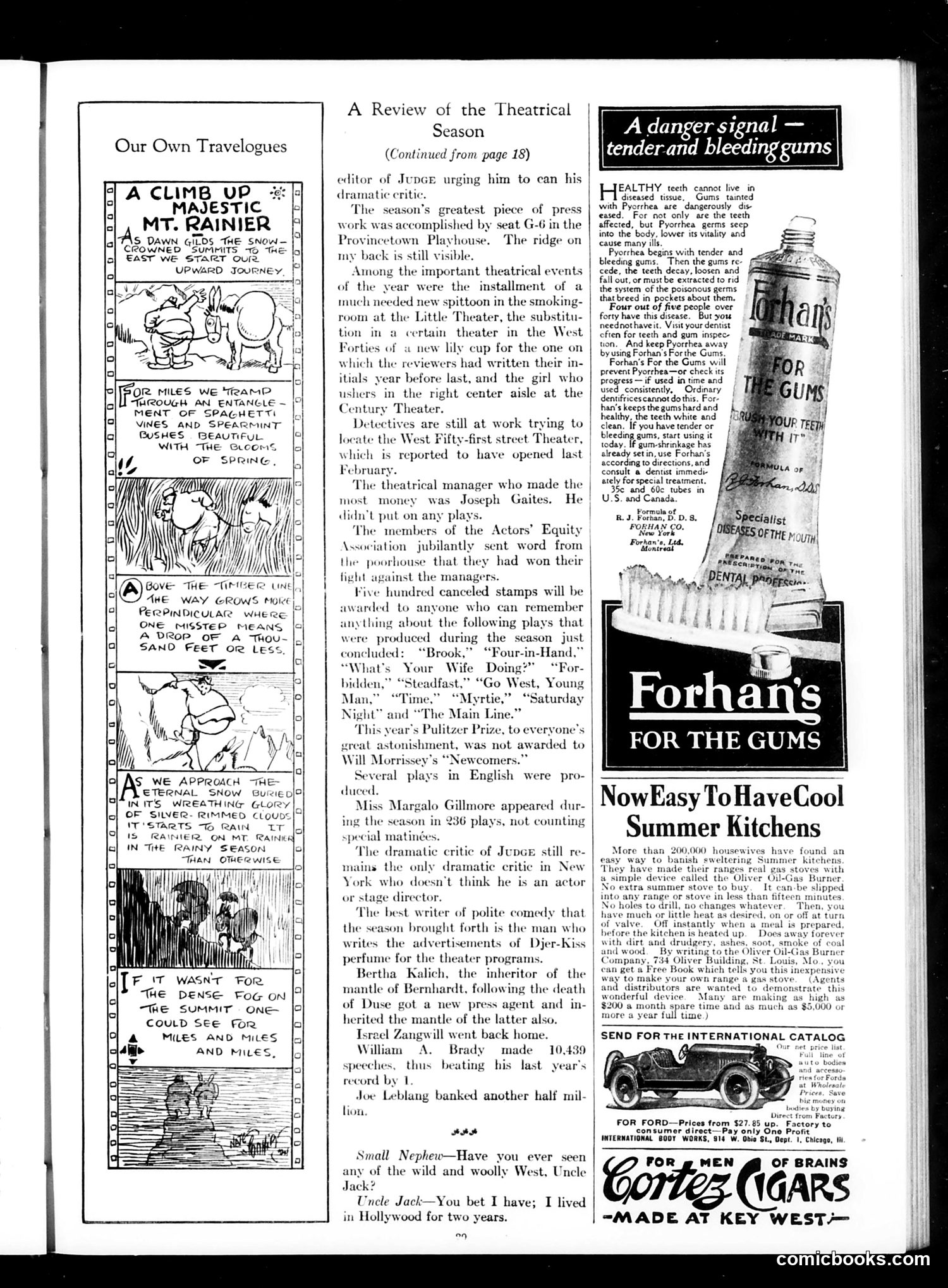
This page from Judge contains two distinct sections: **Left side: "Our Own Travelogues"** — A humorous illustrated comic strip about climbing Mount Rainier. The joke satirizes travel narratives by showing the journey as tedious and disappointing: hikers trudge through dense vegetation, risk fatal falls, encounter constant rain (fitting for the "Rainy" season), and ultimately can't see the summit due to fog. The punchline undercuts the adventure-travel genre's typical grandeur. **Right side: "A Review of the Theatrical Season"** — A satirical theater review mocking Broadway's 1920s output. The critic dismissively notes trivial "achievements" (a new spittoon, a cup), forgotten plays with forgettable titles, and that the only profitable manager (Joseph Gaites) produced *no plays*. It ridicules actors' unions, inflated actress claims (Margalo Gillmore in "236 plays"), and wryly observes that only the Djer-Kiss perfume ad-writer mastered comedy. The page also includes period advertisements for Forhan's toothpaste, kitchen appliances, automobiles, and Cortez cigars.
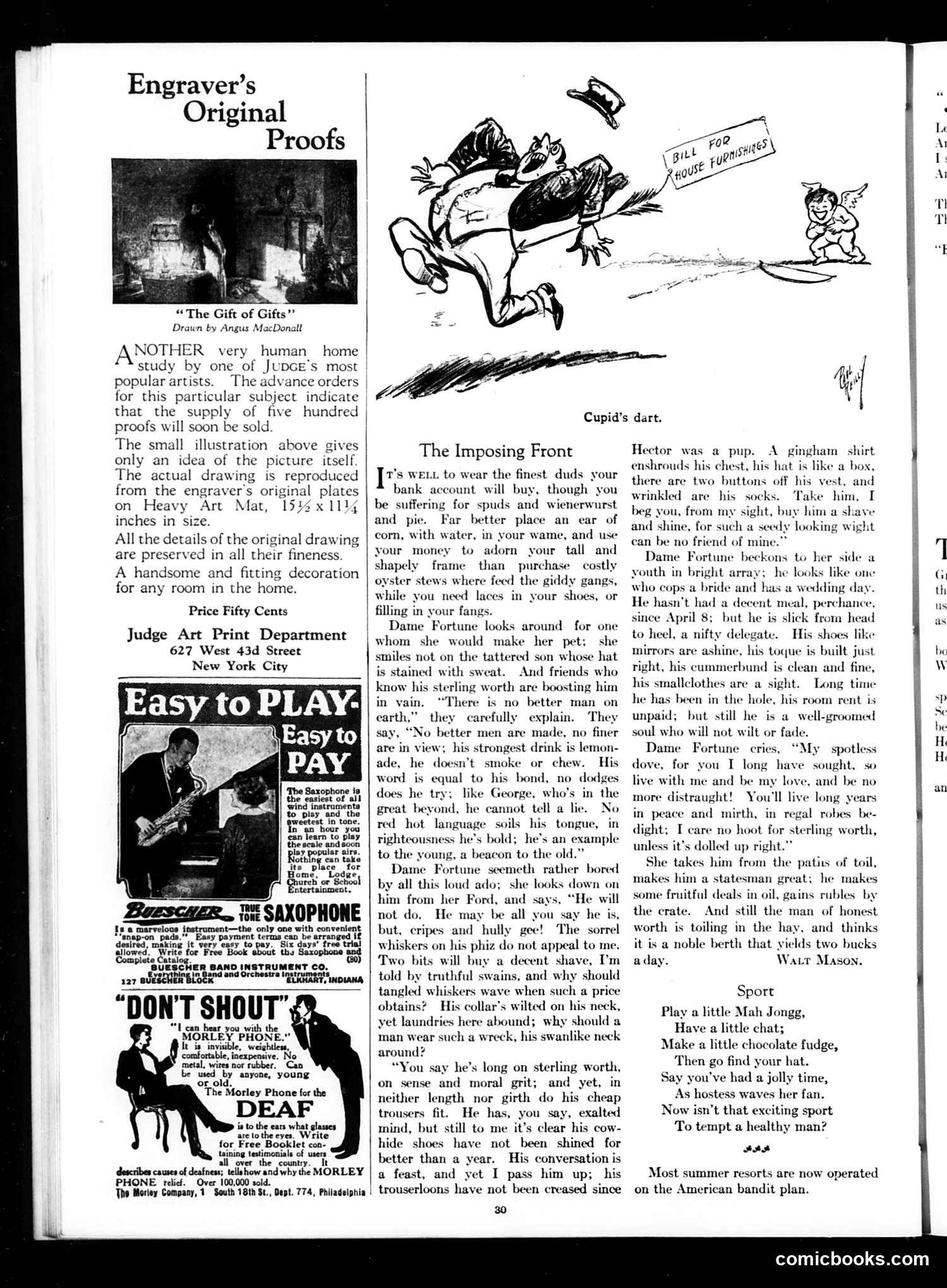
This page satirizes the social superficiality of early 20th-century American society. The main story, illustrated by a cartoon of a disheveled man being rejected, mocks how Dame Fortune (personified Luck/Success) judges people purely by appearance rather than character. The narrative contrasts a morally upright but shabby man with an impeccably dressed but empty youth. Despite his virtue—honesty, sobriety, hard work—the first man is rejected because his shoes are unshined, his collar wilted, and his trousers wrinkled. The well-dressed youth, though materially struggling, succeeds simply through polished presentation. The satire criticizes how society rewards style over substance, suggesting that Americans prioritize superficial grooming and fashionable clothing over genuine merit or moral character. This reflects Gilded Age anxieties about materialism and the erosion of traditional values in an increasingly consumption-focused society. The page also includes period advertisements for the Morley Phone (a hearing aid) and saxophone lessons, typical of Judge's revenue model.
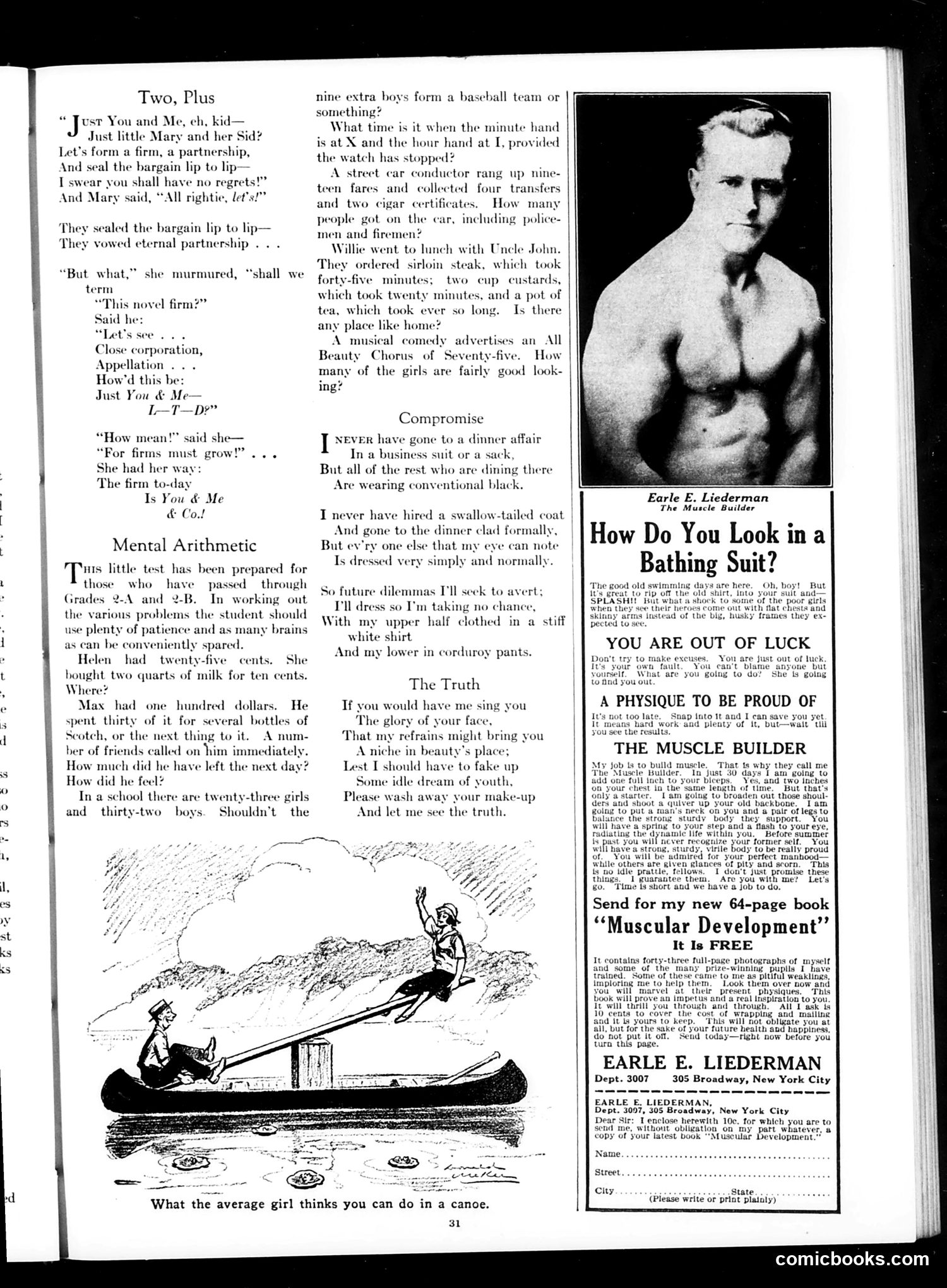
This page contains several distinct sections rather than a single unified cartoon: **"Two, Plus"** (top left): A humorous poem about a young couple (Mary and Sid) forming a romantic "partnership," playfully discussing what to name their relationship as if it were a business. The satire targets young romance and courtship conventions of the era. **"Mental Arithmetic"** (center): A series of math word problems with satirical twists—designed to mock students and social issues. They include absurdist scenarios (a conductor collecting "cigar certificates," a musical comedy's "Beauty Chorus") and contain implicit social commentary about excess and frivolity. **"What the average girl thinks you can do in a canoe"** (bottom left): A cartoon showing exaggerated, impossible feats, satirizing female naïveté or unrealistic expectations about male athletic prowess. **Right side**: An advertisement for Earle E. Liederman's muscle-building course, featuring a shirtless bodybuilder promoting physical fitness—typical early-20th-century fitness marketing. The page primarily mixes light humor with advertising rather than serious political satire.
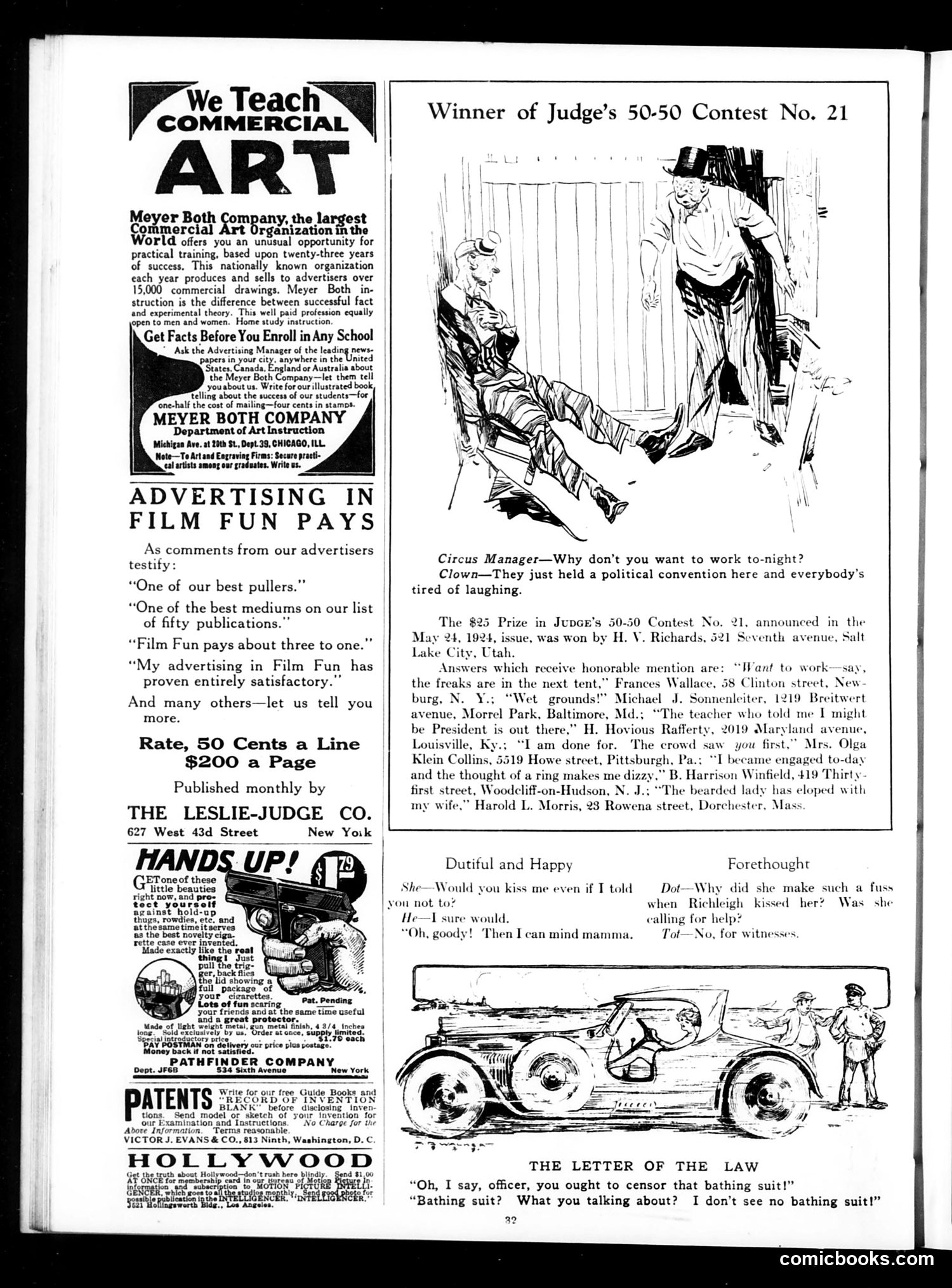
This page from Judge magazine (a satirical publication) contains multiple comic elements satirizing early 1920s American society: **Main cartoon (top right):** A circus clown refuses work after a political convention, joking that audiences are exhausted from laughing at politicians—satirizing the absurdity of political theater as entertainment. **"The Letter of the Law" (bottom):** An officer refuses to censor a woman's bathing suit, claiming he "doesn't see" it—likely mocking both prudish censorship attitudes and selective enforcement of morality laws during the Jazz Age, when bathing suit standards were hotly debated. **Other jokes:** Brief marital and relationship gags reflecting period gender dynamics and courtship customs. The page is primarily **advertising**—for commercial art instruction, patent services, and cigarette cases—with humor interspersed. The satire targets political pretension and inconsistent social policing rather than specific politicians or events.
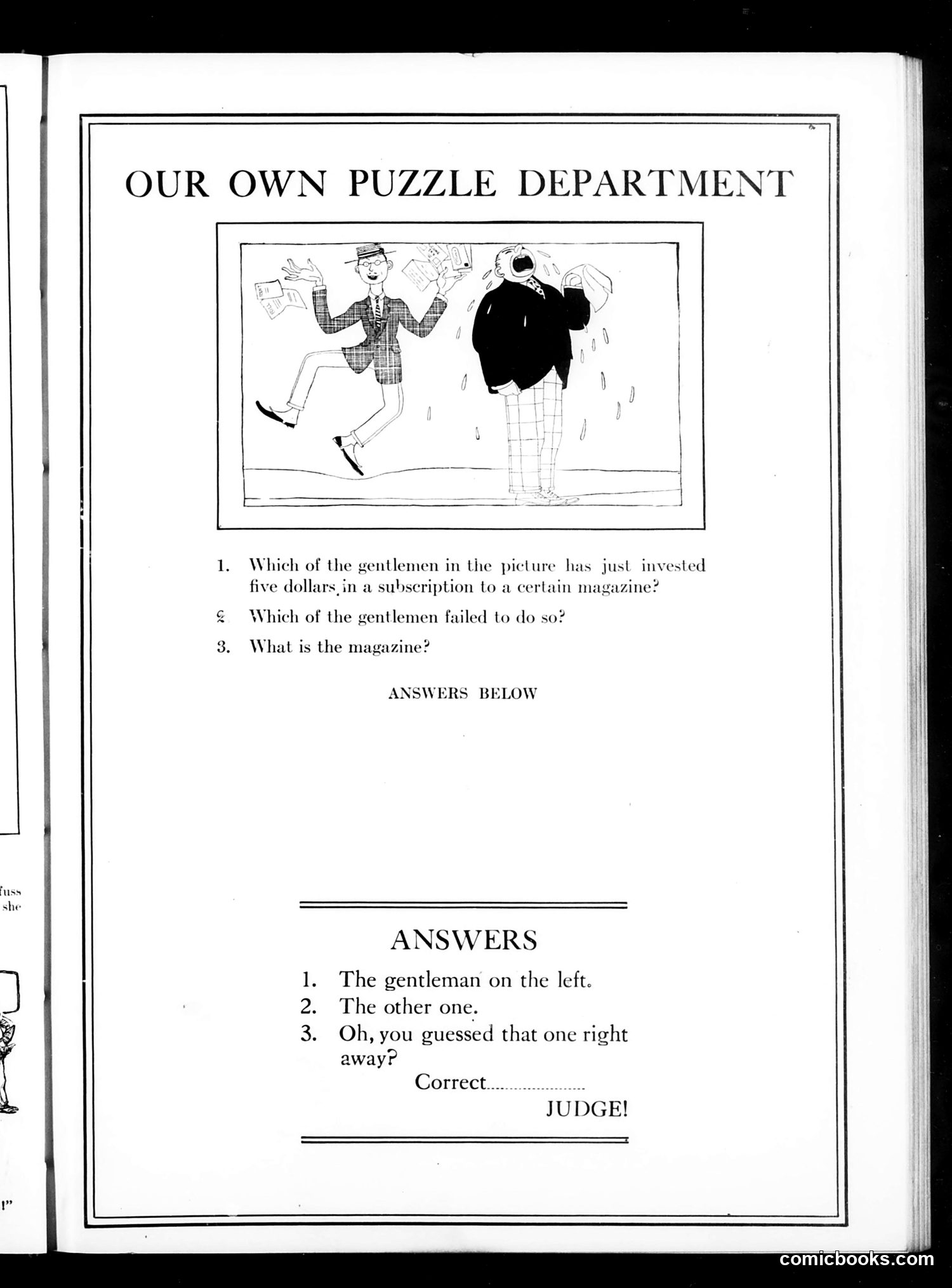
This is a self-referential joke from Judge magazine's puzzle department. The cartoon shows two gentlemen: one on the left appearing cheerful and energetic, the other on the right looking dejected and drenched (indicated by the lines suggesting rain or distress). The puzzle's humor lies in its circular logic: readers are asked to identify which man subscribed to "a certain magazine"—which is Judge itself. The answers reveal the joke: the happy man subscribed (answer: "the gentleman on the left"), the miserable one didn't (answer: "the other one"), and the magazine is Judge (answer: "Oh, you guessed that one right away?"). This is essentially advertising disguised as entertainment—a playful way to promote magazine subscriptions by suggesting that subscribing brings happiness while refusing to do so brings misery. The self-aware punchline acknowledges readers' recognition of the magazine's own promotional intent.
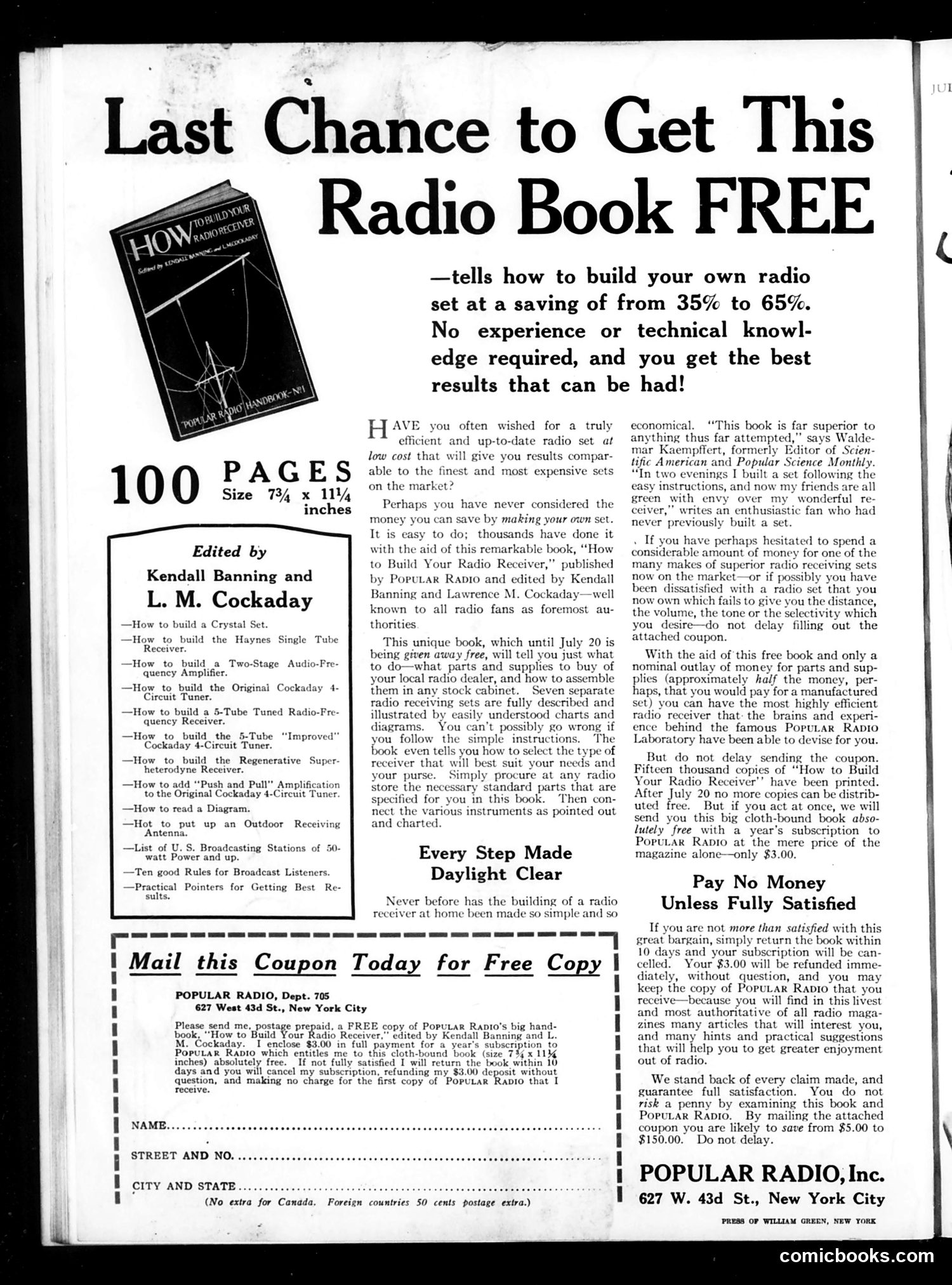
This is not a cartoon but a **full-page advertisement** for a radio-building instruction book published by Popular Radio magazine, circa early 1920s. **The Context:** The 1920s saw an explosive DIY radio craze. Home radio construction was affordable and achievable for amateurs, representing both a technological frontier and a cost-saving alternative to expensive factory-made sets. This ad capitalizes on that enthusiasm. **The Appeal:** The advertisement targets cost-conscious readers by emphasizing savings of 35-65% compared to commercial sets, requiring "no experience or technical knowledge." The testimonial from "Waldemar Kaempflert" (a real Popular Science editor) provides authority. **The Pitch:** A free book (with $3 subscription) promises to simplify radio assembly through clear instructions and diagrams. The limited-time offer ("Last Chance," deadline July 20) creates urgency—a classic sales tactic. This reflects the democratization of radio technology during the 1920s boom, when building one's own receiver was a culturally significant DIY project.